
Failed a Fire Safety Inspection? Here’s What Happens Next
Failing a fire safety inspection can be stressful for any business owner, employer, landlord, or Responsible Person. Whether the inspection identifies minor deficiencies or serious fire safety breaches, the outcome should never be ignored. A failed inspection is more than a compliance issue—it highlights conditions that could place employees, visitors, and property at risk if a fire were to occur.
Many organisations mistakenly assume that failing a fire safety inspection automatically results in heavy fines or immediate closure. In reality, what happens next depends on the nature and severity of the findings. Some businesses receive recommendations for improvement, while others may be issued formal enforcement notices or, in extreme cases, face prosecution or restrictions on using the premises.
Understanding the inspection process and responding quickly to identified issues can significantly reduce legal risks and help your organisation achieve compliance during a follow-up inspection.
This guide explains what happens after a failed fire safety inspection, the different enforcement outcomes, the most common reasons businesses fail inspections, and the practical steps required to pass a reinspection. Whether you operate an office, warehouse, retail store, construction site, hotel, school, healthcare facility, or manufacturing plant, this article will help you understand your responsibilities and prepare for successful compliance.
What Happens If You Fail a Fire Safety Inspection?
If you fail a fire safety inspection, the enforcing authority will usually provide an inspection report outlining the deficiencies that need to be corrected. Minor issues may require improvements within an agreed timeframe, while serious fire safety risks can result in an Improvement Notice, Alterations Notice, Prohibition Notice, prosecution, or temporary closure of part or all of the premises. The outcome depends on the level of risk identified and how quickly corrective actions are taken.
Why Fire Safety Inspections Matter
Fire safety inspections are designed to ensure that buildings remain safe for everyone who uses them. They are not intended to punish businesses but to identify hazards before they lead to injuries, property damage, or loss of life.
Inspectors assess whether fire safety arrangements comply with the Regulatory Reform (Fire Safety) Order 2005 and whether the Responsible Person has implemented suitable fire prevention and protection measures.
During a typical inspection, officers may examine:
- Fire risk assessment
- Fire alarm systems
- Emergency lighting
- Fire extinguishers
- Fire doors
- Escape routes
- Emergency exits
- Fire safety signage
- Staff training records
- Fire drill records
- Maintenance documentation
- Housekeeping standards
The inspection aims to determine whether occupants can evacuate safely in the event of a fire and whether fire protection systems are adequately maintained.
What happens Immediately After You Fail a Fire Safety Inspection?
Failing an inspection does not always mean your business will close immediately. In most cases, the inspector will explain the findings and provide a written report outlining the identified deficiencies.
The next steps generally follow a structured process.
Fire Safety Inspection

↓

Deficiencies Identified

↓

Inspection Report Issued

↓

Risk Assessment by Inspector

↓

Minor Issues?

          Yes
           ↓
 Corrective Actions
           ↓
 Evidence Submitted
           ↓
 Reinspection
           ↓
 Pass

           OR

Major Risks?

           ↓
 Enforcement Notice
           ↓
 Immediate Action
           ↓
 Reinspection
           ↓
 Compliance Achieved
The speed at which corrective actions are completed often determines whether additional enforcement action becomes necessary.
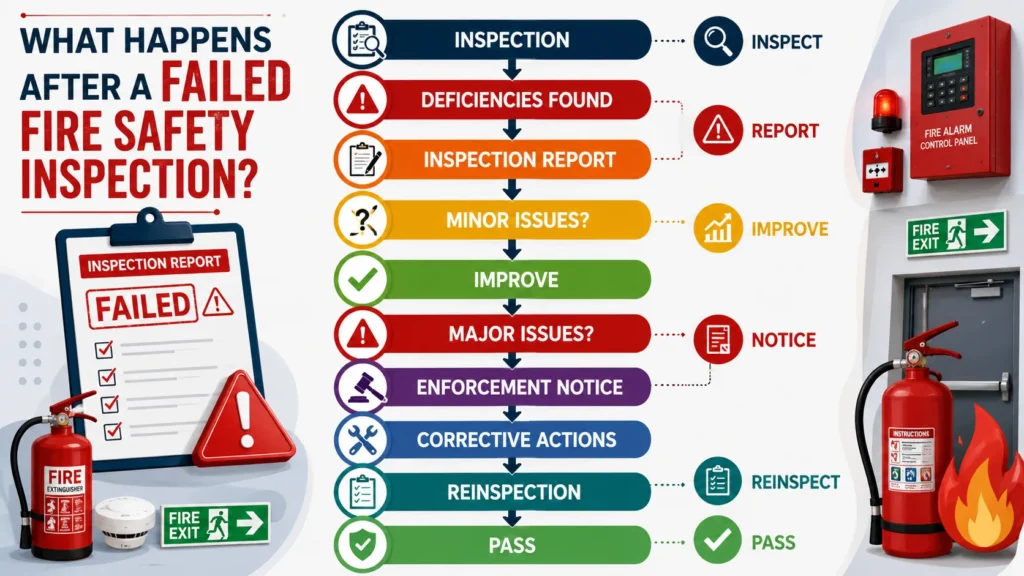
Types of Fire Safety Inspection Outcomes
Not every failed inspection results in the same outcome. Inspectors assess the seriousness of the findings before deciding on the most appropriate course of action.
| Inspection Outcome | What It Means |
|---|---|
| Pass | Fire safety arrangements meet legal requirements. |
| Pass with Recommendations | Minor improvements are recommended but do not require formal enforcement. |
| Improvement Notice | Specific fire safety deficiencies must be corrected within a stated timeframe. |
| Alterations Notice | Future changes to the building or operations must be reported to the enforcing authority. |
| Prohibition Notice | Serious fire risks require part or all of the premises to stop being used immediately until hazards are removed. |
| Prosecution | Serious breaches of fire safety legislation may result in legal proceedings. |
Understanding these outcomes helps organisations respond appropriately and avoid escalating enforcement action.
Common Reasons Businesses Fail Fire Safety Inspections
Although every workplace is different, inspectors repeatedly identify the same fire safety deficiencies across multiple industries.
Addressing these issues before an inspection significantly improves the likelihood of passing.
1. Blocked Fire Exits
Escape routes must remain clear and accessible at all times.
Common inspection findings include:
- Stock stored in corridors
- Locked emergency exits
- Equipment blocking doorways
- Temporary storage in escape routes
Blocked exits can delay evacuation and place occupants at serious risk during a fire.
2. Faulty Fire Alarm Systems
Fire alarms provide the earliest warning during an emergency.
Inspectors often identify:
- Missed maintenance
- Detector faults
- Disabled alarm zones
- Missing testing records
- Fault indicators on alarm panels
Without a reliable alarm system, occupants may not receive sufficient warning to evacuate safely.
3. Damaged Fire Doors
Fire doors help contain fire and smoke, protecting escape routes.
Common deficiencies include:
- Doors wedged open
- Missing seals
- Broken self-closing devices
- Damaged glazing
- Poor maintenance
Fire doors that fail to close correctly cannot perform their intended function.
4. Inadequate Emergency Lighting
Emergency lighting allows occupants to evacuate safely during power failures.
Inspection failures commonly involve:
- Non-functioning lights
- Battery failures
- Poor maintenance
- Missing testing records
5. Poor Housekeeping
Combustible waste remains one of the most common causes of failed inspections.
Inspectors frequently identify:
- Cardboard accumulation
- Overflowing bins
- Flammable waste near ignition sources
- Cluttered storage areas
Good housekeeping is one of the simplest and most effective fire prevention measures.
6. Missing or Inaccessible Fire Extinguishers
Inspectors expect firefighting equipment to be:
- Correctly positioned
- Easily accessible
- Properly serviced
- Clearly identified
Blocked or poorly maintained extinguishers often result in inspection recommendations or enforcement action.
7. Incomplete Fire Risk Assessment
The fire risk assessment is one of the most important documents reviewed during an inspection.
Common issues include:
- No assessment available
- Outdated assessments
- Missing review records
- Failure to address previous findings
A current and suitable fire risk assessment demonstrates proactive fire safety management.
8. Inadequate Staff Training
Even the best fire protection systems cannot compensate for employees who do not know how to respond during an emergency.
Inspectors may request evidence of:
- Fire safety induction
- Fire marshal training
- Fire drills
- Refresher training
- Emergency evacuation procedures
Training records are often reviewed alongside maintenance documentation.
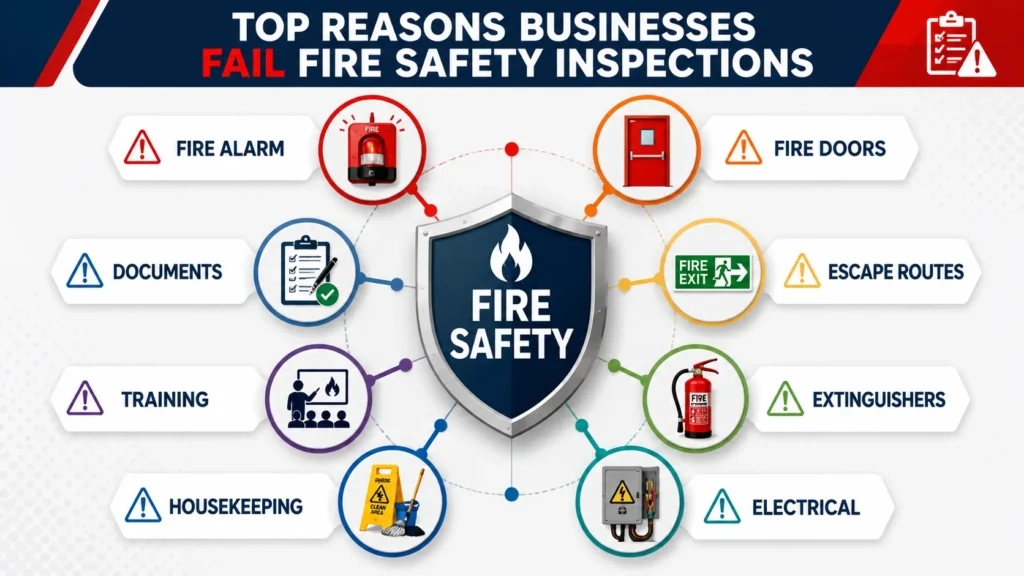
Major vs Minor Fire Safety Failures
Not every inspection finding carries the same level of risk.
The following comparison illustrates the difference.
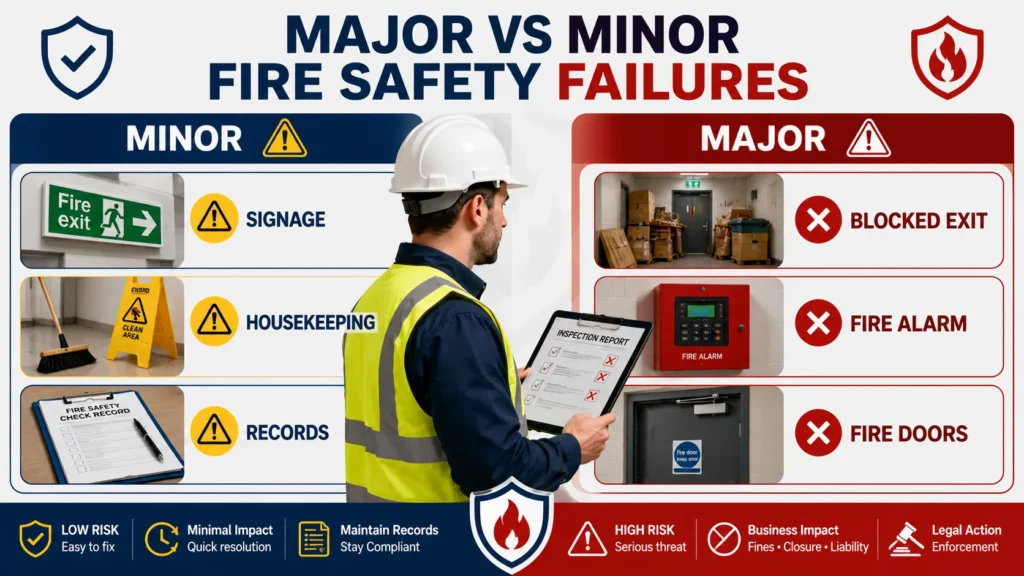
| Minor Deficiency | Major Deficiency |
|---|---|
| Faded fire safety sign | Locked emergency exit |
| Small housekeeping issue | Fire alarm system failure |
| Expired extinguisher inspection tag | Missing fire extinguishers |
| Minor fire door damage | Fire doors unable to close |
| Missing maintenance record | No fire risk assessment |
| Worn emergency lighting label | Emergency lighting not functioning |
| Outdated evacuation notice | Escape routes blocked |
Minor deficiencies generally require corrective action within a reasonable timeframe, whereas major deficiencies may result in immediate enforcement action.
How Fire Inspectors Assess Risk
Inspectors do not simply count the number of deficiencies. They evaluate how each issue affects the safety of occupants during a fire.
Typical considerations include:
- Likelihood of fire occurring
- Number of people at risk
- Vulnerable occupants
- Building layout
- Effectiveness of escape routes
- Reliability of fire protection systems
- Existing management arrangements
A single serious hazard, such as a blocked emergency exit or non-functional fire alarm system, may carry greater significance than several minor administrative issues.
Fire Safety Inspection Risk Priority
| Deficiency | Likelihood | Potential Impact | Priority |
|---|---|---|---|
| Blocked escape route | High | Very High | Immediate |
| Faulty fire alarm | Medium | Very High | Immediate |
| Missing fire risk assessment | Medium | High | High |
| Fire doors wedged open | High | High | High |
| Emergency lighting failure | Medium | High | High |
| Missing extinguisher servicing | Medium | Medium | Medium |
| Housekeeping issues | High | Medium | Medium |
Prioritising corrective actions according to risk helps organisations address the most serious deficiencies first and improve overall fire safety performance.
Business Consequences of Failing a Fire Safety Inspection
Failing a fire safety inspection can have consequences that extend far beyond simply correcting a few deficiencies. The severity of the impact depends on the level of non-compliance, the risks identified, and how quickly the organisation responds.
Ignoring inspection findings can lead to increased legal, financial, and operational risks.
| Consequence | Business Impact |
|---|---|
| Improvement Notice | Mandatory corrective actions within a specified timeframe |
| Prohibition Notice | Partial or complete closure of the premises until risks are removed |
| Financial Loss | Repair costs, operational disruption, and potential legal expenses |
| Business Interruption | Delays to production, services, or customer operations |
| Insurance Issues | Higher premiums or difficulties with future claims |
| Reputational Damage | Reduced customer confidence and negative publicity |
| Legal Action | Possible prosecution for serious breaches of fire safety legislation |
| Employee Safety Risks | Increased likelihood of injuries during a fire emergency |
Responding promptly to inspection findings demonstrates a commitment to fire safety and often helps prevent more serious enforcement action.
Improvement Notice vs Prohibition Notice
Many business owners are unfamiliar with the different enforcement notices that may be issued following a failed fire safety inspection.
Understanding these notices helps organisations appreciate the seriousness of the situation and respond appropriately.
| Improvement Notice | Prohibition Notice |
|---|---|
| Issued when fire safety improvements are required | Issued when there is an immediate risk to life |
| Business may usually continue operating while improvements are completed | Use of part or all of the premises may be prohibited immediately |
| Specifies a deadline for corrective actions | Remains in force until serious risks have been removed |
| Failure to comply may lead to further enforcement | Non-compliance may result in prosecution |
An Improvement Notice provides an opportunity to correct deficiencies, while a Prohibition Notice is reserved for situations where people are considered to be at immediate risk.
How to Pass a Fire Safety Reinspection
Receiving a failed inspection report should be viewed as an opportunity to improve, not simply as a compliance problem.
The following process can help organisations prepare for a successful reinspection.
Step 1: Review the Inspection Report Carefully
Read every finding thoroughly and ensure the reasons for each deficiency are fully understood.
If clarification is required, seek professional advice before beginning corrective work.
Step 2: Prioritise High-Risk Issues
Address hazards that present the greatest danger first.
Examples include:
- Blocked escape routes
- Faulty fire alarms
- Damaged fire doors
- Emergency lighting failures
- Missing firefighting equipment
Step 3: Complete Corrective Actions
Repairs and improvements should be completed by competent individuals using recognised standards and manufacturer guidance where appropriate.
Step 4: Update Documentation
Review and update:
- Fire risk assessment
- Maintenance records
- Fire alarm test logs
- Emergency lighting records
- Fire extinguisher servicing records
- Fire drill records
- Staff training records
Well-maintained documentation demonstrates effective fire safety management.
Step 5: Train Employees
Ensure all staff understand:
- Emergency procedures
- Escape routes
- Assembly points
- Fire reporting procedures
- Fire extinguisher awareness
- Individual responsibilities
Knowledgeable employees contribute significantly to workplace fire safety.
Step 6: Conduct an Internal Inspection
Before the official reinspection, perform an internal audit to verify that all identified issues have been addressed.
Many organisations use independent fire risk assessors to provide an additional level of assurance.
Fire Safety Reinspection Flowchart
Failed Inspection

↓

Review Inspection Report

↓

Prioritise Deficiencies

↓

Complete Repairs

↓

Update Fire Safety Documents

↓

Train Employees

↓

Conduct Internal Inspection

↓

Request Reinspection

↓

Pass Inspection

↓

Continue Monitoring & Regular Reviews
This structured approach helps organisations manage corrective actions efficiently and reduce the likelihood of repeated inspection failures.
Fire Inspection Readiness Checklist
Preparing throughout the year is far more effective than rushing to address problems shortly before an inspection.
Use the following checklist to assess your readiness.
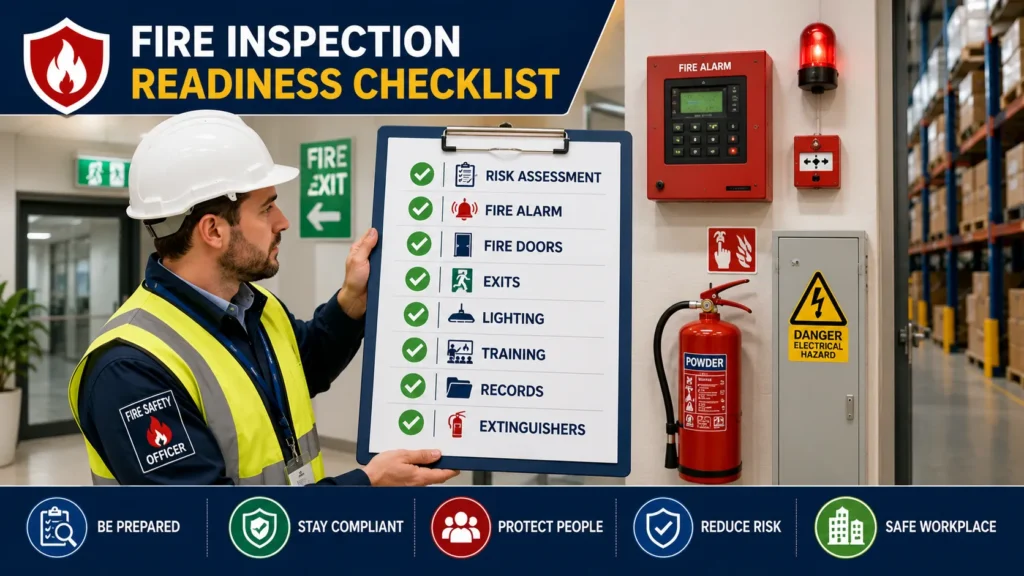
| Inspection Item | Ready |
|---|---|
| Fire Risk Assessment reviewed and up to date | ✓ |
| Fire alarm system tested | ✓ |
| Emergency lighting tested | ✓ |
| Fire extinguishers serviced | ✓ |
| Fire doors inspected | ✓ |
| Escape routes clear | ✓ |
| Fire safety signs visible | ✓ |
| Staff fire safety training completed | ✓ |
| Fire drill records available | ✓ |
| Maintenance records organised | ✓ |
| Housekeeping standards maintained | ✓ |
| Hazardous materials stored safely | ✓ |
Regularly reviewing this checklist helps maintain continuous compliance rather than relying solely on annual inspections.
Industry-Specific Reasons for Inspection Failures
Different industries present different fire safety challenges.
Offices
Common failures include:
- Overloaded electrical sockets
- Portable heaters
- Paper storage
- Blocked escape routes
Warehouses
Inspectors frequently identify:
- High combustible storage
- Blocked aisles
- Damaged fire doors
- Poor pallet storage
Construction Sites
Typical issues include:
- Temporary electrical installations
- Hot work activities
- Gas cylinders
- Inadequate housekeeping
Manufacturing Facilities
Common deficiencies include:
- Machinery maintenance
- Flammable chemicals
- Dust accumulation
- Welding operations
Retail Stores
Inspectors often find:
- Seasonal stock blocking exits
- Decorative combustible materials
- Overstocked storage rooms
- Obstructed firefighting equipment
Schools and Colleges
Common issues include:
- Laboratory hazards
- Kitchen fire risks
- Outdated evacuation notices
- Fire doors wedged open
Hospitals and Care Homes
Particular attention is given to:
- Vulnerable occupants
- Medical gas storage
- Evacuation procedures
- Emergency lighting
Tailoring fire safety management to the specific risks of each workplace greatly improves inspection outcomes.
Common Mistakes Businesses Make After Failing an Inspection
Many organisations repeat the same mistakes after receiving an inspection report.
Avoiding these errors improves the likelihood of passing the next inspection.
Delaying Corrective Actions
Leaving repairs until the last minute often results in incomplete compliance.
Ignoring Minor Deficiencies
Small issues can develop into larger compliance problems if they are not addressed promptly.
Failing to Update Documentation
Completing repairs without updating maintenance records or fire risk assessments may still result in inspection concerns.
Not Training Staff
Employees should understand new procedures introduced following corrective actions.
Treating Compliance as a One-Time Exercise
Fire safety requires continuous monitoring rather than preparation only when inspections are due.
Fire Safety Compliance Roadmap
Developing a proactive fire safety culture helps organisations remain compliant all year round.
Assess Fire Risks

↓

Complete Fire Risk Assessment

↓

Implement Control Measures

↓

Train Employees

↓

Inspect Workplace Regularly

↓

Maintain Fire Protection Systems

↓

Review Fire Risk Assessment

↓

Monitor Performance

↓

Pass Future Fire Safety Inspections
Following this roadmap reduces the likelihood of future inspection failures while improving overall workplace safety.
Why Fire Safety Training Helps Prevent Inspection Failures
Many fire safety deficiencies are caused by a lack of knowledge rather than a lack of equipment.
Providing regular training enables employees and managers to:
- Recognise workplace fire hazards.
- Maintain clear escape routes.
- Report defects promptly.
- Follow safe working practices.
- Respond effectively during emergencies.
- Understand their legal responsibilities.
Training also demonstrates to inspectors that the organisation takes fire safety seriously and has invested in developing staff competence.
Develop Your Fire Safety Knowledge with Inspire College
If you are responsible for workplace fire safety or want to build a career in the industry, professional training can help you develop the practical skills required to maintain compliance and prepare for inspections.
Final Thoughts
Failing a fire safety inspection is not the end of the compliance journey—it is an opportunity to strengthen your organisation’s approach to fire prevention and workplace safety. The outcome of an inspection depends not only on the deficiencies identified but also on how effectively those issues are addressed.
Businesses that respond quickly, prioritise high-risk deficiencies, maintain accurate documentation, train employees, and review their fire risk assessments regularly are far more likely to achieve a successful reinspection and maintain compliance in the future.
Rather than viewing inspections as isolated events, organisations should integrate fire safety into their everyday operations through regular workplace inspections, preventive maintenance, staff awareness, and continuous improvement. This proactive approach protects people, safeguards property, supports business continuity, and demonstrates a genuine commitment to meeting UK fire safety responsibilities.
By investing in effective fire safety management and professional training, organisations can reduce the likelihood of future inspection failures, build confidence among employees and stakeholders, and create safer workplaces for everyone.
Explore More Fire Safety & Risk Assessment Articles
Discover expert guides on fire safety careers, fire risk assessments, workplace compliance, fire protection systems, and professional qualifications to expand your knowledge and advance your career in fire safety.
- What is Fire Safety?
- Fire Risk Assessment
- Fire Safety: Essential Tips for Homes and Workplaces
- What Does a Senior Fire Safety Advisor Do? Roles, Responsibilities, and Career Guide
- Top Skills Every Senior Fire Safety Advisor Should Develop
- Is Fire Safety a Good Career Choice in the UK?
- Senior Fire Safety Advisor Career Progression: Exciting Roles, Salary & Leadership Path
- Is Fire Safety a Good Career Choice in the UK?
- Top Skills Every Senior Fire Safety Advisor Should Develop
- Senior Fire Safety Advisor vs Fire Risk Assessor: Which Career Is Right for You?
- Senior Fire Safety Advisor: Top Industries Hiring Across the UK
- Fire Risk Assessment Explained: A Complete Beginner’s Guide
- Qualified Fire Risk Assessor Career Guide: Training, Skills, and Job Opportunities
- Senior Fire Safety Advisor: Top Industries Hiring Across the UK
- The 5 Essential Steps of Fire Risk Assessment Explained
- Common Risk Assessment Mistakes and How to Avoid Them
- How Fire Safety and Risk Assessment Reduce Workplace Hazards
- Essential Fire Safety Tips Everyone Should Know to Stay Safe
- Fire Safety Planning and Risk Assessment for Businesses
- How to Conduct an Effective Risk Assessment Step by Step
- Fire Safety Checklist for Homes, Offices & Commercial Buildings
- Fire Safety Checklist for Homes, Offices & Commercial Buildings
- Common Risk Assessment Mistakes and How to Avoid Them
- Fire Risk Assessment vs Fire Safety Audit: What’s the Difference?
- How Often Should a Fire Risk Assessment Be Reviewed?
- Top Workplace Fire Hazards Every Inspection Reveals
- Essential Fire Safety Duties for Landlords and Property Managers