
Fire Risk Assessment vs Fire Safety Audit: What’s the Difference?
Fire safety is a fundamental responsibility for every business, regardless of its size or industry. From offices and retail stores to manufacturing plants, warehouses, healthcare facilities, educational institutions, and construction sites, every workplace must manage fire risks to protect people, property, and business operations.
Despite their importance, many organisations confuse fire risk assessments with fire safety audits. While both contribute to workplace fire safety, they serve different purposes and should not be used interchangeably. A fire risk assessment focuses on identifying hazards and evaluating risks before a fire occurs, whereas a fire safety audit examines whether an organisation’s fire safety management system, procedures, and controls are operating effectively.
Understanding the distinction is essential for achieving legal compliance, improving workplace safety, and strengthening business resilience. Organisations that rely on only one of these processes may overlook important hazards or fail to identify weaknesses in their overall fire safety management system.
Rather than choosing between a fire risk assessment and a fire safety audit, businesses should understand how both processes complement each other. A fire risk assessment identifies potential dangers, while a fire safety audit verifies that preventive measures, emergency procedures, employee training, maintenance programmes, and compliance systems are working as intended.
This guide explains the differences between fire risk assessments and fire safety audits, explores when each should be used, and demonstrates how combining both approaches helps organisations build a proactive, compliant, and continuously improving fire safety programme.
Why Businesses Often Confuse Fire Risk Assessments and Fire Safety Audits
The terms fire risk assessment and fire safety audit are frequently used together because both involve workplace inspections and contribute to fire safety. However, they answer different questions and support different objectives.
A fire risk assessment asks:
- What fire hazards exist?
- Who could be harmed?
- How likely is a fire?
- What controls are needed?
A fire safety audit asks:
- Are existing fire safety systems effective?
- Are legal and organisational requirements being followed?
- Are inspections and maintenance being completed?
- Are employees following established procedures?
- Is the organisation continuously improving?
In simple terms:
A fire risk assessment identifies the risks.
A fire safety audit evaluates how well those risks are being managed.
Businesses that understand this distinction make better decisions about fire prevention, compliance, and long-term safety management.
Fire Safety Management at a Glance
| Activity | Primary Purpose |
|---|---|
| Fire Risk Assessment | Identify hazards and evaluate risks |
| Fire Safety Audit | Evaluate compliance and management effectiveness |
| Fire Safety Inspection | Check the condition of equipment and facilities |
| Fire Drill | Test emergency response procedures |
| Fire Safety Training | Improve employee awareness and competence |
Each activity plays a unique role within an effective fire safety management system.
What Is a Fire Risk Assessment?
A fire risk assessment is a systematic process used to identify fire hazards, evaluate the level of risk, determine who may be affected, and implement suitable control measures to reduce the likelihood and consequences of fire.
Rather than waiting for an incident to occur, organisations use fire risk assessments to proactively identify unsafe conditions and take corrective action before hazards develop into emergencies.
A comprehensive fire risk assessment examines every aspect of the workplace, including:
- Building layout
- Electrical installations
- Heating systems
- Machinery
- Flammable materials
- Storage arrangements
- Escape routes
- Fire protection systems
- Employee activities
- Emergency procedures
The outcome is a structured action plan that helps businesses improve workplace fire safety.
Primary Objectives of a Fire Risk Assessment
| Objective | Outcome |
|---|---|
| Identify Fire Hazards | Detect ignition sources and combustible materials |
| Evaluate Risks | Assess likelihood and potential consequences |
| Protect People | Improve employee and visitor safety |
| Reduce Fire Hazards | Introduce effective control measures |
| Support Compliance | Meet workplace fire safety responsibilities |
| Improve Safety | Reduce the probability of fire incidents |
Fire risk assessments are preventive in nature. They focus on understanding what could happen and reducing risks before an emergency occurs.
What Is a Fire Safety Audit?
A fire safety audit is a structured evaluation of an organisation’s fire safety management system to determine whether fire safety policies, procedures, equipment, documentation, training, inspections, and compliance activities are being implemented effectively.
Unlike a fire risk assessment, which identifies hazards, a fire safety audit examines the overall performance of the organisation’s fire safety programme.
During an audit, the auditor typically reviews:
- Fire safety policies
- Fire risk assessment records
- Maintenance documentation
- Fire alarm testing
- Emergency lighting inspections
- Fire door inspections
- Employee training records
- Fire drill reports
- Corrective actions
- Management responsibilities
- Legal compliance
The objective is to verify that fire safety systems are functioning as intended and to identify opportunities for improvement.
Primary Objectives of a Fire Safety Audit
| Objective | Outcome |
|---|---|
| Verify Compliance | Ensure fire safety requirements are being followed |
| Evaluate Systems | Assess effectiveness of fire safety management |
| Identify Gaps | Detect weaknesses in procedures and controls |
| Review Documentation | Confirm records are complete and accurate |
| Improve Performance | Support continual improvement |
| Strengthen Governance | Improve organisational accountability |
Fire safety audits are evaluative rather than investigative. Instead of identifying new hazards, they assess how effectively existing fire safety arrangements are being managed.
Fire Risk Assessment vs Fire Safety Audit
Although both activities contribute to workplace fire safety, they differ significantly in purpose, methodology, scope, and outcomes.
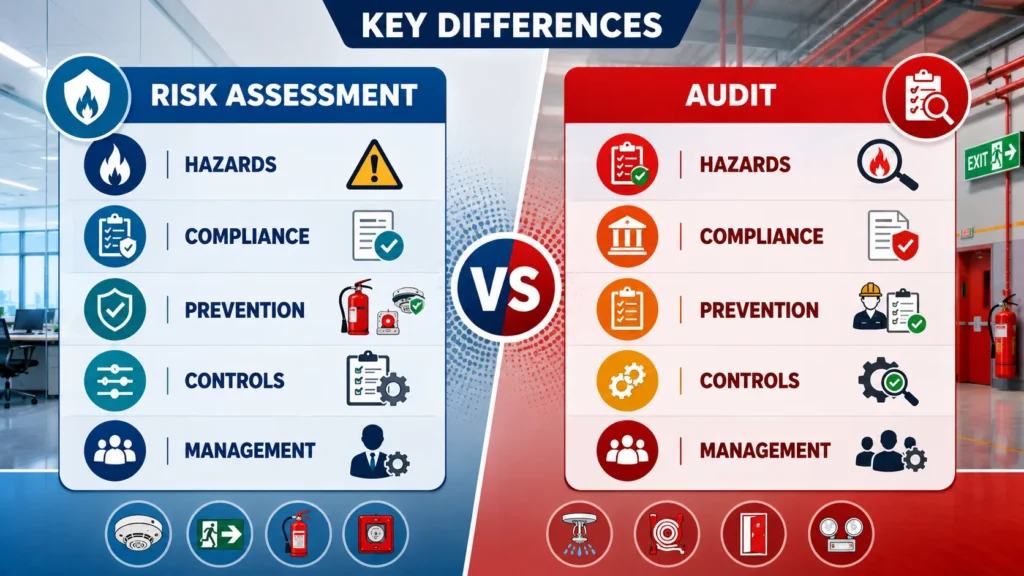
Detailed Comparison
| Fire Risk Assessment | Fire Safety Audit |
|---|---|
| Identifies fire hazards | Evaluates fire safety management systems |
| Focuses on risk identification | Focuses on compliance verification |
| Determines control measures | Assesses whether controls are effective |
| Looks forward to prevent future incidents | Reviews current performance |
| Evaluates workplace hazards | Evaluates organisational processes |
| Produces risk reduction recommendations | Produces audit findings and improvement actions |
| Conducted when workplace risks change | Conducted periodically to verify compliance |
| Supports fire prevention | Supports continual improvement |
| Focuses on hazards | Focuses on management effectiveness |
| Forms the foundation of fire safety planning | Confirms fire safety plans are being followed |
Fire Risk Assessment and Fire Safety Audit Workflow
The two processes are closely connected and should be viewed as complementary rather than competing activities.
Workplace Operations
          │
          ▼
Identify Fire Hazards
          │
          ▼
Conduct Fire Risk Assessment
          │
          ▼
Implement Control Measures
          │
          ▼
Develop Fire Safety Procedures
          │
          ▼
Train Employees
          │
          ▼
Conduct Fire Safety Audit
          │
          ▼
Identify Improvement Opportunities
          │
          ▼
Update Fire Risk Assessment
          │
          ▼
Continuous Improvement
This continuous cycle helps organisations maintain a proactive approach to fire safety while adapting to changing workplace conditions.
Why Both Processes Are Essential
Many businesses mistakenly believe that completing a fire risk assessment is enough to demonstrate effective fire safety management. While identifying hazards is an essential first step, it does not guarantee that recommended control measures are implemented consistently or remain effective over time.
Similarly, conducting a fire safety audit without an up-to-date fire risk assessment limits the auditor’s ability to determine whether workplace risks have been identified accurately.
When used together, these two processes create a comprehensive fire safety management framework. The fire risk assessment identifies what needs to be controlled, while the fire safety audit confirms that those controls are operating effectively, employees understand their responsibilities, and continuous improvement is taking place.
This integrated approach not only strengthens workplace safety but also improves organisational resilience, enhances legal compliance, and reduces the likelihood of fire-related incidents.
Key Differences Between Fire Risk Assessments and Fire Safety Audits
Although fire risk assessments and fire safety audits share the common objective of improving workplace fire safety, they differ in scope, timing, methodology, and outcomes. Understanding these differences enables organisations to select the right process for the right purpose while integrating both into an effective fire safety management system.
Comparison Overview
| Aspect | Fire Risk Assessment | Fire Safety Audit |
|---|---|---|
| Primary Purpose | Identify fire hazards and assess risks | Evaluate fire safety management and compliance |
| Main Question | What could cause a fire? | Are fire safety systems working effectively? |
| Focus | Hazards and risks | Policies, procedures, documentation, and implementation |
| Outcome | Risk reduction measures | Audit findings and improvement recommendations |
| Timing | Before incidents and after significant changes | Periodically as part of management review |
| Approach | Preventive | Evaluative |
| Scope | Physical workplace hazards | Entire fire safety management system |
| Responsibility | Competent fire risk assessor | Internal or external fire safety auditor |
| Key Deliverable | Fire risk assessment report | Fire safety audit report |
| Long-Term Goal | Prevent fires | Improve fire safety performance |
The table illustrates that these processes complement one another rather than replace each other.
Fire Risk Assessment: A Preventive Approach
A fire risk assessment is designed to reduce the likelihood of a fire occurring. It focuses on identifying hazards, evaluating their potential impact, and implementing appropriate control measures before an incident takes place.
Typical activities include:
- Inspecting workplace hazards
- Identifying ignition sources
- Assessing combustible materials
- Evaluating escape routes
- Reviewing fire protection systems
- Assessing people at risk
- Recommending corrective actions
The assessment forms the foundation of a proactive fire safety strategy.
Fire Safety Audit: A Performance Review
A fire safety audit evaluates whether an organisation is effectively managing the controls identified through its fire risk assessment and fire safety procedures.
Rather than searching for new hazards, the audit reviews whether the existing fire safety programme is functioning as intended.
Audit activities may include:
- Reviewing policies and procedures
- Examining maintenance records
- Checking employee training
- Evaluating fire drills
- Verifying inspection schedules
- Assessing legal compliance
- Reviewing corrective actions
- Interviewing responsible personnel
The findings help management identify weaknesses, improve performance, and strengthen governance.
When Does Your Business Need a Fire Risk Assessment?
Every workplace should conduct a fire risk assessment before commencing operations and continue reviewing it whenever workplace conditions change.
A new assessment or review should be considered when:
- Moving into new premises
- Renovating or extending buildings
- Installing new machinery
- Introducing hazardous materials
- Increasing workforce numbers
- Changing building layouts
- Modifying production processes
- Experiencing a fire or near miss
- Identifying recurring fire hazards
- Updating emergency procedures
Waiting until an incident occurs often results in avoidable risks and higher operational costs.
Signs That a Fire Risk Assessment Is Needed
| Workplace Change | Why a Review Is Required |
|---|---|
| Office relocation | New building layout and hazards |
| Warehouse expansion | Increased storage risks |
| New production equipment | Additional ignition sources |
| Process changes | Different fire hazards |
| Building refurbishment | Altered escape routes |
| Increased occupancy | Updated evacuation planning |
| Fire incident | Reassessment of existing controls |
| Regulatory changes | Updated compliance requirements |
Regular reviews ensure the assessment remains suitable and reflects the current workplace environment.
When Should Your Business Conduct a Fire Safety Audit?
Fire safety audits are generally carried out on a planned basis to evaluate the effectiveness of the organisation’s fire safety management system.
Businesses commonly schedule audits:
- Annually
- Before regulatory inspections
- After major organisational changes
- Following repeated safety incidents
- After significant corrective actions
- During management reviews
- Before certification programmes
- After mergers or acquisitions
- Following changes to fire safety policies
Unlike fire risk assessments, audits focus on measuring how well the fire safety programme is operating rather than identifying new hazards.
Common Audit Objectives
| Audit Objective | Expected Outcome |
|---|---|
| Verify Compliance | Confirm legal obligations are being met |
| Review Documentation | Ensure records remain accurate |
| Evaluate Training | Verify employee competence |
| Assess Emergency Preparedness | Improve response capability |
| Review Maintenance | Confirm fire protection systems remain operational |
| Measure Performance | Support continuous improvement |
Which One Does Your Business Need?
One of the most common questions businesses ask is whether they need a fire risk assessment, a fire safety audit, or both.
The answer depends on the organisation’s objectives.
If the goal is to identify workplace fire hazards and determine appropriate control measures, a fire risk assessment is the correct process.
If the goal is to evaluate whether existing fire safety arrangements are working effectively, a fire safety audit is more appropriate.
Most organisations benefit from both because they provide different but complementary information.
Fire Safety Decision Flowchart
Need to Improve Workplace Fire Safety?
                 │
                 ▼
Are Fire Hazards Identified?
          │                 │
         No                Yes
          │                 │
          ▼                 ▼
Conduct Fire        Are Fire Safety
Risk Assessment     Procedures Effective?
                            │
                    ┌───────┴────────┐
                   No               Yes
                    │                │
                    ▼                ▼
          Conduct Fire        Continue Monitoring
          Safety Audit        and Regular Reviews
                    │
                    ▼
         Implement Improvements
                    │
                    ▼
        Review and Improve Continuously
This decision-making process demonstrates how both activities work together within a comprehensive fire safety programme.
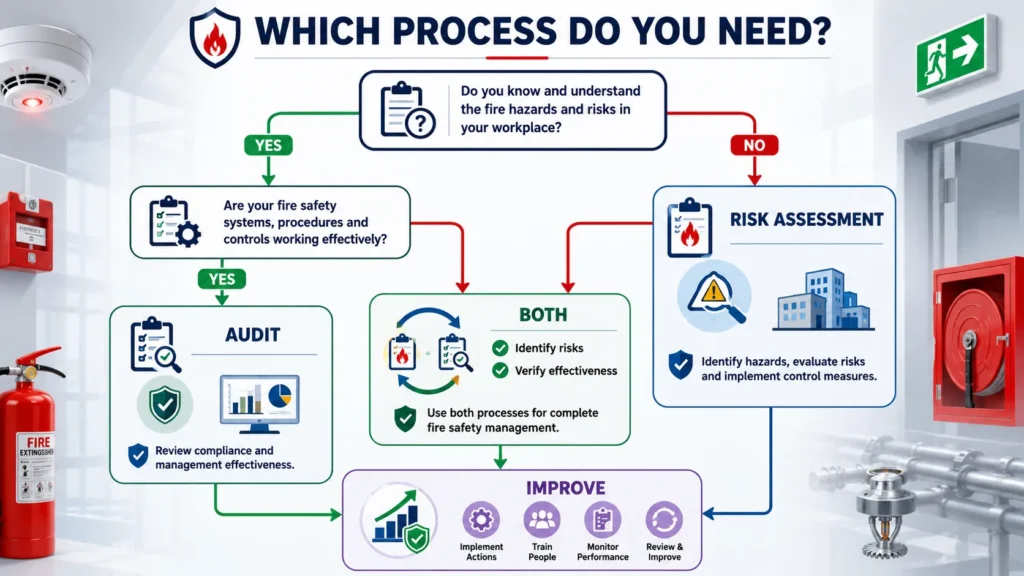
Can Businesses Benefit from Both?
Organisations achieve the best outcomes when fire risk assessments and fire safety audits are integrated into a single fire safety management strategy.
The fire risk assessment identifies what needs attention, while the fire safety audit evaluates whether improvements have been implemented successfully and continue to operate effectively.
Combined Benefits
| Fire Risk Assessment | Fire Safety Audit | Combined Result |
|---|---|---|
| Identifies hazards | Confirms controls work | Stronger fire prevention |
| Assesses risks | Measures compliance | Improved legal compliance |
| Recommends controls | Reviews implementation | Better operational performance |
| Protects people | Improves governance | Safer workplaces |
| Supports planning | Encourages continual improvement | Long-term resilience |
Using both processes creates multiple layers of protection rather than relying on a single assessment.
Industry-Specific Examples
Different industries face different fire hazards, making both fire risk assessments and fire safety audits essential for effective fire safety management.
Offices
Fire Risk Assessment Focus
- Electrical equipment
- Paper storage
- Kitchen appliances
- Escape routes
Fire Safety Audit Focus
- Fire alarm maintenance
- Employee training
- Fire drill records
- Emergency lighting inspections
Manufacturing
Fire Risk Assessment Focus
- Machinery
- Hot work
- Flammable chemicals
- Combustible dust
Fire Safety Audit Focus
- Permit-to-work systems
- Maintenance programmes
- Safety procedures
- Inspection records
Warehousing
Fire Risk Assessment Focus
- High storage racks
- Packaging materials
- Forklift charging areas
- Storage layouts
Fire Safety Audit Focus
- Sprinkler maintenance
- Fire compartmentation
- Housekeeping standards
- Documentation
Healthcare
Fire Risk Assessment Focus
- Medical gases
- Electrical equipment
- Vulnerable occupants
- Oxygen storage
Fire Safety Audit Focus
- Assisted evacuation procedures
- Staff competency
- Emergency planning
- Compliance monitoring
Hospitality
Fire Risk Assessment Focus
- Commercial kitchens
- Cooking oils
- Gas appliances
- Customer occupancy
Fire Safety Audit Focus
- Kitchen suppression systems
- Fire extinguisher servicing
- Staff training
- Emergency communication
These examples demonstrate that while hazards differ across industries, the relationship between fire risk assessments and fire safety audits remains consistent.
Fire Safety Is a Continuous Process
Neither a fire risk assessment nor a fire safety audit should be viewed as a one-time activity. Workplaces evolve continuously through changes in personnel, equipment, building layouts, operational processes, and legislation.
Maintaining a safe workplace requires organisations to identify hazards, evaluate risks, verify compliance, implement improvements, and regularly review performance. Together, fire risk assessments and fire safety audits create a continuous cycle of prevention, evaluation, and improvement that strengthens organisational resilience and reduces the likelihood of fire-related incidents.
Fire Safety Management Systems (FSMS)
An effective Fire Safety Management System (FSMS) brings together fire risk assessments, fire safety audits, policies, procedures, employee training, inspections, maintenance, and continuous improvement into a single, coordinated framework.
Rather than treating fire safety as a collection of separate activities, an FSMS ensures that every aspect of fire prevention and emergency preparedness works together to protect people, property, and business operations.
Businesses with a structured management system are better equipped to identify hazards, monitor performance, respond to changes, and demonstrate compliance with workplace fire safety responsibilities.
Core Elements of a Fire Safety Management System
| Element | Purpose |
|---|---|
| Fire Risk Assessment | Identify hazards and evaluate risks |
| Fire Safety Policy | Define organisational commitments |
| Fire Safety Planning | Establish prevention and emergency procedures |
| Employee Training | Improve competence and awareness |
| Fire Protection Systems | Detect, contain, and suppress fires |
| Inspections | Identify unsafe conditions |
| Fire Safety Audits | Verify compliance and effectiveness |
| Corrective Actions | Resolve identified deficiencies |
| Management Review | Evaluate overall performance |
| Continuous Improvement | Strengthen fire safety over time |
A mature fire safety management system creates consistency across all departments and supports long-term organisational resilience.
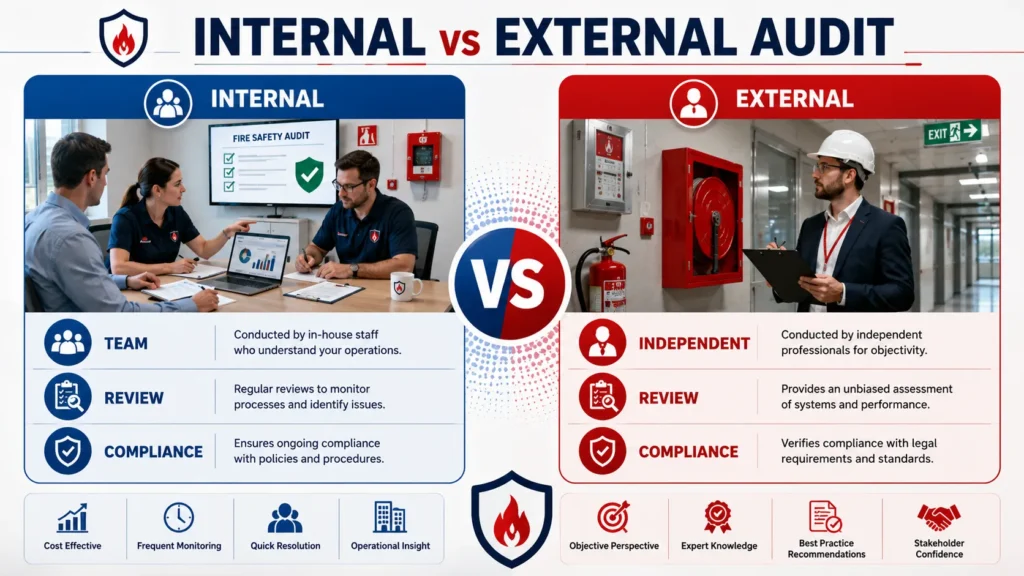
Internal vs External Fire Safety Audits
Fire safety audits may be conducted internally by competent employees or externally by independent specialists. Both approaches provide valuable insights, but they serve different purposes.
Internal Fire Safety Audit
Internal audits help organisations monitor day-to-day compliance and identify opportunities for improvement before external inspections take place.
Benefits include:
- Regular monitoring
- Immediate corrective actions
- Greater employee involvement
- Continuous improvement
- Lower audit costs
- Improved management oversight
External Fire Safety Audit
External audits provide an independent evaluation of the organisation’s fire safety management system.
Benefits include:
- Independent assessment
- Specialist expertise
- Best practice recommendations
- Increased stakeholder confidence
- Objective compliance review
- Fresh perspective on existing systems
Internal vs External Audit Comparison
| Internal Audit | External Audit |
|---|---|
| Conducted by internal personnel | Conducted by independent specialists |
| Supports routine monitoring | Provides independent verification |
| Lower cost | Greater objectivity |
| Frequent reviews | Periodic evaluations |
| Operational focus | Strategic and compliance focus |
| Encourages continuous improvement | Validates management effectiveness |
Many organisations use both approaches to maintain high standards of fire safety management.
Digital Fire Safety Audits
Technology has transformed how organisations conduct fire safety audits and manage compliance.
Digital tools allow businesses to replace paper-based inspections with real-time reporting, automated reminders, cloud storage, and performance dashboards.
Examples include:
- Digital inspection checklists
- Mobile auditing applications
- Cloud-based compliance software
- QR code equipment inspections
- Automated maintenance scheduling
- Digital corrective action tracking
- Electronic document management
- Dashboard reporting
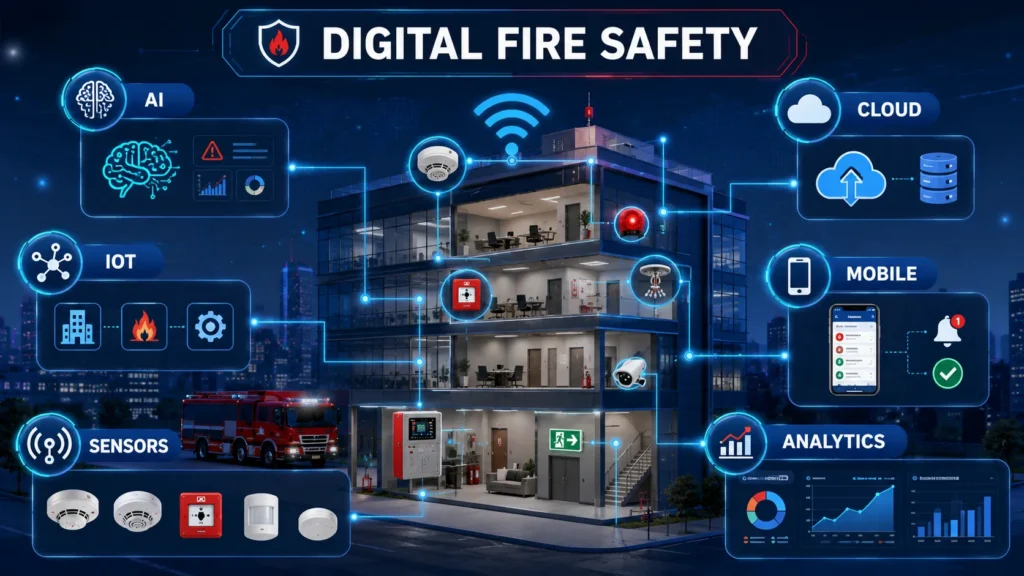
Benefits of Digital Fire Safety Management
| Technology | Business Benefit |
|---|---|
| Mobile Audit Apps | Faster workplace inspections |
| Cloud Reporting | Centralised compliance records |
| QR Code Inspections | Simplified equipment tracking |
| Digital Dashboards | Real-time performance monitoring |
| Automated Alerts | Never miss scheduled inspections |
| Electronic Documentation | Improved record management |
Digital solutions improve efficiency while making compliance easier to demonstrate during inspections and audits.
Fire Safety Key Performance Indicators (KPIs)
Leading organisations monitor fire safety performance using measurable indicators rather than relying solely on annual inspections.
Tracking KPIs enables businesses to identify trends, evaluate improvements, and focus resources where they are most needed.
Examples of Fire Safety KPIs
- Fire risk assessments completed on schedule
- Fire safety audits completed
- Corrective actions closed on time
- Fire drill participation rate
- Employee training completion
- Fire alarm testing compliance
- Fire extinguisher inspection completion
- Emergency lighting inspection compliance
- Fire incidents
- Near-miss reports
Fire Safety KPI Dashboard
| KPI | Performance Indicator |
|---|---|
| Fire Risk Assessments | Completed within scheduled period |
| Fire Safety Audits | Completed annually or as planned |
| Employee Training | Percentage of staff trained |
| Fire Drills | Number completed annually |
| Corrective Actions | Percentage closed on time |
| Equipment Maintenance | Maintenance compliance rate |
| Fire Incidents | Number of reported incidents |
| Near Misses | Number investigated and resolved |
Monitoring KPIs supports evidence-based decision-making and continuous improvement.
Corrective Actions After a Fire Safety Audit
One of the most valuable outcomes of a fire safety audit is the identification of opportunities for improvement.
Audit findings should not simply be recorded—they should lead to practical corrective actions that reduce future risks.
Examples include:
- Repairing damaged fire doors
- Replacing defective emergency lighting
- Updating evacuation procedures
- Providing refresher employee training
- Improving fire safety signage
- Reviewing maintenance schedules
- Updating fire risk assessments
- Improving contractor management
Corrective Action Process
Conduct Audit
      │
      ▼
Identify Findings
      │
      ▼
Prioritise Risks
      │
      ▼
Assign Responsibilities
      │
      ▼
Implement Corrective Actions
      │
      ▼
Verify Effectiveness
      │
      ▼
Update Documentation
      │
      ▼
Continuous Improvement
This structured approach ensures that audit findings result in measurable improvements rather than remaining unresolved.
Common Mistakes Businesses Should Avoid
Many organisations invest in fire safety equipment but overlook management practices that are equally important.
Avoiding these common mistakes strengthens both fire risk assessments and fire safety audits.
Frequent Mistakes
| Mistake | Potential Impact | Best Practice |
|---|---|---|
| Treating assessments as one-off exercises | Outdated information | Review regularly |
| Ignoring audit findings | Recurring compliance issues | Complete corrective actions promptly |
| Poor documentation | Weak evidence of compliance | Maintain organised records |
| Inadequate employee training | Increased human error | Schedule refresher training |
| Delayed maintenance | Equipment failure | Follow preventive maintenance schedules |
| Poor communication | Confusion during emergencies | Clearly communicate procedures |
| Failing to monitor KPIs | Limited performance visibility | Track measurable indicators |
| Lack of management involvement | Weak safety culture | Demonstrate leadership commitment |
Fire Safety Continuous Improvement Cycle
Fire safety should evolve alongside the organisation. New equipment, building alterations, operational changes, and updated legislation can all introduce new risks or affect existing controls.
Businesses that adopt a culture of continuous improvement are better prepared to respond to these changes while maintaining high standards of safety and compliance.
Fire Safety Management Lifecycle
Fire Risk Assessment
          │
          ▼
Implement Controls
          │
          ▼
Employee Training
          │
          ▼
Routine Inspections
          │
          ▼
Fire Safety Audit
          │
          ▼
Corrective Actions
          │
          ▼
Management Review
          │
          ▼
Update Risk Assessment
          │
          └──────────────► Repeat
This ongoing cycle ensures that fire safety management remains proactive rather than reactive.
Preparing for a Fire Safety Audit
Businesses can improve audit outcomes by preparing in advance and ensuring that key fire safety activities are consistently maintained throughout the year.
Preparation should include:
- Reviewing the latest fire risk assessment
- Ensuring maintenance records are complete
- Verifying fire alarm and emergency lighting tests
- Checking fire extinguisher servicing records
- Confirming employee training is up to date
- Reviewing fire drill reports
- Inspecting escape routes and fire doors
- Closing outstanding corrective actions
Organisations that prepare continuously rather than only before an audit typically achieve stronger compliance, better operational performance, and a more resilient fire safety culture.
Business Benefits of Integrating Fire Risk Assessments and Fire Safety Audits
Businesses that integrate fire risk assessments with regular fire safety audits create a stronger and more resilient fire safety management system. Rather than treating these activities as separate compliance tasks, organisations can use them together to identify hazards, verify control measures, improve performance, and support continuous improvement.
This integrated approach helps organisations move beyond simply meeting legal responsibilities and towards building a proactive fire safety culture.
Business Benefits
| Benefit | Fire Risk Assessment | Fire Safety Audit | Combined Value |
|---|---|---|---|
| Employee Safety | Identifies workplace hazards | Confirms controls are effective | Safer working environment |
| Legal Compliance | Supports compliance planning | Verifies ongoing compliance | Reduced regulatory risk |
| Business Continuity | Reduces fire risks | Improves emergency preparedness | Less operational disruption |
| Asset Protection | Identifies vulnerable areas | Reviews maintenance programmes | Lower property damage |
| Cost Control | Prevents incidents | Reduces recurring issues | Long-term financial savings |
| Continuous Improvement | Updates risk controls | Evaluates system performance | Sustainable fire safety management |
When both processes work together, organisations gain greater visibility into fire safety performance and are better prepared to respond to changing workplace risks.
The Cost of Poor Fire Safety Management
Failing to carry out suitable fire risk assessments or neglecting regular fire safety audits can have significant consequences for any organisation.
A single workplace fire can result in:
- Serious injuries or fatalities
- Damage to buildings and equipment
- Business interruption
- Loss of important records
- Increased insurance premiums
- Legal penalties
- Compensation claims
- Reputational damage
- Loss of customer confidence
- Reduced employee morale
Many of these consequences are preventable through effective fire safety planning, regular assessments, and ongoing audits.
Prevention vs Recovery
| Investing in Fire Safety | Cost of a Fire Incident |
|---|---|
| Fire risk assessments | Building repairs |
| Fire safety audits | Equipment replacement |
| Employee training | Business interruption |
| Routine inspections | Lost productivity |
| Preventive maintenance | Insurance increases |
| Emergency planning | Legal costs |
| Fire drills | Compensation claims |
| Digital compliance systems | Reputational damage |
For most organisations, investing in prevention is considerably more cost-effective than recovering from a major fire.
Building a Proactive Fire Safety Culture
Successful organisations recognise that fire safety is not solely the responsibility of health and safety managers or fire wardens. Every employee has a role in identifying hazards, following procedures, reporting unsafe conditions, and contributing to a safer workplace.
A positive fire safety culture is characterised by:
- Strong leadership commitment
- Clear communication
- Regular employee training
- Open hazard reporting
- Routine inspections
- Continuous learning
- Prompt corrective actions
- Management accountability
When fire safety becomes part of everyday decision-making, businesses reduce the likelihood of incidents and improve overall organisational resilience.
Fire Safety Improvement Roadmap
Identify Fire Risks
         │
         ▼
Conduct Fire Risk Assessment
         │
         ▼
Implement Control Measures
         │
         ▼
Train Employees
         │
         ▼
Carry Out Fire Safety Audit
         │
         ▼
Review Findings
         │
         ▼
Implement Corrective Actions
         │
         ▼
Monitor Performance
         │
         ▼
Continuous Improvement
This roadmap illustrates that fire safety is an ongoing management cycle rather than a one-time compliance activity.
Fire Risk Assessment and Fire Safety Audit Across Different Industries
Although the principles remain the same, every industry applies fire risk assessments and fire safety audits differently based on operational activities and fire hazards.
| Industry | Fire Risk Assessment Focus | Fire Safety Audit Focus |
|---|---|---|
| Offices | Electrical equipment, occupancy | Training records, alarm testing, evacuation procedures |
| Construction | Hot work, temporary electrics, fuel storage | Permit-to-work systems, inspections, documentation |
| Manufacturing | Machinery, chemicals, combustible dust | Maintenance programmes, compliance monitoring |
| Warehouses | Storage layouts, packaging materials | Sprinkler systems, housekeeping, fire doors |
| Healthcare | Medical gases, vulnerable persons | Staff competency, evacuation planning |
| Retail | Customer occupancy, stockrooms | Fire alarm maintenance, emergency exits |
| Hospitality | Kitchens, cooking oils, gas appliances | Suppression systems, employee training |
| Education | Laboratories, high occupancy | Fire drills, emergency communication, record keeping |
Tailoring both processes to industry-specific risks improves effectiveness and supports safer workplaces.
Recommended Fire Safety Courses from Inspire College
Readers interested in developing professional knowledge and practical skills in workplace fire safety can explore the following programmes offered by Inspire College. These course titles can be linked internally to strengthen topical authority and improve website navigation.
Fire Safety Courses
- Level 4 Diploma in Fire Safety
- Level 6 Diploma in Advanced Fire Safety Design
- Fire Marshal Training
- Fire Safety Train the Trainer
Fire Risk Assessment Courses
- Level 2 Award in Risk Assessment
- Level 3 Certificate in Risk Assessment
- Level 4 Certificate in Risk Assessment
Key Takeaways
- A fire risk assessment identifies workplace fire hazards, evaluates risks, and recommends appropriate control measures.
- A fire safety audit evaluates whether an organisation’s fire safety management system, policies, procedures, and controls are operating effectively.
- Fire risk assessments are preventive, while fire safety audits are evaluative and focus on continuous improvement.
- Businesses should use both processes together to strengthen fire prevention, improve compliance, and enhance organisational resilience.
- Regular reviews, employee training, routine inspections, and corrective actions ensure that fire safety arrangements remain effective as workplaces evolve.
- Digital fire safety tools, performance monitoring, and structured management systems support more efficient and reliable fire safety management.
- Integrating fire risk assessments and fire safety audits creates a proactive fire safety culture that protects people, property, and business operations.
Conclusion
Understanding the difference between a fire risk assessment and a fire safety audit is essential for building an effective workplace fire safety strategy. Although they serve different purposes, they are most effective when used together as part of a structured fire safety management system.
A fire risk assessment helps organisations identify hazards, evaluate risks, and implement preventive measures before incidents occur. A fire safety audit then verifies that these measures are working effectively, that employees are following established procedures, and that the organisation continues to meet its fire safety responsibilities.
Rather than viewing these processes as standalone compliance requirements, businesses should integrate them into a continuous cycle of assessment, implementation, monitoring, auditing, and improvement. This proactive approach strengthens workplace safety, supports operational resilience, protects valuable assets, and reduces the likelihood of fire-related incidents.
Whether your organisation operates in an office, warehouse, manufacturing facility, healthcare setting, retail environment, hospitality venue, or construction site, combining fire risk assessments with regular fire safety audits is one of the most effective ways to create a safer, more compliant, and future-ready workplace. Continuous evaluation, employee engagement, and a commitment to improvement ensure that fire safety remains a core part of long-term business success.
Explore More Fire Safety & Risk Assessment Articles
Discover expert guides on fire safety careers, fire risk assessments, workplace compliance, fire protection systems, and professional qualifications to expand your knowledge and advance your career in fire safety.
- What is Fire Safety?
- Fire Risk Assessment
- Fire Safety: Essential Tips for Homes and Workplaces
- What Does a Senior Fire Safety Advisor Do? Roles, Responsibilities, and Career Guide
- Top Skills Every Senior Fire Safety Advisor Should Develop
- Is Fire Safety a Good Career Choice in the UK?
- Senior Fire Safety Advisor Career Progression: Exciting Roles, Salary & Leadership Path
- Is Fire Safety a Good Career Choice in the UK?
- Top Skills Every Senior Fire Safety Advisor Should Develop
- Senior Fire Safety Advisor vs Fire Risk Assessor: Which Career Is Right for You?
- Senior Fire Safety Advisor: Top Industries Hiring Across the UK
- Fire Risk Assessment Explained: A Complete Beginner’s Guide
- Qualified Fire Risk Assessor Career Guide: Training, Skills, and Job Opportunities
- Senior Fire Safety Advisor: Top Industries Hiring Across the UK
- The 5 Essential Steps of Fire Risk Assessment Explained
- Common Risk Assessment Mistakes and How to Avoid Them
- How Fire Safety and Risk Assessment Reduce Workplace Hazards
- Essential Fire Safety Tips Everyone Should Know to Stay Safe
- Fire Safety Planning and Risk Assessment for Businesses
- How to Conduct an Effective Risk Assessment Step by Step
- Fire Safety Checklist for Homes, Offices & Commercial Buildings
- Fire Safety Checklist for Homes, Offices & Commercial Buildings
- Common Risk Assessment Mistakes and How to Avoid Them
- How Often Should a Fire Risk Assessment Be Reviewed?
- Top Workplace Fire Hazards Every Inspection Reveals
- Essential Fire Safety Duties for Landlords and Property Managers