
How to Conduct an Effective Risk Assessment Step by Step
Risk assessments are one of the most effective ways to prevent workplace accidents, occupational illnesses, property damage, and costly business disruptions. Whether you manage an office, construction site, warehouse, healthcare facility, manufacturing plant, or educational institution, understanding how to conduct an effective risk assessment is essential for creating a safe working environment and meeting legal health and safety responsibilities.
A risk assessment is far more than a compliance document. It is a structured process that helps organisations identify workplace hazards, evaluate the level of risk, implement appropriate control measures, and continually improve safety performance. By identifying potential dangers before incidents occur, businesses can reduce injuries, protect employees, improve productivity, and strengthen their safety culture.
In the UK, employers and responsible persons have a legal duty to assess workplace risks and take reasonable steps to eliminate or minimise them. Regular risk assessments also help organisations prepare for changing working conditions, new equipment, evolving technologies, and updated health and safety regulations.
This step-by-step guide explains how to conduct an effective risk assessment using practical examples, professional techniques, and industry best practices. You’ll also learn how to identify hazards, evaluate risks, implement control measures, document findings, and review assessments to ensure continuous improvement across your organisation.
What Is a Risk Assessment?
A risk assessment is a systematic process used to identify hazards, evaluate the risks they present, and determine appropriate measures to eliminate or reduce those risks to an acceptable level.
Rather than reacting to accidents after they happen, risk assessments help organisations take proactive action to prevent incidents before they occur. They form the foundation of every successful health and safety management system.
A well-conducted risk assessment answers four key questions:
- What hazards exist?
- Who could be harmed?
- How serious is the risk?
- What controls are needed?
Quick Definition
| Term | Definition |
|---|---|
| Hazard | Anything with the potential to cause harm, injury, illness, or damage. |
| Risk | The likelihood that a hazard will cause harm and the severity of its consequences. |
| Risk Assessment | A structured process used to identify hazards, evaluate risks, and implement suitable control measures. |
| Control Measure | An action taken to eliminate or minimise identified risks. |
Understanding the difference between hazards and risks is essential. For example, electricity is a hazard, while the possibility of receiving an electric shock due to damaged wiring represents the risk.
Why Is Risk Assessment Important?
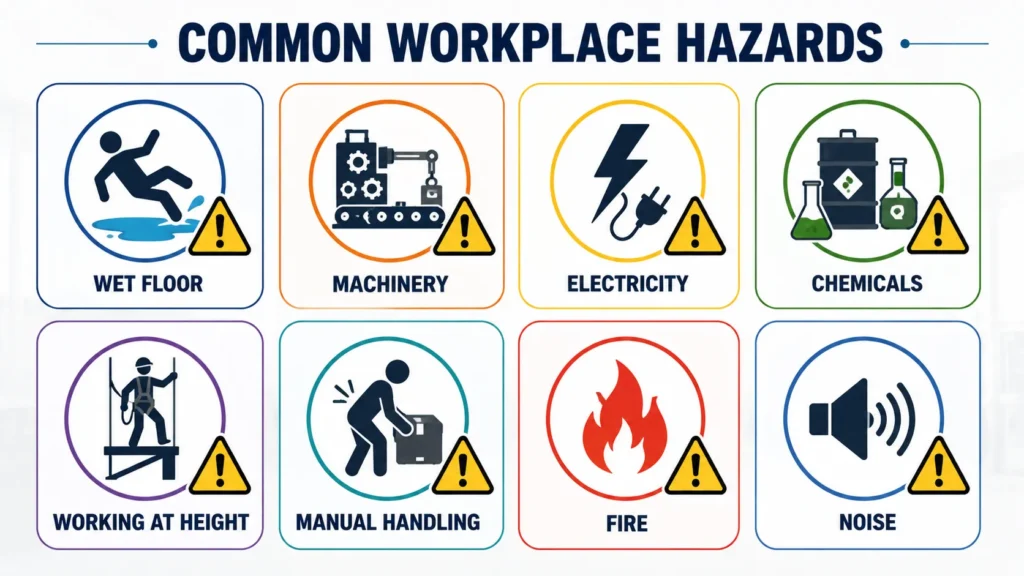
Every workplace contains hazards, regardless of its size or industry. Even environments that appear low-risk, such as offices, can present hazards including electrical equipment, slips and trips, poor ergonomics, fire risks, and manual handling activities.
Conducting regular risk assessments helps organisations identify these hazards before they result in injuries or business disruption.
Benefits of Conducting Risk Assessments
| Benefit | How It Helps |
|---|---|
| Prevents Workplace Accidents | Identifies hazards before incidents occur. |
| Protects Employees | Reduces exposure to dangerous working conditions. |
| Improves Legal Compliance | Supports compliance with UK health and safety legislation. |
| Reduces Financial Losses | Minimises compensation claims, downtime, and repair costs. |
| Improves Productivity | Safer workplaces experience fewer disruptions. |
| Strengthens Safety Culture | Encourages everyone to participate in workplace safety. |
| Supports Business Reputation | Demonstrates a commitment to responsible management. |
An effective risk assessment is not just about identifying problems—it also supports informed decision-making and continuous improvement across the organisation.
UK Legal Responsibilities for Risk Assessments
In the United Kingdom, employers have a legal responsibility to assess workplace risks and implement appropriate control measures to protect employees, contractors, visitors, and members of the public.
The responsibility usually falls to the employer, business owner, or another competent person appointed to manage health and safety within the organisation.
A suitable and sufficient risk assessment should:
- Identify workplace hazards.
- Evaluate the likelihood and severity of harm.
- Determine appropriate control measures.
- Record significant findings where required.
- Be reviewed whenever circumstances change.
- Be communicated to relevant employees.
Regular reviews are particularly important after:
- Workplace accidents.
- Near misses.
- Introduction of new equipment.
- Changes in work processes.
- Building alterations.
- New legislation or guidance.
Who Should Conduct a Risk Assessment?
Although managers often lead the assessment process, effective risk assessments involve people who understand the workplace and the tasks being performed.
Suitable individuals include:
- Employers
- Health and Safety Managers
- Supervisors
- Site Managers
- Facilities Managers
- Competent Risk Assessors
- Department Managers
- Fire Safety Officers
- Maintenance Managers
- External Health and Safety Consultants
Employees should also be consulted because they often identify practical hazards that may otherwise be overlooked.
Types of Risk Assessments
Different workplaces require different approaches depending on the nature of the activities being carried out.
General Workplace Risk Assessment
Covers routine workplace hazards such as:
- Slips and trips
- Electrical safety
- Manual handling
- Housekeeping
- Workplace equipment
Fire Risk Assessment
Focuses on identifying fire hazards, evaluating evacuation procedures, and ensuring fire protection measures remain effective.
COSHH Risk Assessment
Used where hazardous substances may expose employees to chemicals, dust, fumes, gases, or biological agents.
Manual Handling Risk Assessment
Evaluates lifting, carrying, pushing, pulling, and repetitive movements that may cause musculoskeletal injuries.
Display Screen Equipment (DSE) Assessment
Suitable for office workers who regularly use computers and display screens.
Construction Risk Assessment
Addresses high-risk activities such as:
- Working at height
- Excavations
- Heavy machinery
- Temporary works
- Falling objects
Industry Comparison
| Industry | Common Risk Assessments |
|---|---|
| Construction | Working at Height, Excavation, Plant Equipment |
| Manufacturing | Machinery, Chemicals, Manual Handling |
| Healthcare | Infection Control, Sharps, Patient Handling |
| Office | DSE, Fire Safety, Electrical Safety |
| Warehousing | Forklifts, Storage Systems, Loading Operations |
| Education | Laboratories, Fire Safety, Classroom Safety |
| Hospitality | Kitchens, Slips, Hot Surfaces, Food Safety |
Understanding which type of assessment is required ensures organisations apply the most appropriate controls for their working environment.
The Five-Step Risk Assessment Process
Although every workplace is different, most effective risk assessments follow a structured process consisting of five key stages.
Risk Assessment Process Flow
Identify Hazards
↓
Determine Who May Be Harmed
↓
Evaluate Risks
↓
Implement Control Measures
↓
Record Findings and Review Regularly
Following this logical sequence helps ensure that hazards are identified systematically and appropriate actions are taken to reduce risks.
Step 1: Identify Workplace Hazards
The first and most important stage of any risk assessment is identifying hazards.
A hazard is anything that has the potential to cause injury, illness, property damage, environmental harm, or business interruption.
Hazards may be obvious, such as exposed electrical wiring, or less visible, such as repetitive strain injuries caused by poor workstation design.
Common Categories of Workplace Hazards
Physical Hazards
Examples include:
- Slippery floors
- Uneven surfaces
- Noise
- Vibration
- Working at height
- Moving machinery
- Falling objects
Chemical Hazards
These may include:
- Cleaning chemicals
- Solvents
- Paints
- Fuels
- Dust
- Fumes
- Hazardous gases
Biological Hazards
Often found in healthcare and laboratory environments.
Examples include:
- Bacteria
- Viruses
- Mould
- Bloodborne pathogens
- Contaminated waste
Ergonomic Hazards
Poor workplace design can lead to long-term injuries.
Examples include:
- Poor posture
- Repetitive movements
- Heavy lifting
- Poor workstation setup
- Awkward body positions
Psychosocial Hazards
Mental health risks should also be considered.
Examples include:
- Excessive workload
- Workplace stress
- Fatigue
- Bullying
- Violence
- Lone working
Methods for Identifying Hazards
Effective hazard identification combines several techniques rather than relying on a single inspection.
Workplace Inspections
Walk through the workplace and observe activities, equipment, and working conditions.
Employee Consultation
Employees often understand day-to-day hazards better than anyone else because they perform the tasks regularly.
Accident and Near-Miss Records
Review previous incidents to identify recurring hazards that require additional control measures.
Manufacturer Instructions
Equipment manuals frequently contain important safety information that should be incorporated into the assessment.
Safety Audits
Internal and external audits often reveal hazards that routine inspections may miss.
Hazard Identification Checklist
| Inspection Area | Check |
|---|---|
| Floors and walkways | □ |
| Electrical equipment | □ |
| Machinery and tools | □ |
| Fire safety equipment | □ |
| Emergency exits | □ |
| Manual handling tasks | □ |
| Hazardous substances | □ |
| Personal protective equipment | □ |
| Lighting and ventilation | □ |
| Housekeeping standards | □ |
Completing a structured checklist helps ensure no important hazards are overlooked during the assessment process.
Best Practices for Identifying Hazards
To improve the accuracy and effectiveness of hazard identification:
- Observe work activities during normal operations.
- Speak with employees performing the tasks.
- Inspect all work areas, including storage rooms and plant rooms.
- Review maintenance and inspection records.
- Consider non-routine tasks such as maintenance and cleaning.
- Assess risks to visitors, contractors, and members of the public.
- Take photographs where appropriate to support documentation.
- Record findings clearly and objectively.
A thorough hazard identification process forms the foundation of every successful risk assessment. Missing hazards at this stage can undermine the effectiveness of all subsequent steps, making careful observation and consultation essential.
Step 2: Determine Who May Be Harmed and How
After identifying workplace hazards, the next step is to determine who could be affected and how the hazard might cause harm. Every workplace contains a variety of people with different responsibilities, experience levels, and vulnerabilities. An effective risk assessment considers everyone who may come into contact with the identified hazards, not just permanent employees.
This stage helps organisations prioritise suitable control measures and ensures that no group is overlooked during the assessment process.
People Who May Be Harmed
The following groups should be considered during every risk assessment:
- Employees
- Supervisors and managers
- Contractors
- Temporary workers
- Agency staff
- Visitors
- Customers
- Delivery drivers
- Maintenance personnel
- Apprentices and trainees
- Young workers
- Pregnant workers
- People with disabilities
- Members of the public
Each group may be exposed to hazards in different ways depending on their activities, experience, and working environment.
Consider Individual Vulnerabilities
Some people may require additional protection because they are more susceptible to workplace hazards.
Examples include:
- Young workers with limited experience.
- New employees unfamiliar with workplace procedures.
- Pregnant workers who may require modified duties.
- Individuals with mobility impairments.
- Employees working alone.
- Contractors unfamiliar with site-specific hazards.
Considering individual needs helps ensure that control measures are both effective and inclusive.
Questions to Ask
When identifying who may be harmed, consider the following:
- Who works in this area?
- Who enters the area occasionally?
- Who could be affected if something goes wrong?
- Does anyone require additional protection?
- Could nearby departments be affected?
- Could visitors or the public be exposed?
Answering these questions provides a more complete understanding of workplace risks.
People at Risk Assessment Table
| Hazard | Who May Be Harmed | Possible Harm |
|---|---|---|
| Wet Floor | Employees, Visitors | Slips, fractures, sprains |
| Damaged Electrical Cable | Maintenance Staff, Employees | Electric shock, burns |
| Forklift Operations | Warehouse Staff, Contractors | Collision injuries |
| Chemical Storage | Laboratory Staff | Chemical burns, respiratory illness |
| Working at Height | Construction Workers | Falls, serious injury |
| Poor Ergonomics | Office Staff | Musculoskeletal disorders |
Documenting who may be harmed allows organisations to select more appropriate and targeted control measures.
Step 3: Evaluate the Risks
Once hazards and affected persons have been identified, the next stage is evaluating the level of risk. This involves assessing two key factors:
- The likelihood that an incident will occur.
- The severity of the potential consequences.
These two factors determine the overall level of risk and help organisations prioritise corrective actions.
Understanding Likelihood
Likelihood measures how probable it is that the hazard will result in harm.
Factors influencing likelihood include:
- Frequency of exposure.
- Number of people exposed.
- Existing safety measures.
- Condition of equipment.
- Employee competence.
- Environmental conditions.
Understanding Severity
Severity considers the possible consequences if the hazard results in an incident.
Consequences may include:
- Minor injuries.
- Serious injuries.
- Permanent disability.
- Fatalities.
- Property damage.
- Environmental damage.
- Business interruption.
A hazard that is unlikely to occur but could cause catastrophic consequences may still require immediate attention.
Risk Matrix Explained
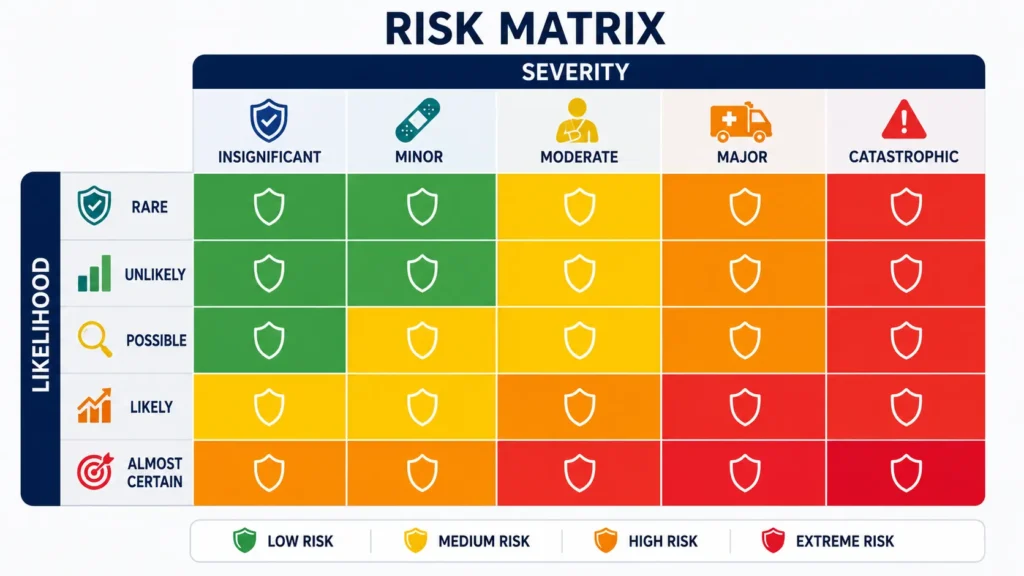
A risk matrix provides a structured method for evaluating workplace risks by combining likelihood and severity.
Likelihood Scale
| Rating | Description |
|---|---|
| 1 | Rare |
| 2 | Unlikely |
| 3 | Possible |
| 4 | Likely |
| 5 | Almost Certain |
Severity Scale
| Rating | Description |
|---|---|
| 1 | Insignificant |
| 2 | Minor Injury |
| 3 | Moderate Injury |
| 4 | Major Injury |
| 5 | Fatality or Catastrophic Loss |
Risk Rating Matrix
| Likelihood ↓ / Severity → | 1 | 2 | 3 | 4 | 5 |
|---|---|---|---|---|---|
| 5 Almost Certain | Medium | High | High | Extreme | Extreme |
| 4 Likely | Medium | Medium | High | High | Extreme |
| 3 Possible | Low | Medium | Medium | High | High |
| 2 Unlikely | Low | Low | Medium | Medium | High |
| 1 Rare | Low | Low | Low | Medium | Medium |
The matrix enables organisations to identify which hazards require immediate action and which can be managed through routine monitoring.
Risk Priority Guide
| Risk Level | Action Required |
|---|---|
| Low | Continue monitoring and maintain existing controls. |
| Medium | Introduce additional controls where practical. |
| High | Implement corrective actions as soon as possible. |
| Extreme | Stop work immediately until risks are controlled. |
Prioritising risks ensures that resources are focused on the hazards with the greatest potential impact.
Practical Risk Assessment Example
The following example demonstrates how hazards can be evaluated using a structured approach.
| Hazard | Likelihood | Severity | Risk Rating |
|---|---|---|---|
| Wet Floor | Possible | Moderate | Medium |
| Faulty Electrical Equipment | Likely | Major | High |
| Working at Height | Possible | Fatal | High |
| Manual Handling | Likely | Moderate | High |
| Poor Lighting | Unlikely | Minor | Low |
| Chemical Spill | Possible | Major | High |
This type of assessment provides a clear justification for selecting appropriate control measures.
Factors That Influence Risk Levels
Risk levels can change depending on workplace conditions. Consider the following when evaluating risks:
Frequency of Exposure
Tasks performed every day generally present a greater overall risk than those carried out occasionally.
Number of People Exposed
Hazards affecting large numbers of employees usually require higher priority.
Existing Control Measures
Assess whether current safeguards are effective or require improvement.
Examples include:
- Guardrails
- Machine guards
- Ventilation systems
- Fire protection equipment
- PPE
- Safe systems of work
Competency
Inexperienced or inadequately trained employees may face greater risks than experienced personnel performing the same task.
Environmental Conditions
Weather, lighting, noise, temperature, and confined spaces may all increase workplace risks.
Risk Evaluation Flowchart
Identify Hazard
↓
Determine Who May Be Harmed
↓
Assess Likelihood
↓
Assess Severity
↓
Calculate Risk Rating
↓
Prioritise Risk
↓
Select Control Measures
↓
Monitor Effectiveness
↓
Review Regularly
Following this structured workflow improves consistency and supports informed decision-making.
Industry Examples of Risk Evaluation
Construction
Common hazards:
- Falls from height
- Excavations
- Moving vehicles
- Power tools
- Falling materials
Typical risk level: High
Manufacturing
Common hazards:
- Machinery
- Noise
- Chemicals
- Manual handling
- Hot surfaces
Typical risk level: Medium to High
Office
Common hazards:
- Slips and trips
- Electrical equipment
- Ergonomic issues
- Fire safety
- Stress
Typical risk level: Low to Medium
Healthcare
Common hazards:
- Infection
- Sharps
- Patient handling
- Hazardous substances
- Violence and aggression
Typical risk level: Medium to High
Warehousing
Common hazards:
- Forklift operations
- Falling stock
- Manual handling
- Loading bays
- Storage systems
Typical risk level: Medium to High
Common Mistakes During Risk Evaluation
Many organisations reduce the effectiveness of their assessments by making avoidable errors.
Common mistakes include:
- Underestimating the severity of hazards.
- Ignoring near-miss incidents.
- Relying on outdated assessments.
- Using generic templates without site-specific information.
- Failing to involve employees.
- Overlooking contractors and visitors.
- Assuming existing controls are always effective.
Avoiding these mistakes results in more accurate assessments and stronger workplace safety.
Tips for Better Risk Evaluation
Improve the quality of your assessments by following these best practices:
- Use objective evidence rather than assumptions.
- Review previous accident records.
- Consult employees performing the work.
- Consider both routine and non-routine tasks.
- Reassess risks whenever significant changes occur.
- Prioritise high-risk activities first.
- Record the reasons behind each risk rating.
A thorough risk evaluation provides the foundation for selecting effective control measures. Once the level of risk has been established, organisations can focus on implementing practical actions to eliminate hazards or reduce them to an acceptable level.
Step 4: Implement Effective Control Measures
Once risks have been evaluated, the next step is to determine how they can be eliminated or reduced. Control measures are actions designed to prevent incidents, minimise exposure to hazards, and protect everyone who may be affected.
The most effective approach is to remove the hazard entirely wherever possible. If elimination is not practical, organisations should apply the Hierarchy of Controls, which ranks control measures from most effective to least effective.
Implementing the right controls not only reduces workplace risks but also demonstrates a proactive commitment to health and safety.
The Hierarchy of Controls
The Hierarchy of Controls is a widely recognised framework used to manage workplace hazards. It encourages organisations to select the most effective solutions before relying on personal protective equipment (PPE).
Hierarchy of Controls Flow
Elimination
↓
Substitution
↓
Engineering Controls
↓
Administrative Controls
↓
Personal Protective Equipment (PPE)
The higher the control appears in the hierarchy, the more effective it is at reducing risk.
1. Elimination
Elimination removes the hazard completely, making it the most effective control measure.
Examples:
- Removing unnecessary hazardous chemicals.
- Designing work to eliminate working at height.
- Replacing manual lifting with automated systems.
- Eliminating unnecessary vehicle movements.
2. Substitution
Where elimination is not possible, replace the hazard with a safer alternative.
Examples:
- Using water-based paints instead of solvent-based products.
- Replacing hazardous chemicals with non-toxic alternatives.
- Using quieter machinery to reduce noise exposure.
3. Engineering Controls
Engineering controls isolate people from hazards through physical changes to the workplace.
Examples:
- Machine guarding.
- Ventilation systems.
- Safety barriers.
- Guardrails.
- Local exhaust ventilation.
- Noise enclosures.
- Automatic shut-off systems.
4. Administrative Controls
Administrative controls reduce exposure by changing the way work is organised.
Examples include:
- Safe systems of work.
- Risk assessment procedures.
- Permit-to-work systems.
- Safety signage.
- Job rotation.
- Employee supervision.
- Training programmes.
- Scheduled maintenance.
5. Personal Protective Equipment (PPE)
PPE should always be considered the last line of defence rather than the primary control measure.
Examples include:
- Safety helmets.
- Protective gloves.
- Eye protection.
- High-visibility clothing.
- Respiratory protection.
- Safety footwear.
- Hearing protection.
PPE is most effective when combined with higher-level control measures.
Hierarchy of Controls Comparison
| Control Level | Effectiveness | Examples |
|---|---|---|
| Elimination | Very High | Remove hazardous activity |
| Substitution | High | Replace hazardous material |
| Engineering Controls | High | Machine guards, ventilation |
| Administrative Controls | Medium | Training, procedures, supervision |
| PPE | Lowest | Gloves, helmets, goggles |
Using multiple control measures often provides the best level of protection.
Step 5: Record Your Findings
Recording the findings of a risk assessment ensures that hazards, risk levels, and control measures are clearly documented. Accurate records also support legal compliance, internal audits, and continuous improvement.
Good documentation should be easy to understand and accessible to everyone responsible for implementing safety measures.
What Should Be Recorded?
A risk assessment record should include:
- Work activity.
- Identified hazards.
- People at risk.
- Existing control measures.
- Risk rating.
- Additional actions required.
- Responsible person.
- Target completion date.
- Review date.
Sample Risk Assessment Record
| Activity | Hazard | Risk | Control Measure | Responsible Person |
|---|---|---|---|---|
| Manual Lifting | Back Injury | High | Mechanical lifting aid and training | Warehouse Manager |
| Office Work | Poor Ergonomics | Medium | Adjustable chairs and workstation assessments | Office Manager |
| Chemical Storage | Chemical Exposure | High | Ventilated storage and PPE | Laboratory Supervisor |
| Working at Height | Falls | High | Guardrails and fall protection systems | Site Manager |
Clear documentation improves accountability and helps ensure corrective actions are completed.
Review and Update the Risk Assessment
A risk assessment should never be considered a one-time exercise. Workplaces evolve, equipment changes, new employees join the organisation, and legislation may be updated. Regular reviews ensure that existing control measures remain effective.
Review Your Risk Assessment When:
- New machinery is introduced.
- Work processes change.
- A workplace accident occurs.
- A near miss is reported.
- New hazards are identified.
- The building layout changes.
- Legislation is updated.
- New employees or contractors begin work.
Regular reviews support continuous improvement and help prevent risks from increasing over time.
Risk Assessment Review Cycle
Identify Changes
↓
Review Existing Assessment
↓
Inspect Workplace
↓
Evaluate New Risks
↓
Update Control Measures
↓
Communicate Changes
↓
Monitor Performance
↓
Review Again
This cycle promotes ongoing improvement rather than reactive safety management.
Digital Risk Assessments
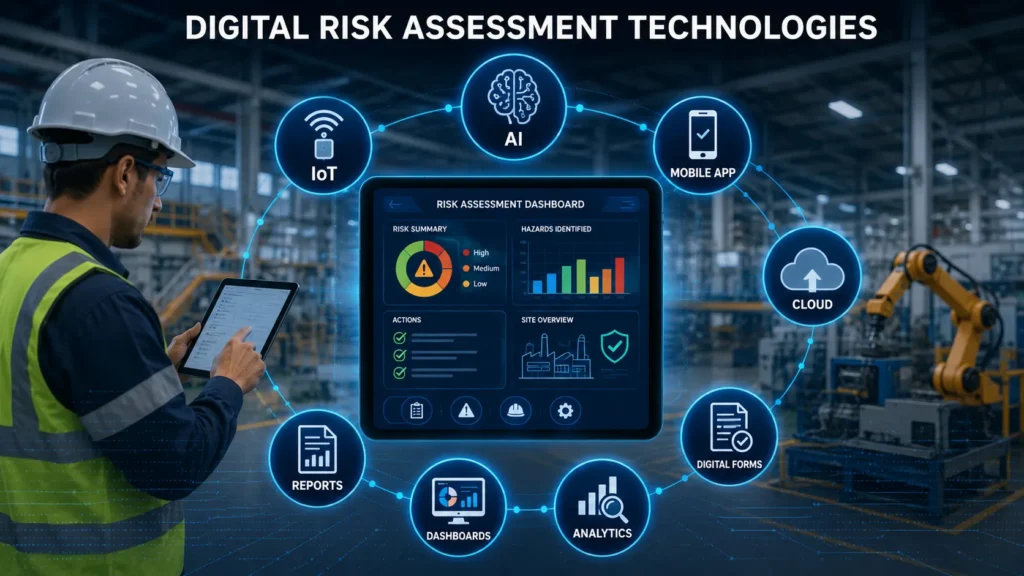
Technology has transformed how organisations manage workplace safety. Digital risk assessment tools allow inspections to be completed more efficiently while improving record keeping and reporting.
Benefits of Digital Risk Assessments
- Faster inspections.
- Mobile access.
- Real-time reporting.
- Cloud storage.
- Photo evidence.
- Automatic reminders.
- Audit-ready documentation.
- Improved collaboration.
- Trend analysis.
- Reduced paperwork.
Digital systems are particularly valuable for organisations managing multiple sites or conducting frequent inspections.
Emerging Technologies in Risk Assessment
Modern workplaces increasingly use technology to improve hazard identification and safety management.
Examples include:
Artificial Intelligence (AI)
AI can analyse inspection data, identify recurring hazards, predict trends, and support better decision-making.
Internet of Things (IoT)
Connected sensors monitor:
- Temperature.
- Air quality.
- Noise.
- Equipment performance.
- Machine vibration.
- Occupancy levels.
Real-time monitoring enables faster responses to emerging risks.
Cloud-Based Reporting
Cloud platforms allow managers to access risk assessments, inspection records, and corrective actions from any location.
Mobile Inspection Applications
Inspectors can:
- Complete assessments on-site.
- Upload photographs.
- Assign corrective actions.
- Generate reports instantly.
These technologies improve efficiency while reducing administrative workload.
Risk Assessment Checklist
The following checklist helps ensure every assessment is completed thoroughly.
| Checklist Item | Complete |
|---|---|
| Hazards identified | □ |
| People at risk identified | □ |
| Existing controls reviewed | □ |
| Risk ratings assigned | □ |
| Additional controls identified | □ |
| Responsibilities allocated | □ |
| Completion dates recorded | □ |
| Findings documented | □ |
| Employees informed | □ |
| Review date scheduled | □ |
Using a standard checklist promotes consistency across departments and projects.
Common Mistakes to Avoid
Even experienced organisations can make mistakes that reduce the effectiveness of their risk assessments.
Using Generic Templates
Every workplace is different. Copying generic templates without adapting them to specific activities often results in important hazards being overlooked.
Ignoring Employee Feedback
Employees perform the work every day and frequently identify hazards that managers may not notice.
Consultation improves the quality and practicality of risk assessments.
Focusing Only on Obvious Hazards
Hidden hazards such as stress, fatigue, repetitive strain injuries, poor ventilation, and mental health risks should also be assessed.
Failing to Implement Control Measures
Identifying hazards is only the beginning. Control measures must be implemented, monitored, and maintained to reduce risk effectively.
Not Reviewing Assessments
Outdated assessments may no longer reflect current workplace conditions, equipment, or legislation.
Regular reviews keep risk assessments accurate and relevant.
Best Practices for Effective Risk Assessments
Organisations with strong safety cultures follow consistent best practices when conducting risk assessments.
These include:
- Plan assessments before work begins.
- Involve employees from different departments.
- Use structured inspection checklists.
- Prioritise high-risk activities.
- Apply the Hierarchy of Controls.
- Record findings clearly.
- Assign responsibilities.
- Monitor corrective actions.
- Review assessments regularly.
- Encourage continuous improvement.
Adopting these practices strengthens workplace safety while supporting long-term compliance and operational excellence.
Practical Example of Risk Control
The following example demonstrates how the five-step process can be applied.
| Hazard | Initial Risk | Control Measure | Residual Risk |
|---|---|---|---|
| Wet Floor | High | Install warning signs, improve cleaning procedures, use non-slip flooring | Low |
| Damaged Electrical Cable | High | Replace cable immediately and introduce inspection programme | Low |
| Working at Height | Extreme | Install guardrails, provide fall protection equipment, deliver training | Medium |
| Manual Handling | High | Introduce lifting equipment and manual handling training | Low |
| Chemical Storage | High | Install ventilated cabinets and improve labelling | Medium |
This demonstrates how effective control measures significantly reduce workplace risk while improving overall safety performance.
Industry-Specific Risk Assessment Examples
Although the five-step risk assessment process remains the same, the hazards and control measures vary across industries. Tailoring assessments to the working environment ensures that risks are managed effectively and appropriate preventive measures are implemented.
Construction Industry
Construction sites are among the highest-risk workplaces due to constantly changing environments, heavy machinery, and hazardous activities.
Common Hazards
- Working at height
- Excavations
- Falling objects
- Moving vehicles
- Temporary electrical installations
- Manual handling
- Dust exposure
- Noise and vibration
Recommended Control Measures
- Fall protection systems
- Guardrails and edge protection
- Safe access and egress
- Equipment inspections
- Site inductions
- PPE requirements
- Traffic management plans
- Regular toolbox talks
Office Environment
Office-based organisations may appear low risk, but everyday activities can still result in injuries and long-term health issues.
Common Hazards
- Poor workstation ergonomics
- Slips and trips
- Electrical equipment
- Fire hazards
- Manual handling
- Workplace stress
Recommended Control Measures
- Display Screen Equipment (DSE) assessments
- Good housekeeping
- Cable management
- Adjustable office furniture
- Fire safety inspections
- Employee wellbeing initiatives
Manufacturing Facilities
Manufacturing environments involve machinery, production processes, chemicals, and manual handling activities.
Common Hazards
- Moving machinery
- Mechanical entanglement
- Chemical exposure
- Hot surfaces
- Noise
- Forklift operations
Recommended Control Measures
- Machine guarding
- Lockout/tagout procedures
- Local exhaust ventilation
- Safe operating procedures
- Routine maintenance
- Competency-based training
Healthcare Facilities
Healthcare workers face a combination of physical, biological, and psychosocial hazards.
Common Hazards
- Infection exposure
- Sharps injuries
- Patient handling
- Hazardous medicines
- Workplace violence
- Stress and fatigue
Recommended Control Measures
- Infection prevention protocols
- Safe disposal systems
- Vaccination programmes
- Manual handling equipment
- Security procedures
- Staff wellbeing support
Warehouses and Logistics
Warehouses combine vehicle movement, storage systems, and manual handling activities.
Common Hazards
- Forklift trucks
- Falling stock
- Loading bays
- Slips and trips
- Repetitive lifting
- Poor storage practices
Recommended Control Measures
- Pedestrian segregation
- Racking inspections
- Mechanical lifting equipment
- Clearly marked walkways
- Traffic management systems
- Warehouse safety training
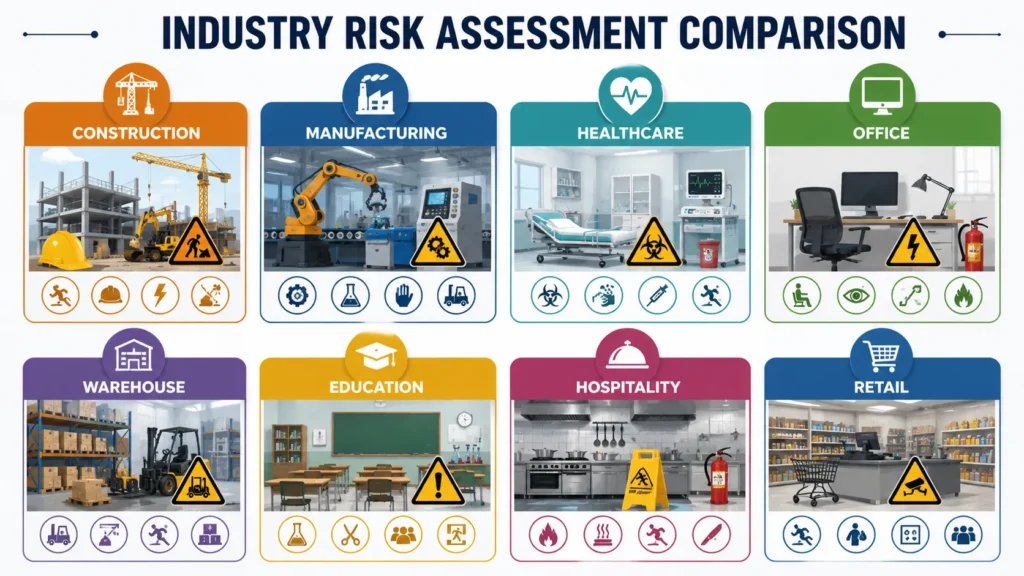
Industry Risk Assessment Comparison
| Industry | High-Risk Activities | Priority Controls |
|---|---|---|
| Construction | Working at height, excavation | Guardrails, permits, PPE |
| Office | Ergonomics, electrical safety | DSE assessments, housekeeping |
| Manufacturing | Machinery, chemicals | Machine guards, ventilation |
| Healthcare | Infection, patient handling | Infection control, lifting aids |
| Warehousing | Forklifts, storage | Traffic management, inspections |
| Education | Laboratories, workshops | Supervision, emergency procedures |
| Hospitality | Kitchens, hot surfaces | Fire safety, slip prevention |
Adapting assessments to each workplace improves both safety and operational efficiency.
Risk Assessment vs Risk Management
These terms are often used interchangeably, but they describe different parts of the overall safety process.
A risk assessment identifies hazards, evaluates risks, and recommends control measures.
Risk management is the broader process of implementing those controls, monitoring performance, reviewing effectiveness, and continuously improving workplace safety.
Comparison Table
| Risk Assessment | Risk Management |
|---|---|
| Identifies hazards | Manages identified risks |
| Evaluates likelihood and severity | Implements and monitors controls |
| Produces assessment findings | Develops long-term safety strategies |
| Conducted periodically | Continuous management process |
| Supports decision-making | Ensures ongoing compliance and improvement |
Think of a risk assessment as the starting point, while risk management is the continuous journey of keeping risks under control.
Risk Assessment vs Job Safety Analysis (JSA)
Another common point of confusion is the difference between a risk assessment and a Job Safety Analysis (JSA).
A risk assessment evaluates the hazards associated with an activity, workplace, or process.
A Job Safety Analysis breaks a specific job into individual steps and identifies hazards associated with each step before determining suitable controls.
Comparison Table
| Risk Assessment | Job Safety Analysis |
|---|---|
| Evaluates overall workplace risks | Focuses on a specific task |
| Broader scope | Task-specific approach |
| Used across departments | Used before high-risk work |
| Covers multiple hazards | Analyses each job step individually |
| Supports overall safety management | Supports safe work procedures |
Both approaches complement each other and contribute to a comprehensive health and safety programme.
Building a Positive Safety Culture
Conducting an effective risk assessment is only one part of creating a safe workplace. The greatest improvements occur when organisations develop a strong safety culture where everyone accepts responsibility for health and safety.
Characteristics of a positive safety culture include:
- Leadership commitment.
- Open communication.
- Employee involvement.
- Continuous learning.
- Regular inspections.
- Hazard reporting.
- Ongoing training.
- Recognition of good safety practices.
- Continuous improvement.
When employees feel empowered to report hazards without fear of blame, organisations identify risks earlier and reduce the likelihood of serious incidents.
Risk Assessment Best Practices
The following best practices help organisations conduct more effective risk assessments and maintain high safety standards.
- Start every assessment with a workplace inspection.
- Consult employees performing the work.
- Consider both routine and non-routine activities.
- Prioritise risks based on evidence.
- Apply the Hierarchy of Controls before relying on PPE.
- Record findings clearly and accurately.
- Assign responsibilities for corrective actions.
- Monitor progress regularly.
- Review assessments after changes or incidents.
- Promote continuous improvement through regular training and audits.
These practices improve consistency, strengthen compliance, and create safer workplaces.
Continue Your Health and Safety Journey with Inspire College
Learning how to conduct an effective risk assessment is an essential skill for anyone responsible for workplace health and safety. However, professional training provides a deeper understanding of hazard identification, legal responsibilities, safety management systems, and practical risk control techniques.
Whether you are starting a career in health and safety or looking to enhance your professional qualifications, Inspire College offers a range of programmes designed to develop practical knowledge and industry-relevant skills.
Conclusion
Conducting an effective risk assessment is one of the most important steps an organisation can take to protect people, property, and business operations. By following a structured process—identifying hazards, determining who may be harmed, evaluating risks, implementing suitable control measures, and regularly reviewing findings—businesses can significantly reduce workplace incidents and create safer working environments.
Risk assessments should never be viewed as a one-time compliance exercise. They are dynamic documents that must evolve alongside changes in workplaces, equipment, processes, and legislation. Regular reviews, employee involvement, and continuous monitoring ensure that identified risks remain under control and that new hazards are addressed promptly.
Whether you work in construction, healthcare, manufacturing, education, hospitality, logistics, or an office environment, applying the principles outlined in this guide will help strengthen your organisation’s safety culture, support legal compliance, and improve operational performance.
Investing in professional health and safety training further enhances your ability to conduct high-quality risk assessments and implement effective risk management strategies. With the right knowledge, practical skills, and commitment to continuous improvement, every workplace can become a safer place for employees, visitors, and the wider community.
Key Takeaways
| Step | Action |
|---|---|
| Step 1 | Identify workplace hazards. |
| Step 2 | Determine who may be harmed and how. |
| Step 3 | Evaluate risks using likelihood and severity. |
| Step 4 | Implement the most effective control measures using the Hierarchy of Controls. |
| Step 5 | Record findings, communicate actions, and review assessments regularly. |
Following these five steps consistently provides a practical framework for reducing risks, improving compliance, and building a proactive safety culture that benefits both organisations and their workforce.
Explore More Fire Safety & Risk Assessment Articles
Discover expert guides on fire safety careers, fire risk assessments, workplace compliance, fire protection systems, and professional qualifications to expand your knowledge and advance your career in fire safety.
- Fire Risk Assessment
- Senior Fire Safety Advisor vs Fire Risk Assessor: Which Career Is Right for You?
- Senior Fire Safety Advisor: Top Industries Hiring Across the UK
- Fire Risk Assessment Explained: A Complete Beginner’s Guide
- Qualified Fire Risk Assessor Career Guide: Training, Skills, and Job Opportunities
- Senior Fire Safety Advisor: Top Industries Hiring Across the UK
- How Fire Safety and Risk Assessment Reduce Workplace Hazards
- Fire Safety Planning and Risk Assessment for Businesses
- Essential Fire Safety Tips Everyone Should Know to Stay Safe
- Fire Risk Assessment vs Fire Safety Audit: What’s the Difference?
- Fire Safety Checklist for Homes, Offices & Commercial Buildings
- How Often Should a Fire Risk Assessment Be Reviewed?
- Top Workplace Fire Hazards Every Inspection Reveals
- Essential Fire Safety Duties for Landlords and Property Managers