
How Often Should a Fire Risk Assessment Be Reviewed?
Fire safety is not something that can be addressed once and then forgotten. Buildings change, workplaces evolve, staff come and go, equipment is upgraded, and business operations expand over time. Every one of these changes can introduce new fire hazards or alter existing risks. That is why carrying out a fire risk assessment is only the beginning of the fire safety management process. Reviewing and updating that assessment regularly is equally important.
Many business owners, landlords, facilities managers, and responsible persons ask the same question: How often should a fire risk assessment be reviewed? The answer is not as straightforward as choosing a fixed number of months or years. UK fire safety legislation does not specify an exact review interval for every premises. Instead, it requires fire risk assessments to remain current and reflect the actual fire risks within the building.
As a best practice, most organisations review their fire risk assessment at least once every 12 months. However, some workplaces require much more frequent reviews, especially those with higher fire risks or significant operational changes. In many situations, a review should be carried out immediately rather than waiting for the annual review date.
This guide explains everything you need to know about fire risk assessment review frequency, including legal requirements, review triggers, industry-specific recommendations, common mistakes to avoid, and practical steps to maintain ongoing compliance. Whether you manage an office, warehouse, retail store, educational institution, healthcare facility, hotel, construction site, or residential building, this article will help you understand when and why your fire risk assessment should be reviewed.
If you are planning to build a career in fire safety or take responsibility for workplace fire compliance, understanding the review process is one of the most valuable skills you can develop.
Quick Answer: How Often Should a Fire Risk Assessment Be Reviewed?
For most workplaces in the UK, a fire risk assessment should be reviewed at least once every 12 months. However, an annual review is only the minimum recommendation for many premises.
A fire risk assessment should also be reviewed immediately whenever significant changes occur that could affect fire safety. These include alterations to the building, changes in occupancy, new work processes, the introduction of hazardous materials, fire incidents, or major changes to evacuation procedures.
The review process ensures that existing control measures remain effective and that any new hazards are identified before they become serious risks.
Featured Snippet Answer
A fire risk assessment should normally be reviewed every year and immediately after any significant change that could affect fire safety. Changes such as building alterations, increased occupancy, new equipment, changes in work activities, or a fire incident may require an immediate review to ensure the assessment remains accurate and legally compliant.
Why Reviewing a Fire Risk Assessment Is So Important
Many organisations mistakenly believe that once a fire risk assessment has been completed, it remains valid indefinitely. This is one of the most common causes of non-compliance with UK fire safety legislation.
A fire risk assessment reflects the conditions present on the day it was carried out. As your workplace evolves, those conditions inevitably change.
For example, a warehouse that stores cardboard packaging today may begin storing flammable chemicals next year. An office may double its workforce, affecting evacuation times. A school may renovate classrooms, altering escape routes. A hotel may install new kitchen equipment that introduces additional fire hazards.
Without regular reviews, the original assessment may no longer identify the actual risks present within the building.
Reviewing a fire risk assessment helps organisations:
- Maintain legal compliance with UK fire safety legislation
- Identify new fire hazards before they cause incidents
- Ensure fire protection measures remain effective
- Protect employees, visitors, residents, and contractors
- Improve emergency preparedness
- Reduce business interruption following fire incidents
- Support insurance compliance
- Demonstrate proactive fire safety management during inspections
Rather than treating fire risk assessments as paperwork, organisations should view them as living documents that evolve alongside the workplace.
What Does UK Law Say About Reviewing Fire Risk Assessments?
In England and Wales, fire safety responsibilities are governed by the Regulatory Reform (Fire Safety) Order 2005. Under this legislation, the Responsible Person has a legal duty to carry out a suitable and sufficient fire risk assessment and keep it up to date.
The law does not specify that reviews must take place every six months or every year. Instead, it requires the assessment to remain current and reflect any significant changes that could affect fire safety.
This means organisations are expected to monitor their premises continuously rather than relying solely on a fixed review schedule.
Examples of circumstances that require a review include:
- Changes to the building structure
- Changes in workplace activities
- Introduction of new equipment
- Increase in occupancy
- Fire incidents or near misses
- Changes affecting vulnerable occupants
- Changes to escape routes
- Installation of new fire protection systems
This flexible approach allows organisations to review their assessments whenever risks change instead of following a rigid timetable.
Who Is Responsible for Reviewing a Fire Risk Assessment?
The responsibility for reviewing a fire risk assessment rests with the Responsible Person. Depending on the premises, this may include:
- Business owner
- Employer
- Building owner
- Managing agent
- Facilities manager
- Landlord
- Occupier
- Organisation director
Although the Responsible Person may appoint a competent fire risk assessor to conduct or review the assessment, legal responsibility cannot be delegated. They remain accountable for ensuring the assessment is reviewed whenever necessary and that recommended actions are completed.
In larger organisations, several individuals may contribute to the review process, including:
| Role | Responsibility During Review |
|---|---|
| Responsible Person | Ensures legal compliance and approves review actions |
| Fire Risk Assessor | Reviews hazards and recommends improvements |
| Facilities Manager | Confirms building changes and maintenance records |
| Health and Safety Manager | Coordinates risk management activities |
| Maintenance Team | Verifies fire protection systems and equipment |
| Department Managers | Report operational changes affecting fire safety |
Collaboration between these roles creates a more accurate and effective review process.
Does a Fire Risk Assessment Expire?
One of the most common misconceptions is that a fire risk assessment has an expiry date similar to a certificate or licence.
In reality, a fire risk assessment does not automatically expire.
Instead, it remains valid only while it accurately reflects the fire risks present within the premises.
If the workplace has remained unchanged since the assessment was completed, and all fire safety measures remain effective, the assessment may still be suitable following a formal review.
However, if significant changes have occurred, the assessment may no longer provide an accurate picture of the building’s fire risks.
This is why periodic reviews are essential, even if no obvious problems have been identified.
Think of a fire risk assessment as a living document rather than a one-time report.
Annual Review vs Immediate Review
Many organisations schedule an annual review because it provides a structured opportunity to evaluate fire safety arrangements.
However, waiting until the annual review can create unnecessary risks if major changes occur during the year.
The following comparison explains the difference.
| Annual Review | Immediate Review |
|---|---|
| Conducted as part of routine fire safety management | Triggered by significant changes |
| Confirms existing assessment remains suitable | Updates assessment to reflect new risks |
| Usually completed every 12 months | Completed whenever circumstances change |
| Reviews maintenance records and inspections | Reviews new hazards introduced by changes |
| Supports ongoing legal compliance | Prevents new risks from being overlooked |
Both types of review play an essential role in maintaining workplace fire safety.
What Events Trigger an Immediate Fire Risk Assessment Review?
Some changes are significant enough that waiting until the annual review would place people and property at unnecessary risk.
The following events should trigger an immediate review of the fire risk assessment.
Building Alterations
Renovations, extensions, refurbishments, or structural modifications may affect:
- Escape routes
- Fire compartmentation
- Fire doors
- Emergency exits
- Smoke movement
- Occupancy levels
Even relatively small layout changes can alter evacuation procedures and fire behaviour.
Changes in Building Occupancy
An increase or decrease in the number of people using the building can significantly affect evacuation planning.
Examples include:
- Recruitment of additional employees
- Increased customer numbers
- New tenants
- Student enrolment growth
- Additional residents
- Event hosting
Higher occupancy often requires reassessment of escape routes, assembly points, and emergency procedures.
Introduction of New Equipment
New machinery or electrical equipment may introduce additional ignition sources.
Examples include:
- Industrial machinery
- Commercial kitchen appliances
- Battery charging stations
- Manufacturing equipment
- Server rooms
- High-powered electrical installations
These changes may require updated control measures and revised maintenance schedules.
Changes in Work Activities
Different work activities often create new fire hazards.
Examples include:
- Hot work operations
- Welding
- Chemical processing
- Storage of flammable liquids
- Manufacturing processes
- Laboratory work
Operational changes should always prompt a review of existing fire precautions.
Fire Incident or Near Miss
Any fire, however small, provides valuable information about weaknesses in existing fire safety measures.
Similarly, a near miss may reveal hazards that were previously overlooked.
Following any incident, organisations should review:
- Cause of ignition
- Fire spread
- Staff response
- Evacuation effectiveness
- Alarm performance
- Firefighting equipment
- Emergency procedures
Lessons learned from incidents are among the most valuable sources of continuous improvement.
Changes Affecting Vulnerable Persons
Fire evacuation becomes more complex when occupants have additional support needs.
Examples include:
- Disabled employees
- Elderly residents
- Young children
- Hospital patients
- Temporary visitors unfamiliar with the building
Changes in occupant characteristics should always be reflected within the fire risk assessment.
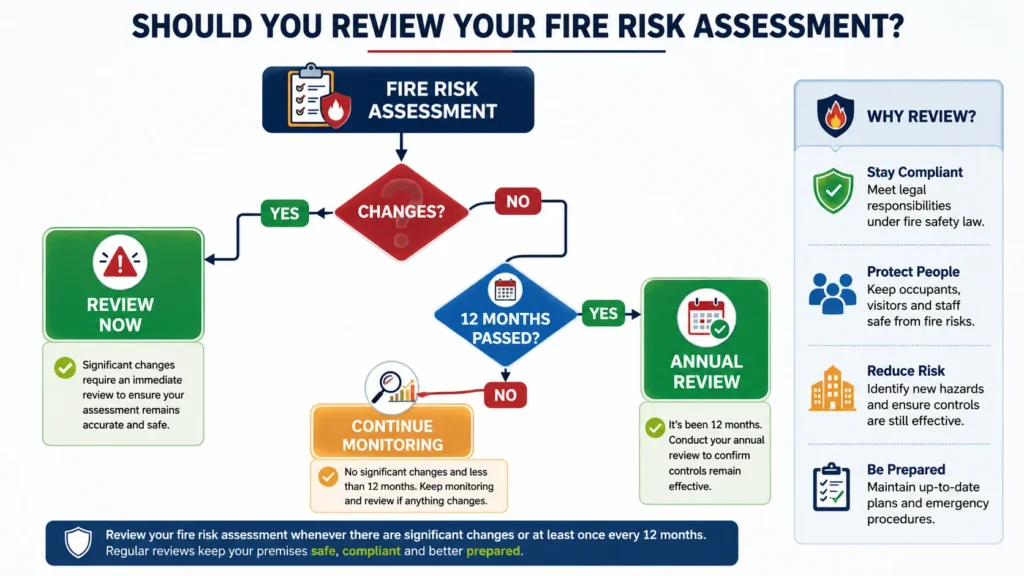
Fire Risk Assessment Review Decision Flow
The following decision process can help determine whether your fire risk assessment should be reviewed.
Fire Risk Assessment Completed

            │
            ▼

Has anything changed since the last review?

        ┌───────────────┐
        │               │
       YES             NO
        │               │
        ▼               ▼

Review Immediately   Has 12 months passed?

                        │
                 ┌──────┴──────┐
                 │             │
                YES           NO
                 │             │
                 ▼             ▼

Conduct Annual     Continue Routine
Review             Monitoring &
                   Regular Fire Checks
This simple decision-making process helps organisations maintain compliance while ensuring that fire safety arrangements remain effective throughout the year.
How Often Should Different Types of Buildings Review Their Fire Risk Assessment?
Although UK legislation does not prescribe a fixed review interval for every premises, different environments present different levels of fire risk. A low-risk office generally requires less frequent review than a care home or manufacturing facility where hazards change more regularly.
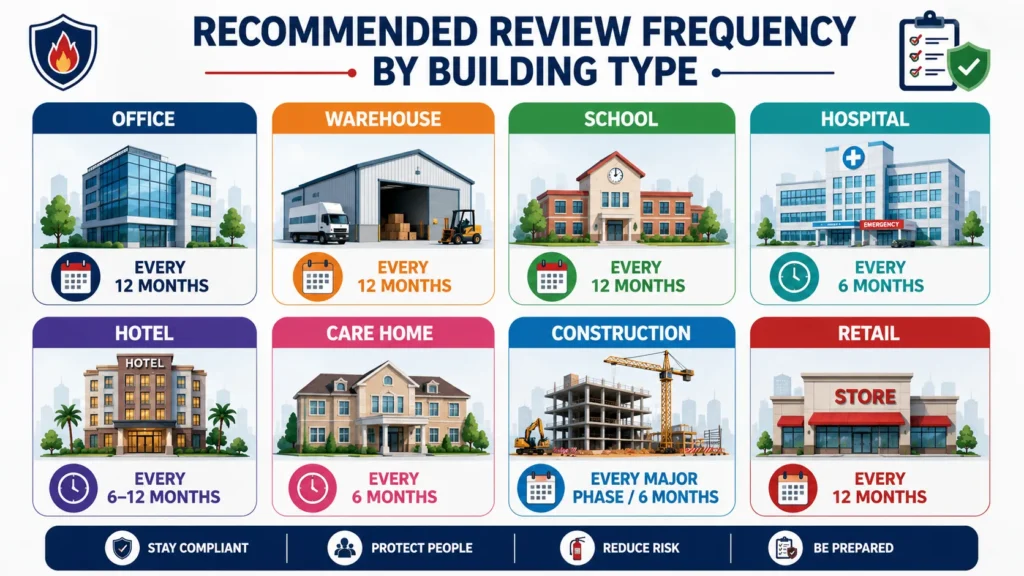
The table below provides best-practice guidance for reviewing fire risk assessments across various sectors.
The higher the level of fire risk and the more frequently a building changes, the more often the fire risk assessment should be reviewed.
Factors That Influence Review Frequency
Rather than relying solely on the calendar, organisations should consider the overall fire risk profile of their premises.
Some of the most important factors include:
Nature of Business Activities
Businesses involving manufacturing, welding, hot works, cooking, chemical storage, or fuel handling typically require more frequent reviews than low-risk office environments.
Occupancy Levels
The greater the number of people within a building, the more complex evacuation becomes. Increased occupancy may require changes to escape routes, assembly points, or emergency procedures.
Vulnerable Occupants
Buildings occupied by children, elderly people, hospital patients, or individuals with disabilities often require more frequent reviews because evacuation arrangements are more complex.
Building Age and Design
Older buildings may present additional challenges such as:
- Complex layouts
- Limited compartmentation
- Narrow escape routes
- Older electrical installations
These factors may justify more frequent reviews.
Previous Fire Incidents
If a building has experienced fires or repeated near misses, regular reviews help ensure corrective actions remain effective.
Changes in Legislation or Guidance
Fire safety legislation, British Standards, and industry guidance continue to evolve. Organisations should review assessments whenever significant legal or technical changes affect their premises.
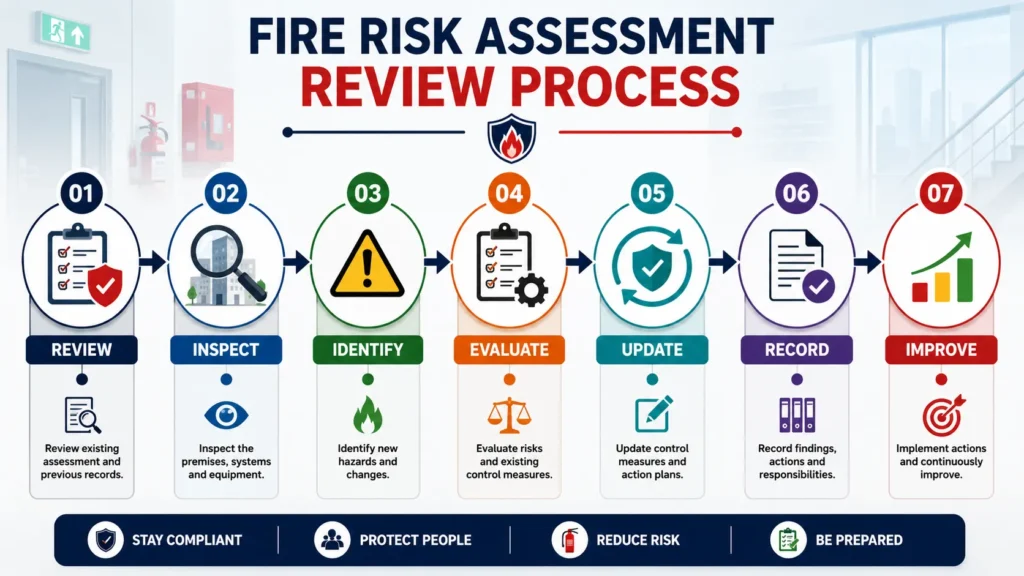
Fire Risk Assessment Review Process
Reviewing a fire risk assessment is more than simply checking whether last year’s report still exists. It is a structured evaluation of whether existing fire safety measures continue to protect people effectively.
The following process reflects good practice.
Start

↓

Review Previous Assessment

↓

Inspect Building

↓

Identify New Hazards

↓

Evaluate Existing Controls

↓

Review Occupancy & Activities

↓

Check Fire Protection Systems

↓

Update Emergency Procedures

↓

Record Findings

↓

Assign Corrective Actions

↓

Complete Review

↓

Monitor Continuously
Following a structured review process helps ensure that no important aspect of fire safety is overlooked.
Fire Risk Assessment Review Checklist
An annual review should consider every aspect of the building’s fire safety arrangements.
| Review Area | Questions to Consider |
|---|---|
| Fire Hazards | Have any new ignition or fuel sources been introduced? |
| Escape Routes | Are escape routes still suitable and unobstructed? |
| Fire Doors | Are fire doors in good condition and functioning correctly? |
| Fire Alarm System | Has testing and maintenance been completed? |
| Emergency Lighting | Is emergency lighting operating correctly? |
| Fire Extinguishers | Have extinguishers been serviced and positioned correctly? |
| Signage | Are emergency signs visible and accurate? |
| Occupancy | Has the number or type of occupants changed? |
| Vulnerable Persons | Do Personal Emergency Evacuation Plans (PEEPs) require updating? |
| Staff Training | Have all employees received appropriate fire safety training? |
| Evacuation Procedures | Are evacuation plans still suitable? |
| Maintenance Records | Are inspection and servicing records complete? |
| Previous Actions | Have recommendations from the previous assessment been completed? |
Using a consistent checklist makes reviews more systematic and easier to document.
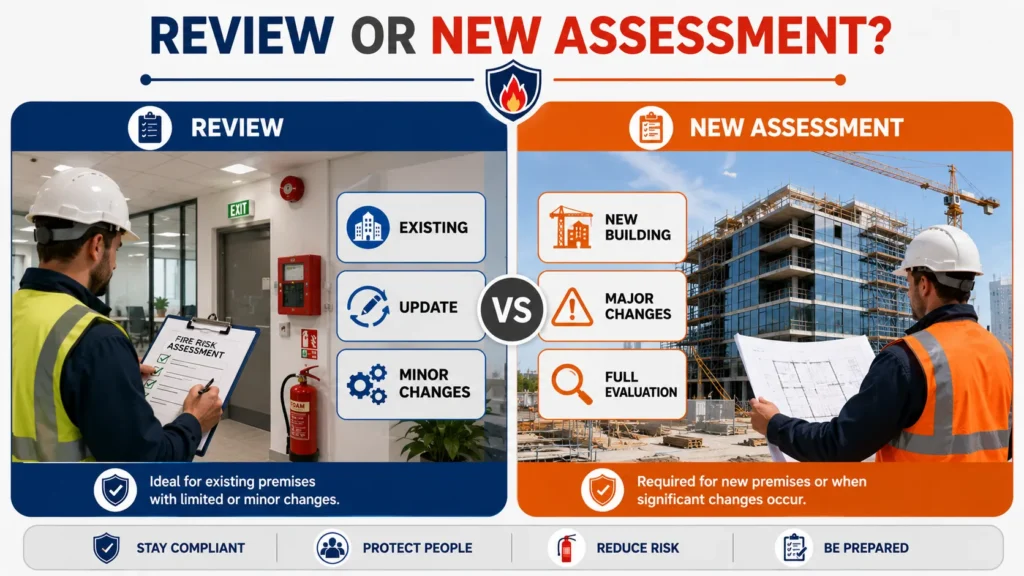
Review vs New Fire Risk Assessment
Many organisations are unsure whether they need a simple review or a completely new fire risk assessment.
The following comparison helps clarify the difference.
| Fire Risk Assessment Review | New Fire Risk Assessment |
|---|---|
| Updates an existing assessment | Creates a completely new assessment |
| Suitable when only limited changes have occurred | Required when major changes significantly alter fire risks |
| Faster and less disruptive | More detailed and comprehensive |
| Focuses on new hazards and existing controls | Reassesses the entire premises from the beginning |
| Maintains continuity with previous documentation | Produces a new baseline assessment |
Examples where a completely new assessment may be appropriate include:
- Construction of a new building
- Major refurbishment projects
- Significant change of building use
- Large-scale structural alterations
- Conversion of residential premises into commercial use
- Introduction of high-risk industrial processes
Common Mistakes When Reviewing Fire Risk Assessments
Many organisations carry out reviews simply to satisfy documentation requirements. Unfortunately, this approach often leaves significant risks unaddressed.
Some of the most common mistakes include:
Treating the Review as a Paper Exercise
A review should include a physical inspection of the premises rather than simply updating dates on existing paperwork.
Ignoring Minor Changes
Small changes such as relocating equipment, adding storage, or moving workstations can alter escape routes and fire hazards.
Failing to Record Completed Actions
Recommendations from previous assessments should be tracked until completed. Outstanding actions can become recurring compliance issues.
Forgetting Staff Training
Fire safety depends on people as much as equipment. Changes in staff, contractors, or work activities should trigger additional fire safety training where necessary.
Not Updating Emergency Plans
Evacuation procedures should always reflect the current layout and occupancy of the building.
Assuming Annual Reviews Are Always Enough
If significant changes occur during the year, waiting for the annual review could expose occupants to unnecessary risk.
Best Practices for Keeping Fire Risk Assessments Up to Date
Organisations with strong fire safety cultures do more than conduct annual reviews. They monitor fire risks continuously.
Some best practices include:
- Carry out regular workplace inspections.
- Encourage employees to report fire hazards immediately.
- Record all significant workplace changes.
- Review fire incidents and near misses thoroughly.
- Keep maintenance records organised and accessible.
- Test fire alarms and emergency lighting according to maintenance schedules.
- Review evacuation drills and identify areas for improvement.
- Ensure contractors understand fire safety procedures before starting work.
- Update Personal Emergency Evacuation Plans whenever occupant needs change.
- Arrange periodic reviews by a competent fire risk assessor where appropriate.
Proactive fire safety management is always more effective than reacting to emergencies after they occur.
Why Fire Safety Training Supports Better Fire Risk Assessment Reviews
Even the most detailed fire risk assessment will only be effective if the people responsible for implementing it understand their duties.
Training helps Responsible Persons, managers, supervisors, and employees recognise hazards, understand legal responsibilities, and respond effectively during emergencies.
A knowledgeable workforce is more likely to:
- Identify new fire hazards early.
- Report unsafe conditions promptly.
- Follow evacuation procedures correctly.
- Maintain good housekeeping standards.
- Support ongoing compliance with fire safety legislation.
For organisations, investing in fire safety education is an investment in long-term risk reduction.
Build Your Fire Safety Knowledge with Inspire College
If you want to strengthen your understanding of fire risk assessments, legal compliance, and workplace fire prevention, professional training can help you develop the practical knowledge needed to manage fire safety confidently.
- Level 2 Award for Fire Marshals
- ProQual Level 4 Certificate in Fire Risk Assessment
- Level 5 Award in Fire Risk Assessment
- Level 4 Diploma in Fire Safety
Final Thoughts
Reviewing a fire risk assessment is not simply about meeting a legal obligation—it is about ensuring that fire safety arrangements continue to reflect the realities of your workplace. As buildings, people, equipment, and work activities change, so too do the risks that need to be managed.
While an annual review is widely recognised as good practice for many premises, organisations should never rely solely on a fixed timetable. Significant changes such as building alterations, increased occupancy, new processes, fire incidents, or changes affecting vulnerable occupants should always trigger an immediate review.
By adopting a proactive approach, maintaining accurate documentation, involving competent people, and providing ongoing fire safety training, organisations can improve compliance, reduce fire risks, and better protect everyone who uses their premises.
Regular fire risk assessment reviews are not just about avoiding enforcement action—they are a key part of creating safer workplaces, protecting property, and ensuring that people can evacuate quickly and safely if a fire ever occurs. A well-maintained fire risk assessment is a living document that supports continuous improvement and demonstrates a genuine commitment to fire safety.
Explore More Fire Safety & Risk Assessment Articles
Discover expert guides on fire safety careers, fire risk assessments, workplace compliance, fire protection systems, and professional qualifications to expand your knowledge and advance your career in fire safety.
- What is Fire Safety?
- Fire Risk Assessment
- Fire Safety: Essential Tips for Homes and Workplaces
- What Does a Senior Fire Safety Advisor Do? Roles, Responsibilities, and Career Guide
- Top Skills Every Senior Fire Safety Advisor Should Develop
- Is Fire Safety a Good Career Choice in the UK?
- Senior Fire Safety Advisor Career Progression: Exciting Roles, Salary & Leadership Path
- Is Fire Safety a Good Career Choice in the UK?
- Top Skills Every Senior Fire Safety Advisor Should Develop
- Senior Fire Safety Advisor vs Fire Risk Assessor: Which Career Is Right for You?
- Senior Fire Safety Advisor: Top Industries Hiring Across the UK
- Fire Risk Assessment Explained: A Complete Beginner’s Guide
- Qualified Fire Risk Assessor Career Guide: Training, Skills, and Job Opportunities
- Senior Fire Safety Advisor: Top Industries Hiring Across the UK
- The 5 Essential Steps of Fire Risk Assessment Explained
- Common Risk Assessment Mistakes and How to Avoid Them
- How Fire Safety and Risk Assessment Reduce Workplace Hazards
- Essential Fire Safety Tips Everyone Should Know to Stay Safe
- Fire Safety Planning and Risk Assessment for Businesses
- How to Conduct an Effective Risk Assessment Step by Step
- Fire Safety Checklist for Homes, Offices & Commercial Buildings
- Fire Safety Checklist for Homes, Offices & Commercial Buildings
- Common Risk Assessment Mistakes and How to Avoid Them
- Fire Risk Assessment vs Fire Safety Audit: What’s the Difference?
- Top Workplace Fire Hazards Every Inspection Reveals
- Essential Fire Safety Duties for Landlords and Property Managers