
The 5 Essential Steps of Fire Risk Assessment Explained
Fire safety is one of the most important responsibilities for employers, landlords, business owners, and property managers in the UK. A fire can spread rapidly, putting lives, property, and business operations at risk. The most effective way to minimise these risks is by carrying out a Fire Risk Assessment using a structured and systematic approach.
The 5 Steps of Fire Risk Assessment provide a practical framework for identifying fire hazards, protecting people, reducing risks, and maintaining legal compliance. Whether you manage a small office, a large warehouse, a school, or a residential building, understanding these five steps will help you create a safer environment while meeting your fire safety responsibilities.
This beginner-friendly guide explains each step in detail, provides practical examples, highlights common mistakes, and demonstrates how following the correct process contributes to better fire safety management.
What Are the 5 Steps of a Fire Risk Assessment?
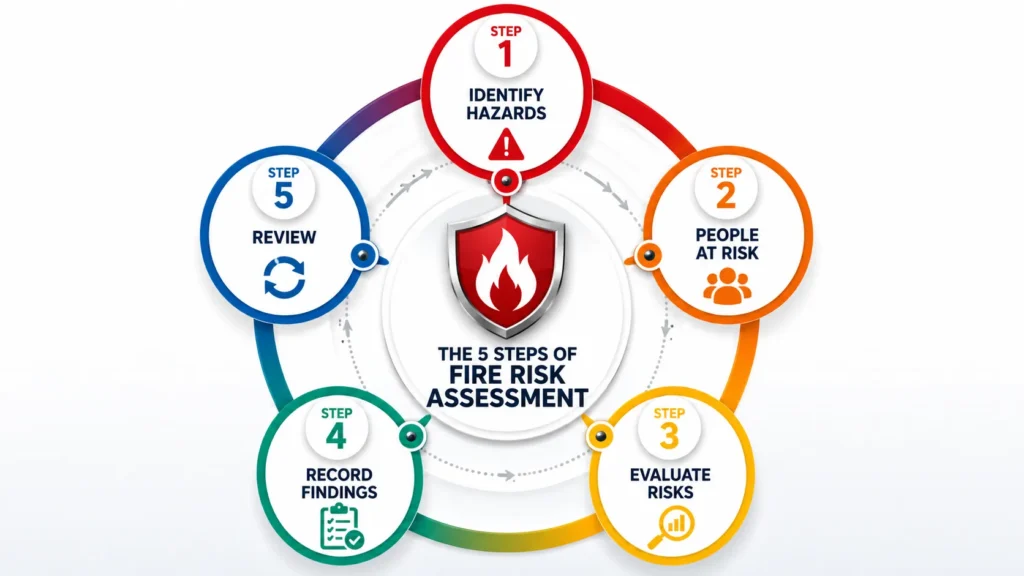
The 5 Steps of Fire Risk Assessment are: identify fire hazards, identify people at risk, evaluate and reduce fire risks, record findings and prepare an action plan, and regularly review the assessment. Following these steps helps organisations improve fire safety, reduce risks, and comply with UK fire safety legislation.
What Is a Fire Risk Assessment?
A Fire Risk Assessment is a structured inspection of a building or workplace that identifies potential fire hazards, evaluates the risks they present, and recommends practical measures to prevent fires or reduce their impact.
Rather than focusing on a single aspect of fire safety, a fire risk assessment examines the entire building, including fire hazards, fire protection systems, emergency procedures, occupancy, and escape routes.
The objective is to answer three important questions:
- What could cause a fire?
- Who could be affected?
- What actions can reduce the risk?
A properly completed fire risk assessment provides organisations with a clear plan for improving safety and protecting people.
Why Is the Five-Step Process Important?
Following a recognised five-step process ensures that fire risk assessments are consistent, comprehensive, and practical.
Instead of overlooking hazards or making assumptions, the structured approach helps assessors evaluate every important aspect of fire safety in a logical sequence.
Benefits of the Five-Step Process
- Identifies fire hazards systematically
- Protects employees, visitors, and residents
- Supports legal compliance
- Improves emergency preparedness
- Reduces property damage
- Protects business operations
- Creates safer workplaces
- Encourages continuous improvement
This structured methodology is widely recognised because it helps organisations manage fire risks effectively while maintaining compliance with UK legislation.
Overview of the Five Steps
Before exploring each stage in detail, it helps to understand how the complete process works.
| Step | Objective |
|---|---|
| Step 1 | Identify Fire Hazards |
| Step 2 | Identify People at Risk |
| Step 3 | Evaluate, Remove, Reduce and Protect from Risk |
| Step 4 | Record Findings and Prepare an Action Plan |
| Step 5 | Review and Update the Assessment Regularly |
Each step builds upon the previous one, creating a complete fire safety management process rather than a simple inspection.
Fire Risk Assessment Process
The five steps should always be followed in sequence.
Fire Risk Assessment Workflow
Identify Fire Hazards
↓
Identify People at Risk
↓
Evaluate Fire Risks
↓
Implement Control Measures
↓
Record Findings
↓
Prepare Action Plan
↓
Review Assessment
↓
Continuous Improvement
This workflow ensures that fire safety becomes an ongoing process instead of a one-time exercise.
Why Fire Risk Assessments Matter
Every year, workplace fires cause injuries, business interruptions, financial losses, and significant property damage. Many of these incidents could be prevented through effective planning and early identification of hazards.
Fire risk assessments help organisations:
- Prevent fire incidents
- Improve evacuation procedures
- Protect vulnerable occupants
- Maintain business continuity
- Reduce insurance risks
- Demonstrate legal compliance
- Improve workplace safety culture
By identifying problems before they become emergencies, organisations can reduce both the likelihood and consequences of fire.
UK Legal Requirements
Fire risk assessments are not simply good practice—they are a legal responsibility for many organisations.
The primary legislation governing fire safety in England and Wales is the Regulatory Reform (Fire Safety) Order 2005, which requires the Responsible Person to carry out a suitable and sufficient fire risk assessment.
Other important legislation includes:
- Fire Safety Act 2021
- Building Safety Act 2022
- Fire Safety (England) Regulations 2022
These laws require organisations to identify fire risks, implement suitable control measures, and regularly review fire safety arrangements.
Who Is Responsible for Completing a Fire Risk Assessment?
The legal responsibility normally falls to the Responsible Person.
Depending on the premises, this may include:
| Building Type | Responsible Person |
|---|---|
| Office | Employer |
| Retail Store | Business Owner |
| Factory | Site Manager |
| School | Headteacher or Governing Body |
| Hospital | Facilities Manager |
| Hotel | Hotel Manager |
| Apartment Building | Landlord or Managing Agent |
| Warehouse | Employer |
Although some Responsible Persons may conduct simple assessments themselves, larger or more complex buildings often require the expertise of a competent Fire Risk Assessor.
Who Benefits from the Five-Step Process?
The structured approach benefits everyone who occupies or manages a building.
Primary Beneficiaries
- Employers
- Employees
- Business owners
- Landlords
- Property managers
- Facilities managers
- Contractors
- Visitors
- Customers
- Residents
The process ensures that fire safety decisions are based on evidence rather than assumptions.
Common Buildings That Require Fire Risk Assessments
Fire risk assessments apply to a wide variety of premises.
Examples include:
- Offices
- Retail stores
- Warehouses
- Factories
- Hotels
- Restaurants
- Schools
- Universities
- Hospitals
- Care homes
- Apartment buildings
- Leisure centres
- Community buildings
- Industrial facilities
Each building presents different hazards, which is why every assessment should be tailored to the specific environment.
Principles Behind Every Fire Risk Assessment
Regardless of building size or industry, every assessment is guided by the same core principles.
Fire Risk Assessment Principles
| Principle | Purpose |
|---|---|
| Hazard Identification | Recognise possible ignition sources |
| Risk Evaluation | Assess likelihood and consequences |
| Fire Prevention | Reduce opportunities for fire to start |
| Life Safety | Protect occupants |
| Property Protection | Reduce damage to buildings and equipment |
| Emergency Planning | Ensure effective evacuation |
| Compliance | Meet legal obligations |
| Continuous Review | Maintain effective fire safety over time |
Applying these principles consistently helps organisations develop stronger fire safety management systems.
Why a Systematic Approach Produces Better Results
Fire safety cannot rely on guesswork. Missing even one significant hazard could have serious consequences during an emergency.
Using the five-step process provides several advantages:
- No important area is overlooked.
- Hazards are prioritised according to risk.
- Corrective actions are easier to manage.
- Documentation becomes more consistent.
- Future reviews become more efficient.
- Compliance is easier to demonstrate during inspections.
This structured approach has become the recognised best practice because it supports safer buildings, stronger compliance, and better decision-making.
Step 1: Identify Fire Hazards
The first step of a fire risk assessment is to identify anything that could start a fire or contribute to its spread. This stage forms the foundation of the entire assessment because any overlooked hazard could increase the likelihood of a fire incident.
Fire hazards are generally grouped into three categories:
Ignition Sources
These are anything capable of producing heat, sparks, or flames.
Common examples include:
- Faulty electrical wiring
- Overloaded extension leads
- Portable heaters
- Cooking appliances
- Smoking materials
- Welding and hot work
- Open flames
- Machinery that generates heat
Fuel Sources
Fuel allows a fire to grow once it has started.
Examples include:
- Paper and cardboard
- Wooden furniture
- Packaging materials
- Waste storage
- Textiles
- Flammable liquids
- Cleaning chemicals
- Gas cylinders
Oxygen Sources
Oxygen supports combustion and can increase the intensity of a fire.
Examples include:
- Natural ventilation
- Air conditioning systems
- Medical oxygen cylinders
- Oxidising chemicals
By identifying these hazards early, organisations can implement suitable control measures before they become serious risks.
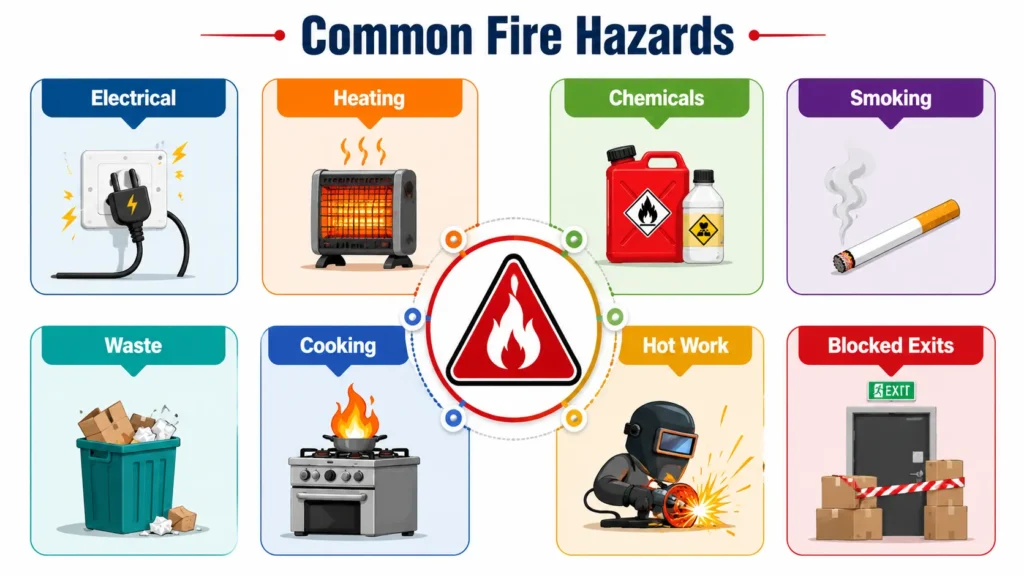
Common Fire Hazards
| Hazard Category | Examples |
|---|---|
| Electrical | Damaged cables, overloaded sockets |
| Heating | Portable heaters, boilers |
| Cooking | Ovens, deep fat fryers |
| Chemicals | Solvents, paints, cleaning products |
| Combustible Materials | Cardboard, paper, textiles |
| Smoking | Cigarettes, matches |
| Waste | Overflowing bins, packaging |
| Hot Work | Welding, grinding, cutting |
Workplace Example
Imagine a warehouse where cardboard boxes are stored beside electrical distribution panels. During an inspection, the Fire Risk Assessor identifies the combustible storage as a significant hazard. By relocating the materials and improving housekeeping, the organisation greatly reduces the risk of fire spreading.
Step 2: Identify People at Risk
After identifying hazards, the next step is to determine who could be affected if a fire occurs.
Not everyone can evacuate a building at the same speed or without assistance. This is why Fire Risk Assessors carefully evaluate building occupancy and consider the needs of different groups.
People Who May Be at Risk
- Employees
- Customers
- Visitors
- Contractors
- Residents
- Students
- Patients
- Elderly people
- Young children
- People with disabilities
- Pregnant workers
- Individuals unfamiliar with the building
Special attention should be given to vulnerable occupants who may require additional support during an emergency.
Questions to Consider
- Who works in the building?
- How many people are present?
- Are visitors regularly on site?
- Does anyone require assisted evacuation?
- Are contractors working in hazardous areas?
- Is the building occupied during evenings or weekends?
Answering these questions helps ensure emergency procedures are suitable for everyone.
People at Risk Assessment
| Occupant Group | Fire Safety Consideration |
|---|---|
| Employees | Fire awareness training |
| Visitors | Clear escape signage |
| Contractors | Site induction |
| Residents | Evacuation procedures |
| Children | Supervised evacuation |
| Elderly Occupants | Additional assistance |
| People with Disabilities | Personal Emergency Evacuation Plans (PEEPs) |
| Patients | Progressive evacuation planning |
Workplace Example
In a healthcare facility, the Fire Risk Assessor recognises that many patients cannot evacuate independently. Instead of relying solely on evacuation routes, the assessment recommends compartmentation, staff training, and phased evacuation procedures.
Step 3: Evaluate, Remove, Reduce and Protect from Risk
Once hazards and people at risk have been identified, the next stage is to evaluate the risks and determine how they can be controlled.
The objective is not simply to identify problems but to reduce the likelihood of fire and minimise its consequences.
Fire Risk Assessors examine whether existing fire safety measures are adequate or whether improvements are needed.
Existing Fire Safety Measures
Typical controls include:
- Fire alarm systems
- Fire detection systems
- Emergency lighting
- Fire extinguishers
- Fire doors
- Fire-resistant walls
- Smoke control systems
- Escape routes
- Fire safety signs
- Staff training
- Fire drills
Each control measure contributes to reducing fire risk.
Fire Protection Systems
| Fire Protection Measure | Purpose |
|---|---|
| Fire Alarm | Early warning |
| Smoke Detectors | Detect developing fires |
| Emergency Lighting | Support safe evacuation |
| Fire Doors | Prevent fire and smoke spread |
| Fire Extinguishers | Control small fires |
| Sprinkler Systems | Automatic fire suppression |
| Fire Signage | Direct occupants safely |
| Escape Routes | Safe evacuation |
Reducing Fire Risks
After evaluating the building, the assessor recommends improvements where necessary.
Examples include:
- Replacing damaged fire doors
- Removing combustible storage
- Repairing faulty electrical systems
- Improving housekeeping
- Installing additional emergency lighting
- Upgrading fire alarm coverage
- Providing fire safety training
- Improving evacuation signage
- Reviewing maintenance schedules
The aim is to reduce risk to the lowest reasonably practicable level.
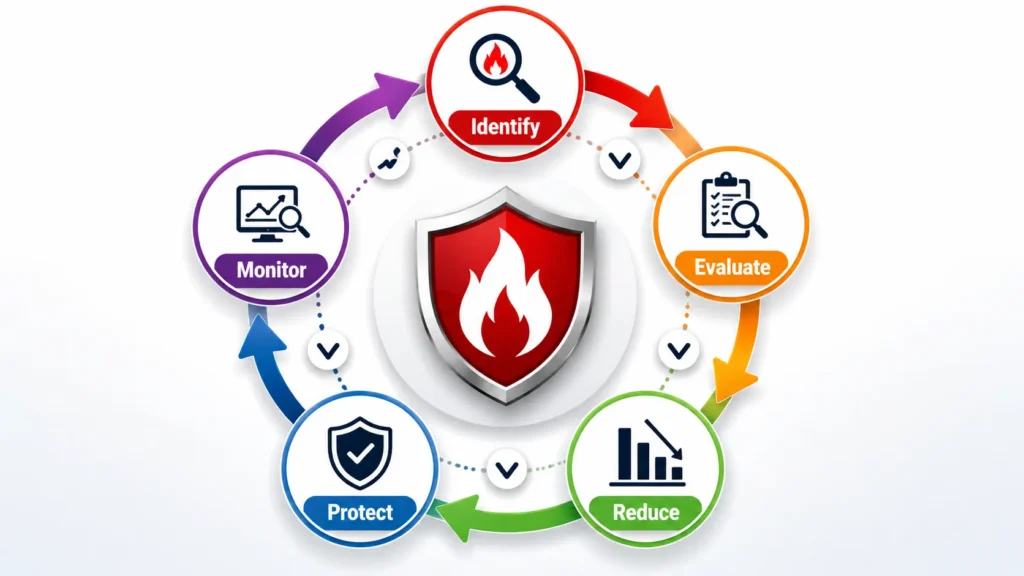
Fire Risk Reduction Process
Fire Hazard Identified
↓
Evaluate Risk
↓
Determine Existing Controls
↓
Recommend Improvements
↓
Implement Corrective Actions
↓
Monitor Performance
↓
Review Effectiveness
This continuous cycle ensures fire safety remains effective over time.
Fire Risk Matrix
During assessments, hazards are often prioritised based on their likelihood and potential consequences.
| Risk Level | Typical Action |
|---|---|
| Low | Monitor and maintain existing controls |
| Moderate | Plan improvements within a reasonable timeframe |
| High | Implement corrective actions as soon as possible |
| Very High | Immediate action required |
Prioritising risks helps organisations focus resources where they are needed most.
Practical Example
A hotel inspection identifies that emergency exit doors are partially blocked by stored furniture.
Assessment
Hazard: Obstructed escape route
People at Risk: Guests and staff
Existing Control: Fire exit signage only
Recommendation:
- Remove stored items immediately.
- Introduce regular housekeeping inspections.
- Train staff to keep exits clear.
- Include escape route checks in routine inspections.
This simple corrective action significantly improves occupant safety.
Common Mistakes During the First Three Steps
Many organisations unintentionally reduce the effectiveness of their fire risk assessments by making avoidable mistakes.
Frequent Errors
- Focusing only on obvious hazards
- Ignoring vulnerable occupants
- Overlooking temporary work activities
- Assuming existing controls are sufficient
- Not inspecting all areas of the building
- Failing to consult employees
- Ignoring maintenance records
- Forgetting storage areas and plant rooms
Avoiding these mistakes results in more accurate and effective assessments.
Tips for Better Fire Risk Assessments
Professionals who consistently deliver high-quality assessments usually follow several best practices.
Best Practice Checklist
✔ Inspect every accessible area
✔ Speak with employees and managers
✔ Check maintenance records
✔ Test emergency arrangements
✔ Review previous assessment reports
✔ Prioritise higher-risk hazards
✔ Recommend practical improvements
✔ Keep detailed records
Applying these practices improves both safety and compliance.
Step 4: Record Findings and Prepare an Action Plan
Once the assessment is complete and risks have been evaluated, the next step is to document the findings clearly and develop an action plan. Recording the assessment provides evidence of the inspection, supports legal compliance, and helps organisations prioritise improvements.
A well-prepared fire risk assessment report should be practical, easy to understand, and focused on actions that reduce risk.
What Should Be Included in the Report?
A professional fire risk assessment report typically includes:
- Building information
- Date of the assessment
- Areas inspected
- Fire hazards identified
- People at risk
- Existing fire safety measures
- Risk evaluation
- Recommended improvements
- Priority level for each action
- Review date
Clear documentation ensures that everyone responsible for fire safety understands what needs to be done and when.
Example Action Plan
| Identified Issue | Recommended Action | Priority |
|---|---|---|
| Fire exit blocked | Remove stored materials immediately | High |
| Damaged fire door | Repair or replace the door | High |
| Expired fire extinguisher | Arrange servicing or replacement | Medium |
| Missing emergency signage | Install compliant signage | Medium |
| Incomplete staff training | Schedule fire safety training | Low |
An organised action plan helps organisations implement improvements systematically rather than reacting after an incident.
Step 5: Review and Update the Assessment Regularly
A fire risk assessment is not a document that should be completed once and then forgotten. Buildings, occupancy levels, equipment, and work activities change over time, which means fire risks also change.
Regular reviews help ensure that the assessment continues to reflect the current conditions of the premises.
When Should a Fire Risk Assessment Be Reviewed?
A review should be carried out when:
- The building layout changes
- New machinery or equipment is installed
- Occupancy levels increase
- Fire protection systems are upgraded
- A fire or near miss occurs
- New work activities introduce additional hazards
- Significant refurbishment takes place
- Fire safety legislation changes
Reviewing the assessment regularly ensures that fire safety arrangements remain effective and legally compliant.
Fire Risk Assessment Review Cycle
Complete Assessment
↓
Implement Recommendations
↓
Monitor Fire Safety Measures
↓
Review Building Changes
↓
Update Assessment
↓
Improve Fire Safety
↓
Repeat the Process
Fire safety is a continuous improvement cycle rather than a one-time exercise.
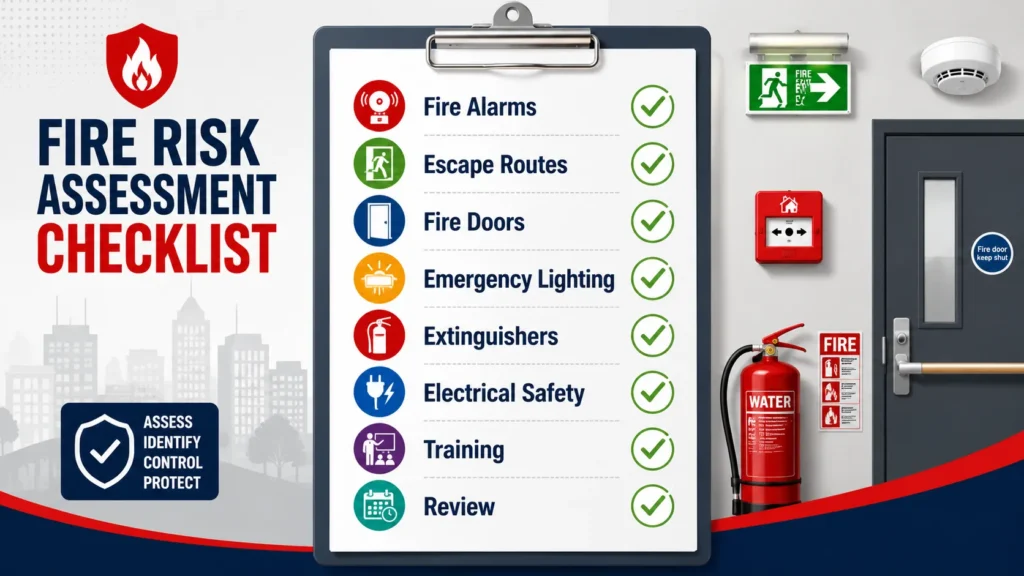
Fire Risk Assessment Checklist
The following checklist can help organisations verify that key fire safety measures are in place.
Essential Checklist
| Fire Safety Item | Status Check |
|---|---|
| Fire alarm system | ✓ |
| Smoke detectors | ✓ |
| Emergency lighting | ✓ |
| Fire extinguishers | ✓ |
| Fire doors | ✓ |
| Escape routes | ✓ |
| Fire exit signage | ✓ |
| Electrical safety | ✓ |
| Staff fire safety training | ✓ |
| Emergency evacuation procedures | ✓ |
| Fire drills completed | ✓ |
| Fire safety records maintained | ✓ |
Using a checklist alongside a professional assessment helps organisations monitor ongoing compliance.
Benefits of Following the Five Steps
Applying the five-step process consistently offers significant advantages beyond meeting legal requirements.
Key Benefits
| Benefit | Why It Matters |
|---|---|
| Improved Safety | Protects employees, residents, and visitors |
| Better Compliance | Supports UK fire safety legislation |
| Reduced Fire Risk | Identifies hazards before incidents occur |
| Stronger Emergency Preparedness | Improves evacuation planning |
| Lower Business Disruption | Reduces downtime after incidents |
| Asset Protection | Safeguards buildings and equipment |
| Improved Safety Culture | Encourages proactive risk management |
| Greater Confidence | Demonstrates commitment to workplace safety |
By following these five steps, organisations create a structured and sustainable approach to fire safety management.
Digital Fire Risk Assessments
Technology is changing how fire risk assessments are conducted. Many organisations now use digital tools that improve efficiency, reporting accuracy, and compliance management.
Common Digital Solutions
- Mobile inspection applications
- Digital fire risk assessment software
- Cloud-based reporting systems
- Compliance management platforms
- QR code maintenance records
- Building Information Modelling (BIM)
- Digital document storage
- Automated inspection reminders
These technologies help organisations maintain accurate records while reducing administrative workload.
Common Mistakes After Completing an Assessment
Completing an assessment is only the beginning. Some organisations fail to act on the findings, reducing the effectiveness of the entire process.
Common mistakes include:
- Delaying corrective actions
- Failing to monitor completed work
- Ignoring review dates
- Not updating emergency procedures
- Poor record keeping
- Forgetting to train new employees
- Assuming hazards remain unchanged
- Not reviewing contractor activities
Addressing these issues ensures the assessment continues to deliver value.
Future of Fire Risk Assessments
Fire safety management continues to evolve alongside technology and changes in UK legislation.
Several trends are shaping the future of fire risk assessments.
Emerging Developments
- Smart fire detection systems
- Cloud-based compliance management
- Digital inspection platforms
- Building Information Modelling (BIM)
- Artificial intelligence for risk analysis
- Predictive maintenance technologies
- Enhanced building safety regulations
- Increased emphasis on professional competence
Fire Risk Assessors who understand these developments will be better prepared to support organisations in increasingly complex environments.
Putting the Five Steps into Practice
The five-step process is designed to be practical and repeatable. Whether you’re responsible for a small office or a large multi-site organisation, following these steps creates a structured approach to managing fire safety risks.
By identifying hazards, protecting people, reducing risks, documenting findings, and reviewing assessments regularly, organisations can improve safety while maintaining compliance with UK fire safety legislation.
The process should be integrated into everyday health and safety management rather than treated as an occasional administrative task.
Conclusion
Understanding the 5 Steps of Fire Risk Assessment is essential for anyone responsible for workplace or building fire safety. The structured approach of identifying fire hazards, recognising people at risk, evaluating and reducing risks, recording findings, and reviewing assessments regularly helps organisations protect lives, safeguard property, and comply with UK fire safety legislation.
A thorough fire risk assessment is far more than a compliance document—it is a proactive strategy that supports safer workplaces, stronger emergency preparedness, and continuous improvement. As buildings, technologies, and regulations evolve, regular reviews and competent assessments become increasingly important for maintaining effective fire safety standards.
By applying the five-step process consistently, organisations can create safer environments while reducing the likelihood and impact of fire incidents.
Strengthen Your Fire Safety Knowledge with Inspire College
If you’re looking to improve your understanding of fire safety or build a career in the industry, Inspire College offers professional training designed to develop practical knowledge and industry-relevant skills.
Explore our courses in:
Whether you’re an employer aiming to strengthen workplace safety or an individual pursuing professional development, Inspire College provides flexible learning opportunities to help you build confidence and competence in fire safety management.
Explore More Fire Safety & Risk Assessment Articles
Discover expert guides on fire safety careers, fire risk assessments, workplace compliance, fire protection systems, and professional qualifications to expand your knowledge and advance your career in fire safety.
- What is Fire Safety?
- Fire Risk Assessment
- Fire Safety Equipment
- Fire Safety: Essential Tips for Homes and Workplaces
- Industrial Fire Safety: Complete Guide to Risk Assessment, Hazards & Prevention (2026)
- Fire Safety Training (2026): Complete Guide, Certification & Workplace Safety
- Level 4 Diploma in Fire Safety: Complete Guide to Career Growth, Skills, Compliance, and Professional Certification
- What Does a Senior Fire Safety Advisor Do? Roles, Responsibilities, and Career Guide
- Top Skills Every Senior Fire Safety Advisor Should Develop
- Is Fire Safety a Good Career Choice in the UK?
- Senior Fire Safety Advisor Career Progression: Exciting Roles, Salary & Leadership Path
- Is Fire Safety a Good Career Choice in the UK?
- Top Skills Every Senior Fire Safety Advisor Should Develop
- Senior Fire Safety Advisor vs Fire Risk Assessor: Which Career Is Right for You?
- Senior Fire Safety Advisor: Top Industries Hiring Across the UK
- Fire Risk Assessment Explained: A Complete Beginner’s Guide
- Qualified Fire Risk Assessor Career Guide: Training, Skills, and Job Opportunities
- Senior Fire Safety Advisor: Top Industries Hiring Across the UK
- How Fire Safety and Risk Assessment Reduce Workplace Hazards
- Fire Safety Planning and Risk Assessment for Businesses
- Essential Fire Safety Tips Everyone Should Know to Stay Safe
- Fire Risk Assessment vs Fire Safety Audit: What’s the Difference?
- How to Conduct an Effective Risk Assessment Step by Step
- Fire Safety Checklist for Homes, Offices & Commercial Buildings
- How Often Should a Fire Risk Assessment Be Reviewed?
- Top Workplace Fire Hazards Every Inspection Reveals
- Failed a Fire Safety Inspection? Here’s What Happens Next
- Essential Fire Safety Duties for Landlords and Property Managers