
How Fire Safety and Risk Assessment Reduce Workplace Hazards
Workplace fires remain one of the most significant safety risks across industries, causing injuries, property damage, operational downtime, financial losses, and in severe cases, fatalities. While many organisations invest in fire extinguishers, alarms, and emergency exits, these measures alone cannot eliminate fire risks. A proactive approach that combines effective fire safety practices with comprehensive fire risk assessments is essential for preventing incidents before they occur.
Every workplace contains potential fire hazards, whether from electrical equipment, flammable materials, heating systems, machinery, cooking appliances, or human error. Without identifying and controlling these hazards, even a small ignition source can quickly develop into a serious emergency. This is where fire safety and fire risk assessment work together to reduce workplace hazards by identifying risks, implementing preventive measures, and ensuring employees know how to respond during emergencies.
A fire risk assessment is much more than a legal requirement in the United Kingdom. It is a structured process that helps employers understand the specific fire risks within their premises and implement suitable control measures. When combined with ongoing fire safety management, employee training, regular inspections, and emergency planning, organisations create a safer working environment that protects both people and business assets.
This guide explains how fire safety and risk assessment reduce workplace hazards, explores common workplace fire risks, outlines best practices for prevention, and highlights why every organisation should integrate fire safety into its overall health and safety strategy.
Why Workplace Fire Safety Matters
Fire safety is a fundamental component of workplace health and safety management. Every organisation, regardless of its size or industry, has a responsibility to protect employees, visitors, contractors, and customers from fire-related hazards.
Unlike many workplace incidents that affect a single individual, a fire emergency can impact an entire building within minutes. Smoke inhalation, structural collapse, toxic gases, blocked escape routes, and panic during evacuation can all contribute to severe consequences if appropriate fire safety measures are not in place.
Beyond protecting lives, effective fire safety also safeguards business continuity. A workplace fire can lead to:
- Serious employee injuries or fatalities
- Damage to buildings and equipment
- Loss of important business records
- Operational downtime
- Legal action and regulatory penalties
- Increased insurance costs
- Damage to organisational reputation
Organisations that invest in proactive fire safety programmes experience fewer incidents, improved employee confidence, and greater compliance with UK fire safety legislation.
Fire Safety at a Glance
| Area | Why It Matters |
|---|---|
| Employee Protection | Reduces injuries and fatalities |
| Business Continuity | Minimises operational disruption |
| Legal Compliance | Helps meet UK fire safety responsibilities |
| Asset Protection | Prevents costly property damage |
| Reputation | Demonstrates commitment to workplace safety |
| Financial Stability | Reduces repair, compensation, and insurance costs |
What Is Fire Safety?
Fire safety refers to the policies, procedures, equipment, and management practices designed to prevent fires, minimise risks, and protect people and property if a fire occurs.
Rather than focusing solely on emergency response, modern fire safety emphasises prevention. It involves identifying hazards, reducing ignition sources, controlling combustible materials, maintaining fire protection systems, and ensuring everyone in the workplace understands their responsibilities.
An effective fire safety programme combines several key elements.
Fire Prevention
Preventing fires before they start is the most effective way to reduce workplace hazards. Preventive measures include:
- Safe electrical installations
- Proper storage of flammable materials
- Routine equipment maintenance
- Good housekeeping practices
- Smoking controls
- Hot work permit systems
Fire Protection
Fire protection systems help detect, contain, and suppress fires before they spread.
Examples include:
- Fire alarm systems
- Smoke detectors
- Fire extinguishers
- Sprinkler systems
- Fire doors
- Emergency lighting
- Fire-resistant construction materials
Emergency Preparedness
Even with strong preventive measures, organisations must prepare for emergencies by establishing clear evacuation procedures and training employees to respond effectively.
Emergency preparedness includes:
- Fire evacuation plans
- Assembly points
- Fire drills
- Emergency communication systems
- Designated fire wardens
- Employee awareness training
Components of an Effective Fire Safety Programme
| Prevention | Protection | Preparedness |
|---|---|---|
| Hazard Identification | Fire Alarms | Evacuation Plans |
| Equipment Maintenance | Sprinklers | Fire Drills |
| Housekeeping | Fire Doors | Employee Training |
| Safe Storage | Smoke Detection | Emergency Lighting |
| Electrical Safety | Fire Extinguishers | Incident Reporting |
What Is a Fire Risk Assessment?
A fire risk assessment is a systematic process used to identify fire hazards, evaluate risks, determine who may be harmed, and implement measures to reduce the likelihood and consequences of a fire.
Instead of assuming that every workplace has the same level of risk, a fire risk assessment examines the specific activities, equipment, building layout, occupancy, and materials present within an organisation.
The assessment helps employers answer critical questions such as:
- Where could a fire start?
- What could ignite combustible materials?
- Who would be affected?
- Are existing safety measures sufficient?
- What improvements are needed?
A well-conducted fire risk assessment is not a one-time exercise. It should be reviewed regularly, particularly after significant workplace changes such as renovations, new equipment installations, changes in occupancy, or operational processes.
Objectives of a Fire Risk Assessment
| Objective | Purpose |
|---|---|
| Identify Hazards | Locate ignition and fuel sources |
| Evaluate Risks | Determine likelihood and consequences |
| Protect People | Reduce exposure to fire hazards |
| Improve Controls | Strengthen preventive measures |
| Support Compliance | Meet legal and organisational requirements |
| Promote Continuous Improvement | Regularly review and update safety measures |
How Fire Safety and Fire Risk Assessment Work Together
Many people mistakenly believe that installing fire extinguishers or conducting annual inspections is enough to maintain workplace safety. In reality, fire safety and fire risk assessment are complementary processes that work together to reduce workplace hazards.
Fire risk assessment identifies the hazards, while fire safety provides the practical controls needed to eliminate or minimise those risks. Without a risk assessment, organisations may overlook hidden hazards. Without effective fire safety measures, identified risks remain unmanaged.
For example, a warehouse may identify overloaded electrical circuits during a fire risk assessment. Fire safety measures would then involve upgrading electrical systems, implementing inspection schedules, training employees to recognise electrical hazards, and ensuring appropriate fire suppression equipment is available.
This continuous cycle of assessment, implementation, monitoring, and improvement forms the foundation of an effective fire safety management system.
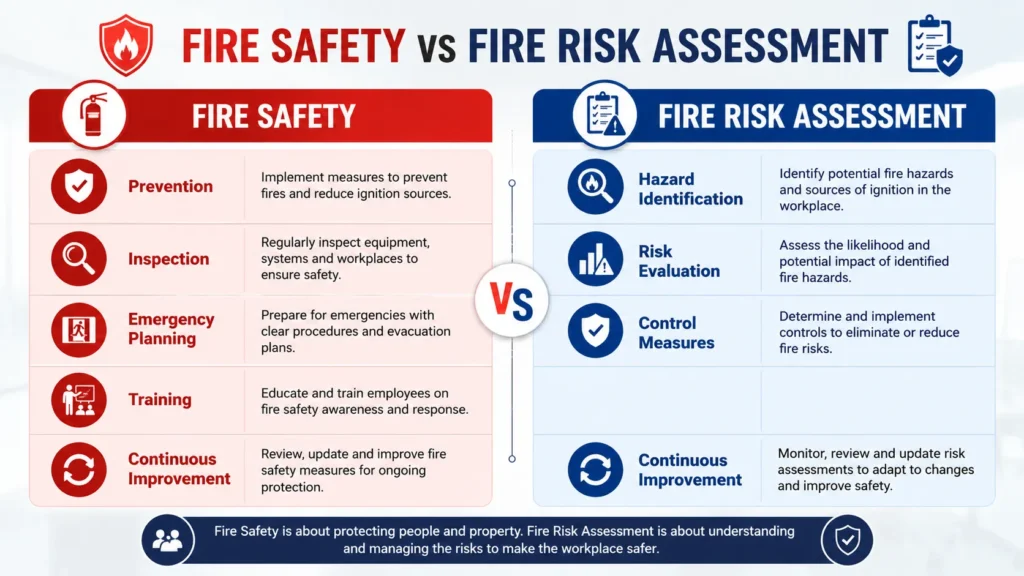
Fire Safety and Risk Assessment Relationship
| Fire Risk Assessment | Fire Safety Measures | Outcome |
|---|---|---|
| Identify ignition sources | Remove or control ignition sources | Reduced fire likelihood |
| Identify combustible materials | Improve storage practices | Lower fire spread potential |
| Evaluate escape routes | Maintain clear emergency exits | Faster evacuation |
| Assess vulnerable persons | Develop evacuation assistance plans | Improved life safety |
| Review existing controls | Upgrade alarms and extinguishers | Better emergency response |
| Monitor workplace changes | Update safety procedures | Continuous risk reduction |
How Workplace Hazards Are Reduced
Identify Workplace Activities
│
▼
Identify Fire Hazards
│
▼
Evaluate Fire Risks
│
▼
Implement Control Measures
│
▼
Train Employees
│
▼
Inspect and Monitor
│
▼
Review and Improve
│
▼
Safer Workplace with Reduced Fire Hazards
Why Prevention Is More Effective Than Response
The most successful organisations understand that preventing a fire is always more effective than responding to one. Emergency response systems are essential, but they should be considered the final layer of protection rather than the primary strategy.
A proactive approach enables organisations to identify unsafe conditions before they lead to an incident, reducing both the likelihood and severity of workplace fires. Regular inspections, ongoing employee training, preventive maintenance, and periodic fire risk assessments create multiple layers of defence that significantly lower overall workplace risk.
By embedding fire safety into everyday operations rather than treating it as an annual compliance exercise, businesses foster a stronger safety culture where hazard awareness becomes part of daily decision-making. This not only protects employees and assets but also strengthens organisational resilience, ensuring that operations can continue safely even as workplaces evolve.
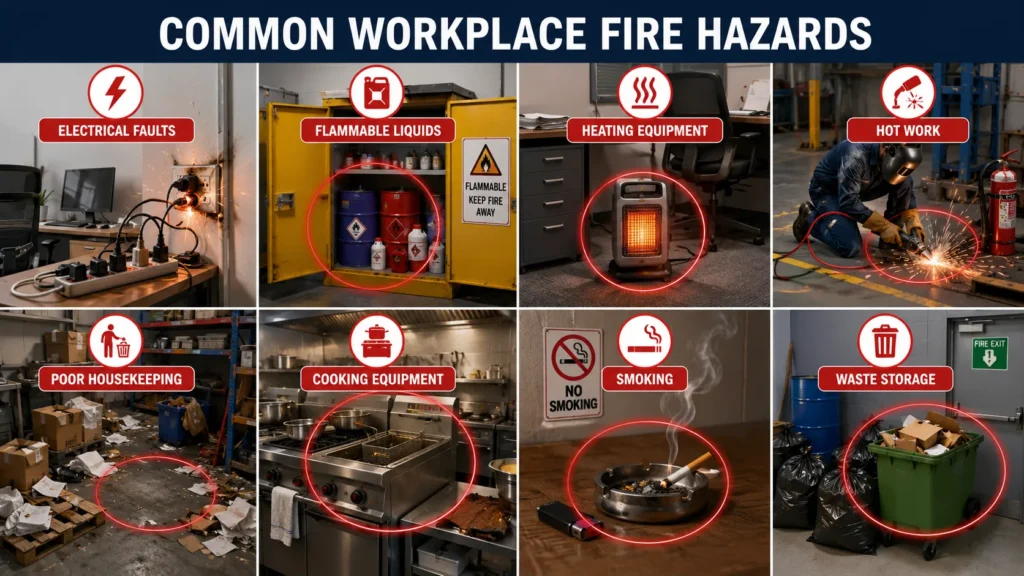
Common Workplace Fire Hazards
Every workplace contains fire hazards, regardless of its size or industry. An office, construction site, warehouse, hospital, retail store, manufacturing facility, or educational institution all present different fire risks. The key to reducing workplace hazards is identifying these risks before they lead to an incident.
Many workplace fires occur because small hazards go unnoticed or are ignored over time. A damaged electrical cable, blocked emergency exit, overloaded extension lead, or poorly stored flammable liquid may seem insignificant individually, but together they can create the conditions for a major fire.
Fire risk assessments help organisations identify these hazards systematically and implement appropriate control measures before they become emergencies.
Common Sources of Workplace Fires
| Hazard Category | Examples | Potential Consequences |
|---|---|---|
| Electrical Hazards | Damaged wiring, overloaded sockets, faulty machinery | Electrical fires and equipment damage |
| Flammable Materials | Chemicals, fuels, paper, cardboard, packaging | Rapid fire spread |
| Heating Equipment | Portable heaters, boilers, furnaces | Ignition of nearby materials |
| Human Error | Smoking, unattended equipment, unsafe practices | Accidental ignition |
| Cooking Equipment | Deep fryers, ovens, microwaves | Kitchen fires |
| Hot Work Activities | Welding, cutting, grinding | Sparks igniting combustible materials |
| Poor Housekeeping | Waste accumulation, clutter, dust | Increased fuel load |
| Arson | Deliberate fire setting | Major property damage |
Electrical Hazards
Electrical faults remain one of the leading causes of workplace fires. Damaged cables, overloaded circuits, poorly maintained equipment, and defective appliances can generate excessive heat or sparks capable of igniting nearby combustible materials.
Common electrical hazards include:
- Overloaded extension leads
- Damaged power cords
- Loose electrical connections
- Portable heaters
- Defective machinery
- Unauthorised electrical modifications
- Lack of equipment maintenance
Risk Reduction Measures
- Conduct routine electrical inspections.
- Replace damaged cables immediately.
- Avoid overloading sockets.
- Use Portable Appliance Testing (PAT) where appropriate.
- Train employees to report electrical faults promptly.
Flammable Materials
Many organisations store or use combustible materials as part of their daily operations. These materials significantly increase fire risk if not stored and handled correctly.
Examples include:
- Cleaning chemicals
- Solvents
- Paints
- Fuels
- Aerosols
- Gas cylinders
- Paper archives
- Wooden pallets
- Packaging materials
The greater the quantity of combustible material, the faster a fire can spread.
Best Practices
| Hazard | Control Measure |
|---|---|
| Chemical Storage | Store in approved fire-resistant cabinets |
| Gas Cylinders | Secure upright and away from ignition sources |
| Paper Storage | Reduce unnecessary accumulation |
| Waste Materials | Remove regularly |
| Fuel Storage | Use designated storage areas |
Human Behaviour and Unsafe Practices
Human error contributes to a significant proportion of workplace fires. Even in organisations with advanced fire protection systems, unsafe behaviours can undermine safety measures.
Examples include:
- Leaving equipment switched on
- Blocking fire exits
- Smoking in prohibited areas
- Ignoring safety procedures
- Using damaged equipment
- Failing to report hazards
- Disabling smoke detectors
Developing a positive fire safety culture is essential for reducing behavioural risks.
Poor Housekeeping
Good housekeeping is one of the simplest yet most effective fire prevention measures.
Poor housekeeping creates additional fuel for fires and may obstruct emergency evacuation routes.
Examples include:
- Excess cardboard
- Dust accumulation
- Cluttered storage rooms
- Waste bins overflowing
- Obstructed corridors
- Combustible waste near machinery
Housekeeping Checklist
| Inspection Item | Safe Practice |
|---|---|
| Waste Removal | Daily disposal |
| Escape Routes | Always clear |
| Storage Areas | Organised and labelled |
| Electrical Rooms | Free from combustible materials |
| Fire Doors | Never blocked open |
Hot Work Activities
Hot work refers to operations that produce heat, flames, or sparks.
Examples include:
- Welding
- Cutting
- Grinding
- Brazing
- Soldering
- Roofing work
These activities present a high fire risk, particularly when carried out near combustible materials.
Safe Hot Work Process
Identify Hot Work Task
│
▼
Complete Hot Work Permit
│
▼
Inspect Work Area
│
▼
Remove Combustible Materials
│
▼
Provide Fire Extinguisher
│
▼
Carry Out Work Safely
│
▼
Conduct Fire Watch
│
▼
Close Permit
The Fire Triangle Explained
Understanding how fires start helps organisations develop effective prevention strategies.
Every fire requires three essential elements:
- Heat
- Fuel
- Oxygen
These three elements form the Fire Triangle.
If any one of these components is removed, the fire cannot start or continue burning.
| Element | Workplace Examples | Control Measures |
|---|---|---|
| Heat | Electrical faults, machinery, heaters | Maintenance and inspections |
| Fuel | Paper, chemicals, wood, packaging | Safe storage and housekeeping |
| Oxygen | Air | Fire suppression and compartmentation |
How Fire Safety Breaks the Fire Triangle
Fire safety measures are designed to interrupt one or more sides of the Fire Triangle.
Examples include:
- Removing combustible waste reduces fuel.
- Electrical maintenance removes heat sources.
- Fire extinguishers cool burning materials.
- Fire doors limit oxygen and fire spread.
- Automatic suppression systems interrupt combustion.
By controlling these elements, organisations significantly reduce the likelihood of workplace fires.
How Fire Safety and Risk Assessment Reduce Workplace Hazards
Fire safety is not a single action but a continuous process of identifying hazards, assessing risks, implementing controls, monitoring effectiveness, and improving systems over time.
A fire risk assessment identifies where hazards exist, while fire safety measures eliminate or reduce those hazards before they lead to an incident.
Step 1: Identify Fire Hazards
The first stage is identifying anything capable of starting or spreading a fire.
Examples include:
- Ignition sources
- Combustible materials
- Oxygen-enriched environments
- Unsafe work practices
- Defective equipment
The earlier hazards are identified, the easier they are to control.
Step 2: Evaluate the Risk
Not every hazard presents the same level of risk.
Risk assessments consider:
- Likelihood of fire
- Severity of consequences
- Number of people exposed
- Existing control measures
- Vulnerable occupants
Risk Evaluation Matrix
| Likelihood | Consequence | Risk Level |
|---|---|---|
| Low | Minor | Low |
| Medium | Moderate | Medium |
| High | Serious | High |
| Very High | Catastrophic | Critical |
This helps organisations prioritise actions based on the level of risk.
Step 3: Implement Control Measures
Once risks have been evaluated, appropriate controls should be introduced.
Typical control measures include:
- Installing fire alarms
- Improving emergency lighting
- Removing ignition sources
- Fire-resistant storage
- Employee training
- Fire extinguishers
- Regular maintenance
- Safe work procedures
The Hierarchy of Fire Risk Controls
Effective organisations follow a hierarchy of controls rather than relying on a single safety measure.
| Control Level | Example |
|---|---|
| Elimination | Remove unnecessary flammable materials |
| Substitution | Use less flammable alternatives |
| Engineering Controls | Fire alarms, sprinklers, fire doors |
| Administrative Controls | Training, inspections, procedures |
| Emergency Controls | Evacuation plans and fire drills |
Applying multiple layers of protection creates a more resilient workplace.
Five-Step Fire Risk Assessment Process
An effective fire risk assessment follows a structured process.
Step 1: Identify Fire Hazards
Inspect the workplace to identify ignition sources, combustible materials, and oxygen sources.
Step 2: Identify People at Risk
Consider:
- Employees
- Contractors
- Visitors
- Customers
- Disabled persons
- Lone workers
- Night staff
Step 3: Evaluate and Control Risks
Determine whether existing fire safety measures are adequate or require improvement.
Step 4: Record Findings
Document:
- Hazards identified
- Risk ratings
- Existing controls
- Recommended actions
- Responsible persons
- Review dates
Step 5: Review Regularly
Review the assessment whenever:
- The workplace changes.
- New equipment is introduced.
- Building alterations occur.
- Fire incidents happen.
- Work activities change.
Fire Risk Assessment Workflow
Inspect Workplace
│
▼
Identify Hazards
│
▼
Identify People at Risk
│
▼
Evaluate Risks
│
▼
Apply Control Measures
│
▼
Record Findings
│
▼
Review Regularly
Industry-Specific Fire Hazards
Different workplaces face different fire risks, making tailored fire risk assessments essential.
| Industry | Common Fire Hazards | Recommended Controls |
|---|---|---|
| Offices | Overloaded sockets, printers, paper storage | Electrical inspections, housekeeping |
| Construction | Hot work, temporary electrics, fuel storage | Permit-to-work systems, fire watches |
| Manufacturing | Machinery, combustible dust, chemicals | Preventive maintenance, dust control |
| Warehouses | High storage racks, packaging, forklifts | Fire compartmentation, sprinkler systems |
| Healthcare | Medical gases, electrical devices, vulnerable occupants | Evacuation planning, specialised staff training |
| Retail | Stockrooms, displays, customer occupancy | Clear exits, alarm systems, staff awareness |
| Hospitality | Commercial kitchens, cooking oils, gas appliances | Wet chemical extinguishers, hood suppression systems |
| Education | Laboratories, electrical equipment, high occupancy | Fire drills, emergency signage, risk-based evacuation |
Each industry requires a risk assessment that reflects its unique operations, occupancy, and fire hazards rather than relying on a generic checklist.
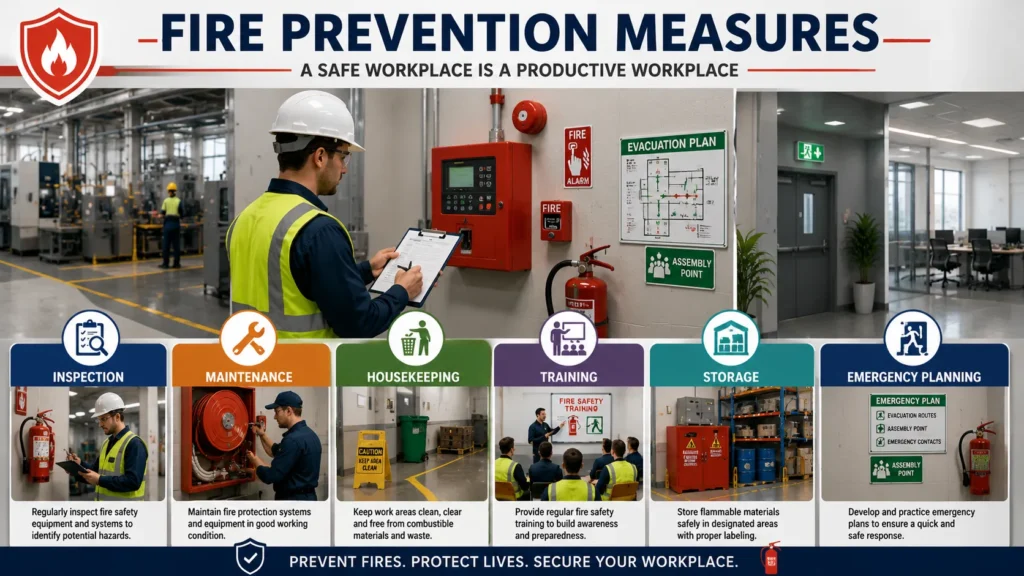
Fire Prevention Measures That Reduce Workplace Hazards
Preventing a fire is always more effective than responding to one. While fire alarms, extinguishers, and emergency evacuation procedures play a vital role during an incident, the greatest reduction in workplace hazards comes from preventing fires from occurring in the first place.
Fire prevention combines engineering controls, administrative procedures, routine inspections, employee awareness, and continuous monitoring. When these measures are implemented together, organisations create multiple layers of protection that significantly reduce both the likelihood and impact of workplace fires.
Key Fire Prevention Measures
| Prevention Measure | Purpose | Workplace Benefit |
|---|---|---|
| Fire Risk Assessments | Identify hazards before incidents occur | Proactive risk reduction |
| Routine Inspections | Detect unsafe conditions early | Prevent equipment failures |
| Preventive Maintenance | Keep systems operating safely | Reduce electrical and mechanical fires |
| Good Housekeeping | Minimise combustible materials | Slow fire growth |
| Safe Storage | Control flammable substances | Lower ignition risk |
| Fire Safety Training | Improve employee awareness | Reduce human error |
| Emergency Planning | Prepare for rapid evacuation | Protect lives during emergencies |
Fire Detection and Early Warning Systems
One of the most effective ways to reduce workplace hazards is to detect a fire in its earliest stage. Early detection provides valuable time for evacuation, emergency response, and fire suppression before flames spread throughout the building.
Modern workplaces often use a combination of fire detection technologies depending on the level of risk and building design.
Common Fire Detection Systems
- Smoke detectors
- Heat detectors
- Flame detectors
- Manual call points
- Fire alarm control panels
- Voice evacuation systems
- Automatic monitoring systems
Benefits of Early Detection
| Benefit | Impact |
|---|---|
| Faster Emergency Response | Fire services can be contacted immediately |
| Earlier Evacuation | Occupants leave before conditions become dangerous |
| Reduced Fire Spread | Quicker suppression limits damage |
| Lower Property Loss | Assets are protected |
| Improved Business Continuity | Faster recovery after an incident |
Fire Protection Systems
Fire protection systems are designed to control or suppress fires after ignition while allowing occupants to evacuate safely.
These systems are classified into passive and active fire protection.
Passive Fire Protection
Passive fire protection helps contain a fire without human intervention.
Examples include:
- Fire-resistant walls
- Fire doors
- Fire-rated ceilings
- Compartmentation
- Fire stopping around service penetrations
- Protected escape routes
Active Fire Protection
Active systems require activation either automatically or manually.
Examples include:
- Fire alarms
- Sprinkler systems
- Fire extinguishers
- Smoke extraction systems
- Emergency lighting
- Fire hose reels
Passive vs Active Fire Protection
| Passive Protection | Active Protection |
|---|---|
| Fire doors | Fire alarms |
| Fire-resistant walls | Sprinklers |
| Fire compartmentation | Smoke detectors |
| Fire stopping | Fire extinguishers |
| Protected staircases | Emergency voice systems |
The combination of passive and active fire protection significantly reduces the severity of workplace fires.
Employee Training: The Human Element of Fire Safety
Even the most advanced fire protection systems cannot compensate for a lack of employee awareness. People make decisions every day that either reduce or increase workplace fire risks.
Training empowers employees to identify hazards, follow safe work practices, respond appropriately during emergencies, and support the organisation’s overall fire safety strategy.
Essential Fire Safety Training Topics
- Understanding workplace fire hazards
- Recognising ignition sources
- Safe use of electrical equipment
- Fire prevention responsibilities
- Emergency evacuation procedures
- Fire extinguisher awareness
- Reporting unsafe conditions
- Assisting vulnerable persons
- Fire warden responsibilities
- Incident reporting procedures
Training Benefits
| Training Outcome | Workplace Impact |
|---|---|
| Increased Awareness | More hazards reported |
| Better Decision-Making | Safer daily practices |
| Improved Emergency Response | Faster evacuation |
| Higher Compliance | Stronger legal compliance |
| Positive Safety Culture | Shared responsibility for fire safety |
Building a Positive Fire Safety Culture
Fire safety is not solely the responsibility of the employer, fire wardens, or health and safety professionals. A strong fire safety culture encourages everyone within the organisation to take ownership of identifying hazards, following procedures, and reporting concerns.
Characteristics of a positive fire safety culture include:
- Leadership commitment
- Employee engagement
- Open reporting of hazards
- Regular communication
- Continuous improvement
- Routine inspections
- Learning from incidents and near misses
Safety Culture Improvement Cycle
Leadership Commitment
│
▼
Employee Engagement
│
▼
Hazard Reporting
│
▼
Risk Assessment
│
▼
Corrective Actions
│
▼
Training & Awareness
│
▼
Continuous Improvement
│
└───────────────► Repeat
Organisations with a mature safety culture are more likely to prevent fires because employees actively identify and address hazards before they escalate.
Emergency Planning and Evacuation
Despite robust prevention measures, organisations must be prepared for emergencies. A well-developed emergency plan ensures that everyone knows what to do if a fire occurs, reducing panic and improving evacuation efficiency.
Elements of an Effective Fire Emergency Plan
- Clearly defined evacuation routes
- Designated assembly points
- Emergency contact information
- Fire warden responsibilities
- Procedures for assisting vulnerable persons
- Communication protocols
- Business continuity arrangements
- Regular evacuation drills
Fire Emergency Response Process
Fire Detected
│
▼
Alarm Activated
│
▼
Emergency Services Contacted
│
▼
Occupants Evacuate
│
▼
Assembly Point
│
▼
Head Count
│
▼
Fire Service Clearance
│
▼
Controlled Re-entry
Regular fire drills help familiarise employees with evacuation procedures and identify any weaknesses in emergency planning.
The Role of Technology in Modern Fire Safety
Advances in technology have transformed workplace fire safety, enabling organisations to identify hazards earlier, respond faster, and make more informed decisions.
Modern fire safety technologies include:
- Smart fire alarm systems
- Internet of Things (IoT) sensors
- Wireless smoke detectors
- AI-powered fire detection
- Thermal imaging cameras
- Digital fire risk assessment software
- Cloud-based inspection records
- Building Information Modelling (BIM) integration
- Remote monitoring systems
Benefits of Smart Fire Safety Technologies
| Technology | Workplace Benefit |
|---|---|
| IoT Sensors | Real-time monitoring of fire risks |
| AI Detection | Faster identification of smoke and flames |
| Digital Checklists | Improved inspection consistency |
| Cloud Reporting | Easy access to compliance records |
| Thermal Cameras | Detect overheating equipment before failure |
| Smart Alarms | Immediate alerts and faster emergency response |
Technology does not replace fire risk assessments but enhances their effectiveness by providing continuous monitoring and data-driven insights.
Legal Responsibilities for Employers
In the United Kingdom, employers and those responsible for non-domestic premises have a legal duty to manage fire safety and protect people from fire risks. Compliance is not only a regulatory obligation but also an essential part of responsible workplace management.
Key employer responsibilities include:
- Conducting suitable and sufficient fire risk assessments
- Identifying fire hazards and people at risk
- Implementing appropriate fire safety measures
- Maintaining fire detection and protection systems
- Providing adequate fire safety training
- Developing emergency evacuation procedures
- Keeping escape routes clear and accessible
- Reviewing fire risk assessments regularly
- Maintaining records where required
- Cooperating with landlords and other responsible parties where applicable
Failure to meet these responsibilities can increase the likelihood of workplace incidents, disrupt business operations, and expose organisations to enforcement action.
Employer Fire Safety Responsibilities Checklist
| Responsibility | Status Check |
|---|---|
| Fire risk assessment completed | ✔ |
| Hazards identified and controlled | ✔ |
| Fire alarms tested regularly | ✔ |
| Fire extinguishers maintained | ✔ |
| Escape routes inspected | ✔ |
| Emergency lighting operational | ✔ |
| Fire doors functioning correctly | ✔ |
| Staff trained in fire safety | ✔ |
| Fire drills conducted | ✔ |
| Assessment reviewed periodically | ✔ |
Monitoring and Continuous Improvement
Fire safety is not a one-time project. As workplaces evolve, new equipment, processes, materials, and personnel can introduce additional fire hazards. Continuous monitoring ensures that existing control measures remain effective and that emerging risks are addressed promptly.
An effective continuous improvement programme includes:
- Scheduled workplace inspections
- Routine maintenance of fire protection systems
- Investigation of fire incidents and near misses
- Periodic review of fire risk assessments
- Updating emergency procedures after workplace changes
- Ongoing employee refresher training
- Management reviews of fire safety performance
Continuous Improvement Cycle
Inspect Workplace
│
▼
Identify New Hazards
│
▼
Update Fire Risk Assessment
│
▼
Implement Improvements
│
▼
Train Employees
│
▼
Monitor Performance
│
└──────────────► Repeat
A cycle of assessment, action, review, and improvement enables organisations to adapt to changing risks while maintaining a consistently high standard of workplace fire safety.
Long-Term Benefits of Effective Fire Safety and Risk Assessment
Fire safety and fire risk assessments deliver far more than regulatory compliance. When integrated into an organisation’s health and safety management system, they create safer workplaces, improve operational resilience, and support long-term business success.
Organisations that adopt a proactive approach to fire safety are better prepared to prevent incidents, minimise disruption, and protect their workforce. Rather than reacting to emergencies, they continuously identify hazards, assess risks, and implement improvements that strengthen workplace safety over time.
Business Benefits of Fire Safety and Risk Assessment
| Benefit | Impact on the Organisation |
|---|---|
| Improved Employee Safety | Fewer injuries and fatalities |
| Better Legal Compliance | Reduced risk of enforcement action |
| Reduced Property Damage | Lower repair and replacement costs |
| Business Continuity | Less operational downtime |
| Higher Productivity | Employees work with greater confidence |
| Lower Insurance Costs | Reduced claims and improved risk profile |
| Stronger Reputation | Demonstrates commitment to workplace safety |
| Better Risk Management | Early identification of workplace hazards |
| Continuous Improvement | Safer processes and procedures |
| Increased Stakeholder Confidence | Builds trust with employees, clients, and regulators |
Financial Impact of Preventing Workplace Fires
A workplace fire can have financial consequences that extend well beyond the immediate cost of repairing damaged property. Businesses may experience production delays, contractual penalties, legal expenses, lost revenue, and reputational damage that affects future opportunities.
Investing in fire prevention is often significantly more cost-effective than recovering from a fire incident.
Comparing Prevention and Recovery
| Fire Prevention Investment | Potential Cost of a Workplace Fire |
|---|---|
| Fire risk assessments | Building repairs |
| Employee training | Equipment replacement |
| Fire alarm maintenance | Business interruption |
| Routine inspections | Loss of productivity |
| Preventive maintenance | Insurance premium increases |
| Emergency planning | Compensation claims |
| Safe storage systems | Regulatory penalties |
| Fire drills | Reputational damage |
By reducing the likelihood of incidents, organisations can protect both their people and their long-term financial stability.
Common Mistakes That Increase Workplace Fire Hazards
Many workplace fires occur because routine hazards are overlooked or safety procedures are not consistently followed. Recognising these common mistakes helps organisations strengthen their fire prevention strategies.
Frequent Fire Safety Mistakes
| Mistake | Potential Consequence | Recommended Action |
|---|---|---|
| Failing to review fire risk assessments | New hazards remain unidentified | Schedule regular reviews |
| Blocking emergency exits | Delayed evacuation | Keep escape routes clear at all times |
| Overloading electrical sockets | Electrical fires | Use electrical systems within their rated capacity |
| Ignoring equipment maintenance | Equipment failure and ignition | Implement preventive maintenance programmes |
| Poor housekeeping | Increased fire load | Remove waste and combustible materials regularly |
| Improper chemical storage | Rapid fire spread | Store hazardous substances safely |
| Lack of employee training | Unsafe behaviour during emergencies | Provide initial and refresher training |
| Missing fire drills | Poor emergency response | Conduct drills at planned intervals |
| Defective fire protection equipment | Reduced emergency effectiveness | Inspect and maintain systems routinely |
| Poor hazard reporting | Small issues develop into major risks | Encourage prompt reporting and corrective action |
Avoiding these mistakes significantly improves workplace resilience and supports a proactive fire safety culture.
Fire Safety Best Practice Framework
The most effective organisations follow a structured framework that integrates prevention, preparedness, response, and continuous improvement.
Identify Workplace Hazards
│
▼
Conduct Fire Risk Assessment
│
▼
Evaluate Fire Risks
│
▼
Implement Fire Safety Controls
│
▼
Provide Employee Training
│
▼
Maintain Fire Protection Systems
│
▼
Conduct Regular Inspections
│
▼
Review and Improve
│
▼
Safer Workplace and Reduced Fire Hazards
This continuous cycle ensures that fire safety remains an active part of everyday workplace operations rather than a one-time compliance exercise.
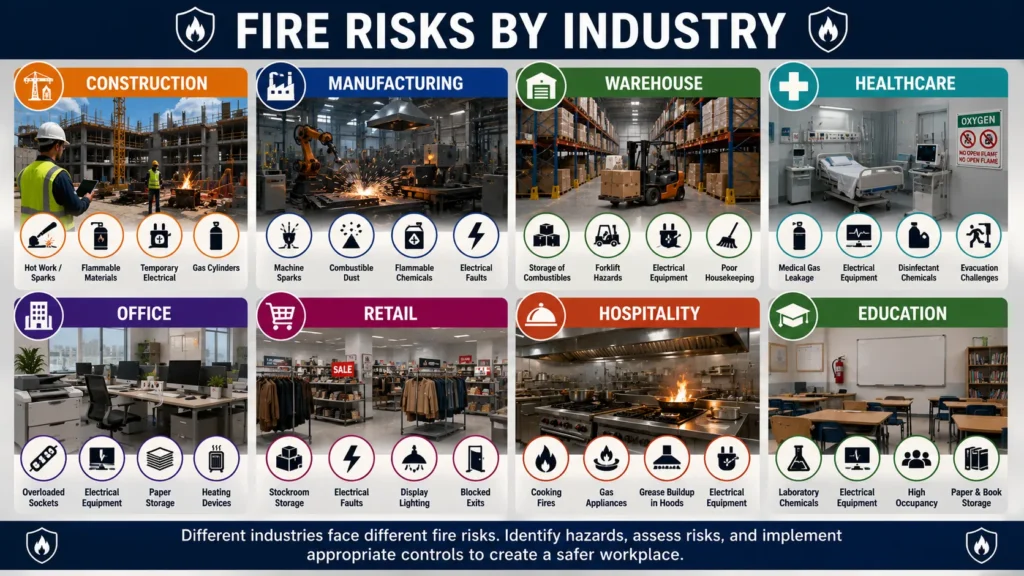
Fire Safety and Risk Assessment Across Different Industries
Although the principles of fire safety remain consistent, each industry faces unique hazards that require tailored control measures.
| Industry | Typical Fire Hazards | Primary Risk Control |
|---|---|---|
| Construction | Hot work, temporary electrics, fuel storage | Permit-to-work systems and site inspections |
| Manufacturing | Machinery, combustible dust, chemicals | Engineering controls and preventive maintenance |
| Warehousing | High storage racks, packaging materials | Sprinklers and compartmentation |
| Healthcare | Medical gases, electrical equipment | Staff training and evacuation planning |
| Hospitality | Commercial kitchens, cooking oils | Kitchen suppression systems and maintenance |
| Offices | Electrical equipment and paper storage | Electrical inspections and housekeeping |
| Education | Laboratories and high occupancy | Fire drills and emergency planning |
| Retail | Stockrooms and customer occupancy | Alarm systems and staff awareness |
A workplace-specific fire risk assessment helps ensure that control measures are appropriate for the environment, activities, and people present.
Fire Safety Is an Ongoing Commitment
Fire safety should never be viewed as a one-off project completed to satisfy legal requirements. Workplaces change constantly through new equipment, altered layouts, increased occupancy, updated processes, and evolving operational demands. Each change has the potential to introduce new fire hazards.
Regular fire risk assessments, routine inspections, employee engagement, and continuous improvement enable organisations to adapt to these changes while maintaining a safe working environment.
Embedding fire safety into everyday operations encourages employees to recognise hazards, follow safe practices, and contribute to a culture where prevention becomes everyone’s responsibility.
Recommended Fire Safety Courses from Inspire College
To develop practical knowledge and professional competence in fire safety and workplace risk management, readers can explore the following programmes offered by Inspire College. These courses are excellent opportunities for internal linking within this blog.
Fire Safety Courses
- Certified Fire Safety Training Course
- Level 4 Diploma in Fire Safety
- Level 5 Diploma in Fire Safety Management
- Fire Marshal Training
Risk Assessment Courses
- Level 2 Award in Risk Assessment
- Level 3 Certificate in Risk Assessment
- Level 4 Certificate in Risk Assessment
- Health and Safety Risk Assessment Course
Health and Safety Qualifications
- Level 3 Award in Health and Safety
- Level 4 Diploma in Occupational Health and Safety
- Level 5 Diploma in Occupational Health and Safety Practice
Key Takeaways
- Fire safety and fire risk assessments work together to reduce workplace hazards by preventing fires before they occur.
- Identifying ignition sources, combustible materials, and people at risk is the foundation of effective fire prevention.
- Regular fire risk assessments help organisations adapt to workplace changes and maintain legal compliance.
- Employee training, emergency planning, and a strong safety culture significantly reduce the likelihood of fire-related incidents.
- Fire detection systems, passive fire protection, and active fire protection provide multiple layers of defence against workplace fires.
- Continuous monitoring, routine maintenance, and regular inspections ensure that fire safety measures remain effective over time.
- Investing in fire safety protects lives, supports business continuity, reduces financial losses, and strengthens organisational resilience.
Conclusion
Fire safety and fire risk assessment are fundamental to creating a safe, compliant, and resilient workplace. While no organisation can eliminate every potential hazard, a proactive approach to identifying risks, implementing effective control measures, and fostering a culture of safety dramatically reduces the likelihood and impact of workplace fires.
Effective fire safety extends beyond installing alarms and extinguishers. It requires ongoing risk assessments, preventive maintenance, employee training, emergency preparedness, and continuous improvement. When these elements work together, organisations not only meet their legal responsibilities but also protect their employees, safeguard valuable assets, and ensure long-term business continuity.
Whether you manage an office, construction site, warehouse, healthcare facility, manufacturing plant, or educational institution, investing in fire safety today helps prevent incidents tomorrow. By making fire risk assessment a core part of your workplace safety strategy, you build an environment where people can work with confidence, hazards are managed proactively, and your organisation is better prepared for the future.
Explore More Fire Safety & Risk Assessment Articles
Discover expert guides on fire safety careers, fire risk assessments, workplace compliance, fire protection systems, and professional qualifications to expand your knowledge and advance your career in fire safety.
- What is Fire Safety?
- Fire Risk Assessment
- Fire Safety: Essential Tips for Homes and Workplaces
- What Does a Senior Fire Safety Advisor Do? Roles, Responsibilities, and Career Guide
- Top Skills Every Senior Fire Safety Advisor Should Develop
- Is Fire Safety a Good Career Choice in the UK?
- Senior Fire Safety Advisor Career Progression: Exciting Roles, Salary & Leadership Path
- Is Fire Safety a Good Career Choice in the UK?
- Top Skills Every Senior Fire Safety Advisor Should Develop
- Senior Fire Safety Advisor vs Fire Risk Assessor: Which Career Is Right for You?
- Senior Fire Safety Advisor: Top Industries Hiring Across the UK
- Fire Risk Assessment Explained: A Complete Beginner’s Guide
- Qualified Fire Risk Assessor Career Guide: Training, Skills, and Job Opportunities
- Senior Fire Safety Advisor: Top Industries Hiring Across the UK
- The 5 Essential Steps of Fire Risk Assessment Explained
- Common Risk Assessment Mistakes and How to Avoid Them
- Fire Safety Planning and Risk Assessment for Businesses
- Essential Fire Safety Tips Everyone Should Know to Stay Safe
- Fire Risk Assessment vs Fire Safety Audit: What’s the Difference?
- How to Conduct an Effective Risk Assessment Step by Step
- Fire Safety Checklist for Homes, Offices & Commercial Buildings
- How Often Should a Fire Risk Assessment Be Reviewed?
- Top Workplace Fire Hazards Every Inspection Reveals
- Essential Fire Safety Duties for Landlords and Property Managers