
Senior Fire Safety Advisor vs Fire Risk Assessor: Which Career Is Right for You?
Choosing a career in fire safety is an excellent decision for professionals who want to protect lives, improve workplace safety, and contribute to legal compliance across a wide range of industries. However, once you begin exploring the profession, one question quickly arises: Should you become a Senior Fire Safety Advisor or a Fire Risk Assessor?
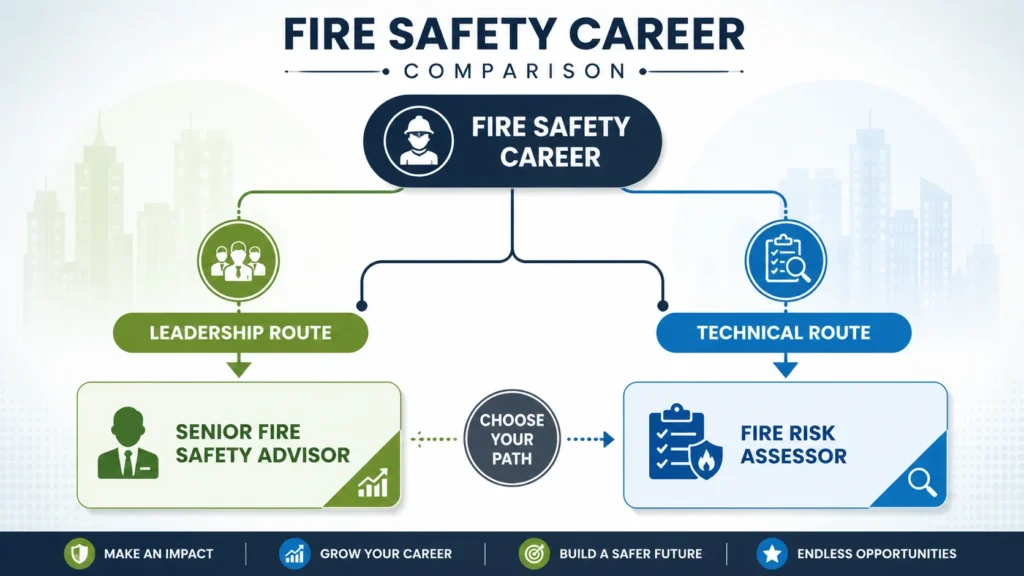
Although both careers focus on reducing fire risks and improving safety standards, they are not the same. A Fire Risk Assessor specialises in inspecting buildings, identifying fire hazards, evaluating risks, and producing detailed fire risk assessment reports. A Senior Fire Safety Advisor, on the other hand, takes a broader organisational role by developing fire safety strategies, managing compliance programmes, leading teams, advising senior management, and ensuring organisations meet their legal responsibilities.
Both careers are in high demand across the UK due to increasing awareness of fire prevention, stricter building safety regulations, and the growing need for competent fire safety professionals. They also offer excellent career prospects, competitive salaries, opportunities for continuous professional development, and pathways into consultancy and senior leadership.
The challenge for many aspiring professionals is deciding which career best aligns with their interests, strengths, and long-term ambitions. Some enjoy practical building inspections and technical assessments, while others are motivated by leadership, strategic planning, and organisational management.
This comprehensive guide compares both careers side by side, examining responsibilities, qualifications, salaries, career progression, industries, required skills, and future opportunities. By the end of this article, you will have a clear understanding of which career path best suits your professional goals.
Understanding Both Careers
Before comparing these professions, it is important to understand what each role involves.
Although both contribute to improving fire safety, they operate at different levels within an organisation and often have different responsibilities.
What Is a Senior Fire Safety Advisor?
A Senior Fire Safety Advisor is responsible for developing and overseeing an organisation’s fire safety management programme. Rather than focusing on individual building assessments alone, they provide strategic guidance that supports long-term compliance, organisational resilience, and effective fire risk management.
Their work often involves collaborating with senior leadership, facilities management teams, health and safety departments, and external stakeholders to ensure that fire safety policies and procedures are implemented consistently across multiple sites or business operations.
Typical responsibilities include:
- Developing fire safety policies
- Managing organisational fire safety programmes
- Advising senior management
- Reviewing fire risk assessments
- Leading compliance initiatives
- Coordinating emergency planning
- Managing fire safety audits
- Delivering staff training
- Monitoring legislative compliance
- Promoting a positive fire safety culture
The role combines technical knowledge with leadership, communication, and strategic planning.
What Is a Fire Risk Assessor?
A Fire Risk Assessor is a specialist responsible for inspecting buildings, identifying fire hazards, evaluating risks, and recommending practical measures to improve fire safety.
Their primary objective is to determine whether existing fire precautions are suitable and sufficient while helping organisations comply with UK fire safety requirements.
Fire Risk Assessors typically work across a wide variety of premises, including:
- Commercial offices
- Residential buildings
- Schools
- Hospitals
- Hotels
- Warehouses
- Retail premises
- Industrial facilities
- Public buildings
- Construction sites
Following each inspection, they prepare detailed reports that identify hazards, evaluate risks, and recommend corrective actions.
Typical responsibilities include:
- Conducting fire risk assessments
- Inspecting fire safety systems
- Evaluating escape routes
- Assessing fire doors and compartmentation
- Identifying ignition sources
- Reviewing emergency procedures
- Preparing technical reports
- Advising clients on corrective actions
- Prioritising fire safety improvements
- Supporting legal compliance
This role is highly technical and requires excellent attention to detail.
Why These Careers Are Often Compared
Many people assume that a Senior Fire Safety Advisor and a Fire Risk Assessor perform the same job because both work within the fire safety profession. In reality, they have different objectives, responsibilities, and career pathways.
A Fire Risk Assessor concentrates on evaluating individual buildings and identifying hazards, whereas a Senior Fire Safety Advisor oversees fire safety from a broader organisational perspective.
The comparison is common because:
- Both careers improve fire safety.
- Both require strong technical knowledge.
- Both support legal compliance.
- Both offer excellent career opportunities.
- Both can progress into consultancy.
- Both work across multiple industries.
- Both require continuous professional development.
Despite these similarities, the day-to-day responsibilities and long-term career progression are quite different.
Key Differences at a Glance
The following table highlights the main differences between the two professions.
| Feature | Senior Fire Safety Advisor | Fire Risk Assessor |
|---|---|---|
| Primary Focus | Fire safety leadership | Fire risk assessments |
| Main Objective | Organisation-wide compliance | Building-level risk evaluation |
| Leadership Responsibility | High | Low to Moderate |
| Team Management | Yes | Rarely |
| Strategic Planning | Yes | Limited |
| Building Inspections | Occasionally | Frequently |
| Technical Reporting | Yes | Yes |
| Policy Development | Yes | No |
| Emergency Planning | Yes | Limited |
| Consultancy Opportunities | Excellent | Excellent |
This comparison demonstrates that although both careers complement each other, they are designed for different professional strengths.
Roles and Responsibilities Compared
Understanding the daily responsibilities of each role is one of the easiest ways to determine which career aligns with your interests.
Senior Fire Safety Advisor Responsibilities
Senior Fire Safety Advisors typically work at a strategic level within an organisation.
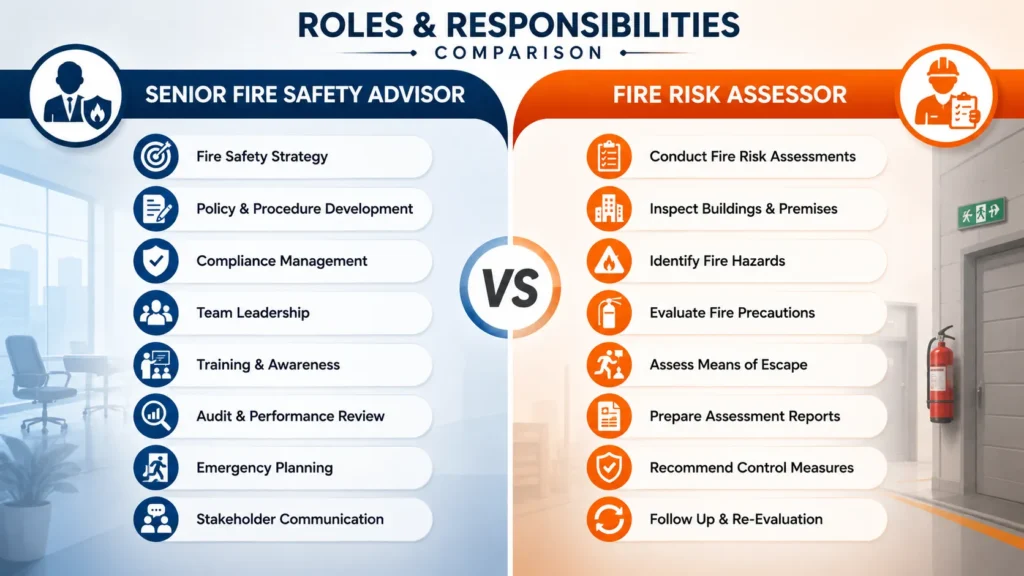
They are responsible for:
- Developing fire safety strategies
- Managing compliance programmes
- Advising directors and senior managers
- Reviewing organisational fire safety performance
- Coordinating emergency response planning
- Leading fire safety improvement projects
- Managing fire safety audits
- Monitoring changes in legislation
- Delivering professional training
- Supporting business continuity planning
Their role focuses on improving fire safety across an entire organisation rather than a single building.
Fire Risk Assessor Responsibilities
Fire Risk Assessors primarily undertake technical inspections and assessments.
Daily responsibilities often include:
- Visiting client premises
- Inspecting buildings
- Identifying fire hazards
- Assessing existing fire precautions
- Reviewing means of escape
- Evaluating fire protection systems
- Recording inspection findings
- Preparing fire risk assessment reports
- Prioritising recommendations
- Advising clients on risk reduction measures
The role is highly practical and often involves travelling between different sites.
Which Role Has Greater Responsibility?
Although both professions are highly respected, the scope of responsibility differs significantly.
| Responsibility Area | Senior Fire Safety Advisor | Fire Risk Assessor |
|---|---|---|
| Organisational Strategy | ✔ | ✘ |
| Fire Risk Assessments | ✔ (review) | ✔ (conduct) |
| Team Leadership | ✔ | ✘ |
| Policy Development | ✔ | ✘ |
| Site Inspections | Moderate | Extensive |
| Compliance Management | ✔ | Limited |
| Emergency Planning | ✔ | Support |
| Technical Reports | ✔ | ✔ |
| Staff Training | ✔ | Occasionally |
| Senior Management Advice | ✔ | Limited |
Senior Fire Safety Advisors generally have broader organisational responsibilities, while Fire Risk Assessors specialise in technical assessment and inspection activities.
Why Both Careers Are in High Demand
The demand for both professions continues to grow across the UK as organisations strengthen their approach to fire prevention, regulatory compliance, and building safety.
Several factors have increased employment opportunities, including:
- Greater focus on workplace safety
- Increased demand for competent fire safety professionals
- Expansion of commercial and residential developments
- Growing investment in compliance and risk management
- More frequent fire risk assessments
- Improved organisational governance
- Increased awareness of fire prevention
- Ongoing development of complex buildings
Whether you choose to become a Senior Fire Safety Advisor or a Fire Risk Assessor, both careers offer long-term stability, competitive salaries, and excellent opportunities for professional development.
Skills Comparison
Both careers require a strong understanding of fire safety principles, but the skills used on a daily basis differ considerably. A Fire Risk Assessor relies heavily on technical expertise, inspection techniques, and analytical thinking, while a Senior Fire Safety Advisor combines technical knowledge with leadership, communication, and strategic management.
Understanding these differences will help you identify which role best matches your strengths and career aspirations.
Technical Skills Comparison
| Senior Fire Safety Advisor | Fire Risk Assessor |
|---|---|
| Fire safety management | Fire risk assessment |
| Fire safety strategy | Building inspections |
| Compliance management | Hazard identification |
| Fire safety auditing | Risk evaluation |
| Emergency planning | Fire safety reporting |
| Business continuity | Fire protection systems |
| Policy development | Means of escape assessment |
| Organisational risk management | Fire door inspections |
| Regulatory compliance | Evidence gathering |
| Fire safety governance | Building construction awareness |
A Fire Risk Assessor spends most of their time evaluating buildings and identifying fire hazards, whereas a Senior Fire Safety Advisor focuses on improving fire safety performance across an entire organisation.
Leadership Skills vs Technical Expertise
One of the most significant differences between these professions is the balance between leadership responsibilities and technical work.
Fire Risk Assessors are primarily technical specialists who evaluate buildings and produce detailed reports. Senior Fire Safety Advisors, however, use their technical expertise to support organisational decision-making, manage fire safety programmes, and influence long-term safety strategies.
Leadership and Professional Skills Comparison
| Senior Fire Safety Advisor | Fire Risk Assessor |
|---|---|
| Team Leadership | Independent Working |
| Strategic Planning | Technical Analysis |
| Policy Development | Site Inspections |
| Project Management | Building Assessments |
| Stakeholder Engagement | Evidence Collection |
| Budget Awareness | Report Writing |
| Staff Development | Hazard Identification |
| Change Management | Practical Problem Solving |
| Decision-Making | Fire Safety Evaluation |
| Organisational Communication | Technical Recommendations |
Professionals who enjoy managing people, leading projects, and influencing organisational strategy often thrive as Senior Fire Safety Advisors. Those who enjoy technical investigations, site visits, and building inspections are generally better suited to the Fire Risk Assessor role.
Qualification Pathways Compared
Although both careers begin with a foundation in fire safety, their progression pathways gradually become more specialised.
Senior Fire Safety Advisor Pathway
Fire Safety Awareness
↓
Level 3 Fire Safety Qualification
↓
Fire Risk Assessment Knowledge
↓
ICTQual Level 4 Diploma Senior Fire Safety Advisor
↓
Fire Safety Management Qualification
↓
Senior Leadership Role
↓
Director-Level Opportunities
This pathway prepares professionals to manage organisational fire safety programmes and lead compliance initiatives.
Fire Risk Assessor Pathway
Fire Safety Fundamentals
↓
Fire Safety Qualification
↓
Fire Risk Assessment Training
↓
Practical Building Experience
↓
Competent Fire Risk Assessor
↓
Senior Fire Risk Assessor
↓
Fire Safety Consultant
This route develops technical competence in inspecting buildings, evaluating fire risks, and producing professional fire risk assessments.
Salary Comparison
Salary is one of the most common considerations when choosing a profession.
Although earnings depend on experience, qualifications, location, and industry, both careers offer attractive salaries and strong long-term earning potential.
Typical UK Salary Comparison
| Experience Level | Fire Risk Assessor | Senior Fire Safety Advisor |
|---|---|---|
| Entry Level | £30,000–£38,000 | £35,000–£42,000 |
| Experienced | £38,000–£50,000 | £45,000–£65,000 |
| Senior | £50,000–£60,000 | £60,000–£80,000 |
| Consultant / Leadership | £60,000–£90,000+ | £70,000–£100,000+ |
Senior Fire Safety Advisors often achieve higher salaries because they are responsible for organisational leadership, compliance management, and strategic decision-making.
Fire Risk Assessors can also achieve excellent earnings, particularly those who specialise in complex buildings or establish independent consultancy businesses.
Career Progression Comparison
Both professions offer excellent opportunities for advancement, but the direction of progression differs.
Senior Fire Safety Advisor Career Roadmap
Senior Fire Safety Advisor
↓
Fire Safety Manager
↓
Head of Fire Safety
↓
Regional Fire Safety Manager
↓
Director of Fire Safety
↓
Director of Health, Safety and Fire Compliance
↓
Chief Safety Officer
This pathway is ideal for professionals who want to lead teams, influence corporate strategy, and manage organisation-wide fire safety programmes.
Fire Risk Assessor Career Roadmap
Fire Risk Assessor
↓
Senior Fire Risk Assessor
↓
Lead Fire Risk Assessor
↓
Fire Safety Consultant
↓
Principal Consultant
↓
Independent Consultancy Owner
This route is particularly attractive for professionals who prefer specialist technical work and consultancy rather than organisational leadership.
Day-in-the-Life Comparison
Understanding how each role operates on a typical working day helps clarify which career better matches your preferred working style.
Senior Fire Safety Advisor
A typical day may include:
- Meeting with senior management
- Reviewing fire safety policies
- Leading compliance meetings
- Managing fire safety projects
- Coordinating emergency planning
- Reviewing fire risk assessment reports
- Delivering staff training
- Monitoring organisational performance
- Advising multiple departments
- Planning long-term fire safety improvements
Most work involves balancing office-based planning with occasional site inspections and stakeholder meetings.
Fire Risk Assessor
A typical day often includes:
- Travelling to client sites
- Inspecting commercial or residential buildings
- Evaluating fire hazards
- Reviewing escape routes
- Assessing fire protection systems
- Photographing inspection findings
- Completing fire risk assessment reports
- Discussing recommendations with clients
- Scheduling follow-up visits
- Keeping assessment records up to date
The role is more site-based and involves frequent travel to different premises.
Which Career Offers Greater Variety?
Both careers provide varied work, but the type of variety differs.
| Area | Senior Fire Safety Advisor | Fire Risk Assessor |
|---|---|---|
| Leadership Responsibilities | High | Low |
| Site Inspections | Moderate | Very High |
| Office-Based Work | High | Moderate |
| Client Interaction | High | High |
| Strategic Planning | Very High | Low |
| Technical Assessments | Moderate | Very High |
| Team Management | High | Low |
| Consultancy Opportunities | Excellent | Excellent |
If you enjoy leading teams, influencing business decisions, and managing organisation-wide compliance, the Senior Fire Safety Advisor role offers broader strategic responsibilities.
If you prefer practical inspections, technical analysis, and working across a variety of buildings, the Fire Risk Assessor career may be the better fit.
Industries Hiring Senior Fire Safety Advisors and Fire Risk Assessors
One of the greatest advantages of choosing either career is the wide range of industries that require competent fire safety professionals. Almost every organisation has a legal responsibility to manage fire risks, making both Senior Fire Safety Advisors and Fire Risk Assessors valuable across the public and private sectors.
Although many industries employ both professionals, their responsibilities often differ. Senior Fire Safety Advisors usually oversee organisational fire safety programmes, while Fire Risk Assessors focus on evaluating buildings and identifying fire hazards.
Industries Employing Both Professionals
| Industry | Senior Fire Safety Advisor | Fire Risk Assessor |
|---|---|---|
| Construction | ✔ | ✔ |
| Healthcare | ✔ | ✔ |
| Education | ✔ | ✔ |
| Manufacturing | ✔ | ✔ |
| Warehousing & Logistics | ✔ | ✔ |
| Hospitality | ✔ | ✔ |
| Residential Property | ✔ | ✔ |
| Local Government | ✔ | ✔ |
| Facilities Management | ✔ | ✔ |
| Aviation | ✔ | ✔ |
| Rail & Transport | ✔ | ✔ |
| Oil & Gas | ✔ | ✔ |
| Energy & Utilities | ✔ | ✔ |
| Retail | ✔ | ✔ |
| Data Centres | ✔ | ✔ |
This flexibility allows professionals to change industries throughout their careers while continuing to build valuable experience.
Which Career Matches Your Personality?
Choosing the right profession is not only about salary or qualifications. It is equally important to select a role that aligns with your interests, working style, and long-term ambitions.
Some professionals enjoy leading teams and developing organisational strategies, while others prefer technical inspections and independent site-based work.
Senior Fire Safety Advisor Is Ideal If You Enjoy
- Leading teams
- Developing fire safety strategies
- Working with senior management
- Managing compliance programmes
- Delivering presentations and training
- Influencing organisational decisions
- Solving complex business challenges
- Planning long-term safety improvements
- Managing multiple projects
- Building a career in leadership
This career suits professionals who enjoy responsibility, communication, and strategic thinking.
Fire Risk Assessor Is Ideal If You Enjoy
- Inspecting buildings
- Conducting site visits
- Identifying fire hazards
- Producing technical reports
- Working independently
- Solving practical problems
- Analysing building layouts
- Evaluating fire protection systems
- Travelling to different locations
- Applying technical knowledge every day
This role is well suited to individuals who prefer practical, detail-oriented work and enjoy being out on site.
Leadership vs Technical Expertise
Although both careers require excellent fire safety knowledge, their primary focus is very different.
Senior Fire Safety Advisor
The role centres on leadership, organisational governance, and strategic planning.
Professionals are expected to:
- Lead fire safety teams
- Develop organisational policies
- Improve fire safety culture
- Manage compliance programmes
- Support senior leadership
- Coordinate emergency planning
- Review organisational performance
- Influence long-term decision-making
Success is measured by the ability to improve fire safety across an entire organisation.
Fire Risk Assessor
The focus is technical excellence and professional competence.
Professionals are responsible for:
- Inspecting buildings
- Assessing fire hazards
- Evaluating fire precautions
- Producing technical reports
- Advising on corrective actions
- Supporting legal compliance
- Conducting detailed inspections
- Providing evidence-based recommendations
Success depends on accuracy, technical knowledge, and practical problem-solving.
Which Career Offers Better Work-Life Balance?
Both professions can provide excellent work-life balance, although the nature of the work differs.
| Factor | Senior Fire Safety Advisor | Fire Risk Assessor |
|---|---|---|
| Office-Based Work | High | Moderate |
| Site Visits | Moderate | High |
| Travel | Moderate | High |
| Leadership Meetings | Frequent | Rare |
| Flexible Working | Often Available | Depends on Employer |
| Independent Working | Moderate | High |
| Team Collaboration | High | Moderate |
Fire Risk Assessors often travel more frequently, while Senior Fire Safety Advisors typically spend more time coordinating projects, attending meetings, and developing organisational strategies.
Future Demand for Both Careers
The future outlook for both professions is extremely positive.
As legislation evolves and organisations invest more heavily in fire prevention, the demand for competent professionals continues to increase across almost every industry.
Several factors are driving this growth:
- Stronger fire safety legislation
- Greater emphasis on building safety
- Expansion of commercial developments
- Increased regulatory inspections
- Rising demand for competent professionals
- Greater investment in compliance
- Growing awareness of business continuity
- More complex building designs
- Increased use of digital fire safety technologies
This makes both professions excellent long-term career choices.
Future Trends Shaping Both Careers
Technology is changing the way fire safety professionals work.
Whether you choose leadership or technical assessment, staying up to date with emerging trends will improve long-term career prospects.
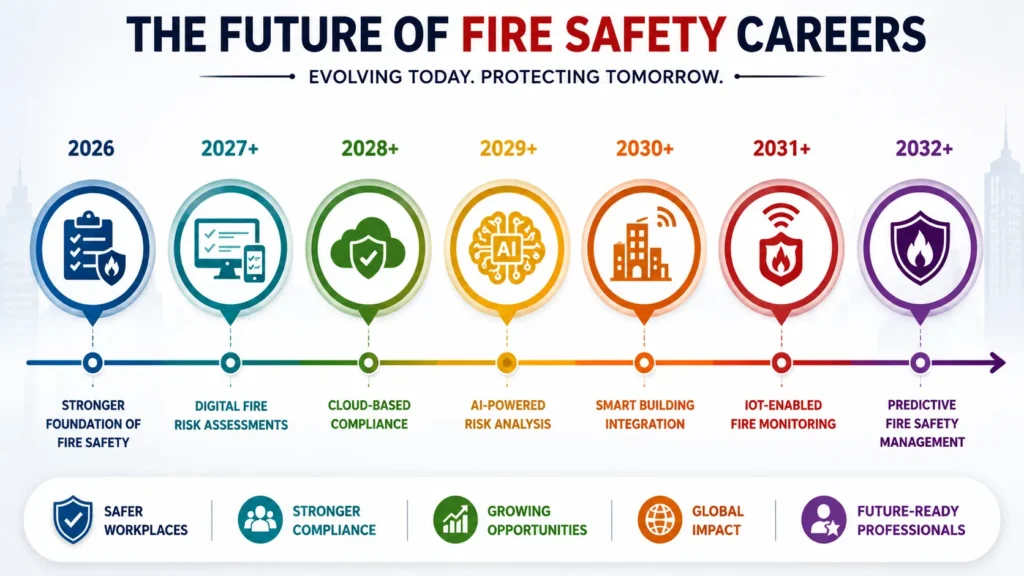
Future Career Timeline
Today
↓
Digital Fire Risk Assessments
↓
Cloud-Based Compliance Systems
↓
Artificial Intelligence Risk Analysis
↓
Smart Building Integration
↓
IoT Fire Monitoring
↓
Predictive Fire Safety Management
↓
Strategic Digital Leadership
Professionals who understand these technologies will be well positioned for future promotions and consultancy opportunities.
Can One Career Lead to the Other?
Yes.
Many professionals begin their careers as Fire Risk Assessors before progressing into Senior Fire Safety Advisor positions.
Likewise, experienced Senior Fire Safety Advisors often continue conducting complex fire risk assessments while managing organisational fire safety programmes.
Career Transition Flowchart
Fire Risk Assessor
↓
Senior Fire Risk Assessor
↓
Senior Fire Safety Advisor
↓
Fire Safety Manager
↓
Head of Fire Safety
↓
Director of Fire Safety
This progression allows professionals to combine technical expertise with leadership responsibilities.
Career Decision Flowchart
If you are still unsure which profession is the best fit, the following roadmap can help.
Which Career Is Right for You?
Enjoy Leadership?
↓
Yes
↓
Senior Fire Safety Advisor
OR
Prefer Technical Site Work?
↓
Yes
↓
Fire Risk Assessor
OR
Enjoy Both Leadership and Technical Work?
↓
Gain Fire Risk Assessment Experience
↓
Progress to Senior Fire Safety Advisor
Many successful professionals follow this blended pathway because it provides strong technical foundations before moving into leadership positions.
Which Career Offers Greater Long-Term Growth?
Both careers offer excellent opportunities, but progression differs.
| Career Area | Senior Fire Safety Advisor | Fire Risk Assessor |
|---|---|---|
| Leadership Growth | Excellent | Moderate |
| Technical Specialisation | High | Excellent |
| Consultancy Opportunities | Excellent | Excellent |
| Organisational Influence | Excellent | Moderate |
| Salary Growth | Excellent | Very Good |
| International Opportunities | Excellent | Excellent |
| Director-Level Progression | Excellent | Limited |
| Business Ownership | Very Good | Excellent |
Professionals seeking executive leadership, organisational strategy, and senior management positions often find the Senior Fire Safety Advisor pathway more suitable.
Those who enjoy technical expertise, inspections, consultancy, and specialist building assessments may find the Fire Risk Assessor role more rewarding.
Inspire College Learning Pathway
Whether you choose to become a Fire Risk Assessor or a Senior Fire Safety Advisor, building your knowledge through structured learning is one of the best investments you can make. A clear progression pathway helps develop the technical competence, practical understanding, and leadership skills required for long-term career success.
Professionals often begin with foundation-level fire safety training before progressing to specialist qualifications in fire risk assessment and advanced fire safety management.
Recommended Learning Pathway
Fire Safety Awareness
↓
ProQual Level 2 Award for Fire Marshals
↓
ICTQual Level 3 Certificate in Fire Safety
↓
ICTQual Level 4 Certificate in Fire Risk Assessment
↓
ICTQual Level 4 Diploma Senior Fire Safety Advisor
↓
ProQual Level 5 Diploma in Fire Risk Assessment
↓
ICTQual Level 6 Diploma in Occupational Health and Safety
↓
ICTQual Level 7 Diploma in Strategic Health and Safety Leadership
This pathway supports continuous professional development while preparing professionals for technical, management, and leadership positions.
Related Fire Safety Courses
If you are planning a long-term career in fire safety, the following courses available through Inspire College can support your professional development and provide excellent internal linking opportunities.
| Course | Career Benefit |
|---|---|
| ProQual Level 2 Award for Fire Marshals | Foundation fire safety knowledge for workplace responsibilities |
| ICTQual Level 4 Certificate in Fire Risk Assessment | Builds competence in conducting professional fire risk assessments |
| ICTQual Level 4 Diploma Senior Fire Safety Advisor | Prepares professionals for senior advisory and leadership roles |
| ProQual Level 5 Diploma in Fire Risk Assessment | Advanced qualification for complex fire risk assessment projects |
| ICQual Level 5 Diploma in Occupational Health and Safety Practice | Broadens expertise across workplace health and safety |
Following a structured learning pathway allows professionals to build confidence while meeting the expectations of employers across a wide range of industries.
Common Misconceptions About These Careers
Many people misunderstand the differences between a Senior Fire Safety Advisor and a Fire Risk Assessor. These misconceptions can make choosing the right career more difficult.
Misconception 1: They Perform the Same Job
Although both careers contribute to fire safety, their responsibilities are different.
A Fire Risk Assessor primarily evaluates buildings and identifies hazards, while a Senior Fire Safety Advisor manages organisational fire safety, develops strategies, and advises senior leadership.
Misconception 2: One Career Is Better Than the Other
Neither career is inherently better. Each offers excellent opportunities depending on your interests, working style, and long-term goals.
The right choice depends on whether you prefer technical assessments or organisational leadership.
Misconception 3: Career Progression Is Limited
Both professions offer excellent advancement opportunities.
Professionals can progress into:
- Fire Safety Management
- Consultancy
- Specialist Technical Roles
- Compliance Leadership
- Corporate Risk Management
- Executive Health and Safety Positions
Misconception 4: You Must Choose One Career Forever
Many professionals move between both roles during their careers.
For example, a Fire Risk Assessor may later become a Senior Fire Safety Advisor after gaining leadership experience, while an experienced Senior Fire Safety Advisor may continue conducting complex fire risk assessments as part of their wider responsibilities.
Which Career Should You Choose?
The answer depends on your interests, personality, and professional ambitions.
Choose a Senior Fire Safety Advisor Career If You Want To:
- Lead fire safety teams
- Develop organisational strategies
- Manage compliance programmes
- Work closely with senior leadership
- Build a long-term management career
- Progress towards director-level positions
- Influence organisational safety culture
- Manage large-scale fire safety projects
Choose a Fire Risk Assessor Career If You Want To:
- Conduct building inspections
- Identify and evaluate fire hazards
- Produce detailed technical reports
- Work across a variety of premises
- Develop specialist technical expertise
- Become an independent consultant
- Enjoy practical site-based work
- Focus on fire risk assessment and compliance
Neither choice is wrong. Both careers are respected, rewarding, and essential for improving fire safety across the UK.
Why Both Careers Have a Strong Future
The fire safety profession continues to evolve as organisations strengthen compliance, modernise buildings, and adopt new technologies.
Professionals in both careers are expected to play an increasingly important role in:
- Building safety management
- Fire prevention strategies
- Digital compliance systems
- Risk management
- Emergency preparedness
- Sustainable building design
- Business continuity planning
- Smart building technologies
As demand for competent fire safety professionals grows, opportunities for career advancement are expected to remain strong across both the public and private sectors.
Final Thoughts
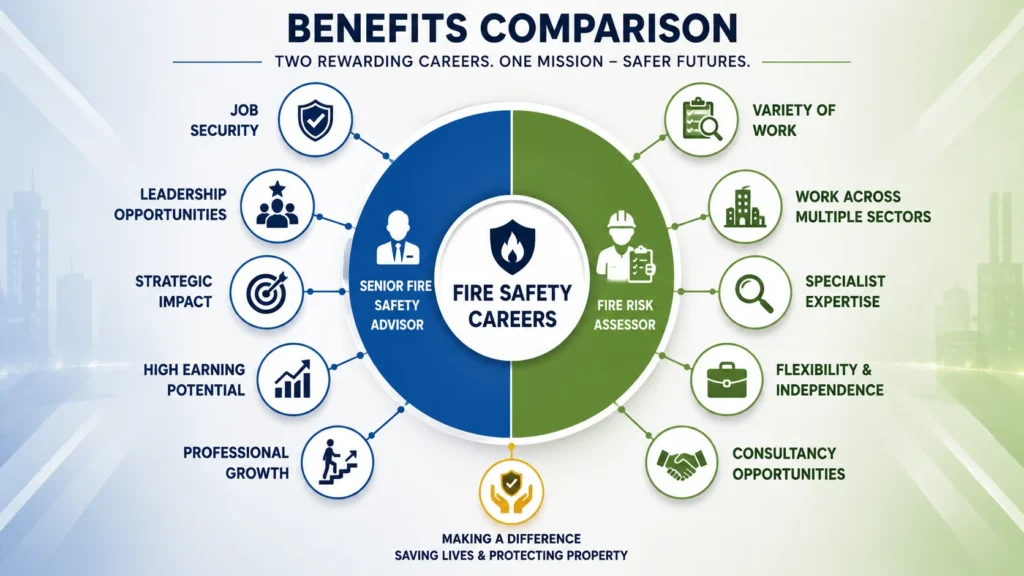
Choosing between a Senior Fire Safety Advisor and a Fire Risk Assessor is not about deciding which profession is better—it is about selecting the career that best aligns with your skills, interests, and long-term ambitions.
If you enjoy technical inspections, hazard identification, building assessments, and independent site-based work, a career as a Fire Risk Assessor can provide an exciting and rewarding future. It offers excellent opportunities to develop specialist expertise, work across diverse industries, and progress into consultancy.
If your ambition is to lead teams, influence organisational strategy, manage compliance programmes, and progress into senior leadership, becoming a Senior Fire Safety Advisor offers broader responsibilities and outstanding long-term career prospects. This pathway can lead to positions such as Fire Safety Manager, Head of Fire Safety, Director of Fire Safety, or Director of Health, Safety and Fire Compliance.
It is also important to remember that these careers complement rather than compete with each other. Many successful professionals begin by developing technical expertise in fire risk assessment before progressing into senior advisory and leadership roles. Combining practical experience with recognised qualifications creates a strong foundation for long-term career growth.
If you are ready to begin or advance your journey, Inspire College offers a comprehensive range of fire safety qualifications designed to support every stage of your professional development. Whether your goal is to become a Fire Risk Assessor, Senior Fire Safety Advisor, or a future Fire Safety Leader, investing in the right training today can open the door to a rewarding, stable, and highly respected career in one of the UK’s fastest-growing professional sectors.
Explore More Fire Safety & Risk Assessment Articles
Discover expert guides on fire safety careers, fire risk assessments, workplace compliance, fire protection systems, and professional qualifications to expand your knowledge and advance your career in fire safety.
- What is Fire Safety?
- Fire Risk Assessment
- Fire Safety Equipment
- Fire Safety: Essential Tips for Homes and Workplaces
- Industrial Fire Safety: Complete Guide to Risk Assessment, Hazards & Prevention (2026)
- Fire Safety Training (2026): Complete Guide, Certification & Workplace Safety
- Level 4 Diploma in Fire Safety: Complete Guide to Career Growth, Skills, Compliance, and Professional Certification
- What Does a Senior Fire Safety Advisor Do? Roles, Responsibilities, and Career Guide
- Top Skills Every Senior Fire Safety Advisor Should Develop
- Is Fire Safety a Good Career Choice in the UK?
- Senior Fire Safety Advisor Career Progression: Exciting Roles, Salary & Leadership Path
- Is Fire Safety a Good Career Choice in the UK?
- Top Skills Every Senior Fire Safety Advisor Should Develop
- The 5 Essential Steps of Fire Risk Assessment Explained
- Fire Risk Assessment Explained: A Complete Beginner’s Guide
- Qualified Fire Risk Assessor Career Guide: Training, Skills, and Job Opportunities
- Senior Fire Safety Advisor: Top Industries Hiring Across the UK
- How Fire Safety and Risk Assessment Reduce Workplace Hazards
- Fire Safety Planning and Risk Assessment for Businesses
- Essential Fire Safety Tips Everyone Should Know to Stay Safe
- Fire Risk Assessment vs Fire Safety Audit: What’s the Difference?
- How to Conduct an Effective Risk Assessment Step by Step
- Fire Safety Checklist for Homes, Offices & Commercial Buildings
- Failed a Fire Safety Inspection? Here’s What Happens Next