
Level 4 Diploma in Fire Safety: Complete Guide to Career Growth, Skills, Compliance, and Professional Certification
Fire safety has become one of the most critical aspects of modern workplaces, public buildings, industrial facilities, healthcare organisations, educational institutions, and residential developments. As governments continue to strengthen fire safety legislation and organisations place greater emphasis on risk management, the demand for qualified fire safety professionals continues to grow across the UK and internationally.
A Level 4 Diploma in Fire Safety provides learners with advanced knowledge of fire prevention, fire risk assessment, emergency planning, fire protection systems, legal compliance, and fire safety management. It bridges the gap between operational fire safety practices and strategic management, preparing professionals to identify hazards, implement effective control measures, and ensure compliance with national and international fire safety regulations.
Whether working in construction, manufacturing, healthcare, oil and gas, hospitality, education, logistics, or facilities management, organisations rely on competent fire safety professionals to protect lives, property, business continuity, and organisational reputation.
Unlike introductory fire safety training, a Level 4 qualification develops practical and managerial competencies that enable professionals to conduct fire risk assessments, manage emergency response procedures, oversee fire protection systems, and support regulatory compliance. It also opens pathways to senior fire safety roles, consultancy, health and safety management, and specialist fire engineering careers.
This comprehensive guide explains everything about the Level 4 Diploma in Fire Safety, including its importance, learning outcomes, industry applications, legal framework, career opportunities, and the professional skills required to succeed in today’s safety-focused industries.
What Is a Level 4 Diploma in Fire Safety?
A Level 4 Diploma in Fire Safety is an advanced vocational qualification designed for individuals responsible for managing fire safety within organisations. The programme equips learners with the knowledge and practical skills needed to identify fire hazards, evaluate risks, implement preventive measures, and ensure compliance with fire safety legislation.
The qualification combines theoretical understanding with practical application, enabling professionals to develop robust fire safety management systems that reduce the likelihood of fire incidents while ensuring organisational resilience.
Typical areas of study include:
- Fire science fundamentals
- Fire behaviour and combustion
- Fire prevention strategies
- Fire risk assessment
- Fire safety legislation
- Active and passive fire protection
- Emergency planning
- Fire detection and alarm systems
- Fire suppression systems
- Fire safety management
- Incident investigation
- Continuous improvement
The qualification is particularly valuable for professionals seeking supervisory or managerial responsibilities in fire safety and risk management.
Why Fire Safety Qualifications Are More Important Than Ever
The increasing complexity of modern buildings, industrial processes, and workplace operations has significantly elevated fire safety risks. Advances in construction materials, electrical systems, renewable energy technologies, and automated manufacturing have created new challenges that require specialist knowledge and effective risk management.
A professionally recognised qualification enables organisations to meet legal obligations while fostering a proactive safety culture.
Some of the key drivers behind the growing demand for fire safety professionals include:
- Stricter regulatory requirements
- Increased workplace inspections
- Greater emphasis on business continuity
- Higher insurance expectations
- Rapid urban development
- Expansion of high-risk industries
- Improved public awareness of fire safety
- Stronger corporate governance requirements
Organisations increasingly recognise that investing in qualified fire safety personnel is more cost-effective than managing the consequences of fire-related incidents.
Benefits of a Level 4 Diploma in Fire Safety
This qualification provides benefits for both individuals and employers.
| For Professionals | For Organisations |
|---|---|
| Career advancement | Improved legal compliance |
| Professional recognition | Reduced fire risks |
| Higher earning potential | Lower insurance claims |
| Advanced technical knowledge | Enhanced workplace safety |
| Management skills | Better emergency preparedness |
| Greater employability | Reduced operational disruptions |
| Progression to senior roles | Stronger safety culture |
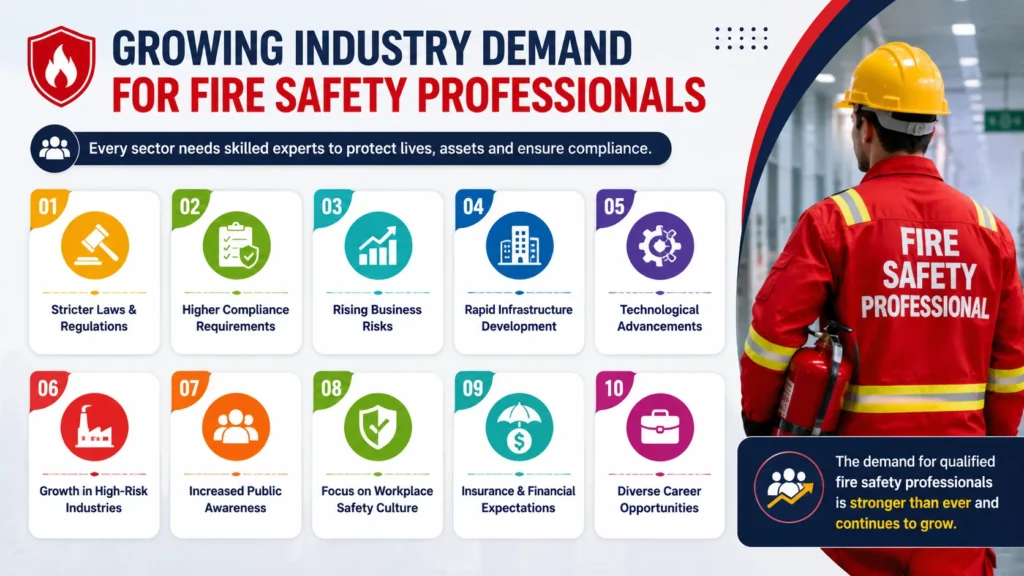
Growing Industry Demand for Fire Safety Professionals
Virtually every industry requires competent fire safety management. Organisations are increasingly recruiting qualified professionals to strengthen their health and safety teams and meet evolving compliance requirements.
Core Learning Areas Covered
Although individual programmes may vary, most Level 4 Diploma in Fire Safety qualifications cover several essential knowledge areas.
| Learning Area | Why It Matters |
|---|---|
| Fire Science | Understand how fires start and spread |
| Fire Risk Assessment | Identify hazards and evaluate risks |
| Fire Safety Law | Ensure legal compliance |
| Fire Prevention | Reduce the likelihood of fire incidents |
| Fire Protection Systems | Protect life and property |
| Emergency Planning | Improve organisational preparedness |
| Fire Investigation | Identify causes and prevent recurrence |
| Fire Safety Management | Develop organisational safety strategies |
These learning areas prepare professionals to manage fire safety across a wide range of operational environments.
Understanding Fire Science
Effective fire safety begins with understanding how fire behaves.
Fire science examines:
- Heat transfer
- Combustion
- Ignition sources
- Fuel characteristics
- Smoke movement
- Fire growth
- Flashover
- Backdraft
- Fire suppression principles
A strong understanding of these principles enables professionals to design effective prevention strategies and emergency response plans.
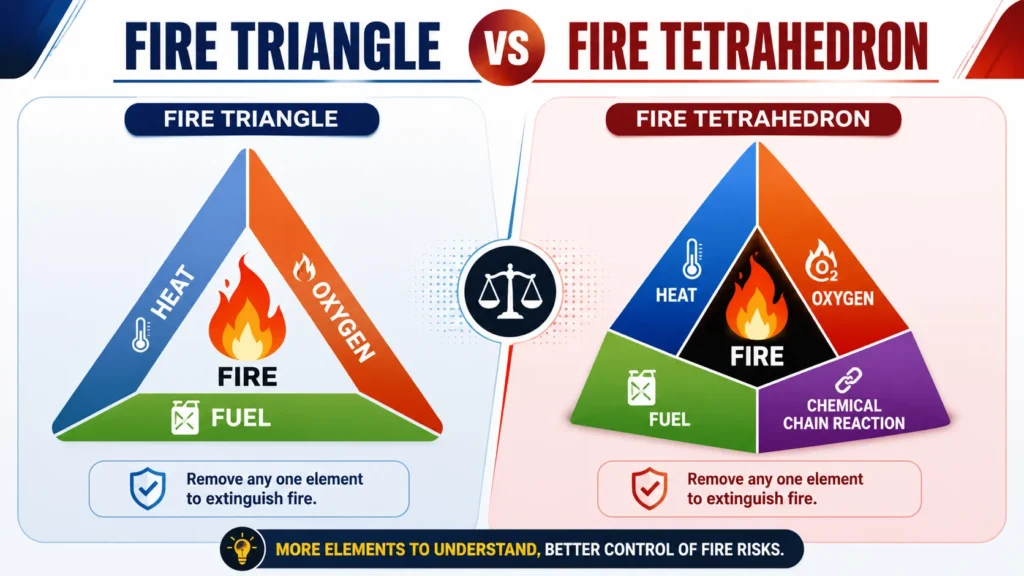
Fire Triangle vs Fire Tetrahedron
Understanding the difference between these two concepts is fundamental to fire prevention.
| Fire Triangle | Fire Tetrahedron |
|---|---|
| Heat | Heat |
| Fuel | Fuel |
| Oxygen | Oxygen |
| — | Chemical Chain Reaction |
The Fire Triangle explains the three basic elements required for combustion. The Fire Tetrahedron expands this model by introducing the chemical chain reaction that sustains a fire. Removing any one of these elements can interrupt combustion and extinguish a fire, making this concept essential when selecting appropriate fire suppression methods.
Fire Risk Assessment: The Foundation of Fire Safety
Fire risk assessment is one of the most important responsibilities of fire safety professionals. It is a systematic process used to identify hazards, evaluate risks, and implement suitable control measures before an incident occurs.
An effective fire risk assessment generally follows these stages:
- Identify potential fire hazards.
- Determine who may be at risk.
- Evaluate existing fire safety measures.
- Assess the level of risk.
- Implement additional control measures where necessary.
- Record findings and actions.
- Review and update assessments regularly.
This structured approach enables organisations to reduce fire risks while maintaining compliance with legal obligations.
Identify Hazards
↓
Identify People at Risk
↓
Evaluate Risks
↓
Implement Controls
↓
Record Findings
↓
Review Regularly
↓
Continuous Improvement
Active Fire Protection vs Passive Fire Protection
Modern buildings rely on a combination of active and passive fire protection systems.
| Active Fire Protection | Passive Fire Protection |
|---|---|
| Fire alarms | Fire-resistant walls |
| Smoke detectors | Fire doors |
| Automatic sprinklers | Fire compartments |
| Fire extinguishers | Fire-resistant ceilings |
| Emergency lighting | Fire stopping materials |
| Suppression systems | Structural fire protection |
Active systems respond when a fire occurs, while passive systems are built into the structure to slow the spread of fire and smoke, protecting occupants and allowing more time for evacuation.
Fire Safety Management Responsibilities
Fire safety management extends beyond responding to emergencies. Qualified professionals are expected to create and maintain comprehensive systems that minimise fire risks across the organisation.
Key responsibilities include:
- Conducting fire risk assessments
- Developing fire safety policies
- Maintaining fire safety records
- Managing emergency evacuation procedures
- Coordinating fire drills
- Inspecting fire protection equipment
- Monitoring legal compliance
- Training employees
- Investigating fire incidents
- Recommending corrective actions
These responsibilities contribute to a safer working environment and demonstrate organisational commitment to health and safety.
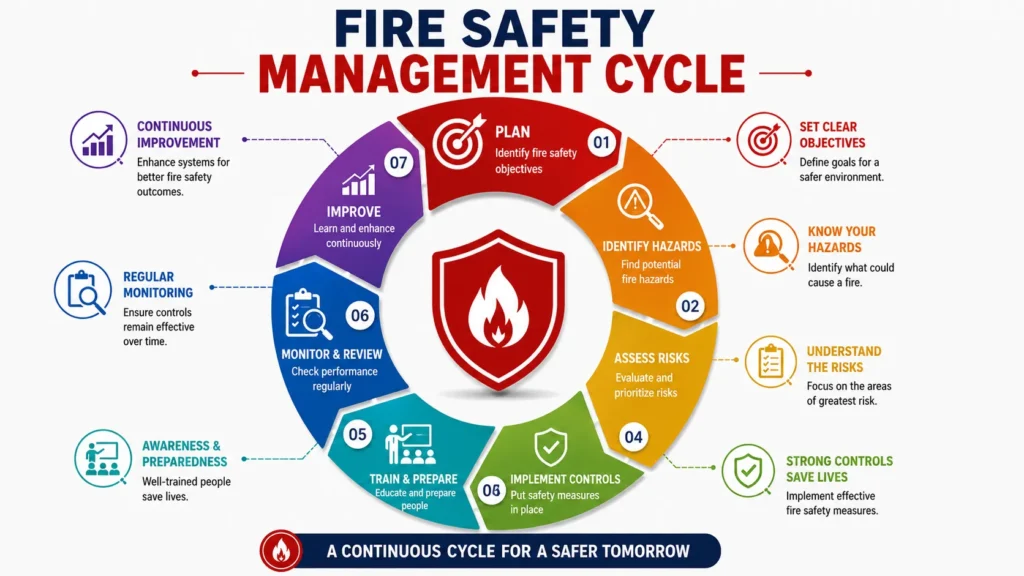
Fire Safety Management Cycle
Effective fire safety is a continuous process rather than a one-time activity. Organisations should regularly review hazards, assess risks, implement controls, train employees, monitor performance, and continuously improve their fire safety management system.
UK Fire Safety Legislation
Understanding legislation is essential for anyone pursuing a Level 4 Diploma in Fire Safety. Compliance with legal requirements protects lives while reducing organisational risk.
Important legislation and regulatory frameworks include:
| Legislation | Purpose |
|---|---|
| Regulatory Reform (Fire Safety) Order 2005 | Places fire safety duties on the Responsible Person |
| Fire Safety Act 2021 | Clarifies fire risk assessment responsibilities for multi-occupied residential buildings |
| Building Safety Act 2022 | Strengthens accountability for higher-risk buildings |
| Health and Safety at Work etc. Act 1974 | Requires employers to provide safe working environments |
| Dangerous Substances and Explosive Atmospheres Regulations (DSEAR) | Controls risks from flammable substances |
A competent fire safety professional must understand how these legal requirements apply within different workplace environments and ensure that organisational practices remain compliant.
Essential Skills Developed Through a Level 4 Diploma in Fire Safety
In addition to technical knowledge, the qualification develops practical and managerial skills that are highly valued across industries.
These include:
- Fire risk assessment
- Hazard identification
- Safety auditing
- Incident investigation
- Emergency planning
- Regulatory compliance
- Technical report writing
- Leadership
- Communication
- Problem-solving
- Decision-making
- Team coordination
- Continuous improvement
- Safety culture development
These competencies prepare professionals to take on leadership roles in fire safety management and contribute to safer, more resilient organisations.
Career Opportunities After Completing a Level 4 Diploma in Fire Safety
A Level 4 Diploma in Fire Safety is more than a professional qualification—it is a gateway to a wide range of career opportunities across industries where protecting people, property, and business operations is a top priority. As organisations continue to strengthen their fire safety management systems and comply with increasingly stringent regulations, the demand for competent fire safety professionals continues to grow.
Unlike entry-level fire safety training, this diploma prepares professionals for supervisory, managerial, and advisory positions. Graduates develop the technical expertise, leadership capabilities, and regulatory knowledge required to oversee fire safety programmes, conduct risk assessments, implement preventive measures, and ensure legal compliance.
Some of the most common career opportunities include:
| Job Role | Primary Responsibilities |
|---|---|
| Fire Safety Officer | Manage workplace fire safety programmes and inspections |
| Fire Risk Assessor | Conduct fire risk assessments and recommend control measures |
| Fire Safety Manager | Develop and oversee organisational fire safety strategies |
| Health and Safety Advisor | Integrate fire safety into wider occupational safety systems |
| Fire Compliance Officer | Ensure compliance with fire legislation and industry standards |
| Fire Prevention Officer | Develop preventive strategies and awareness programmes |
| Facilities Manager | Oversee building safety, maintenance, and fire protection systems |
| Fire Safety Consultant | Provide specialist advice to multiple organisations |
| Emergency Planning Officer | Develop evacuation and emergency response plans |
| HSE Manager | Lead health, safety, and environmental management programmes |
These roles exist across both public and private sectors, offering diverse career paths and long-term professional development opportunities.
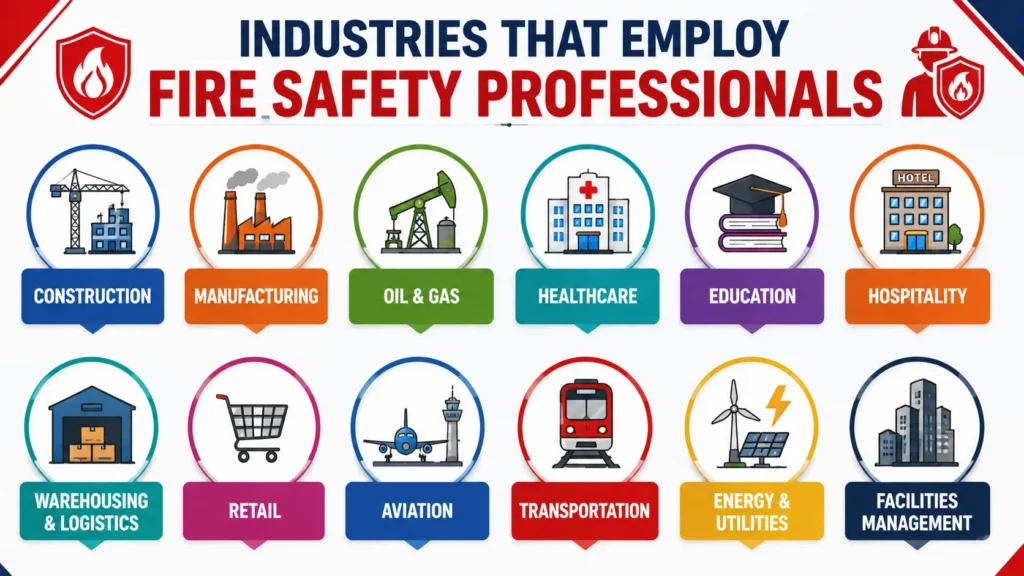
Industries That Employ Fire Safety Professionals
Fire safety expertise is required in almost every sector because every workplace presents unique fire hazards and compliance responsibilities. Organisations increasingly recruit qualified professionals to reduce operational risks, improve emergency preparedness, and protect employees, customers, and assets.
Construction Industry
Construction remains one of the largest employers of fire safety professionals. Large infrastructure projects, commercial buildings, residential developments, and industrial facilities all require fire safety planning throughout the design, construction, and operational phases.
Fire safety professionals in construction may be responsible for:
- Reviewing fire safety designs
- Conducting site inspections
- Monitoring hot work activities
- Managing temporary fire protection
- Verifying fire compartmentation
- Supporting regulatory approvals
Manufacturing Industry
Manufacturing facilities often contain high-risk processes involving machinery, electrical systems, combustible materials, flammable liquids, and hazardous chemicals.
Fire safety professionals help manufacturers by:
- Conducting fire risk assessments
- Developing emergency response plans
- Inspecting fire protection systems
- Managing hazardous material storage
- Investigating fire incidents
- Training production staff
Oil and Gas Sector
Oil refineries, offshore platforms, chemical plants, and fuel storage facilities require some of the most advanced fire safety management systems due to the presence of highly flammable substances.
Typical responsibilities include:
- Explosion risk assessment
- Fire suppression planning
- Emergency shutdown procedures
- Hazardous area inspections
- Process safety coordination
- Compliance auditing
Healthcare
Hospitals, clinics, care homes, and rehabilitation centres accommodate vulnerable occupants who may require assisted evacuation during emergencies.
Fire safety professionals ensure:
- Progressive horizontal evacuation planning
- Fire alarm testing
- Staff evacuation training
- Compartmentation inspections
- Emergency preparedness exercises
Education
Schools, colleges, universities, and training centres must maintain safe learning environments for students, staff, and visitors.
Fire safety teams oversee:
- Emergency evacuation drills
- Fire alarm maintenance
- Building inspections
- Staff awareness programmes
- Regulatory compliance
Hospitality
Hotels, restaurants, entertainment venues, and conference centres accommodate large numbers of guests unfamiliar with the building layout.
Fire safety responsibilities include:
- Guest evacuation planning
- Kitchen fire prevention
- Fire door inspections
- Emergency lighting maintenance
- Staff emergency response training
Warehousing and Logistics
Distribution centres and warehouses often store large volumes of combustible materials.
Professionals manage:
- Storage risk assessments
- Fire detection systems
- Warehouse inspections
- Loading dock safety
- Emergency response coordination
Industry Applications of Fire Safety Knowledge
The knowledge gained through a Level 4 Diploma in Fire Safety can be applied throughout an organisation.
| Business Function | Fire Safety Contribution |
|---|---|
| Building Design | Fire-resistant construction planning |
| Operations | Safe working procedures |
| Maintenance | Inspection of fire protection systems |
| Procurement | Selection of compliant equipment |
| Human Resources | Employee fire safety training |
| Facilities Management | Building compliance |
| Risk Management | Hazard identification and mitigation |
| Business Continuity | Emergency preparedness planning |
This versatility makes fire safety professionals valuable members of multidisciplinary management teams.
Essential Professional Skills Developed
Employers increasingly seek professionals who combine technical competence with strong leadership and communication skills. A Level 4 Diploma in Fire Safety develops both.
Technical Skills
- Fire science
- Fire behaviour analysis
- Fire risk assessment
- Fire legislation
- Fire detection systems
- Fire suppression technologies
- Emergency planning
- Fire investigation
- Passive fire protection
- Active fire protection
Management Skills
- Leadership
- Project management
- Team coordination
- Decision making
- Problem solving
- Resource planning
- Continuous improvement
- Performance monitoring
Communication Skills
- Technical report writing
- Incident reporting
- Employee training
- Audit presentation
- Stakeholder communication
- Regulatory liaison
These competencies enable professionals to manage complex fire safety programmes while supporting organisational objectives.
Career Progression Pathway
A Level 4 qualification often serves as the foundation for long-term career growth.
| Career Stage | Typical Position |
|---|---|
| Entry Level | Fire Warden / Fire Marshal |
| Junior Professional | Fire Safety Officer |
| Intermediate | Fire Risk Assessor |
| Senior Professional | Fire Safety Manager |
| Specialist | Fire Safety Consultant |
| Leadership | Head of Fire Safety |
| Executive | Health, Safety and Fire Director |
Professionals may also choose to specialise in:
- Fire engineering
- Fire investigation
- Building safety
- Fire consultancy
- Emergency planning
- Occupational health and safety
- Regulatory compliance
- Risk management
Salary Expectations
Salary levels vary depending on qualifications, industry, employer, geographic location, and professional experience. Individuals with a recognised Level 4 Diploma often enjoy improved earning potential as they progress into supervisory and management positions.
| Career Level | Typical Salary Potential* |
|---|---|
| Fire Safety Officer | Competitive entry-to-mid-level salary |
| Fire Risk Assessor | Mid-level professional salary |
| Fire Safety Manager | Senior management salary |
| Fire Safety Consultant | Higher consultancy earnings depending on experience |
| HSE Manager | Senior leadership salary |
*Actual salaries vary by country, industry, organisation size, qualifications, and experience.
Why Employers Value Level 4 Diploma Holders
Employers increasingly prefer candidates with recognised qualifications because they demonstrate structured knowledge, practical competence, and an understanding of regulatory responsibilities.
Professionals with a Level 4 Diploma can contribute by:
- Reducing workplace fire risks
- Improving legal compliance
- Supporting insurance requirements
- Reducing operational downtime
- Protecting business assets
- Enhancing organisational reputation
- Improving emergency preparedness
- Promoting a proactive safety culture
These contributions often deliver measurable financial and operational benefits, making qualified fire safety professionals a valuable investment for organisations.
Emerging Trends Shaping the Fire Safety Profession
Fire safety continues to evolve as new technologies and regulations reshape workplace safety. Professionals who understand these developments will be well positioned for future career opportunities.
Key trends include:
Artificial Intelligence (AI)
AI-powered fire detection systems can analyse smoke patterns, temperature changes, and video surveillance in real time, enabling earlier detection and faster emergency response.
Internet of Things (IoT)
Smart sensors connected through IoT networks continuously monitor fire alarms, extinguishers, sprinkler systems, emergency lighting, and environmental conditions, improving maintenance and reducing system failures.
Smart Buildings
Modern buildings integrate fire safety systems with building management platforms, providing automated monitoring, intelligent evacuation support, and enhanced incident management.
Building Information Modelling (BIM)
BIM technology enables fire safety professionals to evaluate building layouts, evacuation routes, fire compartmentation, and protection systems during both design and operational phases.
Sustainability and Renewable Energy
The growing use of lithium-ion batteries, electric vehicle charging infrastructure, photovoltaic systems, and energy storage technologies introduces new fire risks that require specialist knowledge and updated fire safety strategies.
Data-Driven Risk Management
Organisations increasingly use digital inspection platforms, predictive analytics, and cloud-based reporting systems to identify trends, prioritise risks, and support continuous improvement.
Professionals who combine traditional fire safety expertise with digital competencies will be increasingly sought after as organisations modernise their safety management systems.
Why a Level 4 Diploma in Fire Safety Is a Valuable Investment
A Level 4 Diploma in Fire Safety is far more than a qualification that satisfies regulatory requirements. It equips professionals with the knowledge, practical skills, and leadership capabilities needed to create safer workplaces, protect lives, and support organisational resilience. As businesses face increasingly complex fire risks, employers are looking for individuals who can move beyond routine compliance and actively contribute to strategic fire safety management.
The qualification develops a thorough understanding of fire science, fire prevention, emergency planning, fire protection systems, legislation, and risk assessment. It also strengthens decision-making, leadership, communication, and problem-solving skills, enabling professionals to manage fire safety programmes confidently across diverse industries.
For employers, investing in qualified fire safety personnel demonstrates a commitment to legal compliance, operational excellence, and continuous improvement. For professionals, it creates opportunities for career progression, increased responsibility, and long-term employability in an expanding global market.
Benefits for Employers
Fire safety management is an essential component of business continuity and operational resilience. Organisations that employ qualified fire safety professionals benefit from stronger compliance, reduced operational risks, and improved emergency preparedness.
Improved Regulatory Compliance
Qualified professionals understand how to implement fire safety management systems that comply with current legislation and recognised industry standards. This reduces the likelihood of enforcement notices, legal penalties, and costly compliance failures.
Reduced Fire Risks
A structured approach to fire risk assessment helps organisations identify hazards before they develop into serious incidents. Preventive measures reduce the likelihood of fires, property damage, production interruptions, and injuries.
Enhanced Workplace Safety
Effective fire safety management protects employees, contractors, visitors, and customers. Regular inspections, emergency planning, and staff training create a safer working environment and strengthen organisational safety culture.
Lower Financial Losses
Fire incidents often result in equipment damage, production downtime, insurance claims, legal costs, and reputational harm. Investing in competent fire safety management significantly reduces these risks.
Stronger Business Continuity
Emergency response planning enables organisations to respond quickly and effectively to fire incidents, minimising disruption and supporting faster recovery.
Organisational Benefits at a Glance
| Business Objective | How a Level 4 Fire Safety Professional Adds Value |
|---|---|
| Legal Compliance | Ensures compliance with fire safety legislation |
| Risk Reduction | Identifies and controls fire hazards |
| Employee Safety | Develops safer workplaces |
| Asset Protection | Minimises damage to buildings and equipment |
| Operational Efficiency | Reduces downtime caused by fire incidents |
| Reputation | Demonstrates commitment to safety and compliance |
| Insurance Confidence | Supports effective risk management practices |
| Continuous Improvement | Promotes regular audits and system enhancements |
Who Should Consider a Level 4 Diploma in Fire Safety?
This qualification is suitable for professionals seeking to develop advanced fire safety knowledge or progress into leadership roles.
It is particularly beneficial for:
- Fire Safety Officers
- Fire Marshals
- Fire Wardens
- Health and Safety Officers
- Health and Safety Managers
- Facilities Managers
- Building Managers
- Construction Site Managers
- Manufacturing Supervisors
- Maintenance Managers
- Compliance Officers
- Risk Managers
- Fire Risk Assessors
- Property Managers
- Local Authority Officers
- Housing Association Managers
- Hospital Safety Managers
- School and University Facilities Teams
- Oil and Gas Safety Professionals
- Individuals planning a career in fire safety consultancy
Professional Progression After Completing the Qualification
The Level 4 Diploma provides a strong foundation for further professional development. Many learners continue to build their expertise through advanced qualifications in health and safety, risk management, occupational safety, and specialist fire safety disciplines.
Possible progression routes include:
- Advanced Fire Safety Management qualifications
- Health and Safety Management Diplomas
- Occupational Health and Safety qualifications
- Fire Risk Assessment certifications
- Fire Engineering studies
- Emergency Planning and Crisis Management programmes
- Building Safety and Compliance qualifications
- Environmental Health and Safety (EHS) programmes
Continuous professional development helps individuals remain up to date with changing legislation, emerging technologies, and industry best practices.
Related Fire Safety and Health & Safety Courses
To build broader expertise and support career progression, learners can explore related qualifications offered by Inspire College. These courses complement a Level 4 Diploma in Fire Safety and strengthen knowledge across health, safety, compliance, and risk management.
Recommended Internal Resources
| Related Course | Purpose |
|---|---|
| ProQual Level 3 Award in Fire Risk Assessment Awareness | Foundation knowledge of fire prevention and workplace fire safety |
| Fire Risk Assessment Course | Develop practical fire risk assessment skills |
| Fire Marshal Training | Emergency response and evacuation management |
| Health and Safety Management Courses | Broader occupational health and safety knowledge |
| ISO 45001 Lead Auditor Course | Occupational Health and Safety Management Systems |
| ISO 9001 Lead Auditor Course | Quality Management Systems and compliance |
| ISO 14001 Lead Auditor Course | Environmental Management Systems |
| Emergency Response and Incident Management | Emergency planning and crisis response |
Why This Qualification Supports Long-Term Career Success
The future of fire safety extends beyond compliance. Organisations are increasingly adopting integrated safety management systems that combine fire safety, occupational health, environmental management, security, and business continuity planning.
Professionals who understand these interconnected disciplines are well positioned for leadership roles. A Level 4 Diploma in Fire Safety demonstrates technical competence, strategic thinking, and the ability to manage fire risks in complex operational environments.
As industries continue to adopt smart buildings, artificial intelligence, Internet of Things (IoT) technologies, and digital compliance platforms, qualified fire safety professionals will play an increasingly important role in helping organisations adapt to new challenges while maintaining high standards of safety and resilience.
Employers value professionals who can analyse risks, implement preventive strategies, communicate effectively with stakeholders, and foster a culture of continuous improvement. This qualification develops exactly those capabilities, making it a worthwhile investment for individuals seeking sustainable career growth.
Conclusion
Fire safety is a fundamental pillar of responsible business operations, protecting lives, safeguarding assets, and ensuring compliance with increasingly rigorous legal and regulatory requirements. A Level 4 Diploma in Fire Safety equips professionals with the knowledge, technical expertise, and management skills required to identify fire hazards, conduct comprehensive fire risk assessments, implement effective prevention strategies, and oversee fire safety systems across a wide range of industries.
Whether working in construction, manufacturing, healthcare, oil and gas, education, hospitality, logistics, or facilities management, qualified fire safety professionals make a measurable contribution to organisational resilience, workplace safety, and regulatory compliance. Their ability to combine technical knowledge with strategic leadership helps organisations reduce risk, strengthen business continuity, and create safer environments for employees, customers, and the wider community.
For individuals seeking career progression, increased professional credibility, and long-term opportunities within the health and safety sector, a Level 4 Diploma in Fire Safety provides a strong foundation for advancement. As fire safety legislation evolves and emerging technologies reshape the industry, professionals with recognised qualifications and practical expertise will remain in high demand across the UK and globally.
Investing in a recognised fire safety qualification today is an investment in safer workplaces, stronger compliance, and a rewarding professional future.
Explore More Fire Safety & Health and Safety Guides
Expand your knowledge with our expert articles on fire safety, risk assessment, workplace compliance, and health and safety management to build safer, legally compliant workplaces.
- What is Fire Safety?
- UK Fire Safety Compliance: Legal Checklist for 2026
- Fire Risk Assessment: Step-by-Step Guide for Businesses (2026)
- Fire Safety Equipment: Complete Guide for Homes and Workplaces (2026)
- Industrial Fire Safety: Complete Guide to Risk Assessment, Hazards & Prevention (2026)
- Top 10 Fire Hazards in Workplace & Home (Prevention Guide 2026)
- Fire Safety Training (2026): Complete Guide, Certification & Workplace Safety
- Senior Fire Safety Advisor vs Fire Safety Officer: What’s the Difference?
- Senior Fire Safety Advisor: Complete Guide to Becoming One in the UK
- Senior Fire Safety Advisor vs Fire Risk Assessor: Which Career Is Right for You?
- Senior Fire Safety Advisor Career Progression: Exciting Roles, Salary & Leadership Path
- Is Fire Safety a Good Career Choice in the UK?
- Top Skills Every Senior Fire Safety Advisor Should Develop
- Fire Risk Assessment Explained: A Complete Beginner’s Guide
- Qualified Fire Risk Assessor Career Guide: Training, Skills, and Job Opportunities
- Fire Safety Planning and Risk Assessment for Businesses
- Common Risk Assessment Mistakes and How to Avoid Them