
Senior Fire Safety Advisor: Complete Guide to Becoming One in the UK
Fire safety is one of the most important aspects of workplace health and safety, protecting lives, property, and business operations from the devastating impact of fire. In the United Kingdom, employers have a legal responsibility to identify fire hazards, implement appropriate control measures, and ensure compliance with fire safety legislation. As organisations continue to strengthen their health and safety strategies, the demand for experienced fire safety professionals has increased significantly across both public and private sectors.
Among the most respected positions within this field is the Senior Fire Safety Advisor. This advanced professional role combines technical expertise with leadership, strategic planning, regulatory compliance, and organisational risk management. Rather than focusing solely on routine inspections or emergency response, Senior Fire Safety Advisors develop fire safety policies, oversee fire risk assessment programmes, advise senior management, coordinate emergency preparedness, and help organisations create safer working environments.
The role is becoming increasingly important as workplaces adopt smart technologies, construct more complex buildings, and comply with evolving UK fire safety legislation. Employers now seek professionals who can lead fire safety initiatives while supporting business continuity and regulatory compliance.
Whether you are beginning a career in health and safety or looking to progress into a senior fire safety leadership role, this comprehensive guide explains everything you need to know about becoming a Senior Fire Safety Advisor in the UK, including qualifications, skills, career progression, responsibilities, and future opportunities.
Who Is a Senior Fire Safety Advisor?
A Senior Fire Safety Advisor is an experienced fire safety professional responsible for developing, implementing, and managing fire safety systems within an organisation. They provide expert guidance on fire prevention, emergency planning, legislative compliance, and organisational risk management while ensuring that fire safety remains integrated into everyday business operations.
Unlike operational fire safety roles that focus on inspections and routine compliance, Senior Fire Safety Advisors work strategically with senior leadership, facilities managers, health and safety teams, regulatory authorities, insurers, and external contractors to develop long-term fire safety programmes.
Their work helps organisations:
- Protect employees and visitors
- Reduce fire-related risks
- Meet legal obligations
- Improve emergency preparedness
- Protect business assets
- Maintain operational continuity
- Strengthen workplace safety culture
Because of their strategic responsibilities, Senior Fire Safety Advisors are recognised as key contributors to organisational resilience and regulatory compliance.
Why Is This Career Growing in the UK?
Demand for qualified fire safety professionals has increased rapidly across the UK due to changes in legislation, increased public awareness, and growing organisational expectations regarding workplace safety.
Businesses now recognise that effective fire safety management goes beyond legal compliance. It also protects employees, reduces financial losses, supports insurance requirements, and improves corporate reputation.
Several factors continue to drive demand for Senior Fire Safety Advisors.
Stricter Fire Safety Legislation
Recent changes to UK fire safety regulations have increased the need for competent professionals who understand fire risk assessment, building safety, emergency planning, and organisational compliance.
Complex Building Designs
Modern commercial buildings include advanced fire detection systems, intelligent building management technologies, renewable energy installations, and sophisticated fire protection measures that require specialist knowledge.
Increased Employer Responsibility
Employers are expected to demonstrate proactive fire safety management through documented risk assessments, staff training, regular inspections, and continuous monitoring.
Growth in High-Risk Industries
Construction, manufacturing, healthcare, logistics, hospitality, education, aviation, and energy sectors continue to recruit experienced fire safety professionals.
Business Continuity Planning
Fire incidents can result in operational disruption, financial losses, legal action, and reputational damage. Organisations increasingly rely on Senior Fire Safety Advisors to minimise these risks.
Growing Industry Demand for Senior Fire Safety Advisors
| Industry | Demand Level |
|---|---|
| Construction | Very High |
| Manufacturing | Very High |
| Healthcare | High |
| Oil & Gas | Very High |
| Education | High |
| Hospitality | High |
| Logistics | High |
| Commercial Property | Very High |
| Government | High |
| Facilities Management | Very High |
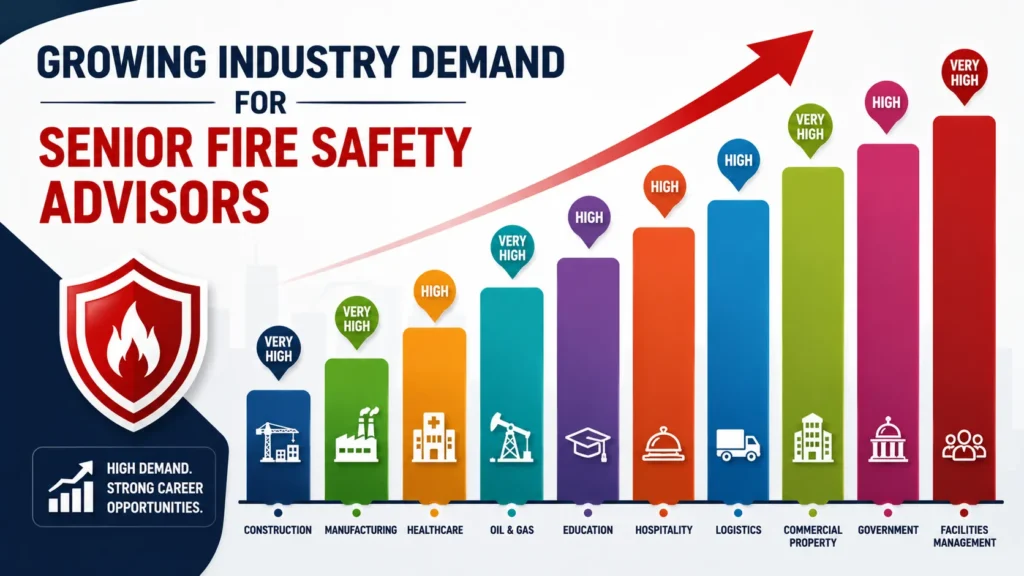
This visual helps readers quickly understand the sectors where demand for qualified fire safety professionals is strongest, reinforcing the excellent career prospects available across the UK.
Step-by-Step Guide to Becoming a Senior Fire Safety Advisor
Although career journeys differ, most successful professionals follow a structured pathway that combines education, practical experience, and continuous professional development.
Step 1: Build a Foundation in Fire Safety
Begin by developing a solid understanding of fire science, workplace hazards, emergency procedures, fire prevention, and fire protection systems.
This knowledge provides the foundation for more advanced fire safety responsibilities.
Step 2: Gain Practical Workplace Experience
Practical experience is essential for understanding how fire safety principles are applied within different industries.
Many professionals begin their careers as:
- Fire Wardens
- Fire Marshals
- Fire Safety Assistants
- Health and Safety Assistants
- Facilities Coordinators
These roles provide valuable exposure to inspections, emergency planning, fire drills, and workplace compliance.
Step 3: Complete a Recognised Qualification
Professional qualifications demonstrate competence and prepare individuals for more advanced responsibilities.
Qualifications provide knowledge in:
- Fire legislation
- Fire risk assessment
- Fire protection systems
- Fire safety management
- Leadership
- Emergency planning
- Organisational compliance
Advanced qualifications such as the ICTQual Level 4 Diploma Senior Fire Safety Advisor are designed specifically for professionals progressing into leadership positions.
Step 4: Develop Leadership Skills
Technical knowledge alone is not enough.
Senior Fire Safety Advisors must also develop:
- Leadership
- Communication
- Decision making
- Team management
- Strategic planning
- Report writing
- Problem solving
These skills enable professionals to influence organisational decision-making while promoting a positive safety culture.
Step 5: Learn Fire Risk Assessment
Fire risk assessment is one of the most important responsibilities within fire safety management.
Professionals should understand how to:
- Identify hazards
- Evaluate risks
- Recommend controls
- Monitor improvements
- Review assessments
Competence in fire risk assessment is essential for senior leadership positions.
Step 6: Understand UK Fire Safety Legislation
Senior professionals are expected to interpret legislation, advise employers, and ensure organisational compliance.
Understanding legal responsibilities strengthens professional credibility while supporting effective fire safety management.
Step 7: Continue Professional Development
Fire safety continues to evolve through changes in legislation, building technologies, and workplace practices.
Continuous learning ensures professionals remain competent throughout their careers.
Career Roadmap
Most professionals progress through several stages before reaching senior leadership positions.
Fire Safety Awareness
↓
Fire Warden
↓
Fire Marshal
↓
Fire Safety Officer
↓
ICTQual Level 4 Diploma
↓
Senior Fire Safety Advisor
↓
Fire Safety Manager
↓
Fire Safety Consultant
↓
Head of Fire Safety
This roadmap demonstrates how qualifications, experience, and leadership development contribute to long-term career progression.
Qualifications Needed to Become a Senior Fire Safety Advisor
Professional qualifications play an important role in developing the technical knowledge and leadership skills required for senior positions.
The following progression illustrates how qualifications support career development.
| Qualification | Career Stage |
|---|---|
| Fire Safety Awareness | Foundation |
| Fire Warden Training | Entry Level |
| Fire Marshal Training | Operational |
| Fire Risk Assessment Course | Intermediate |
| ICTQual Level 4 Diploma Senior Fire Safety Advisor | Advanced |
| Fire Safety Management Qualification | Leadership |
Completing recognised qualifications demonstrates professional competence and increases opportunities for career progression.
Essential Skills Every Senior Fire Safety Advisor Should Develop
Successful professionals combine technical expertise with leadership and communication skills.
Technical Skills
- Fire risk assessment
- Fire legislation
- Fire protection systems
- Fire investigation
- Emergency planning
- Fire safety auditing
Management Skills
- Compliance management
- Strategic planning
- Project management
- Performance monitoring
- Policy development
- Team leadership
Professional Skills
- Communication
- Leadership
- Decision making
- Analytical thinking
- Report writing
- Stakeholder engagement
Professional Skills Matrix
| Technical Skills | Management Skills | Professional Skills |
|---|---|---|
| Fire Risk Assessment | Leadership | Communication |
| Fire Legislation | Strategic Planning | Decision Making |
| Fire Protection Systems | Compliance | Problem Solving |
| Emergency Planning | Project Management | Report Writing |
| Fire Investigation | Team Management | Stakeholder Engagement |
| Fire Auditing | Performance Monitoring | Analytical Thinking |
Developing this balanced skill set prepares professionals to manage complex fire safety programmes across diverse workplace environments.
Fire Risk Assessment Responsibilities
Fire risk assessment is at the heart of effective fire safety management. Senior Fire Safety Advisors oversee the planning, implementation, review, and continuous improvement of fire risk assessment programmes to ensure risks are identified and controlled before they result in incidents.
A typical fire risk assessment process includes:
Identify Hazards
↓
Identify People at Risk
↓
Evaluate Existing Controls
↓
Assess Risk Level
↓
Implement Control Measures
↓
Record Findings
↓
Review and Improve
This structured process helps organisations reduce fire risks, improve workplace safety, and maintain compliance with legal requirements.
Fire Safety Management Cycle
Fire safety is an ongoing management process rather than a one-time inspection.
A structured management cycle typically includes:
- Planning
- Hazard Identification
- Risk Assessment
- Control Implementation
- Training and Awareness
- Performance Monitoring
- Auditing and Review
- Continuous Improvement
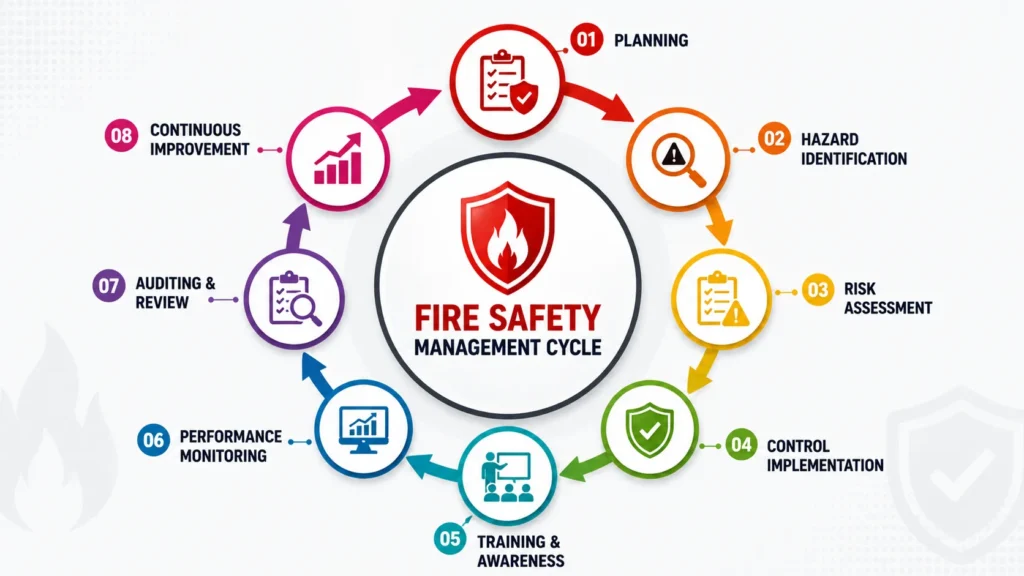
The infographic reinforces the importance of continuous improvement and demonstrates how each stage contributes to a proactive fire safety management system.
UK Fire Safety Legislation
Senior Fire Safety Advisors must understand the legal framework governing workplace fire safety in the UK. Their role includes helping organisations interpret legislation, implement appropriate control measures, and maintain ongoing compliance.
Key legislation includes:
| Legislation | Purpose |
|---|---|
| Regulatory Reform (Fire Safety) Order 2005 | Defines fire safety responsibilities for the Responsible Person |
| Fire Safety Act 2021 | Strengthens fire risk assessment requirements |
| Building Safety Act 2022 | Improves accountability for higher-risk buildings |
| Health and Safety at Work etc. Act 1974 | Requires employers to provide safe working environments |
| Dangerous Substances and Explosive Atmospheres Regulations (DSEAR) | Controls fire and explosion risks associated with hazardous substances |
A strong understanding of these regulations enables Senior Fire Safety Advisors to provide informed guidance, support organisational governance, and promote safer workplaces.
Industries That Employ Senior Fire Safety Advisors
One of the greatest advantages of becoming a Senior Fire Safety Advisor is the diversity of career opportunities available across the UK. Every organisation has a legal responsibility to protect people and property from fire risks, making qualified professionals valuable across both public and private sectors.
As fire safety legislation becomes more demanding and workplace environments become increasingly complex, employers seek experienced professionals who can develop fire safety strategies, manage compliance programmes, and improve organisational resilience.
Construction
Construction remains one of the UK’s largest employers of fire safety professionals. Construction sites involve temporary electrical installations, hot work operations, combustible materials, and changing site conditions that require continuous fire risk management.
Senior Fire Safety Advisors may be responsible for:
- Developing site fire safety plans
- Conducting fire risk assessments
- Monitoring temporary fire protection
- Reviewing emergency procedures
- Supporting regulatory inspections
- Advising project managers
Manufacturing
Manufacturing facilities often contain machinery, combustible materials, flammable liquids, hazardous chemicals, and high-temperature production processes.
Fire safety professionals support manufacturers by:
- Managing fire risk assessments
- Inspecting fire protection systems
- Developing emergency response plans
- Reducing operational risks
- Training production staff
- Monitoring compliance
Healthcare
Hospitals, clinics, care homes, and medical facilities require specialist fire safety management because many occupants require assisted evacuation during emergencies.
Senior Fire Safety Advisors help healthcare organisations by:
- Developing evacuation strategies
- Reviewing compartmentation
- Coordinating emergency drills
- Supporting patient safety
- Managing fire protection systems
- Ensuring legal compliance
Oil and Gas
Oil refineries, offshore facilities, fuel storage terminals, and chemical plants require advanced fire safety expertise due to the presence of highly flammable substances.
Responsibilities include:
- Explosion prevention
- Hazardous area inspections
- Emergency planning
- Fire suppression strategy
- Regulatory compliance
- Incident investigation
Education
Schools, colleges, and universities require robust fire safety programmes to protect students, staff, visitors, and educational facilities.
Senior Fire Safety Advisors assist by:
- Coordinating evacuation procedures
- Managing fire risk assessments
- Supporting compliance
- Delivering awareness programmes
- Reviewing fire protection systems
Hospitality
Hotels, restaurants, entertainment venues, and conference centres accommodate large numbers of people, making effective fire safety management essential.
Typical responsibilities include:
- Guest evacuation planning
- Kitchen fire prevention
- Emergency response planning
- Fire safety inspections
- Staff training
Logistics and Warehousing
Warehouses, distribution centres, and transport hubs present unique fire hazards due to high storage densities, automated systems, and combustible goods.
Fire safety professionals manage:
- Storage risk assessments
- Fire detection systems
- Warehouse inspections
- Emergency preparedness
- Compliance monitoring
Commercial Property and Facilities Management
Office buildings, shopping centres, airports, and mixed-use developments rely on Senior Fire Safety Advisors to oversee fire safety across multiple buildings and occupants.
Industries That Employ Senior Fire Safety Advisors
| Industry | Typical Responsibilities |
|---|---|
| Construction | Site fire safety and compliance |
| Manufacturing | Fire prevention and audits |
| Healthcare | Patient evacuation planning |
| Oil & Gas | Explosion prevention |
| Education | Campus fire safety |
| Hospitality | Guest safety management |
| Logistics | Warehouse fire protection |
| Facilities Management | Building compliance |
| Aviation | Airport fire safety |
| Government | Public sector compliance |
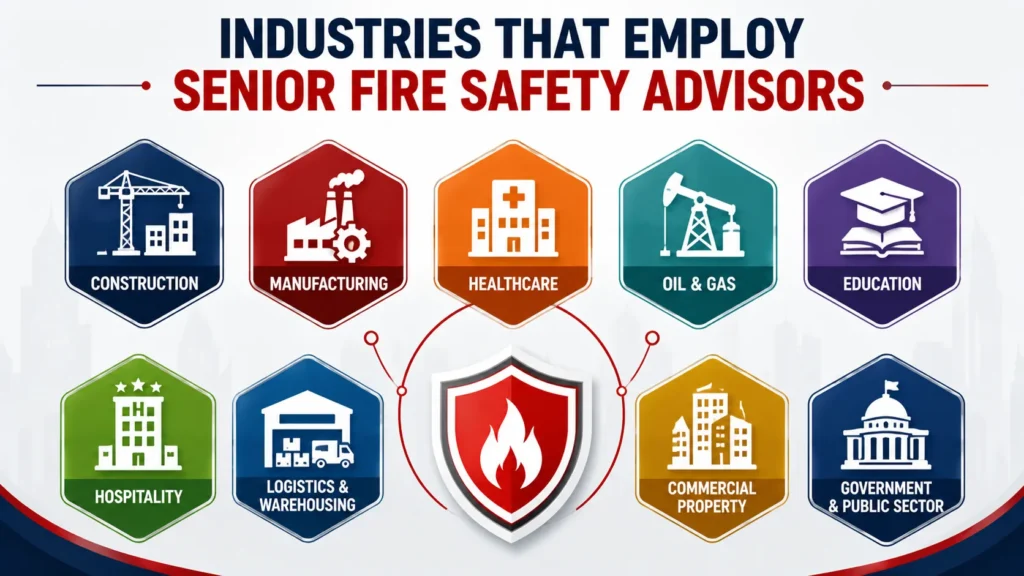
This visual demonstrates the wide range of industries where qualified Senior Fire Safety Advisors are in demand and reinforces the versatility of the profession.
What Employers Look For
Employers recruit Senior Fire Safety Advisors who combine technical expertise with leadership and strategic thinking. Beyond qualifications, organisations value professionals who can improve safety performance, reduce organisational risk, and influence decision-making.
Key qualities include:
- Recognised fire safety qualifications
- Practical workplace experience
- Fire risk assessment competence
- Strong communication skills
- Leadership ability
- Problem-solving capability
- Compliance knowledge
- Report writing skills
- Team management
- Continuous professional development
Professionals who demonstrate these qualities are well positioned for senior leadership opportunities across multiple industries.
Career Progression
Fire safety offers excellent long-term career prospects. Most professionals begin with operational responsibilities before progressing into advisory and management positions.
Career Progression Pathway
Fire Safety Awareness
↓
Fire Warden
↓
Fire Marshal
↓
Fire Safety Officer
↓
Senior Fire Safety Advisor
↓
Fire Safety Manager
↓
Fire Safety Consultant
↓
Head of Fire Safety
↓
Director of Health, Safety & Fire
Each stage introduces greater responsibility, broader organisational influence, and increased leadership opportunities.
Salary Expectations in the UK
Earning potential depends on qualifications, experience, employer, location, and industry. Senior positions generally command higher salaries because they involve organisational leadership, strategic planning, and compliance management.
| Career Level | Salary Potential* |
|---|---|
| Fire Warden | Entry-level responsibility |
| Fire Marshal | Foundation-level role |
| Fire Safety Officer | Competitive professional salary |
| Senior Fire Safety Advisor | Higher professional salary |
| Fire Safety Manager | Senior management salary |
| Fire Safety Consultant | Consultancy earnings vary by experience |
| Head of Fire Safety | Executive-level remuneration |
*Actual salaries vary depending on employer, industry, geographic location, and professional experience.
Why Employers Value Senior Fire Safety Advisors
Modern organisations increasingly recognise that fire safety contributes directly to business resilience rather than simply satisfying legal obligations.
Senior Fire Safety Advisors help organisations:
- Reduce fire risks
- Improve legal compliance
- Protect employees
- Safeguard business assets
- Strengthen emergency preparedness
- Reduce operational downtime
- Improve insurance confidence
- Build a positive safety culture
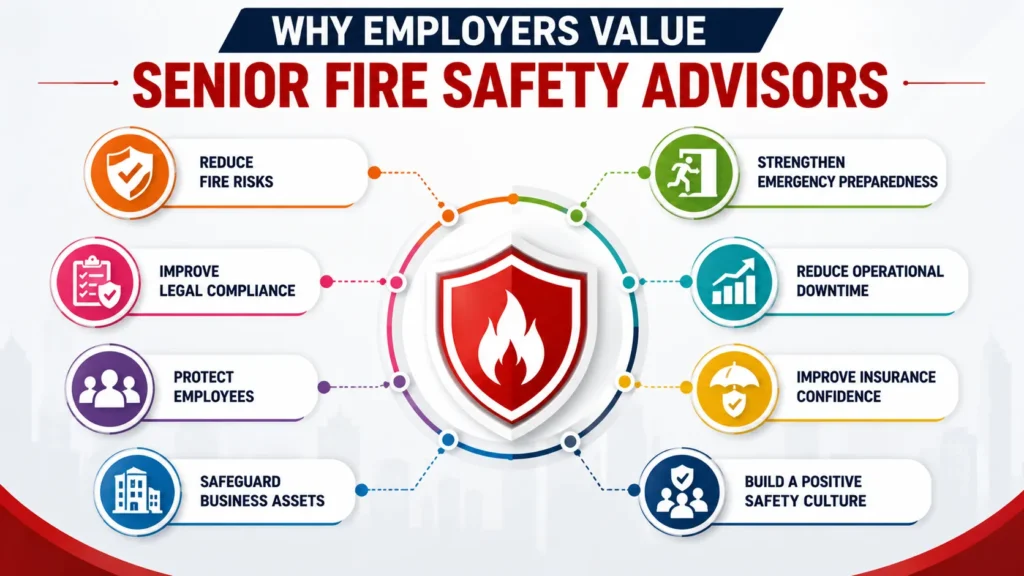
The infographic provides a clear visual summary of the organisational benefits delivered by experienced fire safety leaders.
Future Trends in Fire Safety
Fire safety continues to evolve rapidly as organisations adopt digital technologies and smarter methods of managing risk. Senior Fire Safety Advisors who understand these innovations will be increasingly valuable.
Artificial Intelligence (AI)
AI-powered fire detection systems analyse smoke patterns, heat signatures, and surveillance footage to identify fire incidents earlier and support faster emergency responses.
Internet of Things (IoT)
Connected sensors continuously monitor fire alarms, sprinklers, extinguishers, emergency lighting, and environmental conditions, allowing predictive maintenance and real-time monitoring.
Smart Buildings
Modern buildings integrate fire safety systems with intelligent building management platforms that automate monitoring, emergency communications, and evacuation support.
Building Information Modelling (BIM)
BIM technology enables fire safety professionals to evaluate evacuation routes, fire compartmentation, protection systems, and building layouts throughout the entire building lifecycle.
Digital Compliance
Cloud-based inspection software, mobile auditing applications, digital maintenance records, and automated reporting improve compliance management and support more efficient regulatory inspections.
Sustainability and Renewable Energy
Electric vehicle charging infrastructure, lithium-ion battery storage, solar energy systems, and modern construction materials introduce new fire safety challenges that require specialist knowledge and updated risk management strategies.
Professionals who embrace these technologies will be well positioned for future leadership opportunities.
Why the ICTQual Level 4 Diploma Senior Fire Safety Advisor Supports Career Growth
The ICTQual Level 4 Diploma Senior Fire Safety Advisor equips professionals with advanced knowledge and practical skills needed to manage complex fire safety programmes.
The qualification helps learners:
- Develop advanced fire safety expertise
- Conduct professional fire risk assessments
- Understand UK fire safety legislation
- Improve leadership capabilities
- Strengthen compliance management
- Enhance emergency planning
- Support organisational resilience
- Prepare for senior fire safety roles
Related Fire Safety Courses
| Related Course | Purpose |
|---|---|
| ICTQual Level 4 Diploma Senior Fire Safety Advisor | Advanced fire safety leadership |
| Fire Risk Assessment Course | Practical fire risk assessment |
| Fire Marshal Training | Workplace emergency response |
| Health and Safety Management Courses | Occupational safety leadership |
| Risk Assessment Training | Hazard identification and control |
Conclusion
Becoming a Senior Fire Safety Advisor in the UK is an excellent career choice for professionals who are passionate about protecting lives, improving workplace safety, and supporting organisational resilience. The role extends far beyond routine fire prevention activities, combining technical expertise with leadership, strategic planning, regulatory compliance, and continuous improvement.
As organisations continue to strengthen fire safety management in response to evolving legislation, technological innovation, and increasing public expectations, the demand for competent Senior Fire Safety Advisors will continue to grow across construction, manufacturing, healthcare, education, hospitality, logistics, oil and gas, government, and commercial property sectors.
A successful career begins with developing a strong foundation in fire safety, gaining practical workplace experience, completing recognised qualifications such as the ICTQual Level 4 Diploma Senior Fire Safety Advisor, and committing to continuous professional development. By building expertise in fire risk assessment, emergency planning, fire protection systems, and leadership, professionals can progress into influential roles that shape organisational safety strategies and protect people, property, and business operations.
Whether your ambition is to become a Fire Safety Manager, Fire Safety Consultant, or Head of Fire Safety, investing in the right qualifications and continuously expanding your knowledge will help you build a rewarding and future-focused career in one of the UK’s most essential health and safety professions.
Explore More Fire Safety & Risk Assessment Articles
Discover expert guides on fire safety careers, fire risk assessments, workplace compliance, fire protection systems, and professional qualifications to expand your knowledge and advance your career in fire safety.
- What is Fire Safety?
- Fire Risk Assessment
- Fire Safety Equipment
- Fire Safety: Essential Tips for Homes and Workplaces
- Industrial Fire Safety: Complete Guide to Risk Assessment, Hazards & Prevention (2026)
- Fire Safety Training (2026): Complete Guide, Certification & Workplace Safety
- Level 4 Diploma in Fire Safety: Complete Guide to Career Growth, Skills, Compliance, and Professional Certification
- What Does a Senior Fire Safety Advisor Do? Roles, Responsibilities, and Career Guide
- Senior Fire Safety Advisor vs Fire Risk Assessor: Which Career Is Right for You?
- Senior Fire Safety Advisor Career Progression: Exciting Roles, Salary & Leadership Path
- Is Fire Safety a Good Career Choice in the UK?
- Top Skills Every Senior Fire Safety Advisor Should Develop
- The 5 Essential Steps of Fire Risk Assessment Explained
- Fire Risk Assessment Explained: A Complete Beginner’s Guide
- Qualified Fire Risk Assessor Career Guide: Training, Skills, and Job Opportunities
- How Fire Safety and Risk Assessment Reduce Workplace Hazards
- Fire Safety Planning and Risk Assessment for Businesses
- How to Conduct an Effective Risk Assessment Step by Step
- Fire Safety Checklist for Homes, Offices & Commercial Buildings
- Common Risk Assessment Mistakes and How to Avoid Them
- Failed a Fire Safety Inspection? Here’s What Happens Next