
Fire Safety Checklist for Homes, Offices & Commercial Buildings
Fire safety is one of the most important responsibilities for homeowners, employers, landlords, property managers, and business owners. A well-planned fire safety checklist helps identify potential hazards before they become emergencies, protects lives and property, and supports compliance with UK fire safety legislation. Whether managing a family home, a busy office, or a large commercial building, regular fire safety inspections reduce risks and improve emergency preparedness.
Many fires are preventable. Common causes such as faulty electrical equipment, unattended cooking, overloaded sockets, blocked escape routes, and poorly maintained fire protection systems can all be identified through routine inspections. A structured fire safety checklist ensures that smoke alarms, fire extinguishers, emergency exits, fire doors, emergency lighting, and evacuation procedures remain effective at all times.
For businesses in the UK, carrying out regular fire safety checks is not only good practice but also a legal responsibility under the Regulatory Reform (Fire Safety) Order 2005. Responsible Persons must assess fire risks, implement appropriate control measures, and maintain fire safety equipment. Residential property owners also benefit from regular inspections by improving family safety and reducing property damage.
This comprehensive guide explains everything needed to create and maintain an effective fire safety checklist for homes, offices, and commercial buildings. It also provides practical inspection schedules, maintenance guidance, common mistakes to avoid, and best practices that support safer environments for occupants and visitors.
What Is a Fire Safety Checklist?
A fire safety checklist is a structured inspection tool used to verify that fire prevention measures, fire protection equipment, and emergency procedures are in place and functioning correctly. It helps identify hazards before they develop into serious risks and ensures that buildings remain safe for occupants.
Unlike a one-time inspection, a fire safety checklist is designed for continuous monitoring. It provides a systematic approach for checking fire alarms, smoke detectors, fire extinguishers, emergency lighting, escape routes, fire doors, electrical installations, housekeeping standards, and emergency evacuation procedures.
Quick Definition
| Term | Definition |
|---|---|
| Fire Safety Checklist | A structured list of inspections used to verify that fire prevention and protection measures are working correctly. |
An effective checklist supports:
- Fire prevention
- Early fire detection
- Safe evacuation
- Legal compliance
- Protection of people and property
- Reduced business disruption
Why Every Building Needs a Fire Safety Checklist
Regardless of the building type, fire risks exist wherever electricity, heat sources, combustible materials, or human activity are present. A routine inspection programme significantly reduces these risks by identifying issues before they escalate.
Benefits of Using a Fire Safety Checklist
| Benefit | Why It Matters |
|---|---|
| Protects Lives | Reduces the likelihood of injuries and fatalities. |
| Prevents Property Damage | Identifies hazards before they cause costly incidents. |
| Supports Legal Compliance | Helps meet UK fire safety regulations. |
| Improves Emergency Preparedness | Ensures occupants know how to respond during emergencies. |
| Reduces Insurance Risks | Demonstrates proactive fire risk management. |
| Maintains Business Continuity | Minimises downtime following fire-related incidents. |
Regular inspections also help organisations build a stronger safety culture where employees understand their responsibilities and actively contribute to maintaining safe workplaces.
UK Fire Safety Responsibilities
Fire safety responsibilities vary depending on the type of building, but every property should have someone accountable for maintaining fire safety standards.
For workplaces and commercial premises, the Responsible Person must:
- Carry out fire risk assessments.
- Identify fire hazards.
- Maintain fire safety equipment.
- Keep escape routes unobstructed.
- Ensure emergency lighting functions correctly.
- Provide staff with fire safety training.
- Develop emergency evacuation procedures.
- Review fire safety arrangements regularly.
For homeowners, responsibilities include maintaining smoke alarms, checking electrical safety, storing flammable materials correctly, and creating an evacuation plan for family members.
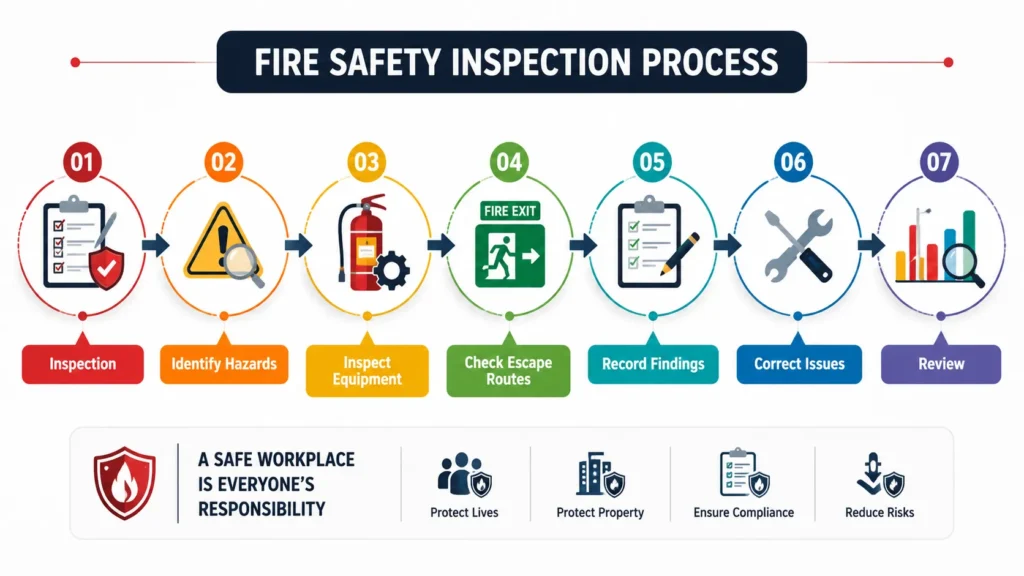
Fire Safety Checklist Flow
Inspection Planning
↓
Identify Fire Hazards
↓
Inspect Fire Protection Equipment
↓
Check Escape Routes
↓
Verify Emergency Procedures
↓
Record Findings
↓
Correct Identified Issues
↓
Review and Repeat Regularly
This structured approach ensures continuous improvement rather than relying on occasional inspections.
Essential Fire Safety Equipment Checklist
Every building should contain appropriate fire safety equipment suitable for its size, occupancy, and level of risk.
| Equipment | Home | Office | Commercial Building |
|---|---|---|---|
| Smoke Alarms | ✔ | ✔ | ✔ |
| Fire Alarm System | Optional | ✔ | ✔ |
| Fire Extinguishers | Recommended | ✔ | ✔ |
| Fire Blankets | ✔ | Kitchen Areas | Kitchen Areas |
| Emergency Lighting | Optional | ✔ | ✔ |
| Fire Doors | Some Properties | ✔ | ✔ |
| Fire Exit Signs | Not Usually Required | ✔ | ✔ |
| Evacuation Plans | ✔ | ✔ | ✔ |
| First Aid Kit | ✔ | ✔ | ✔ |
Each item should be inspected routinely to ensure it remains fully operational.
Fire Safety Checklist for Homes
Although residential properties are generally smaller than workplaces, they present numerous fire hazards. Most house fires occur because of everyday activities, making routine inspections essential.
Smoke Alarms
Install smoke alarms on every level of the home.
Check that alarms:
- Are securely mounted.
- Produce an audible warning.
- Have functioning batteries.
- Are tested every month.
- Are replaced according to manufacturer recommendations.
Electrical Safety
Inspect:
- Damaged electrical cables.
- Overloaded extension leads.
- Faulty plugs.
- Loose sockets.
- Portable heaters.
- Appliance condition.
Never overload power sockets or use damaged electrical equipment.
Kitchen Fire Safety
The kitchen remains one of the highest-risk areas for domestic fires.
Inspect:
- Cooker cleanliness
- Cooking appliances
- Fire blanket availability
- Gas appliances
- Extractor filters
- Cooking supervision procedures
Avoid leaving cooking unattended and keep combustible materials away from heat sources.
Heating Equipment
Ensure:
- Portable heaters remain clear of furniture.
- Chimneys are cleaned regularly.
- Boilers receive scheduled servicing.
- Fireplaces are properly maintained.
Home Fire Safety Checklist
| Inspection Item | Status |
|---|---|
| Smoke alarms tested | □ |
| Carbon monoxide alarm checked | □ |
| Electrical wiring inspected | □ |
| Escape routes clear | □ |
| Fire blanket available | □ |
| Emergency contacts accessible | □ |
| Family evacuation plan reviewed | □ |
| Heating appliances inspected | □ |
Fire Safety Checklist for Offices
Office environments may appear to have a lower fire risk than industrial premises, but they contain numerous hazards, including electrical equipment, paper records, kitchen appliances, server rooms, and high occupant density. A proactive fire safety checklist helps employers create a safer workplace while meeting legal obligations under UK fire safety legislation.
Regular inspections should focus on prevention, early detection, and safe evacuation. Every employee should know how to report hazards, raise the alarm, and evacuate safely during an emergency.
Office Fire Safety Inspection Checklist
| Inspection Area | What to Check | Recommended Frequency |
|---|---|---|
| Fire Alarm System | Alarm operates correctly and call points are accessible | Weekly |
| Smoke Detectors | Clean, unobstructed and fully operational | Monthly |
| Fire Extinguishers | Correct type, accessible, serviced and pressure checked | Monthly |
| Emergency Lighting | Illuminates escape routes during power failure | Monthly |
| Fire Doors | Self-closing correctly and not wedged open | Weekly |
| Escape Routes | Free from obstructions and clearly marked | Daily |
| Electrical Equipment | No damaged cables or overloaded sockets | Weekly |
| Kitchen Area | Appliances switched off, clean and free from grease | Daily |
| Fire Exit Signs | Clearly visible and illuminated where required | Monthly |
| Assembly Point | Clearly identified and communicated to staff | Quarterly |
Reception and Visitor Areas
Reception areas are often the first point of entry and should remain organised and free from unnecessary fire hazards.
Inspect:
- Emergency exits remain unlocked during occupancy.
- Fire alarm call points are visible.
- Fire exit signage is clearly displayed.
- Visitor evacuation procedures are available.
- Reception staff understand emergency procedures.
Open-Plan Office Areas
Open workspaces typically contain numerous electrical devices and combustible materials.
Check:
- Computers are switched off after working hours where appropriate.
- Extension leads are not overloaded.
- Portable heaters are used safely.
- Paper storage is kept away from heat sources.
- Walkways remain clear.
- Fire extinguishers are easily accessible.
Meeting Rooms
Meeting rooms should be included in routine inspections.
Verify:
- Exit doors open freely.
- Occupancy limits are respected.
- Emergency lighting functions correctly.
- Fire safety signage remains visible.
- Electrical presentation equipment is safely maintained.
Server Rooms and IT Facilities
Server rooms present a higher fire risk because of continuous electrical operation.
Inspect:
- Ventilation systems.
- Cable management.
- Fire suppression systems.
- Electrical panels.
- UPS equipment.
- Restricted access controls.
Avoid storing cardboard boxes, paper files or cleaning materials inside server rooms.
Office Fire Safety Flowchart
Daily Visual Inspection
↓
Check Escape Routes
↓
Inspect Fire Doors
↓
Verify Fire Alarm Indicators
↓
Confirm Fire Extinguishers Are Accessible
↓
Identify Hazards
↓
Record Findings
↓
Report Defects
↓
Correct Issues
↓
Review During Next Inspection
This routine creates consistency and ensures hazards are addressed promptly.
Fire Safety Checklist for Commercial Buildings
Commercial buildings vary significantly in size and complexity. Shopping centres, warehouses, hotels, hospitals, schools, factories and mixed-use premises all require tailored fire safety management.
Because these buildings often accommodate large numbers of people, inspections should be more detailed and supported by documented maintenance programmes.
Commercial Building Fire Safety Checklist
| Inspection Item | Yes | No | Action Required |
|---|---|---|---|
| Fire alarm operational | □ | □ | |
| Smoke detection working | □ | □ | |
| Emergency lighting functional | □ | □ | |
| Fire doors closing correctly | □ | □ | |
| Escape routes unobstructed | □ | □ | |
| Fire extinguishers serviced | □ | □ | |
| Sprinkler system operational | □ | □ | |
| Fire signage visible | □ | □ | |
| Staff trained | □ | □ | |
| Evacuation plan displayed | □ | □ |
Warehouse Fire Safety
Warehouses contain high fire loads due to stored goods and packaging materials.
Inspect:
- Storage heights.
- Aisle widths.
- Forklift charging areas.
- Flammable material storage.
- Electrical installations.
- Emergency exits.
- Sprinkler protection.
- Fire compartmentation.
Storage should never block sprinkler heads or emergency exits.
Retail Stores
Retail premises experience continuous customer movement.
Routine inspections should include:
- Display arrangements.
- Emergency exits.
- Fire alarm call points.
- Electrical display equipment.
- Decorative lighting.
- Stockroom housekeeping.
- Fire doors.
- Staff awareness.
Hotels
Hotels require additional attention because guests may be unfamiliar with evacuation procedures.
Inspect:
- Guest room smoke alarms.
- Fire doors.
- Escape route signage.
- Emergency lighting.
- Kitchen fire suppression systems.
- Laundry facilities.
- Housekeeping practices.
Schools and Educational Buildings
Educational facilities should prioritise occupant safety through regular inspections.
Check:
- Classroom exits.
- Science laboratories.
- Assembly halls.
- Electrical equipment.
- Kitchen facilities.
- Fire alarm systems.
- Staff training records.
- Student evacuation procedures.
Healthcare Facilities
Hospitals and care homes require specialised evacuation planning because some occupants may have limited mobility.
Inspect:
- Refuge areas.
- Fire compartmentation.
- Evacuation chairs.
- Oxygen storage.
- Medical gas systems.
- Emergency communication systems.
Common Fire Hazards Found During Inspections
Many fires begin because small hazards remain unnoticed over time. Routine inspections help identify these issues before they develop into emergencies.
Electrical Hazards
Common examples include:
- Overloaded extension leads.
- Damaged electrical cables.
- Loose sockets.
- Faulty appliances.
- Portable heaters positioned too close to combustible materials.
Combustible Materials
Poor housekeeping significantly increases fire risk.
Examples include:
- Paper waste.
- Cardboard packaging.
- Wooden pallets.
- Cleaning materials.
- Textiles.
- Plastic storage.
These materials should be stored safely and disposed of regularly.
Blocked Escape Routes
Escape routes must remain clear at all times.
Never allow:
- Furniture.
- Deliveries.
- Waste bins.
- Storage boxes.
- Equipment.
- Temporary displays.
to obstruct emergency exits.
Faulty Fire Protection Equipment
Inspection findings often identify:
- Empty fire extinguishers.
- Expired servicing dates.
- Damaged smoke detectors.
- Broken emergency lighting.
- Missing fire signs.
These issues should be corrected immediately.
Fire Hazard Risk Assessment Matrix
| Hazard | Likelihood | Consequence | Priority |
|---|---|---|---|
| Faulty Wiring | High | High | Immediate Action |
| Blocked Fire Exit | High | High | Immediate Action |
| Expired Fire Extinguisher | Medium | High | High Priority |
| Poor Housekeeping | Medium | Medium | Medium Priority |
| Missing Fire Signage | Low | Medium | Routine Action |
| Damaged Emergency Lighting | Medium | High | High Priority |
Using a simple risk matrix helps organisations prioritise corrective actions based on both likelihood and potential impact.
Fire Safety Inspection Best Practice
A thorough inspection should follow a consistent sequence to avoid overlooking critical areas.
Inspection Preparation
↓
Review Previous Inspection Records
↓
Walk Through the Entire Building
↓
Identify Fire Hazards
↓
Inspect Fire Protection Systems
↓
Check Escape Routes
↓
Verify Emergency Equipment
↓
Record Deficiencies
↓
Assign Corrective Actions
↓
Complete Follow-Up Inspection
Maintaining this structured inspection process improves consistency, supports compliance, and helps create a safer environment for occupants.
Fire Safety Maintenance Schedule
A fire safety checklist is only effective when inspections are carried out consistently. Fire protection equipment can deteriorate over time, emergency exits may become obstructed, and workplace layouts often change. Establishing a planned maintenance schedule ensures that every aspect of fire safety is reviewed at appropriate intervals.
The table below provides a practical maintenance schedule suitable for homes, offices, and commercial buildings.
| Frequency | Inspection Activities |
|---|---|
| Daily | Check escape routes, emergency exits, housekeeping standards, and identify visible fire hazards. |
| Weekly | Test fire alarm systems, inspect fire doors, verify emergency exits are accessible, and check fire alarm call points. |
| Monthly | Test smoke alarms, inspect fire extinguishers, check emergency lighting, and review electrical safety. |
| Quarterly | Conduct evacuation drills, inspect safety signage, review staff training records, and assess emergency procedures. |
| Annually | Complete a comprehensive fire risk assessment, service fire protection systems, inspect electrical installations, and update emergency plans. |
Following a structured schedule helps ensure that no critical inspection is overlooked while supporting continuous compliance with fire safety requirements.
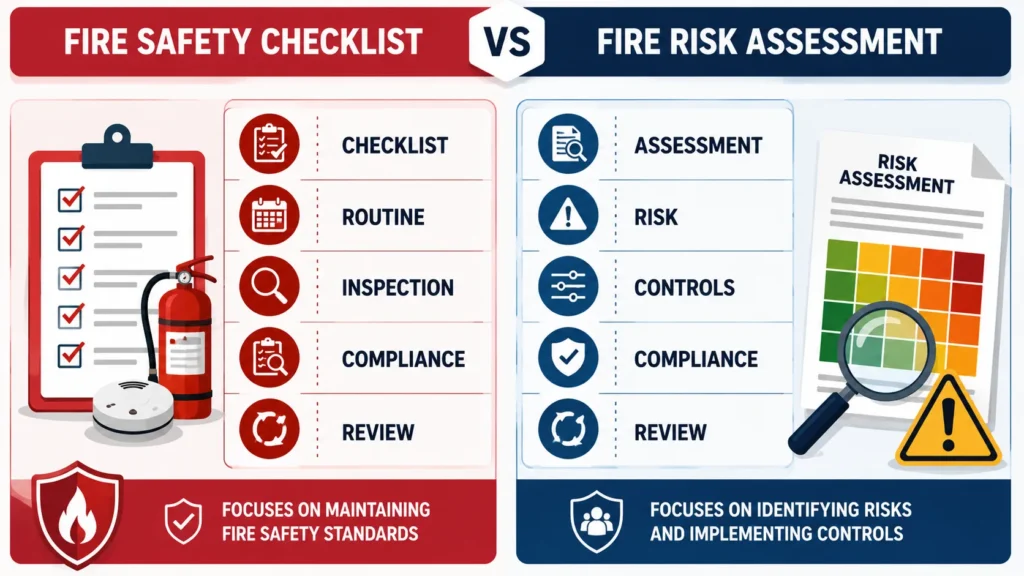
Fire Safety Checklist vs Fire Risk Assessment
Many people mistakenly believe that a fire safety checklist and a fire risk assessment are the same. While they are closely related, they serve different purposes.
A fire safety checklist focuses on routine inspections to confirm that fire prevention measures and emergency systems remain effective.
A fire risk assessment is a formal evaluation that identifies fire hazards, assesses the level of risk, determines who may be affected, and recommends appropriate control measures.
Comparison Table
| Fire Safety Checklist | Fire Risk Assessment |
|---|---|
| Routine inspection tool | Formal risk assessment process |
| Conducted regularly | Reviewed periodically or when significant changes occur |
| Confirms equipment and procedures are working | Identifies hazards and evaluates risks |
| Focuses on maintenance | Focuses on prevention and risk reduction |
| Suitable for daily or weekly use | Forms part of legal compliance for many workplaces |
| Records inspection findings | Documents hazards, risks, and recommended actions |
The two processes work together. Regular inspections help maintain fire safety standards, while fire risk assessments provide the strategic framework for managing fire risks across the building.
Common Fire Safety Mistakes to Avoid
Even organisations with established fire safety procedures can overlook important details. Identifying these common mistakes helps prevent unnecessary risks.
Ignoring Small Electrical Faults
Loose sockets, damaged cables, overheating equipment, and overloaded extension leads are often ignored because they appear minor. However, electrical faults remain one of the leading causes of building fires.
Electrical defects should be reported and repaired immediately rather than being left until scheduled maintenance.
Blocking Emergency Exits
Emergency exits should never be used as temporary storage areas.
Common obstructions include:
- Cardboard boxes
- Cleaning equipment
- Office furniture
- Deliveries
- Stock
- Waste containers
Even partial obstructions can delay evacuation during an emergency.
Failing to Test Fire Alarms
Installing fire alarms is only part of maintaining fire safety.
Routine testing verifies that:
- Alarm sounders operate correctly.
- Detection devices function properly.
- Occupants recognise the alarm signal.
- Fault indicators are identified promptly.
Poor Housekeeping
Accumulated waste significantly increases the available fuel during a fire.
Good housekeeping includes:
- Removing combustible waste daily.
- Keeping storage rooms organised.
- Separating flammable materials.
- Maintaining clear walkways.
- Cleaning kitchen areas regularly.
Inadequate Staff Training
Fire safety equipment is only effective when occupants know how to respond appropriately.
Training should cover:
- Raising the alarm.
- Evacuation procedures.
- Fire extinguisher awareness.
- Assembly point locations.
- Reporting hazards.
Regular refresher training reinforces knowledge and improves confidence during emergencies.
Emergency Evacuation Checklist
A successful evacuation depends on preparation rather than improvisation.
Every building should have a documented emergency evacuation plan that is understood by all occupants.
Essential Evacuation Checklist
| Checklist Item | Complete |
|---|---|
| Emergency exits clearly marked | □ |
| Escape routes unobstructed | □ |
| Assembly point identified | □ |
| Emergency contacts displayed | □ |
| Fire wardens appointed (where applicable) | □ |
| Visitors included in evacuation procedures | □ |
| Disabled evacuation arrangements available | □ |
| Fire drills conducted regularly | □ |
| Evacuation plan reviewed annually | □ |
Evacuation plans should also consider contractors, visitors, customers, and individuals with reduced mobility.
Emergency Evacuation Process
Fire Detected
↓
Raise the Fire Alarm
↓
Notify Emergency Services
↓
Stop Work Immediately
↓
Leave the Building Using the Nearest Safe Exit
↓
Do Not Use Lifts
↓
Proceed to the Assembly Point
↓
Account for Occupants
↓
Await Instructions from Emergency Services
This simple process helps reduce confusion and promotes an orderly evacuation during an emergency.
Building-Specific Fire Safety Priorities
Although many fire safety principles apply to every property, each type of building presents unique challenges.
Home Fire Safety Priorities
Focus on:
- Smoke alarms
- Cooking safety
- Electrical safety
- Heating appliances
- Family escape plans
- Safe storage of flammable materials
Office Fire Safety Priorities
Focus on:
- Fire alarm systems
- Fire doors
- Emergency lighting
- Staff awareness
- Electrical equipment
- Server rooms
- Escape routes
Commercial Building Priorities
Focus on:
- Fire compartmentation
- Sprinkler systems
- Occupant management
- Large-scale evacuation
- Fire safety documentation
- Maintenance records
- Contractor management
Fire Safety Equipment Inspection Guide
Every piece of fire protection equipment should be inspected according to manufacturer recommendations and relevant standards.
| Equipment | What to Inspect |
|---|---|
| Smoke Alarm | Test button, battery, cleanliness, expiry date |
| Fire Alarm Panel | Fault indicators, zone status, power supply |
| Fire Extinguisher | Pressure gauge, safety pin, service label, accessibility |
| Fire Blanket | Packaging condition and accessibility |
| Emergency Lighting | Illumination, battery backup, damage |
| Fire Doors | Self-closing mechanism, seals, signage, damage |
| Fire Exit Signs | Visibility, lighting, positioning |
| Sprinkler System | Obstructions, valves, maintenance records |
Routine inspections improve reliability and ensure equipment performs effectively during an emergency.
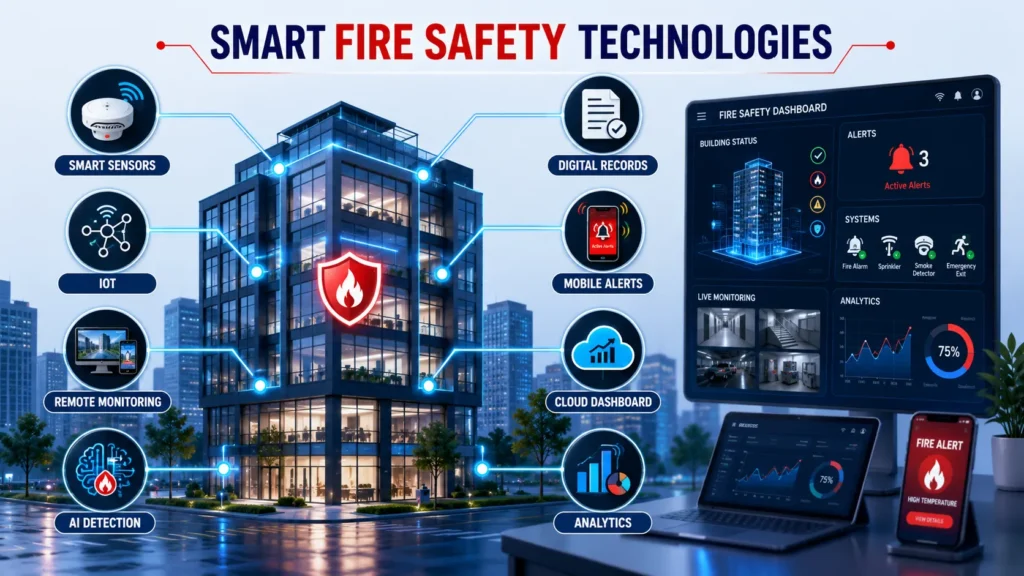
Smart Fire Safety Technologies
Technology continues to improve the way buildings prevent, detect, and respond to fires. Modern fire safety systems provide faster detection, better monitoring, and improved maintenance planning.
Examples include:
Smart Smoke Detection
Modern detectors can:
- Detect smoke earlier.
- Reduce false alarms.
- Send remote notifications.
- Integrate with building management systems.
Internet of Things (IoT) Fire Monitoring
Connected fire safety devices allow facility managers to monitor multiple systems from a central dashboard.
Benefits include:
- Real-time alerts.
- Predictive maintenance.
- Remote diagnostics.
- Faster response times.
Intelligent Emergency Lighting
Smart emergency lighting systems automatically perform self-tests, reducing manual inspection requirements while providing detailed maintenance reports.
Digital Fire Safety Records
Replacing paper records with digital inspection systems offers several advantages:
- Faster reporting.
- Improved compliance.
- Historical inspection tracking.
- Easier corrective action management.
- Better audit preparation.
Organisations adopting digital fire safety management often achieve greater consistency and improved regulatory compliance.
Creating a Fire Safety Culture
Fire safety should become part of everyday operations rather than being viewed as a once-a-year compliance exercise.
A positive fire safety culture encourages everyone within the building to recognise hazards, report concerns promptly, and follow established procedures.
Successful organisations achieve this by:
- Promoting regular fire safety awareness.
- Encouraging hazard reporting.
- Providing ongoing training.
- Conducting realistic fire drills.
- Reviewing lessons learned after inspections and exercises.
- Recognising employees who contribute to safer workplaces.
When fire safety becomes a shared responsibility, the likelihood of incidents decreases significantly while improving confidence among staff, residents, and visitors.
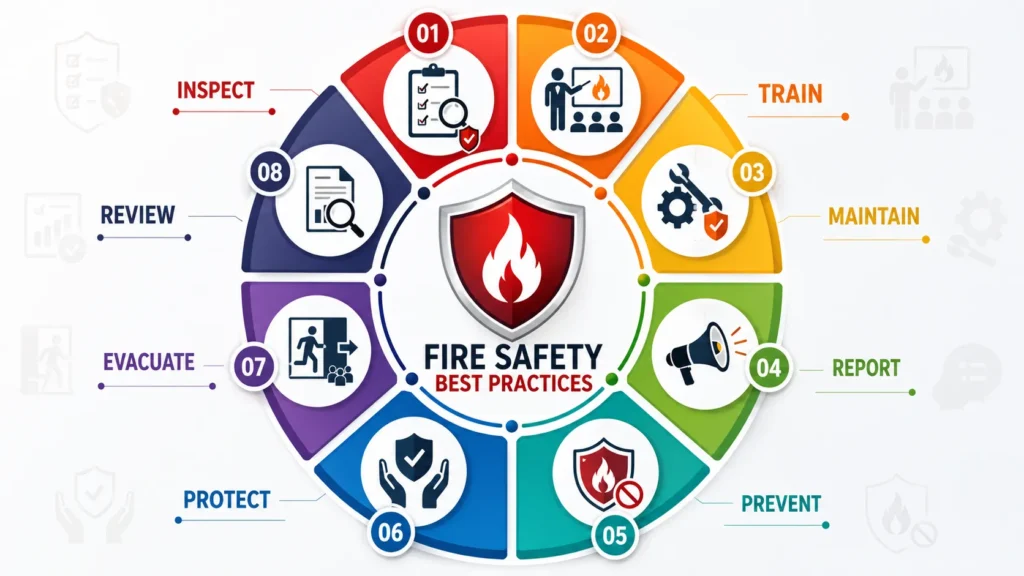
Fire Safety Best Practices for Every Building
An effective fire safety checklist is most valuable when supported by consistent best practices. Whether managing a family home, a corporate office, or a large commercial facility, adopting a proactive approach helps reduce fire risks and improves emergency preparedness.
Consider implementing the following best practices:
- Carry out regular fire safety inspections.
- Review and update fire risk assessments when building layouts or occupancy change.
- Test smoke alarms and fire alarm systems according to the recommended schedule.
- Ensure fire extinguishers are correctly located, maintained, and accessible.
- Keep emergency exits and escape routes clear at all times.
- Store flammable liquids and combustible materials safely.
- Maintain electrical installations and replace damaged equipment promptly.
- Train occupants on fire prevention and emergency evacuation procedures.
- Conduct regular fire drills and review the outcomes.
- Keep accurate maintenance and inspection records.
Embedding these practices into everyday operations creates a safer environment and helps demonstrate a commitment to protecting people, property, and business continuity.
Building a Fire Safety Inspection Programme
An organised inspection programme ensures that fire safety remains an ongoing process rather than a reactive response.
Fire Safety Inspection Workflow
Create Inspection Schedule
↓
Assign Responsible Person
↓
Inspect Building Areas
↓
Identify Fire Hazards
↓
Assess Risk Level
↓
Record Findings
↓
Implement Corrective Actions
↓
Verify Improvements
↓
Maintain Inspection Records
↓
Repeat According to Schedule
Following this structured workflow supports continuous improvement and makes it easier to identify recurring issues before they become significant risks.
Fire Safety Documentation Checklist
Maintaining accurate documentation is essential for demonstrating compliance, supporting audits, and improving fire safety management.
The following records should be kept up to date where applicable:
| Document | Purpose |
|---|---|
| Fire Risk Assessment | Identifies hazards and control measures |
| Fire Safety Inspection Records | Tracks routine inspections and corrective actions |
| Fire Alarm Testing Log | Confirms regular testing and maintenance |
| Fire Extinguisher Service Records | Demonstrates equipment servicing history |
| Emergency Lighting Test Log | Verifies emergency lighting performance |
| Fire Drill Records | Evaluates evacuation procedures |
| Staff Fire Safety Training Records | Demonstrates competency and awareness |
| Maintenance Reports | Confirms repairs and servicing have been completed |
| Emergency Evacuation Plan | Provides clear evacuation procedures |
| Incident Reports | Records fire-related events and lessons learned |
Good documentation not only supports compliance but also helps identify trends that can improve future fire prevention strategies.
Who Should Use a Fire Safety Checklist?
A fire safety checklist is valuable for anyone responsible for managing or occupying a building.
It is particularly useful for:
- Homeowners
- Landlords
- Property managers
- Office managers
- Facilities managers
- Business owners
- Responsible Persons
- Health and Safety Managers
- Fire Wardens and Fire Marshals
- School administrators
- Healthcare facility managers
- Warehouse supervisors
- Retail store managers
- Hotel operators
- Building maintenance teams
Regardless of the building type, routine inspections contribute to safer environments and greater confidence during emergencies.
Develop Your Fire Safety Knowledge with Inspire College
Understanding how to complete a fire safety checklist is an important first step, but professional training provides the knowledge and practical skills needed to manage fire risks effectively.
If you want to build your expertise or progress your career in fire safety, explore the range of specialist programmes available through Inspire College.
Recommended Fire Safety Courses
Consider linking internally to relevant course pages, such as:
- Level 4 Diploma in Senior Fire Safety Advisor
- Fire Risk Assessment Training
- Fire Marshal Training
- Occupational Health and Safety Programmes
Why Regular Fire Safety Checks Matter
Fire safety is not simply about meeting legal obligations—it is about protecting lives, safeguarding property, and ensuring that people can respond quickly and safely if a fire occurs.
Routine inspections help identify hazards that might otherwise go unnoticed, including damaged electrical equipment, blocked escape routes, faulty fire doors, expired fire extinguishers, and malfunctioning alarm systems. Addressing these issues early significantly reduces the likelihood of serious incidents.
A well-maintained fire safety checklist also improves organisational resilience by supporting business continuity, reducing insurance risks, and demonstrating a proactive commitment to health and safety.
Whether you are inspecting a family home, a modern office, a warehouse, a retail store, or a large commercial building, consistency is the key to effective fire prevention.
Conclusion
A comprehensive fire safety checklist is one of the simplest and most effective tools for protecting people, property, and businesses from the devastating consequences of fire. By carrying out routine inspections, maintaining fire protection equipment, keeping escape routes clear, and ensuring occupants understand emergency procedures, building owners and managers can significantly reduce fire risks while creating safer environments for everyone.
Although the specific inspection requirements vary between homes, offices, and commercial buildings, the underlying principles remain the same: identify hazards early, maintain fire safety systems, educate occupants, and review procedures regularly. When these activities become part of everyday operations rather than occasional tasks, fire safety becomes a continuous process of improvement rather than a reactive response to emergencies.
Whether you are responsible for your family’s home or managing a complex commercial property, adopting a structured fire safety checklist supports better decision-making, stronger legal compliance, and greater peace of mind. Combined with professional training and ongoing awareness, regular fire safety inspections form the foundation of a safer future for every building.
Explore More Fire Safety & Risk Assessment Articles
Discover expert guides on fire safety careers, fire risk assessments, workplace compliance, fire protection systems, and professional qualifications to expand your knowledge and advance your career in fire safety.
- What is Fire Safety?
- Fire Risk Assessment
- Fire Safety Equipment
- Fire Safety: Essential Tips for Homes and Workplaces
- Industrial Fire Safety: Complete Guide to Risk Assessment, Hazards & Prevention (2026)
- Fire Safety Training (2026): Complete Guide, Certification & Workplace Safety
- Level 4 Diploma in Fire Safety: Complete Guide to Career Growth, Skills, Compliance, and Professional Certification
- What Does a Senior Fire Safety Advisor Do? Roles, Responsibilities, and Career Guide
- Top Skills Every Senior Fire Safety Advisor Should Develop
- Is Fire Safety a Good Career Choice in the UK?
- Senior Fire Safety Advisor Career Progression: Exciting Roles, Salary & Leadership Path
- Is Fire Safety a Good Career Choice in the UK?
- Top Skills Every Senior Fire Safety Advisor Should Develop
- Senior Fire Safety Advisor vs Fire Risk Assessor: Which Career Is Right for You?
- Senior Fire Safety Advisor: Top Industries Hiring Across the UK
- Fire Risk Assessment Explained: A Complete Beginner’s Guide
- Qualified Fire Risk Assessor Career Guide: Training, Skills, and Job Opportunities
- Senior Fire Safety Advisor: Top Industries Hiring Across the UK
- How Fire Safety and Risk Assessment Reduce Workplace Hazards
- Fire Safety Planning and Risk Assessment for Businesses
- Essential Fire Safety Tips Everyone Should Know to Stay Safe
- Fire Risk Assessment vs Fire Safety Audit: What’s the Difference?
- How to Conduct an Effective Risk Assessment Step by Step
- How Often Should a Fire Risk Assessment Be Reviewed?
- Top Workplace Fire Hazards Every Inspection Reveals
- Failed a Fire Safety Inspection? Here’s What Happens Next
- Essential Fire Safety Duties for Landlords and Property Managers