
Qualified Fire Risk Assessor Career Guide: Training, Skills, and Job Opportunities
Fire safety is one of the fastest-growing professions in the UK, creating exciting opportunities for qualified professionals who can help organisations identify fire hazards, protect lives, and meet legal compliance requirements. As businesses, public organisations, and property owners place greater emphasis on fire prevention and building safety, the demand for Qualified Fire Risk Assessors continues to rise across multiple industries.
Whether you’re starting a career in fire safety or looking to progress into a specialist role, becoming a Qualified Fire Risk Assessor offers strong job security, competitive salaries, and clear career progression. This guide explains everything you need to know, including the role, responsibilities, training pathways, essential skills, and employment opportunities available in the UK.
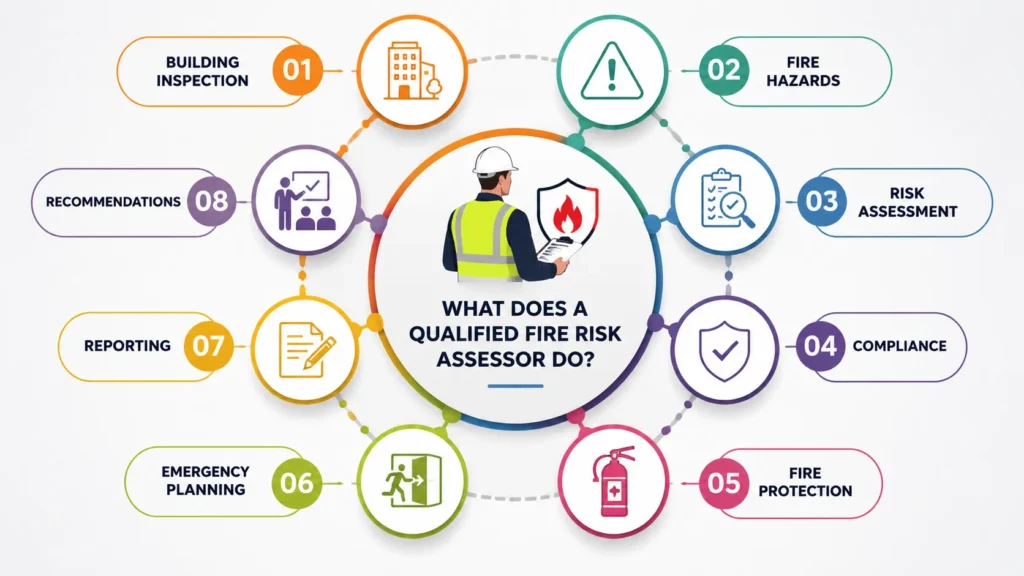
What Is a Qualified Fire Risk Assessor?
A Qualified Fire Risk Assessor is a competent professional who evaluates buildings and workplaces to identify fire hazards, assess potential risks, and recommend practical measures to reduce the likelihood and impact of fire incidents.
Fire Risk Assessors help organisations comply with UK fire safety legislation while protecting employees, residents, visitors, customers, and valuable assets. They inspect premises, review fire protection systems, assess emergency procedures, and produce detailed reports outlining recommended improvements.
Unlike general health and safety professionals, Fire Risk Assessors specialise in identifying fire-related risks and ensuring that buildings remain compliant with current fire safety requirements.
Why Are Qualified Fire Risk Assessors Important?
Fire incidents can result in serious injuries, loss of life, business disruption, legal action, and significant financial losses. A Qualified Fire Risk Assessor helps organisations prevent these outcomes by identifying hazards before they become emergencies.
Their work supports:
- Fire prevention
- Legal compliance
- Business continuity
- Building safety
- Employee protection
- Public safety
- Property protection
- Risk reduction
As UK fire safety legislation continues to evolve, organisations increasingly rely on competent professionals who can deliver accurate, practical, and legally compliant fire risk assessments.
What Does a Qualified Fire Risk Assessor Do?
A Fire Risk Assessor carries out detailed inspections of buildings, evaluates fire risks, and provides recommendations that improve fire safety standards.
The role combines technical knowledge, legislation, practical inspections, report writing, and communication with clients, building managers, contractors, and enforcement authorities.
Typical responsibilities vary depending on the organisation and industry, but the overall objective remains the same—reducing fire risks and protecting people.
Key Responsibilities of a Qualified Fire Risk Assessor
| Responsibility | Purpose |
|---|---|
| Conduct Fire Risk Assessments | Identify fire hazards and evaluate risks |
| Inspect Buildings | Review fire safety arrangements and building conditions |
| Evaluate Fire Protection Systems | Check alarms, extinguishers, emergency lighting, and fire doors |
| Assess Means of Escape | Ensure safe evacuation routes are available |
| Prepare Fire Risk Reports | Document findings and recommendations |
| Recommend Control Measures | Reduce fire risks through practical improvements |
| Monitor Compliance | Help organisations meet UK fire safety legislation |
| Review Emergency Plans | Improve evacuation procedures |
| Advise Management | Support decision-making on fire safety improvements |
| Conduct Follow-Up Reviews | Verify that corrective actions have been implemented |
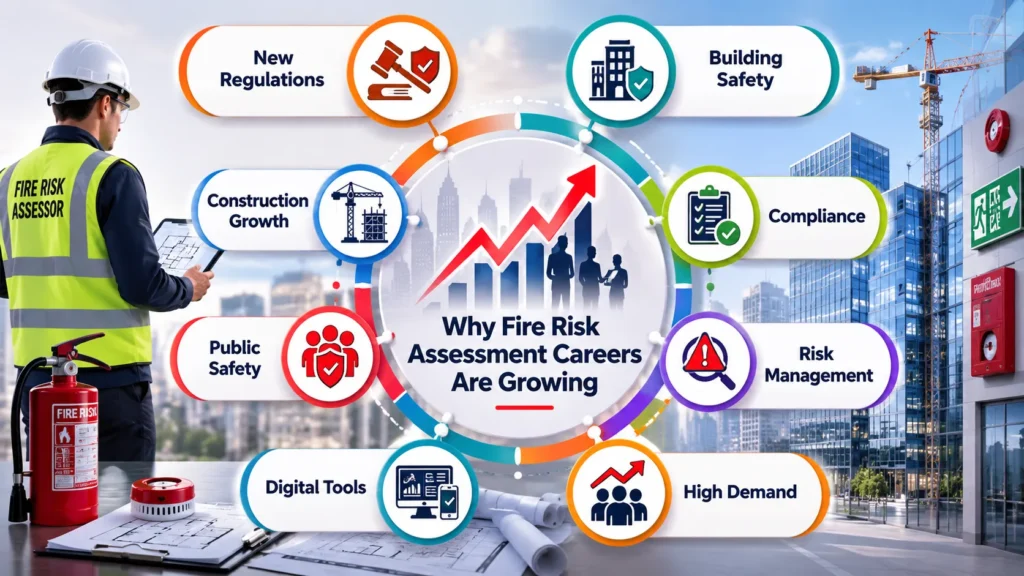
Why Is This Career Growing in the UK?
The UK has experienced significant changes in fire safety regulation over recent years. These developments have increased the demand for qualified professionals capable of delivering high-quality fire risk assessments across a wide range of industries.
Several factors continue to drive employment growth.
Stronger Fire Safety Legislation
Recent legislation has placed greater responsibility on organisations to identify, manage, and reduce fire risks.
Important legislation includes:
- Regulatory Reform (Fire Safety) Order 2005
- Fire Safety Act 2021
- Building Safety Act 2022
- Fire Safety (England) Regulations 2022
These regulations require organisations to regularly review fire risks, maintain fire safety systems, and demonstrate compliance through competent assessments.
Increased Focus on Building Safety
Following significant changes in the UK’s building safety landscape, property owners and employers are investing more heavily in fire safety professionals.
Qualified Fire Risk Assessors now play a central role in:
- High-rise residential buildings
- Hospitals
- Schools
- Commercial offices
- Industrial facilities
- Construction projects
- Hotels
- Shopping centres
Growing Investment in Infrastructure
The continued development of housing, healthcare facilities, transport infrastructure, renewable energy projects, and commercial property has created new opportunities for Fire Risk Assessors.
Every new building requires fire safety planning throughout its lifecycle—from design and construction to occupation and ongoing maintenance.
Rising Employer Expectations
Today’s employers seek professionals who can do more than complete inspections. They value assessors who can interpret legislation, communicate risks effectively, recommend practical improvements, and contribute to long-term fire safety strategies.
Featured Snippet: How Do You Become a Qualified Fire Risk Assessor?
To become a Qualified Fire Risk Assessor in the UK, you typically need relevant fire safety training, a strong understanding of UK fire safety legislation, practical experience conducting fire risk assessments, and ongoing professional development. Employers also value competence in building safety, emergency planning, report writing, and communication skills.
Essential Qualities of a Successful Fire Risk Assessor
Technical knowledge alone is not enough to succeed in this profession. Fire Risk Assessors must combine analytical thinking with practical problem-solving and effective communication.
Technical Skills vs Professional Skills
| Technical Skills | Professional Skills |
|---|---|
| Fire Risk Assessment | Communication |
| Fire Safety Legislation | Leadership |
| Building Construction Knowledge | Decision-Making |
| Passive Fire Protection | Problem Solving |
| Active Fire Protection Systems | Report Writing |
| Emergency Planning | Attention to Detail |
| Fire Behaviour | Client Management |
| Compliance Auditing | Time Management |
Professionals who continuously develop both technical and interpersonal skills are more likely to progress into senior advisory, consultancy, or management positions.
Fire Risk Assessment Process
Every assessment follows a structured methodology designed to identify hazards, evaluate risks, and recommend appropriate control measures.
Fire Risk Assessment Workflow
Building Inspection
↓
Identify Fire Hazards
↓
Identify People at Risk
↓
Evaluate Existing Fire Controls
↓
Assess Level of Risk
↓
Recommend Improvements
↓
Prepare Fire Risk Assessment Report
↓
Implement Corrective Actions
↓
Review and Update Assessment
This systematic process helps organisations reduce fire risks while maintaining compliance with UK legislation.
Where Do Qualified Fire Risk Assessors Work?
One of the greatest advantages of this career is the wide variety of employment opportunities available. Qualified Fire Risk Assessors are employed across both public and private sectors, giving professionals the flexibility to specialise in industries that match their interests and experience.
Common Employers
| Employer Type | Typical Workplace |
|---|---|
| Fire Safety Consultancies | Commercial and residential projects |
| Construction Companies | New developments and infrastructure |
| Housing Associations | Residential properties |
| NHS Trusts | Hospitals and healthcare facilities |
| Local Authorities | Public buildings and community facilities |
| Facilities Management Companies | Multi-site commercial properties |
| Manufacturing Businesses | Factories and industrial plants |
| Universities and Schools | Educational campuses |
| Hotels and Hospitality Groups | Hotels, resorts, and conference centres |
| Retail Organisations | Shopping centres and retail stores |
These organisations require competent professionals to conduct inspections, support compliance, reduce risks, and promote a strong fire safety culture.
Demand for Qualified Fire Risk Assessors Across UK Industries
The need for Fire Risk Assessors extends far beyond traditional fire safety organisations. As regulations become more stringent and businesses place greater emphasis on risk management, demand continues to grow across multiple sectors.
| Industry | Demand Level | Primary Focus |
|---|---|---|
| Healthcare | Very High | Patient and staff safety |
| Construction | Very High | Building compliance |
| Housing Associations | Very High | Residential fire safety |
| Facilities Management | Very High | Multi-site compliance |
| Local Government | High | Public building safety |
| Manufacturing | High | Industrial fire prevention |
| Commercial Property | High | Workplace compliance |
| Education | High | Campus safety |
| Hospitality | High | Guest protection |
| Transport | High | Passenger safety |
Step-by-Step Guide to Becoming a Qualified Fire Risk Assessor
There is no single route to becoming a Qualified Fire Risk Assessor in the UK. Employers generally look for professionals who combine recognised training, practical experience, technical knowledge, and a strong understanding of fire safety legislation. Developing competence through continuous learning and real-world application is the key to building a successful career.
Step 1: Build a Strong Foundation in Fire Safety
The first step is to gain a solid understanding of fire science, fire prevention, fire protection systems, emergency procedures, and UK fire safety legislation.
Areas to learn include:
- Fire behaviour and fire development
- Fire prevention principles
- Means of escape
- Passive fire protection
- Active fire protection systems
- Emergency planning
- Fire safety management
- UK fire safety legislation
This knowledge forms the basis of every professional fire risk assessment.
Step 2: Complete Professional Fire Safety Training
Employers prefer candidates who have completed recognised fire safety and fire risk assessment training. A structured training programme helps develop both theoretical knowledge and practical assessment skills.
Training typically covers:
- Fire hazard identification
- Risk evaluation techniques
- Fire safety legislation
- Building inspections
- Fire protection systems
- Report writing
- Emergency evacuation planning
- Fire safety auditing
Continuous professional development is equally important to keep knowledge current as legislation and industry standards evolve.
Step 3: Gain Practical Experience
Practical experience allows aspiring Fire Risk Assessors to apply their knowledge in real environments. Many professionals begin their careers in related roles before progressing into specialist fire risk assessment positions.
Common starting roles include:
- Fire Safety Assistant
- Fire Warden
- Fire Marshal
- Health and Safety Officer
- Facilities Coordinator
- Compliance Officer
- Building Safety Officer
Working alongside experienced professionals helps develop confidence in identifying hazards, inspecting buildings, and preparing accurate fire risk reports.
Step 4: Develop Competency
Competency extends beyond holding a qualification. Employers increasingly seek professionals who can demonstrate the ability to apply knowledge effectively, make informed decisions, and produce practical recommendations.
Competent Fire Risk Assessors can:
- Evaluate complex fire risks
- Interpret legislation
- Prioritise corrective actions
- Communicate findings clearly
- Produce professional reports
- Recommend realistic control measures
Practical competence is often what distinguishes experienced professionals from entry-level candidates.
Step 5: Continue Professional Development
Fire safety is constantly evolving due to new legislation, technologies, and building practices. Ongoing learning helps professionals remain effective throughout their careers.
Continuous development may include:
- Advanced fire safety training
- Building safety updates
- Fire engineering awareness
- Digital inspection technologies
- Leadership development
- Industry seminars and workshops
Professionals who invest in lifelong learning are often considered for senior advisory and management roles.
Becoming a Qualified Fire Risk Assessor
Career Path Flowchart
Interest in Fire Safety
↓
Fire Safety Training
↓
Learn UK Fire Safety Legislation
↓
Gain Practical Experience
↓
Develop Inspection Skills
↓
Conduct Fire Risk Assessments
↓
Become a Qualified Fire Risk Assessor
↓
Senior Fire Risk Assessor
↓
Fire Safety Consultant
↓
Head of Fire Safety
Qualifications Employers Value
While different organisations have their own recruitment requirements, employers consistently value candidates who possess relevant education, recognised fire safety training, and practical experience.
The strongest candidates demonstrate competence in:
- Fire risk assessment
- Fire safety management
- Building safety
- Emergency planning
- Fire legislation
- Risk management
- Compliance auditing
- Report preparation
Rather than focusing on one specific qualification, employers often assess whether candidates can apply their knowledge effectively in real workplace situations.
Essential Technical Skills
Technical expertise enables Fire Risk Assessors to identify hazards accurately, evaluate risks, and recommend practical improvements.
Core Technical Skills
| Technical Skill | Why It Matters |
|---|---|
| Fire Risk Assessment | Identifies hazards and evaluates risk levels |
| Fire Safety Legislation | Supports legal compliance |
| Building Construction Knowledge | Helps assess structural fire risks |
| Passive Fire Protection | Evaluates fire doors, walls, and compartmentation |
| Active Fire Protection Systems | Reviews alarms, extinguishers, and suppression systems |
| Emergency Planning | Improves evacuation preparedness |
| Fire Safety Auditing | Verifies compliance with legislation |
| Risk Management | Reduces operational and financial risks |
| Building Inspection | Identifies fire safety deficiencies |
| Report Writing | Documents findings clearly and professionally |
Employers often look for professionals who can combine technical knowledge with practical decision-making.
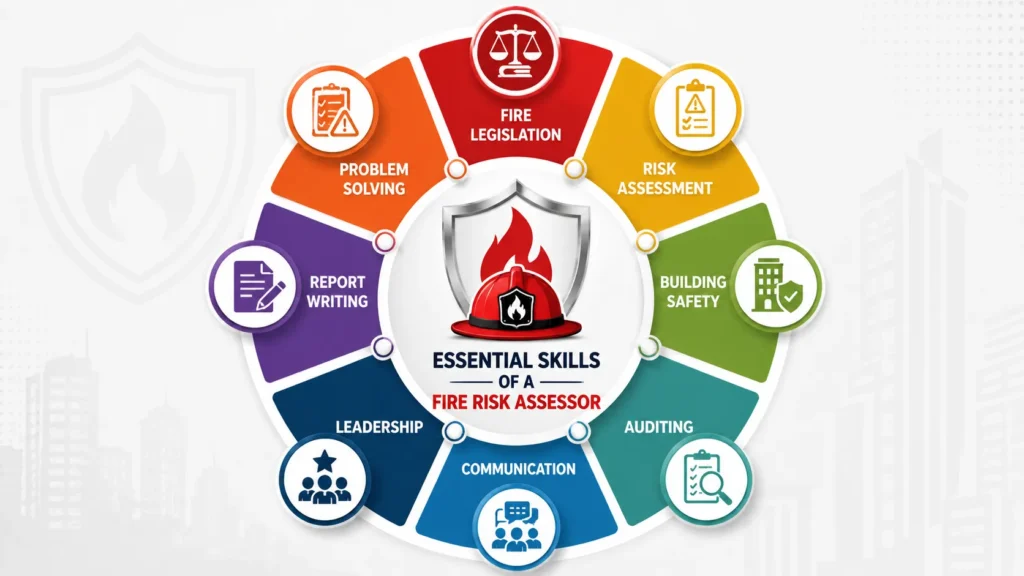
Essential Soft Skills
Fire Risk Assessors interact with clients, managers, contractors, engineers, and enforcement authorities. Strong interpersonal skills are therefore just as important as technical competence.
Professional Skills Employers Seek
| Professional Skill | Workplace Benefit |
|---|---|
| Communication | Explains technical findings clearly |
| Analytical Thinking | Evaluates complex fire risks |
| Problem Solving | Recommends practical solutions |
| Leadership | Guides fire safety improvements |
| Attention to Detail | Identifies hidden hazards |
| Time Management | Completes assessments efficiently |
| Report Writing | Produces professional documentation |
| Decision-Making | Prioritises corrective actions |
| Teamwork | Collaborates with multiple departments |
| Client Management | Builds professional relationships |
These skills help Fire Risk Assessors communicate recommendations effectively and support organisations in improving fire safety performance.
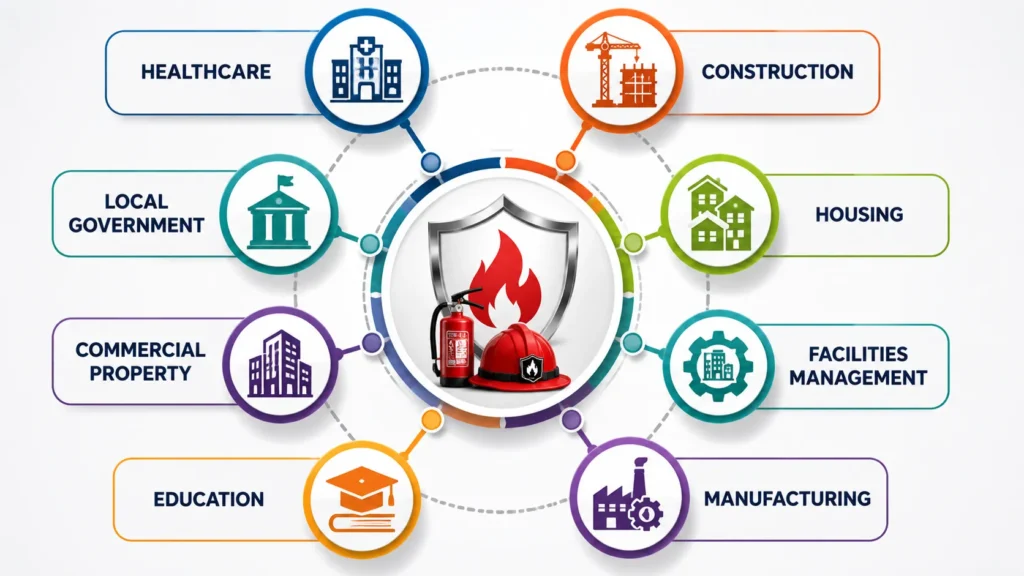
Industries Hiring Qualified Fire Risk Assessors
Fire Risk Assessors are employed across many sectors because almost every organisation has legal responsibilities relating to fire safety.
Healthcare
Hospitals, healthcare facilities, and care homes require regular fire risk assessments to protect vulnerable occupants and maintain compliance.
Construction
Construction companies recruit Fire Risk Assessors to support building safety throughout design, construction, and project completion.
Housing Associations
Residential landlords require fire risk assessments for communal areas, apartment buildings, and high-rise developments.
Facilities Management
Facilities management companies oversee fire safety across multiple commercial buildings and public-sector properties.
Manufacturing
Factories and industrial facilities employ Fire Risk Assessors to manage hazards associated with machinery, electrical systems, chemicals, and production processes.
Commercial Property
Office buildings, shopping centres, hotels, and business parks all require regular fire safety inspections and compliance reviews.
Education
Schools, colleges, universities, and student accommodation providers rely on Fire Risk Assessors to maintain safe learning environments.
Local Government
Local authorities manage public buildings, leisure centres, libraries, museums, and community facilities that require ongoing fire safety management.
Industry Comparison
| Industry | Hiring Demand | Career Growth | Risk Complexity |
|---|---|---|---|
| Healthcare | Very High | Excellent | High |
| Construction | Very High | Excellent | High |
| Housing Associations | Very High | High | Medium |
| Facilities Management | Very High | Excellent | Medium |
| Manufacturing | High | Excellent | High |
| Commercial Property | High | High | Medium |
| Education | High | High | Medium |
| Local Government | High | High | Medium |
Salary Expectations in the UK
Salaries vary depending on experience, location, qualifications, industry, and employer. Professionals working in specialist consultancy or high-risk sectors often command higher salaries.
Estimated Salary Guide
| Experience Level | Approximate Annual Salary |
|---|---|
| Entry-Level Fire Risk Assessor | £30,000–£38,000 |
| Intermediate Fire Risk Assessor | £40,000–£50,000 |
| Experienced Fire Risk Assessor | £50,000–£60,000 |
| Senior Fire Risk Assessor | £60,000–£75,000+ |
| Fire Safety Consultant | £70,000–£90,000+ |
In addition to competitive salaries, many employers offer benefits such as professional development support, pension schemes, flexible working arrangements, and opportunities to progress into leadership roles.
What Employers Look for During Recruitment
Recruiters evaluate more than qualifications alone. They want professionals who can demonstrate technical competence, practical experience, and the ability to communicate effectively.
Employer Recruitment Process
Application
↓
Qualification Review
↓
Fire Safety Knowledge Assessment
↓
Technical Interview
↓
Practical Competency Evaluation
↓
Report Writing Assessment
↓
Final Interview
↓
Employment Offer
Candidates who can confidently explain fire safety principles, interpret legislation, and present practical recommendations are more likely to secure rewarding positions.
Tools and Technology Used by Qualified Fire Risk Assessors
Modern fire risk assessments go far beyond paper checklists. Many organisations now use digital tools to improve accuracy, streamline reporting, and maintain compliance records across multiple sites. Qualified Fire Risk Assessors who are comfortable with these technologies are often more competitive in the job market.
Common technologies include:
- Digital fire risk assessment software
- Mobile inspection applications
- Building Information Modelling (BIM)
- Computer-Aided Facility Management (CAFM) systems
- Digital compliance management platforms
- Fire alarm monitoring systems
- Emergency lighting testing software
- Cloud-based document management systems
These tools help professionals complete assessments more efficiently while providing clients and employers with accurate, accessible documentation.
A Typical Working Day for a Fire Risk Assessor
Every day is different, but most Fire Risk Assessors follow a structured workflow that balances site inspections, documentation, and communication.
Daily Workflow
Receive Assignment
↓
Review Building Information
↓
Visit Site
↓
Inspect Fire Hazards
↓
Assess Existing Fire Controls
↓
Photograph Key Findings
↓
Discuss Issues with Duty Holders
↓
Prepare Fire Risk Assessment Report
↓
Recommend Corrective Actions
↓
Schedule Follow-Up Review
This combination of fieldwork and office-based reporting makes the profession both varied and rewarding.
Common Challenges in the Role
Fire Risk Assessment is a highly responsible profession that requires sound judgement and attention to detail. Professionals must often evaluate complex environments while balancing legal compliance with practical business needs.
Some common challenges include:
- Assessing older buildings with outdated fire safety features
- Keeping up with changes in legislation and guidance
- Managing large multi-site property portfolios
- Communicating technical findings to non-technical stakeholders
- Prioritising recommendations based on risk levels
- Meeting reporting deadlines while maintaining quality
- Coordinating with contractors and building managers
- Adapting to new technologies and digital compliance systems
Overcoming these challenges requires continuous learning, strong organisational skills, and effective communication.
Why Choose a Career as a Qualified Fire Risk Assessor?
Many professionals choose this career because it combines technical expertise with meaningful public safety responsibilities. Every assessment contributes to reducing fire risks, protecting lives, and helping organisations meet their legal obligations.
Key Benefits
| Benefit | Career Advantage |
|---|---|
| Strong Job Demand | Excellent employment opportunities |
| Competitive Salaries | Attractive earning potential |
| Career Stability | Essential role across many industries |
| Professional Development | Continuous learning and advancement |
| Diverse Workplaces | Opportunities in public and private sectors |
| Leadership Potential | Clear progression into senior roles |
| Positive Social Impact | Protecting people, property, and businesses |
| Consultancy Opportunities | Option to work independently or establish a consultancy |
For professionals who enjoy problem-solving, compliance, and helping organisations improve safety, this career offers long-term satisfaction and growth.
Future Outlook for Fire Risk Assessors (2026–2030)
The future of fire risk assessment in the UK looks highly promising. Continued investment in infrastructure, tighter regulatory oversight, and greater awareness of building safety are expected to sustain demand for qualified professionals over the coming years.
Several trends are shaping the future of the profession:
Digital Transformation
Inspection software, cloud-based reporting, mobile applications, and smart building technologies are becoming standard tools within fire safety management.
Smarter Buildings
Modern buildings increasingly incorporate intelligent fire detection, automated suppression systems, and integrated building management systems. Fire Risk Assessors will need to understand how these technologies influence fire safety strategies.
Greater Focus on Competency
Employers are placing increasing emphasis on practical competence, ongoing professional development, and the ability to apply knowledge effectively in real-world environments.
Sustainable Construction
As sustainable and energy-efficient buildings become more common, Fire Risk Assessors will need to understand emerging construction materials, renewable energy systems, and evolving fire safety challenges.
Expansion of Consultancy Services
Many organisations now outsource fire safety expertise, creating more opportunities for experienced assessors to work as consultants across multiple industries.
Skills That Will Be Most Valuable in the Future
The profession is evolving beyond traditional inspections. Future employers are likely to value professionals who combine technical expertise with digital capabilities and leadership skills.
| Future Technical Skills | Future Professional Skills |
|---|---|
| Digital Inspection Systems | Strategic Thinking |
| Smart Building Technologies | Leadership |
| Data Analysis | Communication |
| Fire Safety Management Systems | Project Management |
| Building Safety Compliance | Stakeholder Engagement |
| Risk-Based Decision Making | Change Management |
| Compliance Reporting | Problem Solving |
| Fire Investigation | Continuous Learning |
Developing these skills can improve employability and prepare professionals for senior leadership or consultancy roles.
How to Stand Out to Employers
Competition for specialist fire safety roles continues to increase. Candidates who demonstrate both competence and commitment to professional development are more likely to secure interviews and progress into senior positions.
To improve employability:
- Stay informed about updates to UK fire safety legislation.
- Build practical experience through workplace assessments and site inspections.
- Develop strong report writing and communication skills.
- Gain experience across different building types and industries.
- Keep records of professional development and completed training.
- Learn to use digital fire safety and compliance management tools.
- Strengthen leadership and problem-solving abilities.
- Network with professionals in the fire safety and health and safety sectors.
A combination of technical expertise, practical experience, and continuous learning will help build a successful long-term career.
Conclusion
A career as a Qualified Fire Risk Assessor offers excellent opportunities for professionals who are passionate about protecting people, property, and businesses from fire-related risks. As fire safety regulations continue to evolve and organisations place greater emphasis on compliance and building safety, the demand for competent Fire Risk Assessors is expected to remain strong across healthcare, construction, housing, facilities management, education, manufacturing, commercial property, and the public sector.
Success in this profession requires more than completing a training course. Employers seek individuals who can demonstrate practical competence, understand UK fire safety legislation, communicate recommendations effectively, and adapt to changing technologies and industry standards. By investing in recognised training, gaining hands-on experience, and committing to continuous professional development, aspiring professionals can build a rewarding career with clear progression into senior advisory, management, and consultancy roles.
Whether you’re entering the fire safety profession or looking to advance your existing career, becoming a Qualified Fire Risk Assessor is a valuable step towards long-term professional growth in one of the UK’s most important safety disciplines.
Advance Your Fire Safety Career with Inspire College
If you’re ready to develop the knowledge and practical skills needed to succeed as a Qualified Fire Risk Assessor, explore Inspire College’s range of professional fire safety and health and safety programmes.
Browse our courses to find training in:
- Fire Risk Assessment Courses
- Fire Safety Courses
- Senior Fire Safety Advisor Courses
- Fire Marshal Training
With flexible learning options, industry-relevant content, and career-focused qualifications, Inspire College can help you build the competence and confidence needed to succeed in today’s growing fire safety sector.
Explore More Fire Safety & Risk Assessment Articles
Discover expert guides on fire safety careers, fire risk assessments, workplace compliance, fire protection systems, and professional qualifications to expand your knowledge and advance your career in fire safety.
- What is Fire Safety?
- Fire Risk Assessment
- Fire Safety Equipment
- Fire Safety: Essential Tips for Homes and Workplaces
- Industrial Fire Safety: Complete Guide to Risk Assessment, Hazards & Prevention (2026)
- Fire Safety Training (2026): Complete Guide, Certification & Workplace Safety
- Level 4 Diploma in Fire Safety: Complete Guide to Career Growth, Skills, Compliance, and Professional Certification
- What Does a Senior Fire Safety Advisor Do? Roles, Responsibilities, and Career Guide
- Top Skills Every Senior Fire Safety Advisor Should Develop
- Is Fire Safety a Good Career Choice in the UK?
- Senior Fire Safety Advisor Career Progression: Exciting Roles, Salary & Leadership Path
- Is Fire Safety a Good Career Choice in the UK?
- Top Skills Every Senior Fire Safety Advisor Should Develop
- Senior Fire Safety Advisor vs Fire Risk Assessor: Which Career Is Right for You?
- Senior Fire Safety Advisor: Top Industries Hiring Across the UK
- The 5 Essential Steps of Fire Risk Assessment Explained
- Fire Risk Assessment Explained: A Complete Beginner’s Guide
- Senior Fire Safety Advisor: Top Industries Hiring Across the UK
- How Fire Safety and Risk Assessment Reduce Workplace Hazards
- Fire Safety Planning and Risk Assessment for Businesses
- Essential Fire Safety Tips Everyone Should Know to Stay Safe
- Fire Risk Assessment vs Fire Safety Audit: What’s the Difference?
- How to Conduct an Effective Risk Assessment Step by Step
- Fire Safety Checklist for Homes, Offices & Commercial Buildings
- How Often Should a Fire Risk Assessment Be Reviewed?
- Top Workplace Fire Hazards Every Inspection Reveals
- Failed a Fire Safety Inspection? Here’s What Happens Next