
Fire Safety Planning and Risk Assessment for Businesses
Fire safety is one of the most critical aspects of workplace health and safety management. Every business, regardless of its size or industry, faces potential fire risks that can threaten employees, customers, property, and business operations. From faulty electrical equipment and combustible materials to human error and inadequate emergency planning, workplace fire hazards can develop quickly if they are not properly identified and controlled.
Many organisations believe that installing fire extinguishers and smoke detectors is enough to protect their premises. While these safety measures are essential, they represent only one part of an effective fire safety strategy. Businesses also need a structured fire safety plan supported by a comprehensive fire risk assessment to identify hazards, implement preventive measures, prepare for emergencies, and continuously improve workplace safety.
Fire safety planning is not simply about meeting legal requirements. It is a proactive management process that helps businesses reduce operational risks, minimise financial losses, improve emergency preparedness, and protect their reputation. A well-developed fire safety plan ensures that everyone understands their responsibilities before, during, and after a fire emergency.
Similarly, a fire risk assessment provides a systematic approach to identifying potential fire hazards, evaluating risks, and introducing suitable control measures. Together, fire safety planning and fire risk assessments create a safer working environment while supporting business continuity and long-term organisational resilience.
This guide explains how businesses can develop an effective fire safety plan, conduct meaningful fire risk assessments, implement preventive strategies, and build a workplace culture where fire safety becomes part of everyday operations.
Why Every Business Needs a Fire Safety Plan
No business is completely immune to fire risks. Whether operating from an office, warehouse, retail store, healthcare facility, manufacturing plant, hospitality venue, or construction site, organisations must prepare for the possibility of a fire emergency.
A fire can have consequences far beyond property damage. It may result in employee injuries, business interruption, legal action, financial losses, environmental damage, and reputational harm. Recovering from a serious workplace fire can take months or even years.
A fire safety plan helps organisations prepare for these risks by establishing clear procedures that reduce the likelihood of fire incidents and improve emergency response.
Key benefits include:
- Protecting employees and visitors
- Reducing workplace fire hazards
- Supporting compliance with UK fire safety legislation
- Improving emergency preparedness
- Protecting business assets
- Reducing insurance claims
- Minimising operational downtime
- Strengthening business continuity
- Building employee confidence
- Promoting a positive safety culture
Businesses that regularly review and improve their fire safety plans are generally better equipped to respond effectively when unexpected incidents occur.
Why Fire Safety Planning Matters
| Business Objective | Fire Safety Benefit |
|---|---|
| Employee Protection | Reduces injuries and fatalities |
| Legal Compliance | Supports compliance with UK fire safety responsibilities |
| Business Continuity | Minimises disruption after fire incidents |
| Financial Protection | Reduces repair and insurance costs |
| Operational Efficiency | Prevents avoidable interruptions |
| Reputation Management | Demonstrates commitment to workplace safety |
What Is a Fire Safety Plan?
A fire safety plan is a documented framework that outlines how a business will prevent fires, protect people, respond to emergencies, and recover from fire-related incidents.
Rather than focusing only on emergency response, an effective fire safety plan integrates prevention, preparedness, protection, communication, and continuous improvement into daily business operations.
The plan should clearly explain how fire risks will be managed, who is responsible for different fire safety activities, what emergency procedures employees must follow, and how fire protection systems will be maintained.
An effective fire safety plan typically includes:
- Fire prevention procedures
- Emergency evacuation arrangements
- Fire detection systems
- Fire protection equipment
- Fire safety responsibilities
- Employee training programmes
- Inspection schedules
- Maintenance procedures
- Incident reporting processes
- Regular plan reviews
Fire safety planning should be tailored to each organisation’s activities, building layout, occupancy levels, and operational risks rather than using a generic template.
Core Components of a Fire Safety Plan
| Component | Purpose |
|---|---|
| Fire Prevention | Reduce ignition sources and combustible materials |
| Emergency Procedures | Ensure safe evacuation |
| Fire Detection | Identify fires quickly |
| Fire Protection Systems | Control or suppress fires |
| Employee Training | Improve awareness and response |
| Maintenance | Keep safety systems operational |
| Documentation | Record inspections and actions |
| Continuous Review | Adapt to workplace changes |
What Is a Fire Risk Assessment?
A fire risk assessment is a structured process used to identify fire hazards, evaluate the likelihood and consequences of a fire, determine who may be affected, and implement measures to reduce risks.
It serves as the foundation of every successful fire safety plan by providing the information needed to make informed decisions about workplace safety.
Instead of relying on assumptions, businesses use fire risk assessments to examine their unique work environment, equipment, materials, building design, and operational activities.
A typical assessment considers questions such as:
- What could start a fire?
- What combustible materials are present?
- Who is at risk?
- Are current fire safety measures effective?
- What additional controls are required?
Fire risk assessments should not be viewed as one-time exercises. They should be reviewed whenever significant changes occur, such as building alterations, process changes, new equipment installations, increased occupancy, or following a fire incident.
Objectives of a Fire Risk Assessment
| Objective | Outcome |
|---|---|
| Identify Fire Hazards | Detect potential ignition sources |
| Assess Risks | Prioritise workplace hazards |
| Protect People | Improve employee and visitor safety |
| Strengthen Controls | Reduce fire likelihood and impact |
| Support Compliance | Meet fire safety responsibilities |
| Drive Improvement | Keep safety measures up to date |
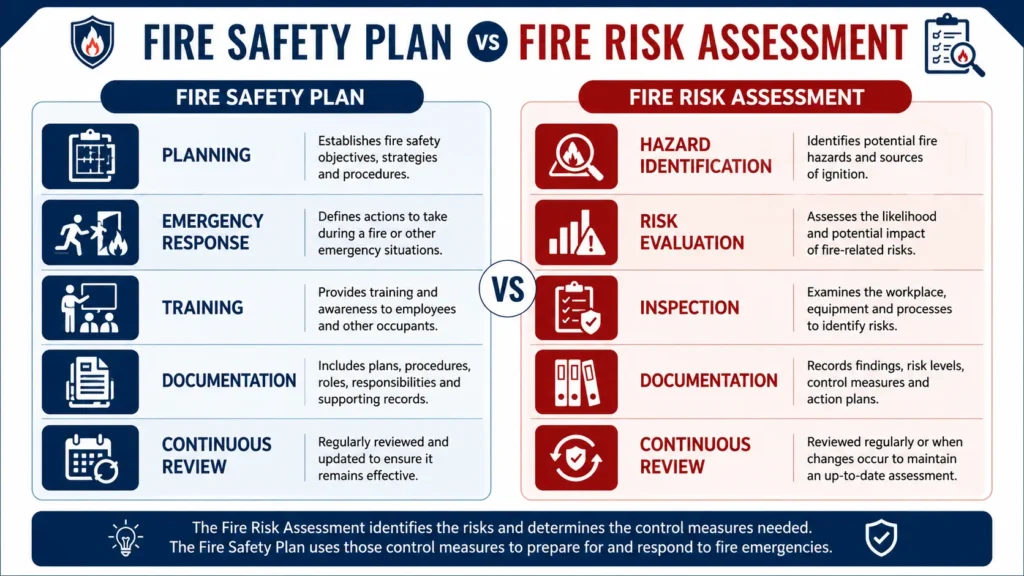
Fire Safety Plan vs Fire Risk Assessment
Many businesses use these terms interchangeably, but they serve different purposes.
A fire risk assessment identifies hazards and evaluates risks, while a fire safety plan explains how those risks will be managed through policies, procedures, training, equipment, and emergency arrangements.
Think of the fire risk assessment as the analysis and the fire safety plan as the action plan.
Comparison Table
| Fire Safety Plan | Fire Risk Assessment |
|---|---|
| Focuses on managing fire safety | Focuses on identifying and evaluating risks |
| Includes emergency procedures | Identifies workplace hazards |
| Defines employee responsibilities | Determines people at risk |
| Covers training programmes | Evaluates existing controls |
| Includes maintenance schedules | Recommends improvements |
| Updated after organisational changes | Reviewed whenever risks change |
| Supports long-term fire management | Supports informed decision-making |
Both are essential and should work together to create a comprehensive fire safety management system.
How Fire Safety Planning and Risk Assessment Work Together
Fire safety planning and fire risk assessment are not separate activities. They are interconnected processes that support one another throughout the lifecycle of workplace safety management.
The fire risk assessment identifies hazards and determines the level of risk. The fire safety plan then translates those findings into practical actions, ensuring that preventive measures, emergency procedures, training, inspections, and maintenance activities are implemented consistently.
For example, if a fire risk assessment identifies overloaded electrical circuits in a warehouse, the fire safety plan may include actions such as upgrading electrical installations, introducing regular inspections, training employees to recognise electrical hazards, and scheduling preventive maintenance.
This ongoing cycle of assessment, planning, implementation, monitoring, and review enables businesses to adapt to changing workplace conditions while maintaining a high standard of fire safety.
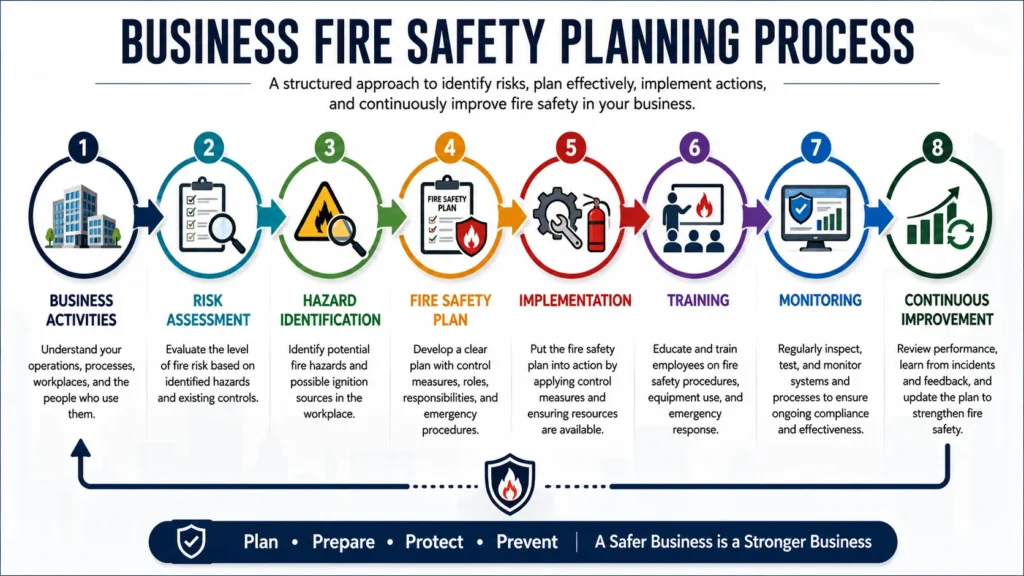
Fire Safety Management Workflow
Identify Workplace Activities
           │
           ▼
Conduct Fire Risk Assessment
           │
           ▼
Identify Fire Hazards
           │
           ▼
Evaluate Risks
           │
           ▼
Develop Fire Safety Plan
           │
           ▼
Implement Fire Prevention Measures
           │
           ▼
Train Employees
           │
           ▼
Inspect and Monitor
           │
           ▼
Review and Improve
           │
           ▼
Safer Business Environment
Why Businesses Should Take a Proactive Approach
Waiting for a fire incident before improving workplace safety can have devastating consequences. A proactive approach enables businesses to identify hazards early, reduce risks before they escalate, and create systems that support continuous improvement.
Organisations that integrate fire safety planning into their overall health and safety strategy are better positioned to protect employees, maintain compliance, reduce operational disruption, and strengthen long-term resilience.
How Fire Safety Planning Protects Businesses
An effective fire safety plan does more than help an organisation respond to emergencies—it creates a proactive system for preventing fires, protecting people, safeguarding assets, and maintaining business operations. By combining planning, prevention, training, and continuous monitoring, businesses can significantly reduce the likelihood of fire-related incidents and minimise their impact if one occurs.
Fire safety planning should be integrated into the organisation’s overall health and safety management system rather than treated as a standalone compliance document. This approach encourages regular reviews, accountability, and continuous improvement.
Key Benefits of Fire Safety Planning
| Benefit | Business Impact |
|---|---|
| Fire Prevention | Reduces the likelihood of workplace fires |
| Employee Safety | Protects staff, visitors, and contractors |
| Asset Protection | Minimises damage to buildings and equipment |
| Legal Compliance | Supports compliance with UK fire safety legislation |
| Business Continuity | Reduces downtime after an incident |
| Financial Protection | Lowers repair, replacement, and insurance costs |
| Reputation | Demonstrates a commitment to workplace safety |
| Operational Resilience | Improves preparedness for emergencies |
The Five-Step Fire Risk Assessment Process
A fire risk assessment should follow a logical and structured process to ensure that hazards are identified and controlled effectively. The five-step approach is widely recognised as best practice and helps businesses implement consistent fire safety measures.
Step 1: Identify Fire Hazards
The first stage involves identifying anything that could start a fire or contribute to its spread.
Typical workplace fire hazards include:
- Faulty electrical equipment
- Overloaded sockets
- Portable heaters
- Flammable liquids
- Gas cylinders
- Combustible waste
- Hot work activities
- Cooking appliances
- Smoking materials
The inspection should cover all work areas, storage rooms, plant rooms, kitchens, and external spaces.
Step 2: Identify People at Risk
The assessment should identify everyone who could be affected by a fire, including those who may need additional assistance during an evacuation.
People at risk may include:
- Employees
- Visitors
- Contractors
- Customers
- Temporary workers
- Lone workers
- Night shift staff
- Persons with disabilities
- Young or inexperienced workers
Understanding who is at risk allows businesses to develop suitable evacuation procedures and allocate appropriate resources.
Step 3: Evaluate the Risks and Implement Controls
After identifying hazards and people at risk, businesses should evaluate the likelihood and potential consequences of each hazard.
Control measures may include:
- Installing fire alarms
- Maintaining fire extinguishers
- Improving housekeeping
- Removing combustible waste
- Upgrading electrical systems
- Improving storage arrangements
- Installing emergency lighting
- Creating fire compartments
- Providing employee training
Risk Rating Matrix
| Likelihood | Consequence | Risk Level |
|---|---|---|
| Low | Minor | Low |
| Medium | Moderate | Medium |
| High | Major | High |
| Very High | Severe | Critical |
This approach helps prioritise actions based on the level of risk.
Step 4: Record Findings and Implement the Plan
Recording assessment findings ensures that hazards, recommended actions, responsibilities, and review dates are clearly documented.
Typical records include:
- Identified hazards
- Existing controls
- Additional recommendations
- Responsible persons
- Completion dates
- Inspection records
- Fire drill reports
- Maintenance schedules
Good documentation supports consistency, accountability, and continuous improvement.
Step 5: Review and Update Regularly
Workplaces constantly change as organisations introduce new equipment, modify layouts, hire additional staff, or change operational processes. Fire risk assessments should therefore be reviewed whenever significant changes occur or after a fire incident, near miss, or periodic inspection.
Regular reviews ensure that fire safety arrangements remain suitable and effective.
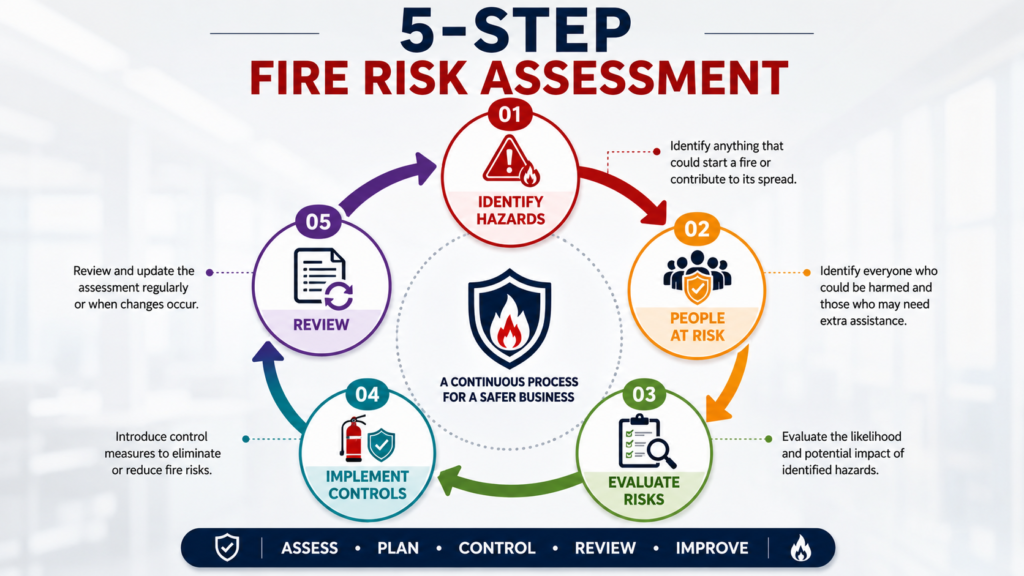
Fire Risk Assessment Process Flowchart
Inspect Workplace
        │
        ▼
Identify Fire Hazards
        │
        ▼
Identify People at Risk
        │
        ▼
Evaluate Risks
        │
        ▼
Implement Control Measures
        │
        ▼
Record Findings
        │
        ▼
Review Regularly
        │
        ▼
Continuous Improvement
Essential Components of a Business Fire Safety Plan
A comprehensive fire safety plan combines preventive measures, emergency procedures, defined responsibilities, and routine monitoring. Every organisation should tailor its plan to reflect its specific operations, building design, and fire risks.
Fire Safety Plan Components
| Component | Purpose |
|---|---|
| Fire Risk Assessment | Identifies workplace hazards |
| Fire Prevention Measures | Reduces ignition and fuel sources |
| Fire Detection Systems | Provides early warning |
| Fire Protection Equipment | Controls or suppresses fires |
| Emergency Evacuation Plan | Ensures safe evacuation |
| Roles and Responsibilities | Defines accountability |
| Employee Training | Builds awareness and preparedness |
| Maintenance Programme | Keeps systems operational |
| Documentation | Records inspections and compliance |
| Plan Review | Supports continuous improvement |
Each element contributes to a coordinated approach that reduces fire risks and improves emergency readiness.
Fire Prevention Strategies for Businesses
The most effective fire safety plans focus on preventing fires before they occur. Preventive measures reduce ignition sources, control combustible materials, and promote safe working practices throughout the organisation.
Practical Fire Prevention Measures
- Inspect electrical installations regularly.
- Replace damaged cables and faulty equipment immediately.
- Store flammable liquids in approved containers.
- Keep escape routes free from obstructions.
- Remove combustible waste frequently.
- Maintain heating equipment.
- Implement hot work permit procedures.
- Prohibit smoking in designated areas.
- Inspect fire doors routinely.
- Test fire alarms according to maintenance schedules.
Fire Prevention Strategy Table
| Hazard | Preventive Measure |
|---|---|
| Electrical Faults | Routine inspection and maintenance |
| Flammable Liquids | Secure storage in fire-resistant cabinets |
| Combustible Waste | Regular housekeeping and waste removal |
| Hot Work | Permit-to-work system and fire watch |
| Smoking | Designated smoking areas |
| Cooking Equipment | Routine cleaning and maintenance |
| Heating Equipment | Preventive servicing |
| Storage Areas | Safe stacking and separation of materials |
Applying multiple preventive measures creates several layers of protection, making it less likely that a single hazard will develop into a workplace fire.
Emergency Evacuation Planning
A fire safety plan should include detailed evacuation procedures that enable everyone to leave the building quickly and safely.
An effective evacuation plan should identify:
- Primary and secondary escape routes
- Emergency exits
- Assembly points
- Fire wardens
- Procedures for assisting vulnerable persons
- Emergency communication methods
- Responsibilities during evacuation
- Procedures for contacting emergency services
Employees should understand evacuation procedures before an emergency occurs rather than learning them during an incident.
Emergency Evacuation Process
Fire Detected
       │
       ▼
Alarm Activated
       │
       ▼
Emergency Services Contacted
       │
       ▼
Occupants Evacuate
       │
       ▼
Fire Wardens Assist
       │
       ▼
Assembly Point
       │
       ▼
Head Count
       │
       ▼
Emergency Services Clearance
       │
       ▼
Safe Re-entry
Regular evacuation drills help employees become familiar with procedures, identify weaknesses in emergency planning, and improve response times.
Business Continuity Through Fire Safety Planning
Many businesses focus on immediate emergency response but overlook how fire safety planning supports long-term operational resilience. A well-designed fire safety plan helps organisations recover more quickly after an incident by reducing disruption and protecting critical resources.
Fire safety planning contributes to business continuity by:
- Protecting essential infrastructure
- Safeguarding important documents and digital records
- Reducing production downtime
- Supporting faster recovery after incidents
- Maintaining customer confidence
- Minimising financial losses
- Protecting contractual commitments
Businesses that integrate fire safety planning into their continuity strategy are better prepared to manage unexpected events while maintaining essential operations.
How Fire Safety Planning Protects Businesses
An effective fire safety plan does more than help an organisation respond to emergencies—it creates a proactive system for preventing fires, protecting people, safeguarding assets, and maintaining business operations. By combining planning, prevention, training, and continuous monitoring, businesses can significantly reduce the likelihood of fire-related incidents and minimise their impact if one occurs.
Fire safety planning should be integrated into the organisation’s overall health and safety management system rather than treated as a standalone compliance document. This approach encourages regular reviews, accountability, and continuous improvement.
Key Benefits of Fire Safety Planning
| Benefit | Business Impact |
|---|---|
| Fire Prevention | Reduces the likelihood of workplace fires |
| Employee Safety | Protects staff, visitors, and contractors |
| Asset Protection | Minimises damage to buildings and equipment |
| Legal Compliance | Supports compliance with UK fire safety legislation |
| Business Continuity | Reduces downtime after an incident |
| Financial Protection | Lowers repair, replacement, and insurance costs |
| Reputation | Demonstrates a commitment to workplace safety |
| Operational Resilience | Improves preparedness for emergencies |
The Five-Step Fire Risk Assessment Process
A fire risk assessment should follow a logical and structured process to ensure that hazards are identified and controlled effectively. The five-step approach is widely recognised as best practice and helps businesses implement consistent fire safety measures.
Step 1: Identify Fire Hazards
The first stage involves identifying anything that could start a fire or contribute to its spread.
Typical workplace fire hazards include:
- Faulty electrical equipment
- Overloaded sockets
- Portable heaters
- Flammable liquids
- Gas cylinders
- Combustible waste
- Hot work activities
- Cooking appliances
- Smoking materials
The inspection should cover all work areas, storage rooms, plant rooms, kitchens, and external spaces.
Step 2: Identify People at Risk
The assessment should identify everyone who could be affected by a fire, including those who may need additional assistance during an evacuation.
People at risk may include:
- Employees
- Visitors
- Contractors
- Customers
- Temporary workers
- Lone workers
- Night shift staff
- Persons with disabilities
- Young or inexperienced workers
Understanding who is at risk allows businesses to develop suitable evacuation procedures and allocate appropriate resources.
Step 3: Evaluate the Risks and Implement Controls
After identifying hazards and people at risk, businesses should evaluate the likelihood and potential consequences of each hazard.
Control measures may include:
- Installing fire alarms
- Maintaining fire extinguishers
- Improving housekeeping
- Removing combustible waste
- Upgrading electrical systems
- Improving storage arrangements
- Installing emergency lighting
- Creating fire compartments
- Providing employee training
Risk Rating Matrix
| Likelihood | Consequence | Risk Level |
|---|---|---|
| Low | Minor | Low |
| Medium | Moderate | Medium |
| High | Major | High |
| Very High | Severe | Critical |
This approach helps prioritise actions based on the level of risk.
Step 4: Record Findings and Implement the Plan
Recording assessment findings ensures that hazards, recommended actions, responsibilities, and review dates are clearly documented.
Typical records include:
- Identified hazards
- Existing controls
- Additional recommendations
- Responsible persons
- Completion dates
- Inspection records
- Fire drill reports
- Maintenance schedules
Good documentation supports consistency, accountability, and continuous improvement.
Step 5: Review and Update Regularly
Workplaces constantly change as organisations introduce new equipment, modify layouts, hire additional staff, or change operational processes. Fire risk assessments should therefore be reviewed whenever significant changes occur or after a fire incident, near miss, or periodic inspection.
Regular reviews ensure that fire safety arrangements remain suitable and effective.
Fire Risk Assessment Process Flowchart
Inspect Workplace
        │
        ▼
Identify Fire Hazards
        │
        ▼
Identify People at Risk
        │
        ▼
Evaluate Risks
        │
        ▼
Implement Control Measures
        │
        ▼
Record Findings
        │
        ▼
Review Regularly
        │
        ▼
Continuous Improvement
Essential Components of a Business Fire Safety Plan
A comprehensive fire safety plan combines preventive measures, emergency procedures, defined responsibilities, and routine monitoring. Every organisation should tailor its plan to reflect its specific operations, building design, and fire risks.
Fire Safety Plan Components
| Component | Purpose |
|---|---|
| Fire Risk Assessment | Identifies workplace hazards |
| Fire Prevention Measures | Reduces ignition and fuel sources |
| Fire Detection Systems | Provides early warning |
| Fire Protection Equipment | Controls or suppresses fires |
| Emergency Evacuation Plan | Ensures safe evacuation |
| Roles and Responsibilities | Defines accountability |
| Employee Training | Builds awareness and preparedness |
| Maintenance Programme | Keeps systems operational |
| Documentation | Records inspections and compliance |
| Plan Review | Supports continuous improvement |
Each element contributes to a coordinated approach that reduces fire risks and improves emergency readiness.
Fire Prevention Strategies for Businesses
The most effective fire safety plans focus on preventing fires before they occur. Preventive measures reduce ignition sources, control combustible materials, and promote safe working practices throughout the organisation.
Practical Fire Prevention Measures
- Inspect electrical installations regularly.
- Replace damaged cables and faulty equipment immediately.
- Store flammable liquids in approved containers.
- Keep escape routes free from obstructions.
- Remove combustible waste frequently.
- Maintain heating equipment.
- Implement hot work permit procedures.
- Prohibit smoking in designated areas.
- Inspect fire doors routinely.
- Test fire alarms according to maintenance schedules.
Fire Prevention Strategy Table
| Hazard | Preventive Measure |
|---|---|
| Electrical Faults | Routine inspection and maintenance |
| Flammable Liquids | Secure storage in fire-resistant cabinets |
| Combustible Waste | Regular housekeeping and waste removal |
| Hot Work | Permit-to-work system and fire watch |
| Smoking | Designated smoking areas |
| Cooking Equipment | Routine cleaning and maintenance |
| Heating Equipment | Preventive servicing |
| Storage Areas | Safe stacking and separation of materials |
Applying multiple preventive measures creates several layers of protection, making it less likely that a single hazard will develop into a workplace fire.
Emergency Evacuation Planning
A fire safety plan should include detailed evacuation procedures that enable everyone to leave the building quickly and safely.
An effective evacuation plan should identify:
- Primary and secondary escape routes
- Emergency exits
- Assembly points
- Fire wardens
- Procedures for assisting vulnerable persons
- Emergency communication methods
- Responsibilities during evacuation
- Procedures for contacting emergency services
Employees should understand evacuation procedures before an emergency occurs rather than learning them during an incident.
Emergency Evacuation Process
Fire Detected
       │
       ▼
Alarm Activated
       │
       ▼
Emergency Services Contacted
       │
       ▼
Occupants Evacuate
       │
       ▼
Fire Wardens Assist
       │
       ▼
Assembly Point
       │
       ▼
Head Count
       │
       ▼
Emergency Services Clearance
       │
       ▼
Safe Re-entry
Regular evacuation drills help employees become familiar with procedures, identify weaknesses in emergency planning, and improve response times.
Business Continuity Through Fire Safety Planning
Many businesses focus on immediate emergency response but overlook how fire safety planning supports long-term operational resilience. A well-designed fire safety plan helps organisations recover more quickly after an incident by reducing disruption and protecting critical resources.
Fire safety planning contributes to business continuity by:
- Protecting essential infrastructure
- Safeguarding important documents and digital records
- Reducing production downtime
- Supporting faster recovery after incidents
- Maintaining customer confidence
- Minimising financial losses
- Protecting contractual commitments
Businesses that integrate fire safety planning into their continuity strategy are better prepared to manage unexpected events while maintaining essential operations.
Employee Roles and Responsibilities in Fire Safety Planning
An effective fire safety plan depends on the active participation of everyone within the organisation. While employers have the overall responsibility for fire safety, managers, supervisors, fire wardens, contractors, and employees all contribute to creating a safer workplace.
Clearly defined responsibilities improve accountability, strengthen emergency response, and ensure fire safety becomes part of everyday business operations rather than a once-a-year compliance exercise.
Fire Safety Responsibilities
| Role | Key Responsibilities |
|---|---|
| Employer | Develop fire safety policies, conduct fire risk assessments, provide resources, and maintain compliance |
| Managers | Implement fire safety procedures, monitor workplace hazards, and support employee training |
| Fire Wardens | Assist during evacuations, inspect escape routes, and report hazards |
| Employees | Follow fire safety procedures, report hazards, and participate in fire drills |
| Contractors | Comply with site fire safety rules and permit-to-work procedures |
| Visitors | Follow emergency instructions and evacuation procedures |
When everyone understands their responsibilities, businesses create a stronger culture of prevention and preparedness.
Fire Safety Documentation and Record Keeping
Maintaining accurate documentation is essential for demonstrating that fire safety measures are being implemented consistently and reviewed regularly. Well-organised records also support inspections, audits, incident investigations, and continuous improvement.
Important documents include:
- Fire risk assessment reports
- Fire safety policy
- Emergency evacuation plan
- Fire drill records
- Employee training records
- Fire alarm testing logs
- Fire extinguisher maintenance records
- Emergency lighting inspection reports
- Fire door inspection records
- Corrective action reports
Fire Safety Documentation Checklist
| Document | Purpose |
|---|---|
| Fire Risk Assessment | Identifies hazards and control measures |
| Fire Safety Plan | Defines prevention and emergency procedures |
| Inspection Reports | Monitor workplace conditions |
| Maintenance Records | Verify fire protection systems remain operational |
| Training Records | Demonstrate employee competence |
| Fire Drill Reports | Evaluate emergency preparedness |
| Incident Reports | Support investigations and improvements |
| Review Records | Track updates to fire safety arrangements |
Good documentation helps businesses maintain consistency and respond effectively to workplace changes.
Industry-Specific Fire Safety Planning
Although the principles of fire safety remain consistent, every industry faces different hazards. Businesses should tailor their fire safety plans to reflect their operational activities, occupancy levels, equipment, and building layouts.
Fire Safety Priorities by Industry
| Industry | Primary Fire Risks | Recommended Planning Focus |
|---|---|---|
| Offices | Electrical equipment, paper storage | Electrical inspections and evacuation planning |
| Construction | Hot work, temporary electrics, fuel storage | Permit-to-work systems and site inspections |
| Manufacturing | Machinery, combustible dust, chemicals | Preventive maintenance and engineering controls |
| Warehousing | High storage racks, packaging materials | Fire compartmentation and sprinkler systems |
| Healthcare | Medical gases, vulnerable occupants | Assisted evacuation procedures and staff training |
| Retail | Stockrooms, customer occupancy | Escape route management and fire detection |
| Hospitality | Commercial kitchens, cooking oils, gas appliances | Kitchen suppression systems and maintenance |
| Education | Laboratories, electrical equipment, high occupancy | Fire drills, emergency communication, and staff awareness |
A tailored fire safety plan is far more effective than a generic document because it addresses the specific risks associated with each workplace.
The Role of Technology in Modern Fire Safety Planning
Technology has transformed how businesses manage fire safety. Modern systems enable organisations to detect hazards earlier, automate inspections, monitor fire protection equipment, and improve compliance through digital record keeping.
Examples of modern fire safety technologies include:
- Smart fire alarm systems
- Internet of Things (IoT) fire sensors
- AI-powered smoke and flame detection
- Wireless fire detection devices
- Digital fire risk assessment software
- Cloud-based compliance platforms
- Thermal imaging cameras
- Mobile inspection applications
- Building Information Modelling (BIM) integration
Technology Benefits
| Technology | Business Benefit |
|---|---|
| Smart Fire Alarms | Faster emergency notification |
| IoT Sensors | Continuous monitoring of fire risks |
| AI Fire Detection | Early identification of smoke and flames |
| Digital Inspections | Improved consistency and reporting |
| Cloud Documentation | Easy access to fire safety records |
| Thermal Cameras | Detect overheating equipment before failure |
Digital technologies improve efficiency, but they should complement—not replace—regular fire risk assessments and competent fire safety management.
Common Fire Safety Planning Mistakes Businesses Should Avoid
Many fire incidents occur because organisations overlook simple but important fire safety practices. Identifying these common mistakes can help businesses strengthen their fire safety plans and reduce unnecessary risks.
Frequent Mistakes
| Mistake | Potential Consequence | Recommended Solution |
|---|---|---|
| Treating the fire safety plan as a one-time document | Outdated procedures | Review and update regularly |
| Not reviewing fire risk assessments | New hazards remain unmanaged | Schedule periodic reviews |
| Blocking emergency exits | Delayed evacuation | Keep escape routes clear |
| Poor housekeeping | Increased fire load | Remove waste routinely |
| Inadequate employee training | Unsafe emergency response | Provide refresher training |
| Ignoring equipment maintenance | Equipment failure | Implement preventive maintenance |
| Poor storage of flammable materials | Faster fire spread | Use approved storage methods |
| Not conducting fire drills | Confusion during emergencies | Schedule regular evacuation exercises |
Avoiding these issues significantly improves workplace resilience and supports a proactive fire safety culture.
Business Benefits of Effective Fire Safety Planning
Fire safety planning delivers long-term value that extends well beyond compliance. Organisations that invest in prevention, planning, and continuous improvement often experience lower operational risks and greater organisational resilience.
Business Benefits
| Benefit | Positive Outcome |
|---|---|
| Improved Employee Safety | Fewer workplace injuries |
| Better Compliance | Reduced risk of enforcement action |
| Lower Financial Losses | Reduced repair and insurance costs |
| Business Continuity | Faster recovery after incidents |
| Stronger Reputation | Increased trust among clients and stakeholders |
| Higher Productivity | Employees work with greater confidence |
| Reduced Downtime | Operations resume more quickly after emergencies |
| Better Risk Management | Continuous identification and control of hazards |
Fire safety planning should be viewed as an investment in people, property, and long-term business sustainability rather than simply a legal obligation.
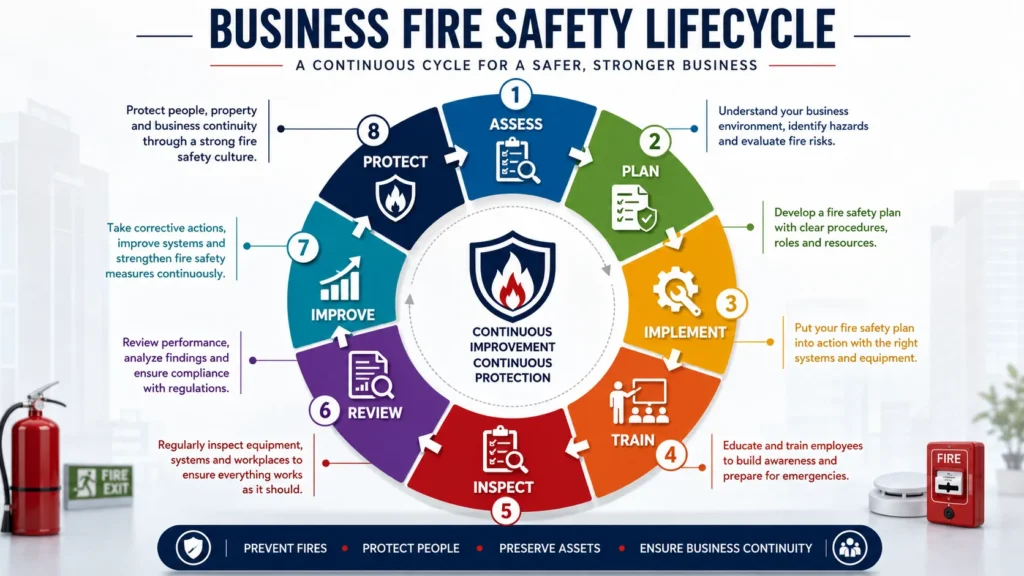
Fire Safety Planning Lifecycle
Business Activities
        │
        ▼
Fire Risk Assessment
        │
        ▼
Fire Safety Plan
        │
        ▼
Implement Control Measures
        │
        ▼
Employee Training
        │
        ▼
Emergency Drills
        │
        ▼
Inspection & Maintenance
        │
        ▼
Review & Continuous Improvement
        │
        └────────────────────► Repeat
This continuous cycle enables businesses to adapt to changing workplace conditions while maintaining effective fire safety management.
Recommended Inspire College Courses
To strengthen workplace fire safety knowledge and support professional development, businesses and individuals can explore the following courses offered by Inspire College.
Fire Safety Courses
- Level 3 Certificate in Fire Safety Principles
- Level 4 Diploma in Fire Safety
- Level 5 Diploma in Fire Safety Management
- Fire Marshal Training
- Fire Safety Train the Trainer
Risk Assessment Courses
- Level 2 Award in Risk Assessment
- Level 3 Certificate in Risk Assessment
- Level 4 Certificate in Risk Assessment
Key Takeaways
- Fire safety planning provides a structured approach to preventing fires and protecting people, property, and business operations.
- Fire risk assessments identify hazards and guide the development of effective fire safety plans.
- Regular inspections, employee training, preventive maintenance, and emergency planning are essential components of workplace fire safety.
- Businesses should tailor fire safety plans to their industry, operational activities, and workplace risks.
- Digital technologies such as smart fire alarms, IoT sensors, and cloud-based compliance systems enhance modern fire safety management.
- Continuous review and improvement ensure fire safety arrangements remain effective as workplaces evolve.
- Investing in fire safety planning supports legal compliance, strengthens business continuity, and builds a resilient safety culture.
Conclusion
Fire safety planning and fire risk assessments are essential for protecting businesses from one of the most serious workplace hazards. Together, they provide a structured framework for identifying fire risks, implementing preventive measures, preparing employees for emergencies, and ensuring that organisations can respond effectively if an incident occurs.
A successful fire safety programme goes beyond compliance. It requires ongoing commitment, leadership, employee involvement, regular reviews, and continuous improvement. Businesses that proactively manage fire risks are better positioned to safeguard their workforce, protect valuable assets, minimise operational disruption, and maintain customer confidence.
Whether your organisation operates in an office, warehouse, healthcare facility, retail environment, construction site, or manufacturing plant, developing a comprehensive fire safety plan supported by regular fire risk assessments is one of the most effective investments you can make. By embedding fire safety into everyday operations, businesses create a safer, more resilient workplace that is prepared for today’s risks and tomorrow’s challenges.
Explore More Fire Safety & Risk Assessment Articles
Discover expert guides on fire safety careers, fire risk assessments, workplace compliance, fire protection systems, and professional qualifications to expand your knowledge and advance your career in fire safety.
- What is Fire Safety?
- Fire Risk Assessment
- Fire Safety: Essential Tips for Homes and Workplaces
- What Does a Senior Fire Safety Advisor Do? Roles, Responsibilities, and Career Guide
- Top Skills Every Senior Fire Safety Advisor Should Develop
- Is Fire Safety a Good Career Choice in the UK?
- Senior Fire Safety Advisor Career Progression: Exciting Roles, Salary & Leadership Path
- Is Fire Safety a Good Career Choice in the UK?
- Top Skills Every Senior Fire Safety Advisor Should Develop
- Senior Fire Safety Advisor vs Fire Risk Assessor: Which Career Is Right for You?
- Senior Fire Safety Advisor: Top Industries Hiring Across the UK
- Fire Risk Assessment Explained: A Complete Beginner’s Guide
- Qualified Fire Risk Assessor Career Guide: Training, Skills, and Job Opportunities
- Senior Fire Safety Advisor: Top Industries Hiring Across the UK
- The 5 Essential Steps of Fire Risk Assessment Explained
- Common Risk Assessment Mistakes and How to Avoid Them
- How Fire Safety and Risk Assessment Reduce Workplace Hazards
- Essential Fire Safety Tips Everyone Should Know to Stay Safe
- Fire Risk Assessment vs Fire Safety Audit: What’s the Difference?
- How to Conduct an Effective Risk Assessment Step by Step
- Fire Safety Checklist for Homes, Offices & Commercial Buildings
- How Often Should a Fire Risk Assessment Be Reviewed?
- Top Workplace Fire Hazards Every Inspection Reveals
- Essential Fire Safety Duties for Landlords and Property Managers