
Essential Fire Safety Duties for Landlords and Property Managers
Fire safety is one of the most important legal and moral responsibilities for landlords and property managers. Whether managing a single rental property, a House in Multiple Occupation (HMO), a block of flats, or a commercial building, ensuring that occupants can live and work safely is not optional—it is a legal requirement. A failure to meet fire safety obligations can lead to enforcement action, financial penalties, reputational damage, and, most importantly, put lives at risk.
Modern buildings contain numerous potential fire hazards, including electrical equipment, heating systems, combustible materials, and shared escape routes. Without effective fire safety management, these hazards can quickly develop into serious emergencies. This is why UK fire safety legislation requires landlords and property managers to take proactive steps to prevent fires, maintain fire protection systems, and regularly assess fire risks.
Many people mistakenly believe that installing smoke alarms is enough to meet their responsibilities. In reality, fire safety involves far more than basic alarm installation. It requires ongoing inspections, fire risk assessments, maintenance of fire protection equipment, clear emergency procedures, accurate documentation, and regular reviews whenever significant changes occur.
This guide explains the essential fire safety duties every landlord and property manager should understand, outlines the legal responsibilities under UK legislation, and provides practical steps to help maintain compliance while protecting tenants, visitors, and property.
What Are the Essential Fire Safety Duties for Landlords and Property Managers?
The essential fire safety duties for landlords and property managers include conducting suitable fire risk assessments, maintaining fire alarm systems, ensuring fire doors and escape routes remain safe, installing and testing smoke alarms, maintaining emergency lighting where required, keeping accurate fire safety records, communicating fire procedures to occupants, and regularly reviewing fire safety arrangements to remain compliant with UK legislation.
Why Fire Safety Responsibilities Matter
Fire safety is not simply about complying with regulations. It is about protecting people, safeguarding property, and reducing the likelihood of devastating fire incidents.
Effective fire safety management helps to:
- Protect tenants and visitors.
- Reduce the likelihood of fire.
- Improve emergency preparedness.
- Protect property investments.
- Support business continuity.
- Reduce insurance risks.
- Demonstrate legal compliance.
- Build trust with occupants.
A proactive approach also reduces the likelihood of enforcement action following inspections by the Fire and Rescue Service.
Understanding the UK Fire Safety Legal Framework
Landlords and property managers must understand the legal framework governing fire safety responsibilities.
Depending on the type of property, responsibilities may arise under legislation such as:
- Regulatory Reform (Fire Safety) Order 2005
- Fire Safety (England) Regulations 2022
- Housing Act 2004
- Smoke and Carbon Monoxide Alarm Regulations
- Building Regulations
- Relevant British Standards relating to fire protection systems
These regulations require responsible individuals to identify fire hazards, implement suitable precautions, and maintain fire safety measures throughout the life of the property.
Rather than treating compliance as a one-time task, landlords should view fire safety as an ongoing management process.
Who Is Responsible for Fire Safety?
One of the most common questions asked by landlords is who is legally responsible for fire safety within a property.
The answer depends on the property type and how it is managed.
For many rented properties, responsibility may be shared between landlords, property managers, managing agents, employers, and tenants.
However, in buildings containing communal areas or non-domestic premises, a Responsible Person is legally required to manage fire safety.
Typical responsibilities include:
- Identifying fire hazards.
- Completing fire risk assessments.
- Maintaining fire protection equipment.
- Keeping escape routes safe.
- Reviewing fire safety arrangements.
- Arranging maintenance and inspections.
- Maintaining fire safety records.
Delegating tasks does not remove overall legal responsibility.
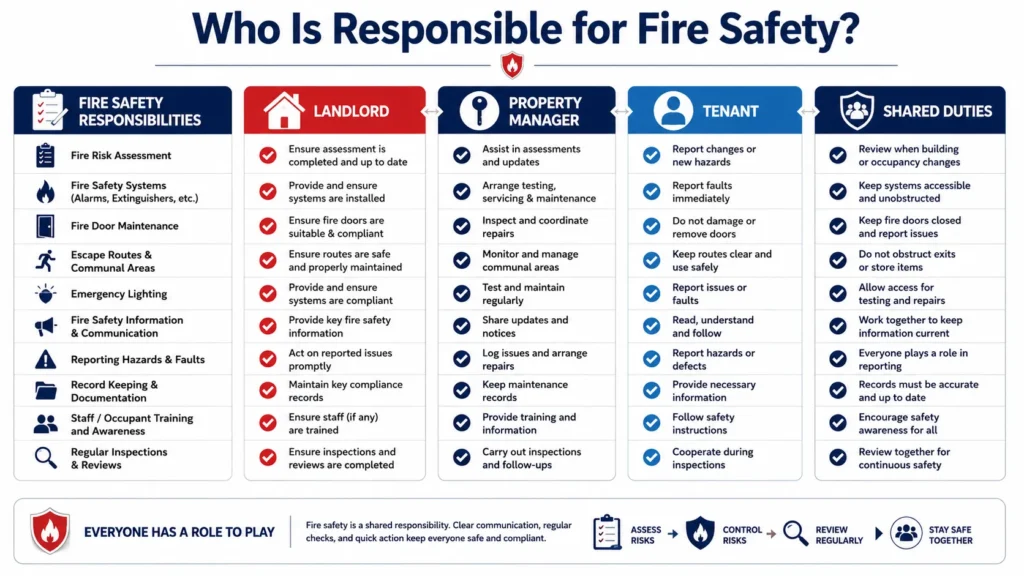
Fire Safety Responsibility Matrix
Understanding who is responsible for different fire safety activities helps prevent confusion and improves compliance.
| Fire Safety Duty | Landlord | Property Manager | Tenant |
|---|---|---|---|
| Fire Risk Assessment | ✓ | Assist | Report hazards |
| Smoke Alarm Installation | ✓ | Assist | Test where instructed |
| Fire Alarm Maintenance | ✓ | ✓ | Report faults |
| Fire Door Maintenance | ✓ | ✓ | Do not damage or obstruct |
| Escape Route Management | ✓ | ✓ | Keep routes clear |
| Emergency Lighting | ✓ | ✓ | Report defects |
| Fire Safety Information | ✓ | ✓ | Follow instructions |
| Hazard Reporting | Monitor | Monitor | ✓ |
A clear allocation of responsibilities helps ensure that no important fire safety duty is overlooked.
Core Fire Safety Duties Every Landlord and Property Manager Should Know
Although responsibilities vary according to property type, several duties apply to almost every landlord and property manager.
1. Conduct a Suitable Fire Risk Assessment
A fire risk assessment forms the foundation of every effective fire safety management system.
It identifies:
- Fire hazards
- People at risk
- Existing control measures
- Additional improvements required
- Emergency arrangements
The assessment should be reviewed whenever:
- Significant alterations are made.
- Occupancy changes.
- Building layout changes.
- Fire incidents occur.
- New hazards are introduced.
A well-maintained fire risk assessment demonstrates proactive fire safety management and supports ongoing compliance.
2. Install and Maintain Fire Detection Systems
Early fire detection saves lives.
Depending on the property, appropriate fire detection may include:
- Smoke alarms
- Heat detectors
- Fire alarm systems
- Carbon monoxide alarms (where applicable)
Landlords should ensure these systems are:
- Correctly installed
- Regularly tested
- Properly maintained
- Promptly repaired if faults occur
Maintenance records should be retained for future reference.
3. Maintain Safe Escape Routes
Escape routes are critical during emergencies.
Inspectors expect escape routes to remain:
- Clearly identified
- Free from obstructions
- Adequately illuminated
- Easy to access
- Suitable for all occupants
Regular inspections help ensure these routes remain safe throughout the year.
4. Inspect and Maintain Fire Doors
Fire doors slow the spread of fire and smoke, providing valuable time for occupants to evacuate safely.
Routine inspections should check:
- Self-closing devices
- Smoke seals
- Door frames
- Hinges
- Latches
- Glazing
- Overall condition
Fire doors should never be wedged open unless approved hold-open systems are installed.
5. Maintain Emergency Lighting
Emergency lighting assists occupants when normal lighting fails during an emergency.
Where emergency lighting is required, landlords and property managers should ensure:
- Functional testing
- Routine servicing
- Battery checks
- Prompt repairs
- Accurate maintenance records
Well-maintained emergency lighting supports safe evacuation and regulatory compliance.
6. Keep Firefighting Equipment Ready for Use
Many commercial buildings, HMOs, and communal areas require firefighting equipment appropriate to the identified risks.
Inspectors expect fire extinguishers to be:
- Clearly visible
- Easily accessible
- Correctly located
- Properly serviced
- Clearly signed
Obstructed or poorly maintained equipment may reduce its effectiveness during an emergency.
Essential Fire Safety Systems Every Property Should Be Monitored
Different properties require different fire protection systems.
However, landlords and property managers should routinely monitor the following:
| Fire Protection System | Purpose |
|---|---|
| Fire Risk Assessment | Identifies hazards and required controls |
| Smoke Alarms | Early fire detection |
| Fire Alarm System | Warns occupants of fire |
| Fire Doors | Limits fire and smoke spread |
| Emergency Lighting | Supports evacuation during power loss |
| Escape Routes | Safe evacuation |
| Fire Extinguishers | Initial firefighting where appropriate |
| Fire Safety Signage | Directs occupants during emergencies |
Maintaining these systems significantly improves overall fire safety performance.
The Landlord Fire Safety Management Process
Fire safety should be viewed as a continuous cycle rather than a single inspection or assessment.
Identify Legal Duties

↓

Conduct Fire Risk Assessment

↓

Install Fire Protection Measures

↓

Inspect Property Regularly

↓

Maintain Fire Safety Systems

↓

Record Maintenance Activities

↓

Review Fire Risk Assessment

↓

Continue Monitoring Compliance
Following a structured process helps landlords identify issues early, reduce fire risks, and maintain compliance throughout the property’s lifecycle.
Why Regular Reviews Are Essential
Fire safety responsibilities do not end once systems have been installed.
Properties constantly change through:
- New tenants
- Building alterations
- Refurbishments
- New equipment
- Changes in occupancy
- Maintenance work
Each of these changes can introduce new fire risks.
Regular reviews ensure that fire safety arrangements remain suitable, effective, and legally compliant as the property evolves over time.
Fire Safety Duties for Different Property Types
Fire safety responsibilities vary depending on the type of property being managed. A single rental house does not require the same level of fire safety management as a House in Multiple Occupation (HMO) or a commercial building.
Understanding the specific risks associated with each property type helps landlords and property managers implement suitable fire safety measures while meeting their legal obligations.
Single-Let Residential Properties
For most privately rented homes, landlords are expected to provide a safe living environment by ensuring basic fire protection measures are in place.
Key responsibilities include:
- Installing smoke alarms on every storey.
- Installing carbon monoxide alarms where legally required.
- Maintaining electrical installations.
- Ensuring gas appliances are safely maintained.
- Providing safe escape routes.
- Repairing fire safety defects promptly.
Although the fire safety requirements are generally less complex than those for larger buildings, regular property inspections remain essential.
Houses in Multiple Occupation (HMOs)
HMOs present higher fire risks because multiple households occupy the same building.
Additional responsibilities may include:
- Comprehensive Fire Risk Assessment.
- Fire alarm systems appropriate to the building.
- Certified fire doors.
- Emergency lighting where required.
- Fire-resistant compartmentation.
- Fire safety signage.
- Protected escape routes.
- Regular maintenance of communal areas.
Because HMOs often contain shared kitchens, corridors, and staircases, landlords must pay particular attention to common areas.
Blocks of Flats
In apartment buildings, landlords or managing agents usually have responsibility for communal areas.
Typical duties include:
- Maintaining communal fire alarms where installed.
- Inspecting fire doors.
- Keeping stairwells clear.
- Testing emergency lighting.
- Managing evacuation information.
- Reviewing Fire Risk Assessments regularly.
Individual residents also have responsibilities, but the management of shared spaces generally rests with the landlord or property manager.
Commercial Properties
Commercial buildings often have additional legal duties because employees, contractors, customers, and visitors may all occupy the premises.
Responsibilities typically include:
- Suitable Fire Risk Assessment.
- Fire evacuation planning.
- Staff fire safety training.
- Fire alarm maintenance.
- Fire extinguisher servicing.
- Fire drills.
- Emergency lighting testing.
- Ongoing fire safety inspections.
The complexity of fire safety management generally increases with the size and occupancy of the building.
Fire Safety Responsibilities by Property Type
| Property Type | Main Fire Safety Duties |
|---|---|
| Single-Let Property | Smoke alarms, electrical safety, gas safety, safe escape routes |
| HMO | Fire Risk Assessment, fire alarm system, fire doors, emergency lighting |
| Block of Flats | Management of communal areas, escape routes, fire doors, emergency lighting |
| Commercial Property | Fire Risk Assessment, evacuation planning, maintenance, staff training |
| Mixed-Use Building | Shared fire safety coordination, compartmentation, inspections |
This comparison highlights why a one-size-fits-all approach to fire safety is rarely appropriate.
Creating an Effective Fire Safety Maintenance Schedule
One of the most common reasons organisations fail inspections is poor maintenance.
Rather than reacting to faults as they arise, landlords and property managers should implement a planned maintenance programme.
Daily Checks
- Escape routes remain clear.
- Fire doors are unobstructed.
- No obvious fire hazards.
- Housekeeping standards maintained.
Weekly Checks
- Fire alarm testing (where applicable).
- Visual inspection of fire extinguishers.
- Inspection of communal areas.
Monthly Checks
- Emergency lighting function tests.
- Fire door visual inspections.
- Review maintenance records.
Quarterly Checks
- Internal fire safety inspection.
- Review contractor maintenance.
- Inspect signage and evacuation information.
Annual Checks
- Fire Risk Assessment review.
- Fire alarm servicing.
- Fire extinguisher servicing.
- Emergency lighting servicing.
- Fire door inspections by competent persons.
A structured maintenance programme demonstrates effective fire safety management and significantly reduces compliance risks.
Fire Safety Documentation Checklist
Maintaining accurate documentation is just as important as maintaining physical fire safety systems.
Inspectors frequently request evidence that fire safety arrangements are actively managed.
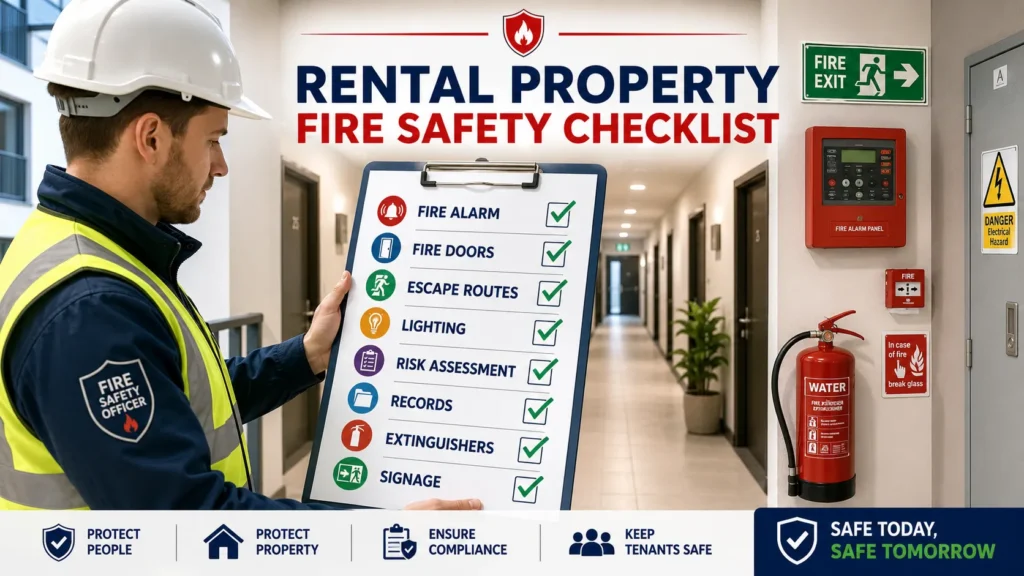
Essential documents include:
| Document | Purpose |
|---|---|
| Fire Risk Assessment | Identifies hazards and control measures |
| Fire Alarm Test Records | Demonstrates routine testing |
| Fire Alarm Service Reports | Confirms professional maintenance |
| Emergency Lighting Records | Verifies testing and servicing |
| Fire Door Inspection Reports | Demonstrates ongoing maintenance |
| Fire Extinguisher Service Certificates | Confirms annual servicing |
| Electrical Inspection Reports | Supports electrical fire safety |
| Gas Safety Certificate | Demonstrates appliance safety |
| Fire Safety Training Records | Confirms staff competence |
| Maintenance Logs | Records completed repairs and inspections |
Good documentation helps demonstrate compliance during inspections and provides evidence that responsibilities are being fulfilled.
Fire Safety Compliance Roadmap
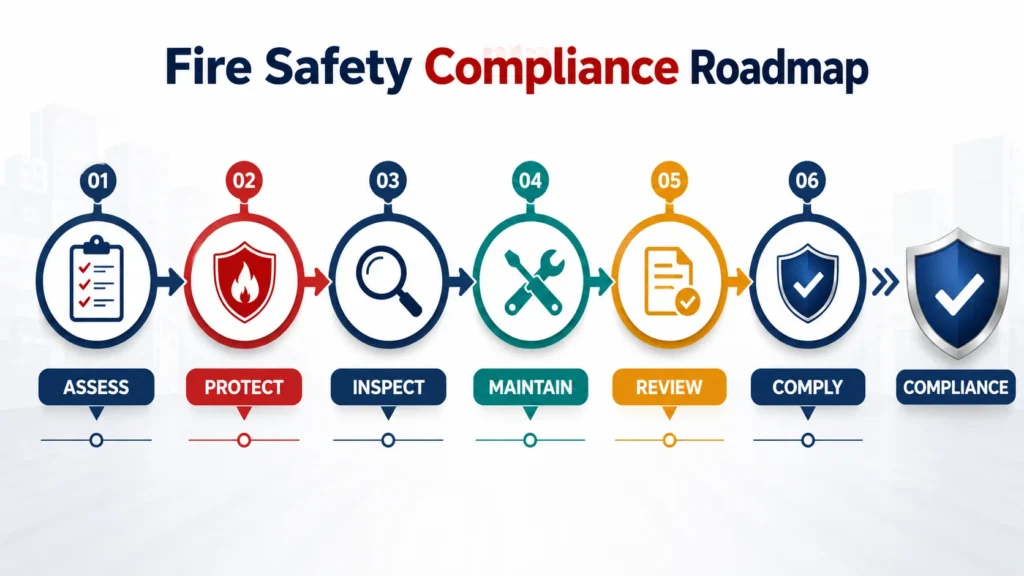
Successful fire safety management is built on continuous improvement rather than one-time compliance.
Understand Legal Duties

↓

Conduct Fire Risk Assessment

↓

Identify Fire Hazards

↓

Install Fire Protection Measures

↓

Inspect Property Regularly

↓

Maintain Fire Safety Systems

↓

Train Staff and Agents

↓

Update Fire Safety Records

↓

Review Fire Risk Assessment

↓

Maintain Continuous Compliance
This roadmap provides a practical framework for landlords and property managers to manage fire safety throughout the property’s lifecycle.
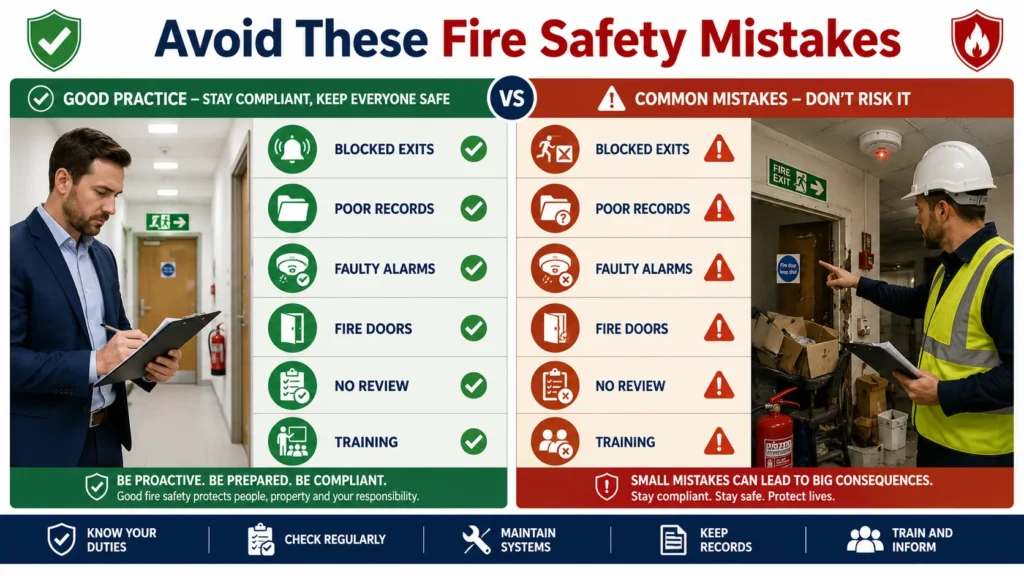
Common Fire Safety Mistakes Made by Landlords and Property Managers
Many enforcement actions result from avoidable mistakes rather than a complete lack of fire safety measures.
Recognising these common errors helps prevent compliance failures.
Assuming a Fire Risk Assessment Never Needs Reviewing
Fire Risk Assessments should be reviewed whenever significant changes occur within the property.
Ignoring Communal Areas
Corridors, stairwells, entrance halls, and shared storage areas are common locations for fire hazards.
Poor Record Keeping
Even where maintenance has been completed, missing documentation can create compliance concerns during inspections.
Delaying Repairs
Small defects such as damaged fire door seals or faulty emergency lighting should be repaired promptly before they become significant risks.
Failing to Communicate with Occupants
Tenants should understand:
- Fire evacuation procedures.
- Emergency contact information.
- Reporting procedures for hazards.
- Responsibilities relating to communal areas.
Good communication contributes to a stronger fire safety culture.
Relying Solely on Contractors
Although maintenance contractors play an important role, landlords remain responsible for ensuring work is completed and compliance is maintained.
Preparing for a Fire Safety Inspection
Routine preparation makes inspections less stressful and improves the likelihood of achieving a positive outcome.
Before an inspection, landlords and property managers should verify that:
- Fire Risk Assessment is current.
- Fire alarms operate correctly.
- Fire doors function properly.
- Emergency lighting has been tested.
- Escape routes remain unobstructed.
- Fire safety signs are visible.
- Maintenance certificates are available.
- Fire safety records are organised.
- Any previous inspection findings have been addressed.
Regular internal inspections often identify issues before official inspections take place.
Best Practices for Long-Term Fire Safety Compliance
Maintaining compliance requires continuous attention rather than occasional inspections.
Best practice includes:
- Reviewing Fire Risk Assessments regularly.
- Conducting routine property inspections.
- Maintaining all fire protection systems.
- Keeping accurate maintenance records.
- Encouraging occupants to report hazards.
- Scheduling preventive maintenance.
- Providing ongoing fire safety training.
- Monitoring legislative updates.
- Working with competent fire safety professionals when required.
A proactive approach reduces risk while protecting occupants and property investments.
Develop Professional Fire Safety Knowledge with Inspire College
Understanding legal responsibilities is only one part of effective fire safety management. Professional training helps landlords, property managers, facilities managers, and Responsible Persons develop the knowledge needed to manage fire risks confidently.
- Level 3 Award in the Inspection and Testing of Fire Stopping Installations
- Level 4 Certificate in Fire Risk Assessment
- Fire Marshal Training
Final Thoughts
Fire safety is an ongoing responsibility that requires careful planning, regular monitoring, and continuous improvement. For landlords and property managers, compliance extends far beyond installing smoke alarms or arranging occasional maintenance. It involves understanding legal duties, conducting suitable Fire Risk Assessments, maintaining fire protection systems, keeping accurate records, and ensuring occupants can evacuate safely if an emergency occurs.
By adopting a structured fire safety management approach, carrying out regular inspections, reviewing Fire Risk Assessments whenever significant changes occur, and maintaining essential fire safety systems, landlords can reduce risks while meeting their legal obligations.
Investing in professional fire safety training and implementing best practices not only supports compliance with UK legislation but also demonstrates a genuine commitment to protecting tenants, visitors, employees, and valuable property assets. A proactive fire safety strategy creates safer buildings, reduces the likelihood of enforcement action, and contributes to long-term confidence in property management.
Explore More Fire Safety & Risk Assessment Articles
Discover expert guides on fire safety careers, fire risk assessments, workplace compliance, fire protection systems, and professional qualifications to expand your knowledge and advance your career in fire safety.
- Senior Fire Safety Advisor Career Progression: Exciting Roles, Salary & Leadership Path
- Is Fire Safety a Good Career Choice in the UK?
- Top Skills Every Senior Fire Safety Advisor Should Develop
- Senior Fire Safety Advisor vs Fire Risk Assessor: Which Career Is Right for You?
- Senior Fire Safety Advisor: Top Industries Hiring Across the UK
- Fire Risk Assessment Explained: A Complete Beginner’s Guide
- Qualified Fire Risk Assessor Career Guide: Training, Skills, and Job Opportunities
- Senior Fire Safety Advisor: Top Industries Hiring Across the UK
- The 5 Essential Steps of Fire Risk Assessment Explained
- Common Risk Assessment Mistakes and How to Avoid Them
- How Fire Safety and Risk Assessment Reduce Workplace Hazards
- Essential Fire Safety Tips Everyone Should Know to Stay Safe
- Fire Safety Planning and Risk Assessment for Businesses
- How to Conduct an Effective Risk Assessment Step by Step
- Fire Safety Checklist for Homes, Offices & Commercial Buildings
- Fire Safety Checklist for Homes, Offices & Commercial Buildings
- Common Risk Assessment Mistakes and How to Avoid Them
- Fire Risk Assessment vs Fire Safety Audit: What’s the Difference?
- How Often Should a Fire Risk Assessment Be Reviewed?
- Top Workplace Fire Hazards Every Inspection Reveals
- Failed a Fire Safety Inspection? Here’s What Happens Next
- Fire Safety Act 2021: What Businesses Need to Know