
Common Risk Assessment Mistakes and How to Avoid Them
Risk assessments are the foundation of effective workplace health and safety. Whether in an office, construction site, warehouse, healthcare facility, school, or manufacturing plant, a well-prepared risk assessment helps identify hazards, evaluate potential risks, and implement appropriate control measures before accidents occur. However, many organisations make common mistakes that reduce the effectiveness of their risk assessments, leaving employees, visitors, and businesses exposed to unnecessary risks.
In the UK, employers have a legal duty to assess workplace risks and take reasonable steps to protect anyone who may be affected by their activities. A poorly completed or outdated risk assessment can lead to workplace injuries, legal action, financial penalties, operational disruption, and damage to an organisation’s reputation.
This guide explains the most common risk assessment mistakes, why they happen, and practical ways to avoid them. Whether you are a business owner, manager, supervisor, health and safety professional, or someone interested in improving workplace safety knowledge, this article provides actionable advice based on recognised UK health and safety principles.
What Is a Risk Assessment?
A risk assessment is a systematic process used to identify workplace hazards, evaluate the likelihood and severity of harm, and determine suitable control measures to reduce risks to an acceptable level.
The objective is not to eliminate every possible risk, as this is often impossible, but to ensure risks are managed effectively through planning, prevention, and continuous improvement.
A suitable and sufficient risk assessment should answer the following questions:
- What hazards exist?
- Who could be harmed?
- How serious is the risk?
- What control measures are already in place?
- Are additional controls required?
- How will the assessment be reviewed?
When carried out correctly, risk assessments create safer workplaces while supporting legal compliance and business continuity.
Why Accurate Risk Assessments Matter
Many organisations view risk assessments as paperwork completed solely for compliance purposes. In reality, they are one of the most valuable tools for preventing workplace incidents.
An effective risk assessment helps organisations:
- Prevent workplace injuries and illnesses
- Reduce fire and safety hazards
- Protect employees, contractors, visitors, and customers
- Improve legal compliance
- Reduce insurance claims
- Minimise downtime caused by accidents
- Increase employee confidence
- Support continuous health and safety improvements
Businesses that invest time in quality risk assessments often experience fewer incidents, better operational performance, and stronger safety cultures.
UK Legal Requirements for Risk Assessments
Employers in the United Kingdom have legal responsibilities to protect people from workplace hazards.
Key legislation includes:
| Legislation | Purpose |
|---|---|
| Health and Safety at Work etc. Act 1974 | Places a duty on employers to protect employees and others affected by their work activities. |
| Management of Health and Safety at Work Regulations 1999 | Requires suitable and sufficient risk assessments to identify and control workplace hazards. |
| Regulatory Reform (Fire Safety) Order 2005 | Requires responsible persons to assess and manage fire risks in non-domestic premises. |
| Control of Substances Hazardous to Health (COSHH) Regulations | Requires assessment and control of hazardous substances. |
| Manual Handling Operations Regulations | Requires assessment of manual handling risks. |
A legally compliant risk assessment should be:
- Suitable and sufficient
- Specific to the workplace
- Based on actual hazards
- Reviewed regularly
- Updated whenever significant changes occur
- Communicated to relevant people
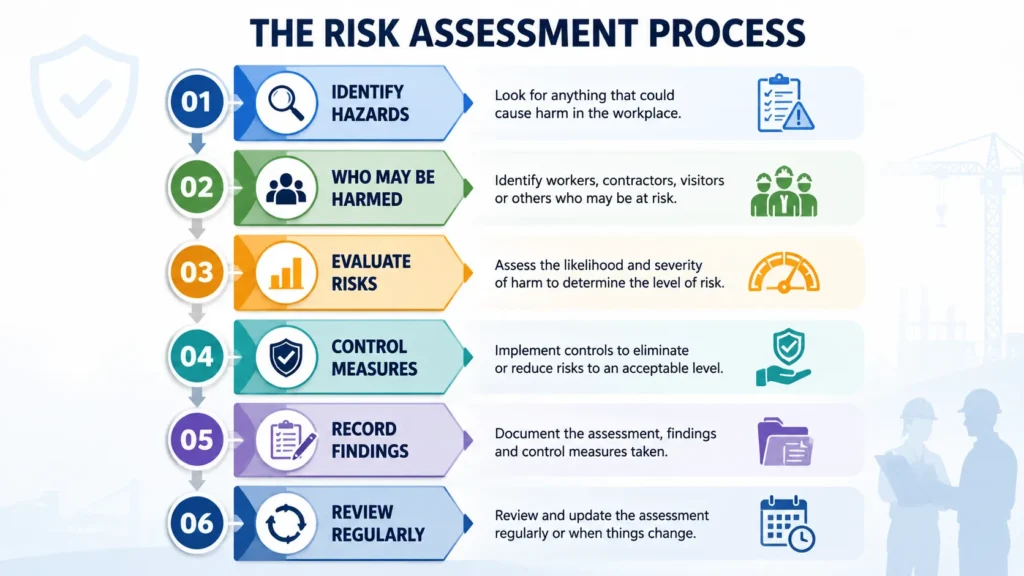
The Risk Assessment Process Explained
Following a structured process helps ensure no important step is overlooked.
Step 1: Identify Hazards
Look for anything capable of causing harm, including:
- Fire hazards
- Electrical equipment
- Machinery
- Chemicals
- Slips and trips
- Manual handling
- Working at height
- Poor housekeeping
- Workplace vehicles
- Stress and fatigue
Step 2: Identify Who May Be Harmed
Consider everyone who could be affected:
- Employees
- Contractors
- Visitors
- Customers
- Maintenance staff
- Vulnerable workers
- Pregnant employees
- Young workers
Step 3: Evaluate the Risks
Assess:
- Likelihood of harm
- Severity of consequences
- Existing control measures
- Residual risk after controls
Step 4: Implement Control Measures
Apply appropriate controls using the hierarchy of controls wherever possible.
Examples include:
- Eliminating hazards
- Substituting dangerous materials
- Installing engineering controls
- Introducing administrative procedures
- Providing suitable PPE
Step 5: Record Findings
Document:
- Hazards identified
- Persons at risk
- Existing controls
- Additional actions
- Responsible persons
- Review dates
Step 6: Review and Update
Risk assessments should never remain static.
Review them when:
- New equipment is introduced
- Processes change
- Workplace layouts change
- An accident occurs
- New legislation is introduced
- New hazards emerge
Risk Assessment Process Flowchart
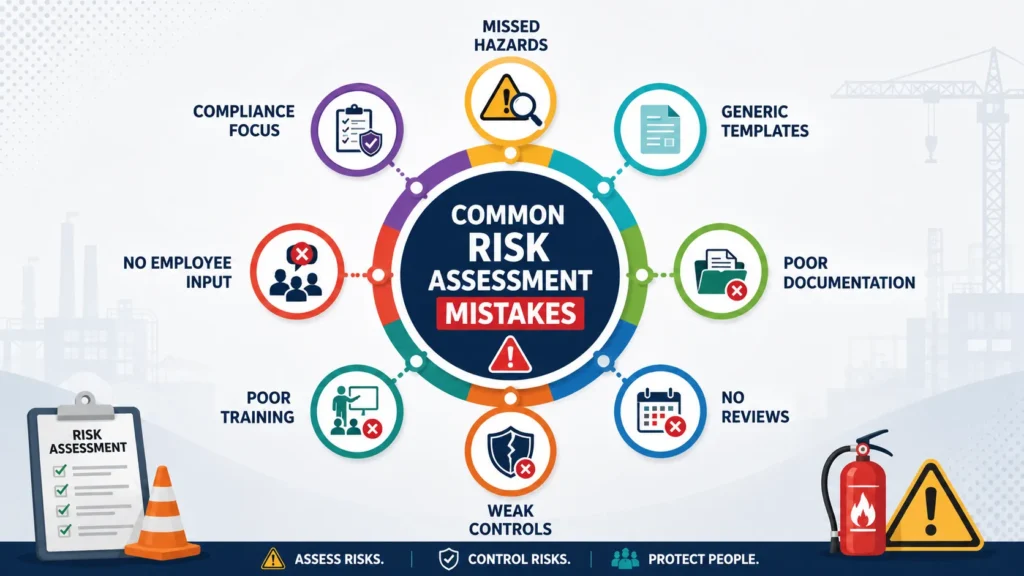
Common Risk Assessment Mistake #1: Failing to Identify All Hazards
One of the most frequent mistakes is overlooking hazards that are not immediately obvious. Many assessments focus only on visible physical dangers while ignoring less obvious risks such as occupational stress, lone working, ergonomic issues, fire safety deficiencies, or exposure to hazardous substances.
Why It Happens
- Poor workplace inspections
- Lack of experience
- Time pressures
- Inadequate consultation with employees
- Using outdated hazard checklists
How to Avoid It
Conduct thorough inspections of all work areas, involve employees who perform the tasks daily, review previous incident reports, and use industry-specific hazard checklists. Regular site walks can reveal hazards that may otherwise be missed.
Example: A warehouse assessment identifies forklift traffic but fails to consider poor lighting in loading bays, increasing the risk of collisions during early morning shifts.
Common Risk Assessment Mistake #2: Using Generic Templates Without Customisation
Generic templates can save time, but copying them without adapting them to the actual workplace often results in incomplete or misleading assessments.
Every organisation has unique:
- Equipment
- Processes
- Workforce
- Building layouts
- Environmental conditions
- Operational risks
Why It Happens
- Convenience
- Lack of expertise
- Limited resources
- Over-reliance on downloaded templates
How to Avoid It
Use templates only as a starting point. Inspect the workplace personally, gather relevant information, and tailor every section to reflect the specific activities being assessed.
| Generic Assessment | Effective Assessment |
|---|---|
| Same document used for every workplace | Written specifically for each location |
| Broad hazards listed | Workplace-specific hazards identified |
| Minimal detail | Practical control measures included |
| Rarely updated | Reviewed regularly |
Common Risk Assessment Mistake #3: Ignoring Employee Input
Employees often recognise workplace hazards before managers or consultants because they interact with equipment, machinery, and work environments every day.
Failing to involve employees can result in important hazards being overlooked.
Why It Happens
- Poor communication
- Limited consultation
- Tight deadlines
- Management assumptions
How to Avoid It
Encourage employees to report hazards, participate in inspections, and contribute to risk assessment reviews. Safety meetings, toolbox talks, and anonymous reporting systems can improve engagement.
Example: Maintenance technicians may identify recurring electrical faults that management is unaware of, allowing preventive action before an incident occurs.
Common Risk Assessment Mistake #4: Underestimating Risk Levels
Some organisations classify high-risk activities as low risk to avoid implementing additional control measures. Others overestimate risks, leading to unnecessary controls and increased costs.
Both approaches reduce the effectiveness of the assessment.
Risk Evaluation Should Consider
| Factor | Questions to Ask |
|---|---|
| Likelihood | How likely is the incident to occur? |
| Severity | What would be the consequences? |
| Exposure | How often are people exposed? |
| Existing Controls | Are they effective? |
| Residual Risk | Is further action required? |
How to Avoid It
Use a consistent risk matrix, involve competent persons, and base decisions on evidence rather than assumptions.
Common Risk Assessment Mistake #5: Implementing Weak Control Measures
Identifying hazards alone does not improve safety. The real value comes from selecting effective control measures.
Many assessments rely heavily on warning signs or personal protective equipment when stronger controls could eliminate or significantly reduce the hazard.
Hierarchy of Controls
- Eliminate the hazard
- Substitute with a safer alternative
- Apply engineering controls
- Introduce administrative controls
- Provide personal protective equipment
Example
Instead of relying solely on hearing protection, install quieter machinery or acoustic barriers to reduce noise exposure at the source.
Common Risk Assessment Mistake #6: Poor Documentation
Incomplete or poorly organised records make it difficult to demonstrate compliance, monitor improvements, or investigate incidents.
Common documentation problems include:
- Missing review dates
- Vague descriptions
- No responsible person assigned
- Incomplete hazard information
- Missing action plans
How to Avoid It
Every risk assessment should clearly record:
- Identified hazards
- Persons affected
- Existing controls
- Additional actions
- Deadlines
- Responsible individuals
- Review schedule
Clear documentation also supports audits, inspections, and continuous improvement.
Common Risk Assessment Mistake #7: Treating Risk Assessments as a One-Time Exercise
A risk assessment should be a living document, not a file stored away after completion.
Workplaces evolve constantly through new equipment, changing processes, staffing changes, and updated legislation. An outdated assessment may no longer reflect actual workplace risks.
Signs Your Risk Assessment Needs Reviewing
- New machinery has been installed.
- Work processes have changed.
- An accident or near miss has occurred.
- The workplace layout has been altered.
- New hazardous substances are introduced.
- Staff responsibilities have changed.
- Legal or industry guidance has been updated.
How to Avoid It
Establish a formal review schedule and trigger additional reviews whenever significant workplace changes occur. Assign responsibility for monitoring changes and ensure findings are communicated to relevant employees.
By treating risk assessment as an ongoing process rather than a one-off task, organisations can continuously improve safety performance and remain compliant with UK health and safety requirements.
Common Risk Assessment Mistake #8: Failing to Review Risk Assessments After Workplace Changes
One of the biggest reasons risk assessments become ineffective is that they are not updated when the workplace changes. Even a well-prepared assessment can become outdated if new equipment, processes, or personnel are introduced.
Common Workplace Changes That Require a Review
- New machinery or equipment
- Office relocation or building renovations
- New production processes
- Additional employees or contractors
- New hazardous substances
- Changes in legislation
- Introduction of shift work
- Changes to emergency procedures
How to Avoid It
Create a review schedule and assign responsibility to a competent person. Every significant workplace change should trigger a fresh assessment rather than waiting for the annual review.
Example
A manufacturing company installs automated machinery but continues using an old risk assessment written for manual production. New pinch points and maintenance hazards remain unidentified, increasing the likelihood of injuries.
Common Risk Assessment Mistake #9: Ignoring Near Misses and Previous Incidents
Many organisations investigate accidents but overlook near misses. However, near misses often provide valuable warnings before a serious incident occurs.
Why This Is a Problem
If a hazard has already almost caused harm, there is a good chance it will happen again.
How to Avoid It
Develop a reporting culture where employees feel comfortable reporting:
- Near misses
- Unsafe conditions
- Unsafe behaviours
- Equipment failures
- Fire hazards
- Housekeeping issues
Review incident trends regularly and update risk assessments accordingly.
| Poor Practice | Best Practice |
|---|---|
| Ignore near misses | Investigate every near miss |
| Wait for accidents | Prevent accidents before they occur |
| No reporting system | Encourage open reporting |
| Reactive safety | Proactive safety culture |
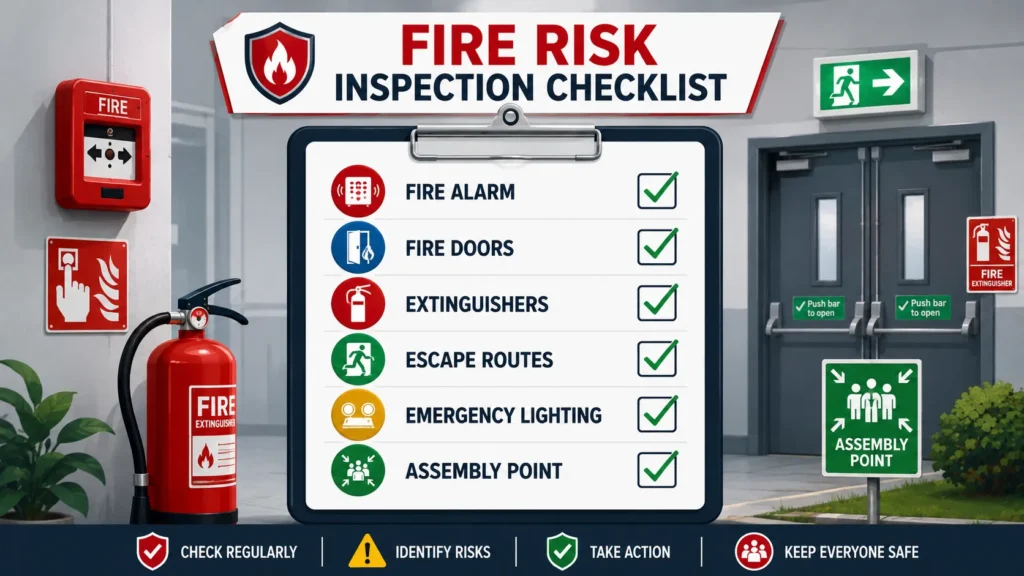
Common Risk Assessment Mistake #10: Inadequate Fire Risk Consideration
Many general workplace risk assessments fail to give enough attention to fire hazards. Fire safety should never be treated as a minor section within a broader assessment.
Common Fire Risks
- Faulty electrical equipment
- Overloaded sockets
- Poor housekeeping
- Blocked fire exits
- Improper chemical storage
- Hot work activities
- Flammable liquids
- Inadequate fire detection systems
How to Avoid It
Include dedicated fire risk assessments where required and regularly inspect:
- Fire extinguishers
- Fire alarm systems
- Emergency lighting
- Fire doors
- Escape routes
- Assembly points
Example
An office stores cardboard boxes in front of an emergency exit. Although the fire alarm system works correctly, employees may be unable to evacuate safely during an emergency.
Common Risk Assessment Mistake #11: Focusing Only on Physical Hazards
Modern workplaces present more than physical risks. Many assessments fail to consider health, wellbeing, and psychological hazards.
Examples of Non-Physical Risks
- Workplace stress
- Fatigue
- Excessive workload
- Lone working
- Bullying
- Poor workstation ergonomics
- Mental health pressures
How to Avoid It
Assess both physical and non-physical hazards. Speak with employees regularly to understand workload pressures and wellbeing concerns.
Healthy employees are generally safer, more productive, and more engaged.
Common Risk Assessment Mistake #12: Inadequate Training
Even the best-written risk assessment will fail if employees do not understand it.
Common Training Problems
- No induction training
- Infrequent refresher sessions
- Poor emergency drills
- Lack of task-specific instruction
- Contractors not trained
How to Avoid It
Provide regular training covering:
- Hazard awareness
- Safe systems of work
- Emergency procedures
- Fire safety
- Manual handling
- PPE use
- Incident reporting
Employee Training Cycle
Identify Training Needs
│
▼
Provide Initial Training
│
▼
Practical Demonstration
│
▼
Employee Assessment
│
▼
Refresher Training
│
▼
Continuous Improvement
Common Risk Assessment Mistake #13: Not Assigning Responsibility
Many action plans fail because nobody has been given responsibility for implementing the required improvements.
Poor Example
“Repair damaged flooring.”
Who?
When?
No one knows.
Better Example
| Action | Responsible Person | Deadline | Status |
|---|---|---|---|
| Replace damaged flooring | Facilities Manager | 15 August | In Progress |
| Service fire extinguishers | Fire Safety Officer | 30 July | Completed |
| Review manual handling assessment | Health & Safety Manager | 20 August | Planned |
Assigning ownership improves accountability and ensures corrective actions are completed on time.
Common Risk Assessment Mistake #14: Prioritising Compliance Over Safety
Some organisations complete risk assessments simply because legislation requires them.
This “tick-box” approach often produces documents that satisfy audits but fail to improve workplace safety.
Signs of a Tick-Box Assessment
- Generic wording
- No workplace inspection
- No employee consultation
- Old review dates
- Copied information
- No follow-up actions
How to Avoid It
Focus on reducing real risks rather than simply completing paperwork.
Ask:
- Will these controls genuinely reduce risk?
- Are employees following safe procedures?
- Have improvements actually been implemented?
A useful risk assessment should improve safety, not simply fill a folder.
Common Risk Assessment Mistake #15: Failing to Monitor Control Measures
Implementing controls is only the beginning. Organisations must verify that those controls continue to work effectively.
Examples
Installing safety barriers
↓
Are employees using them correctly?
Providing PPE
↓
Is it being worn?
Introducing safe procedures
↓
Are they being followed?
Installing fire extinguishers
↓
Are inspections up to date?
How to Avoid It
Carry out regular:
- Workplace inspections
- Safety audits
- Supervisor observations
- Employee feedback sessions
- Maintenance checks
- Performance reviews
Continuous monitoring ensures that control measures remain effective over time.
Industry-Specific Risk Assessment Challenges
Different industries face different risks. A single generic approach rarely provides adequate protection.
| Industry | Common Risks | Key Controls |
|---|---|---|
| Construction | Falls from height, moving machinery, excavation | PPE, permits, edge protection, inspections |
| Healthcare | Infection, sharps, manual handling | Hygiene procedures, training, PPE |
| Manufacturing | Machinery, noise, chemicals | Guards, maintenance, ventilation |
| Warehousing | Forklifts, falling objects, slips | Traffic management, housekeeping |
| Offices | Ergonomics, fire safety, stress | DSE assessments, wellbeing programmes |
| Education | Fire safety, slips, laboratory hazards | Supervision, emergency planning |
| Hospitality | Hot surfaces, kitchens, manual handling | Equipment maintenance, staff training |
| Retail | Customer safety, stockrooms, manual handling | Housekeeping, security, inspections |
Tailoring assessments to each industry’s activities significantly improves safety outcomes.
Risk Assessment Best Practices
Following recognised best practices helps organisations create more effective and legally compliant assessments.
Best Practice Checklist
✔ Inspect the workplace personally.
✔ Consult employees.
✔ Identify all foreseeable hazards.
✔ Consider everyone who may be affected.
✔ Use a consistent risk rating system.
✔ Apply the hierarchy of controls.
✔ Record findings clearly.
✔ Assign responsibilities.
✔ Monitor implementation.
✔ Review assessments regularly.
These principles support continuous improvement rather than one-time compliance.
Risk Assessment Do’s and Don’ts
| Do | Don’t |
|---|---|
| Visit the workplace | Rely only on paperwork |
| Speak with employees | Ignore frontline experience |
| Keep assessments updated | Use outdated documents |
| Prioritise high risks | Treat every risk equally |
| Record actions clearly | Leave responsibilities unclear |
| Monitor improvements | Assume controls always work |
| Learn from incidents | Ignore near misses |
| Review after changes | Wait until something goes wrong |
Workplace Risk Assessment Checklist
Use this checklist before finalising any workplace risk assessment.
| Item | Complete |
|---|---|
| Workplace inspected | □ |
| Hazards identified | □ |
| Employees consulted | □ |
| Vulnerable persons considered | □ |
| Existing controls reviewed | □ |
| Additional controls identified | □ |
| Risk levels evaluated | □ |
| Fire safety considered | □ |
| Emergency procedures checked | □ |
| Responsible persons assigned | □ |
| Review date recorded | □ |
| Findings communicated | □ |
Completing this checklist helps ensure the assessment is suitable, sufficient, and practical rather than simply meeting minimum compliance requirements.
Risk Assessment Improvement Cycle
Identify Hazards
│
▼
Assess Risks
│
▼
Implement Controls
│
▼
Train Employees
│
▼
Monitor Performance
│
▼
Investigate Incidents
│
▼
Review Assessment
│
▼
Continuous Improvement
By adopting this continuous improvement cycle, organisations move beyond compliance and build a proactive safety culture that reduces incidents, protects people, and supports long-term operational success.
Key Takeaways
The most effective risk assessments are those that become part of an organisation’s everyday operations rather than a one-time compliance exercise.
Remember these essential principles:
- Identify hazards thoroughly.
- Consult employees throughout the process.
- Assess risks objectively.
- Apply effective control measures.
- Keep documentation accurate.
- Review assessments regularly.
- Learn from incidents and near misses.
- Promote continuous improvement.
Organisations that follow these practices are better positioned to reduce accidents, improve compliance, and create safer working environments for everyone.
Conclusion
A well-executed risk assessment is far more than a legal requirement—it is a practical tool for protecting people, property, and business operations. By avoiding common mistakes such as overlooking hazards, relying on generic templates, ignoring employee input, failing to review assessments, or neglecting ongoing monitoring, organisations can significantly reduce workplace risks and build a stronger safety culture.
Effective risk assessments require careful planning, competent judgement, and continuous improvement. They should evolve alongside changes in the workplace and be supported by regular training, clear communication, and active employee participation.
Whether you manage a small office, a busy construction site, a healthcare facility, or a large manufacturing plant, investing time in high-quality risk assessments helps create safer workplaces, improve compliance with UK health and safety requirements, and reduce the likelihood of costly incidents.
Developing professional knowledge through recognised health and safety training is one of the best ways to improve the quality of workplace risk assessments and strengthen long-term organisational safety performance.
Continue Your Health and Safety Journey
Looking to build your expertise in workplace risk management and safety compliance?
Explore Inspire College’s Health and Safety courses, including specialist programmes in Risk Assessment, Fire Safety, Fire Risk Assessment, Construction Safety, and other industry-recognised qualifications designed to help professionals develop practical skills and advance their careers.
Whether you’re starting a career in health and safety or looking to enhance your existing knowledge, Inspire College offers flexible learning opportunities to support your professional development.
Explore More Fire Safety & Risk Assessment Articles
Discover expert guides on fire safety careers, fire risk assessments, workplace compliance, fire protection systems, and professional qualifications to expand your knowledge and advance your career in fire safety.
- What is Fire Safety?
- Fire Risk Assessment
- Fire Safety: Essential Tips for Homes and Workplaces
- What Does a Senior Fire Safety Advisor Do? Roles, Responsibilities, and Career Guide
- Top Skills Every Senior Fire Safety Advisor Should Develop
- Is Fire Safety a Good Career Choice in the UK?
- Senior Fire Safety Advisor Career Progression: Exciting Roles, Salary & Leadership Path
- Is Fire Safety a Good Career Choice in the UK?
- Top Skills Every Senior Fire Safety Advisor Should Develop
- Senior Fire Safety Advisor vs Fire Risk Assessor: Which Career Is Right for You?
- Senior Fire Safety Advisor: Top Industries Hiring Across the UK
- Fire Risk Assessment Explained: A Complete Beginner’s Guide
- Qualified Fire Risk Assessor Career Guide: Training, Skills, and Job Opportunities
- Senior Fire Safety Advisor: Top Industries Hiring Across the UK
- The 5 Essential Steps of Fire Risk Assessment Explained
- How Fire Safety and Risk Assessment Reduce Workplace Hazards
- Fire Safety Planning and Risk Assessment for Businesses
- Essential Fire Safety Tips Everyone Should Know to Stay Safe
- Fire Risk Assessment vs Fire Safety Audit: What’s the Difference?
- How to Conduct an Effective Risk Assessment Step by Step
- Fire Safety Checklist for Homes, Offices & Commercial Buildings
- How Often Should a Fire Risk Assessment Be Reviewed?
- Top Workplace Fire Hazards Every Inspection Reveals
- Failed a Fire Safety Inspection? Here’s What Happens Next
- Essential Fire Safety Duties for Landlords and Property Managers