
Senior Fire Safety Advisor Career Progression: Exciting Roles, Salary & Leadership Path
A career in fire safety offers much more than job stability and competitive salaries. It provides a structured pathway to leadership, consultancy, compliance management, and strategic safety roles across a wide range of industries. For professionals who have already become a Senior Fire Safety Advisor, the next stage of their career is often defined by greater responsibility, higher earning potential, and opportunities to influence organisational safety culture at a strategic level.
As fire safety legislation continues to evolve and organisations place greater emphasis on regulatory compliance, experienced fire safety professionals are becoming increasingly valuable. Employers are no longer looking for individuals who simply understand fire prevention; they seek leaders who can develop fire safety strategies, manage complex risks, advise senior management, oversee compliance programmes, and protect people, property, and business continuity.
Whether your ambition is to become a Fire Safety Manager, Head of Fire Safety, Fire Safety Consultant, or Director of Health, Safety and Fire Compliance, understanding the available career pathways is essential. Career progression is not solely determined by years of experience. It also depends on professional competence, recognised qualifications, leadership ability, technical expertise, and a commitment to continuous professional development.
This guide explores the career opportunities available after becoming a Senior Fire Safety Advisor, the skills required for advancement, salary expectations, qualification pathways, and the industries offering the strongest long-term prospects. It also provides practical advice to help professionals build rewarding careers while remaining competitive in an industry that continues to grow across the UK.
Why Career Progression Matters in Fire Safety
Fire safety is one of the few professions where continuous development has a direct impact on both career success and public safety. As professionals gain experience, they become responsible for increasingly complex buildings, larger teams, strategic decision-making, and organisation-wide compliance programmes.
Career progression is important because it enables professionals to:
- Increase their earning potential
- Take on leadership responsibilities
- Manage larger and more complex projects
- Develop specialist expertise
- Influence organisational safety culture
- Expand career opportunities across different industries
- Build credibility within the profession
- Prepare for consultancy or executive leadership roles
Rather than remaining in a single operational role, many professionals gradually move towards strategic positions where they shape policies, oversee compliance programmes, mentor junior staff, and contribute to long-term organisational planning.
What Does a Senior Fire Safety Advisor Do?
A Senior Fire Safety Advisor is responsible for leading fire safety initiatives, ensuring compliance with fire safety legislation, and providing expert guidance on risk management across an organisation. Unlike entry-level fire safety roles that focus primarily on inspections and routine compliance activities, senior advisors play a strategic role in developing policies, advising leadership teams, and managing complex fire safety programmes.
Typical responsibilities include:
- Conducting complex fire risk assessments
- Advising organisations on fire safety legislation
- Developing fire safety policies and procedures
- Reviewing emergency evacuation strategies
- Managing fire safety audits and inspections
- Overseeing fire protection systems
- Delivering professional fire safety training
- Supporting incident investigations
- Preparing technical reports for senior management
- Monitoring organisational compliance
These responsibilities require a combination of technical expertise, leadership skills, communication, and sound professional judgement.
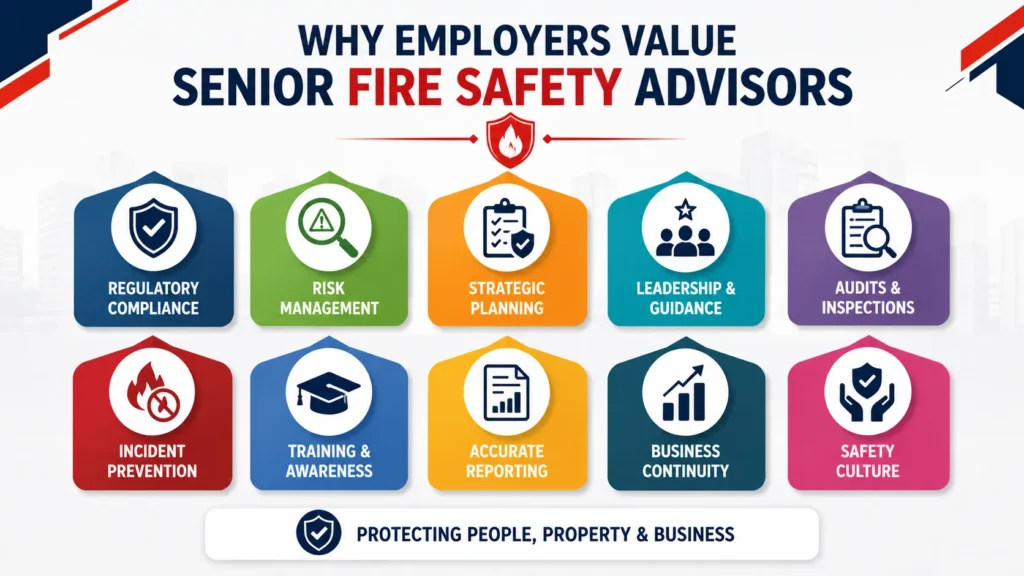
Why Employers Value Senior Fire Safety Advisors
Organisations increasingly recognise that effective fire safety management goes beyond legal compliance. It is an essential part of protecting employees, visitors, assets, reputation, and business continuity.
Senior Fire Safety Advisors are valued because they help organisations reduce risks before incidents occur. Their recommendations improve operational resilience while ensuring compliance with current fire safety requirements.
Employers particularly value professionals who can:
| Employer Requirement | How a Senior Fire Safety Advisor Adds Value |
|---|---|
| Regulatory Compliance | Ensures fire safety responsibilities are met |
| Risk Management | Identifies hazards before they become major risks |
| Strategic Planning | Develops long-term fire safety improvement plans |
| Leadership | Guides teams and promotes a positive safety culture |
| Incident Prevention | Reduces the likelihood of fire-related emergencies |
| Business Continuity | Protects operations through effective fire safety planning |
| Staff Development | Delivers training and improves workforce awareness |
| Technical Expertise | Provides evidence-based recommendations for complex situations |
As organisations continue investing in safety management, experienced advisors are increasingly involved in executive decision-making and organisational governance.
Career Progression Begins with Continuous Professional Development
One of the biggest misconceptions is that promotion happens automatically after gaining experience. In reality, successful professionals actively invest in their own development by expanding their technical knowledge, improving leadership skills, and keeping up to date with industry developments.
Continuous Professional Development (CPD) plays a vital role throughout a fire safety career. It demonstrates a commitment to maintaining professional competence while ensuring knowledge remains current as legislation, guidance, and technology continue to evolve.
Examples of professional development activities include:
- Completing advanced fire safety qualifications
- Attending industry conferences and seminars
- Participating in specialist workshops
- Learning new digital inspection tools
- Developing leadership and management skills
- Expanding knowledge of building safety regulations
- Studying emerging fire protection technologies
- Gaining experience across different industries
Professionals who consistently invest in their development are often the first to be considered for senior leadership positions and specialist consultancy roles.
Career Progression Roadmap After Becoming a Senior Fire Safety Advisor
One of the advantages of working in fire safety is that there are multiple career pathways available. Some professionals prefer to progress into management, while others specialise in consultancy, compliance, or technical fire safety.
The following roadmap illustrates a typical progression pathway.
Career Progression Flowchart
Senior Fire Safety Advisor
↓
Fire Safety Manager
↓
Head of Fire Safety
↓
Fire Safety Consultant
↓
Principal Fire Safety Consultant
↓
Director of Fire Safety
↓
Director of Health, Safety and Fire Compliance
This pathway is not fixed. Career progression depends on individual interests, qualifications, leadership ability, and the industries in which professionals choose to work.
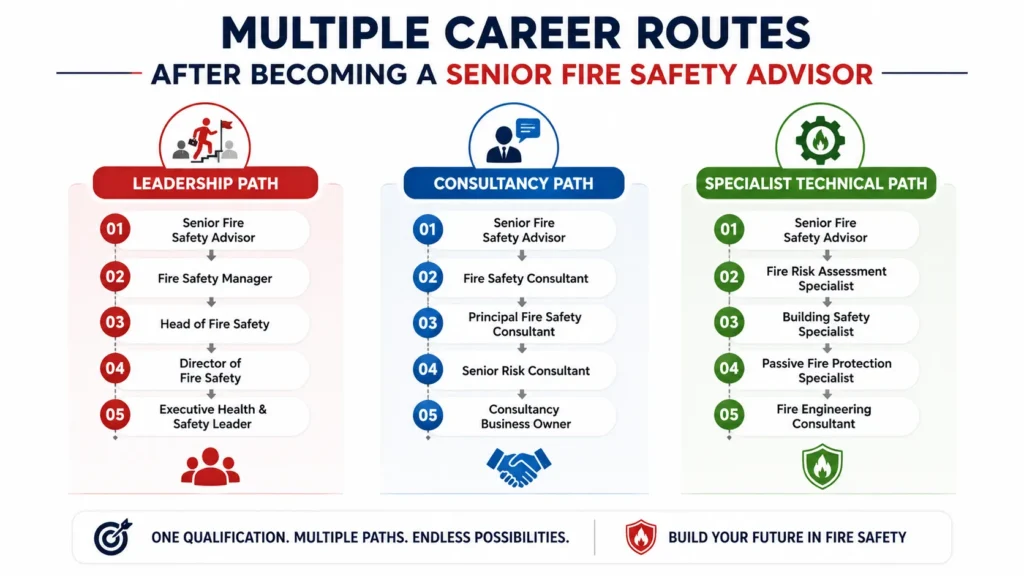
Multiple Career Routes After Becoming a Senior Fire Safety Advisor
A significant advantage of this profession is that there is no single route to success. Experienced professionals can choose from several rewarding career paths depending on their strengths and long-term ambitions.
Leadership Path
Professionals who enjoy managing teams and influencing organisational strategy often progress into leadership positions.
Senior Fire Safety Advisor
↓
Fire Safety Manager
↓
Head of Fire Safety
↓
Director of Fire Safety
↓
Executive Health and Safety Leader
Leadership roles involve managing fire safety programmes, developing organisational policies, overseeing compliance, mentoring teams, and supporting senior executives in strategic decision-making.
Consultancy Path
Professionals with extensive technical expertise may choose consultancy.
Senior Fire Safety Advisor
↓
Independent Fire Safety Consultant
↓
Principal Consultant
↓
Senior Risk Consultant
↓
Consultancy Business Owner
Consultants often work with multiple organisations, providing specialist advice, conducting fire risk assessments, reviewing compliance, and supporting major construction or infrastructure projects.
Specialist Technical Path
Some professionals choose to become recognised experts within specific areas of fire safety.
Senior Fire Safety Advisor
↓
Fire Risk Assessment Specialist
↓
Building Safety Specialist
↓
Passive Fire Protection Specialist
↓
Fire Engineering Consultant
This pathway is particularly attractive for professionals who enjoy solving technical challenges and working on complex or high-risk buildings.
Why Career Planning Is More Important Than Ever
The fire safety profession continues to evolve as organisations respond to changing legislation, advances in technology, and increasing expectations around building safety. Professionals who actively plan their careers are better positioned to take advantage of emerging opportunities, leadership roles, and specialist areas of practice.
Successful career planning involves more than seeking promotions. It requires identifying long-term goals, gaining relevant experience, pursuing advanced qualifications, and developing both technical expertise and leadership capability.
Leadership Career Path After Becoming a Senior Fire Safety Advisor
For many professionals, the natural progression after becoming a Senior Fire Safety Advisor is moving into leadership. These positions involve far more than overseeing day-to-day fire safety activities. Leaders are responsible for developing organisational strategies, influencing senior management, managing budgets, and ensuring that fire safety is fully integrated into business operations.
Leadership roles are ideal for professionals who enjoy mentoring others, making strategic decisions, and driving continuous improvement across an organisation.
Typical Leadership Progression
Senior Fire Safety Advisor
↓
Fire Safety Manager
↓
Head of Fire Safety
↓
Regional Fire Safety Manager
↓
Director of Fire Safety
↓
Director of Health, Safety and Fire Compliance
Each stage requires broader technical knowledge, stronger leadership capabilities, and greater responsibility for organisational performance.
Responsibilities in Leadership Roles
| Leadership Role | Key Responsibilities |
|---|---|
| Fire Safety Manager | Manage fire safety programmes, lead teams, oversee compliance |
| Head of Fire Safety | Develop strategy, manage multiple sites, advise senior executives |
| Regional Fire Safety Manager | Standardise fire safety across multiple locations |
| Director of Fire Safety | Lead organisational fire safety governance and policy |
| Director of Health, Safety and Fire Compliance | Integrate fire safety into wider corporate risk management |
Professionals who develop leadership skills often enjoy greater career stability, increased influence within organisations, and significantly higher salaries.
Consultancy Career Path
Many experienced Senior Fire Safety Advisors choose consultancy because it offers variety, independence, and the opportunity to work with organisations across multiple industries.
Consultants provide specialist expertise rather than managing a single organisation’s fire safety programme. They advise clients on compliance, conduct independent assessments, review complex buildings, and support organisations with strategic fire safety planning.
Consultancy Progression
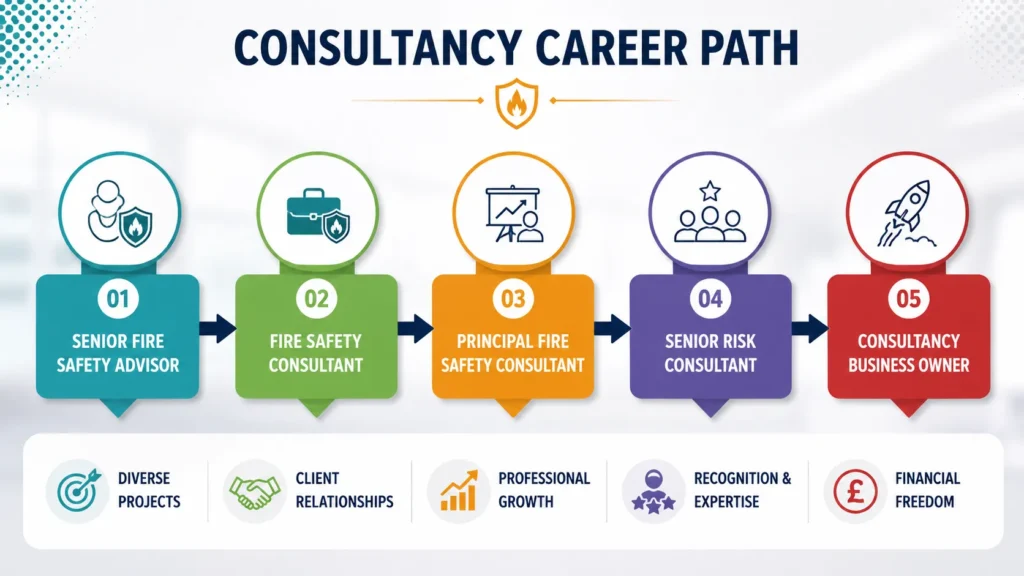
This pathway is particularly attractive for professionals who enjoy solving technical challenges and working with a diverse range of clients.
Typical Consultancy Services
- Fire Risk Assessments
- Fire Safety Audits
- Fire Strategy Reviews
- Fire Door Inspections
- Emergency Evacuation Planning
- Building Safety Consultancy
- Fire Safety Compliance Reviews
- Staff Training Programmes
- Policy Development
- Expert Witness Services
Consultancy also provides opportunities to work on major commercial developments, healthcare projects, educational institutions, transport infrastructure, and high-rise residential buildings.
Specialist Fire Safety Career Path
Not every professional wants to move into management. Many choose to specialise in highly technical areas where demand continues to increase.
Specialists develop deep expertise within a particular aspect of fire safety and often become recognised authorities in their field.
Specialist Career Roadmap
Senior Fire Safety Advisor
↓
Fire Risk Assessment Specialist
↓
Passive Fire Protection Specialist
↓
Building Safety Specialist
↓
Fire Engineering Consultant
↓
Technical Fire Safety Expert
These professionals are frequently involved in high-risk premises, major construction projects, heritage buildings, healthcare environments, and complex commercial developments.
High-Demand Specialist Areas
| Specialism | Primary Focus |
|---|---|
| Fire Risk Assessment | Complex building assessments |
| Passive Fire Protection | Fire doors, compartmentation, fire stopping |
| Active Fire Protection | Fire alarms, sprinklers, suppression systems |
| Building Safety | Compliance with modern building regulations |
| Emergency Planning | Evacuation strategies and resilience planning |
| Fire Safety Auditing | Independent compliance reviews |
| Fire Investigation | Incident analysis and recommendations |
| Technical Consultancy | Specialist advice on challenging fire safety issues |
Specialisation often leads to higher earning potential because organisations value professionals with advanced expertise in complex environments.
Director-Level Career Opportunities
For professionals with significant experience, advanced qualifications, and strong leadership skills, director-level positions represent the highest stage of career progression.
These roles focus on strategic governance rather than operational fire safety.
Typical responsibilities include:
- Developing corporate fire safety strategy
- Advising executive leadership teams
- Managing organisational risk
- Leading compliance programmes
- Overseeing multiple departments
- Managing significant budgets
- Supporting board-level decision-making
- Driving organisational safety culture
Director-level professionals influence long-term business strategy while ensuring organisations remain compliant with changing legislation and industry standards.
Executive Career Progression
Head of Fire Safety
↓
Director of Fire Safety
↓
Director of Health, Safety and Fire Compliance
↓
Corporate Risk Director
↓
Chief Safety Officer
These positions are typically found within large organisations operating across healthcare, transport, manufacturing, construction, local government, higher education, and critical infrastructure.
Salary Progression After Becoming a Senior Fire Safety Advisor
Career progression is often accompanied by substantial salary growth. As professionals gain experience, take on greater responsibility, and develop specialist expertise, their earning potential increases considerably.
Although salaries vary depending on industry, employer, qualifications, and location, experienced professionals can achieve significant financial rewards throughout their careers.
Typical UK Salary Progression
| Career Stage | Approximate Annual Salary |
|---|---|
| Senior Fire Safety Advisor | £45,000–£65,000 |
| Fire Safety Manager | £55,000–£80,000 |
| Head of Fire Safety | £70,000–£95,000 |
| Principal Fire Safety Consultant | £65,000–£100,000+ |
| Director of Fire Safety | £90,000–£120,000+ |
| Director of Health, Safety and Fire Compliance | £100,000–£130,000+ |
Professionals working within specialist sectors such as nuclear energy, aviation, oil and gas, pharmaceutical manufacturing, or major infrastructure projects may earn even higher salaries due to the complexity of these environments.
Factors That Influence Career Progression
Two professionals with similar experience can progress at very different rates. Promotion depends on much more than years spent in a role.
Employers typically evaluate several factors before appointing individuals to senior positions.
Key Factors
- Leadership ability
- Technical competence
- Advanced qualifications
- Practical experience
- Knowledge of current legislation
- Report-writing skills
- Communication and stakeholder management
- Project management experience
- Ability to manage complex risks
- Commitment to Continuous Professional Development (CPD)
Professionals who consistently develop these areas often progress more quickly into senior leadership or consultancy positions.
Which Career Path Is Right for You?
Choosing the right progression pathway depends on your interests, strengths, and long-term career goals.
| Career Path | Best Suited For |
|---|---|
| Leadership | Professionals who enjoy managing teams and developing strategy |
| Consultancy | Individuals who prefer variety, client-facing work, and independent projects |
| Specialist Technical | Professionals interested in complex fire safety challenges and technical expertise |
| Director-Level | Experienced leaders who want to influence organisational governance and corporate strategy |
There is no single “best” route. Many successful professionals move between these pathways throughout their careers, gaining valuable experience that broadens their expertise and opens new opportunities.
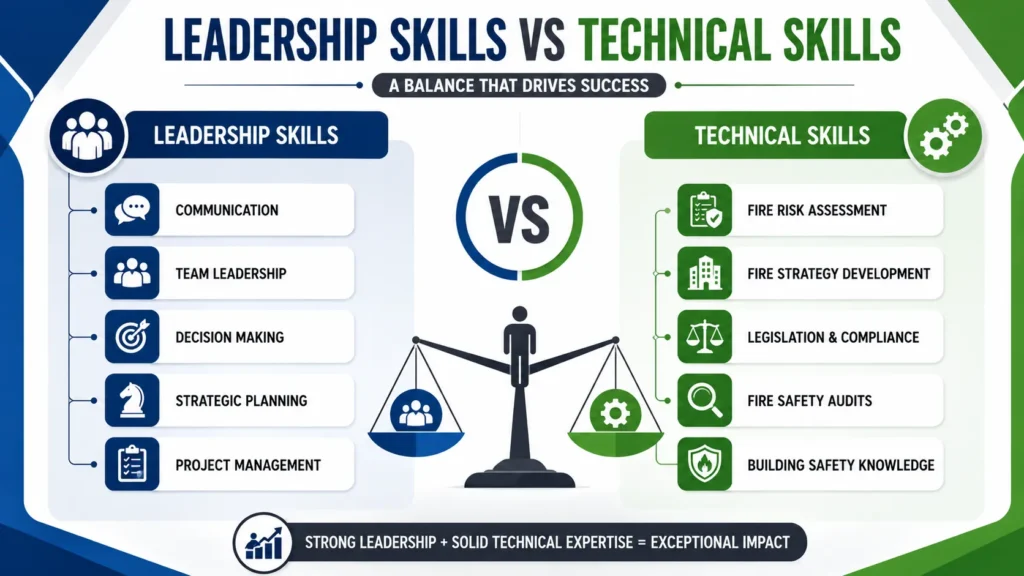
Skills Needed to Progress Beyond a Senior Fire Safety Advisor
Career progression in fire safety is determined by more than technical knowledge. As professionals move into leadership, consultancy, and director-level positions, employers expect them to demonstrate a combination of advanced technical expertise, strategic thinking, leadership capability, and strong communication skills.
Developing these competencies not only improves promotion prospects but also enables professionals to manage larger teams, oversee complex projects, and influence organisational decision-making.
Advanced Technical Skills
Senior roles require a deeper understanding of fire safety than entry-level or operational positions. Professionals should continually expand their expertise in specialist areas that support organisational compliance and risk management.
Key technical skills include:
- Advanced Fire Risk Assessment
- Fire Safety Legislation and Regulatory Compliance
- Building Safety Principles
- Passive Fire Protection
- Active Fire Protection Systems
- Fire Strategy Development
- Fire Safety Auditing
- Emergency Planning and Business Continuity
- Building Construction and Fire Behaviour
- Fire Safety Management Systems
- Incident Investigation
- Risk Analysis and Evaluation
- Technical Report Writing
- Digital Fire Safety Management Software
- Building Information Modelling (BIM) Awareness
Professionals with expertise across these areas are better prepared to manage complex projects and advise organisations on strategic fire safety improvements.
Leadership Skills That Accelerate Career Growth
Technical competence may help secure a Senior Fire Safety Advisor position, but leadership skills often determine who progresses into management and executive roles.
Employers increasingly seek professionals who can inspire teams, communicate effectively with stakeholders, and contribute to organisational strategy.
Leadership Skills Employers Value
| Leadership Skill | Why It Matters |
|---|---|
| Strategic Planning | Supports long-term fire safety objectives |
| Team Leadership | Motivates and develops fire safety teams |
| Decision-Making | Enables effective responses to complex risks |
| Communication | Explains technical issues clearly to different audiences |
| Stakeholder Management | Builds relationships with clients, regulators, and senior leaders |
| Budget Management | Oversees fire safety investment and resource planning |
| Project Management | Delivers compliance programmes successfully |
| Change Management | Supports implementation of new legislation and procedures |
| Coaching and Mentoring | Develops future fire safety professionals |
| Negotiation | Helps secure organisational support for safety improvements |
Leadership capabilities become increasingly important as professionals progress towards senior management and director-level positions.
Advanced Qualifications That Support Career Progression
Qualifications remain one of the strongest indicators of professional commitment and competence. While experience is essential, advanced education demonstrates that a professional is prepared for greater responsibility and strategic leadership.
Professionals aiming for career progression should consider qualifications that build both technical expertise and management capability.
Recommended Professional Development Pathway
Level 3 Fire Safety Qualification
↓
Level 4 Fire Risk Assessment Qualification
↓
ICTQual Level 4 Diploma Senior Fire Safety Advisor
↓
Level 5 Fire Safety Management Qualification
↓
Level 6 Senior Fire Safety Qualification
↓
Strategic Health and Safety Leadership Qualification
This structured pathway allows professionals to continuously develop their knowledge while preparing for increasingly senior positions.
Industries Offering the Best Career Progression Opportunities
One of the advantages of becoming a Senior Fire Safety Advisor is the flexibility to work across a wide range of industries. Different sectors offer varying levels of responsibility, technical complexity, and career advancement.
Professionals who gain experience in multiple industries often become highly sought after because they can apply best practices across different working environments.
Industries with Strong Career Growth
| Industry | Career Opportunities |
|---|---|
| Construction | Fire Safety Manager, Compliance Lead |
| Healthcare | Head of Fire Safety, Estates Compliance Manager |
| Higher Education | Fire Safety Adviser, Campus Safety Manager |
| Manufacturing | Fire and Process Safety Manager |
| Oil and Gas | Fire Safety Consultant, HSE Manager |
| Aviation | Airport Fire Safety Manager |
| Rail and Transport | Infrastructure Fire Safety Specialist |
| Facilities Management | Regional Fire Safety Manager |
| Local Government | Corporate Fire Safety Adviser |
| Housing Associations | Building Safety Manager |
| Energy and Utilities | Fire Protection Specialist |
| Data Centres | Fire Safety Compliance Manager |
Working within highly regulated sectors often accelerates career progression because these environments demand advanced technical competence and strategic leadership.
Future Trends Shaping Fire Safety Careers
The fire safety profession continues to evolve as organisations embrace new technologies, stricter regulations, and smarter approaches to risk management.
Professionals who understand these trends will be better positioned for future leadership opportunities.
Future Career Timeline
Today
↓
Digital Fire Risk Assessments
↓
Cloud-Based Compliance Systems
↓
Artificial Intelligence Risk Analysis
↓
Smart Buildings
↓
Internet of Things (IoT) Fire Monitoring
↓
Predictive Fire Safety Management
↓
Integrated Building Safety Leadership
Understanding these developments allows professionals to remain competitive and continue adding value to employers.
Emerging Skills for the Next Generation of Fire Safety Leaders
Future senior roles will require a broader skill set than ever before.
Professionals should begin developing expertise in areas such as:
- Artificial Intelligence applications in fire safety
- Digital inspection platforms
- Data analysis and reporting
- Smart building technologies
- ESG (Environmental, Social and Governance) compliance
- Building Safety Act implementation
- Sustainability and resilient building design
- Digital documentation systems
- Risk analytics
- Cross-functional leadership
Employers increasingly value professionals who combine traditional fire safety knowledge with digital competence and strategic thinking.
Why Networking Supports Career Progression
Technical ability alone does not always lead to promotion. Building a strong professional network can create opportunities to learn from experienced professionals, stay informed about industry developments, and access new career opportunities.
Networking can include:
- Attending fire safety conferences
- Participating in professional workshops
- Joining industry associations
- Contributing to professional discussions
- Sharing knowledge through seminars and webinars
- Collaborating with multidisciplinary safety teams
Strong professional relationships often lead to consultancy opportunities, leadership positions, and invitations to work on major projects.
Becoming a Recognised Fire Safety Leader
The most successful professionals do more than perform their daily responsibilities—they actively contribute to improving fire safety standards within their organisations and across the wider industry.
Characteristics of recognised leaders include:
- Commitment to continuous learning
- Strong ethical standards
- Excellent communication skills
- Ability to manage organisational change
- Confidence in advising senior executives
- Commitment to mentoring future professionals
- Strategic thinking and innovation
- Passion for protecting people and property
Developing these qualities not only supports career progression but also establishes long-term credibility within the profession.
Common Mistakes That Slow Career Progression
Many professionals assume that experience alone is enough to secure promotions. While practical experience is essential, career progression in fire safety depends on continuously developing technical expertise, leadership skills, and professional competence.
Avoiding common mistakes can significantly improve long-term career prospects.
1. Stopping Professional Development
The fire safety industry continues to evolve through changes in legislation, technology, and building safety practices. Professionals who stop learning often struggle to remain competitive.
Regularly updating knowledge through qualifications, training courses, workshops, and industry events helps maintain competence and prepares professionals for senior responsibilities.
2. Focusing Only on Technical Skills
Technical knowledge is fundamental, but leadership roles require much more. Communication, strategic planning, project management, stakeholder engagement, and team leadership become increasingly important as careers progress.
Professionals who balance technical expertise with leadership capability are more likely to move into management and executive positions.
3. Ignoring Leadership Opportunities
Many professionals wait until they become managers before developing leadership skills.
Instead, take opportunities to:
- Lead fire safety projects
- Mentor junior colleagues
- Deliver training sessions
- Coordinate emergency exercises
- Present reports to senior management
- Participate in organisational improvement initiatives
Demonstrating leadership before promotion makes career progression much smoother.
4. Remaining in One Industry
Working in different sectors exposes professionals to new challenges, regulations, and building types.
Experience across industries such as healthcare, construction, manufacturing, education, transport, and facilities management creates a broader skill set that employers highly value.
5. Neglecting Professional Networking
Building relationships with other fire safety professionals helps individuals stay informed about industry developments, discover career opportunities, and learn from experienced practitioners.
Networking can also lead to consultancy opportunities, collaborations, and invitations to work on specialist projects.
6. Underestimating the Importance of Report Writing
Senior roles require clear, accurate, and evidence-based documentation.
Professionals who produce well-structured reports demonstrate professionalism, technical competence, and the ability to communicate effectively with clients, regulators, and senior leaders.
Building a Long-Term Career Development Plan
Career progression rarely happens by chance. Professionals who achieve leadership positions usually follow a structured development plan that combines education, practical experience, and continuous improvement.
Career Development Flowchart
Build Technical Knowledge
↓
Gain Practical Experience
↓
Achieve Professional Qualifications
↓
Develop Leadership Skills
↓
Manage Complex Projects
↓
Lead Fire Safety Teams
↓
Expand Industry Expertise
↓
Progress into Consultancy or Executive Leadership
This approach allows professionals to steadily build the knowledge, confidence, and competence required for increasingly senior roles.
Related Courses to Explore
If your goal is to build a successful long-term career in fire safety and health and safety management, the following Inspire College qualifications provide valuable progression opportunities.
| Course | Career Focus |
|---|---|
| ProQual Level 2 Award for Fire Marshals | Essential Fire Marshal Training Workplace Safety |
| ProQual Level 4 Certificate in Fire Risk Assessment | Practical fire risk assessment skills |
| ICTQual Level 4 Diploma Senior Fire Safety Advisor | Senior advisory and compliance responsibilities |
| ProQual Level 5 Diploma in Fire Risk Assessment | Advanced Fire Risk Assessment Professional Qualification |
These courses naturally complement one another and create a clear educational pathway for professionals seeking long-term career advancement.
Why Continuous Professional Development Is the Key to Success
The most successful Senior Fire Safety Advisors understand that learning is an ongoing process rather than a one-time achievement.
Continuous Professional Development (CPD) enables professionals to:
- Stay up to date with changing fire safety legislation
- Understand emerging technologies and digital compliance tools
- Improve leadership and management capabilities
- Strengthen technical competence
- Expand career opportunities across multiple industries
- Increase confidence when advising senior decision-makers
- Enhance long-term employability
Professionals who actively invest in CPD are often viewed as trusted advisors capable of managing complex fire safety challenges.
Why Now Is the Best Time to Progress Your Career
The UK’s increasing focus on building safety, regulatory compliance, and organisational resilience has created excellent opportunities for experienced fire safety professionals.
Employers are actively seeking individuals who can:
- Lead organisational fire safety programmes
- Manage compliance across multiple sites
- Conduct complex fire risk assessments
- Advise senior leadership teams
- Develop strategic fire safety policies
- Improve business continuity and emergency preparedness
- Support organisational governance
This demand creates strong career prospects for professionals who combine recognised qualifications with practical experience and leadership capability.
Final Thoughts
Becoming a Senior Fire Safety Advisor is an important professional achievement, but it should be viewed as the beginning of a much broader career journey rather than the final destination.
With the right combination of experience, recognised qualifications, leadership skills, and continuous professional development, professionals can progress into rewarding roles such as Fire Safety Manager, Head of Fire Safety, Principal Fire Safety Consultant, Director of Fire Safety, or Director of Health, Safety and Fire Compliance.
Career progression is not defined by time alone. It is shaped by the willingness to learn, adapt, lead, and embrace new challenges. Professionals who continually expand their technical expertise, strengthen their leadership abilities, and remain informed about evolving legislation and industry trends are best positioned for long-term success.
Whether your ambition is to lead fire safety teams, specialise in complex fire risk management, establish an independent consultancy, or influence organisational strategy at executive level, there has never been a better time to invest in your professional development.
If you are ready to take the next step, the ICTQual Level 4 Diploma Senior Fire Safety Advisor at Inspire College provides a strong foundation for developing the advanced knowledge, practical competence, and leadership skills needed to progress confidently within the UK’s growing fire safety profession. Combined with ongoing learning and real-world experience, it can help unlock exciting career opportunities across a wide range of industries.
Explore More Fire Safety & Risk Assessment Articles
Discover expert guides on fire safety careers, fire risk assessments, workplace compliance, fire protection systems, and professional qualifications to expand your knowledge and advance your career in fire safety.
- What is Fire Safety?
- Fire Risk Assessment
- Fire Safety Equipment
- Fire Safety: Essential Tips for Homes and Workplaces
- Industrial Fire Safety: Complete Guide to Risk Assessment, Hazards & Prevention (2026)
- Fire Safety Training (2026): Complete Guide, Certification & Workplace Safety
- Level 4 Diploma in Fire Safety: Complete Guide to Career Growth, Skills, Compliance, and Professional Certification
- What Does a Senior Fire Safety Advisor Do? Roles, Responsibilities, and Career Guide
- Top Skills Every Senior Fire Safety Advisor Should Develop
- Is Fire Safety a Good Career Choice in the UK?
- Senior Fire Safety Advisor vs Fire Risk Assessor: Which Career Is Right for You?
- Is Fire Safety a Good Career Choice in the UK?
- Top Skills Every Senior Fire Safety Advisor Should Develop
- The 5 Essential Steps of Fire Risk Assessment Explained
- Fire Risk Assessment Explained: A Complete Beginner’s Guide
- Qualified Fire Risk Assessor Career Guide: Training, Skills, and Job Opportunities
- Senior Fire Safety Advisor: Top Industries Hiring Across the UK
- How Fire Safety and Risk Assessment Reduce Workplace Hazards
- Fire Safety Planning and Risk Assessment for Businesses
- Essential Fire Safety Tips Everyone Should Know to Stay Safe
- How to Conduct an Effective Risk Assessment Step by Step
- Fire Safety Checklist for Homes, Offices & Commercial Buildings
- Failed a Fire Safety Inspection? Here’s What Happens Next