
Top Skills Every Senior Fire Safety Advisor Should Develop
Fire safety is no longer limited to checking extinguishers, conducting fire drills, or ensuring emergency exits remain unobstructed. Modern organisations require experienced professionals who can identify fire risks, interpret legislation, implement safety strategies, and lead compliance initiatives across diverse environments. This growing demand has made the Senior Fire Safety Advisor one of the most valuable roles in the health and safety sector.
A Senior Fire Safety Advisor is responsible for protecting lives, property, and business continuity by developing comprehensive fire safety programmes, conducting detailed fire risk assessments, auditing compliance, and advising organisations on legal responsibilities. The role combines technical expertise, leadership, communication, and strategic decision-making to create safer workplaces.
However, qualifications alone do not guarantee success. Employers increasingly look for professionals who can demonstrate practical competencies, leadership qualities, and the ability to solve complex fire safety challenges. Developing the right combination of technical and professional skills allows Senior Fire Safety Advisors to deliver greater value to employers while advancing their own careers.
In this guide, you’ll discover the most important skills every Senior Fire Safety Advisor should develop, why these competencies matter, and how they contribute to safer workplaces and stronger career opportunities.
Why Skills Matter More Than Qualifications
Professional qualifications provide the theoretical foundation required for fire safety management, but employers ultimately assess how effectively a professional applies that knowledge in real-world situations.
A highly skilled Senior Fire Safety Advisor can:
- Identify hidden fire hazards before they become emergencies.
- Interpret complex fire safety legislation accurately.
- Conduct comprehensive fire risk assessments.
- Lead fire safety inspections and audits.
- Develop practical emergency response strategies.
- Influence senior management to improve safety standards.
- Train employees and promote a positive fire safety culture.
- Ensure continuous legal compliance across multiple sites.
Organisations increasingly seek professionals who combine technical knowledge with leadership, communication, and analytical thinking. This combination enables advisors to support business objectives while protecting people, property, and organisational reputation.
What Does a Senior Fire Safety Advisor Do?
The responsibilities of a Senior Fire Safety Advisor extend far beyond routine inspections. They play a strategic role in helping organisations prevent fire incidents, comply with legislation, and continuously improve fire safety performance.
Typical responsibilities include:
| Responsibility | Purpose |
|---|---|
| Conduct Fire Risk Assessments | Identify hazards and recommend suitable control measures |
| Perform Fire Safety Audits | Evaluate compliance with legislation and organisational policies |
| Review Building Fire Safety Systems | Ensure active and passive fire protection measures remain effective |
| Develop Emergency Plans | Prepare organisations for fire incidents and safe evacuation |
| Advise Senior Management | Support strategic fire safety decisions |
| Deliver Fire Safety Training | Improve staff awareness and competence |
| Investigate Fire Incidents | Identify root causes and prevent recurrence |
| Monitor Legal Compliance | Ensure ongoing adherence to UK fire safety legislation |
These responsibilities require a broad skill set that combines technical expertise with leadership and communication.
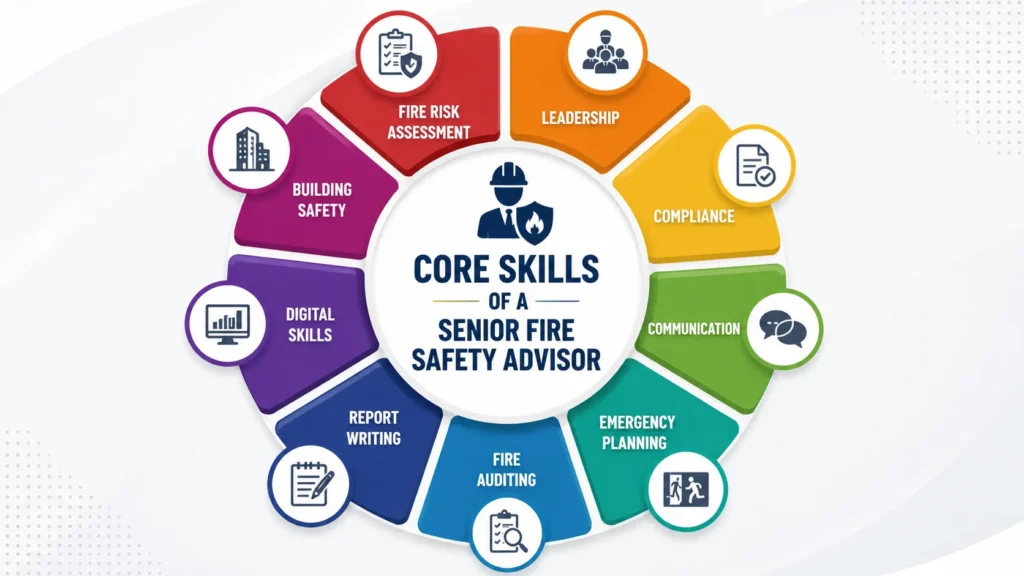
The Core Skills Every Senior Fire Safety Advisor Should Develop
1. Fire Risk Assessment Expertise
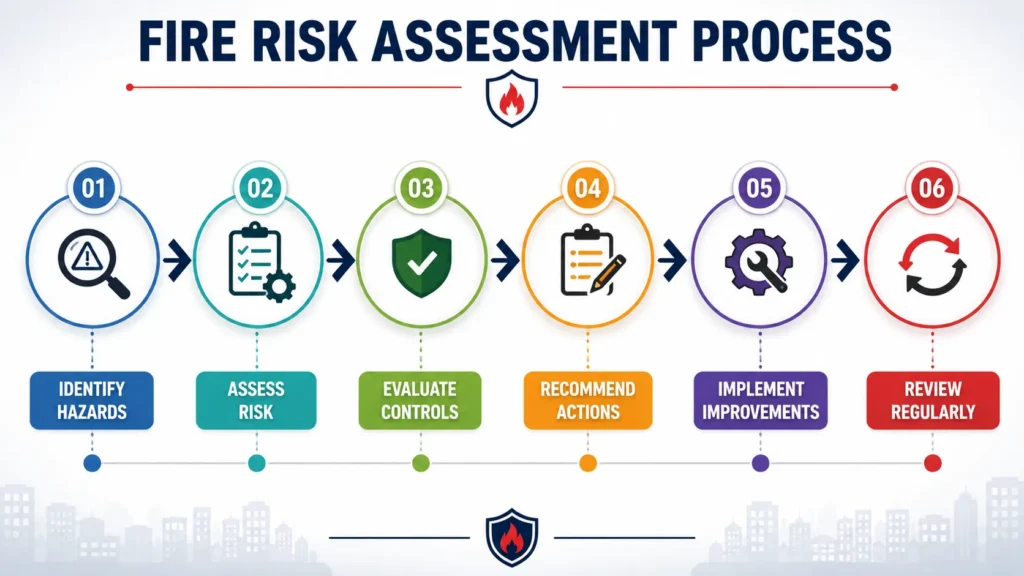
Fire risk assessment is the foundation of effective fire safety management. Every recommendation, inspection, and improvement begins with the ability to accurately identify hazards and evaluate risks.
A Senior Fire Safety Advisor should be able to:
- Identify ignition sources.
- Recognise combustible materials.
- Assess vulnerable occupants.
- Evaluate existing fire protection measures.
- Determine suitable control measures.
- Prioritise risks based on severity.
- Produce clear and actionable reports.
Practical Workplace Example
During an inspection of a manufacturing facility, a Senior Fire Safety Advisor may identify improperly stored flammable chemicals located near electrical equipment. Rather than simply recording the issue, they assess the likelihood of ignition, evaluate potential consequences, recommend safer storage solutions, and establish ongoing monitoring procedures.
Key Competencies
- Hazard identification
- Risk evaluation
- Control measure selection
- Documentation
- Risk prioritisation
Fire Risk Assessment Process
2. Comprehensive Knowledge of Fire Safety Legislation
An effective Senior Fire Safety Advisor must possess a thorough understanding of current fire safety legislation and recognised industry standards.
Legislation continues to evolve, particularly following significant regulatory changes within the UK. Organisations rely on competent advisors to interpret legal requirements and ensure ongoing compliance.
Important areas of knowledge include:
- Fire safety responsibilities
- Building fire safety regulations
- Fire risk assessment requirements
- Means of escape
- Fire detection systems
- Emergency planning
- Occupancy considerations
- Record keeping
Understanding legislation enables advisors to make informed decisions while reducing organisational legal risk.
Why This Skill Matters
Without accurate legal knowledge, even well-intentioned recommendations may fail to meet statutory requirements, potentially exposing organisations to enforcement action, financial penalties, or increased fire risk.
3. Fire Safety Auditing and Inspection Skills
Fire safety audits verify whether an organisation’s policies, procedures, and physical fire protection measures remain effective.
Unlike routine inspections, audits examine the complete fire safety management system.
A Senior Fire Safety Advisor should confidently evaluate:
- Fire alarm systems
- Emergency lighting
- Escape routes
- Fire doors
- Fire extinguishers
- Staff training records
- Maintenance documentation
- Emergency procedures
Inspection Checklist Example
| Inspection Area | Review Focus |
|---|---|
| Fire Alarms | Operational testing and maintenance |
| Fire Doors | Integrity, self-closing function and signage |
| Emergency Lighting | Operational performance |
| Escape Routes | Accessibility and signage |
| Fire Extinguishers | Servicing and suitability |
| Electrical Systems | Potential ignition sources |
| Housekeeping | Combustible waste management |
| Staff Competence | Fire safety awareness |
Strong auditing skills allow advisors to identify weaknesses before they become serious compliance issues.
4. Hazard Identification and Risk Analysis
Fire hazards exist in every workplace, but experienced advisors recognise risks that others often overlook.
Hazard identification requires systematic observation, technical understanding, and practical experience.
Common hazards include:
- Faulty electrical installations
- Overloaded sockets
- Flammable liquids
- Gas cylinders
- Poor housekeeping
- Blocked fire exits
- Damaged fire doors
- Inadequate compartmentation
- Hot work activities
- Poor storage practices
An effective Senior Fire Safety Advisor analyses not only the hazard itself but also the likelihood of occurrence, potential consequences, and available control measures.
Hazard Identification Flow
Observe Workplace
↓
Identify Hazards
↓
Assess Likelihood
↓
Evaluate Consequences
↓
Recommend Controls
↓
Monitor Effectiveness
Developing this skill significantly reduces workplace fire incidents and improves organisational resilience.
5. Fire Protection Systems Knowledge
Senior Fire Safety Advisors are expected to understand how fire protection systems work together to reduce fire risks and protect building occupants.
This includes both active and passive fire protection measures.
Active Fire Protection
- Fire alarm systems
- Automatic detection systems
- Sprinkler systems
- Fire extinguishers
- Smoke control systems
Passive Fire Protection
- Fire-resistant walls
- Fire doors
- Fire stopping
- Compartmentation
- Protected escape routes
Understanding these systems enables advisors to evaluate their effectiveness during inspections and recommend appropriate improvements where necessary.
System Integration Overview
| Fire Protection System | Primary Purpose |
|---|---|
| Fire Detection | Early identification of fire |
| Fire Alarm | Occupant notification |
| Emergency Lighting | Safe evacuation |
| Fire Doors | Contain smoke and fire |
| Sprinklers | Suppress fire growth |
| Fire Extinguishers | Initial fire response |
| Smoke Control | Improve visibility during evacuation |
6. Emergency Planning and Incident Preparedness
Preparing for emergencies is just as important as preventing them.
Senior Fire Safety Advisors develop emergency response strategies that minimise confusion and enable rapid evacuation during fire incidents.
Effective emergency planning includes:
- Evacuation procedures
- Assembly point management
- Emergency communication
- Fire wardens
- Disabled evacuation arrangements
- Business continuity planning
- Incident reporting procedures
Emergency Planning Cycle
Identify Risks
↓
Develop Emergency Plan
↓
Train Employees
↓
Conduct Fire Drills
↓
Evaluate Performance
↓
Improve Procedures
Regular review and testing ensure emergency plans remain effective as organisations evolve.
7. Building Construction and Fire Behaviour Knowledge
Understanding how buildings respond to fire enables Senior Fire Safety Advisors to make informed recommendations during inspections and fire risk assessments.
Construction materials, building layout, occupancy type, and structural design all influence how quickly fire and smoke spread.
Professionals should understand:
- Fire-resistant construction
- Structural fire protection
- Smoke movement
- Compartmentation principles
- Means of escape design
- Building occupancy classifications
- Fire loading
- Ventilation effects
Why This Knowledge Is Essential
For example, a warehouse, hospital, educational institution, and residential building each present different fire behaviour characteristics and evacuation challenges. A competent Senior Fire Safety Advisor adapts recommendations based on these factors rather than applying a one-size-fits-all approach.
Building construction knowledge also supports effective communication with architects, engineers, contractors, and facilities managers during renovation projects, new developments, or fire safety improvement programmes.
8. Leadership and Decision-Making Skills
A Senior Fire Safety Advisor is often responsible for leading fire safety initiatives, coordinating inspections, and guiding organisations through complex compliance requirements. Strong leadership skills help create a proactive fire safety culture where employees understand their responsibilities and management supports continuous improvement.
Effective leaders inspire confidence, encourage accountability, and ensure that fire safety remains a priority across all departments. They also make informed decisions during emergencies, balancing legal compliance with practical solutions.
Key leadership skills include:
- Strategic planning
- Team coordination
- Decision-making under pressure
- Delegation
- Conflict resolution
- Coaching and mentoring
- Performance monitoring
- Change management
Leadership Impact on Fire Safety
| Leadership Skill | Workplace Benefit |
|---|---|
| Decision-Making | Faster response during emergencies |
| Team Leadership | Improved collaboration across departments |
| Coaching | Better employee competence |
| Accountability | Stronger compliance culture |
| Strategic Planning | Long-term fire safety improvements |
9. Communication and Stakeholder Management
Excellent communication is one of the most valuable skills for a Senior Fire Safety Advisor. Technical knowledge has limited value if recommendations cannot be clearly explained to managers, employees, contractors, or regulatory authorities.
Senior Fire Safety Advisors regularly communicate with:
- Senior management
- Facilities managers
- Health and safety teams
- Fire wardens
- Building owners
- Contractors
- Local fire and rescue services
- Regulatory inspectors
Effective communication involves translating complex fire safety requirements into practical guidance that different audiences can understand and implement.
Communication Process
Identify Issue
↓
Collect Evidence
↓
Explain Risk Clearly
↓
Recommend Practical Solutions
↓
Gain Stakeholder Agreement
↓
Monitor Implementation
Professionals who communicate confidently are more successful at influencing organisational change and securing management support for fire safety improvements.
10. Fire Safety Report Writing
Clear documentation is essential for demonstrating compliance and supporting informed decision-making. Senior Fire Safety Advisors produce reports that become official records and may be reviewed during audits, inspections, or legal investigations.
Professional reports should be:
- Accurate
- Objective
- Evidence-based
- Easy to understand
- Action-oriented
- Well-structured
A high-quality fire safety report normally includes:
| Report Section | Purpose |
|---|---|
| Executive Summary | Overview of findings |
| Inspection Scope | Areas assessed |
| Identified Hazards | Fire risks discovered |
| Risk Rating | Level of concern |
| Recommendations | Corrective actions |
| Priority Level | Immediate, medium, or long-term actions |
| Review Date | Future reassessment schedule |
Good report writing demonstrates professionalism while helping organisations prioritise improvements efficiently.
11. Fire Incident Investigation
Every fire incident provides valuable lessons that can prevent future occurrences. Senior Fire Safety Advisors investigate incidents to identify root causes rather than simply recording what happened.
A structured investigation examines:
- Origin of the fire
- Source of ignition
- Contributing factors
- Human behaviour
- Equipment failures
- Procedural weaknesses
- Emergency response effectiveness
- Corrective actions
Incident Investigation Flow
Fire Incident
↓
Secure Area
↓
Collect Evidence
↓
Interview Witnesses
↓
Identify Root Cause
↓
Recommend Improvements
↓
Monitor Corrective Actions
Strong investigative skills help organisations reduce repeat incidents while improving overall fire safety performance.
12. Digital Fire Safety and Technology Skills
Technology is transforming the fire safety profession. Modern organisations increasingly rely on digital tools to improve inspections, compliance monitoring, and risk management.
Senior Fire Safety Advisors should become familiar with technologies such as:
- Digital inspection software
- Cloud-based compliance systems
- Mobile auditing applications
- Building Information Modelling (BIM)
- Smart fire detection systems
- Internet of Things (IoT) sensors
- Digital maintenance records
- AI-assisted risk analysis
Using digital solutions improves efficiency, accuracy, and record management while enabling organisations to monitor compliance across multiple locations.
Traditional vs Digital Fire Safety
| Traditional Approach | Modern Digital Approach |
|---|---|
| Paper inspections | Mobile inspections |
| Manual records | Cloud documentation |
| Physical filing | Digital compliance management |
| Reactive maintenance | Predictive maintenance |
| Separate systems | Integrated safety platforms |
Developing digital competence prepares professionals for the future of fire safety management.
13. Compliance Management
Compliance management involves ensuring that an organisation consistently meets legal obligations, industry standards, and internal fire safety policies.
Rather than responding only when problems arise, Senior Fire Safety Advisors establish systems that maintain compliance throughout the year.
Core compliance activities include:
- Monitoring legislation
- Reviewing organisational policies
- Scheduling inspections
- Tracking corrective actions
- Maintaining documentation
- Verifying maintenance records
- Reviewing contractor compliance
- Preparing for external audits
Professionals who understand compliance management help organisations avoid enforcement actions while maintaining safer workplaces.
14. Training and Coaching Skills
Fire safety is everyone’s responsibility, making education one of the most important responsibilities of a Senior Fire Safety Advisor.
Employees who understand fire hazards are more likely to identify unsafe conditions, report concerns promptly, and respond correctly during emergencies.
Training responsibilities may include:
- Fire awareness sessions
- Fire warden training
- Evacuation exercises
- Practical extinguisher demonstrations
- Induction programmes
- Refresher training
- Contractor briefings
Effective trainers adapt their communication style to different audiences, ensuring information is practical, engaging, and easy to remember.
Employee Development Cycle
Identify Training Needs
↓
Develop Training Plan
↓
Deliver Training
↓
Conduct Practical Exercises
↓
Assess Competence
↓
Provide Feedback
↓
Schedule Refresher Training
A well-trained workforce significantly reduces fire risks and improves emergency preparedness.
15. Continuous Professional Development (CPD)
Fire safety legislation, building technologies, and industry best practices continue to evolve. Senior Fire Safety Advisors must commit to lifelong learning to remain effective in their roles.
Continuous Professional Development helps professionals:
- Stay informed about legislative changes
- Improve technical expertise
- Learn new inspection techniques
- Develop leadership capabilities
- Understand emerging fire safety technologies
- Strengthen professional credibility
Practical CPD activities include:
- Attending industry seminars
- Completing advanced fire safety qualifications
- Participating in professional workshops
- Reading technical guidance documents
- Following updates to British Standards
- Joining professional safety networks
- Completing online learning programmes
Professionals who invest in continuous learning are better prepared to advise organisations on evolving risks and regulatory expectations.
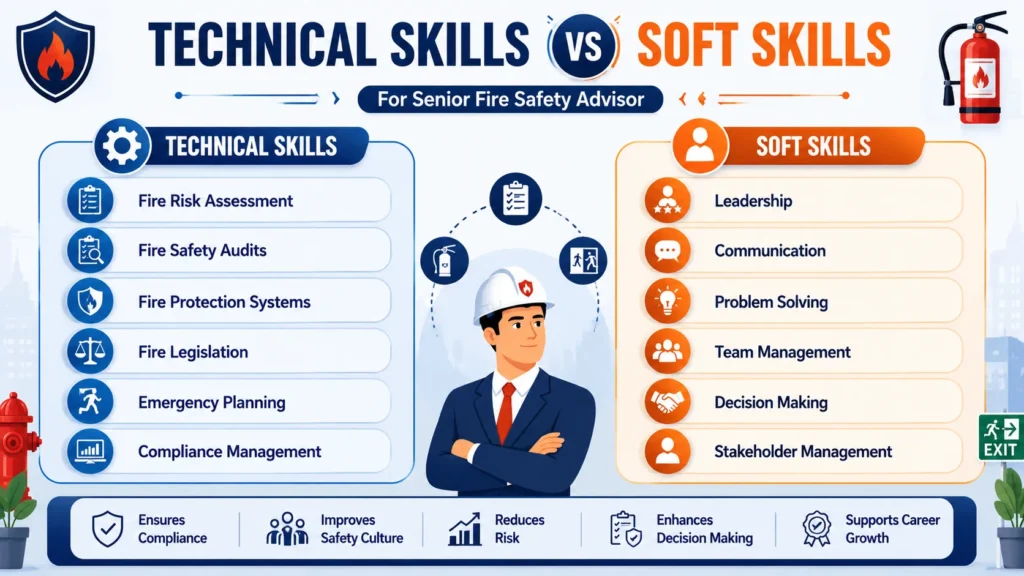
Skills Employers Value Most
While technical expertise is essential, employers increasingly seek professionals who combine specialist knowledge with strong interpersonal and strategic capabilities.
The most desirable qualities include:
| Technical Skills | Professional Skills |
|---|---|
| Fire Risk Assessment | Leadership |
| Fire Safety Audits | Communication |
| Fire Protection Systems | Problem Solving |
| Emergency Planning | Decision Making |
| Fire Legislation | Stakeholder Management |
| Incident Investigation | Negotiation |
| Compliance Management | Time Management |
| Digital Fire Safety | Adaptability |
Candidates who demonstrate excellence across both technical and professional competencies are more likely to progress into senior advisory and management positions.
Common Skill Gaps That Limit Career Progression
Many professionals possess strong technical knowledge but struggle to advance because they overlook broader professional competencies.
Common development areas include:
- Limited leadership experience
- Weak report writing skills
- Poor presentation abilities
- Insufficient understanding of digital compliance systems
- Limited knowledge of modern building technologies
- Difficulty influencing senior management
- Lack of strategic planning experience
- Inadequate understanding of changing legislation
Recognising these gaps early allows professionals to focus their learning on the areas that have the greatest impact on career progression.
How to Develop the Skills of a Senior Fire Safety Advisor
Developing into a highly competent Senior Fire Safety Advisor requires more than workplace experience. It involves combining formal education, practical application, continuous learning, and professional development. The most successful professionals actively improve both their technical expertise and leadership abilities throughout their careers.
A structured approach to skill development includes:
- Complete recognised fire safety qualifications.
- Gain practical experience in different workplace environments.
- Participate in fire risk assessments and compliance audits.
- Work alongside experienced fire safety professionals.
- Develop technical report writing skills.
- Improve leadership and communication abilities.
- Stay updated with changes in fire safety legislation.
- Learn to use modern digital inspection and compliance tools.
- Attend industry seminars, webinars, and professional workshops.
- Regularly review lessons learned from real fire incidents.
Professional Development Roadmap
Start Fire Safety Career
↓
Gain Fundamental Knowledge
↓
Complete Professional Qualification
↓
Develop Workplace Experience
↓
Conduct Fire Risk Assessments
↓
Lead Fire Safety Audits
↓
Manage Compliance Programmes
↓
Develop Leadership Skills
↓
Become a Senior Fire Safety Advisor
Following a structured development plan helps professionals build confidence while preparing for greater responsibilities.
Building a Successful Career as a Senior Fire Safety Advisor
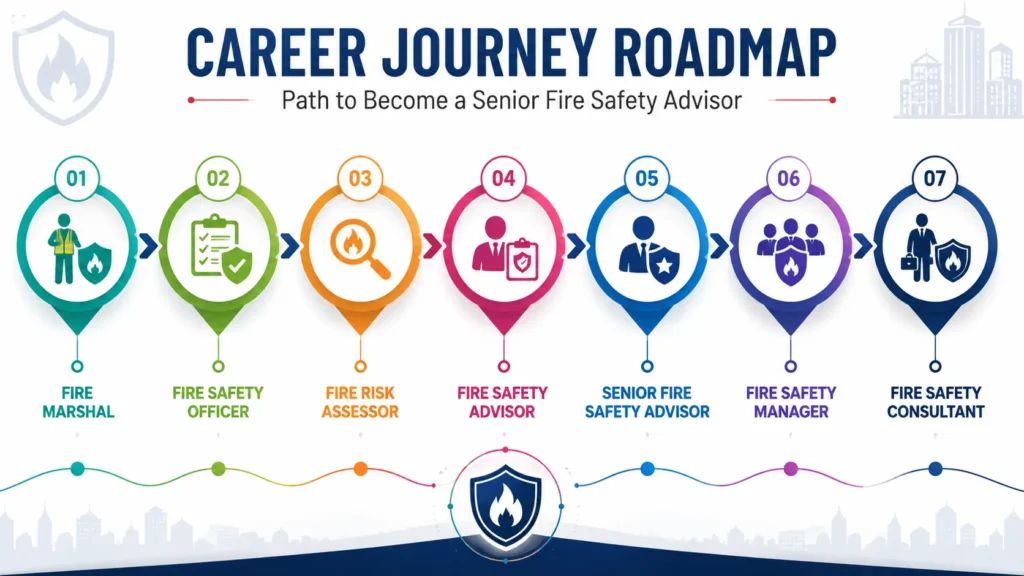
Career progression within fire safety depends on competence, experience, and the ability to manage increasingly complex responsibilities. As professionals gain expertise, they often move from operational roles into advisory, consultancy, and leadership positions.
A typical career pathway may include:
| Career Stage | Primary Responsibilities |
|---|---|
| Fire Marshal | Emergency response and workplace fire awareness |
| Fire Safety Officer | Routine inspections and fire safety monitoring |
| Fire Risk Assessor | Conducting fire risk assessments and recommending improvements |
| Fire Safety Advisor | Providing compliance advice and managing fire safety programmes |
| Senior Fire Safety Advisor | Leading fire safety strategy, audits, investigations, and organisational compliance |
| Fire Safety Manager | Managing fire safety teams and multi-site compliance programmes |
| Fire Safety Consultant | Providing specialist advice across multiple organisations |
Each stage requires additional knowledge, stronger leadership skills, and a broader understanding of fire safety management.
Future Skills Every Senior Fire Safety Advisor Should Prepare For
The fire safety profession continues to evolve as legislation, technology, and building design become more sophisticated. Professionals who embrace innovation will be better positioned to support employers and remain competitive in the job market.
Emerging trends include:
Digital Fire Safety Management
Many organisations are replacing paper-based inspections with cloud-based compliance systems, allowing faster reporting, improved record management, and better monitoring across multiple locations.
Smart Buildings
Modern buildings increasingly incorporate intelligent fire detection systems, automated smoke control, occupancy monitoring, and integrated emergency response technologies. Understanding how these systems operate will become an essential competency.
Artificial Intelligence
Artificial Intelligence is beginning to support fire safety by analysing inspection data, identifying recurring compliance issues, predicting maintenance requirements, and improving risk analysis. While AI does not replace professional judgement, it enables advisors to make faster and more informed decisions.
Building Information Modelling (BIM)
Building Information Modelling is transforming the way construction and facility management professionals manage fire safety information. Senior Fire Safety Advisors who understand BIM can collaborate more effectively during new construction, refurbishment, and maintenance projects.
Sustainability and Fire Safety
As organisations adopt sustainable construction methods and energy-efficient building materials, fire safety professionals must understand how these innovations affect fire behaviour, evacuation strategies, and compliance requirements.
Professionals who stay ahead of these developments will remain valuable contributors to organisations operating in increasingly complex environments.
Practical Tips for Becoming a Highly Effective Senior Fire Safety Advisor
The following habits can significantly improve professional performance:
- Keep detailed records of inspections and recommendations.
- Review fire risk assessments regularly rather than treating them as one-time documents.
- Build positive relationships with managers, employees, and contractors.
- Focus on preventing incidents rather than reacting to them.
- Learn from every inspection, audit, and fire incident.
- Improve presentation and public speaking skills.
- Develop confidence when advising senior leadership.
- Stay informed about changes in legislation and industry guidance.
- Continue developing both technical and leadership competencies.
Small improvements made consistently over time often lead to significant professional growth.
Recommended Courses to Support Your Career
If you want to strengthen your knowledge and develop the competencies discussed in this guide, the following programmes from Inspire College can support your professional development.
Fire Safety Qualifications
- ICTQual Level 6 Diploma in Senior Fire Safety Advisor
- ProQual Level 5 Diploma in Fire Safety and Risk Management
- Qualsafe Level 2 Award in Fire Safety (RQF)
Health and Safety Qualifications
- Level 7 Diploma in Occupational Health and Safety
- Level 5 Diploma in Occupational Health and Safety
- Health and Safety Management Courses
Leadership and Management Courses
- LICQual UK Level 8 Diploma in Strategic Management and Leadership Practice
- MBA in Quality Management (Top-up)
These courses provide valuable knowledge that can help professionals improve their technical competence, leadership capabilities, and career prospects within the fire safety industry.
Why Employers Value Highly Skilled Senior Fire Safety Advisors
Employers recognise that experienced Senior Fire Safety Advisors contribute far more than regulatory compliance. Their expertise supports organisational resilience, protects employees, reduces operational disruption, and strengthens business reputation.
Highly skilled advisors help organisations to:
- Reduce the likelihood of fire incidents.
- Improve legal compliance.
- Protect employees, visitors, and assets.
- Strengthen emergency preparedness.
- Improve inspection outcomes.
- Reduce insurance and operational risks.
- Develop a positive safety culture.
- Support continuous organisational improvement.
For these reasons, organisations increasingly invest in professionals who demonstrate both technical excellence and strong leadership.
Final Thoughts
Developing the right skills is essential for anyone aspiring to become an effective Senior Fire Safety Advisor. While professional qualifications provide the knowledge needed to understand fire safety principles and legislation, long-term success depends on applying that knowledge through practical experience, sound judgement, and continuous professional development.
The most successful Senior Fire Safety Advisors combine expertise in fire risk assessment, auditing, emergency planning, compliance management, and fire protection systems with leadership, communication, report writing, and strategic decision-making. As digital technologies, smart buildings, and modern compliance systems continue to reshape the industry, professionals who embrace lifelong learning will be best positioned to lead organisations safely into the future.
Whether you are beginning your fire safety career or progressing towards a senior advisory role, investing in the development of these essential skills will improve your professional credibility, expand career opportunities, and enable you to make a lasting contribution to workplace safety. Continuous learning, practical experience, and recognised qualifications remain the strongest foundation for becoming a trusted and respected Senior Fire Safety Advisor.
Explore More Fire Safety & Risk Assessment Articles
Discover expert guides on fire safety careers, fire risk assessments, workplace compliance, fire protection systems, and professional qualifications to expand your knowledge and advance your career in fire safety.
- What is Fire Safety?
- Fire Risk Assessment
- Fire Safety Equipment
- Fire Safety: Essential Tips for Homes and Workplaces
- Industrial Fire Safety: Complete Guide to Risk Assessment, Hazards & Prevention (2026)
- Fire Safety Training (2026): Complete Guide, Certification & Workplace Safety
- Level 4 Diploma in Fire Safety: Complete Guide to Career Growth, Skills, Compliance, and Professional Certification
- What Does a Senior Fire Safety Advisor Do? Roles, Responsibilities, and Career Guide
- Senior Fire Safety Advisor vs Fire Risk Assessor: Which Career Is Right for You?
- Senior Fire Safety Advisor Career Progression: Exciting Roles, Salary & Leadership Path
- Is Fire Safety a Good Career Choice in the UK?
- The 5 Essential Steps of Fire Risk Assessment Explained
- Fire Risk Assessment Explained: A Complete Beginner’s Guide
- Qualified Fire Risk Assessor Career Guide: Training, Skills, and Job Opportunities
- How Fire Safety and Risk Assessment Reduce Workplace Hazards
- Fire Safety Planning and Risk Assessment for Businesses
- Essential Fire Safety Tips Everyone Should Know to Stay Safe
- How to Conduct an Effective Risk Assessment Step by Step
- Fire Safety Checklist for Homes, Offices & Commercial Buildings
- Failed a Fire Safety Inspection? Here’s What Happens Next