
Senior Fire Safety Advisor vs Fire Safety Officer: What’s the Difference?
Fire safety is a critical component of workplace health, business continuity, and regulatory compliance. Organisations across construction, manufacturing, healthcare, education, hospitality, oil and gas, logistics, aviation, and commercial property management rely on qualified professionals to protect people, property, and operations from fire-related risks. As workplace environments become more complex and fire safety legislation continues to evolve, employers increasingly seek specialists who can manage fire risks effectively while ensuring compliance with legal requirements.
Among the most common fire safety careers are Fire Safety Officer and Senor Fire Safety Advisor. Although these job titles are often used interchangeably, they represent two distinct professional roles with different responsibilities, levels of authority, and career expectations. A Fire Safety Officer generally focuses on operational fire safety activities such as inspections, emergency preparedness, and routine compliance, while a Senior Fire Safety Advisor provides strategic leadership, develops organisational fire safety policies, oversees risk management programmes, and advises senior management on fire safety governance.
Understanding these differences is important for anyone planning a career in fire safety, considering professional qualifications, or recruiting fire safety personnel. Choosing the right career path depends on experience, leadership aspirations, technical knowledge, and long-term professional goals.
This comprehensive guide compares the roles of a Senior Fire Safety Advisor and a Fire Safety Officer, explaining their responsibilities, daily duties, required competencies, legal obligations, and career progression opportunities to help individuals and employers make informed decisions.
Why People Often Confuse These Roles
Many organisations use different job titles depending on their size, industry, and internal structure. In some workplaces, a Fire Safety Officer performs responsibilities similar to those of a Fire Safety Advisor, while larger organisations distinguish clearly between operational and strategic roles.
The confusion also arises because both professionals share common responsibilities, including:
- Fire risk assessments
- Workplace inspections
- Emergency planning
- Fire safety training
- Fire prevention
- Fire protection systems
- Regulatory compliance
However, the scope of responsibility, decision-making authority, and leadership expectations differ significantly.
In general:
- Fire Safety Officers focus on implementing fire safety procedures and monitoring compliance.
- Senior Fire Safety Advisors develop organisational strategies, lead compliance programmes, advise senior management, and oversee fire safety management systems.
Understanding this distinction helps organisations recruit the right professional while supporting career development for individuals working within the fire safety sector.
Who Is a Fire Safety Officer?
A Fire Safety Officer is an operational fire safety professional responsible for implementing workplace fire safety procedures, conducting inspections, monitoring fire protection systems, supporting emergency preparedness, and helping organisations comply with fire safety regulations.
Fire Safety Officers work directly with employees, contractors, facilities teams, and emergency services to reduce fire risks and maintain safe working environments.
Their responsibilities often include:
- Conducting workplace inspections
- Checking fire extinguishers
- Testing fire alarm systems
- Monitoring emergency exits
- Supporting evacuation drills
- Delivering basic fire safety training
- Recording inspection findings
- Reporting fire hazards
- Assisting with fire risk assessments
- Monitoring compliance
They play a vital role in maintaining everyday fire safety standards across an organisation.
Who Is a Senior Fire Safety Advisor?
A Senior Fire Safety Advisor is a leadership-level professional responsible for developing, implementing, and overseeing an organisation’s fire safety strategy. Rather than focusing solely on operational activities, they take a broader view of organisational fire safety by integrating risk management, regulatory compliance, emergency planning, governance, and continuous improvement.
Senior Fire Safety Advisors typically work closely with:
- Executive leadership
- Health and Safety Managers
- Facilities Managers
- Building Managers
- External regulators
- Fire and Rescue Services
- Insurance providers
- Contractors
- Compliance teams
They provide expert advice that influences organisational decision-making while ensuring fire safety remains aligned with legal requirements and business objectives.
Senior Fire Safety Advisor vs Fire Safety Officer
The differences between these two roles become clearer when compared side by side.
| Feature | Senior Fire Safety Advisor | Fire Safety Officer |
|---|---|---|
| Primary Focus | Strategic fire safety management | Operational fire safety |
| Organisational Level | Senior leadership | Operational staff |
| Decision Making | Strategic | Day-to-day |
| Fire Risk Assessments | Leads and approves | Conducts and supports |
| Policy Development | Develops policies | Implements policies |
| Compliance | Oversees programmes | Monitors activities |
| Reporting | Executive reporting | Departmental reporting |
| Leadership | Manages teams | Supports teams |
| Emergency Planning | Develops strategies | Participates in drills |
| Continuous Improvement | Leads improvement programmes | Supports implementation |
This comparison highlights how a Senior Fire Safety Advisor takes responsibility for organisational strategy, while a Fire Safety Officer focuses on implementing and maintaining daily fire safety operations.
Key Responsibilities Compared
Although both roles contribute to workplace fire safety, the scope of their responsibilities varies considerably.
| Senior Fire Safety Advisor | Fire Safety Officer |
|---|---|
| Develop fire safety strategy | Conduct routine inspections |
| Lead compliance programmes | Check fire equipment |
| Approve fire risk assessments | Record inspection findings |
| Develop organisational policies | Deliver staff briefings |
| Advise senior management | Support evacuation drills |
| Coordinate audits | Monitor emergency exits |
| Manage contractors | Test fire alarms |
| Promote continuous improvement | Report hazards |
Senior Fire Safety Advisors operate at a strategic level, ensuring long-term fire safety performance, whereas Fire Safety Officers focus on maintaining day-to-day compliance.
Daily Duties Compared
The working day of each professional reflects the difference in responsibility.
| Senior Fire Safety Advisor | Fire Safety Officer |
|---|---|
| Strategic planning meetings | Workplace inspections |
| Compliance reviews | Equipment checks |
| Risk assessment approvals | Fire alarm testing |
| Policy development | Emergency drill support |
| Contractor coordination | Hazard reporting |
| Management reporting | Safety observations |
| Audit preparation | Routine documentation |
| Leadership meetings | Staff awareness activities |
This distinction demonstrates how leadership responsibilities increase with seniority.
Fire Protection Responsibilities
Fire protection is a shared responsibility across both roles, although Senior Fire Safety Advisors generally oversee organisational programmes while Fire Safety Officers assist with implementation.
Key responsibilities include:
| Fire Protection Area | Responsibility |
|---|---|
| Fire Detection | Monitor alarm systems |
| Fire Prevention | Reduce ignition risks |
| Emergency Planning | Coordinate evacuation procedures |
| Compliance | Maintain legal requirements |
| Training | Improve staff awareness |
| Auditing | Verify fire safety performance |
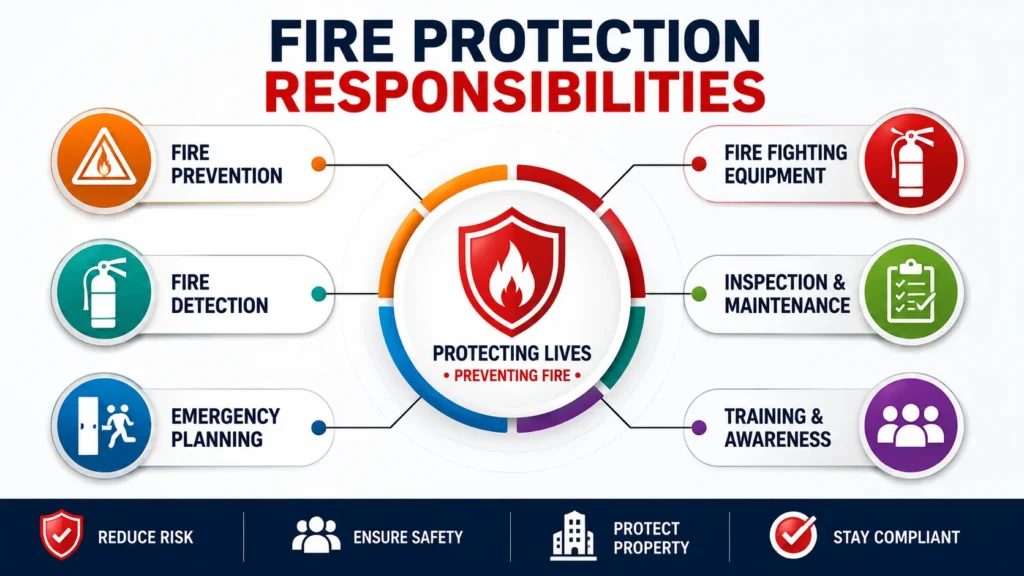
The infographic provides a quick visual summary of the core areas that contribute to an effective fire protection programme and complements the detailed explanation above.
Fire Risk Assessment Responsibilities
Fire risk assessment is one of the most important responsibilities performed by both professionals, although the level of responsibility differs.
Fire Safety Officers often assist with inspections and information gathering, while Senior Fire Safety Advisors typically lead, review, and approve fire risk assessments.
A structured fire risk assessment generally follows this process:
Identify Fire Hazards
↓
Identify People at Risk
↓
Evaluate Existing Controls
↓
Assess Risk Level
↓
Implement Control Measures
↓
Record Findings
↓
Review and Improve
This structured approach helps organisations identify hazards before they become emergencies while supporting continuous improvement.
Fire Safety Management System
An effective fire safety programme is not based on isolated inspections. Instead, organisations manage fire safety through an integrated management system that promotes continuous monitoring and improvement.
The Fire Safety Management System includes:
- Planning
- Hazard Identification
- Risk Assessment
- Control Implementation
- Employee Training
- Performance Monitoring
- Auditing
- Continuous Improvement
Fire Safety Management Cycle
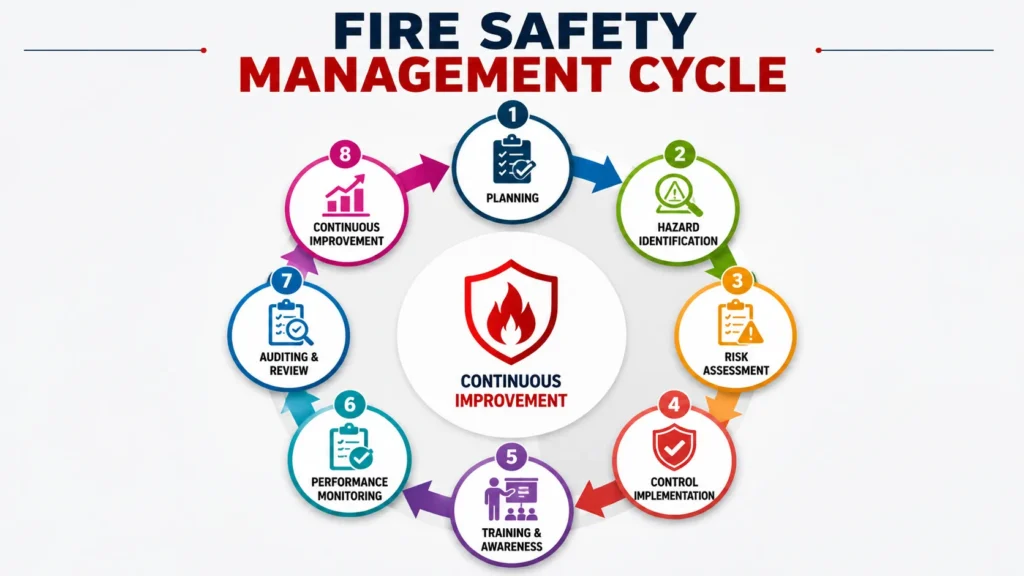
This visual demonstrates that fire safety is a continuous process requiring regular evaluation, monitoring, and improvement rather than a one-time activity.
UK Fire Safety Legislation
Both Fire Safety Officers and Senior Fire Safety Advisors must understand the legal framework governing workplace fire safety. However, Senior Fire Safety Advisors are generally responsible for ensuring organisational compliance, interpreting legislative requirements, and advising management on regulatory obligations.
Key legislation includes:
| Legislation | Purpose |
|---|---|
| Regulatory Reform (Fire Safety) Order 2005 | Defines fire safety responsibilities for the Responsible Person |
| Fire Safety Act 2021 | Strengthens fire risk assessment requirements for multi-occupied residential buildings |
| Building Safety Act 2022 | Improves accountability for higher-risk buildings |
| Health and Safety at Work etc. Act 1974 | Requires employers to provide safe working environments |
| Dangerous Substances and Explosive Atmospheres Regulations (DSEAR) | Controls fire and explosion risks associated with hazardous substances |
Understanding these regulations enables both professionals to support workplace safety, while Senior Fire Safety Advisors ensure fire safety strategies remain aligned with legal and organisational requirements.
Skills Comparison
Both roles require a solid understanding of fire safety principles, but the depth of knowledge and level of responsibility differ considerably. Fire Safety Officers generally focus on operational competence, while Senior Fire Safety Advisors require advanced technical expertise combined with leadership, strategic planning, and regulatory knowledge.
The following comparison highlights the skills typically expected in each role.
| Skill Area | Senior Fire Safety Advisor | Fire Safety Officer |
|---|---|---|
| Fire Risk Assessment | Advanced | Intermediate |
| Fire Safety Legislation | Advanced | Working Knowledge |
| Fire Protection Systems | Advanced | Operational Knowledge |
| Emergency Planning | Leads Strategy | Supports Implementation |
| Compliance Management | Leads | Assists |
| Fire Safety Auditing | Advanced | Basic |
| Leadership | High | Moderate |
| Policy Development | Yes | Limited |
| Report Writing | Executive Level | Operational Level |
| Communication | Organisation-wide | Department Level |
Professionals seeking leadership positions should focus on developing strategic thinking, compliance management, and decision-making skills alongside their technical expertise.
Qualifications Comparison
The qualifications required for each role often reflect the level of responsibility.
A Fire Safety Officer usually begins with foundation or intermediate fire safety qualifications before gaining practical workplace experience. A Senior Fire Safety Advisor typically holds advanced qualifications that demonstrate competence in fire safety management, legislation, leadership, and organisational compliance.
| Fire Safety Officer | Senior Fire Safety Advisor |
|---|---|
| Fire Safety Awareness Training | ICTQual Level 4 Diploma Senior Fire Safety Advisor |
| Fire Marshal Training | Advanced Fire Safety Management |
| Fire Warden Training | Fire Risk Assessment Qualification |
| Workplace Fire Safety Course | Health and Safety Management Qualification |
| Basic Risk Assessment | Leadership and Compliance Training |
Continuous professional development is equally important for both roles, ensuring knowledge remains aligned with changing legislation, technologies, and industry best practices.
Leadership Responsibilities
Leadership is one of the defining differences between these two careers.
A Fire Safety Officer primarily supports the implementation of workplace fire safety procedures, whereas a Senior Fire Safety Advisor is responsible for developing organisational strategy, influencing decision-making, and creating a positive fire safety culture.
Typical leadership responsibilities include:
- Developing fire safety strategies
- Leading compliance programmes
- Advising executive management
- Managing fire safety budgets
- Coordinating multidisciplinary teams
- Reviewing organisational risks
- Managing external contractors
- Supporting regulatory inspections
- Leading continuous improvement initiatives
- Mentoring junior fire safety professionals
These responsibilities require not only technical competence but also strong communication, planning, and management skills.
Industries That Employ Both Roles
Fire safety professionals are required across almost every industry because protecting people and property is a universal responsibility. While Fire Safety Officers often work on day-to-day operational activities, Senior Fire Safety Advisors usually oversee organisation-wide fire safety management.
Major industries include:
Construction
Fire safety planning, temporary fire protection, hot work management, and regulatory compliance.
Manufacturing
Fire prevention, machinery safety, hazardous materials management, and emergency preparedness.
Healthcare
Hospital evacuation planning, patient safety, compartmentation, and fire protection system management.
Oil and Gas
Explosion prevention, hazardous area inspections, emergency response planning, and compliance auditing.
Education
Campus fire safety, evacuation planning, student safety, and regulatory compliance.
Hospitality
Hotel fire safety, guest evacuation procedures, kitchen fire prevention, and emergency response.
Logistics and Warehousing
Warehouse fire risk assessments, storage safety, fire detection systems, and emergency planning.
Commercial Property
Building compliance, facilities management, contractor coordination, and fire protection maintenance.
Industries Employing Fire Safety Professionals
| Industry | Common Responsibilities |
|---|---|
| Construction | Site fire safety and compliance |
| Manufacturing | Hazard control and inspections |
| Healthcare | Evacuation planning |
| Oil & Gas | Fire and explosion prevention |
| Education | Campus safety management |
| Hospitality | Guest protection |
| Logistics | Warehouse fire safety |
| Commercial Property | Building compliance |
| Aviation | Airport fire safety |
| Government | Public sector fire safety |
Industries That Employ Senior Fire Safety Advisors
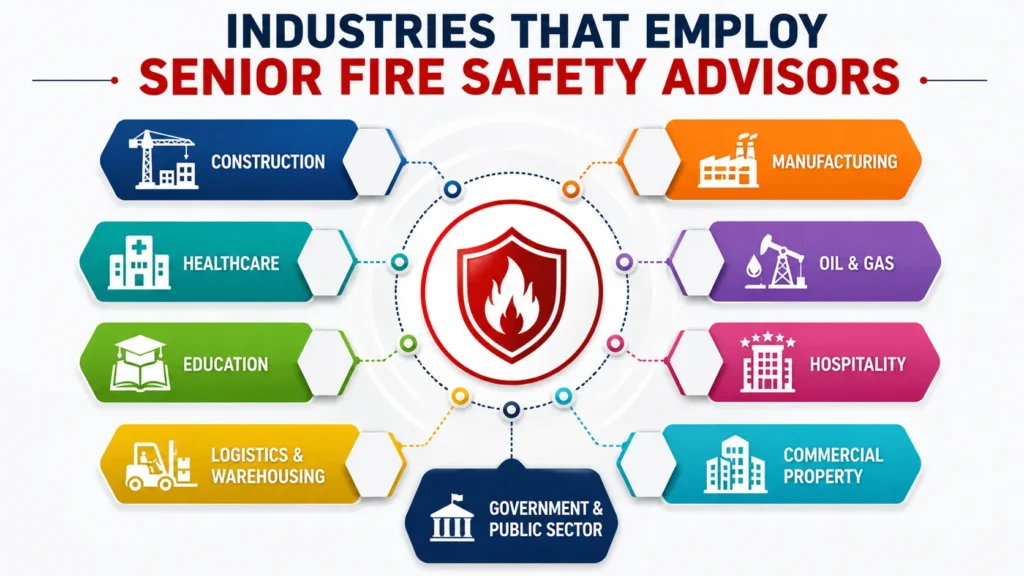
This infographic highlights the wide range of sectors where experienced fire safety professionals are employed, reinforcing the strong career prospects within the industry.
Career Progression
Fire safety offers excellent long-term career opportunities. Many professionals begin with operational roles before progressing into leadership and consultancy positions.
A typical career pathway looks like this:
Fire Warden
↓
Fire Marshal
↓
Fire Safety Officer
↓
Senior Fire Safety Advisor
↓
Fire Safety Manager
↓
Fire Safety Consultant
↓
Head of Fire Safety
↓
Director of Health, Safety & Fire
As professionals gain experience and advanced qualifications, they take on broader organisational responsibilities, larger teams, and increasingly strategic decision-making roles.
Salary Expectations
Salary levels depend on experience, qualifications, employer, location, and industry. Generally, Senior Fire Safety Advisors earn higher salaries because they manage strategic programmes, oversee compliance, and provide expert advice to senior management.
| Career Level | Salary Outlook* |
|---|---|
| Fire Safety Officer | Competitive entry-to-mid-level salary |
| Senior Fire Safety Advisor | Higher professional salary |
| Fire Safety Manager | Senior management salary |
| Fire Safety Consultant | Consultancy-based earnings |
| Head of Fire Safety | Executive-level remuneration |
*Actual salaries vary by country, employer, industry, and professional experience.
Which Career Should You Choose?
Choosing between these two careers depends on your current experience, career ambitions, and professional interests.
A Fire Safety Officer may be suitable if you:
- Are beginning a fire safety career.
- Prefer operational and site-based work.
- Enjoy inspections and practical activities.
- Want to build experience before moving into management.
A Senior Fire Safety Advisor may be suitable if you:
- Have fire safety or health and safety experience.
- Enjoy leadership and strategic planning.
- Want to advise senior management.
- Prefer compliance, governance, and organisational improvement.
- Aspire to senior management or consultancy roles.
For many professionals, becoming a Fire Safety Officer is an important stepping stone towards a Senior Fire Safety Advisor position.
Emerging Trends in Fire Safety
Fire safety continues to evolve rapidly as organisations adopt new technologies and smarter approaches to risk management.
Artificial Intelligence (AI)
AI-powered fire detection systems analyse smoke, heat, and video data to identify fire incidents earlier than conventional detection methods.
Internet of Things (IoT)
Connected sensors monitor alarms, extinguishers, sprinkler systems, emergency lighting, and environmental conditions in real time.
Smart Buildings
Building management systems now integrate fire alarms, access control, HVAC systems, and emergency communications into a single intelligent platform.
Building Information Modelling (BIM)
BIM enables fire safety professionals to evaluate evacuation routes, fire compartmentation, and protection systems throughout a building’s lifecycle.
Digital Compliance
Cloud-based inspections, mobile auditing software, digital maintenance records, and automated reporting improve compliance management and audit readiness.
Professionals who understand these technologies will be increasingly valuable as organisations modernise their fire safety management systems.
Why Employers Prefer Senior Fire Safety Advisors
Modern employers increasingly recognise the value of experienced professionals who can integrate fire safety into broader organisational strategy.
Key benefits include:
- Stronger legal compliance
- Lower organisational risk
- Safer workplaces
- Improved emergency preparedness
- Protection of assets
- Better business continuity
- Enhanced corporate reputation
- Continuous improvement
Why Employers Value Senior Fire Safety Advisors
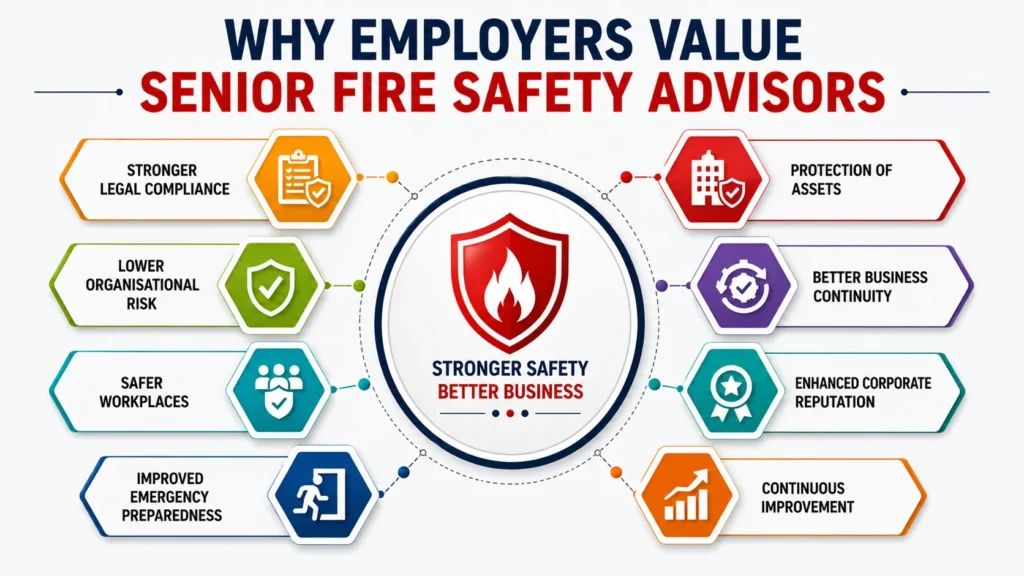
This visual summarises the organisational benefits of employing experienced fire safety leaders and reinforces the value of strategic fire safety management.
Related Courses for Further Learning
| Related Course | Purpose |
|---|---|
| ICTQual Level 4 Diploma Senior Fire Safety Advisor | Advanced fire safety leadership and compliance |
| Fire Risk Assessment Course | Practical fire risk assessment skills |
| Fire Marshal Training | Emergency response and evacuation |
| Risk Assessment Training | Hazard identification and control measures |
Conclusion
Although Fire Safety Officers and Senior Fire Safety Advisors share a common objective of protecting people, property, and organisations from fire-related risks, their responsibilities differ significantly. Fire Safety Officers focus on operational fire safety activities, including inspections, equipment checks, emergency drills, and supporting compliance. In contrast, Senior Fire Safety Advisors provide strategic leadership by developing fire safety policies, leading risk management programmes, overseeing organisational compliance, and advising senior management on governance and continuous improvement.
As workplaces become more technologically advanced and fire safety legislation continues to evolve, organisations increasingly require professionals who can combine technical expertise with leadership, regulatory knowledge, and strategic decision-making. This growing demand creates excellent career opportunities for individuals who invest in advanced qualifications and continuous professional development.
Whether you are starting your journey in fire safety or aiming to progress into senior leadership, understanding the differences between these roles will help you choose the career path that aligns with your ambitions. By gaining recognised qualifications, developing practical experience, and embracing emerging technologies, you can build a rewarding career that contributes to safer workplaces, stronger compliance, and long-term organisational resilience.
Explore More Fire Safety & Risk Assessment Articles
Discover expert guides on fire safety careers, fire risk assessments, workplace compliance, fire protection systems, and professional qualifications to expand your knowledge and advance your career in fire safety.
- What is Fire Safety?
- Fire Risk Assessment
- Fire Safety Equipment
- Fire Safety: Essential Tips for Homes and Workplaces
- Industrial Fire Safety: Complete Guide to Risk Assessment, Hazards & Prevention (2026)
- Fire Safety Training (2026): Complete Guide, Certification & Workplace Safety
- Level 4 Diploma in Fire Safety: Complete Guide to Career Growth, Skills, Compliance, and Professional Certification
- Senior Fire Safety Advisor: Complete Guide to Becoming One in the UK
- What Does a Senior Fire Safety Advisor Do? Roles, Responsibilities, and Career Guide
- Senior Fire Safety Advisor vs Fire Risk Assessor: Which Career Is Right for You?
- Senior Fire Safety Advisor Career Progression: Exciting Roles, Salary & Leadership Path
- Is Fire Safety a Good Career Choice in the UK?
- Top Skills Every Senior Fire Safety Advisor Should Develop
- Fire Risk Assessment Explained: A Complete Beginner’s Guide
- Qualified Fire Risk Assessor Career Guide: Training, Skills, and Job Opportunities
- Fire Safety Planning and Risk Assessment for Businesses
- How to Conduct an Effective Risk Assessment Step by Step
- Fire Safety Checklist for Homes, Offices & Commercial Buildings
- Common Risk Assessment Mistakes and How to Avoid Them