
Fire Safety Requirements for Hotels
Hotels welcome hundreds or even thousands of guests every week, making fire safety one of the most important responsibilities for owners, operators, and managers. Unlike many other workplaces, hotels operate around the clock, accommodate people who may be unfamiliar with the building, and include high-risk areas such as commercial kitchens, laundry rooms, electrical plant rooms, and storage facilities. These factors make effective fire safety management essential for protecting lives, safeguarding property, and ensuring business continuity.
Meeting the Fire Safety Requirements for Hotels involves much more than installing fire alarms or placing fire extinguishers throughout the building. Hotel operators must identify fire hazards, conduct suitable fire risk assessments, maintain fire protection systems, train employees, develop emergency evacuation procedures, and continuously monitor compliance with UK fire safety legislation.
Recent changes to fire safety and building safety regulations have increased the importance of competent fire safety management within the hospitality sector. Guests expect hotels to provide a safe environment, insurers expect effective risk management, and regulators require businesses to demonstrate compliance with legal duties. Failure to meet these responsibilities can result in enforcement action, financial penalties, reputational damage, and increased risk to occupants.
Whether operating a boutique hotel, luxury resort, business hotel, serviced apartments, or a large hospitality complex, every establishment should have a comprehensive fire safety strategy that reflects its size, occupancy, and operational risks.
This complete guide explains the Fire Safety Requirements for Hotels, including UK legal obligations, hotel management responsibilities, fire risk assessment principles, staff training, fire protection systems, and best practices for maintaining a safe and compliant hospitality environment.
What Are Fire Safety Requirements for Hotels?
The Fire Safety Requirements for Hotels refer to the legal, operational, and practical measures that hotels must implement to prevent fires, protect occupants, and ensure safe evacuation during emergencies. These requirements are designed to minimise fire risks while providing guests, employees, contractors, and visitors with a safe environment.
An effective hotel fire safety programme combines prevention, protection, preparedness, and continuous improvement. Rather than relying on a single control measure, hotels should integrate multiple layers of fire safety management into their daily operations.
Key Components of Hotel Fire Safety
A comprehensive hotel fire safety programme should include:
- Fire risk assessments
- Fire prevention measures
- Fire detection and alarm systems
- Emergency lighting
- Protected escape routes
- Fire doors and compartmentation
- Fire extinguishers
- Emergency evacuation procedures
- Fire Marshal arrangements
- Staff fire safety training
- Regular fire drills
- Maintenance and inspection programmes
- Fire safety records and documentation
These components work together to reduce the likelihood of fire while improving emergency response if an incident occurs.
Objectives of Hotel Fire Safety
The primary objectives of implementing effective Fire Safety Requirements for Hotels are to:
- Protect guests and employees.
- Prevent fire incidents.
- Reduce property damage.
- Support rapid emergency response.
- Ensure legal compliance.
- Maintain business continuity.
- Protect organisational reputation.
- Improve overall hospitality safety standards.
Fire safety should be viewed as an ongoing management process rather than a one-time compliance exercise.
Why Fire Safety Is Critical in Hotels
Hotels present unique fire safety challenges because they combine accommodation, food preparation, entertainment, storage, and commercial operations within a single premises. Guests may be asleep, unfamiliar with the building layout, or unable to respond quickly during an emergency, increasing the importance of robust fire safety arrangements.
High Occupancy Levels
Hotels often accommodate large numbers of people at any time of day or night.
Occupants may include:
- Overnight guests
- Families with children
- Elderly visitors
- International tourists
- Conference delegates
- Contractors
- Restaurant customers
- Hotel employees
Managing the safe evacuation of these diverse groups requires detailed planning and regular staff training.
Guests Are Unfamiliar with the Building
Unlike employees, hotel guests usually do not know:
- Escape routes
- Fire exit locations
- Assembly points
- Fire alarm procedures
- Emergency contacts
This makes clear signage, emergency information, and trained staff essential during an evacuation.
Continuous Operations
Most hotels operate 24 hours a day.
This creates additional challenges, including:
- Night-time staffing
- Shift changes
- Reduced supervision
- Sleeping occupants
- Ongoing maintenance activities
- Continuous kitchen operations
Fire safety arrangements must remain effective regardless of the time of day.
Multiple High-Risk Areas
Hotels contain several areas with elevated fire risks.
Examples include:
- Commercial kitchens
- Laundry facilities
- Electrical switch rooms
- Boiler rooms
- Plant rooms
- Storage areas
- Restaurants and bars
- Function rooms
- Staff accommodation
- Waste storage areas
Each area requires specific risk controls based on its operational hazards.
Business Continuity
A significant fire can result in:
- Temporary closure
- Loss of bookings
- Insurance claims
- Regulatory investigations
- Reputational damage
- Financial losses
Investing in fire safety helps protect both people and long-term business performance.
UK Fire Safety Legislation for Hotels
Hotels operating in the United Kingdom must comply with several important pieces of legislation governing fire safety, workplace safety, and building management.
Understanding these legal responsibilities helps hotel operators establish effective fire safety systems while demonstrating compliance with regulatory requirements.
Regulatory Reform (Fire Safety) Order 2005
The Regulatory Reform (Fire Safety) Order 2005 is the primary fire safety legislation for non-domestic premises in England and Wales.
Under this legislation, the Responsible Person must:
- Carry out suitable and sufficient fire risk assessments.
- Identify fire hazards.
- Maintain fire safety equipment.
- Establish emergency procedures.
- Provide employee training.
- Maintain escape routes.
- Review fire safety arrangements regularly.
Most hotel fire safety responsibilities are built around these legal duties.
Fire Safety Act 2021
The Fire Safety Act strengthens fire safety obligations for certain premises by clarifying that fire risk assessments should consider external walls, flat entrance doors where applicable, and other relevant building elements.
Hotels should ensure fire safety assessments remain current and reflect any changes to building structure or occupancy.
Building Safety Act 2022
The Building Safety Act introduces enhanced accountability for higher-risk buildings and promotes stronger safety management throughout the lifecycle of qualifying buildings.
Although not every hotel falls within its scope, the principles of competent building safety management are highly relevant across the hospitality sector.
Health and Safety at Work etc. Act 1974
This legislation requires employers to protect the health, safety, and welfare of employees and others affected by workplace activities.
For hotels, this includes implementing appropriate fire safety arrangements for both staff and guests.
Management of Health and Safety at Work Regulations 1999
These regulations require employers to:
- Assess workplace risks.
- Develop emergency procedures.
- Provide suitable information.
- Deliver employee training.
- Monitor workplace safety.
Fire safety forms an integral part of broader workplace risk management.
Responsibilities of Hotel Owners, Managers, and the Responsible Person
Successful hotel fire safety depends on clearly defined responsibilities. While overall accountability usually rests with the Responsible Person or hotel owner, effective fire safety requires cooperation across multiple departments.
The Responsible Person
The Responsible Person has overall responsibility for ensuring the hotel complies with fire safety legislation.
Their duties typically include:
- Arranging fire risk assessments.
- Maintaining fire protection systems.
- Providing staff training.
- Reviewing emergency procedures.
- Ensuring adequate evacuation arrangements.
- Keeping fire safety records.
- Monitoring ongoing compliance.
The Responsible Person may delegate tasks but cannot delegate legal responsibility.
Hotel Owners
Hotel owners should ensure sufficient resources are available to support effective fire safety management.
This includes investment in:
- Fire alarm systems.
- Emergency lighting.
- Fire doors.
- Staff training.
- Maintenance programmes.
- Professional fire risk assessments.
- Compliance monitoring.
A proactive approach reduces both legal and operational risks.
Hotel Managers
Managers play a vital role in implementing fire safety policies on a day-to-day basis.
Typical responsibilities include:
- Supervising staff.
- Monitoring fire safety procedures.
- Supporting Fire Marshals.
- Organising fire drills.
- Reporting hazards.
- Ensuring housekeeping standards.
- Maintaining emergency documentation.
Managers help translate policy into practical action.
Department Supervisors
Department supervisors should ensure fire safety procedures are followed within their specific operational areas.
Examples include:
- Kitchen managers monitoring cooking safety.
- Housekeeping supervisors maintaining escape routes.
- Maintenance managers inspecting equipment.
- Front office managers coordinating guest information.
- Food and beverage managers controlling fire risks in restaurants and bars.
Department-level accountability strengthens overall compliance.
Hotel Fire Safety Responsibilities
The table below summarises the primary responsibilities within a hotel fire safety management system.
| Role | Primary Fire Safety Responsibilities |
|---|---|
| Responsible Person | Legal compliance, fire risk assessment, emergency planning |
| Hotel Owner | Resource allocation, policy approval, overall safety oversight |
| General Manager | Day-to-day implementation, monitoring, staff supervision |
| Fire Marshal | Evacuation support, fire drills, reporting hazards |
| Reception Team | Guest communication, emergency information, emergency services liaison |
| Housekeeping | Keeping escape routes clear, identifying hazards, reporting defects |
| Maintenance Team | Inspection, testing, repairs, fire protection system maintenance |
| Kitchen Manager | Cooking safety, gas safety, hot work control, housekeeping |
| Security Staff | Emergency coordination, access control, incident support |
Clearly defined responsibilities help ensure every employee contributes to maintaining a safe hotel environment.
Step-by-Step Hotel Fire Risk Assessment Process
A fire risk assessment forms the foundation of effective hotel fire safety management. It enables hotel owners and managers to identify hazards, evaluate risks, implement suitable control measures, and continuously improve fire safety standards.
The Fire Safety Requirements for Hotels cannot be met without a suitable and sufficient fire risk assessment that reflects the size, layout, occupancy, and operational activities of the premises.
A fire risk assessment should not be treated as a one-time exercise. Hotels are dynamic environments where guest numbers, room layouts, equipment, and operational processes change regularly. Continuous review ensures the assessment remains accurate and effective.
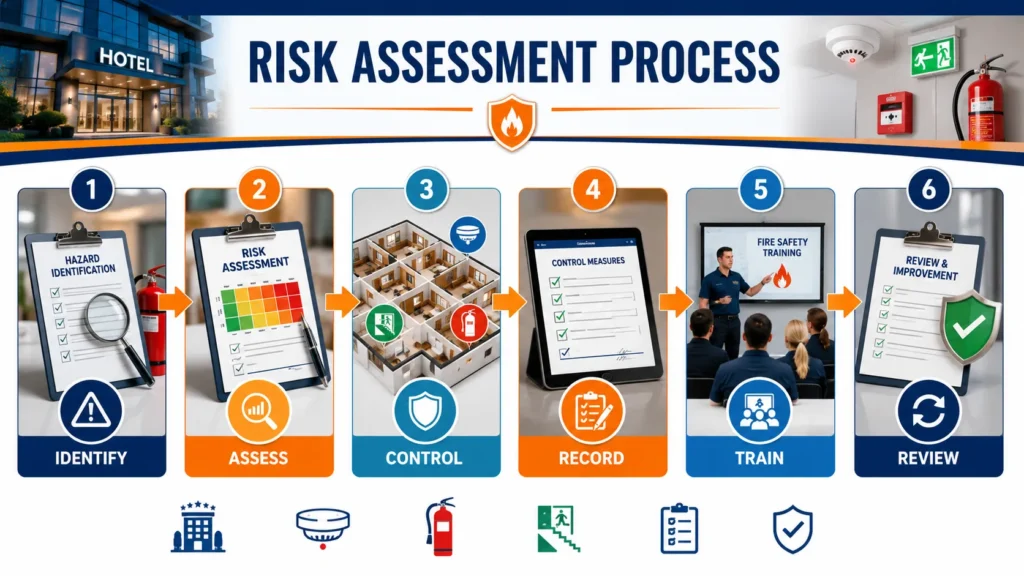
Step 1: Identify Fire Hazards
The first stage involves identifying anything that could start or spread a fire.
Common sources of ignition include:
- Cooking equipment
- Electrical installations
- Portable heaters
- Lighting systems
- Laundry machinery
- Smoking materials
- Hot work activities
- Faulty appliances
Sources of fuel may include:
- Bedding and mattresses
- Furniture
- Curtains and carpets
- Cleaning chemicals
- Paper products
- Decorative materials
- Waste storage
- Linen supplies
Understanding both ignition and fuel sources provides the basis for effective risk control.
Step 2: Identify People at Risk
Hotels accommodate a wide variety of occupants with different needs and levels of familiarity with the building.
People who may be at greater risk include:
- Sleeping guests
- Children
- Elderly guests
- Guests with disabilities
- Individuals with reduced mobility
- International visitors unfamiliar with emergency procedures
- Contractors
- Night-shift employees
Identifying vulnerable occupants helps ensure evacuation procedures are appropriate for everyone.
Step 3: Evaluate Fire Risks
Once hazards and occupants have been identified, the next step is to evaluate the likelihood of fire occurring and the potential consequences.
Consider factors such as:
- Existing fire protection systems
- Building layout
- Occupancy levels
- Escape route availability
- Fire compartmentation
- Staff competency
- Maintenance arrangements
The objective is to determine whether current fire safety measures are sufficient or require improvement.
Step 4: Implement Control Measures
Where unacceptable risks are identified, suitable control measures should be introduced.
Examples include:
- Improving housekeeping standards
- Installing additional fire detection devices
- Upgrading emergency lighting
- Repairing fire doors
- Enhancing staff training
- Introducing stricter maintenance procedures
- Improving evacuation arrangements
Control measures should be prioritised according to risk level.
Step 5: Record Findings
Significant findings should be documented, including:
- Identified hazards
- People at risk
- Existing control measures
- Recommended improvements
- Responsible persons
- Completion dates
Accurate documentation supports legal compliance and future reviews.
Step 6: Review Regularly
Fire risk assessments should be reviewed whenever:
- Building layouts change
- Occupancy increases
- Hotel renovations occur
- Fire protection systems are upgraded
- Significant incidents occur
- New equipment is introduced
- Legislation changes
Regular reviews help ensure the hotel continues to meet the Fire Safety Requirements for Hotels.
Hotel Fire Risk Assessment Flowchart
The following workflow illustrates a structured approach to hotel fire risk assessment.
Identify Fire Hazards
↓
Identify People at Risk
↓
Evaluate Fire Risks
↓
Implement Control Measures
↓
Record Significant Findings
↓
Train Employees
↓
Monitor Performance
↓
Review and Update Assessment
This process promotes continuous improvement and supports long-term compliance with UK fire safety legislation.
Common Fire Hazards in Hotels
Hotels contain a wide range of fire hazards because they combine accommodation, catering, leisure, maintenance, and commercial activities within one building.
Recognising these hazards enables hotel operators to reduce fire risks before incidents occur.
Commercial Kitchens
Commercial kitchens remain one of the highest-risk areas within hotels.
Common hazards include:
- Cooking oils
- Open flames
- Gas appliances
- Deep-fat fryers
- Grease accumulation
- Extraction systems
- Electrical cooking equipment
Regular cleaning and maintenance are essential.
Laundry Facilities
Laundry rooms often contain:
- Dryers
- Washing machines
- Lint accumulation
- Electrical equipment
- Large quantities of combustible textiles
Routine maintenance helps reduce overheating and fire risks.
Guest Bedrooms
Potential hazards include:
- Electrical chargers
- Portable appliances
- Smoking materials where permitted
- Hair styling equipment
- Overloaded sockets
Guests should receive clear fire safety information upon arrival.
Plant Rooms and Electrical Areas
Electrical switch rooms, boiler rooms, and plant rooms require controlled access and routine inspection.
Potential hazards include:
- Electrical faults
- Overheating equipment
- Fuel systems
- Mechanical failures
Preventive maintenance reduces the likelihood of fire.
Storage Areas
Poor storage practices can significantly increase fire loading.
Common issues include:
- Excess cardboard
- Linen storage
- Cleaning chemicals
- Waste accumulation
- Flammable materials stored near ignition sources
Good housekeeping plays a major role in fire prevention.
Charging Stations and Lithium Batteries
Modern hotels increasingly provide:
- Electric vehicle charging
- Battery-powered maintenance equipment
- Portable electronic devices
Lithium battery fires require appropriate risk assessments and charging procedures.
Essential Fire Protection Systems for Hotels
Fire protection systems provide multiple layers of defence that detect, contain, suppress, and support safe evacuation during a fire.
An effective hotel should integrate both active and passive fire protection measures.
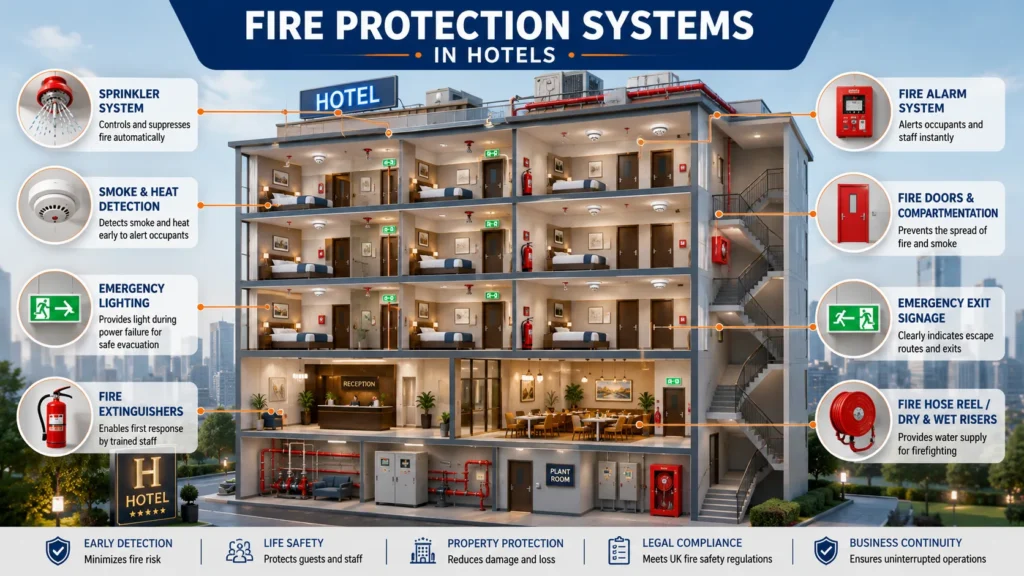
Active Fire Protection
Active systems require activation, either automatically or manually.
Examples include:
- Fire alarm systems
- Smoke detectors
- Heat detectors
- Sprinkler systems
- Fire extinguishers
- Voice alarm systems
These systems help identify fires early and reduce their impact.
Passive Fire Protection
Passive protection helps prevent fire and smoke from spreading throughout the building.
Examples include:
- Fire-resistant walls
- Fire doors
- Fire compartmentation
- Fire stopping
- Protected stairwells
- Fire-resistant ceilings
Passive systems remain effective even without human intervention.
Emergency Lighting
Emergency lighting supports safe evacuation during power failures by illuminating:
- Escape routes
- Staircases
- Corridors
- Emergency exits
- Assembly route access
Routine testing helps ensure reliability.
Emergency Exit Signage
Emergency signage should:
- Clearly identify escape routes.
- Remain visible during emergencies.
- Be positioned consistently.
- Comply with recognised standards.
- Support unfamiliar guests.
Hotels should assume many occupants have never visited the building before.
Fire Protection Systems and Inspection Frequency
Regular maintenance is essential to ensure fire protection systems remain operational.
| Fire Protection System | Typical Inspection Frequency |
|---|---|
| Fire alarm system | Weekly user test and scheduled servicing |
| Emergency lighting | Monthly functional test and annual full-duration test |
| Fire extinguishers | Monthly visual inspection and annual servicing |
| Fire doors | Monthly inspection and after building alterations |
| Smoke and heat detectors | Routine inspection and scheduled maintenance |
| Sprinkler systems | Regular inspection in accordance with maintenance standards |
| Emergency exit signage | Routine visual inspection |
| Dry and wet risers | Scheduled inspection and testing by competent persons |
Hotels should maintain detailed inspection records for all fire protection systems.
Hotel Staff Fire Safety Training Requirements
Even the most advanced fire protection systems cannot replace a well-trained workforce. Staff are often the first people to respond when a fire alarm activates, making regular fire safety training essential.
Every employee should understand their responsibilities and know how to respond calmly and effectively.
Fire Safety Induction Training
New employees should receive fire safety training before beginning normal duties.
Induction training should cover:
- Fire alarm procedures
- Escape routes
- Emergency exits
- Assembly points
- Fire reporting procedures
- Fire prevention responsibilities
- Basic use of fire extinguishers where appropriate
Refresher Training
Knowledge fades over time, particularly in environments with staff turnover.
Regular refresher training helps employees:
- Maintain awareness.
- Understand updated procedures.
- Learn from fire drills.
- Reinforce emergency responsibilities.
Training should reflect changes within the hotel.
Practical Fire Drills
Fire drills help employees:
- Practice evacuation procedures.
- Improve confidence.
- Identify weaknesses.
- Test communication systems.
- Evaluate evacuation times.
Lessons learned should be incorporated into future planning.
Fire Marshal Responsibilities in Hotels
Fire Marshals provide essential support during both routine operations and emergency situations.
Before an Emergency
Fire Marshals assist by:
- Monitoring escape routes.
- Reporting fire hazards.
- Supporting fire drills.
- Promoting fire safety awareness.
- Assisting with inspections.
During an Emergency
Fire Marshals may:
- Direct guests towards emergency exits.
- Check designated areas where safe.
- Assist vulnerable occupants.
- Prevent re-entry.
- Guide occupants to assembly points.
- Communicate with emergency services.
After Evacuation
Following evacuation, Fire Marshals help by:
- Reporting evacuation status.
- Assisting attendance checks.
- Providing information to emergency responders.
- Supporting incident reviews.
- Identifying improvements for future procedures.
Competent Fire Marshals strengthen hotel emergency preparedness and contribute significantly to maintaining compliance with the Fire Safety Requirements for Hotels.
Guest Fire Safety Procedures
Protecting guests is the primary objective of the Fire Safety Requirements for Hotels. Unlike employees, guests are often unfamiliar with the building layout, emergency exits, and fire procedures. Clear communication, effective signage, and well-trained staff are essential to ensure a safe evacuation during an emergency.
Every hotel should establish guest fire safety procedures that are easy to understand and accessible to all occupants.
Fire Safety Information for Guests
Guests should receive clear fire safety information through:
- Fire action notices displayed behind bedroom doors
- Emergency evacuation maps
- Emergency exit signage
- Information provided during check-in where appropriate
- Digital guest information systems
- Hotel mobile applications
Emergency instructions should use simple language and internationally recognised safety symbols to assist guests from different countries.
Supporting Vulnerable Guests
Hotels should consider the needs of guests who may require additional assistance during an emergency, including:
- Older adults
- Individuals with mobility impairments
- Wheelchair users
- Guests with hearing or visual impairments
- Families travelling with young children
- Pregnant guests
Personal Emergency Evacuation Plans (PEEPs) should be developed where appropriate, and staff should understand how to provide safe assistance without placing themselves or others at unnecessary risk.
Assembly Points
Assembly points should be:
- Clearly identified
- Located a safe distance from the building
- Easily accessible
- Large enough for expected occupancy
- Kept clear of emergency vehicle access routes
Hotel staff should direct guests calmly to the designated assembly point and provide reassurance until emergency services confirm that it is safe to return.
Emergency Evacuation Planning for Hotels
An effective evacuation plan enables employees and guests to respond quickly, safely, and confidently during an emergency.
Every hotel should have written emergency procedures tailored to its building layout, occupancy levels, and operational activities.
Elements of a Hotel Evacuation Plan
A comprehensive evacuation plan should include:
- Fire alarm activation procedures
- Emergency communication methods
- Escape routes
- Alternative evacuation routes
- Assembly points
- Fire Marshal responsibilities
- Guest accountability procedures
- Emergency contact numbers
- Procedures for assisting vulnerable guests
- Coordination with emergency services
The plan should be reviewed regularly and updated whenever significant changes occur.
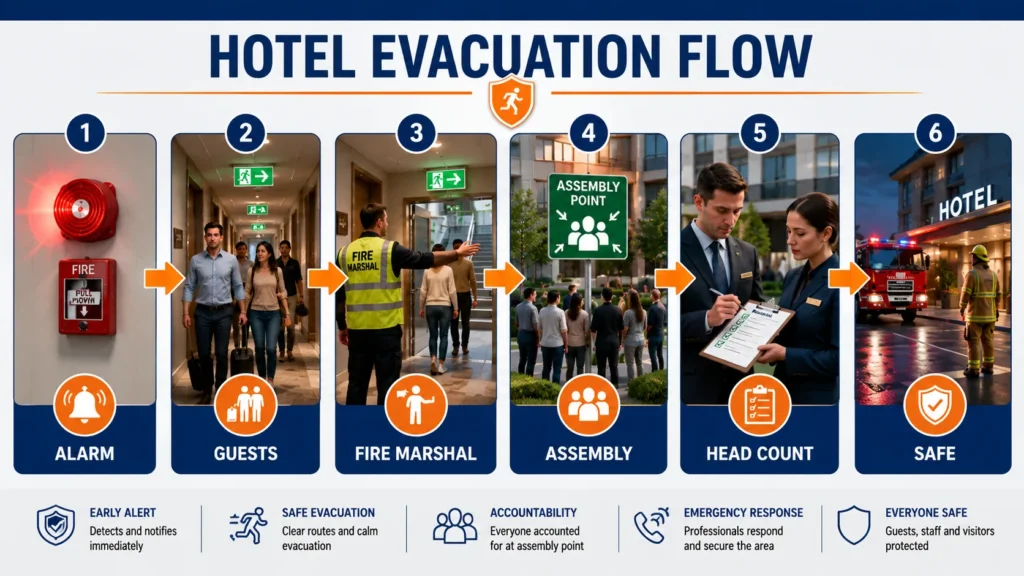
Hotel Emergency Evacuation Flow
The following workflow illustrates a typical hotel evacuation process.
Fire Alarm Activated
↓
Reception Notified
↓
Fire Marshal Responds
↓
Guests and Staff Evacuate
↓
Assembly Point
↓
Head Count and Guest Accountability
↓
Emergency Services Assessment
↓
Authorised Re-entry or Alternative Arrangements
Regular drills help ensure every stage of the evacuation process can be carried out efficiently.
Hotel Fire Safety Inspection Schedule
Routine inspections help hotels identify potential issues before they become significant safety risks. Preventive maintenance also supports legal compliance and demonstrates a proactive approach to fire safety management.
Recommended Inspection Schedule
| Inspection Activity | Recommended Frequency |
|---|---|
| Fire alarm user test | Weekly |
| Emergency lighting functional test | Monthly |
| Fire extinguisher visual inspection | Monthly |
| Fire doors inspection | Monthly |
| Emergency exit inspection | Weekly |
| Fire drills | At least every 6 months or as determined by the fire risk assessment |
| Staff refresher training | Regularly and whenever procedures change |
| Fire risk assessment review | Periodically and following significant changes, incidents, or alterations |
| Smoke detector maintenance | In accordance with manufacturer guidance and maintenance schedules |
| Sprinkler system inspection | In accordance with applicable maintenance standards |
Inspection records should be maintained accurately and reviewed as part of the hotel’s fire safety management system.
Modern Fire Safety Technologies for Hotels
Technology continues to improve the way hotels detect, monitor, and respond to fire risks. Integrating modern systems into a hotel’s fire safety strategy can enhance occupant protection while supporting operational efficiency.
Smart Fire Detection Systems
Modern detection systems can:
- Identify smoke more quickly
- Pinpoint the location of an incident
- Reduce false alarms
- Integrate with building management systems
- Provide remote monitoring
Early detection allows staff and emergency services to respond more effectively.
AI-Powered Fire Monitoring
Artificial Intelligence is increasingly being used to:
- Analyse fire risk trends
- Predict maintenance requirements
- Monitor alarm performance
- Identify recurring compliance issues
- Improve inspection planning
AI supports more proactive fire safety management.
Internet of Things (IoT) Sensors
Connected sensors can continuously monitor:
- Smoke
- Heat
- Equipment performance
- Emergency lighting
- Fire door status
Real-time monitoring enables maintenance teams to address issues before they compromise safety.
Digital Fire Safety Management
Many hotels now use digital platforms to manage:
- Fire risk assessments
- Maintenance records
- Inspection schedules
- Training records
- Compliance documentation
- Corrective actions
Digital systems improve accuracy, efficiency, and audit readiness.
Common Hotel Fire Safety Mistakes
Even well-managed hotels can experience compliance issues if fire safety is not monitored consistently. Recognising common mistakes helps reduce risk and supports continuous improvement.
Blocked Escape Routes
Escape routes should remain clear at all times.
Common obstructions include:
- Cleaning equipment
- Linen trolleys
- Storage boxes
- Waste materials
- Furniture
Routine inspections help identify and remove obstructions promptly.
Poor Housekeeping
Poor housekeeping increases fire loading and may contribute to rapid fire spread.
Hotels should regularly manage:
- Waste disposal
- Linen storage
- Cleaning chemical storage
- Kitchen cleanliness
- Plant room organisation
Good housekeeping remains one of the simplest yet most effective fire prevention measures.
Inadequate Staff Training
Employees who are unfamiliar with emergency procedures may delay evacuation or respond incorrectly during an incident.
Regular induction, refresher training, and practical fire drills are essential.
Failure to Maintain Fire Protection Systems
Neglecting routine inspections or maintenance may result in critical equipment failing during an emergency.
Hotels should maintain detailed servicing schedules and ensure all systems are inspected by competent persons where required.
Outdated Fire Risk Assessments
Fire risk assessments should evolve alongside the hotel.
Reviews should be completed following:
- Renovations
- Changes in occupancy
- New equipment installation
- Significant incidents
- Changes to legislation
An outdated assessment may no longer reflect actual risks.
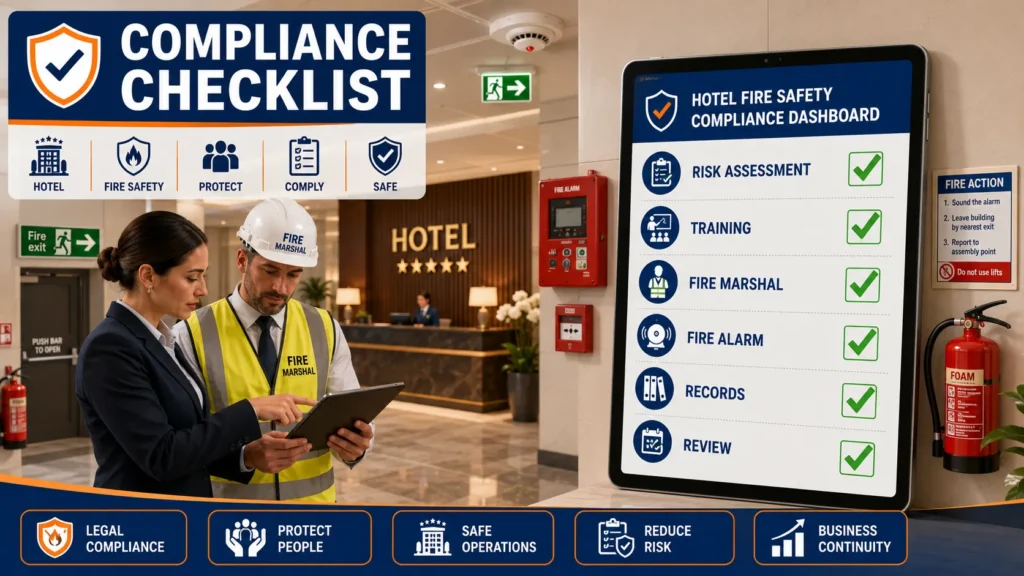
Hotel Fire Safety Compliance Checklist
A structured checklist helps hotel owners and managers verify that key elements of their fire safety management system remain effective.
| Compliance Requirement | Status |
|---|---|
| Fire risk assessment completed and reviewed | ✓ |
| Fire alarm system maintained | ✓ |
| Emergency lighting tested | ✓ |
| Fire doors inspected | ✓ |
| Escape routes kept clear | ✓ |
| Fire extinguishers serviced | ✓ |
| Fire Marshal appointed and trained | ✓ |
| Staff fire safety training completed | ✓ |
| Fire drills conducted | ✓ |
| Guest fire safety information provided | ✓ |
| Maintenance records updated | ✓ |
| Emergency evacuation plan reviewed | ✓ |
Using a checklist supports continuous compliance and helps prepare for inspections or audits.
Continue Your Fire Safety Learning with Inspire College
Developing expertise in hotel fire safety requires a combination of recognised qualifications, practical experience, and ongoing professional development. Whether you are a hotel owner, facilities manager, Fire Marshal, or aspiring fire safety specialist, further training can strengthen your competence and career prospects.
- Fire Safety Courses
- Fire Risk Assessment Training
- Diploma in Advanced Fire Safety Design
- Fire Marshal Training
Conclusion
Meeting the Fire Safety Requirements for Hotels requires a proactive and systematic approach that goes far beyond meeting minimum legal obligations. Hotels must identify and control fire hazards, conduct regular fire risk assessments, maintain fire protection systems, train employees, and develop effective emergency evacuation procedures that protect both guests and staff.
The hospitality industry presents unique challenges due to continuous operations, sleeping occupants, commercial kitchens, high occupancy levels, and diverse visitor needs. By implementing robust fire safety management systems, hotels can significantly reduce the likelihood of fire incidents while improving emergency preparedness and business resilience.
Regular inspections, staff training, competent Fire Marshals, well-maintained fire protection systems, and ongoing reviews of fire risk assessments all contribute to maintaining compliance with UK fire safety legislation. Embracing modern technologies such as smart fire detection, digital compliance systems, and AI-supported monitoring can further strengthen fire safety performance.
Whether managing a boutique hotel, luxury resort, serviced apartment, or large hospitality complex, investing in effective fire safety protects lives, safeguards property, supports legal compliance, and strengthens guest confidence. By continuously improving fire safety standards and developing staff competence through recognised training, hotel operators can create safer environments while supporting long-term operational success and sustainable business growth.