
The Critical Role of Fire Compartmentation Explained
Fire can spread through a building in just a few minutes, turning a small incident into a life-threatening emergency. While fire alarms, sprinkler systems, and extinguishers play an important role in detecting and suppressing fires, they are only one part of a comprehensive fire safety strategy. Equally important is passive fire protection, which helps contain fire and smoke before they spread throughout a building.
One of the most effective passive fire protection measures is fire compartmentation. By dividing a building into fire-resistant compartments, it slows the spread of flames, heat, and toxic smoke. This provides occupants with valuable time to evacuate safely, allows firefighters to respond more effectively, and helps minimise structural damage and business disruption.
Fire compartmentation is widely used in offices, hospitals, schools, hotels, warehouses, residential buildings, shopping centres, manufacturing facilities, and other commercial premises. It forms a critical part of modern building design and ongoing fire safety management.
Understanding how fire compartmentation works is essential for property owners, employers, facilities managers, fire risk assessors, and anyone pursuing a career in fire safety. It also supports compliance with UK fire safety legislation and helps organisations create safer environments for employees, visitors, and residents.
In this comprehensive guide, you’ll learn what fire compartmentation is, why it is critical for life safety and property protection, how it works during a fire, and why maintaining compartmentation should be a priority for every building.
What is Fire Compartmentation?
Fire compartmentation is the practice of dividing a building into smaller fire-resistant sections, known as fire compartments, using specially designed construction materials and passive fire protection systems.
Each compartment is designed to contain fire and smoke within a specific area for a defined period. Rather than allowing a fire to spread freely through an entire building, compartmentation slows its progress, protecting escape routes and limiting damage.
A fire compartment is created using a combination of fire-resistant building elements, including:
- Fire-resistant walls
- Fire-resistant floors
- Fire-resistant ceilings
- Certified fire doors
- Fire stopping systems
- Cavity barriers
- Fire-resistant glazing
- Fire dampers
- Smoke dampers
Together, these components create a complete fire-resistant barrier that helps maintain the structural integrity of the building during a fire.
Unlike active fire protection systems, which rely on activation during an emergency, fire compartmentation provides continuous protection without requiring electricity, human intervention, or mechanical operation.
Why Fire Compartmentation Is Critical
Every modern building contains potential fire hazards, including electrical equipment, combustible materials, furnishings, paper products, plastics, and storage areas. Without effective compartmentation, fire and smoke can spread rapidly through corridors, ceiling voids, service shafts, and ventilation systems.
Fire compartmentation plays a critical role because it:
- Slows the spread of flames
- Restricts smoke movement
- Protects escape routes
- Supports safe evacuation
- Reduces structural damage
- Improves firefighter access
- Protects valuable assets
- Supports business continuity
- Enhances overall building resilience
Rather than attempting to extinguish a fire, compartmentation focuses on containing it until emergency responders arrive.
Life Safety Comes First
The primary purpose of fire compartmentation is to protect people.
Most fire-related fatalities are caused not by burns but by smoke inhalation. Smoke can quickly fill corridors, stairwells, and escape routes, reducing visibility and making evacuation extremely difficult.
By restricting smoke movement, compartmentation helps maintain tenable conditions for longer, giving occupants additional time to leave the building safely.
Protecting Property and Assets
Fire can destroy equipment, documents, stock, machinery, and building infrastructure within a short period.
Effective compartmentation helps:
- Protect offices and workspaces
- Safeguard IT equipment
- Preserve manufacturing facilities
- Reduce warehouse losses
- Protect critical infrastructure
- Limit repair costs
For many organisations, containing a fire to one compartment can prevent millions of pounds in damage and reduce lengthy operational downtime.
Active Fire Protection vs Passive Fire Protection
Many people confuse active and passive fire protection systems. Although they work together, they serve different purposes.
Active fire protection systems detect, alert, or suppress fire after it has started.
Passive fire protection systems are built into the structure of the building and continuously resist the spread of fire and smoke.
Active Fire Protection vs Passive Fire Protection
| Feature | Active Fire Protection | Passive Fire Protection |
|---|---|---|
| Purpose | Detects or suppresses fire | Contains fire and smoke |
| Activation | Requires activation | Always active |
| Examples | Fire alarms, sprinklers, extinguishers | Fire compartmentation, fire doors, fire walls |
| Main Objective | Alert occupants and control fire | Prevent fire spread |
| Protects Escape Routes | Yes | Yes |
| Structural Protection | Limited | High |
Fire compartmentation forms one of the most important elements of passive fire protection because it supports every other fire safety measure within the building.
The Science Behind Fire Compartmentation
To understand why compartmentation is so effective, it is important to understand how fire behaves inside a building.
A fire develops in stages, becoming progressively more dangerous as temperatures rise and smoke accumulates.
Without fire-resistant barriers, flames, heat, and smoke naturally seek pathways through doors, ceilings, service openings, ventilation ducts, and structural voids.
Fire compartmentation interrupts this process by creating physical barriers that resist heat transfer and limit the movement of combustion products.
Heat Transfer
Fire spreads through three main methods of heat transfer:
Conduction
Heat travels directly through solid materials.
Fire-resistant construction materials slow this transfer, reducing the likelihood of adjacent compartments igniting.
Convection
Hot gases and smoke rise rapidly through ceiling spaces, stairwells, lift shafts, and service risers.
Compartment walls and fire stopping systems reduce these pathways, helping contain smoke within the affected compartment.
Radiation
Heat energy radiates from flames to nearby combustible materials.
Fire-resistant walls, glazing, and doors help reduce radiant heat exposure in neighbouring areas.
Smoke Migration
Smoke often travels much faster than flames.
It can spread through:
- Cable penetrations
- Pipe openings
- Ceiling voids
- Ventilation ducts
- Lift shafts
- Service risers
Properly installed fire stopping systems seal these openings, significantly reducing smoke migration.
Preventing Flashover
Flashover occurs when temperatures inside a compartment become so high that nearly all combustible materials ignite simultaneously.
Although flashover may still occur within the room of origin, effective compartmentation helps prevent it from spreading rapidly into neighbouring areas.
This greatly improves occupant survival and gives firefighters additional time to intervene.
How Fire Compartmentation Works
Fire compartmentation works by dividing a building into independent fire-resistant zones.
If a fire starts within one compartment, the surrounding fire-resistant construction delays its spread.
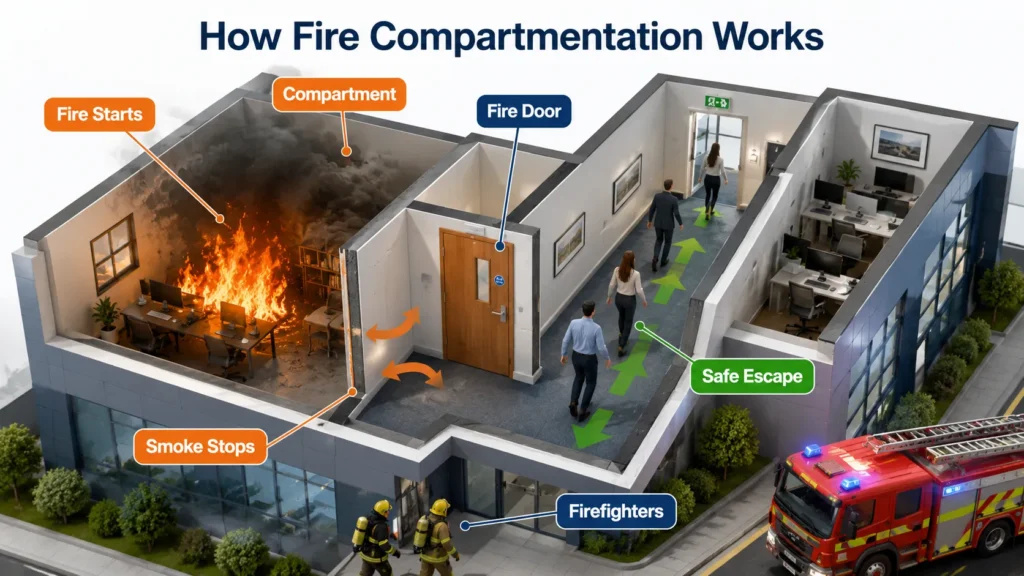
As a result:
- Fire remains confined
- Smoke movement is restricted
- Escape routes remain usable
- Occupants evacuate safely
- Emergency responders gain valuable response time
- Property damage is significantly reduced
Each compartment functions as an individual protective barrier within the overall building.
How Fire Compartmentation Protects Buildings
Fire Starts in One Room
│
▼
Fire and Smoke Begin to Spread
│
▼
Fire Compartment Walls Resist Heat
│
▼
Fire Doors Close Automatically
│
▼
Smoke Is Contained Within the Compartment
│
▼
Escape Routes Remain Protected
│
▼
Occupants Evacuate Safely
│
▼
Firefighters Control the Incident
This sequence demonstrates how passive fire protection supports both life safety and property protection throughout an emergency.
The Main Components of a Fire Compartment
Fire compartmentation is not created by a single product. It relies on multiple fire-resistant elements working together as an integrated system.
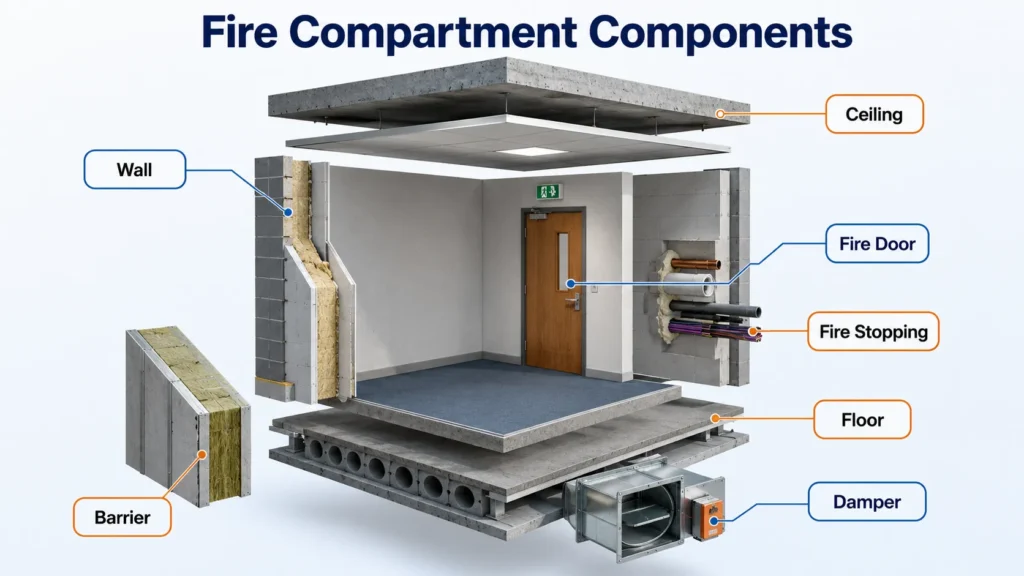
If one component fails, the effectiveness of the entire compartment may be reduced.
Fire-Resistant Walls
Compartment walls separate different areas of a building and provide resistance to fire for a specified period.
These walls are designed to prevent flames and excessive heat from passing into neighbouring compartments.
Fire-Resistant Floors
Fire can spread vertically as well as horizontally.
Compartment floors reduce the movement of fire between different storeys, helping to protect occupants above and below the affected area.
Fire-Resistant Ceilings
Ceilings help maintain compartment integrity by preventing fire from entering ceiling voids and spreading through concealed spaces.
Fire Doors
Fire doors are one of the most recognisable components of compartmentation.
When closed, they create a fire-resistant barrier within corridors, stairwells, plant rooms, and other critical locations.
Self-closing devices ensure the door returns to its closed position after use, maintaining the integrity of the compartment.
Fire Stopping Systems
Buildings contain numerous service penetrations for:
- Electrical cables
- Water pipes
- Gas pipes
- Data cabling
- Ventilation ducts
Fire stopping materials seal these openings, preventing flames and smoke from bypassing compartment walls.
Cavity Barriers
Hidden cavities within walls, ceilings, and roof spaces can allow fire to spread unnoticed.
Cavity barriers close these concealed pathways and limit unseen fire development.
Fire Dampers and Smoke Dampers
Ventilation systems can unintentionally carry fire and smoke between compartments.
Fire dampers automatically close when exposed to high temperatures, while smoke dampers help control smoke movement through HVAC systems.
Fire-Resistant Glazing
Where visibility is required, certified fire-resistant glazing provides both transparency and fire resistance.
It allows natural light and visibility without compromising compartment integrity.
Components of a Fire Compartment and Their Purpose
| Component | Primary Function | Contribution to Fire Safety |
|---|---|---|
| Fire-Resistant Walls | Divide building into compartments | Slow horizontal fire spread |
| Fire Floors | Separate storeys | Reduce vertical fire spread |
| Fire Ceilings | Protect concealed spaces | Maintain compartment integrity |
| Fire Doors | Protect openings | Control fire and smoke movement |
| Fire Stopping | Seal service penetrations | Prevent hidden fire spread |
| Cavity Barriers | Close concealed voids | Stop unseen fire development |
| Fire Dampers | Protect ventilation systems | Restrict fire through ducts |
| Smoke Dampers | Control smoke movement | Protect escape routes |
| Fire-Resistant Glazing | Maintain visibility | Resist heat and flames |
Understanding how these components interact is essential for anyone involved in fire safety, facilities management, construction, or fire risk assessment.
Fire Compartmentation vs Fire Stopping
Although the terms fire compartmentation and fire stopping are often used interchangeably, they refer to different aspects of passive fire protection.
Fire compartmentation is the overall strategy of dividing a building into fire-resistant sections. Fire stopping is one of the methods used to maintain the integrity of those compartments by sealing openings created for building services.
Think of fire compartmentation as the complete protective system, while fire stopping is one of its most important supporting components.
For example, a compartment wall may provide excellent fire resistance, but if electrical cables or pipes pass through the wall without proper sealing, fire and smoke can quickly bypass the barrier. Fire stopping restores the wall’s original fire resistance by sealing these penetrations with approved fire-resistant materials.
Fire Compartmentation vs Fire Stopping
| Feature | Fire Compartmentation | Fire Stopping |
|---|---|---|
| Purpose | Divide a building into fire-resistant compartments | Seal openings in fire-resistant elements |
| Main Objective | Contain fire and smoke within one area | Maintain the integrity of compartment walls and floors |
| Includes | Fire walls, floors, ceilings, fire doors, cavity barriers | Fire-resistant sealants, collars, wraps, pillows, boards, mortars |
| Typical Locations | Throughout the building structure | Around pipes, cables, ducts and service penetrations |
| Inspection Focus | Overall integrity of compartments | Quality and condition of penetration seals |
| Role in Fire Safety | Primary passive fire protection strategy | Essential supporting protection |
Both systems are equally important. A well-designed compartment can fail if fire stopping is missing or damaged.
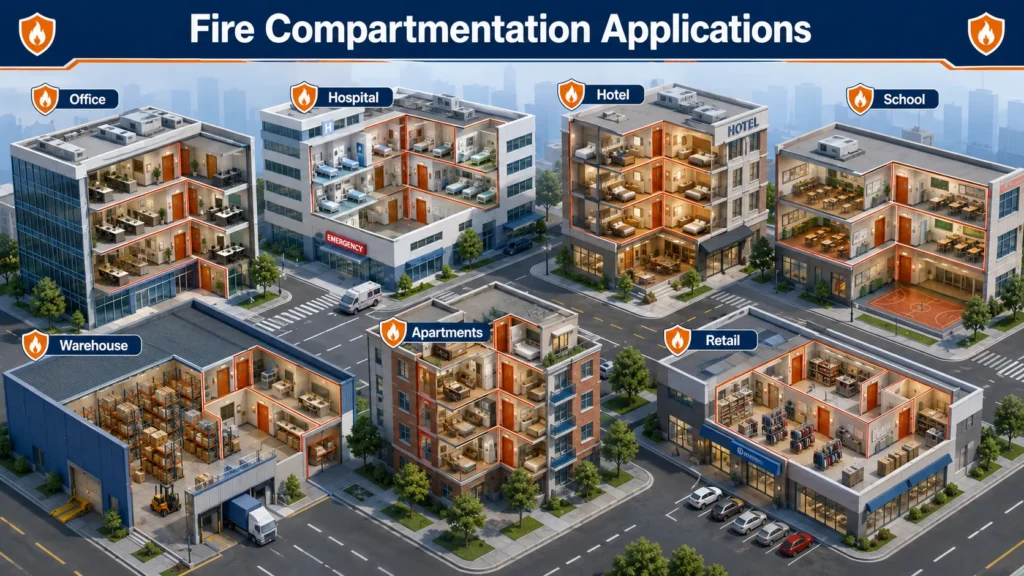
Where Fire Compartmentation Is Required
Fire compartmentation is used in almost every modern building because fire can spread quickly through occupied spaces, concealed voids, and service routes.
The level of compartmentation depends on factors such as building size, occupancy, fire risk, and intended use.
Offices
Office buildings contain electrical equipment, meeting rooms, kitchens, archives, and server rooms.
Compartmentation helps:
- Protect employees
- Preserve business operations
- Reduce equipment damage
- Keep escape routes usable
Hospitals and Healthcare Facilities
Hospitals require some of the highest levels of fire safety because many patients cannot evacuate independently.
Compartmentation supports phased evacuation by protecting:
- Wards
- Operating theatres
- Intensive care units
- Escape corridors
- Medical equipment rooms
Schools, Colleges and Universities
Educational buildings accommodate large numbers of people every day.
Compartmentation protects:
- Classrooms
- Laboratories
- Libraries
- Assembly halls
- Sports facilities
- Plant rooms
Hotels
Hotels rely heavily on compartmentation because occupants may be asleep and unfamiliar with the building layout.
Fire-resistant construction protects:
- Guest bedrooms
- Corridors
- Stairwells
- Kitchens
- Laundry rooms
- Service areas
Residential Apartment Buildings
Compartmentation helps prevent fire spreading between individual flats and communal areas.
This allows neighbouring residents additional time to evacuate safely.
Warehouses
Warehouses often store combustible materials and valuable stock.
Compartmentation helps:
- Reduce inventory losses
- Limit structural damage
- Improve firefighter access
- Reduce business interruption
Manufacturing Facilities
Factories frequently contain:
- Machinery
- Flammable liquids
- Electrical systems
- Production lines
Fire-resistant compartments reduce the likelihood of a fire spreading across the entire site.
Shopping Centres and Retail Stores
Retail environments contain high public occupancy and significant stock levels.
Compartmentation protects:
- Sales floors
- Storage rooms
- Loading bays
- Plant rooms
- Escape corridors
Data Centres
Data centres rely on compartmentation to protect:
- Servers
- Communication equipment
- Power supplies
- Cooling systems
Even a small fire can result in major operational disruption if not contained quickly.
Benefits of Effective Fire Compartmentation
A properly maintained compartmentation system provides benefits far beyond regulatory compliance.
These include:
- Improved occupant safety
- Slower fire spread
- Better smoke control
- Reduced structural damage
- Lower repair costs
- Improved business continuity
- Increased firefighter safety
- Better protection for critical assets
- Enhanced building resilience
- Greater confidence during emergency evacuation
These benefits make compartmentation one of the most valuable long-term investments in building safety.
UK Fire Safety Requirements and Fire Compartmentation
Fire compartmentation is an important element of fire safety compliance in the United Kingdom.
Several legal frameworks place responsibilities on those who own, manage, or occupy buildings to ensure that fire safety measures remain effective throughout the life of the property.
These responsibilities include maintaining passive fire protection systems, including fire compartments, fire doors, and fire stopping, so they continue to perform as intended.
In practice, building owners and responsible persons should ensure that:
- Fire-resistant walls remain intact.
- Fire doors operate correctly.
- Service penetrations are appropriately sealed.
- Fire stopping is not damaged during maintenance work.
- Compartmentation is reviewed following refurbishment or alterations.
- Records of inspections and repairs are maintained.
Rather than viewing compartmentation as a one-time construction requirement, organisations should treat it as an ongoing fire safety responsibility.
Common Fire Compartmentation Failures
Even well-designed buildings can lose their compartmentation if maintenance is neglected or alterations are carried out incorrectly.
Fire risk assessors frequently identify defects that significantly reduce the effectiveness of passive fire protection.
Unsealed Service Penetrations
One of the most common issues involves cables and pipes passing through fire-resistant walls without suitable fire stopping.
These gaps allow flames, smoke, and hot gases to spread between compartments.
Damaged Fire Doors
A fire door that:
- does not close properly,
- has damaged seals,
- contains excessive gaps,
- or has unsuitable hardware,
may no longer provide its intended fire resistance.
Ceiling Void Breaches
Maintenance work often creates openings above suspended ceilings.
If these openings are left unsealed, fire can spread unnoticed through concealed spaces.
Missing Cavity Barriers
Roof spaces and wall cavities require cavity barriers to interrupt hidden fire spread.
Missing or incorrectly installed barriers significantly increase fire risk.
Poor Fire Stopping Repairs
Temporary repairs using expanding foam, general-purpose sealants, or unsuitable materials do not provide certified fire resistance.
Only approved fire stopping systems should be used.
Unauthorised Building Alterations
Renovation work frequently compromises compartmentation.
Examples include:
- New cable routes
- Pipe installations
- Ventilation upgrades
- Structural alterations
Every alteration should preserve the original fire resistance of the compartment.
Damaged Fire-Resistant Walls
Impact damage, drilling, or poor workmanship may reduce the effectiveness of compartment walls.
Regular inspections help identify these defects before they become major safety issues.
How Fire Compartmentation Can Fail
Building Alteration
│
▼
Service Penetration Created
│
▼
Opening Left Unsealed
│
▼
Smoke and Fire Bypass Compartment
│
▼
Escape Routes Become Contaminated
│
▼
Fire Spreads to Adjacent Compartments
│
▼
Greater Risk to Occupants and Property
This illustrates why maintaining compartment integrity is just as important as installing it correctly.
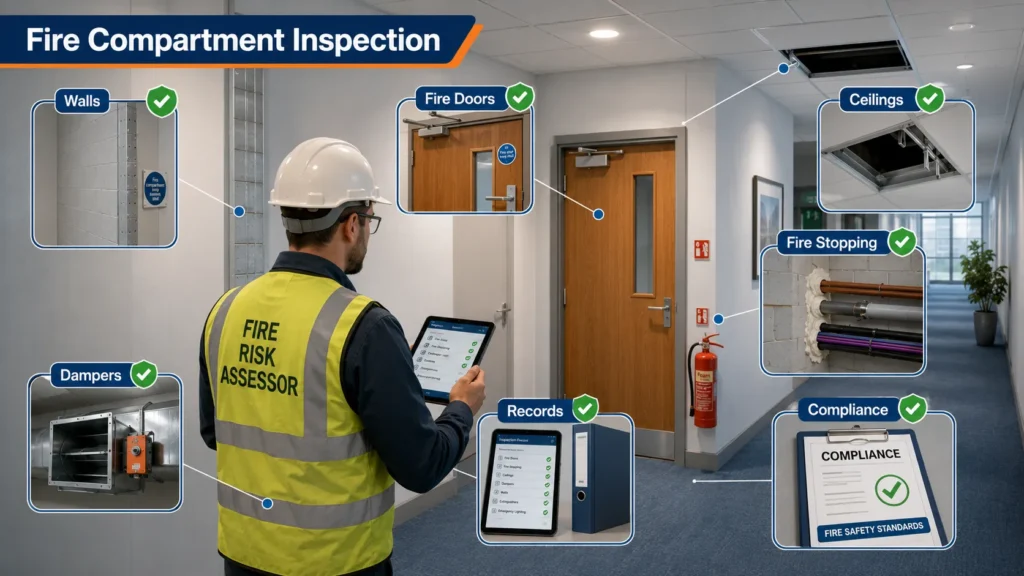
Fire Compartment Inspection Checklist
Routine inspections help ensure passive fire protection systems continue to perform effectively throughout the building’s life.
A comprehensive inspection should include every element that contributes to compartment integrity.
Walls and Partitions
✔ No cracks or damage
✔ No unauthorised openings
✔ Fire-resistant construction maintained
Fire Doors
✔ Close completely
✔ Self-closing devices function correctly
✔ Seals remain intact
✔ Hinges secure
✔ Appropriate certification present
Floors and Ceilings
✔ No unsealed penetrations
✔ Fire-resistant construction undamaged
✔ Suspended ceilings inspected where necessary
Fire Stopping
✔ Pipes sealed correctly
✔ Electrical cables protected
✔ Cable trays appropriately sealed
✔ Duct penetrations protected
Cavity Barriers
✔ Correctly installed
✔ Not removed during refurbishment
✔ No visible damage
Dampers
✔ Fire dampers inspected
✔ Smoke dampers operational
✔ Access panels available for maintenance
Documentation
✔ Inspection records updated
✔ Repairs documented
✔ Maintenance programme current
✔ Future inspections scheduled
Fire Compartment Inspection Priorities
| Inspection Area | What to Check | Potential Risk if Defective |
|---|---|---|
| Fire Walls | Cracks, damage, unauthorised openings | Fire spreads between compartments |
| Fire Doors | Closing action, seals, hinges | Smoke and flames escape |
| Fire Stopping | Penetration seals around services | Hidden fire spread |
| Cavity Barriers | Presence and condition | Fire spreads through concealed voids |
| Fire Dampers | Correct operation | Fire travels through ductwork |
| Ceilings and Floors | Structural integrity | Vertical fire spread |
| Records | Inspection and repair history | Missed defects and compliance issues |
A structured inspection programme helps organisations identify defects early, prioritise corrective actions, and maintain the effectiveness of their passive fire protection systems.
Fire Compartmentation and Fire Risk Assessments
Fire compartmentation is a fundamental element of every comprehensive fire risk assessment. While fire alarms, emergency lighting, and evacuation procedures are important, a fire risk assessment must also evaluate whether passive fire protection systems can effectively contain a fire if one occurs.
A Fire Risk Assessor examines the building to identify any weaknesses that could allow flames, heat, or smoke to spread beyond the room where a fire starts.
Typical inspection areas include:
- Fire compartment walls
- Fire-resistant floors and ceilings
- Fire doors and self-closing devices
- Fire stopping around service penetrations
- Cavity barriers
- Fire dampers and smoke dampers
- Structural damage affecting compartment integrity
- Escape routes protected by compartmentation
The assessor also considers whether building alterations have compromised compartmentation. For example, new electrical installations, plumbing work, or ventilation upgrades can unintentionally create unsealed openings that allow fire and smoke to bypass fire-resistant barriers.
Any deficiencies identified during the assessment should be documented, prioritised according to the level of risk, and addressed through appropriate remedial work.
Fire Compartmentation in the Fire Risk Assessment Process
Identify Fire Hazards
│
▼
Inspect Fire Compartments
│
▼
Check Fire Doors and Fire Stopping
│
▼
Identify Defects and Risks
│
▼
Recommend Corrective Actions
│
▼
Complete Repairs
│
▼
Review and Reinspect
This continuous cycle helps ensure that passive fire protection remains effective throughout the building’s lifecycle.
Fire Compartmentation and Business Continuity
When people think about fire safety, they often focus on life protection. However, fire compartmentation also plays a major role in protecting business operations.
A fire that spreads throughout an entire building can result in:
- Long-term business closure
- Extensive repair costs
- Loss of customer confidence
- Damage to critical equipment
- Loss of important records
- Supply chain disruption
- Reduced productivity
- Increased insurance claims
Effective compartmentation helps limit these consequences by containing the fire to its area of origin.
For example, if a fire starts in a server room but remains confined within that compartment, the rest of the office may continue operating after the affected area has been made safe. Without compartmentation, smoke and fire could spread throughout the building, forcing the entire business to close.
Business Benefits of Fire Compartmentation
Organisations that maintain effective compartmentation often benefit from:
- Reduced financial losses
- Faster recovery after fire incidents
- Lower repair and restoration costs
- Better protection of business-critical assets
- Improved resilience during emergencies
- Enhanced confidence among employees and stakeholders
Fire compartmentation is therefore not only a life safety measure but also an important part of business continuity planning.
Future Trends in Fire Compartmentation
As buildings become smarter and more complex, passive fire protection is evolving alongside new technologies. Digital tools are helping organisations manage fire compartmentation more effectively throughout a building’s lifecycle.
Building Information Modelling (BIM)
Building Information Modelling allows designers, contractors, and facilities managers to create digital models that accurately record the location and specification of fire compartments, fire doors, and fire stopping systems.
This information simplifies inspections, maintenance, and future renovations.
Digital Fire Safety Records
Many organisations now replace paper records with digital fire safety management systems.
These systems allow maintenance teams to:
- Record inspections
- Upload photographs
- Track repairs
- Monitor compliance
- Schedule future inspections
Digital records also improve communication between building owners, contractors, and fire safety professionals.
AI-Assisted Inspections
Artificial intelligence is beginning to support fire safety inspections by analysing photographs and identifying visible defects.
AI tools may assist in recognising:
- Damaged fire doors
- Missing fire stopping
- Open service penetrations
- Incomplete compartment barriers
- Maintenance trends
Although AI cannot replace professional judgement, it can improve inspection efficiency and support preventative maintenance.
Smart Building Technology
Modern buildings increasingly integrate fire safety systems with digital monitoring platforms.
Future developments may include:
- Digital compartment mapping
- Remote inspection reporting
- Intelligent maintenance scheduling
- Integrated compliance dashboards
- Real-time building safety records
These technologies will help organisations maintain safer buildings while improving regulatory compliance.
Why Fire Compartmentation Knowledge Matters for Fire Safety Careers
Fire compartmentation is one of the core subjects studied by professionals working in fire safety and building management. A strong understanding of compartmentation enables professionals to identify defects, interpret building layouts, and recommend practical improvements that protect both occupants and property.
Knowledge of passive fire protection is valuable across many industries, including construction, facilities management, housing, healthcare, education, manufacturing, and commercial property management.
Professionals who regularly work with fire compartmentation include:
- Fire Risk Assessors
- Fire Safety Advisors
- Fire Engineers
- Building Safety Managers
- Health and Safety Managers
- Facilities Managers
- Estates Managers
- Compliance Officers
- Property Managers
- Building Inspectors
- Maintenance Supervisors
- Construction Project Managers
Developing expertise in this area can enhance career progression and support organisations in maintaining safer, more resilient buildings.
Benefits of Learning About Fire Compartmentation
Whether you are entering the fire safety profession or expanding your existing knowledge, understanding compartmentation provides several advantages.
These include:
- Improved understanding of passive fire protection
- Greater confidence during fire risk assessments
- Better recognition of compartmentation defects
- Enhanced compliance awareness
- Stronger decision-making in building safety
- Increased career opportunities
- Practical knowledge applicable across multiple industries
As fire safety legislation and building standards continue to evolve, professionals with expertise in passive fire protection are becoming increasingly valuable.
Fire Safety Courses
- Fire Safety Courses
- Diploma in Advanced Fire Safety Design and Building Risk Management
- Fire Risk Assessment Training
- Fire Marshal Training
Who Benefits from Fire Compartmentation?
| Stakeholder | Key Benefits |
|---|---|
| Employees | Safer evacuation and improved workplace protection |
| Employers | Reduced operational disruption and improved resilience |
| Property Owners | Lower repair costs and better asset protection |
| Facilities Managers | Easier maintenance of passive fire protection systems |
| Landlords | Improved building safety and regulatory compliance |
| Firefighters | Safer access and more effective firefighting operations |
| Residents | Better protection in multi-occupied buildings |
| Fire Risk Assessors | More accurate evaluation of passive fire protection |
Conclusion
Fire compartmentation is one of the most effective forms of passive fire protection, yet it often receives less attention than active systems such as alarms and sprinklers. By dividing a building into fire-resistant compartments, it slows the spread of flames, heat, and smoke, protecting escape routes, preserving structural integrity, and providing valuable time for safe evacuation and emergency response.
An effective compartmentation system depends on the combined performance of fire-resistant walls, floors, ceilings, fire doors, fire stopping, cavity barriers, dampers, and fire-resistant glazing. If any one of these elements is damaged, removed, or incorrectly installed, the integrity of the entire compartment may be compromised.
Regular inspections, planned maintenance, and periodic fire risk assessments are essential to ensure these passive fire protection systems continue to perform as intended. Organisations should also recognise that refurbishment, maintenance work, and new service installations can affect compartmentation if not properly managed.
Beyond protecting lives, fire compartmentation supports business continuity by reducing property damage, safeguarding critical assets, limiting operational downtime, and helping organisations recover more quickly after a fire. As digital technologies, Building Information Modelling (BIM), and AI-assisted inspection tools become more widely adopted, managing compartmentation will become increasingly accurate and efficient.
For professionals working in fire safety, facilities management, construction, or compliance, a thorough understanding of fire compartmentation is an essential skill. It enables informed decision-making, supports legal compliance, and contributes to creating safer buildings for everyone who lives, works, studies, or visits them.
Investing in effective fire compartmentation is not simply about meeting regulatory expectations—it is a long-term commitment to protecting people, preserving property, strengthening organisational resilience, and building a safer future.