
Building Safety Act 2022 Explained for Building Owners
The Building Safety Act 2022 is one of the most significant changes to UK building legislation in decades. Introduced in response to the findings of the Grenfell Tower Inquiry and Dame Judith Hackitt’s Independent Review of Building Regulations and Fire Safety, the Act establishes a stronger regulatory framework for the design, construction, occupation, and ongoing management of higher-risk buildings. Its primary objective is to improve accountability, enhance resident safety, and ensure that building owners and those responsible for managing buildings take a proactive approach to building safety throughout a building’s lifecycle.
For building owners, landlords, managing agents, facilities managers, and property professionals, the legislation introduces new legal duties that go far beyond traditional building maintenance. Organisations must now demonstrate that building safety risks are identified, assessed, controlled, and continuously managed using accurate documentation, competent professionals, and transparent communication with residents.
Unlike previous legislation that focused primarily on fire safety or construction standards, the Building Safety Act adopts a whole-building approach. It integrates structural safety, fire safety, information management, resident engagement, and regulatory oversight into one comprehensive framework. This shift means compliance is no longer a one-time exercise completed during construction but an ongoing responsibility that continues throughout the life of a building.
Understanding the practical implications of the Act is essential for anyone responsible for residential or mixed-use buildings. Failure to comply can result in enforcement action, financial penalties, delays in occupation, reputational damage, and increased legal liability.
This comprehensive guide explains the Building Safety Act 2022 in plain English, outlines the responsibilities of building owners, clarifies the roles of the Building Safety Regulator, Accountable Person, and Principal Accountable Person, explains Higher-Risk Buildings and the Golden Thread of Information, and provides practical guidance to help organisations strengthen compliance and improve long-term building safety.
What is the Building Safety Act 2022?
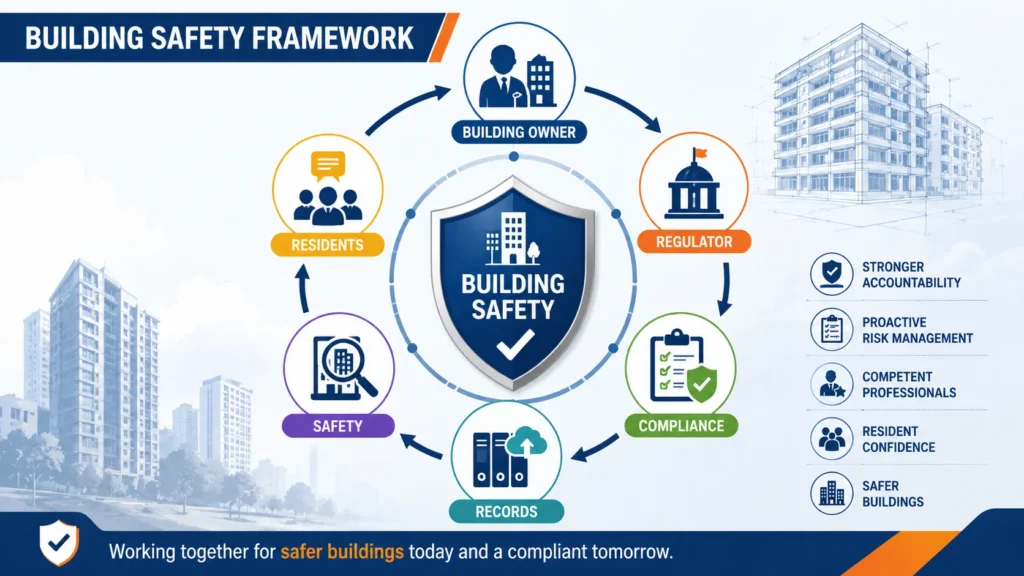
The Building Safety Act 2022 is a major piece of UK legislation designed to improve the safety of buildings, particularly higher-risk residential buildings. It establishes a new regulatory system that places greater responsibility on those who design, construct, own, manage, and maintain buildings.
The legislation aims to create a culture in which safety is considered throughout every stage of a building’s lifecycle rather than focusing solely on construction or reactive maintenance.
The Act introduces several important changes, including:
- A new Building Safety Regulator.
- Enhanced oversight of Higher-Risk Buildings.
- Clearly defined legal responsibilities.
- New competency requirements.
- Stronger resident engagement.
- Improved building information management.
- The Golden Thread of Information.
- Safety Case Reports.
- Greater accountability for building owners.
Rather than replacing existing fire safety legislation, the Building Safety Act works alongside laws such as the Regulatory Reform (Fire Safety) Order 2005 and the Fire Safety Act 2021 to create a more integrated building safety framework.
Why was the Building Safety Act Introduced?
The introduction of the Building Safety Act was driven by the need to restore public confidence in the safety of residential buildings following the Grenfell Tower fire in 2017.
The tragedy highlighted weaknesses across several areas, including:
- Poor building design.
- Inadequate fire safety measures.
- Insufficient regulatory oversight.
- Weak accountability.
- Poor record management.
- Limited resident involvement.
- Inconsistent competency standards.
Following the incident, the Independent Review of Building Regulations and Fire Safety, led by Dame Judith Hackitt, identified the need for fundamental reform rather than isolated improvements.
The review concluded that the existing regulatory system lacked clear accountability and encouraged a fragmented approach to managing building safety. The Building Safety Act addresses these concerns by introducing stronger governance, clearer responsibilities, and continuous monitoring throughout a building’s lifecycle.
Objectives of the Building Safety Act
The legislation seeks to achieve several long-term objectives.
These include:
- Improving resident safety.
- Strengthening accountability.
- Enhancing competence across the construction and property sectors.
- Promoting better building information management.
- Encouraging proactive risk management.
- Supporting continuous compliance.
- Increasing transparency.
- Improving public confidence.
Rather than reacting to safety failures after they occur, the legislation encourages organisations to identify and manage risks before they become significant.
Who does the Building Safety Act Apply To?
Although much attention focuses on Higher-Risk Buildings, the principles introduced by the Building Safety Act influence a much wider range of organisations involved in the built environment.
Depending on the type of building and stage of its lifecycle, the legislation may affect:
- Building owners.
- Landlords.
- Property management companies.
- Facilities managers.
- Housing associations.
- Developers.
- Principal Designers.
- Principal Contractors.
- Architects.
- Engineers.
- Fire safety professionals.
- Building control professionals.
- Contractors.
- Resident management companies.
Each stakeholder has different legal responsibilities, but all contribute to creating safer buildings through effective planning, construction, maintenance, and management.
Why Building Owners Should Pay Particular Attention
Building owners occupy a central position within the new regulatory framework because they are often responsible for ensuring that safety arrangements remain effective after construction has been completed.
Their responsibilities may include:
- Maintaining building safety systems.
- Managing fire and structural risks.
- Keeping accurate safety records.
- Appointing competent professionals.
- Supporting resident engagement.
- Cooperating with regulators.
- Monitoring ongoing compliance.
Building owners therefore play a vital role in ensuring that safety remains a continuous priority rather than a one-off compliance exercise.
Understanding Higher-Risk Buildings
One of the most important concepts introduced by the Building Safety Act is the Higher-Risk Building (HRB).
Higher-Risk Buildings are subject to additional legal duties because they present greater potential consequences if building safety risks are not effectively managed.
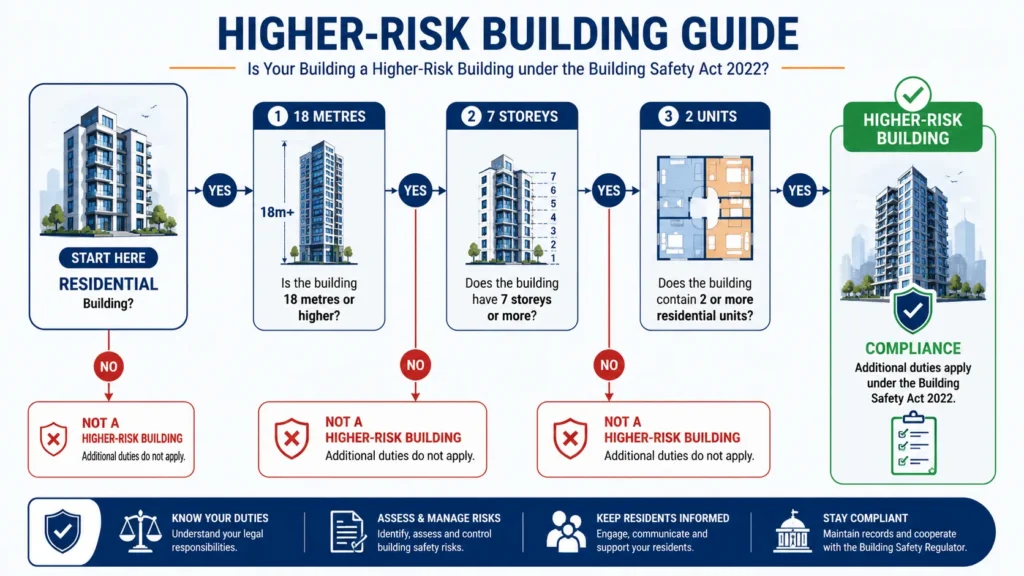
In England, a Higher-Risk Building generally refers to a building that:
- Is at least 18 metres in height or has seven or more storeys, and
- Contains at least two residential units.
Examples include:
- High-rise apartment buildings.
- Residential tower blocks.
- Student accommodation meeting the criteria.
- Some mixed-use developments with residential accommodation.
Certain buildings, such as hospitals and care homes, may be subject to different regulatory arrangements depending on the applicable legislation.
How to Identify a Higher-Risk Building
The following flowchart provides a simple overview of the decision-making process.
Residential Building?
│
Yes
│
▼
18 Metres or
7+ Storeys?
│
Yes
│
▼
Two or More
Residential Units?
│
Yes
│
▼
Higher-Risk Building
Additional Legal Duties Apply
Understanding whether a building falls within this category is essential because additional registration, safety management, and reporting obligations may apply.
Key Building Safety Terms Every Building Owner Should Know
The Building Safety Act introduces several new legal concepts that may be unfamiliar to many property owners and managers. Understanding these terms helps organisations navigate their responsibilities more effectively.
| Term | Meaning | Why It Matters |
|---|---|---|
| Building Safety Regulator | The national regulator responsible for overseeing building safety in England | Ensures compliance, regulates Higher-Risk Buildings, and monitors safety standards |
| Higher-Risk Building (HRB) | A residential building meeting specified height and occupancy criteria | Subject to additional legal duties under the Act |
| Accountable Person | Individual or organisation responsible for managing building safety risks | Must assess and control fire and structural safety risks |
| Principal Accountable Person | The main organisation responsible where multiple Accountable Persons exist | Coordinates overall building safety management |
| Golden Thread of Information | Accurate digital information maintained throughout the building lifecycle | Supports informed safety decisions and regulatory compliance |
| Safety Case Report | Evidence demonstrating how building safety risks are managed | Required for Higher-Risk Buildings to support regulatory oversight |
| Resident Engagement Strategy | Plan for involving residents in building safety matters | Encourages transparency, communication, and shared responsibility |
| Duty Holders | Individuals responsible for building safety during design and construction | Ensure competence and compliance throughout project delivery |
Understanding these terms provides a strong foundation for interpreting the practical requirements introduced by the legislation.
Why the Building Safety Act Represents a New Approach to Compliance
Previous legislation often focused on meeting minimum regulatory standards at specific stages of a project’s lifecycle. The Building Safety Act shifts this approach by requiring organisations to demonstrate continuous accountability.
Instead of asking whether a building was compliant when it was constructed, the legislation asks whether it remains safe today and whether sufficient evidence exists to prove that risks are being actively managed.
This represents a significant cultural change for the property sector. Compliance is no longer based solely on inspections or certificates but on ongoing risk management, accurate information, competent decision-making, and continuous improvement.
For building owners, adopting this mindset is essential. Maintaining up-to-date records, reviewing risks regularly, engaging with residents, and working with competent professionals are now integral parts of responsible building management rather than optional administrative tasks.
Practical Responsibilities of Building Owners Under the Building Safety Act 2022
The Building Safety Act 2022 places building owners at the centre of long-term building safety management. Rather than focusing solely on construction or maintenance, the legislation requires owners to adopt a proactive, evidence-based approach that demonstrates risks are continuously identified, assessed, controlled, and reviewed.
Building owners should view compliance as an ongoing management process rather than a one-time legal obligation.
In practice, this means ensuring that:
- Building safety risks are regularly assessed.
- Competent professionals are appointed.
- Safety information remains accurate.
- Residents receive appropriate information.
- Maintenance activities are documented.
- Safety improvements are implemented promptly.
- Compliance is regularly reviewed.
By embedding these activities into everyday operations, organisations can improve both regulatory compliance and overall building resilience.
Maintain Safe Building Systems
Owners should ensure all life safety systems remain fully operational throughout the building’s lifecycle.
This includes:
- Fire alarm systems.
- Emergency lighting.
- Fire doors.
- Smoke control systems.
- Fire stopping.
- Sprinkler systems.
- Structural safety measures.
- Emergency escape routes.
Routine inspections, testing, servicing, and maintenance should be supported by accurate records.
Keep Accurate Building Information
One of the biggest changes introduced by the Act is the expectation that building information remains accurate throughout the building’s life.
Examples include:
- Building drawings.
- Structural information.
- Fire safety strategies.
- Maintenance history.
- Inspection reports.
- Alteration records.
- Safety certificates.
- Resident information.
Accurate information enables informed decisions and supports effective risk management.
Monitor Building Safety Risks
Building safety risks evolve over time.
Owners should regularly review:
- Fire hazards.
- Structural defects.
- Building alterations.
- Occupancy changes.
- Contractor activities.
- Equipment failures.
- Resident concerns.
Early identification reduces the likelihood of significant safety failures.
Appoint Competent Professionals
Competence is a recurring theme throughout the Building Safety Act.
Owners should engage appropriately qualified professionals for activities such as:
- Fire Risk Assessments.
- Structural inspections.
- Building surveys.
- Fire engineering.
- Fire door inspections.
- Building maintenance.
- Safety audits.
Selecting competent professionals helps ensure decisions are based on sound technical expertise.
Understanding the Building Safety Regulator
The Building Safety Regulator (BSR) was established to improve standards across the built environment and oversee the implementation of the Building Safety Act in England.
The Regulator operates within the Health and Safety Executive (HSE) and plays a central role in promoting safer buildings.
Its responsibilities include:
- Regulating Higher-Risk Buildings.
- Overseeing the new building control regime.
- Improving professional competence.
- Monitoring compliance.
- Supporting enforcement.
- Promoting consistent standards across the industry.
Rather than inspecting every building directly, the Building Safety Regulator establishes the regulatory framework that organisations must follow.
Why the Building Safety Regulator Matters
The introduction of the Building Safety Regulator represents a shift from reactive enforcement towards proactive oversight.
Its objectives include:
- Improving accountability.
- Reducing regulatory gaps.
- Strengthening public confidence.
- Encouraging continuous improvement.
- Supporting safer building management.
For building owners, this means maintaining ongoing compliance rather than preparing only when inspections occur.
Accountable Person Explained
The Building Safety Act introduces the legal concept of the Accountable Person.
An Accountable Person is generally the individual or organisation responsible for repairing or maintaining the common parts of a Higher-Risk Building.
Depending on ownership arrangements, this may include:
- Building owners.
- Freeholders.
- Management companies.
- Resident management organisations.
- Housing associations.
The Accountable Person has legal responsibility for managing building safety risks associated with:
- Fire.
- Structural failure.
Their responsibilities extend beyond maintenance to include planning, documentation, communication, and continual improvement.
Responsibilities of the Accountable Person
An Accountable Person should:
- Assess building safety risks.
- Implement control measures.
- Maintain the Golden Thread.
- Prepare Safety Case Reports.
- Cooperate with regulators.
- Keep residents informed.
- Monitor building safety performance.
- Maintain compliance documentation.
Principal Accountable Person Explained
Some buildings have multiple organisations responsible for different parts of the premises.
In these situations, one organisation becomes the Principal Accountable Person (PAP).
The Principal Accountable Person coordinates building safety management across the entire building.
Typical responsibilities include:
- Coordinating multiple Accountable Persons.
- Managing resident engagement.
- Maintaining the Safety Case Report.
- Registering Higher-Risk Buildings.
- Liaising with the Building Safety Regulator.
- Maintaining the Golden Thread.
This role ensures building safety responsibilities remain coordinated rather than fragmented.
Understanding Duty Holders
The Building Safety Act also strengthens the responsibilities of Duty Holders during design and construction.
Duty Holders include:
- Client.
- Principal Designer.
- Designers.
- Principal Contractor.
- Contractors.
Each Duty Holder has legal responsibilities relating to competence, planning, communication, and risk management.
Their role is to ensure safety is considered from the earliest stages of a project rather than being addressed after construction has finished.
Stakeholder Responsibilities Under the Building Safety Act
| Stakeholder | Primary Responsibility | Key Compliance Duties |
|---|---|---|
| Building Owner | Overall building management | Maintain safety systems, appoint competent professionals, ensure compliance |
| Accountable Person | Manage building safety risks | Assess risks, maintain documentation, prepare Safety Case Reports |
| Principal Accountable Person | Coordinate building safety | Register Higher-Risk Buildings, manage Golden Thread, oversee resident engagement |
| Principal Designer | Safe building design | Eliminate foreseeable risks during design |
| Principal Contractor | Safe construction | Coordinate safe construction activities |
| Contractors | Competent workmanship | Complete work safely and provide accurate records |
| Building Safety Regulator | Regulatory oversight | Monitor compliance and improve industry standards |
| Residents | Participate in safety | Report concerns and follow building safety procedures |
Understanding these responsibilities helps reduce confusion and promotes effective collaboration between all parties.
The Golden Thread of Information Explained
One of the most important innovations introduced by the Building Safety Act is the Golden Thread of Information.
Rather than storing building information in disconnected paper files or multiple databases, organisations must maintain accurate, accessible, and up-to-date digital information throughout the building’s lifecycle.
The Golden Thread supports informed decision-making by ensuring everyone involved has access to reliable building information.
What Information Should the Golden Thread Include?
Examples include:
- Building design information.
- Structural drawings.
- Fire safety strategies.
- Construction records.
- Product specifications.
- Maintenance history.
- Inspection reports.
- Alteration records.
- Fire Risk Assessments.
- Safety Case Reports.
- Resident safety information.
- Emergency procedures.
Maintaining accurate information helps organisations understand how safety decisions affect the building over time.
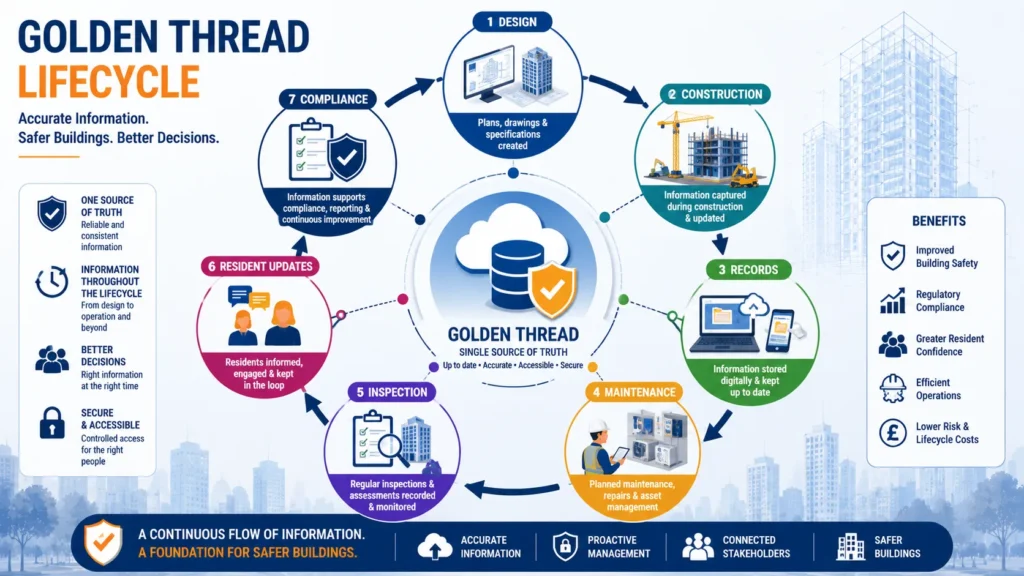
Golden Thread of Information Lifecycle
Planning
│
▼
Design
│
▼
Construction
│
▼
Building Information
Created
│
▼
Golden Thread
Maintained
│
▼
Maintenance
Updates
│
▼
Safety
Inspections
│
▼
Resident
Information
│
▼
Continuous
Compliance
This lifecycle demonstrates that building information is never static. It evolves as the building changes, ensuring decisions are always based on accurate and current data.
Safety Case Reports Explained
Another significant requirement for Higher-Risk Buildings is the preparation of a Safety Case Report.
A Safety Case Report provides evidence that building safety risks have been identified, assessed, and appropriately managed.
Rather than acting as a simple compliance document, it demonstrates that the Accountable Person understands the building’s risks and has implemented suitable control measures.
Typical Contents of a Safety Case Report
A comprehensive report may include:
- Building description.
- Fire safety strategy.
- Structural safety information.
- Risk assessments.
- Hazard identification.
- Control measures.
- Maintenance arrangements.
- Inspection records.
- Emergency procedures.
- Resident engagement activities.
- Review processes.
The report should evolve alongside the building and be updated whenever significant changes occur.
Why Resident Engagement Is Essential
Building safety is most effective when residents understand both the risks and the measures in place to manage them.
The Building Safety Act therefore encourages meaningful communication between building owners and occupants.
A strong Resident Engagement Strategy should:
- Explain safety arrangements clearly.
- Encourage residents to report concerns.
- Provide updates on significant works.
- Share emergency procedures.
- Promote cooperation during inspections and maintenance.
Engaged residents are more likely to identify hazards early, follow emergency procedures correctly, and contribute positively to the overall safety culture of the building.
Building Safety as a Continuous Process
One of the most important principles introduced by the Building Safety Act is that compliance does not end when construction is complete or when a building receives approval for occupation.
Building owners should establish management systems that support:
- Regular inspections.
- Continuous maintenance.
- Accurate documentation.
- Competent decision-making.
- Resident communication.
- Ongoing review of building safety risks.
- Continuous improvement.
This lifecycle approach helps organisations remain compliant while protecting residents, visitors, contractors, and the long-term value of the building.
Building Safety Act 2022 vs Fire Safety Act 2021
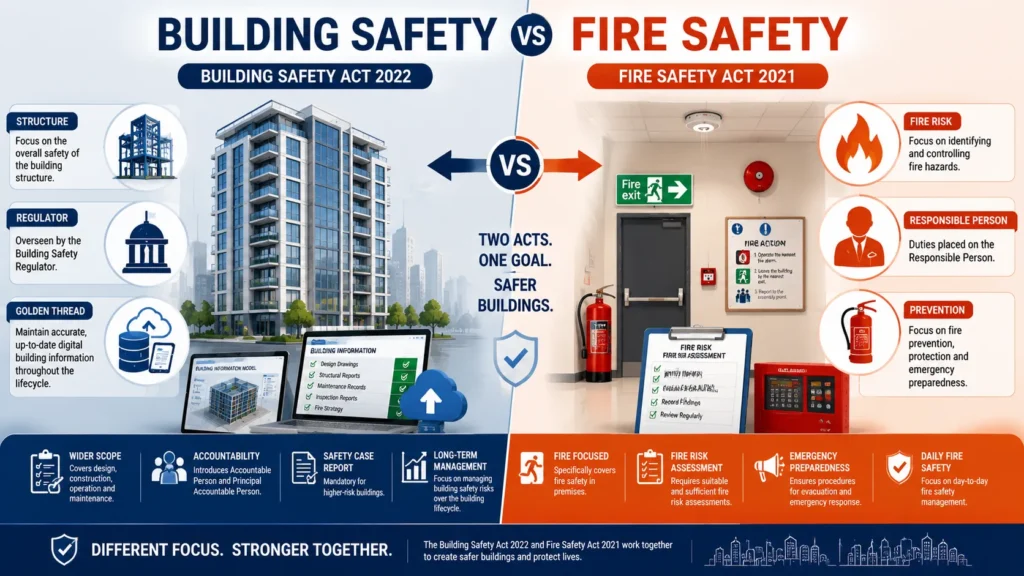
Many building owners assume the Building Safety Act 2022 and the Fire Safety Act 2021 are the same legislation. Although both were introduced to improve building safety following the Grenfell Tower tragedy, they have different purposes and legal requirements.
The Fire Safety Act 2021 strengthens fire safety legislation by clarifying that external walls, balconies, flat entrance doors, and other building structures must be considered within fire risk assessments for multi-occupied residential buildings.
The Building Safety Act 2022 introduces a much broader regulatory framework covering building safety management, accountability, resident engagement, competence, information management, and oversight of Higher-Risk Buildings throughout their entire lifecycle.
Together, these Acts complement one another and should be viewed as part of a comprehensive building safety strategy rather than separate compliance requirements.
Building Safety Act 2022 vs Fire Safety Act 2021
| Building Safety Act 2022 | Fire Safety Act 2021 |
|---|---|
| Covers overall building safety management | Focuses primarily on fire safety risks |
| Applies enhanced duties to Higher-Risk Buildings | Clarifies fire safety responsibilities for multi-occupied residential buildings |
| Introduces the Building Safety Regulator | Enforced mainly through Fire and Rescue Authorities |
| Introduces Accountable Person and Principal Accountable Person | Reinforces the responsibilities of the Responsible Person |
| Requires the Golden Thread of Information | Requires comprehensive Fire Risk Assessments |
| Introduces Safety Case Reports | Focuses on identifying and managing fire hazards |
| Promotes resident engagement throughout the building lifecycle | Supports fire prevention and emergency preparedness |
| Covers design, construction, occupation, maintenance, and refurbishment | Primarily addresses fire safety during occupation |
Understanding the relationship between these two Acts helps building owners develop a coordinated approach to compliance instead of managing each legal requirement independently.
Common Building Safety Compliance Mistakes
Many organisations invest heavily in physical safety improvements but overlook management processes that demonstrate compliance. The following mistakes are commonly identified during regulatory reviews and internal audits.
Treating Compliance as a One-Off Exercise
Building safety should be reviewed continuously rather than only before inspections or regulatory deadlines.
Poor Information Management
Common issues include:
- Outdated building drawings.
- Missing maintenance records.
- Incomplete inspection reports.
- Multiple versions of important documents.
- Poor document control.
Accurate information supports better decision-making throughout the building’s lifecycle.
Inadequate Resident Communication
Residents should understand:
- Emergency procedures.
- Planned maintenance.
- Building safety improvements.
- Reporting procedures.
- Building safety responsibilities.
Limited communication often results in reduced confidence and missed opportunities to identify emerging risks.
Failure to Maintain the Golden Thread
Many organisations create building information during construction but fail to update it following refurbishments, maintenance work, or changes in occupancy.
Maintaining accurate information is one of the key principles of the Building Safety Act.
Competency Gaps
Building safety depends upon competent professionals making informed decisions.
Organisations should ensure contractors, designers, surveyors, facilities managers, and fire safety professionals possess appropriate qualifications, knowledge, and experience.
Delayed Corrective Actions
Inspections frequently identify improvements that remain unresolved for extended periods.
Every identified action should be:
- Assigned.
- Prioritised.
- Monitored.
- Completed.
- Verified.
Prompt action demonstrates effective safety management.
Building Safety Compliance Checklist
Building owners can use the following checklist to review their compliance arrangements.
| Compliance Activity | Complete | Review Current |
|---|---|---|
| Identify whether the building is Higher-Risk | ✓ / ✗ | ✓ / ✗ |
| Register Higher-Risk Building (where applicable) | ✓ / ✗ | ✓ / ✗ |
| Appoint Accountable Person | ✓ / ✗ | ✓ / ✗ |
| Appoint Principal Accountable Person (if required) | ✓ / ✗ | ✓ / ✗ |
| Maintain Golden Thread Information | ✓ / ✗ | ✓ / ✗ |
| Complete Fire Risk Assessment | ✓ / ✗ | ✓ / ✗ |
| Prepare Safety Case Report | ✓ / ✗ | ✓ / ✗ |
| Maintain Resident Engagement Strategy | ✓ / ✗ | ✓ / ✗ |
| Conduct Regular Safety Inspections | ✓ / ✗ | ✓ / ✗ |
| Maintain Building Safety Records | ✓ / ✗ | ✓ / ✗ |
| Review Emergency Procedures | ✓ / ✗ | ✓ / ✗ |
| Verify Contractor Competence | ✓ / ✗ | ✓ / ✗ |
| Review Compliance Annually | ✓ / ✗ | ✓ / ✗ |
Using this checklist regularly helps organisations identify compliance gaps before they become regulatory issues.
Building Safety Act Timeline
Understanding how UK building safety legislation has evolved helps building owners appreciate why the current regulatory framework places greater emphasis on accountability and continuous compliance.
2017
Grenfell Tower Fire
│
▼
2018
Hackitt Review
│
▼
2021
Fire Safety Act
│
▼
2022
Building Safety Act
│
▼
2023
New Duty Holder
Regulations
│
▼
2024
Higher-Risk Building
Occupation Regime
│
▼
Ongoing
Continuous Building
Safety Compliance
The timeline illustrates that building safety legislation continues to evolve. Organisations should therefore review regulatory updates regularly rather than relying solely on historical compliance arrangements.
Benefits of Complying with the Building Safety Act
Although compliance requires time, investment, and effective management, the long-term benefits extend far beyond meeting legal obligations.
Building owners that implement robust building safety systems are more likely to achieve:
- Improved resident safety.
- Better fire and structural risk management.
- Greater regulatory confidence.
- Stronger business reputation.
- Reduced legal liability.
- Better insurance outcomes.
- Improved building asset value.
- Enhanced operational efficiency.
- Stronger documentation and record management.
- Better communication between stakeholders.
A proactive approach to compliance also supports long-term sustainability by reducing the likelihood of major safety incidents and promoting continual improvement.
Continue Your Building Safety Journey with Inspire College
Understanding the Building Safety Act is only one aspect of effective building safety management. Organisations also benefit from developing competent professionals who understand legislation, fire safety, risk assessment, compliance, and health and safety management.
Inspire College offers industry-relevant qualifications that help individuals build the knowledge and practical skills needed to meet modern building safety responsibilities.
| Course | How It Supports Inspection Readiness |
|---|---|
| Fire Safety Courses | Develops knowledge of workplace fire prevention and legal responsibilities |
| Level 4 Certificate in Fire Risk Assessment | Develops practical skills for conducting and reviewing fire risk assessments |
| Fire Marshal Training | Prepares employees to manage evacuations and emergency response effectively |
Why Continuous Professional Development Matters
Building safety legislation, standards, and industry best practices continue to evolve. Ongoing professional development helps building owners, facilities managers, and safety professionals remain informed about regulatory changes, emerging risks, and improved management techniques.
Investing in accredited training can help organisations:
- Improve legal compliance.
- Strengthen competence.
- Enhance decision-making.
- Reduce operational risk.
- Support career progression.
- Foster a proactive safety culture.
By developing knowledgeable professionals, organisations are better equipped to meet both current and future building safety challenges.
Conclusion
The Building Safety Act 2022 represents a major shift in how building safety is managed across England. Rather than concentrating solely on construction standards or periodic inspections, the legislation establishes a continuous framework of accountability that extends throughout the entire lifecycle of a building.
For building owners, compliance now means far more than maintaining physical assets. It requires effective governance, accurate information management, meaningful resident engagement, competent professionals, and a commitment to continually identifying and controlling building safety risks.
By understanding the responsibilities of the Building Safety Regulator, Accountable Person, Principal Accountable Person, and Duty Holders, organisations can develop stronger compliance systems that protect residents, reduce legal risk, and support long-term operational resilience.
Whether managing a Higher-Risk Building or preparing for future regulatory changes, adopting a proactive approach to building safety will help create safer environments, improve stakeholder confidence, and demonstrate responsible ownership.
Building safety is not a single project or regulatory milestone—it is an ongoing commitment to protecting people, preserving buildings, and ensuring compliance throughout every stage of the building lifecycle.