
Regulatory Reform (Fire Safety) Order 2005 Explained
Fire safety is a legal responsibility that every business, employer, landlord, and building owner must take seriously. A workplace fire can lead to devastating consequences, including injuries, loss of life, property damage, business interruption, financial losses, and legal action. To reduce these risks, the UK introduced the Regulatory Reform (Fire Safety) Order 2005, which remains the cornerstone of fire safety legislation for non-domestic premises in England and Wales.
The Regulatory Reform (Fire Safety) Order 2005 replaced several previous fire safety laws with a single risk-based approach that places responsibility on those who control premises. Instead of relying solely on inspections by fire authorities, businesses are expected to proactively identify fire hazards, assess risks, implement suitable fire precautions, and continuously review their fire safety arrangements.
Whether you operate an office, retail store, warehouse, hotel, healthcare facility, educational institution, manufacturing plant, or construction site, understanding the Regulatory Reform (Fire Safety) Order 2005 is essential for protecting people and ensuring legal compliance.
This comprehensive guide explains the legislation in plain English, outlines who must comply, explores the duties of the Responsible Person, explains fire risk assessments, compares the Order with newer legislation such as the Fire Safety Act 2021, and provides practical guidance to help businesses build a safer workplace.
What is the Regulatory Reform (Fire Safety) Order 2005?
The Regulatory Reform (Fire Safety) Order 2005 (commonly known as the Fire Safety Order or RRO 2005) is the primary fire safety legislation governing most non-domestic premises in England and Wales.
It came into force on 1 October 2006 and introduced a modern, risk-based approach to fire safety management.
Rather than requiring businesses to obtain traditional fire certificates, the legislation places legal responsibility on those who control premises to identify fire hazards, assess risks, implement suitable fire safety measures, and protect everyone who may be affected by a fire.
The Order applies to almost every workplace and many shared areas of residential buildings.
Its main objectives are to:
- Protect life from fire.
- Reduce the likelihood of fire incidents.
- Improve workplace fire safety.
- Clarify legal responsibilities.
- Promote proactive fire risk management.
- Encourage continuous improvement.
The legislation recognises that every workplace is different, meaning fire safety measures should be based on the specific risks associated with each building rather than applying a one-size-fits-all approach.
Why was the Regulatory Reform (Fire Safety) Order 2005 Introduced?
Before the introduction of the Regulatory Reform (Fire Safety) Order 2005, UK fire safety legislation consisted of numerous overlapping regulations and certification systems that were often difficult for businesses to understand and administer.
Many premises required fire certificates, while others were regulated under different legislation, creating inconsistency and unnecessary complexity.
The Fire Safety Order was introduced to simplify the legal framework by replacing more than 100 separate pieces of fire safety legislation with one unified system.
The new approach shifted responsibility away from fire authorities and placed greater accountability on employers, building owners, and other duty holders.
The legislation encourages organisations to:
- Identify hazards before fires occur.
- Assess risks systematically.
- Implement appropriate fire precautions.
- Train employees.
- Maintain fire safety equipment.
- Continuously review fire safety arrangements.
This proactive approach has become the foundation of modern workplace fire safety management throughout England and Wales.
Timeline of UK Fire Safety Legislation
Understanding the development of UK fire safety legislation helps explain why the Regulatory Reform (Fire Safety) Order 2005 remains central to workplace fire safety today.
| Year | Legislative Development | Significance |
|---|---|---|
| Before 2005 | Fire Precautions Act and other legislation | Multiple fire safety laws and fire certificate system |
| 2005 | Regulatory Reform (Fire Safety) Order 2005 | Introduced a unified risk-based fire safety framework |
| 2006 | Fire Safety Order came into force | Responsible Persons assumed legal duties |
| 2017 | Grenfell Tower Fire | Triggered national review of building and fire safety |
| 2021 | Fire Safety Act 2021 | Clarified the scope of fire risk assessments in certain buildings |
| 2022 | Fire Safety (England) Regulations | Introduced additional responsibilities for specific residential buildings |
| Ongoing | Building Safety Reforms | Continued improvements to fire safety legislation and compliance |
This timeline demonstrates how UK fire safety law has evolved from a reactive certification system to a proactive risk management approach focused on protecting people and improving building safety.
What does the Regulatory Reform (Fire Safety) Order 2005 Aim to Achieve?
The Fire Safety Order is designed to ensure that organisations take responsibility for managing fire risks instead of relying solely on external inspections.
Its key aims include:
- Preventing fires.
- Protecting employees and the public.
- Improving emergency preparedness.
- Encouraging effective fire risk assessments.
- Supporting safe building management.
- Promoting continuous fire safety improvement.
- Strengthening legal accountability.
- Reducing injuries and fatalities caused by fire.
Rather than prescribing identical fire precautions for every workplace, the legislation allows organisations to implement measures that reflect the specific risks associated with their premises.
Does the Regulatory Reform (Fire Safety) Order 2005 Apply to My Business?
One of the most common questions businesses ask is whether the Regulatory Reform (Fire Safety) Order 2005 applies to their premises.
In most cases, the answer is yes.
The legislation applies to almost all non-domestic premises, regardless of the size of the organisation.
Examples include:
- Offices.
- Retail stores.
- Shopping centres.
- Restaurants.
- Cafés.
- Hotels.
- Warehouses.
- Factories.
- Manufacturing facilities.
- Schools.
- Colleges.
- Universities.
- Hospitals.
- Care homes.
- Leisure facilities.
- Community centres.
- Construction site offices.
- Shared areas of residential buildings.
Whether your organisation employs two people or several thousand, fire safety responsibilities remain an essential legal obligation.
Which Premises Are Covered by the Fire Safety Order?
The Regulatory Reform (Fire Safety) Order 2005 applies to a wide variety of premises where people work, visit, or access shared facilities.
Commercial Offices
Office buildings require effective fire detection systems, emergency evacuation procedures, escape routes, and staff training.
Retail Premises
Retail stores must protect employees and customers through suitable fire precautions, clear escape routes, and emergency planning.
Hospitality Businesses
Hotels, restaurants, pubs, cafés, and entertainment venues often accommodate large numbers of people and therefore require comprehensive fire safety management.
Educational Institutions
Schools, colleges, universities, and training providers should maintain fire risk assessments, emergency evacuation procedures, and regular fire drills.
Healthcare Facilities
Hospitals, clinics, surgeries, and care homes require specialised evacuation planning because many occupants may require assistance during emergencies.
Warehouses and Distribution Centres
Large storage facilities present unique fire risks associated with combustible goods, forklift operations, battery charging, and extensive storage systems.
Manufacturing and Industrial Premises
Factories and industrial sites frequently involve machinery, electrical equipment, flammable substances, and hot work processes that require robust fire safety controls.
Common Areas of Residential Buildings
The Fire Safety Order also applies to communal areas such as stairwells, corridors, entrance halls, and shared escape routes within residential buildings.
Understanding whether your premises fall within the scope of the legislation is the first step towards maintaining legal compliance.
Who is the Responsible Person?
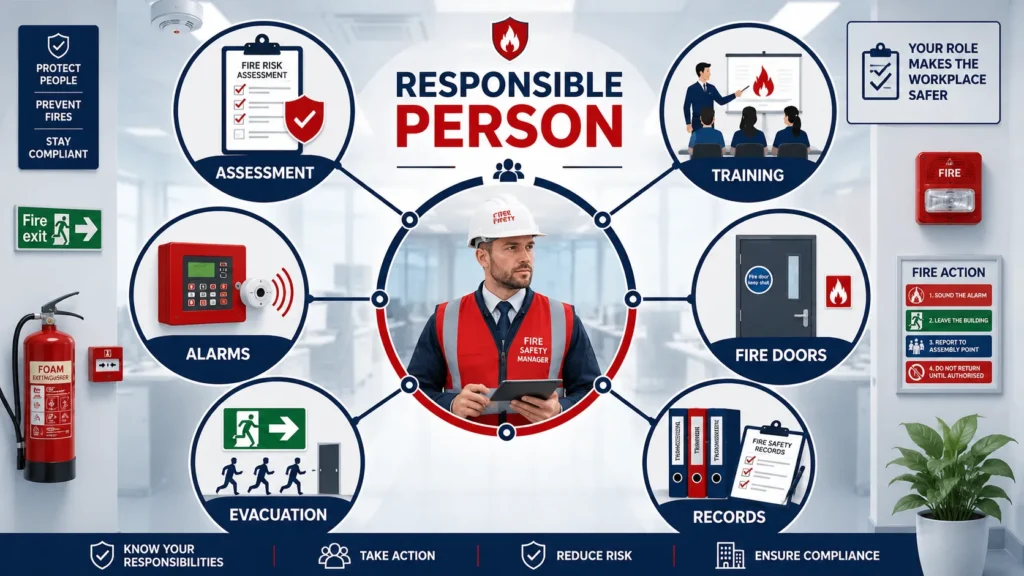
One of the most important concepts within the Regulatory Reform (Fire Safety) Order 2005 is the Responsible Person.
The Responsible Person is legally accountable for ensuring that appropriate fire safety arrangements are implemented and maintained within the premises.
Depending on the organisation, the Responsible Person may be:
- The employer.
- The business owner.
- The building owner.
- A landlord.
- A facilities manager.
- A managing agent.
- Anyone with control over all or part of the premises.
In larger or multi-occupied buildings, there may be more than one Responsible Person. In these situations, cooperation and coordination between duty holders are essential to ensure fire safety measures remain effective throughout the building.
What are the Responsibilities of the Responsible Person?
The Responsible Person has a legal duty to ensure that suitable fire safety arrangements are in place and remain effective.
Key responsibilities include:
- Carrying out suitable and sufficient fire risk assessments.
- Identifying fire hazards.
- Reducing fire risks where reasonably practicable.
- Maintaining fire alarms and detection systems.
- Ensuring emergency lighting remains operational.
- Keeping escape routes clear.
- Maintaining fire doors.
- Providing appropriate firefighting equipment.
- Developing emergency procedures.
- Training employees in fire safety.
- Conducting regular fire drills.
- Maintaining fire safety records.
- Reviewing fire safety arrangements whenever significant changes occur.
- Cooperating with other Responsible Persons where responsibilities overlap.
The Responsible Person does not need to complete every task personally but remains legally responsible for ensuring that competent individuals carry out the required work.
Why is Understanding the Fire Safety Order Important?
Understanding the Regulatory Reform (Fire Safety) Order 2005 is about much more than avoiding penalties. It enables organisations to create safer workplaces, protect lives, reduce operational risks, and build resilience against fire-related incidents.
Businesses that understand their legal duties are better equipped to:
- Prevent workplace fires.
- Protect employees and visitors.
- Reduce property damage.
- Maintain business continuity.
- Demonstrate legal compliance.
- Improve organisational reputation.
- Strengthen health and safety culture.
- Support long-term operational resilience.
By embedding fire safety into everyday management practices, organisations can move beyond minimum legal compliance and create safer environments for everyone.
What is a Fire Risk Assessment?
A fire risk assessment is one of the most important legal requirements under the Regulatory Reform (Fire Safety) Order 2005. It is a structured process used to identify fire hazards, evaluate the level of risk, determine who may be affected, and implement suitable control measures to reduce or eliminate those risks.
The purpose of a fire risk assessment is not simply to comply with legislation—it is to protect lives, minimise property damage, and ensure that people can evacuate safely if a fire occurs.
A suitable and sufficient fire risk assessment should consider the specific activities carried out within the premises, the building layout, the number and type of occupants, and any circumstances that could increase the likelihood or consequences of fire.
The assessment should also identify practical improvements that can reduce fire risks while maintaining normal business operations.
Why is a Fire Risk Assessment Important?
A well-prepared fire risk assessment provides numerous benefits beyond legal compliance.
It helps businesses to:
- Identify fire hazards before incidents occur.
- Protect employees, visitors, contractors, and customers.
- Reduce the likelihood of fire.
- Improve emergency preparedness.
- Maintain business continuity.
- Reduce insurance risks.
- Demonstrate compliance with legislation.
- Support continuous improvement.
Rather than being completed once and forgotten, fire risk assessments should form part of an ongoing fire safety management programme.
Who can Carry Out a Fire Risk Assessment?
The Responsible Person has legal responsibility for ensuring that a suitable fire risk assessment is completed.
In some small, low-risk workplaces, the Responsible Person may be capable of carrying out the assessment themselves if they have sufficient knowledge and competence.
However, larger or more complex premises often require assistance from a competent fire risk assessor who possesses appropriate training, knowledge, and practical experience.
Examples include:
- Fire safety consultants.
- Qualified fire risk assessors.
- Fire safety engineers.
- Health and Safety professionals with fire safety competence.
Regardless of who completes the assessment, the Responsible Person remains legally accountable for ensuring that it is suitable, sufficient, and kept up to date.
How to Conduct a Fire Risk Assessment
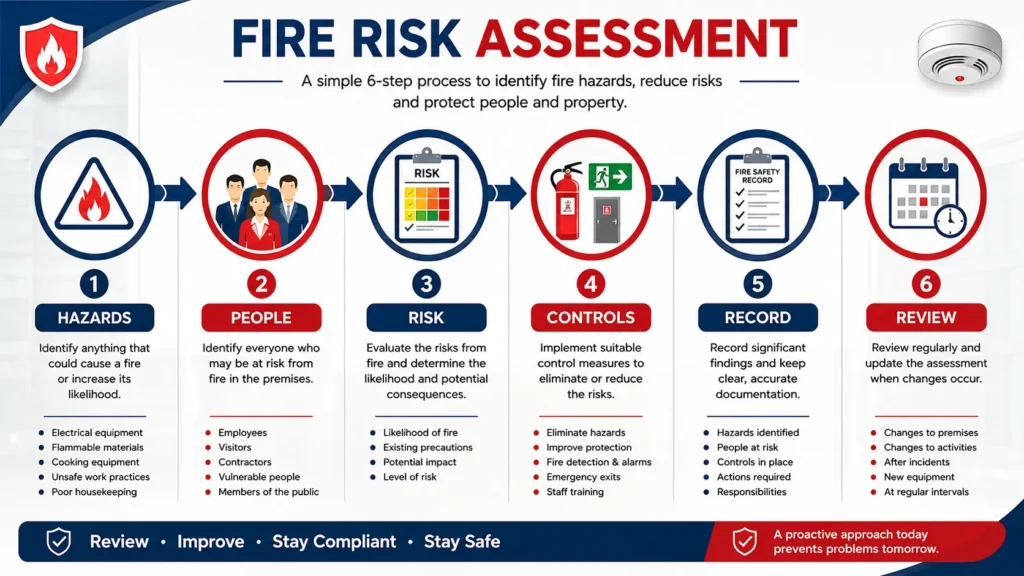
A systematic approach helps ensure that all significant hazards are identified and appropriately controlled.
Step 1: Identify Fire Hazards
Identify anything capable of causing or contributing to a fire.
Typical hazards include:
- Electrical equipment.
- Portable heaters.
- Cooking equipment.
- Flammable liquids.
- Gas installations.
- Hot work activities.
- Combustible waste.
- Poor housekeeping.
- Smoking materials.
Step 2: Identify People at Risk
Consider everyone who may be affected by a fire.
This includes:
- Employees.
- Customers.
- Visitors.
- Contractors.
- Disabled persons.
- Lone workers.
- Elderly occupants.
- Children.
- Temporary workers.
Understanding who is at risk helps determine the level of protection required.
Step 3: Evaluate the Risks
Assess:
- The likelihood of fire occurring.
- Existing fire precautions.
- Potential consequences.
- Whether further controls are needed.
Risk evaluation should consider both fire prevention and emergency response.
Step 4: Implement Control Measures
Introduce practical measures to reduce identified risks.
Examples include:
- Improving housekeeping.
- Installing fire detection systems.
- Maintaining fire doors.
- Removing ignition sources.
- Providing staff training.
- Improving emergency lighting.
- Updating evacuation procedures.
Step 5: Record Significant Findings
Document:
- Hazards identified.
- Persons at risk.
- Existing controls.
- Additional actions required.
- Responsibilities.
- Completion dates.
Maintaining accurate records demonstrates compliance and supports future reviews.
Step 6: Review Regularly
Fire risk assessments should be reviewed whenever:
- The building changes.
- Business activities change.
- Occupancy changes.
- Fire incidents occur.
- New equipment is installed.
- Legislation changes.
- Significant hazards are identified.
Regular reviews help ensure that fire safety arrangements remain effective.
Fire Risk Assessment Process
The following flowchart illustrates the recommended fire risk assessment process.
Identify Fire Hazards
│
▼
Identify People at Risk
│
▼
Evaluate Fire Risks
│
▼
Implement Control Measures
│
▼
Record Findings
│
▼
Review Regularly
This simple process supports continuous improvement and forms the foundation of effective fire safety management.
Fire Safety Compliance Checklist
Maintaining compliance with the Regulatory Reform (Fire Safety) Order 2005 requires regular monitoring rather than occasional inspections.
The following checklist can help organisations assess their current arrangements.
| Fire Safety Requirement | Compliance Action |
|---|---|
| Fire Risk Assessment | Complete and review regularly |
| Fire Alarm System | Test and maintain routinely |
| Emergency Lighting | Inspect and service |
| Fire Doors | Check operation and condition |
| Fire Extinguishers | Annual servicing and monthly inspections |
| Escape Routes | Keep unobstructed |
| Fire Signage | Clearly displayed |
| Staff Training | Induction and refresher training |
| Fire Drills | Conduct regularly |
| Emergency Plan | Maintain and review |
| Maintenance Records | Keep accurate documentation |
| Contractor Controls | Monitor high-risk work activities |
Using a structured checklist helps businesses identify compliance gaps before they develop into serious safety issues.
Regulatory Reform (Fire Safety) Order 2005 vs Fire Safety Act 2021
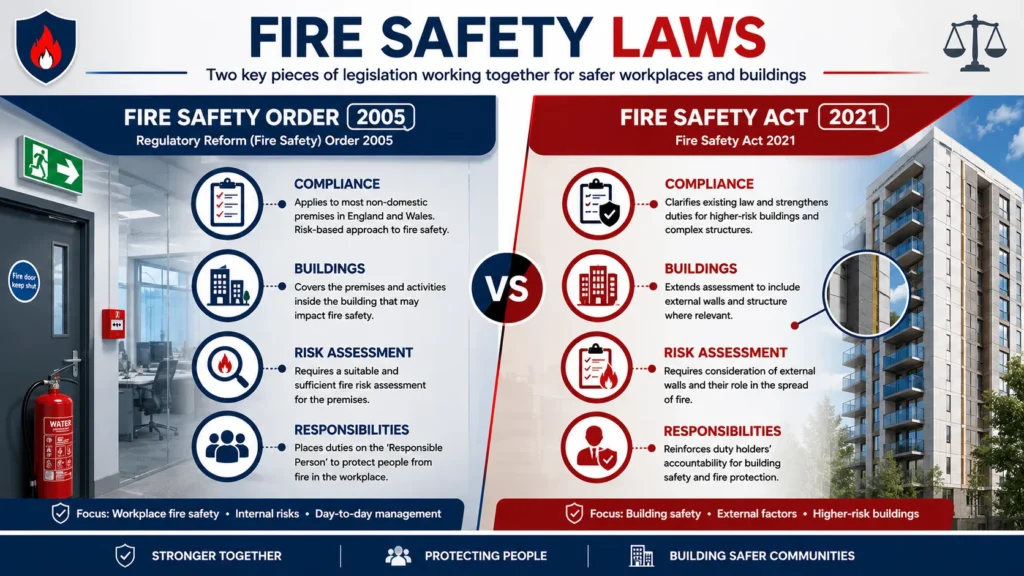
Many people mistakenly believe that the Fire Safety Act 2021 replaced the Regulatory Reform (Fire Safety) Order 2005.
In reality, the Fire Safety Act builds upon and clarifies the existing legislation rather than replacing it.
Comparison Table
| Regulatory Reform (Fire Safety) Order 2005 | Fire Safety Act 2021 |
|---|---|
| Primary fire safety legislation | Clarifies existing legislation |
| Introduced Responsible Person duties | Expanded interpretation of building scope |
| Requires fire risk assessments | Clarifies inclusion of external walls where applicable |
| Covers most non-domestic premises | Supports improved building fire safety |
| Risk-based management approach | Greater legal clarity for assessments |
| Ongoing fire safety management | Strengthens application of existing duties |
Together, these pieces of legislation create a stronger and more comprehensive fire safety framework.
Which Industries Are Most Affected by the Regulatory Reform (Fire Safety) Order 2005?
Although the Fire Safety Order applies to most non-domestic premises, certain industries face higher fire risks because of their activities, occupancy levels, or building design.
| Industry | Primary Fire Safety Risks |
|---|---|
| Offices | Electrical equipment, occupancy |
| Retail | Public access, storage, displays |
| Hospitality | Kitchens, sleeping accommodation |
| Healthcare | Vulnerable occupants, evacuation |
| Warehousing | High fire loading, storage systems |
| Manufacturing | Machinery, hot work, chemicals |
| Construction | Temporary structures, hot work |
| Education | Large occupancies, evacuation |
| Leisure Facilities | High visitor numbers |
| Hotels | Guest safety, evacuation planning |
Each sector should tailor its fire safety arrangements to reflect its specific operational risks.
Common Fire Safety Compliance Mistakes
Many enforcement actions arise from avoidable mistakes rather than major structural failures.
Businesses should avoid the following common problems.
Blocked Emergency Exits
Escape routes must always remain clear and immediately accessible.
Fire Doors Wedged Open
Fire doors are designed to prevent the spread of smoke and flames. Holding them open defeats their purpose.
Poor Housekeeping
Accumulated rubbish, cardboard, and combustible waste significantly increase fire loading.
Overloaded Electrical Systems
Multiple extension leads, damaged cables, and overloaded sockets remain common causes of workplace fires.
Outdated Fire Risk Assessments
Businesses frequently forget to review fire risk assessments after changes to buildings, staffing, or work activities.
Inadequate Employee Training
Employees should understand:
- Fire prevention.
- Alarm procedures.
- Evacuation routes.
- Assembly points.
- Fire extinguisher awareness.
Poor Maintenance
Fire alarms, extinguishers, emergency lighting, smoke detectors, and fire doors require regular inspection and servicing.
Missing Emergency Plans
Every workplace should have documented evacuation procedures that employees understand.
Weak Record Keeping
Maintenance logs, training records, fire drill reports, and inspection records demonstrate compliance and support continual improvement.
Ignoring Contractor Activities
Contractors performing welding, cutting, electrical work, or maintenance may introduce temporary fire risks that require additional controls.
Does Every Business Need Fire Safety Training?
Yes. Even the most sophisticated fire protection systems cannot replace knowledgeable employees.
Fire safety training helps staff:
- Identify hazards.
- Prevent fires.
- Respond quickly.
- Evacuate safely.
- Protect colleagues.
- Report fire safety concerns.
- Support emergency procedures.
Training should form part of every employee’s induction and continue throughout their employment.
Common Types of Fire Safety Training
Businesses may provide:
- Fire Safety Awareness Training.
- Fire Marshal Training.
- Fire Warden Training.
- Practical Fire Extinguisher Training.
- Evacuation Training.
- Contractor Fire Safety Induction.
- Refresher Fire Safety Training.
Providing appropriate training strengthens compliance while creating a safer and more confident workforce.
How is the Regulatory Reform (Fire Safety) Order 2005 Enforced?
The Regulatory Reform (Fire Safety) Order 2005 is enforced by the relevant fire and rescue authority. Fire safety inspectors have the legal authority to visit premises, examine fire safety arrangements, review documentation, and determine whether businesses are meeting their legal responsibilities.
Inspections may be carried out:
- As part of routine inspection programmes.
- Following complaints.
- After fire incidents.
- When significant alterations have been made to premises.
- As part of targeted enforcement campaigns.
Inspectors may review:
- Fire risk assessments.
- Emergency procedures.
- Fire alarm testing records.
- Emergency lighting maintenance.
- Fire door inspections.
- Fire extinguisher servicing records.
- Staff training records.
- Fire drill reports.
- Maintenance documentation.
- Means of escape.
A well-maintained fire safety management system makes inspections smoother while demonstrating a proactive approach to compliance.
What happens If a Business Fails to Comply?
Failure to comply with the Regulatory Reform (Fire Safety) Order 2005 can have serious legal and financial consequences. The severity of enforcement action depends on the level of risk, the seriousness of the breach, and whether people have been placed in danger.
Alterations Notice
An Alterations Notice may be issued where future changes to the premises could significantly increase fire risks. Businesses must inform the enforcing authority before making specified alterations.
Enforcement Notice
If inspectors identify deficiencies in fire safety arrangements, they may issue an Enforcement Notice requiring improvements within a specified timescale.
Prohibition Notice
Where serious fire safety deficiencies create an immediate risk to life, a Prohibition Notice may restrict or prohibit the use of part or all of the premises until appropriate improvements have been completed.
Criminal Prosecution
Serious breaches of fire safety legislation can result in prosecution through the courts.
Potential penalties include:
- Unlimited fines.
- Criminal convictions.
- Imprisonment in serious cases.
- Business closure.
- Loss of operating licences where applicable.
- Increased insurance costs.
- Significant reputational damage.
Investing in fire safety management is almost always far less costly than responding to enforcement action after non-compliance.
Fire Safety Compliance Roadmap
Maintaining compliance with the Regulatory Reform (Fire Safety) Order 2005 should be viewed as a continuous management cycle rather than a one-time exercise.
The following roadmap provides a practical approach for businesses.
Fire Safety Compliance Flowchart
Identify Premises
│
▼
Appoint Responsible Person
│
▼
Complete Fire Risk Assessment
│
▼
Identify Fire Hazards
│
▼
Implement Fire Safety Measures
│
▼
Train Employees
│
▼
Inspect & Maintain Equipment
│
▼
Review and Improve Regularly
Following this structured process helps organisations maintain compliance while continuously improving workplace safety.
How Technology Is Transforming Fire Safety Compliance
Modern technology has changed how organisations manage fire safety. Digital tools make inspections more efficient, improve record keeping, and support quicker identification of potential hazards.
Businesses increasingly use technology to strengthen compliance and reduce administrative workloads.
Smart Fire Detection Systems
Modern intelligent fire detection systems identify smoke and heat more accurately while reducing false alarms. Early detection enables faster emergency response and minimises potential damage.
Internet of Things (IoT)
Connected sensors continuously monitor fire alarms, emergency lighting, smoke control systems, and other fire protection equipment. Faults can be detected quickly, reducing the likelihood of system failures.
Digital Fire Risk Assessments
Many organisations now complete fire risk assessments electronically. Digital systems simplify updates, enable easier record management, and improve collaboration between Responsible Persons and assessors.
Cloud-Based Compliance Software
Cloud platforms centralise inspection records, maintenance schedules, fire risk assessments, corrective actions, and compliance documentation, making audits and inspections easier to manage.
Mobile Inspection Applications
Inspectors can complete fire safety inspections using tablets or smartphones, allowing photographs, notes, and corrective actions to be recorded instantly.
Building Management Systems (BMS)
Integrated building management systems monitor multiple safety systems, including fire alarms, emergency lighting, smoke ventilation, access control, and environmental monitoring from a single platform.
Adopting digital solutions helps organisations improve efficiency while maintaining stronger fire safety oversight.
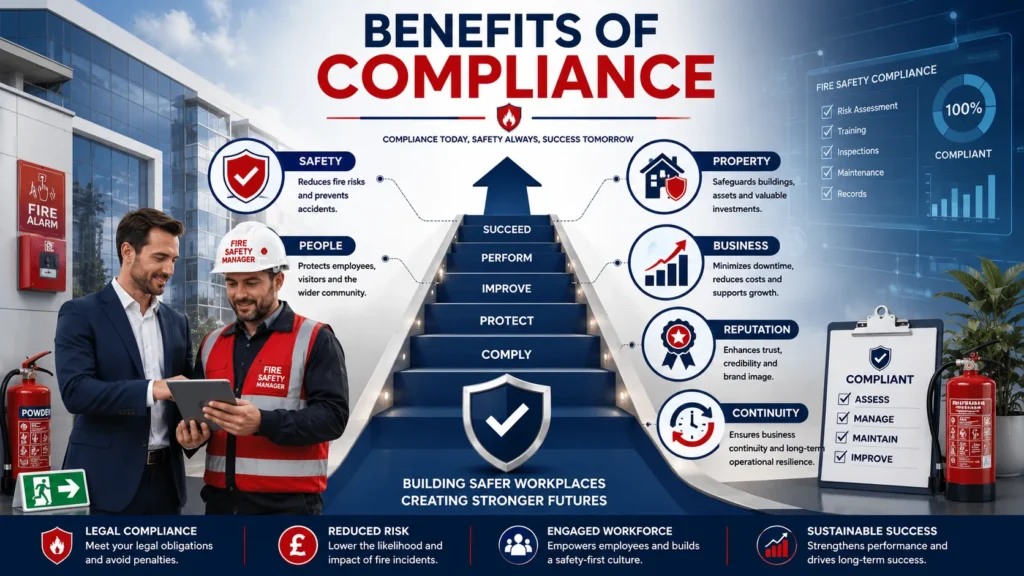
Benefits of Complying with the Regulatory Reform (Fire Safety) Order 2005
Compliance should not be viewed solely as a legal obligation. Effective fire safety management delivers measurable operational, financial, and organisational benefits.
Protecting Employees and Visitors
The greatest benefit of compliance is protecting lives. Effective fire safety arrangements reduce the likelihood of injuries and improve evacuation during emergencies.
Supporting Business Continuity
Fire incidents can interrupt operations for extended periods. Preventing fires helps organisations avoid costly downtime and maintain productivity.
Protecting Buildings and Assets
Fire can destroy buildings, machinery, equipment, stock, records, and IT infrastructure. Strong fire safety management reduces the likelihood of extensive property damage.
Strengthening Corporate Reputation
Customers, investors, insurers, and regulators increasingly expect organisations to demonstrate responsible safety management. Strong compliance enhances trust and credibility.
Improving Employee Confidence
Employees who receive regular training and work within safe environments are generally more confident and better prepared to respond during emergencies.
Supporting Insurance Requirements
Well-maintained fire protection systems and documented compliance may assist insurers when assessing risks and handling claims.
Demonstrating Good Corporate Governance
Strong fire safety management reflects effective leadership, responsible decision-making, and a commitment to protecting people and assets.
Building a Positive Fire Safety Culture
The most successful organisations treat fire safety as a shared responsibility rather than a compliance exercise.
A positive fire safety culture encourages everyone to contribute to maintaining a safe workplace.
Key characteristics include:
- Leadership commitment.
- Employee involvement.
- Regular communication.
- Continuous training.
- Hazard reporting.
- Routine inspections.
- Learning from incidents.
- Continuous improvement.
When employees understand their role in preventing fires, organisations become significantly safer.
Future Trends in UK Fire Safety
Fire safety legislation and workplace practices continue to evolve alongside technological innovation and changing building designs.
Several trends are shaping the future of fire safety management.
Artificial Intelligence
AI-powered systems can analyse data from multiple sensors to identify abnormal conditions, predict equipment failures, and improve emergency response.
Smart Buildings
Modern buildings increasingly integrate fire safety systems with access control, security, ventilation, and energy management platforms.
Predictive Maintenance
Rather than waiting for equipment to fail, predictive maintenance identifies components requiring attention before faults occur.
Digital Compliance Management
Cloud-based compliance platforms are replacing paper-based systems, enabling businesses to manage fire safety documentation more efficiently.
Sustainable Building Design
As low-carbon construction methods, solar panels, battery storage systems, and electric vehicle charging infrastructure become more common, fire risk assessments must adapt to address emerging hazards.
Continuous Professional Development
Fire safety professionals increasingly require ongoing training to keep pace with legislative updates, technological advances, and evolving industry best practices.
Organisations that embrace innovation while maintaining strong fire safety management systems will be better prepared for future regulatory developments.
Explore Related Fire Safety and Health & Safety Courses at Inspire College
If you want to strengthen your understanding of workplace fire safety or progress towards a career in health and safety, fire risk assessment, or compliance management, Inspire College offers a range of professional qualifications that complement the Regulatory Reform (Fire Safety) Order 2005.
Adding internal links to these courses will improve topical authority, user engagement, and website navigation while helping learners discover suitable progression pathways.
Fire Safety Courses
- Fire Safety Courses
- Fire Risk Assessment Course
- Fire Marshal Training
- Fire Safety Management Qualification
- Workplace Fire Safety Training
Why every Business Should Treat Fire Safety as a Strategic Priority
The Regulatory Reform (Fire Safety) Order 2005 is often viewed as a legal requirement, but its real value extends much further. Effective fire safety management supports operational resilience, protects organisational assets, and creates a safer working environment for everyone.
Businesses that invest in proactive fire safety management benefit from:
- Improved legal compliance.
- Safer workplaces.
- Reduced operational disruption.
- Better employee confidence.
- Lower long-term risk.
- Stronger organisational reputation.
- Greater customer trust.
- Improved emergency preparedness.
- Enhanced business continuity.
Fire safety should therefore be integrated into everyday business operations rather than treated as an occasional compliance exercise.
Final Thoughts
The Regulatory Reform (Fire Safety) Order 2005 remains the foundation of workplace fire safety legislation in England and Wales. It introduced a modern, risk-based approach that places responsibility on employers, building owners, landlords, facilities managers, and other duty holders to identify fire risks, protect occupants, and maintain effective fire safety arrangements.
Throughout this guide, we have explained how the legislation works, who it applies to, the responsibilities of the Responsible Person, how fire risk assessments should be conducted, common compliance mistakes, enforcement action, modern fire safety technologies, and the practical benefits of maintaining strong fire safety management systems.
Rather than viewing compliance as a legal burden, organisations should recognise it as an opportunity to improve safety, strengthen resilience, protect people, and build long-term business success.
Conclusion
The Regulatory Reform (Fire Safety) Order 2005 transformed workplace fire safety by replacing a complex system of fire certificates with a practical, risk-based approach that places responsibility on those who control premises. More than two decades later, it continues to form the legal foundation of fire safety management across England and Wales.
Understanding the legislation is essential for employers, landlords, facilities managers, Responsible Persons, and business owners who want to protect employees, visitors, contractors, and property while meeting their legal obligations.
By carrying out suitable fire risk assessments, maintaining fire protection systems, training employees, reviewing procedures regularly, and fostering a positive fire safety culture, organisations can significantly reduce the likelihood and impact of fire incidents.
As legislation, technology, and workplace environments continue to evolve, businesses should adopt a proactive approach to fire safety that goes beyond minimum compliance. Investing in recognised fire safety education and continuous professional development helps organisations remain compliant, resilient, and prepared for future challenges.
At Inspire College, we are committed to supporting individuals and organisations with high-quality fire safety and health & safety training. Whether you are seeking to improve workplace compliance, enhance professional knowledge, or build a successful career in fire safety, the right education provides the confidence and practical skills needed to create safer workplaces and protect what matters most.