
Fire Safety Compliance Checklist for UK Employers and Commercial Premises
Fire safety compliance is a fundamental responsibility for employers, business owners and commercial premises managers throughout the United Kingdom. Every workplace must have appropriate arrangements to prevent fires, protect employees and visitors, maintain suitable fire protection measures and ensure people can evacuate safely during an emergency. A well-managed fire safety programme reduces the likelihood of workplace fires, limits potential injuries and property damage, and helps organisations demonstrate that they take their responsibilities seriously.
A Fire Safety Compliance Checklist provides a structured method for reviewing the condition of workplace fire precautions, identifying potential hazards and checking whether essential safety arrangements are operating effectively. It enables employers to assess important areas such as fire risk assessments, electrical safety, emergency escape routes, fire alarms, fire doors, emergency lighting, firefighting equipment, staff training and maintenance documentation. Rather than treating fire safety as an occasional administrative exercise, organisations can use a checklist to establish consistent inspection routines and monitor outstanding corrective actions.
In the UK, fire safety requirements depend on the relevant national legislation and the nature of the premises. The Regulatory Reform (Fire Safety) Order 2005 is the principal general fire safety legislation for England and Wales, while Scotland and Northern Ireland operate under separate legal frameworks. Employers must therefore confirm which requirements apply to their location and building.
For organisations operating offices, shops, warehouses, factories, restaurants, educational facilities and other commercial premises, effective fire safety management requires a combination of risk assessment, physical precautions, employee awareness, competent maintenance and reliable documentation. This guide explains how UK employers can develop and apply a practical fire safety compliance checklist to strengthen workplace protection and maintain effective fire safety arrangements.
What is a Fire Safety Compliance Checklist?
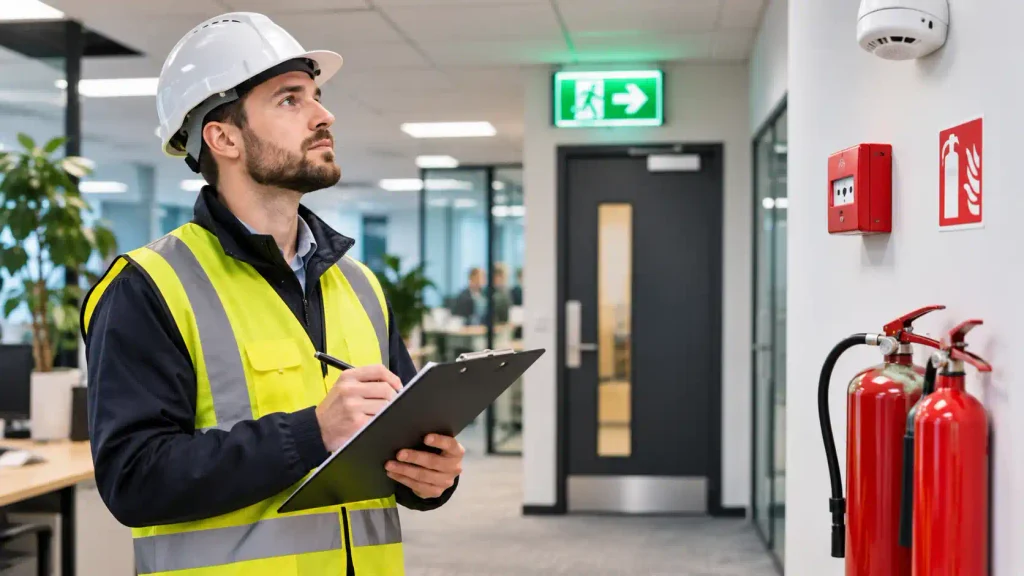
A Fire Safety Compliance Checklist is a structured inspection and monitoring document used to assess whether a workplace has appropriate fire prevention, detection, protection and emergency arrangements. It helps employers and premises managers identify hazards, review existing precautions, recognise deficiencies and assign corrective actions before problems create serious risks.
The checklist is not simply a list of fire safety equipment. It considers the complete management of workplace fire safety, including the people responsible for safety, the condition of the building, employee knowledge, emergency arrangements and the records supporting ongoing compliance.
A comprehensive checklist normally covers the following areas:
- Fire risk assessment and hazard identification.
- Fire prevention and workplace housekeeping.
- Fire detection and alarm arrangements.
- Emergency escape routes and exit signage.
- Emergency lighting.
- Fire doors and passive fire protection.
- Fire extinguishers and firefighting equipment.
- Emergency evacuation procedures.
- Employee fire safety training.
- Fire marshal responsibilities.
- Maintenance and inspection records.
- Contractor management and hot-work controls.
- Corrective action monitoring and assessment reviews.
For example, an employer inspecting an office may discover that a fire exit is partially obstructed by stored materials. The checklist helps the organisation record the problem, assess the potential impact, arrange immediate corrective action and verify that the escape route remains clear.
Similarly, a warehouse manager may identify combustible packaging stored too close to electrical equipment. Recording this issue provides a basis for reviewing storage arrangements and strengthening fire prevention controls.
The effectiveness of a Fire Safety Compliance Checklist depends on how consistently it is used. A completed form does not automatically establish compliance. Employers must investigate failures, introduce appropriate precautions and ensure that identified problems are resolved.
Who Is Responsible for Fire Safety in Commercial Premises?
Understanding responsibility is essential before implementing a workplace fire safety checklist. Employers, building owners, landlords, occupiers and facilities managers may have different responsibilities depending on their level of control over the premises, the employment arrangements and the applicable legislation.
Employer Responsibilities
Employers must take appropriate steps to protect employees and other people who may be affected by workplace activities. Their fire safety arrangements should reflect the nature of the business, the building, the work processes and the people using the premises.
Key responsibilities include:
- Identifying workplace fire hazards.
- Ensuring suitable fire risk assessments are undertaken.
- Providing appropriate fire prevention measures.
- Maintaining necessary fire protection arrangements.
- Establishing emergency evacuation procedures.
- Providing suitable fire safety information and instruction.
- Ensuring employees understand their emergency responsibilities.
- Monitoring workplace conditions.
- Addressing identified fire safety deficiencies.
Employers should also ensure that fire safety responsibilities are properly allocated rather than assuming that appointing a fire marshal or facilities manager transfers all organisational accountability.
Responsible Person Duties
Under the Regulatory Reform (Fire Safety) Order 2005, the Responsible Person is generally the employer in relation to workplaces under their control, or another person who has control of the premises, such as an owner, landlord or occupier.
Where more than one Responsible Person has duties concerning the same premises, they must cooperate and coordinate their arrangements.
The Responsible Person must ensure that a suitable and sufficient fire risk assessment is carried out, appropriate general fire precautions are implemented and maintained, relevant information is provided to employees and emergency procedures are established.
The specific duties should be checked against the applicable legislation and the circumstances of the premises. GOV.UK+1
Building Owners and Facilities Managers
Building owners and facilities managers often oversee important aspects of fire safety, particularly in multi-occupancy commercial buildings.
Their responsibilities may include:
- Maintaining shared escape routes.
- Coordinating building-wide emergency arrangements.
- Managing fire alarm and emergency lighting maintenance.
- Monitoring fire door conditions.
- Arranging competent contractors.
- Maintaining building safety records.
- Communicating relevant fire safety information to occupiers.
Where several organisations share a building, responsibilities should be documented clearly. Employers should not assume that a landlord’s building-wide arrangements automatically cover every risk arising from their own activities.
Employees and Fire Marshals
Employees contribute to fire safety by following workplace procedures, reporting hazards and using equipment responsibly. Fire marshals may have additional responsibilities, including helping communicate evacuation instructions, supporting evacuation arrangements and reporting concerns to management. Their duties must be clearly defined, supported by appropriate training and proportionate to the size, layout and risk profile of the workplace.
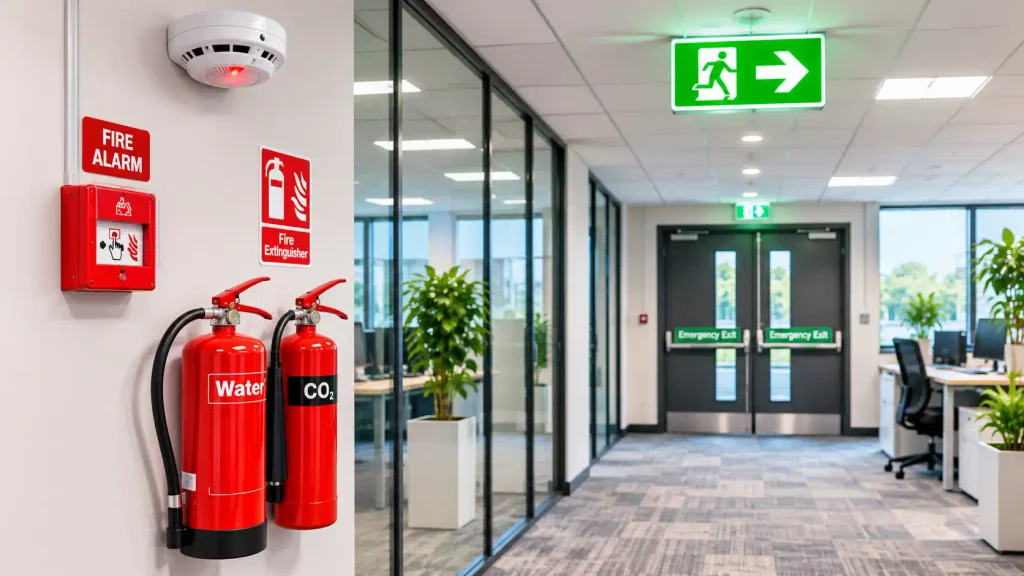
Essential Fire Safety Compliance Checklist for UK Employers
A practical Fire Safety Compliance Checklist should examine the complete workplace environment rather than concentrating on a single item of equipment. Employers should adapt the following inspection categories to their premises, activities, fire risk assessment and relevant legal requirements.
Fire Risk Assessment and Hazard Identification
A suitable and sufficient fire risk assessment is the foundation of effective workplace fire safety management. It identifies potential ignition sources, combustible materials, people who may be affected and the precautions needed to reduce risks.
Employers should check that:
- A suitable fire risk assessment has been completed.
- The assessment reflects the actual workplace layout and activities.
- Potential ignition sources have been identified.
- Combustible materials and fuel sources have been assessed.
- Employees, contractors and visitors have been considered.
- People requiring additional evacuation assistance have been identified.
- Existing fire prevention and protection measures have been evaluated.
- Significant findings and necessary actions have been recorded.
- Relevant employees or their representatives have been informed.
- The assessment is reviewed when circumstances change.
A fire risk assessment should not be treated as a permanent document that remains suitable regardless of operational changes.
For example, introducing new machinery, increasing warehouse storage capacity, changing internal layouts or converting office space into a workshop may introduce additional fire hazards. These changes should trigger a review of the assessment and associated precautions.
Employers should use a competent fire risk assessor where the complexity or risk profile of the premises requires specialist knowledge.
Fire Prevention and Workplace Housekeeping
Preventing a fire from starting is one of the most important objectives of a workplace fire safety programme. Organisations should identify ignition sources and combustible materials and establish appropriate controls.
The checklist should include:
- Electrical equipment is maintained in a safe condition.
- Damaged plugs, cables and electrical accessories are reported.
- Electrical installations receive appropriate inspection and maintenance.
- Portable heaters are used safely.
- Smoking restrictions are communicated and followed.
- Waste materials are removed regularly.
- Combustible materials are stored appropriately.
- Flammable liquids are controlled and stored safely.
- Cooking equipment is used and maintained appropriately.
- Machinery is operated according to safety procedures.
- Hot-work activities are controlled through suitable arrangements.
- External waste storage does not create unnecessary fire exposure.
- Security arrangements address potential deliberate ignition.
Good housekeeping is particularly important in warehouses, manufacturing facilities and retail premises where packaging, stock and waste can accumulate quickly.
Employers should establish clear storage arrangements, designated waste collection points and responsibilities for checking work areas at the end of shifts.
Fire Detection and Alarm Systems
Fire detection and alarm systems provide early warning, allowing occupants to respond before a fire develops into a more dangerous situation.
Employers should check that:
- Appropriate fire detection arrangements are provided.
- Alarm systems are suitable for the premises and identified risks.
- Manual call points are accessible.
- Detectors are not obstructed or damaged.
- Alarm sounders and visual warning devices are maintained.
- Warning signals can be recognised by employees.
- Arrangements account for people who may not hear an audible alarm.
- Routine user tests are completed according to the system’s requirements.
- Defects are reported and investigated promptly.
- Professional maintenance is completed at appropriate intervals.
- Test and maintenance records are retained.
The type of detection system will depend on the building layout, occupancy, fire risks and evacuation strategy.
For instance, a small office may use a straightforward alarm arrangement, while a large warehouse or multi-storey commercial building may require more sophisticated detection, zoning and warning arrangements.
Employers should ensure that employees understand what the alarm sounds like and what action they must take when it operates.
Emergency Escape Routes and Fire Exit Signage
Escape routes must enable people to reach a place of safety without unnecessary delay or exposure to unacceptable risks. A workplace may have suitable fire exits installed but still present serious evacuation problems if access routes are obstructed, exit doors cannot be opened or occupants do not understand the evacuation arrangements.
The inspection checklist should confirm that:
- Escape routes are clearly identified.
- Corridors and stairways are unobstructed.
- Final exit doors can be opened safely.
- Exit doors are not improperly locked or secured.
- Escape route signage is visible.
- Directional signs are appropriate to the building layout.
- Fire exits are not used for routine storage.
- Stairways are maintained in a suitable condition.
- Escape routes account for expected occupancy.
- Alternative escape arrangements are available where required.
- External assembly points are identified.
- Employees understand the available evacuation routes.
Employers should also consider how visitors, contractors and people unfamiliar with the building will find their way out. Escape route arrangements must be suitable for the building’s occupancy and fire strategy. A route that works under normal operating conditions may become unsuitable if workplace layouts, stock arrangements or staffing levels change.
Emergency Lighting
Emergency lighting supports safe evacuation when normal lighting fails during a fire or another emergency. It is particularly important in internal corridors, stairways, windowless areas and routes where occupants may struggle to identify exits in darkness.
The checklist should include:
- Emergency lighting is provided where the risk assessment requires it.
- Escape routes have suitable emergency illumination.
- Exit signs are visible.
- Emergency luminaires are accessible for inspection.
- Damaged fittings are reported.
- Functional tests are completed according to applicable requirements.
- Duration tests are arranged at appropriate intervals.
- Defects are investigated and corrected.
- Inspection and maintenance records are maintained.
Employers should not assume that ordinary building lighting provides sufficient protection during a power failure.
Emergency lighting arrangements should be evaluated by competent persons, particularly where the premises have complex escape routes or specialist lighting systems.
Fire Doors and Passive Fire Protection
Fire doors and other passive fire protection measures help restrict the movement of smoke and fire through a building. They can provide valuable time for occupants to evacuate and support the overall fire safety strategy.
Employers and premises managers should check that:
- Fire doors are suitable for their intended locations.
- Doors close properly within their frames.
- Self-closing devices operate correctly.
- Intumescent and smoke seals are in suitable condition.
- Door leaves and frames show no significant damage.
- Hinges and essential hardware are secure.
- Fire doors are not routinely wedged open.
- Vision panels are maintained where provided.
- Fire-resisting walls and partitions are not unnecessarily penetrated.
- Service penetrations have appropriate fire-stopping.
- Defects are referred to competent specialists.
A fire door that does not close correctly may fail to provide the protection intended by its design.
Similarly, poorly maintained fire-stopping around cables, pipes and ventilation services can undermine compartmentation. Managers should ensure that remedial work does not involve unsuitable modifications to certified fire doors or fire-resisting construction.
Fire Extinguishers and Firefighting Equipment
Appropriate firefighting equipment can support emergency response when it is safe and suitable for trained individuals to use. However, employees should never be expected to fight a fire when doing so would expose them to danger or delay evacuation.
The checklist should include:
- Fire extinguishers are suitable for identified fire risks.
- Equipment is located in accessible positions.
- Extinguishers are correctly identified.
- Operating instructions are visible.
- Equipment is not obstructed.
- Safety seals and indicators are checked as appropriate.
- Damage or missing equipment is reported.
- Routine inspections are documented.
- Servicing is undertaken by competent persons.
- Employees understand when not to attempt firefighting.
Different types of extinguishers are designed for different fire classifications. For example, equipment suitable for ordinary combustible materials may not be appropriate for certain flammable liquid or electrical hazards.
The Responsible Person should ensure that equipment selection is based on the fire risk assessment and that maintenance follows applicable standards and manufacturer instructions.
Fire Evacuation Plans and Emergency Procedures
An effective evacuation plan explains what occupants must do when a fire is discovered or an alarm sounds. It should be straightforward, practical and appropriate to the premises.
Employers should verify that:
- Emergency procedures are documented.
- Employees know how to raise the alarm.
- Evacuation routes are clearly explained.
- Assembly points are identified.
- Fire marshal duties are assigned.
- Visitors and contractors receive relevant instructions.
- Arrangements exist for people requiring assistance.
- Procedures cover different working shifts.
- Arrangements consider lone workers.
- Emergency contacts are available.
- Procedures explain how to report missing persons.
- Employees understand that they must not re-enter until authorised.
Evacuation procedures should also account for situations where the normal escape route is unavailable.
For example, a manufacturing facility may need to identify alternative exits because machinery, hazardous processes or changing work areas could affect access during an emergency.
The plan should be communicated through induction, workplace signage, employee briefings and appropriate training.
Staff Fire Safety Training and Fire Marshal Responsibilities
Fire safety equipment and procedures cannot protect people effectively if employees do not understand how to respond to an emergency. Employers should provide appropriate fire safety information, instruction and training based on workplace risks and employee responsibilities.
The checklist should confirm that:
- New employees receive fire safety induction.
- Employees know how to raise the alarm.
- Emergency exits and assembly points are explained.
- Staff understand evacuation procedures.
- Fire safety information is refreshed when necessary.
- Fire marshals receive suitable role-specific training.
- Temporary workers receive relevant instructions.
- Contractors are informed about applicable emergency arrangements.
- Training records are maintained.
- Changes to procedures are communicated.
Fire marshal training should address practical responsibilities such as evacuation support, reporting hazards, understanding building arrangements and assisting with communication.
Employees should also understand the limits of their responsibilities. They must not be encouraged to enter dangerous areas, search for missing occupants in unsafe conditions or use firefighting equipment beyond their competence.
Fire Drills and Evacuation Exercises
Fire drills help employers assess whether their emergency arrangements work in practice. A documented evacuation procedure may appear adequate on paper, but an exercise can reveal unexpected problems such as confusion over exit routes, inaccessible doors, delayed responses or insufficient communication.
Employers should:
- Plan evacuation exercises appropriate to the premises.
- Communicate relevant expectations to participants.
- Test the effectiveness of evacuation arrangements.
- Observe how employees respond to alarms.
- Review evacuation times in the context of the building and its risks.
- Identify communication problems.
- Assess the performance of assigned fire marshals.
- Record significant findings.
- Assign corrective actions.
- Review procedures following identified weaknesses.
The appropriate frequency of drills depends on the workplace, occupancy, risks and applicable guidance. A single universal frequency should not be assumed for every business. A drill should be treated as an opportunity for improvement rather than simply an exercise in achieving a particular evacuation time.
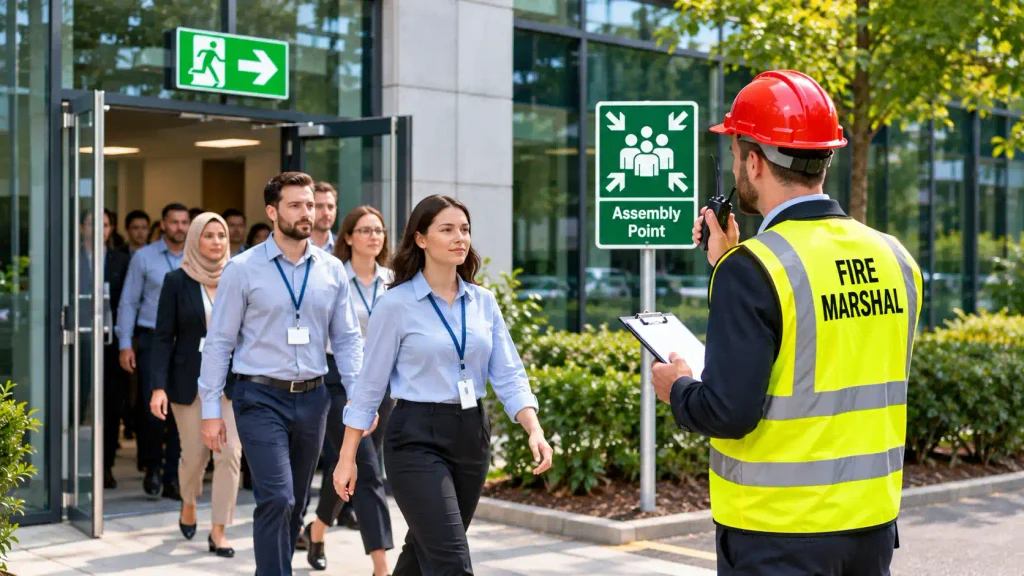
Personal Emergency Evacuation Arrangements
Some people may require additional support to evacuate safely because of mobility limitations, sensory impairments, temporary injuries or other individual circumstances. Employers should assess these needs and establish suitable arrangements before an emergency occurs.
The checklist should consider:
- Employees who may have difficulty using stairs.
- People with visual or hearing impairments.
- Temporary medical or mobility limitations.
- Visitors requiring additional assistance.
- Contractors unfamiliar with the premises.
- Accessible evacuation communication.
- Appropriate evacuation equipment where necessary.
- Identified assistance responsibilities.
- Suitable arrangements for different shifts.
- Regular reviews of individual requirements.
Personal Emergency Evacuation Plans (PEEPs) may be appropriate for employees or other relevant individuals who require individual arrangements. Employers should also consider suitable general arrangements for visitors and others who may need assistance.
The important principle is that evacuation planning must consider the actual needs of people using the building rather than assuming that everyone can follow the same procedure without support.
Fire Safety Documentation and Maintenance Records
Documentation provides evidence that fire safety arrangements are planned, monitored and maintained. An organisation may have suitable equipment installed, but incomplete maintenance records can make it difficult to demonstrate whether essential checks have been completed or whether reported defects were resolved. Employers should maintain records appropriate to their legal responsibilities and management arrangements.
The following table identifies important records and their purposes.
| Fire safety document | Main purpose |
|---|---|
| Fire risk assessment | Identifies hazards, risks and required precautions |
| Fire safety policy | Defines responsibilities and management arrangements |
| Emergency evacuation plan | Explains emergency actions and evacuation procedures |
| Fire alarm test records | Records routine testing and identified defects |
| Emergency lighting records | Demonstrates inspection and maintenance |
| Fire extinguisher records | Tracks equipment inspections and servicing |
| Fire door inspection records | Documents condition and remedial work |
| Employee training records | Demonstrates fire safety instruction and training |
| Fire drill reports | Records exercise findings and improvements |
| Contractor and hot-work records | Documents relevant fire risk controls |
| Corrective action register | Tracks outstanding issues and completed actions |
Records should be accurate, accessible and sufficiently detailed to support management reviews and relevant inspections.
For example, a fire alarm maintenance record should identify the inspection or service completed, the date, relevant findings and any defects requiring attention.
Where corrective work remains outstanding, the organisation should document the issue, responsible person, interim arrangements and expected completion date.
Contractor Management and Hot-Work Controls
Contractors can introduce additional fire risks through maintenance, construction, repair and installation activities.
Hot work, including welding, cutting and grinding, is particularly important because it can generate sparks, heat and ignition sources.
The checklist should verify that:
- Contractors receive relevant site fire safety information.
- Work activities are assessed for fire hazards.
- Suitable permits are used where required by the organisation’s risk controls.
- Combustible materials are removed or protected.
- Appropriate firefighting arrangements are available.
- Fire detection systems are not disabled without proper authorisation and controls.
- Temporary changes to escape routes are assessed.
- Work areas are inspected after hot-work activities.
- Contractors report incidents and defects.
- Relevant work records are retained.
Employers should coordinate with contractors and building managers to ensure that temporary work does not undermine existing fire precautions.
Corrective Actions and Compliance Monitoring
A checklist becomes valuable when it leads to practical improvements. If an inspection identifies an issue, employers should not simply mark it as incomplete and move on. The problem must be assessed, prioritised and resolved through a documented process.
For example, an obstructed fire exit may require immediate action, while a damaged fire door may require assessment and specialist repair. Both issues must be addressed appropriately, but their urgency and corrective arrangements may differ.
The following process provides a practical approach.
Workplace Fire Safety Corrective Action Process
A structured process for identifying fire safety deficiencies, implementing corrective measures and preventing recurring problems.
Fire Safety Checklist for Different Commercial Premises
Fire risks differ between commercial environments because each workplace has different building layouts, activities, equipment, materials and occupancy patterns. A Fire Safety Compliance Checklist should therefore be adapted to the specific risks associated with the premises.
Office Buildings
Offices may appear relatively low-risk compared with industrial workplaces, but electrical equipment, overloaded sockets, kitchen appliances, paper storage and obstructed escape routes can create significant fire hazards.
Office managers should check:
- Electrical equipment is maintained and used safely.
- Workstations do not obstruct escape routes.
- Kitchen appliances are switched off when appropriate.
- Wastepaper and combustible materials are controlled.
- Fire doors close correctly.
- Escape route signage is visible.
- Emergency lighting is maintained.
- Employees understand evacuation arrangements.
- Visitors receive suitable emergency information.
- Fire alarm testing and maintenance are recorded.
Office managers should also consider out-of-hours working, lone workers, cleaning staff and contractors who may be present when normal staffing arrangements are reduced.
Retail Premises
Retail environments present additional challenges because customer access, changing displays, stock storage and seasonal activities can affect fire safety arrangements.
Retail managers should check:
- Customer walkways remain unobstructed.
- Emergency exits are accessible.
- Stock is not stored in escape routes.
- Electrical display equipment is maintained.
- Decorative materials are assessed for fire risks.
- Storage areas are organised.
- Waste packaging is removed regularly.
- Staff understand customer evacuation procedures.
- Fire safety arrangements remain effective during busy periods.
- Temporary promotional displays do not obstruct fire protection equipment.
Retail premises should pay particular attention to stock deliveries and seasonal changes because temporary storage can quickly reduce the available escape space.
Warehouses and Distribution Centres
Warehouses can contain substantial quantities of combustible materials, packaging, pallets and stored products. Their large floor areas, high storage arrangements and vehicle operations require careful fire safety management.
Warehouse managers should check:
- Storage arrangements reflect the fire risk assessment.
- Combustible materials are appropriately controlled.
- Fire exits and escape routes remain accessible.
- Fire detection arrangements suit the building.
- Fire doors and compartmentation remain effective.
- Charging areas for industrial batteries are appropriately managed.
- Electrical equipment is maintained.
- Hot-work activities are controlled.
- Waste packaging is removed.
- Fire protection equipment remains accessible.
- Employees understand warehouse evacuation procedures.
- Vehicle access does not obstruct emergency service access.
Managers should also consider the potential impact of high-level storage on fire development, detection and suppression arrangements. Any changes to racking configuration or storage height should be assessed for their effect on the existing fire strategy.
Manufacturing Facilities
Manufacturing workplaces may involve machinery, high-temperature processes, chemicals, combustible dust, flammable substances and specialist electrical installations.
Their fire safety arrangements must reflect the actual industrial processes being undertaken.
The checklist should include:
- Production equipment is maintained.
- Ignition sources are identified and controlled.
- Flammable substances are stored appropriately.
- Dust accumulation is controlled.
- Extraction and ventilation arrangements are maintained.
- Hot-work activities follow approved procedures.
- Emergency shutdown arrangements are understood.
- Fire detection is appropriate for production areas.
- Escape routes are accessible during operating activities.
- Contractors receive relevant fire safety instructions.
- Employees receive task-specific fire safety information.
Manufacturing organisations should coordinate fire safety inspections with production management and maintenance teams. This helps ensure that changes in processes, machinery or materials are reflected in workplace fire precautions.
Restaurants and Commercial Kitchens
Commercial kitchens can present significant fire risks because of cooking equipment, hot surfaces, oils, grease accumulation, extraction systems and electrical appliances.
Restaurant managers should check:
- Cooking equipment is maintained.
- Extraction systems receive appropriate cleaning and maintenance.
- Grease accumulation is controlled.
- Combustible materials are kept away from heat sources.
- Appropriate firefighting equipment is available.
- Fire suppression arrangements are maintained where installed.
- Gas installations and appliances receive competent servicing.
- Emergency exits remain accessible.
- Staff understand kitchen fire procedures.
- Waste is managed safely.
- Closing procedures include appropriate fire prevention checks.
Commercial kitchens should pay particular attention to extraction ductwork because accumulated grease can contribute to rapid fire development and spread.
Hotels and Hospitality Premises
Hotels and hospitality buildings require additional attention because people may be sleeping, unfamiliar with the premises or unable to respond quickly to an emergency.
Managers should verify:
- Appropriate fire detection and warning arrangements are provided.
- Escape routes are clearly identified.
- Guest evacuation information is available.
- Fire doors remain effective.
- Emergency lighting is maintained.
- Staff understand emergency responsibilities.
- Night-shift arrangements are suitable.
- People requiring evacuation assistance are considered.
- Fire safety procedures cover contractors and visitors.
- Maintenance and inspection records are current.
Sleeping accommodation requires specialist consideration because occupants may not recognise an emergency immediately or may be unfamiliar with the building layout.
Educational and Healthcare Premises
Educational and healthcare environments require particular attention to the people using the building.
Children, patients, residents and individuals requiring assistance may need supervised or supported evacuation arrangements.
The checklist should consider:
- Suitable evacuation arrangements for different occupant groups.
- Staff responsibilities during emergencies.
- Clear communication procedures.
- Appropriate fire detection and warning arrangements.
- Accessible escape routes.
- Specialist evacuation equipment where required.
- Fire safety training for relevant personnel.
- Contractor and visitor management.
- Procedures for areas containing specialist equipment.
- Regular review of emergency arrangements.
Healthcare and care environments may require more complex evacuation strategies, including progressive horizontal evacuation or other arrangements appropriate to the building and the occupants. These should be designed and assessed by suitably competent professionals.
How Often Should Fire Safety Checks Be Conducted?
Fire safety checks should take place at intervals appropriate to the premises, equipment, fire risk assessment, manufacturer instructions and applicable technical standards.
There is no single inspection timetable that applies identically to every workplace. Some checks are routine management activities, while others require specialist testing or maintenance by competent persons.
The following table provides an indicative management schedule. It should be adapted to the building’s actual requirements rather than treated as a universal legal timetable.
| Inspection or activity | Indicative frequency | Main purpose |
|---|---|---|
| Workplace housekeeping checks | Daily or each working shift, where appropriate | Identify obstructions and fire hazards |
| Escape route inspections | Regularly, based on occupancy and risk | Maintain safe evacuation routes |
| Fire alarm user tests | Commonly weekly, according to system requirements | Confirm basic alarm operation |
| Emergency lighting functional checks | Commonly monthly | Identify basic operational defects |
| Emergency lighting duration tests | At appropriate scheduled intervals | Verify required emergency operation |
| Fire extinguisher inspections | At regular intervals and during servicing | Confirm equipment condition and accessibility |
| Fire door inspections | Risk-based routine checks and competent inspections | Identify damage and closing defects |
| Fire drills | At intervals determined by risk and applicable guidance | Test evacuation arrangements |
| Fire alarm professional servicing | According to applicable standards and system requirements | Maintain system reliability |
| Fire risk assessment review | Regularly and following significant changes | Keep risk controls appropriate |
Employers should distinguish between routine visual checks, functional testing and specialist maintenance.
For example, a weekly fire alarm user test does not replace periodic professional servicing. Similarly, a visual check of emergency lighting does not replace the required duration testing.
Developing a Workplace Fire Safety Inspection Schedule
A well-managed inspection programme should identify the activity, responsible person, expected frequency, recording method and procedure for reporting defects.
For example, an office manager may oversee routine escape route checks, while a competent fire alarm contractor undertakes specialist maintenance.
The organisation should also identify what happens when an inspection cannot be completed or when a system becomes defective. A missed inspection should not simply disappear from the schedule. It should be recorded, reassigned where necessary and completed as soon as appropriate.
Workplace Fire Safety Inspection Management
A structured process for planning, conducting and reviewing workplace fire safety inspections.
The organisation should periodically review whether its inspection schedule remains suitable as business operations, occupancy and workplace risks change.
UK Fire Safety Legislation and Compliance Requirements
Employers should understand the legislation governing their premises before applying a Fire Safety Compliance Checklist. Although the overall objective of protecting people from fire is consistent across the UK, the legal frameworks are not identical in all four nations.
Regulatory Reform (Fire Safety) Order 2005
The Regulatory Reform (Fire Safety) Order 2005 is the principal general fire safety legislation for non-domestic premises in England and Wales.
It establishes duties relating to fire risk assessment, general fire precautions, emergency procedures, maintenance, employee information and cooperation between people with relevant responsibilities.
Important provisions include:
- Article 8: Duty to take general fire precautions.
- Article 9: Fire risk assessment.
- Article 13: Firefighting and fire detection.
- Article 14: Emergency routes and exits.
- Article 15: Procedures for serious and imminent danger.
- Article 17: Maintenance.
- Article 19: Provision of information to employees.
For employers, these provisions provide an important legal foundation for developing workplace fire safety management arrangements.
Fire Safety Act 2021
The Fire Safety Act 2021 clarified the application of the Fire Safety Order to the structure, external walls and flat entrance doors of buildings containing two or more sets of domestic premises.
This is particularly relevant to responsible persons managing multi-occupied residential buildings that contain commercial premises or shared areas.
It is important to understand that this legislation does not mean every ordinary commercial office or shop has identical residential-building responsibilities. Its provisions must be interpreted in the context of the relevant building and the Fire Safety Order.
Fire Safety (England) Regulations 2022
The Fire Safety (England) Regulations 2022 introduced additional duties for responsible persons in specified multi-occupied residential buildings in England.
Depending on the building type and height, these can include requirements concerning:
- Fire door checks.
- Building information for fire and rescue services.
- Floor plans and building plans.
- Wayfinding signage.
- Information about external wall systems.
- Checks of firefighting lifts and equipment.
These regulations apply in England and should not be presented as universal requirements for every commercial premises throughout the UK.
Fire Safety Requirements in Scotland
In Scotland, general fire safety duties for most non-domestic premises are primarily established under:
- The Fire (Scotland) Act 2005.
- The Fire Safety (Scotland) Regulations 2006.
These provisions establish responsibilities for employers and other dutyholders, including the need to assess fire risks and introduce appropriate fire safety measures.
Scottish Government guidance provides specific information for non-domestic premises, including commercial, industrial, educational and entertainment environments.
Employers operating in Scotland should use the relevant Scottish guidance rather than relying solely on the England and Wales Fire Safety Order framework.
Fire Safety Requirements in Northern Ireland
Northern Ireland has its own general fire safety framework, primarily established through:
- The Fire and Rescue Services (Northern Ireland) Order 2006.
- The Fire Safety Regulations (Northern Ireland) 2010.
Employers and other persons with relevant control over premises have duties to assess fire risks, introduce appropriate precautions and maintain suitable arrangements to protect employees and other relevant people.
The terminology and legal structure differ from England and Wales. Northern Ireland guidance refers to the appropriate person and provides separate information through the Northern Ireland Fire and Rescue Service and the Health and Safety Executive for Northern Ireland.
Understanding the UK-Wide Legal Position
The following comparison helps employers identify the appropriate starting point for checking fire safety obligations.
| UK nation | Main general fire safety framework | Relevant authority or guidance |
|---|---|---|
| England | Regulatory Reform (Fire Safety) Order 2005 and applicable amendments | Home Office and local Fire and Rescue Service |
| Wales | Regulatory Reform (Fire Safety) Order 2005 and applicable amendments | Welsh Government and local Fire and Rescue Service |
| Scotland | Fire (Scotland) Act 2005 and Fire Safety (Scotland) Regulations 2006 | Scottish Government and Scottish Fire and Rescue Service |
| Northern Ireland | Fire and Rescue Services (Northern Ireland) Order 2006 and Fire Safety Regulations (Northern Ireland) 2010 | Northern Ireland Fire and Rescue Service and HSENI |
Employers operating in more than one UK nation should maintain jurisdiction-specific compliance information and ensure that policies and procedures reflect the legislation applicable to each workplace.
Common Fire Safety Compliance Mistakes UK Businesses Should Avoid
Even organisations with established fire safety arrangements can experience compliance problems when routine inspections, staff training or maintenance activities are not managed consistently. Identifying common weaknesses helps employers strengthen their fire safety management systems and reduce the likelihood of serious incidents.
Incomplete or Outdated Fire Risk Assessments
A fire risk assessment may become unsuitable when workplace conditions change.
Common problems include:
- Assessments that do not reflect the current building layout.
- New equipment or machinery not included in the assessment.
- Changes in storage arrangements not evaluated.
- New fire hazards not properly considered.
- Employees requiring additional assistance overlooked.
- Previous corrective actions left unresolved.
Employers should ensure assessments are reviewed regularly and whenever significant changes or other relevant circumstances indicate that an update is necessary.
Obstructed Emergency Escape Routes
Blocked exits are among the most concerning workplace fire safety failures. Boxes, deliveries, waste materials, office furniture and stored equipment can gradually reduce the available escape space. Businesses should establish clear rules prohibiting inappropriate storage in escape routes and ensure that managers inspect these areas routinely.
Poor Fire Door Management
Fire doors may lose their effectiveness because of damaged seals, defective closers, loose hinges, unsuitable modifications or inappropriate use. One common mistake is leaving fire doors permanently open using wedges or other unauthorised devices. Employers should ensure that doors remain suitable for their intended purpose and that defects are referred for appropriate inspection and repair.
Inadequate Employee Fire Safety Training
Employees may not respond effectively if they have never received adequate information about workplace fire risks and evacuation arrangements.
Common training weaknesses include:
- New starters not receiving fire safety induction.
- Employees being unfamiliar with emergency exits.
- Fire marshals not understanding their assigned duties.
- Temporary workers being overlooked.
- Training records being incomplete.
- Changes to evacuation arrangements not communicated.
Training should be appropriate to employee responsibilities and the actual risks present in the workplace.
Missing or Incomplete Maintenance Records
Businesses sometimes arrange maintenance but fail to retain sufficient evidence of the work undertaken. This can create difficulties when management needs to verify whether equipment was tested, whether defects were identified or whether repairs were completed. Organisations should establish a consistent record-management process and ensure that contractors provide relevant service documentation.
Failure to Coordinate Shared Premises
Commercial buildings may accommodate several businesses, contractors and building management organisations. If these parties do not communicate, important fire safety responsibilities can be overlooked.
For example, a tenant may change its internal layout without informing the building manager, potentially affecting escape routes or fire protection arrangements. Responsible parties should cooperate, share relevant information and coordinate their emergency procedures.
Ignoring Corrective Actions
Another serious weakness occurs when inspections identify problems but management does not ensure that they are resolved. Recording a defect is only the beginning of the process.
Employers should allocate responsibility, establish suitable deadlines, introduce interim precautions where necessary and verify that completed work has addressed the original problem.
What Happens When a Business Fails to Meet Fire Safety Requirements?
Failure to maintain appropriate fire safety arrangements can expose employees, visitors, contractors and members of the public to preventable danger. It can also lead to enforcement action, financial penalties, operational disruption and reputational damage. The consequences depend on the applicable legislation, the seriousness of the failure, the level of risk and the circumstances of the case.
Fire Safety Enforcement Action
In England and Wales, the enforcing authority will generally be the local Fire and Rescue Authority. Where an inspection identifies deficiencies, the authority may take enforcement action using the powers available under the applicable legislation.
This may include:
- Providing advice about identified shortcomings.
- Issuing an informal notification of concerns.
- Serving an enforcement notice requiring specified improvements.
- Serving a prohibition notice where serious risks require restrictions on the use of premises.
- Taking legal action where offences have occurred.
A prohibition notice can restrict or prohibit the use of premises where the relevant statutory conditions are met. Enforcement action should therefore be treated as a serious matter rather than simply an administrative warning. In Scotland and Northern Ireland, enforcement operates under their respective fire safety legislation and procedures.
Financial and Legal Consequences
Businesses that fail to meet their legal duties may face prosecution and substantial financial penalties. In serious cases, individuals may also face criminal consequences where the relevant legal conditions are satisfied.
The Regulatory Reform (Fire Safety) Order 2005 provides enforcement and offence provisions, while the specific penalties and procedures depend on the nature of the breach and applicable legislation.
Employers should not assume that having a fire risk assessment document automatically protects them from enforcement. The actual precautions and management arrangements must be appropriate and maintained.
Operational Disruption
Fire safety failures can also affect normal business operations. For example, an enforcement notice may require an organisation to complete remedial work within a specified period. A prohibition notice may prevent certain activities or the use of affected premises.
Businesses may also experience:
- Temporary closure.
- Delays to production.
- Disruption to customer services.
- Additional maintenance costs.
- Emergency relocation expenses.
- Increased insurance and recovery difficulties.
- Loss of customer confidence.
Reputational Damage
Customers, employees, business partners and other stakeholders expect organisations to maintain safe working environments. A serious fire incident or enforcement action can undermine confidence in management and create long-term reputational problems. Strong fire safety management demonstrates that an organisation takes its responsibilities seriously and actively works to protect people.
How to Create an Effective Fire Safety Compliance Action Plan
An effective action plan converts inspection findings into measurable improvements. It provides a structured method for prioritising fire safety issues, assigning responsibility and monitoring whether corrective measures have been completed.
Employers should avoid treating every inspection finding as equally urgent. The potential consequences of the problem, the number of people exposed, the existing controls and the likelihood of harm should influence the priority assigned.
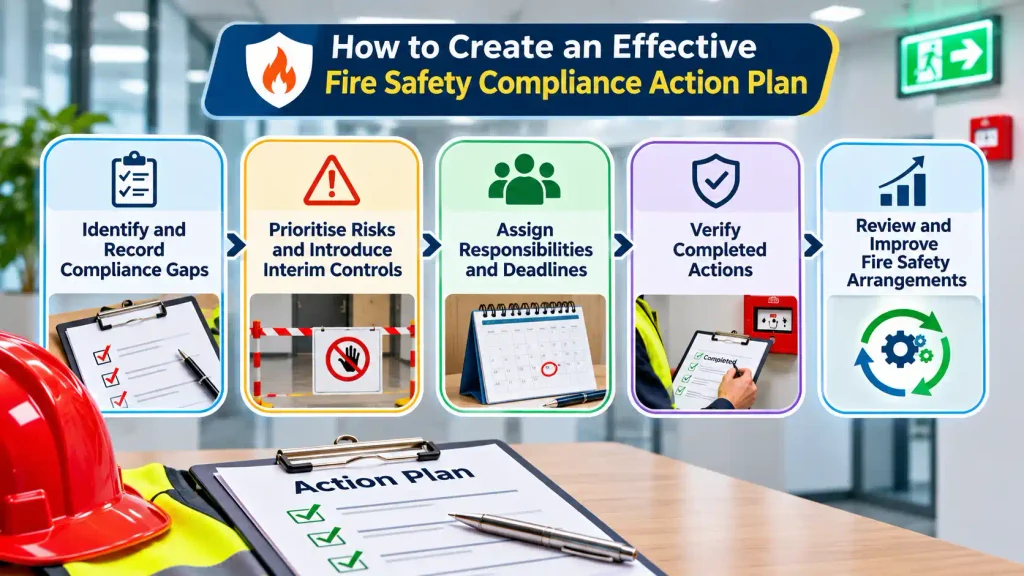
Identify and Record Compliance Gaps
The first step is to compare actual workplace conditions with the requirements identified through the fire risk assessment and applicable legal duties.
Examples include:
- Missing or unsuitable fire safety signage.
- Defective fire doors.
- Obstructed escape routes.
- Incomplete fire alarm records.
- Inadequate staff training.
- Unresolved emergency lighting defects.
- Poor storage arrangements.
- Incomplete contractor documentation.
Each finding should be recorded with enough information to understand the problem and determine the appropriate response.
Prioritise Risks and Introduce Interim Controls
Some deficiencies require immediate attention because they may directly affect people’s ability to escape or receive an adequate warning. For example, an unusable final exit or a serious failure in an essential alarm arrangement may require immediate management intervention.
Where permanent repairs cannot be completed immediately, employers should introduce appropriate interim measures based on competent advice and the actual risk. These may include restricting access to affected areas, arranging temporary precautions or changing operational arrangements. Interim controls must not become a substitute for permanent corrective work.
Assign Responsibilities and Deadlines
Every corrective action should have a clearly identified owner. This could be a facilities manager, maintenance supervisor, fire safety manager, departmental manager or external contractor.
The action plan should explain:
- What needs to be corrected.
- Why the action is necessary.
- Who is responsible.
- What resources are required.
- When the action should be completed.
- What evidence will demonstrate completion.
- Who will verify the result.
Clear ownership prevents important issues from being overlooked.
Verify Completed Actions
Employers should confirm that corrective work has addressed the original deficiency. For example, repairing a fire door should involve checking that the door closes correctly and that relevant components remain suitable for their intended function.
Similarly, after resolving an alarm system defect, appropriate testing and documentation should confirm that the system has returned to satisfactory operation. The responsible manager should update the action register and retain supporting evidence.
Review and Improve Fire Safety Arrangements
The final stage is to evaluate whether the improvements have strengthened workplace fire safety.
Managers should consider:
- Whether the identified problem has been resolved.
- Whether similar problems exist elsewhere.
- Whether additional employee training is necessary.
- Whether the fire risk assessment requires updating.
- Whether inspection procedures need improvement.
- Whether contractors are meeting expected standards.
- Whether management responsibilities remain clear.
This approach supports continuous improvement and helps organisations prevent repeated compliance failures.
Fire Safety Compliance Checklist: Printable Workplace Inspection Summary
Employers can use the following summary as a starting point for routine workplace inspections.
The checklist should be adapted to the premises, the fire risk assessment and the applicable legal requirements. It is not a substitute for a suitable fire risk assessment, technical maintenance or a competent specialist inspection.
Fire Safety Compliance Checklist for UK Employers and Commercial Premises
Workplace Inspection Reference | Complete and review each section to monitor workplace fire safety arrangements.
Premises Information
1. Fire Risk Assessment
2. Fire Prevention
3. Fire Detection and Warning
4. Escape Routes and Emergency Arrangements
5. Fire Protection Equipment
6. Employee Training and Evacuation
7. Documentation and Corrective Actions
8. Inspection Outcome
For a more detailed inspection programme, employers can convert this summary into a controlled workplace register with inspection history, action priorities, responsible individuals and evidence of completed work.
Building a Sustainable Fire Safety Compliance Management System
A checklist is most effective when it forms part of a wider workplace fire safety management system. Organisations should establish procedures that ensure fire safety responsibilities are understood, inspections are completed, defects are corrected and employees remain aware of potential hazards.
Establish Clear Management Responsibilities
Employers should identify the individuals responsible for managing different aspects of workplace fire safety.
For example, a facilities manager may coordinate equipment maintenance, while departmental managers oversee housekeeping and employee awareness. Responsibilities should be documented and communicated so that important activities are not overlooked.
Maintain a Centralised Fire Safety Record System
A centralised record system helps management maintain access to important fire safety information.
It should include:
- Current fire risk assessments.
- Inspection reports.
- Fire alarm maintenance records.
- Emergency lighting test reports.
- Fire door inspection records.
- Fire extinguisher servicing documentation.
- Employee training records.
- Evacuation drill reports.
- Contractor safety documentation.
- Outstanding corrective actions.
Digital systems can help organisations manage inspection schedules, assign tasks and monitor overdue actions. However, records must remain accurate, accessible and protected against unauthorised changes or loss.
Conduct Management Reviews
Senior management should periodically review fire safety performance rather than relying exclusively on individual inspection reports. A management review can examine recurring defects, overdue maintenance, employee training gaps, evacuation exercise findings and changes in workplace operations.
This helps organisations identify whether their fire safety arrangements are effective and whether additional resources or improvements are necessary.
Promote Employee Participation
Employees often identify workplace hazards before they appear in formal inspection reports. Organisations should encourage workers to report damaged equipment, obstructed escape routes, unsafe storage and other fire safety concerns.
Managers should provide accessible reporting channels and ensure that reported problems receive appropriate attention. A positive workplace fire safety culture develops when employees understand that preventing fires and protecting people are shared priorities.
How Inspire College Supports Workplace Fire Safety Knowledge and Professional Development
Effective fire safety management depends on appropriate knowledge, competent personnel and an understanding of workplace risks. Employers should ensure that employees receive fire safety information and instruction relevant to their responsibilities. Individuals assigned specialist fire safety duties may also require additional training to develop the knowledge and practical competence needed for their roles.
Professional fire safety training can support organisations by strengthening understanding of:
- Workplace fire hazards and prevention.
- Fire risk assessment principles.
- Emergency evacuation procedures.
- Fire protection arrangements.
- Fire safety management responsibilities.
- Inspection and maintenance awareness.
- Fire safety documentation.
- Workplace emergency response.
For organisations seeking to strengthen their internal capabilities, relevant fire safety courses and professional certifications can contribute to workforce development.
Inspire College provides vocational and professional learning opportunities that organisations and individuals can explore when identifying suitable training pathways.
You can explore the available programmes through the Inspire College website and add a contextual internal link here to the most relevant fire safety course or certification page.
Training should always be selected according to the individual’s responsibilities, the workplace risk profile and the level of competence required. Completing a training course does not automatically make someone competent to undertake every specialist fire safety assessment, inspection or maintenance activity.
Conclusion
Fire safety compliance is an ongoing responsibility that requires effective planning, regular inspections, suitable fire protection arrangements and active employee participation. For UK employers and commercial premises managers, a well-structured Fire Safety Compliance Checklist provides a practical way to assess workplace conditions, identify deficiencies and monitor improvements.
An effective checklist should cover fire risk assessments, prevention measures, detection systems, emergency escape routes, fire doors, emergency lighting, firefighting equipment, evacuation procedures, employee training and essential documentation. It should also reflect the specific risks associated with different premises, including offices, retail environments, warehouses, manufacturing facilities, restaurants, hotels and educational workplaces.
Employers must ensure that their fire safety arrangements comply with the legislation applicable to their premises. The Regulatory Reform (Fire Safety) Order 2005 provides the principal general framework in England and Wales, while Scotland and Northern Ireland operate under separate legislation. Understanding these differences is particularly important for organisations operating across multiple UK locations.
Most importantly, completing a checklist should lead to meaningful action. Identified deficiencies must be assessed, assigned to responsible individuals, corrected and verified. Regular reviews, suitable training and reliable documentation help organisations maintain effective fire safety arrangements as workplace conditions change.
By adopting a systematic approach to fire safety management, UK employers can strengthen workplace protection, improve emergency preparedness and demonstrate a consistent commitment to protecting employees, visitors, contractors and everyone who uses their commercial premises.
Recommended Authoritative Resources
The following official resources should be used when reviewing or updating the article and checking the legal requirements applicable to particular premises.
- GOV.UK – Fire Safety: Guidance for Those with Legal Duties.
- Regulatory Reform (Fire Safety) Order 2005.
- Fire Safety Act 2021.
- Fire Safety (England) Regulations 2022.
- Scottish Government – Non-Domestic Fire Safety.
- Northern Ireland Fire & Rescue Service – Business Fire Safety.
- Health and Safety Executive for Northern Ireland – Fire Safety.
Editorial note: This article provides general educational information and should not be interpreted as legal advice or a substitute for a suitable and sufficient fire risk assessment. Employers should check current legislation, official guidance and competent professional advice before making compliance decisions.
Frequently Asked Questions About Fire Safety Compliance
Find practical answers to additional fire safety compliance questions for UK employers, business owners and commercial premises managers.
Who is responsible for fire safety in a shared commercial building?
Responsibility may be shared between employers, landlords, managing agents, building owners and other parties who have control over different parts of the premises. Each responsible person must understand their area of responsibility and cooperate with others to coordinate fire safety arrangements.
For example, a tenant may manage fire safety within its office, while the building manager oversees shared corridors and common areas. Responsibilities should be clearly communicated and documented.
Read official workplace fire safety guidanceDo employers need individual evacuation arrangements for disabled employees?
Employers should consider the individual evacuation needs of employees, regular visitors and other people who may need assistance during an emergency. A Personal Emergency Evacuation Plan (PEEP) can document the support, equipment, communication arrangements and escape procedures required by an individual.
Plans should be developed through consultation with the individual and reviewed when their needs or workplace arrangements change. Suitable arrangements should also consider temporary visitors who may need assistance.
Read guidance on means of escape for disabled peopleWhat fire safety information should employers provide to contractors?
Contractors should receive relevant information about workplace fire hazards, emergency alarms, evacuation routes, assembly points, restricted areas and site-specific safety procedures before starting work.
Employers should also coordinate arrangements where contractor activities could affect other occupants. Work involving heat, sparks or other ignition sources may require additional precautions, suitable authorisation and supervision.
When should a commercial fire risk assessment be reviewed after workplace changes?
A fire risk assessment should be reviewed when there is reason to suspect that it is no longer valid or when significant changes could affect fire safety. Examples include building alterations, changes in business activities, new machinery, different storage arrangements or increased occupancy.
Employers should assess whether these changes introduce additional hazards, affect escape routes or require adjustments to existing fire precautions.
Explore UK workplace fire safety responsibilitiesDo fire safety compliance requirements differ across England, Scotland, Wales and Northern Ireland?
Yes. Although the four UK nations share the objective of protecting people from fire risks, their fire safety legislation, guidance and enforcement arrangements are not identical.
Employers operating in multiple UK nations should identify the legal requirements applicable to each workplace rather than relying on one generic checklist for every location. The assessment and management arrangements should reflect the relevant national framework.
Check workplace fire safety guidance and national differencesCan employers delegate fire safety responsibilities to an external contractor?
Employers and other legally responsible persons can appoint competent contractors or specialist consultants to help manage fire safety activities. However, appointing an external provider does not automatically remove the responsible person’s legal duties.
The organisation should maintain appropriate oversight, check the contractor’s competence, agree the scope of work and ensure that identified defects and recommendations receive suitable attention.
Read guidance on responsible person duties