
Fire Extinguisher Selection Explained: Protect Lives with the Right Fire Class Choice
Choosing the correct fire extinguisher is one of the most important decisions in workplace fire safety. A fire extinguisher can prevent a small fire from becoming a life-threatening emergency, but only when the correct extinguisher is used for the specific type of fire. Using the wrong extinguisher can worsen the situation, spread the fire, cause explosions, or place lives at greater risk.
Effective Fire Extinguisher Selection is not simply about recognising different extinguisher colours. It involves understanding fire classes, identifying workplace hazards, complying with UK fire safety legislation, and ensuring employees receive appropriate fire safety training. Every commercial building, whether an office, warehouse, school, hotel, healthcare facility, or manufacturing plant, presents unique fire risks that require carefully selected firefighting equipment.
In the UK, employers and Responsible Persons have legal duties under the Regulatory Reform (Fire Safety) Order 2005 to provide suitable firefighting equipment where necessary. The selection, installation, maintenance, and positioning of fire extinguishers should always be based on a comprehensive Fire Risk Assessment rather than guesswork.
This guide explains everything you need to know about Fire Extinguisher Selection, including fire classes, extinguisher types, colour codes, British Standards, workplace recommendations, and practical guidance for choosing the right extinguisher for every fire class. Whether you are responsible for workplace safety or planning a career in fire safety management, this resource will help you make informed decisions that protect lives and property.
Why Fire Extinguisher Selection Matters
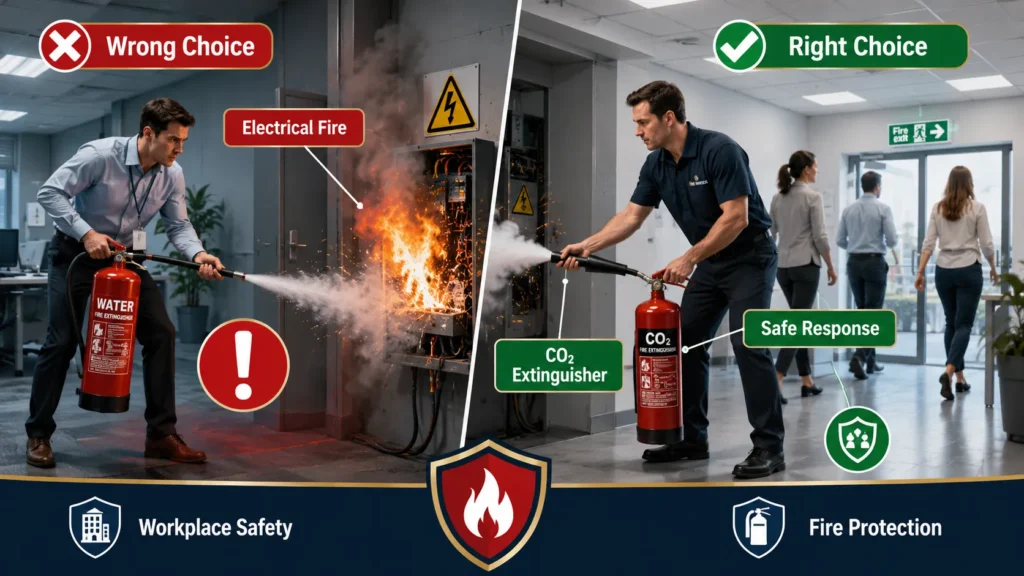
A portable fire extinguisher is often the first line of defence against a developing fire. When selected correctly and used by a trained person, it can control or extinguish a small fire before emergency services arrive.
However, not every extinguisher is suitable for every fire.
For example:
- Using a water extinguisher on an electrical fire can result in electric shock.
- Using water on burning cooking oil may cause a dangerous fireball.
- Using an unsuitable extinguisher on flammable liquids can spread the fire rapidly.
- Incorrect extinguisher selection may increase property damage and place occupants at greater risk.
Proper Fire Extinguisher Selection helps organisations:
- Protect employees, visitors, and customers.
- Reduce fire-related injuries.
- Minimise damage to buildings and equipment.
- Support faster emergency response.
- Meet legal fire safety obligations.
- Improve workplace resilience.
- Increase confidence during emergency situations.
Selecting the correct extinguisher is therefore a critical component of an effective fire safety strategy.
Fire Extinguisher Selection Starts with a Fire Risk Assessment
One of the biggest misconceptions is that organisations should purchase extinguishers based solely on the building type or available budget.
In reality, Fire Extinguisher Selection should always begin with a suitable and sufficient Fire Risk Assessment.
A Fire Risk Assessment identifies:
- Potential ignition sources.
- Combustible materials.
- Occupancy levels.
- Escape routes.
- High-risk work activities.
- Electrical hazards.
- Cooking facilities.
- Chemical storage.
- Flammable liquids.
- Special fire risks.
Only after these hazards have been identified can the appropriate extinguisher types and quantities be determined.
This risk-based approach ensures compliance with UK fire safety legislation while improving workplace protection.
The Fire Extinguisher Selection Process
Flowchart: Fire Extinguisher Selection Journey
Conduct Fire Risk Assessment
↓
Identify Fire Hazards
↓
Determine Fire Classes Present
↓
Select Suitable Fire Extinguishers
↓
Install in Correct Locations
↓
Train Employees
↓
Inspect & Maintain Regularly
↓
Review After Workplace Changes
This structured process ensures that fire extinguishers remain effective throughout the life of the building and continue to meet changing workplace risks.
Understanding Fire Classes
Before selecting an extinguisher, it is essential to understand the different classes of fire recognised in the UK.
Each fire class is based on the type of fuel involved. Because different fuels burn in different ways, each requires a specific extinguishing agent.
Choosing the wrong extinguisher can make the fire significantly more dangerous.
Class A Fires
Class A fires involve ordinary combustible materials such as:
- Wood
- Paper
- Cardboard
- Textiles
- Furniture
- Plastics (non-melting types)
These are among the most common workplace fires.
Typical locations include:
- Offices
- Schools
- Hotels
- Warehouses
- Retail stores
Class B Fires
Class B fires involve flammable liquids including:
- Petrol
- Diesel
- Paint
- Solvents
- Oils
- Alcohol
- Adhesives
These fires spread rapidly because vapours ignite easily.
Common environments include:
- Workshops
- Garages
- Manufacturing facilities
- Chemical storage areas
Class C Fires
Class C fires involve flammable gases such as:
- Propane
- Butane
- Methane
- LPG
Gas fires should only be tackled if the gas supply can be safely isolated.
Typical locations include:
- Commercial kitchens
- Industrial facilities
- Laboratories
- Heating plant rooms
Class D Fires
Class D fires involve combustible metals, including:
- Magnesium
- Aluminium powder
- Titanium
- Sodium
- Potassium
- Lithium (metal)
These fires require specialist extinguishing agents and should only be tackled by trained personnel.
Common locations include:
- Metal processing plants
- Aerospace manufacturing
- Research laboratories
Electrical Fires
Although electrical fires are not a separate fire class in the UK, they present a unique hazard because electricity remains energised.
Common causes include:
- Faulty wiring
- Overloaded sockets
- Electrical panels
- Servers
- Machinery
- Switchgear
Electricity should be isolated before extinguishing whenever it is safe to do so.
Class F Fires
Class F fires involve:
- Cooking oils
- Deep-fat fryers
- Vegetable oils
- Animal fats
These fires burn at extremely high temperatures and can reignite quickly.
They are most commonly found in:
- Restaurants
- Hotels
- Commercial kitchens
- Cafeterias
- Food production facilities
Fire Classes at a Glance
| Fire Class | Fuel Source | Common Workplace Examples |
|---|---|---|
| Class A | Solid combustibles | Offices, schools, hotels, retail stores |
| Class B | Flammable liquids | Workshops, garages, warehouses |
| Class C | Flammable gases | Plant rooms, laboratories, industrial sites |
| Class D | Combustible metals | Manufacturing, aerospace, laboratories |
| Electrical Hazard | Energised electrical equipment | Offices, server rooms, factories |
| Class F | Cooking oils and fats | Restaurants, hotels, commercial kitchens |
Understanding these fire classes forms the foundation of effective Fire Extinguisher Selection and ensures that organisations choose equipment capable of tackling the specific hazards present in their premises.
Types of Fire Extinguishers Explained
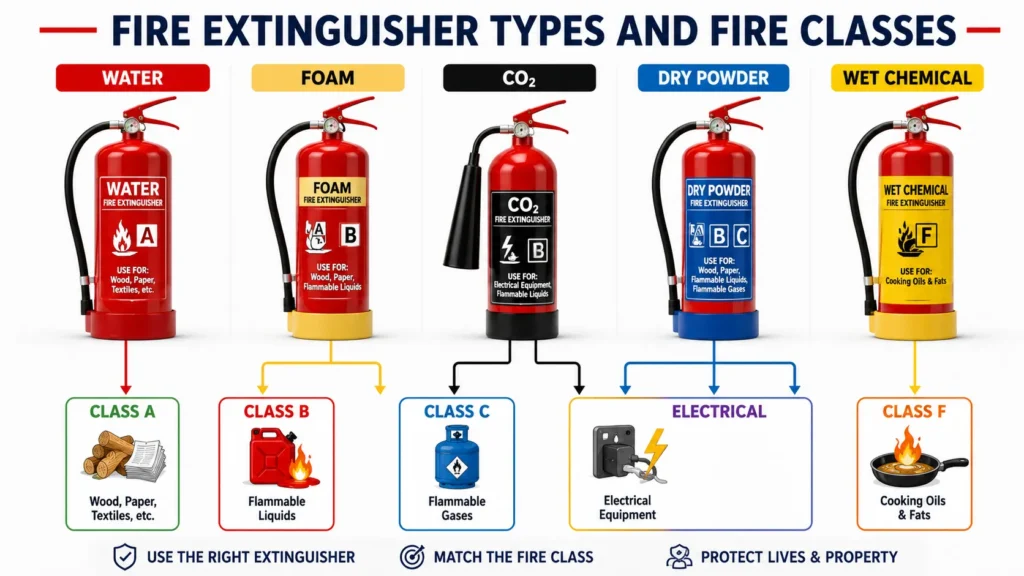
Different extinguishers contain different extinguishing agents, each designed to combat specific types of fire.
Selecting the correct extinguisher depends entirely on the fire risks identified during the Fire Risk Assessment.
Water Fire Extinguishers
Water extinguishers are the most common type found in offices, schools, retail premises, and public buildings.
They work by cooling burning materials until combustion stops.
Suitable for:
- Class A fires
Not suitable for:
- Flammable liquids
- Electrical equipment
- Cooking oils
- Metal fires
Foam Fire Extinguishers
Foam extinguishers create a blanket over burning liquids, cutting off oxygen while also cooling the fire.
Suitable for:
- Class A fires
- Class B fires
Common locations include:
- Offices
- Warehouses
- Garages
- Fuel storage areas
Carbon Dioxide (CO₂) Fire Extinguishers
CO₂ extinguishers remove oxygen around the fire without leaving residue, making them particularly suitable for protecting valuable electrical equipment.
Suitable for:
- Electrical equipment
- Class B fires
Typical locations include:
- Offices
- Server rooms
- Electrical switch rooms
- Laboratories
- Data centres
Dry Powder Fire Extinguishers
Dry powder extinguishers interrupt the chemical reaction that sustains combustion.
They are highly versatile and capable of tackling several fire types.
Suitable for:
- Class A
- Class B
- Class C
However, because powder reduces visibility and may present respiratory concerns, its use inside occupied buildings is generally limited.
Wet Chemical Fire Extinguishers
Wet chemical extinguishers are specifically designed for Class F fires involving cooking oils and fats.
They cool the burning oil while forming a protective layer that helps prevent re-ignition.
Typical applications include:
- Commercial kitchens
- Restaurants
- Hotels
- Catering facilities
Fire Extinguisher Selection Overview
| Extinguisher Type | Suitable For | Typical Workplace |
|---|---|---|
| Water | Class A | Offices, schools, retail |
| Foam | Class A & B | Warehouses, garages, factories |
| CO₂ | Electrical & Class B | Offices, server rooms, laboratories |
| Dry Powder | Class A, B & C | Industrial environments |
| Wet Chemical | Class F | Commercial kitchens, hotels |
Fire Extinguisher Colour Codes Explained
Fire extinguisher colour coding helps users quickly identify the extinguishing agent inside the cylinder. While all extinguishers manufactured under BS EN 3 have a red body, coloured bands indicate the type of extinguishing medium they contain.
Although colour identification is useful, Fire Extinguisher Selection should never rely on colour alone. Always check the extinguisher label, fire rating, and intended application before use.
Water Extinguishers – Red Label
Water extinguishers are designed for ordinary combustible materials.
Suitable for:
- Class A fires
Common locations:
- Offices
- Schools
- Libraries
- Retail stores
- Hotels
Foam Extinguishers – Cream Label
Foam extinguishers provide effective protection against solid combustible materials and flammable liquids.
Suitable for:
- Class A fires
- Class B fires
Common locations:
- Warehouses
- Vehicle workshops
- Manufacturing facilities
- Petrol stations
Carbon Dioxide (CO₂) Extinguishers – Black Label
CO₂ extinguishers leave no residue, making them ideal for protecting sensitive electrical equipment.
Suitable for:
- Electrical equipment
- Class B fires
Common locations:
- Server rooms
- Offices
- Electrical switch rooms
- Laboratories
Dry Powder Extinguishers – Blue Label
Dry powder extinguishers are versatile and can tackle multiple fire classes. However, they are generally recommended for outdoor or industrial environments because the powder reduces visibility and may create respiratory irritation.
Suitable for:
- Class A
- Class B
- Class C
Typical locations:
- Construction sites
- Fuel storage
- Industrial plants
- Agricultural facilities
Wet Chemical Extinguishers – Yellow Label
Wet chemical extinguishers are specifically designed for commercial catering environments.
Suitable for:
- Class F fires
- Limited Class A fires
Typical locations:
- Restaurants
- Hotels
- School kitchens
- Food production facilities
Fire Extinguisher Colour Code Reference
| Colour Band | Extinguisher Type | Suitable Fire Classes | Typical Workplace |
|---|---|---|---|
| Red | Water | Class A | Offices, schools |
| Cream | Foam | Class A, B | Warehouses, garages |
| Black | CO₂ | Electrical, Class B | Offices, server rooms |
| Blue | Dry Powder | Class A, B, C | Industrial sites |
| Yellow | Wet Chemical | Class F | Commercial kitchens |
Understanding these colour codes supports quicker identification during emergencies, but training and clear signage remain essential.
Fire Class vs Fire Extinguisher Selection
One of the most effective ways to improve workplace fire safety is by matching each fire class with the correct extinguisher type.
Using an unsuitable extinguisher can rapidly increase the danger.
Fire Class and Extinguisher Compatibility
| Fire Class | Water | Foam | CO₂ | Dry Powder | Wet Chemical |
|---|---|---|---|---|---|
| Class A | ✓ | ✓ | ✗ | ✓ | Limited |
| Class B | ✗ | ✓ | ✓ | ✓ | ✗ |
| Class C | ✗ | ✗ | ✗ | ✓ | ✗ |
| Electrical Equipment | ✗ | ✗ | ✓ | ✓ | ✗ |
| Class D | ✗ | ✗ | ✗ | Specialist Only | ✗ |
| Class F | ✗ | ✗ | ✗ | ✗ | ✓ |
This comparison highlights why Fire Extinguisher Selection should always be based on the fire hazard rather than convenience or appearance.
How to Choose the Right Fire Extinguisher
Selecting the correct extinguisher involves more than identifying the type of fuel. A systematic approach improves workplace safety and supports legal compliance.
Before choosing an extinguisher, consider:
- What materials are present?
- What ignition sources exist?
- Are electrical systems involved?
- Will the building contain members of the public?
- Are cooking facilities available?
- Are flammable liquids stored?
- Are hazardous gases or metals present?
- Have employees received extinguisher training?
The answers to these questions determine which extinguisher types are required.
Fire Extinguisher Selection Decision Process
Flowchart: Selecting the Correct Fire Extinguisher
Identify Fire Hazard
↓
Determine Fuel Source
↓
Identify Fire Class
↓
Check for Electrical Risk
↓
Select Suitable Fire Extinguisher
↓
Verify Employee Training
↓
Safe to Fight Fire?
↓ ↓
Yes No
↓ ↓
Use Correct Evacuate &
Extinguisher Call Fire Service
This decision-making process encourages people to prioritise life safety over attempting to fight fires unnecessarily.
Fire Risk Assessment and Fire Extinguisher Selection
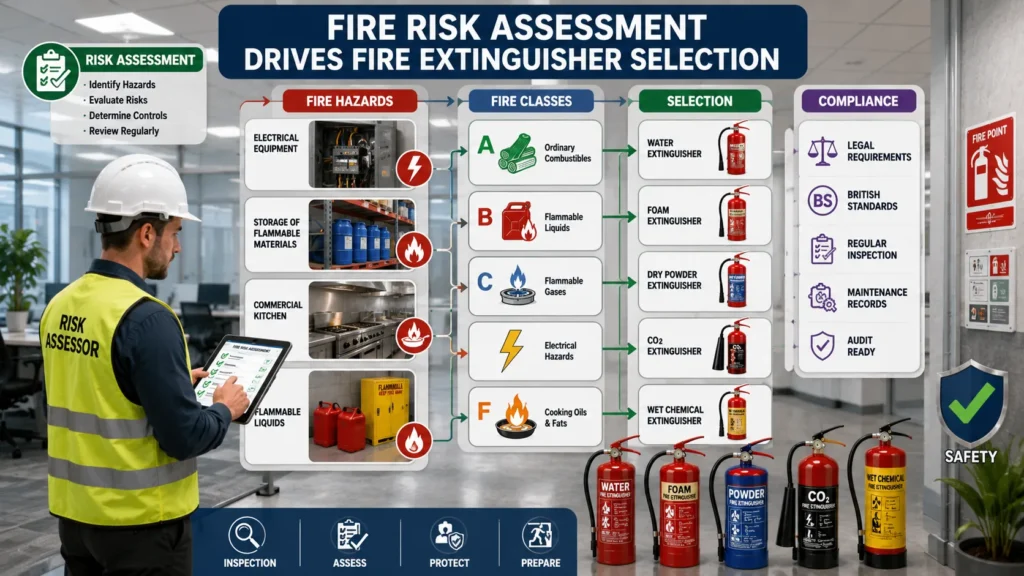
Every commercial building presents different fire risks. Consequently, extinguisher provision should never follow a one-size-fits-all approach.
A competent Fire Risk Assessment identifies:
- Sources of ignition.
- Combustible materials.
- Hazardous processes.
- Escape routes.
- Occupancy levels.
- Vulnerable persons.
- Electrical hazards.
- Cooking facilities.
- Storage arrangements.
- High-risk activities.
The findings determine:
- Number of extinguishers required.
- Extinguisher types.
- Capacity and fire rating.
- Installation locations.
- Signage requirements.
- Employee training needs.
This risk-based methodology ensures that Fire Extinguisher Selection supports both life safety and legal compliance.
Fire Extinguisher Selection by Workplace Type
Different workplaces require different combinations of extinguishers because fire hazards vary significantly.
Office Buildings
Typical hazards include:
- Electrical equipment
- Paper
- Furniture
- Kitchenettes
Recommended extinguishers:
- Water
- CO₂
Warehouses
Common hazards:
- Packaging
- Pallets
- Flammable liquids
- Machinery
Recommended extinguishers:
- Water
- Foam
- CO₂ (electrical areas)
Retail Stores
Fire risks include:
- Electrical displays
- Stock storage
- Packaging
- Public occupancy
Recommended extinguishers:
- Water
- Foam
- CO₂
Hotels
Hotels combine accommodation, restaurants, kitchens, and plant rooms.
Recommended extinguishers:
- Water
- Foam
- CO₂
- Wet Chemical (kitchens)
Restaurants and Commercial Kitchens
Primary hazards include:
- Cooking oils
- Electrical appliances
- Gas supplies
Recommended extinguishers:
- Wet Chemical
- CO₂ (electrical equipment)
Schools and Colleges
Typical hazards include:
- Paper
- Furniture
- Science laboratories
- Electrical equipment
Recommended extinguishers:
- Water
- CO₂
- Foam where appropriate
Healthcare Facilities
Hospitals contain:
- Medical gases
- Electrical equipment
- Laboratories
- Kitchens
Recommended extinguishers:
- Water
- CO₂
- Wet Chemical
- Specialist extinguishers where required
Manufacturing Facilities
Hazards vary depending on production processes.
Potential risks include:
- Flammable liquids
- Electrical equipment
- Machinery
- Gas cylinders
- Metal processing
Recommended extinguisher combinations should always be determined through a detailed Fire Risk Assessment.
Why Employee Training Is Essential
Even correctly selected extinguishers become ineffective if employees do not know when or how to use them.
Training should cover:
- Fire classes.
- Extinguisher identification.
- Safe operating techniques.
- Emergency evacuation procedures.
- Situations where extinguishers should not be used.
- Raising the alarm.
- Calling emergency services.
Practical demonstrations and periodic refresher training improve confidence and reduce the likelihood of incorrect extinguisher use during emergencies.
Common Mistakes During Fire Extinguisher Selection
Many organisations unknowingly reduce their level of fire protection through poor extinguisher planning.
Frequent mistakes include:
Choosing Based Only on Colour
Colour coding is helpful but should never replace reading the extinguisher label or understanding the fire risks present.
Ignoring Electrical Hazards
Many workplaces install water extinguishers but fail to provide suitable protection for electrical equipment.
Using the Same Extinguisher Everywhere
Different areas of a building often require different extinguisher types. A kitchen, office, warehouse, and plant room rarely share identical fire risks.
Overlooking Employee Training
Installing extinguishers without providing fire safety training can create a false sense of security.
Failing to Review After Workplace Changes
Office refurbishments, new machinery, warehouse expansion, or process changes may introduce new hazards requiring different extinguisher provision.
Flowchart: Fire Risk Assessment to Fire Extinguisher Selection
Assess Workplace Risks
↓
Identify Fire Hazards
↓
Determine Fire Classes
↓
Select Suitable Extinguishers
↓
Install Correct Signage
↓
Train Employees
↓
Inspect & Maintain Equipment
↓
Review Following Workplace Changes
This continuous improvement cycle ensures that Fire Extinguisher Selection remains effective as workplaces evolve.
Where Should Fire Extinguishers Be Installed?
Even the most suitable extinguisher will be ineffective if it cannot be reached quickly during an emergency. Fire extinguishers should be positioned where they are clearly visible, easily accessible, and located close to identified fire hazards without obstructing escape routes.
The exact number and location of extinguishers should always be determined through a Fire Risk Assessment and installed in accordance with relevant British Standards, including BS 5306.
Fire extinguishers are commonly installed:
- Near final exit doors.
- Along escape routes.
- At corridor intersections.
- Near electrical switch rooms.
- Adjacent to commercial kitchens.
- Close to boiler rooms.
- Near workshops and plant rooms.
- Beside server and IT rooms.
- Near storage areas containing flammable materials.
- At warehouse loading bays.
Extinguishers should never be hidden behind furniture, stored inside cupboards, or placed where access could be blocked during an emergency.
Fire Extinguisher Placement Checklist
| Workplace Area | Recommended Extinguisher |
|---|---|
| Office workspace | Water, CO₂ |
| Reception | Water |
| Server room | CO₂ |
| Electrical switch room | CO₂ |
| Warehouse | Water, Foam |
| Workshop | Foam, CO₂ |
| Commercial kitchen | Wet Chemical, CO₂ |
| Laboratory | CO₂, Specialist (where required) |
| Plant room | CO₂ |
| Loading bay | Foam |
Proper placement improves response times and supports safer evacuation by ensuring firefighting equipment is available where it is most likely to be needed.
How to Use a Fire Extinguisher Safely
Having the correct extinguisher is only one part of effective fire safety. Employees should understand how to operate portable extinguishers safely and recognise when evacuation is the safer option.
The internationally recognised PASS method provides a simple approach.
Pull
Pull the safety pin to unlock the extinguisher.
Aim
Aim the nozzle at the base of the fire rather than the flames.
Squeeze
Squeeze the operating handle to discharge the extinguishing agent.
Sweep
Sweep the nozzle from side to side until the fire is extinguished or the extinguisher is empty.
Only trained individuals should attempt to tackle a fire, and only when it is safe to do so.
When Should You Not Use a Fire Extinguisher?
One of the most overlooked aspects of Fire Extinguisher Selection is understanding when not to use one.
Fire extinguishers are intended for small, contained fires during the early stages of development.
Do not attempt to fight a fire if:
- The fire is spreading rapidly.
- Smoke is making breathing difficult.
- Flames are reaching the ceiling.
- You do not know which extinguisher to use.
- Your escape route could become blocked.
- Hazardous chemicals are involved.
- Gas cylinders are threatened by heat.
- The fire has already filled the room.
- You have not received fire extinguisher training.
In these situations:
- Raise the alarm.
- Evacuate immediately.
- Close doors behind you if safe.
- Call the Fire and Rescue Service.
Protecting life should always take priority over protecting property.
Fire Extinguisher Inspection and Maintenance
Selecting the correct extinguisher is only the beginning. Ongoing inspection and maintenance ensure extinguishers remain ready for use throughout their service life.
Regular inspections help identify:
- Physical damage.
- Missing safety pins.
- Pressure loss.
- Corrosion.
- Obstructed access.
- Missing identification labels.
- Expired servicing dates.
A planned maintenance programme also demonstrates compliance during fire safety inspections.
Fire Extinguisher Maintenance Schedule
| Maintenance Activity | Frequency | Purpose |
|---|---|---|
| Visual inspection | Monthly | Confirm extinguisher is present, accessible, and undamaged |
| Professional servicing | Annually | Ensure extinguisher remains fully operational |
| Extended service | As recommended by manufacturer and British Standards | Replace or overhaul components |
| Pressure check | During servicing | Confirm correct operating pressure |
| Record updates | After every inspection or service | Demonstrate legal compliance |
Maintaining accurate inspection records supports due diligence and provides evidence that fire safety equipment is being managed responsibly.
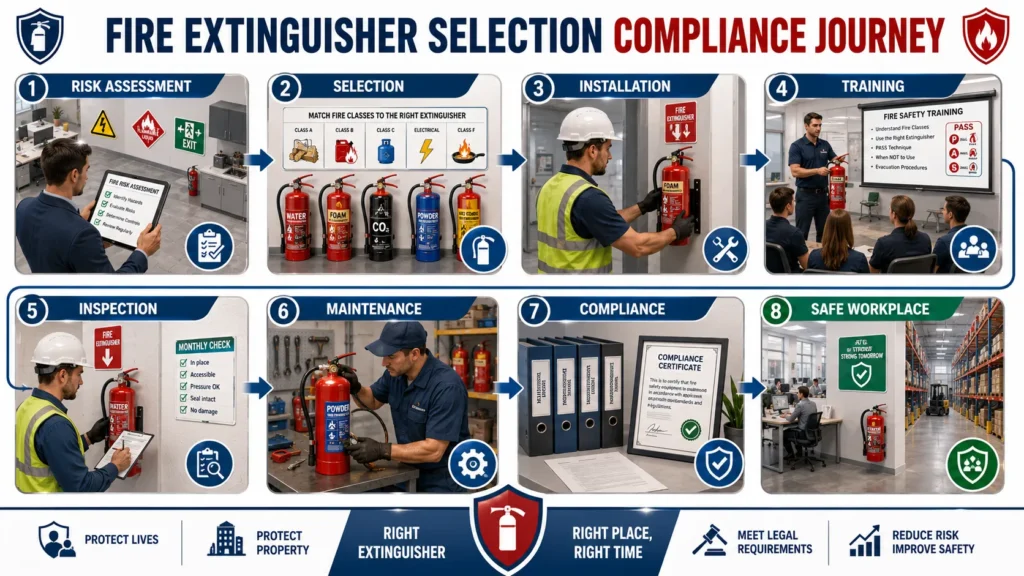
Fire Extinguisher Lifecycle
Like all safety equipment, portable fire extinguishers have a defined lifecycle.
They should be monitored from installation through to replacement.
Flowchart: Fire Extinguisher Lifecycle
Fire Risk Assessment
↓
Fire Extinguisher Selection
↓
Installation
↓
Employee Training
↓
Monthly Inspection
↓
Annual Servicing
↓
Extended Maintenance
↓
Replacement
↓
Continuous Fire Safety Compliance
Regular review ensures extinguishers remain suitable as workplace risks evolve.
Modern Trends in Fire Extinguisher Management
Fire safety technology continues to evolve, helping organisations manage equipment more efficiently while improving compliance.
Smart Fire Extinguishers
Some modern extinguishers include sensors that monitor pressure, location, and service status in real time.
Benefits include:
- Faster fault detection.
- Reduced manual inspections.
- Improved compliance reporting.
- Enhanced asset management.
QR Code Inspections
Many organisations now use QR codes attached to extinguishers.
Inspectors can:
- Record inspections digitally.
- Access service history.
- Report defects instantly.
- Update maintenance records using mobile devices.
Digital Compliance Systems
Cloud-based fire safety management platforms allow facilities managers to:
- Schedule servicing.
- Monitor inspection dates.
- Store compliance documents.
- Receive maintenance reminders.
- Produce audit reports quickly.
These technologies improve efficiency while reducing the risk of missed inspections.
Common Fire Extinguisher Selection Mistakes
Even organisations with suitable firefighting equipment can experience compliance issues due to avoidable mistakes.
Common errors include:
- Selecting extinguishers without completing a Fire Risk Assessment.
- Providing too few extinguishers for the building size.
- Installing extinguishers in inaccessible locations.
- Failing to provide specialist extinguishers where required.
- Ignoring changes to building layouts.
- Missing annual servicing.
- Allowing inspection records to become incomplete.
- Assuming employees know how to use extinguishers without training.
- Choosing extinguishers based solely on cost rather than risk.
Avoiding these mistakes significantly improves workplace safety and legal compliance.
Why Fire Extinguisher Training Is Essential
Even the best Fire Extinguisher Selection cannot protect people unless staff understand how to respond during an emergency.
Effective fire safety training helps employees:
- Recognise different fire classes.
- Identify extinguisher types.
- Operate extinguishers safely.
- Understand evacuation procedures.
- Protect themselves and others.
- Make informed decisions during emergencies.
Training also supports compliance with workplace health and safety responsibilities and builds confidence across the workforce.
Recommended Fire Safety Courses
To strengthen workplace fire safety knowledge and develop practical skills, consider linking this article to relevant training programmes available through Inspire College.
Suggested internal links include:
- Level 3 Award in Fire Safety Awareness
- Level 3 Award in Fire Marshal Training
- Level 4 Diploma in Fire Safety
- Level 5 Diploma in Fire Safety and Risk Management
- Fire Risk Assessment Training
- Fire Warden Training
- Health and Safety in the Workplace
- Workplace Risk Assessment Training
- IOSH Managing Safely
- Construction Health and Safety Courses
- Occupational Health and Safety Qualifications
- Facilities Management Programmes
These courses support professionals responsible for fire safety, facilities management, compliance, and workplace risk management while reinforcing your website’s topical authority.
Why Fire Extinguisher Selection Is a Key Part of Workplace Fire Safety
Fire extinguishers should never be viewed as standalone pieces of equipment. They are one element of a wider fire safety strategy that includes:
- Fire Risk Assessments.
- Fire detection and alarm systems.
- Emergency lighting.
- Clearly marked escape routes.
- Fire safety signage.
- Employee training.
- Routine fire drills.
- Planned equipment maintenance.
- Emergency evacuation procedures.
When these measures work together, organisations create a safer environment for employees, visitors, contractors, and customers.
Conclusion
Effective Fire Extinguisher Selection is about much more than choosing a cylinder with the correct colour band. It requires a clear understanding of fire classes, workplace hazards, British Standards, and legal responsibilities. Selecting the appropriate extinguisher for each fire risk, positioning it correctly, maintaining it regularly, and ensuring employees receive suitable training all contribute to a safer workplace and a more effective emergency response.
A thorough Fire Risk Assessment should always form the foundation of every fire extinguisher strategy. By identifying specific hazards, organisations can provide the right equipment for each area, reduce the likelihood of incorrect extinguisher use, and improve compliance with UK fire safety legislation.
As workplaces continue to adopt digital inspection systems, smart monitoring technologies, and proactive fire safety management practices, maintaining effective Fire Extinguisher Selection becomes easier and more reliable. However, technology cannot replace the importance of competent risk assessment, regular maintenance, and ongoing staff training.
By following the guidance outlined in this article, businesses can protect lives, minimise property damage, strengthen legal compliance, and create a workplace where employees are prepared to respond safely and confidently if a fire occurs.