
Regulatory Reform (Fire Safety) Order 2005: Duties, Responsibilities and Compliance
Fire safety is a legal responsibility for businesses, employers, property owners and people who manage premises. In England and Wales, the Regulatory Reform (Fire Safety) Order 2005 (FSO) establishes the principal framework for managing fire risks in most non-domestic premises and the common parts of buildings containing two or more domestic premises. It requires those with relevant control to assess risks, implement suitable precautions and maintain effective fire safety arrangements.
Understanding the Regulatory Reform (Fire Safety) Order 2005, including its duties, responsibilities and compliance requirements, is essential for protecting employees, visitors, contractors, residents and other people who may be affected by a fire.
However, compliance involves more than installing alarms or displaying evacuation notices. Organisations must understand who holds legal responsibilities, assess the actual risks present, maintain escape routes, provide appropriate training, inspect relevant safety equipment and review arrangements when circumstances change.
This guide explains the key provisions of the Fire Safety Order, the role of the responsible person, the practical steps for compliance, the consequences of non-compliance and the training options that can support professional development.
Legal scope: This guide focuses on England and Wales. Scotland and Northern Ireland operate under different fire safety legislation. The information is educational and should be checked against the current legislation and official guidance applicable to your premises.
What is the Regulatory Reform (Fire Safety) Order 2005?
The Regulatory Reform (Fire Safety) Order 2005 is a statutory instrument that establishes legal duties for fire safety in relevant premises in England and Wales. It came into force on 1 October 2006 and introduced a risk-based approach that places responsibility for identifying and managing fire hazards on those who control premises.
Rather than relying on a general fire safety certificate as proof of compliance, the framework requires a responsible person to assess the risks and put appropriate precautions in place.
The legislation covers matters including:
- Fire risk assessment and prevention.
- Fire detection, warning and firefighting arrangements.
- Emergency routes and exits.
- Emergency procedures and evacuation planning.
- Fire safety maintenance and record-keeping.
- Employee information and training.
- Cooperation between responsible persons.
- Enforcement by the relevant authorities.
The precise measures required depend on the premises, their use, the people who may be affected and the risks identified.
Who does the Fire Safety Order apply to?
The Order applies to most workplaces and non-domestic premises, including offices, shops, warehouses, factories, schools, hotels, restaurants and many other commercial or public buildings. It also applies to the common parts of buildings containing two or more domestic premises.
For example, a business owner may have responsibilities for a shop, an employer may be responsible for workplace fire precautions, and a building manager may have duties relating to shared corridors, staircases or other common areas.
The precise allocation of responsibility depends on legal control, the nature of the premises and any relevant contractual arrangements. Domestic premises are not generally covered in their entirety by the Order, although relevant common parts and certain building elements are covered.
Official guidance should be consulted for specialist premises and circumstances.
Who Is the Responsible Person Under the Fire Safety Order?
The responsible person is the person or organisation with the legal responsibility to implement the relevant fire safety duties under the Order.
Under Article 3, the responsible person is generally:
- The employer, where a workplace is under the employer’s control.
- The person controlling other relevant premises in connection with a business or undertaking.
- The owner, in circumstances where the relevant premises are not controlled by another person in connection with a business or undertaking.
A responsible person may be an individual, a company or another organisation, depending on the circumstances.
Examples of responsible persons
| Premises or situation | Potential responsible person |
|---|---|
| Commercial office | Employer or organisation controlling the workplace |
| Retail shop | Business operator or other person with relevant control |
| Hotel or guesthouse | Operator or organisation controlling the premises |
| Shared residential building | Person or organisation responsible for the relevant common parts |
| Commercial premises with a landlord and tenant | Landlord, tenant or both, depending on their respective areas of control and duties |
| Contractor working at a client site | The contractor may have relevant duties for areas or activities under their control, alongside the site’s responsible person |
These are examples rather than automatic legal assignments. The facts of each arrangement matter.
Can a building have more than one responsible person?
Yes. More than one person can hold responsibilities for the same premises or different parts of them.
For example, a landlord may control communal stairways while a tenant operates a commercial unit. Each party must understand the extent of their control, meet their applicable duties and cooperate with other responsible persons where required.
Article 22 addresses cooperation and coordination. Simply assigning fire safety responsibilities to another organisation does not necessarily remove a person’s own legal obligations.
Practical recommendation: Document who is responsible for each relevant area, who maintains each fire safety system, who manages evacuation procedures and how identified defects will be reported and resolved.
What Are the Main Duties Under the Regulatory Reform (Fire Safety) Order 2005?
The Order contains specific legal duties across several articles. Understanding these provisions helps organisations turn general fire safety expectations into a manageable compliance programme.
Article 8: General fire precautions
Article 8 requires the responsible person to take appropriate general fire precautions to protect employees, so far as is reasonably practicable, and to protect other relevant persons in accordance with the requirements of the Order.
General fire precautions include measures to reduce the risk of fire and its spread, provide safe means of escape and support the safe use of escape routes. They also include appropriate arrangements for firefighting, fire detection and emergency procedures.
In practice, this can mean controlling ignition sources, managing combustible materials, ensuring exits remain usable and providing suitable warning systems.
Article 9: Fire risk assessment
Article 9 requires a suitable and sufficient assessment of the risks to which relevant persons may be exposed. The assessment identifies the precautions needed to comply with the Order.
A meaningful assessment should consider:
- Potential sources of ignition.
- Combustible materials and sources of fuel.
- People who could be affected by fire.
- Existing prevention and protection measures.
- Escape routes and evacuation arrangements.
- Fire detection and warning systems.
- Any dangerous substances present.
- Additional measures required to reduce identified risks.
The assessment must be reviewed regularly and when circumstances make a review necessary. Significant changes to the premises, work activities or identified hazards may trigger a review.
Article 10: Principles of prevention
Article 10 requires the responsible person to apply relevant principles of prevention. These include avoiding risks where possible, evaluating unavoidable risks, addressing risks at source and adapting preventive measures to the circumstances.
For instance, a business should consider whether a hazardous activity can be eliminated or made safer before relying solely on warnings or personal behaviour.
Article 11: Fire safety arrangements
Article 11 requires appropriate arrangements for the effective planning, organisation, control, monitoring and review of preventive and protective measures.
For businesses, this means fire safety should form part of routine management rather than being treated as an isolated inspection task.
Responsibilities should be assigned, maintenance organised, deficiencies recorded and corrective actions monitored.
Article 12: Dangerous substances
Where dangerous substances are present, the responsible person must take appropriate steps to eliminate or reduce related risks so far as reasonably practicable.
Examples may include flammable liquids, gases or substances used in industrial processes. Their storage, handling, transport and interaction with other hazards should be considered in the risk assessment.
Articles 13–18: Equipment, evacuation and safety assistance
These provisions address important operational aspects of fire safety.
- Article 13: Suitable firefighting equipment and fire detection or alarm systems where necessary, together with appropriate firefighting arrangements.
- Article 14: Emergency routes and exits that are available, usable and properly maintained.
- Article 15: Procedures for serious and imminent danger, including appropriate evacuation arrangements and competent assistance.
- Article 16: Additional emergency measures relating to dangerous substances.
- Article 17: Maintenance of premises and relevant equipment, devices and systems.
- Article 18: Appointment of competent persons to assist with preventive and protective measures where required.
The type and extent of equipment should reflect the premises and risks rather than a one-size-fits-all checklist. Legislation.gov.uk+1
Articles 19–23: Information, training and cooperation
The Order also requires relevant information and training to support safe working practices.
Employees need appropriate information about risks and the precautions in place. People working on the premises for outside organisations may also need relevant safety information. Article 21 addresses employee training, including training when employees begin work, when they are exposed to new or increased risks, and periodically where appropriate.
Article 22 requires responsible persons to cooperate and coordinate where duties overlap, while Article 23 sets out general duties for employees at work.
These provisions help ensure that fire safety arrangements are understood and implemented rather than existing only on paper.
How to Carry Out a Fire Risk Assessment
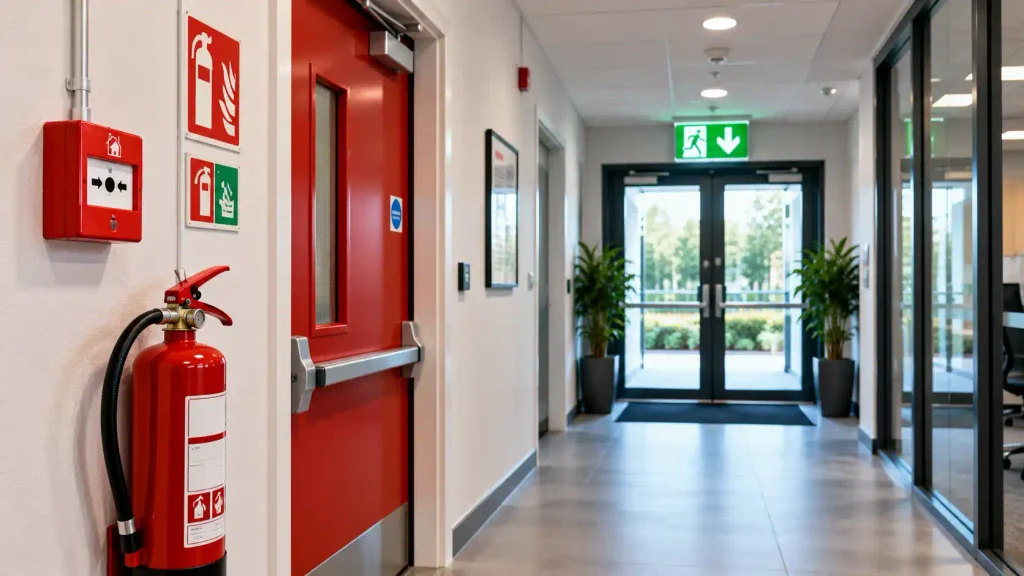
A fire risk assessment is one of the most important parts of compliance with the Regulatory Reform (Fire Safety) Order 2005. It identifies fire hazards, evaluates the people who may be harmed, assesses existing precautions and determines what further action is needed.
The responsible person must ensure the assessment is suitable and sufficient. A generic template that does not reflect the actual premises is unlikely to provide an adequate basis for managing fire risk.
Step-by-step fire risk assessment process
Step 1: Identify fire hazards
Look for ignition sources, combustible materials, unsafe electrical equipment, cooking activities, heating equipment and any dangerous substances. Consider how ordinary work activities might create additional hazards.
Step 2: Identify people at risk
Consider employees, visitors, customers, contractors and people who may need additional assistance to evacuate. Assess how the building is used and when occupancy or risk may change.
Step 3: Evaluate existing precautions
Review alarms, escape routes, emergency lighting where provided, firefighting equipment, fire doors, staff procedures and relevant maintenance records. Identify weaknesses and decide whether existing controls are adequate.
Step 4: Record significant findings and take action
Document the important hazards, people at risk, existing measures, outstanding deficiencies and further precautions required. Assign actions to appropriate people and set realistic deadlines based on risk.
Step 5: Review and update
Review the assessment regularly and whenever there is a reason to believe it is no longer valid, including significant changes or relevant incidents. Verify that corrective actions have actually been completed.
This is a practical summary of the process, not a substitute for the official fire risk assessment guidance appropriate to the premises.
The UK government’s fire safety guidance collection includes a five-step checklist and separate guidance for different types of premises.
When must a fire risk assessment be reviewed?
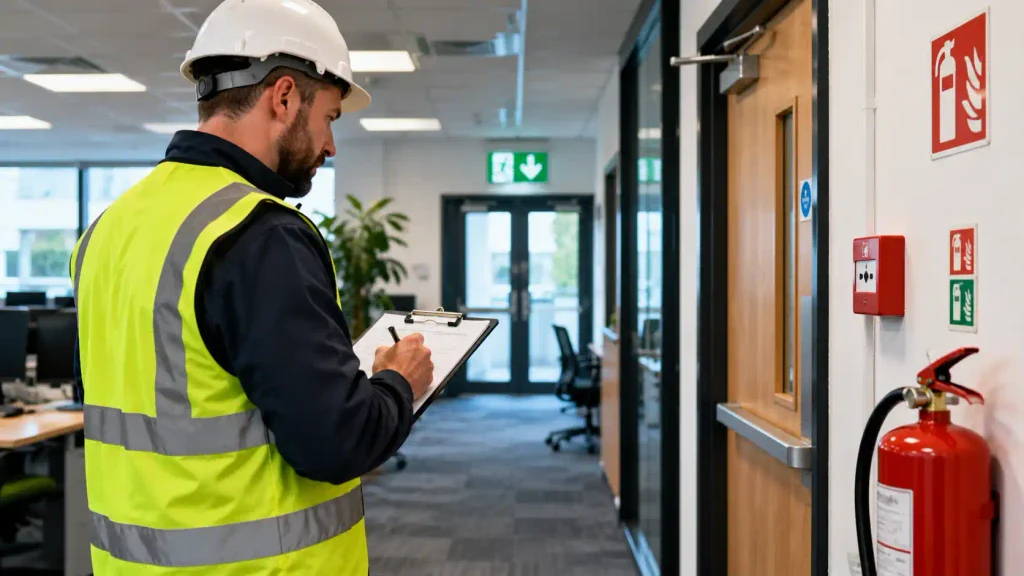
There is no single universal annual review deadline that applies to every premises under Article 9. The responsible person must keep the assessment up to date and review it regularly, particularly when relevant circumstances change.
A review may be necessary when:
- The layout or use of the premises changes.
- New equipment or work processes introduce hazards.
- The number or needs of occupants change significantly.
- Fire protection systems are altered or deficiencies are discovered.
- An incident, near miss or inspection identifies weaknesses.
- The existing assessment no longer accurately reflects the premises.
A scheduled review can be useful, but it does not replace the need to review an assessment following a significant change.
Who can carry out a fire risk assessment?
The responsible person may carry out the assessment themselves if they have sufficient competence for the premises and the complexity of the risks. They may instead appoint a competent employee or engage a specialist assessor.
Competence means having the appropriate knowledge, training, experience and other relevant capabilities to assess the risks and recommend suitable precautions. Complex premises or higher-risk activities may require specialist expertise.
The responsible person retains responsibility for ensuring that the assessment is suitable and sufficient and that necessary measures are implemented. Hiring a consultant does not automatically transfer all legal duties.
Fire Safety Compliance Checklist for UK Businesses
A practical checklist can help employers, facilities managers and building operators identify gaps in their fire safety arrangements. It should be used alongside a suitable risk assessment, applicable legislation and official guidance.
Workplace Fire Safety Self-Check
Review each item and tick the box when you have verified that the relevant measure is in place. Use this checklist to help identify areas that may require further attention.
Important: This checklist is an initial screening aid, not a legal certification or a substitute for a suitable and sufficient fire risk assessment. Ticking an item does not independently verify legal compliance.
This checklist is an initial screening aid, not a legal certification or a replacement for a fire risk assessment. Ticking an item does not independently verify compliance.
Fire Safety Duties for Employers, Landlords and Facilities Managers
Understanding the Regulatory Reform (Fire Safety) Order 2005 duties and responsibilities requires distinguishing between the legal framework and the day-to-day actions different people perform.
Employers
Employers who control workplace premises should ensure that appropriate fire precautions are in place for their employees and other relevant persons.
Typical responsibilities include:
- Ensuring a suitable fire risk assessment is completed.
- Providing appropriate fire safety information and training.
- Maintaining relevant fire safety arrangements.
- Establishing emergency procedures.
- Monitoring workplace changes that may affect fire risk.
An employer should also make sure staff know how to raise concerns and report hazards.
Landlords and property owners
Landlords and owners may have responsibilities for relevant premises or building areas under their control. In multi-occupied residential buildings, the Order applies to relevant common parts and, following the Fire Safety Act 2021, specified building elements.
The exact duties depend on the building, the nature of the accommodation, the person’s control and any applicable additional legal requirements.
Landlords should not assume that a tenant is responsible for every fire safety issue merely because the tenant occupies part of a property.
Facilities managers
Facilities managers often coordinate the practical systems that support fire safety compliance. Depending on their authority and contractual role, their activities may include:
- Coordinating fire risk assessment reviews.
- Scheduling inspections and maintenance.
- Monitoring escape routes and fire doors.
- Organising staff training and drills.
- Maintaining records and tracking corrective actions.
- Coordinating with contractors and other responsible persons.
A facilities manager is not automatically the legally defined responsible person simply because they manage a building. However, a person with control over relevant premises or activities may have duties under the legislation.
Contractors and external service providers
Contractors may need information about site-specific fire risks, emergency arrangements and restricted areas. Responsible persons should coordinate relevant activities where duties overlap.
For example, hot work can introduce ignition sources, while maintenance activities may temporarily affect alarm systems, fire doors or escape routes. Such work should be planned and controlled to prevent an avoidable increase in fire risk.
What changed after the Fire Safety Act 2021?
The Fire Safety Act 2021 clarified how the Fire Safety Order applies to certain parts of multi-occupied residential buildings. It specifies that the relevant structure, external walls (including cladding and balconies) and individual flat entrance doors between domestic premises and common parts fall within the Order’s scope.
This matters because fire risk assessment cannot always be confined to shared corridors, staircases and communal facilities.
Where relevant to the building, the responsible person needs to consider matters such as:
- The external wall system and any relevant cladding.
- Balconies and other relevant external features.
- The structure of the building.
- Flat entrance doors that form part of the boundary between private dwellings and common areas.
The assessment must reflect the building’s actual circumstances and the responsible person’s duties. Specialist advice may be necessary where external wall construction, compartmentation or other complex building features require technical evaluation.
What about the Fire Safety (England) Regulations 2022?
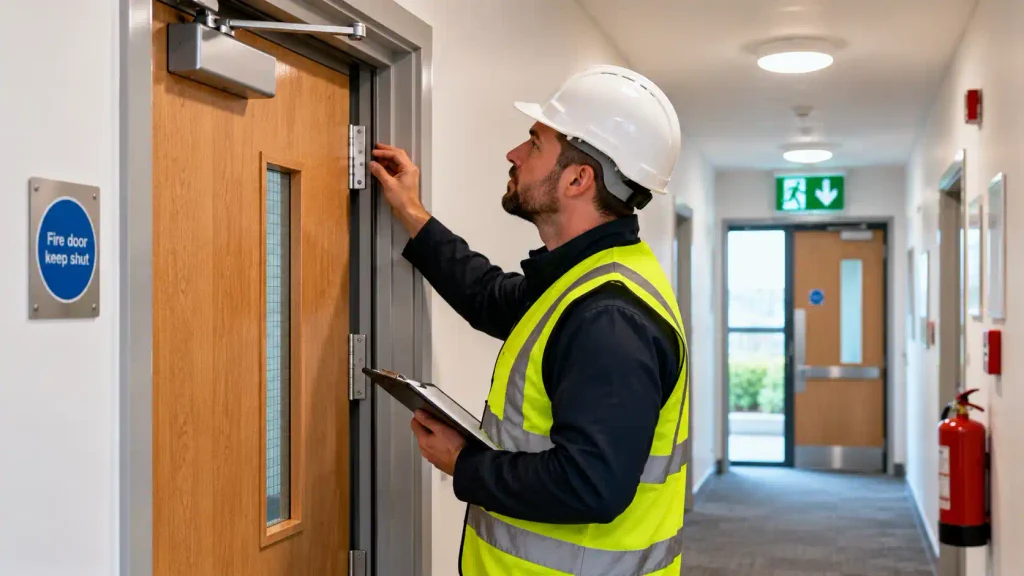
The Fire Safety (England) Regulations 2022 introduced additional duties for responsible persons in relevant residential buildings in England. Depending on the building and its characteristics, these include requirements relating to fire door information and checks, building information for fire and rescue services, and other fire safety measures.
These regulations apply in England; they should not be treated as a universal set of rules for every building across the UK. Additional duties under section 156 of the Building Safety Act 2022 also need to be considered where applicable. GOV.UK+1
Responsible persons should consult the current official guidance rather than relying on older summaries that may predate these developments.
Fire Safety Order Compliance: Records and Documentation
Effective fire safety management requires more than completing an assessment. Organisations also need to implement precautions, monitor their effectiveness and retain relevant evidence.
What fire safety records should a business maintain?
Depending on the premises and applicable requirements, useful records include:
| Record | Why it matters |
|---|---|
| Fire risk assessment | Documents hazards, people at risk and required precautions |
| Action plan | Tracks deficiencies, responsible individuals and completion dates |
| Alarm and detection maintenance | Provides evidence of inspection, testing and maintenance |
| Emergency lighting records | Supports verification of relevant emergency lighting arrangements |
| Fire door and fire protection inspection reports | Records defects and follow-up actions |
| Staff training records | Helps demonstrate that appropriate instruction has been provided |
| Evacuation drill records | Identifies practical problems with emergency procedures |
| Contractor and maintenance records | Helps coordinate work that could affect fire safety |
| Cooperation and coordination records | Clarifies how overlapping duties and shared risks are managed |
The exact records required depend on the legislation, premises and circumstances. This table is a practical management recommendation rather than a claim that every listed document is universally mandatory in every situation.
Under Article 9, the Order requires the fire risk assessment to be recorded in specified circumstances, including where the responsible person employs five or more employees, where a relevant premises licence is in force, or where an alterations notice requires recording. Other applicable legislation may impose additional requirements.
How can organisations make records more effective?
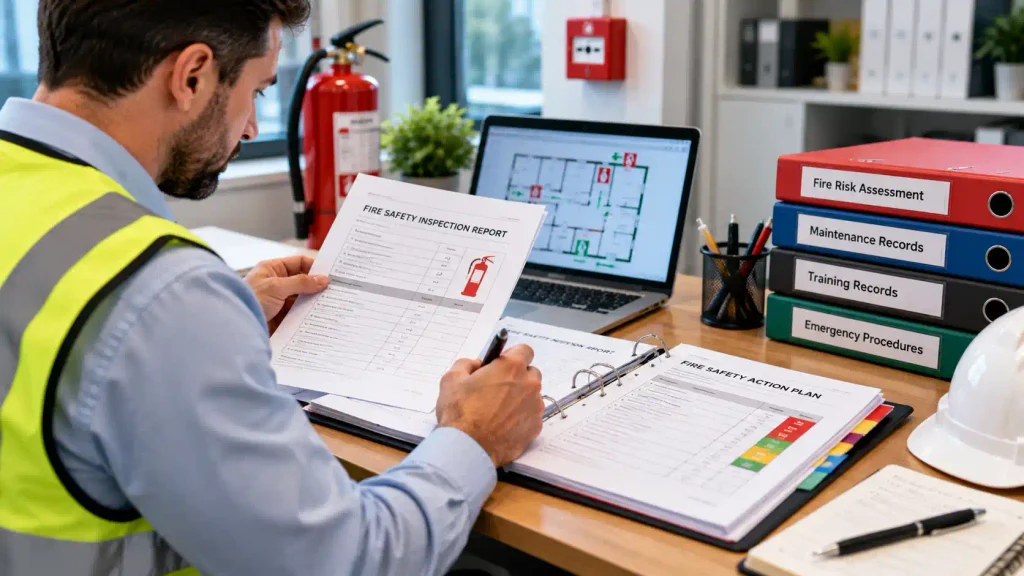
Use a simple, consistent process:
- Give each action a named owner.
- Record the defect or issue in specific terms.
- Set a completion date appropriate to the level of risk.
- Identify interim controls where immediate permanent action is not possible.
- Retain evidence that the work was completed.
- Verify that the completed action resolves the identified problem.
- Update the risk assessment or procedures if necessary.
A maintenance entry that says “fire door checked” provides less useful information than a record identifying the door, inspection date, defect found, corrective action and outcome.
Good records support management decisions and help demonstrate what the organisation has done to control fire risks.
What happens if a Business fails to Comply?
Fire safety enforcement in England and Wales is carried out by the relevant enforcing authority, commonly the local fire and rescue authority for ordinary business premises, subject to the allocation of enforcement responsibilities under the legislation.
The Fire Safety Order provides powers for inspection and enforcement. Depending on the circumstances, an authority may take formal action where fire safety duties are not adequately met.
Potential measures include:
- Alterations notices: Used in circumstances specified by the Order where changes to premises could create a serious risk.
- Enforcement notices: Require specified deficiencies to be remedied within the applicable period.
- Prohibition notices: Restrict or prohibit the use of premises or part of premises where the statutory conditions are met.
- Criminal proceedings: Certain breaches can result in prosecution and penalties under the applicable provisions.
The appropriate response depends on the nature and seriousness of the breach and the relevant legal requirements.
Non-compliance can also disrupt business operations, affect staff confidence, create financial costs and expose people to avoidable danger.
The best approach is preventive: identify shortcomings early, prioritise serious risks, document corrective action and seek competent advice where necessary.
Common Fire Safety Compliance Mistakes to Avoid
Even organisations with established safety procedures can overlook important details. The following mistakes are worth checking during a compliance review.
Treating the fire risk assessment as a one-time task
An assessment that was suitable several years ago may no longer reflect the building, equipment, occupancy or work activities. Keep it under review and update it when circumstances require.
Assuming that purchasing equipment guarantees compliance
Alarms, extinguishers and emergency lighting are useful only when they are appropriate to the risk, correctly installed where required, maintained and supported by suitable procedures.
Blocking escape routes with stock or equipment
Temporary obstructions can become permanent if no one monitors them. Regular checks should ensure escape routes and exits remain available for their intended purpose.
Overlooking the needs of people who may need assistance
Evacuation arrangements should reflect the actual people using the premises, including disabled people and visitors unfamiliar with the building. Where necessary, individual arrangements and appropriate staff training should support safe evacuation.
Failing to coordinate shared responsibilities
A landlord, tenant, managing agent and contractor may all have relevant responsibilities. Unclear ownership of alarms, fire doors or communal areas can lead to maintenance gaps.
Relying on generic online templates
Templates can help structure an assessment, but they cannot replace a competent evaluation of the specific premises, their hazards and the people exposed to risk.
Failing to follow up inspection findings
Identifying a defective door or alarm is only the beginning. The organisation must ensure appropriate corrective action is taken and that the issue is not left unresolved.
Practical Example: Applying the Fire Safety Order in an Office
Consider a business operating from a two-storey office with 35 employees, visiting clients, a small kitchen and a storage room containing paper supplies.
During a workplace review, the responsible person identifies several concerns:
- Cardboard boxes have been stored near an escape route.
- The fire alarm maintenance record is overdue for review.
- Several employees are unfamiliar with the evacuation procedure.
- A fire door does not close properly.
- No one has clearly been assigned responsibility for following up maintenance defects.
A suitable response would involve several coordinated actions.
First, control immediate hazards. Remove obstructions from the escape route and assess whether the defective door creates an urgent safety concern requiring temporary controls and prompt repair.
Second, review the risk assessment. Check whether the existing assessment accurately covers the storage arrangements, escape routes, fire door condition and relevant occupancy risks.
Third, address equipment and maintenance. Arrange appropriate inspection and maintenance of the alarm system and fire door, using competent people where necessary.
Fourth, reinforce emergency arrangements. Ensure employees understand the alarm response, escape routes and assembly arrangements. Provide appropriate information and training.
Finally, document and verify. Assign owners and deadlines to outstanding actions, retain relevant evidence and confirm that the deficiencies have been resolved.
This example demonstrates an important principle: compliance is an ongoing management process, not simply a collection of documents or installed devices.
How can Staff and Managers improve their Fire Safety knowledge?
Appropriate training helps employees understand hazards, follow emergency procedures and carry out assigned fire safety responsibilities. Managers and specialists may need more advanced knowledge to assess risks, coordinate precautions and evaluate compliance.
Training needs should reflect each person’s responsibilities, the nature of the premises and the complexity of the risks. A basic awareness course may be suitable for general staff, whereas a person developing professional fire safety expertise may benefit from a more advanced qualification.
Inspire College of Technologies offers relevant programmes for learners interested in fire safety, risk assessment and related building compliance work.
Four Related Courses from Inspire College of Technologies
The following courses can support learners who want to build their understanding of workplace safety, fire risk management and specialist fire protection. Choose a course according to your experience and career objectives.
1. ProQual Level 5 Diploma in Fire Safety and Risk Management
Advanced fire safety and risk management
Suitable for professionals seeking to develop their knowledge of fire safety legislation, risk assessment, emergency planning, fire protection and compliance management. Inspire College of Technologies UK+1
2. LICQual Level 1 Award in Risk Assessment
Foundational risk assessment skills
An introductory option for learners developing skills in hazard identification, risk evaluation, control measures and risk assessment reporting. Inspire College of Technologies UK
3. ProQual Level 3 Award in the Inspection and Testing of Fire Resisting Door Installations
Specialist fire door inspection
Relevant to people seeking knowledge of fire door components, inspection procedures, defect identification, pass/fail criteria and reporting. Inspire College of Technologies UK
4. ProQual Level 3 Award in the Inspection and Testing of Fire Stopping Installations
Passive fire protection and compartmentation
Develops knowledge of fire stopping systems, penetration seals, cavity barriers, inspection methods and reporting non-compliant installations. Inspire College of Technologies UK
Explore the full Inspire College courses catalogue to compare relevant qualifications and find a programme aligned with your professional development goals.
Conclusion: Making Fire Safety Compliance Part of Everyday Management
The Regulatory Reform (Fire Safety) Order 2005 establishes essential duties for protecting people from fire risks in relevant premises across England and Wales. Understanding who the responsible person is, carrying out a suitable fire risk assessment, maintaining appropriate precautions and providing effective training are fundamental parts of compliance.
However, effective fire safety depends on consistent implementation. Organisations need to monitor changing risks, coordinate responsibilities, maintain relevant systems, address defects promptly and review their arrangements when circumstances change.
Employers, property managers and facilities professionals can use the practical guidance in this article to identify areas requiring attention and develop a more organised approach to fire safety management.
For those seeking to strengthen their professional knowledge, explore Inspire College of Technologies’ fire safety and risk assessment courses to identify a programme suited to their current experience and career goals.
Important: This article provides general educational information, not legal advice or a substitute for a competent assessment of specific premises. Always verify current legislation and applicable official guidance.