
Fire Safety Records and Documentation: What UK Businesses Should Keep
Fire safety is an essential responsibility for every organisation that operates commercial premises, employs staff or provides services to members of the public. Installing fire alarms, providing extinguishers and displaying emergency evacuation notices are important measures, but businesses must also demonstrate that these precautions are properly managed, inspected and maintained.
This is where fire safety records and documentation become essential. They provide written evidence of how an organisation identifies fire hazards, assesses risks, maintains protective equipment, trains employees and manages emergency procedures. Without reliable records, it can be difficult to establish whether appropriate fire safety arrangements have been implemented and whether identified problems have been addressed.
UK fire safety legislation places important responsibilities on the people who control non-domestic premises. In England and Wales, the Regulatory Reform (Fire Safety) Order 2005, as amended by the Building Safety Act 2022, requires Responsible Persons to maintain records of their fire risk assessments and fire safety arrangements. The requirements were strengthened from 1 October 2023, making comprehensive documentation particularly important for businesses of every size.
This guide explains which fire safety documents UK businesses should maintain, what information each record should contain, how frequently records should be reviewed, how long they should be retained and how organisations can establish an effective documentation management system.
What Are Fire Safety Records and Documentation?
Fire safety records and documentation are the written or electronic evidence used to demonstrate how an organisation manages fire risks and maintains appropriate fire prevention and protection arrangements.
These records cover several aspects of workplace fire safety, including risk assessments, equipment inspections, fire alarm testing, emergency lighting maintenance, staff training, evacuation drills and corrective actions.
They are not limited to a single fire safety logbook. Instead, they form an organised collection of documents that demonstrate how fire safety responsibilities are planned, implemented, monitored and reviewed.
For example, a business might have a fire alarm installed by a competent contractor. However, the installation certificate alone does not demonstrate that the system continues to operate correctly. Regular testing records, maintenance reports, fault notifications and evidence of completed repairs help establish that the system is being managed over time.
Why Are Fire Safety Records Important?
Fire safety documentation serves several important purposes:
- Legal compliance: Provides evidence that relevant fire safety duties and arrangements are being addressed.
- Risk management: Helps identify recurring hazards, equipment failures and weaknesses in emergency procedures.
- Maintenance monitoring: Establishes whether fire protection equipment receives appropriate inspections and servicing.
- Employee protection: Demonstrates that employees receive relevant fire safety information and training.
- Accountability: Identifies who performed inspections, reported defects and completed corrective actions.
- Inspection readiness: Helps organisations provide relevant information when requested by enforcing authorities.
- Business continuity: Supports consistent fire safety management when staff, managers or contractors change.
Good documentation should describe what happened, when it happened, who was responsible and what action followed.
What Does UK Fire Safety Law Require Businesses to Record?
The legal requirements depend on the jurisdiction in which the premises are located. Businesses should identify the applicable legislation before establishing their documentation arrangements.
1. England and Wales: Regulatory Reform (Fire Safety) Order 2005
The Regulatory Reform (Fire Safety) Order 2005 is the principal fire safety legislation for most non-domestic premises in England and Wales.
It places duties on the Responsible Person to undertake a suitable and sufficient fire risk assessment, implement appropriate preventive and protective measures, establish fire safety arrangements and maintain relevant facilities and equipment.
Several provisions are particularly important when considering fire safety records.
| Legal provision | Main responsibility | Documentation relevance |
|---|---|---|
| Article 9 | Fire risk assessment | Assessment and review records |
| Article 11 | Fire safety arrangements | Written records of management arrangements |
| Article 13 | Firefighting and fire detection arrangements | Evidence of appropriate provision and management |
| Article 17 | Maintenance | Inspection, servicing and repair evidence |
| Article 19 | Information to employees | Relevant employee information records |
| Article 21 | Employee training | Training and instruction records |
| Article 22 | Cooperation and coordination | Information exchanged between Responsible Persons |
The legal wording and associated amendments should be consulted when determining the precise requirements for individual premises. Legislation.gov.uk+1
2. What Changed on 1 October 2023?
Section 156 of the Building Safety Act 2022 introduced important amendments to the Regulatory Reform (Fire Safety) Order 2005.
These changes strengthened the documentation responsibilities of Responsible Persons in England and Wales.
The main changes include:
- Full fire risk assessment recording: Responsible Persons must record their fire risk assessment in full, including all findings. The previous limitations based on employee numbers and certain licensing or enforcement circumstances were removed.
- Recording fire safety arrangements: Businesses must record their fire safety arrangements. These arrangements explain how fire safety measures are planned, organised, controlled, monitored and reviewed.
- Recording assessor information: Where an individual or organisation is appointed to assist with completing or reviewing a fire risk assessment, their identity must be recorded.
- Information sharing between Responsible Persons: Where more than one Responsible Person has duties in relation to the same premises, they must take reasonable steps to identify each other, exchange relevant information and record the extent of their respective responsibilities.
- Providing relevant information: Responsible Persons must provide relevant fire safety information to residents in applicable multi-occupied residential buildings and comply with the associated information-sharing requirements.
These changes apply from 1 October 2023 and cover non-domestic premises regulated by the Fire Safety Order, including workplaces and relevant communal areas of multi-occupied residential buildings. Individual domestic premises are not covered by these particular requirements.
3. Scotland: Fire Safety Legislation
Scotland has a separate fire safety framework under the Fire (Scotland) Act 2005 and the Fire Safety (Scotland) Regulations 2006. People with relevant duties must assess workplace fire risks, implement appropriate precautions and review assessments when necessary.
The Scottish regulations also contain requirements concerning the recording of assessment information and fire safety arrangements. However, the recording thresholds and statutory provisions should not be confused with the amended England and Wales requirements introduced through Section 156. Businesses operating in Scotland should consult the Scottish Fire and Rescue Service business guidance and the relevant legislation.
4. Northern Ireland: Fire Safety Legislation
Northern Ireland follows a separate legal framework, primarily involving:
- Fire and Rescue Services (Northern Ireland) Order 2006.
- Fire Safety Regulations (Northern Ireland) 2010.
Businesses must assess fire risks, implement appropriate precautions, maintain relevant fire safety arrangements and provide suitable employee training.
Northern Ireland Fire and Rescue Service provides guidance and inspection information covering fire risk assessments, fire safety logbooks, equipment servicing, emergency plans, staff training and fire drills. Northern Ireland Fire & Rescue Service+2
Important: A business operating in multiple UK nations should not assume that one jurisdiction’s recording rules automatically apply throughout the organisation. Its fire safety documentation policy should account for the legislation governing each premises.
Essential Fire Safety Records Every UK Business Should Maintain
Although the exact documents depend on the building, its activities and applicable legal duties, businesses should establish an organised documentation system covering the following areas.
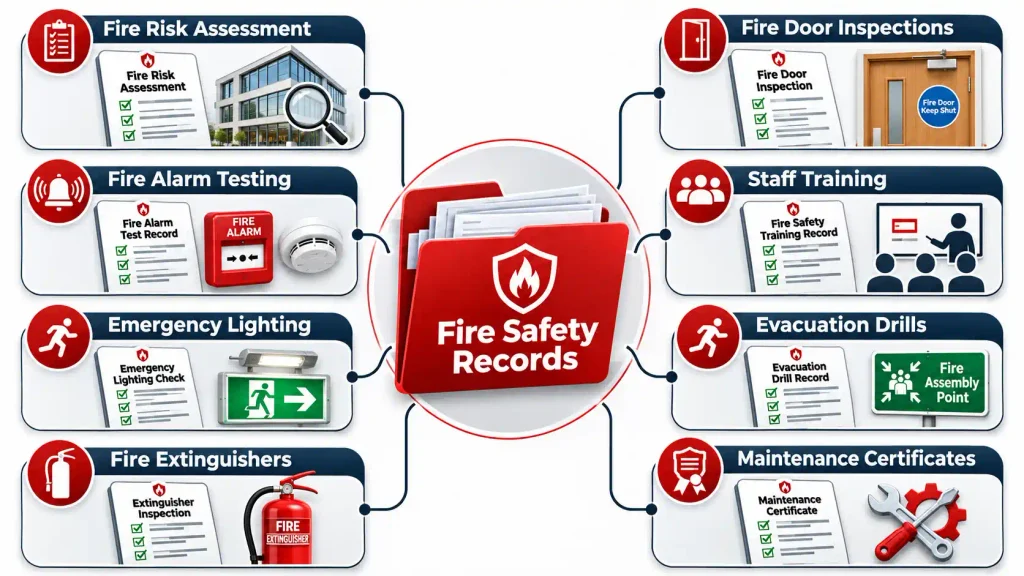
1. Fire Risk Assessment Records
The fire risk assessment is the foundation of an organisation’s fire safety management arrangements. It identifies potential fire hazards, evaluates who might be harmed, considers existing precautions and establishes additional measures needed to reduce risks.
A suitable assessment should consider:
- Sources of ignition, fuel and oxygen.
- People who may be particularly vulnerable.
- Fire detection and warning arrangements.
- Emergency exits and escape routes.
- Firefighting equipment.
- Emergency lighting.
- Fire doors and compartmentation.
- Storage and handling of flammable materials.
- Emergency evacuation arrangements.
- Responsibilities for implementing protective measures.
What should the record contain?
| Information | Purpose |
|---|---|
| Premises identification | Establishes which building or area was assessed |
| Assessment date | Shows when the assessment was completed |
| Assessor details | Identifies the person or organisation involved |
| Fire hazards | Documents identified sources of fire |
| People at risk | Identifies employees, visitors and vulnerable occupants |
| Existing precautions | Records current protective measures |
| Findings and recommendations | Identifies necessary improvements |
| Action responsibilities | Establishes who must address each finding |
| Review information | Supports ongoing assessment management |
A fire risk assessment should not be treated as a permanent document. It must remain relevant to the actual premises and its activities.
For example, a warehouse that introduces new battery-charging equipment, changes its storage arrangements or increases the quantity of combustible materials should consider whether the existing assessment remains valid.
Under Article 9, assessments must be reviewed regularly and particularly where there is reason to suspect that they are no longer valid or significant changes have occurred.
2. Fire Alarm Testing and Maintenance Records
Fire detection and alarm systems provide early warning and support safe evacuation. Businesses should maintain evidence that these systems are tested, inspected and serviced appropriately. A fire alarm record should identify the work performed and the results rather than simply stating that the system was checked.
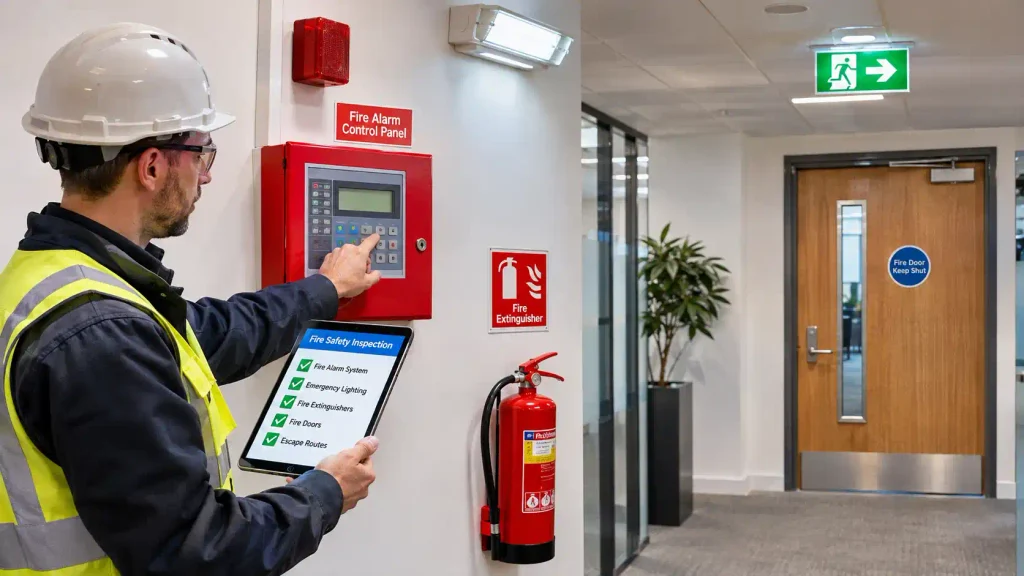
Important information to record:
- Date and time of the test.
- Manual call point, zone or equipment tested.
- Whether the alarm activated correctly.
- Audible and visual warning observations where relevant.
- Faults or irregularities identified.
- Name of the person conducting the test.
- Contractor inspection and servicing details.
- Corrective action and completion date.
For example, if a fire alarm test reveals that a call point is not operating, the documentation should show when the fault was identified, who was informed, what temporary precautions were introduced where necessary and when the system was restored. Testing frequency should follow the applicable system standard, manufacturer instructions, risk assessment and maintenance arrangements.
3. Emergency Lighting Inspection Records
Emergency lighting helps occupants navigate escape routes when normal lighting fails.
Businesses should maintain records demonstrating that emergency lighting has been inspected and tested in accordance with the applicable maintenance programme.
These records should include:
| Record element | Details to document |
|---|---|
| Inspection date | Date of the inspection or test |
| Equipment location | Area, floor or emergency lighting unit |
| Test type | Functional or duration test |
| Results | Whether the equipment operated correctly |
| Defects | Failed lights, batteries or other problems |
| Corrective action | Repair or replacement arrangements |
| Completion | Date the issue was resolved |
A failed emergency light should trigger appropriate corrective action. Simply recording the failure without documenting its resolution creates an incomplete maintenance history.
4. Fire Extinguisher Inspection and Servicing Records
Fire extinguishers and other portable firefighting equipment must remain suitable, accessible and maintained in an efficient working condition. Businesses should retain inspection and servicing records for the equipment installed on their premises.
These records should cover:
- Equipment identification and location.
- Extinguisher type and suitability.
- Routine visual inspection results.
- Professional servicing dates.
- Pressure or condition concerns where relevant.
- Damage, missing equipment or obstructions.
- Replacements and repairs.
- Contractor details and service reports.
For example, an organisation may have several extinguishers positioned throughout its building. A structured equipment register helps managers identify missing units, expired service information or extinguishers that have become inaccessible.
5. Fire Door Inspection Records
Fire doors are important components of a building’s passive fire protection system. They help restrict the spread of fire and smoke when correctly installed, maintained and used. Businesses should maintain appropriate inspection and maintenance evidence, particularly where fire doors form part of designated escape routes or compartmentation arrangements.
A fire door inspection record may include:
- Door identification and location.
- Door leaf condition.
- Frame and surrounding structure.
- Hinges and closing devices.
- Intumescent and smoke seals.
- Glazing and vision panels where fitted.
- Gaps and alignment.
- Latch and locking arrangements.
- Defects identified.
- Repair recommendations and completion dates.
Example: An inspection identifies a damaged smoke seal and a faulty self-closing device. The inspection record should identify both defects, allocate responsibility for repairs and document the subsequent verification.
A completed checklist without evidence that identified defects were corrected is not an effective maintenance record.
6. Fire Drill and Evacuation Records
Fire drills allow organisations to evaluate whether employees understand emergency procedures and can evacuate safely. A drill record should demonstrate that evacuation arrangements have been tested and that lessons identified have been considered.
Include:
- Date and time of the drill.
- Areas and departments involved.
- Number of participants, where recorded.
- Evacuation time and observations.
- Whether the alarm and communication arrangements worked.
- Problems encountered during evacuation.
- Assistance arrangements for people requiring support.
- Recommendations for improvement.
- Responsible persons and completion dates for actions.
For instance, a drill might identify that employees in a rear storage area cannot clearly hear the alarm. The organisation should document the problem, investigate the warning arrangements and record the corrective measures. There is no single universal fire drill interval suitable for every workplace. The organisation should establish an appropriate programme based on its risk assessment, premises and applicable guidance.
7. Fire Safety Training Records
Employers must ensure that employees receive adequate fire safety training, including relevant instruction when they start work and when they are exposed to new or increased risks. Article 21 of the Regulatory Reform (Fire Safety) Order 2005 addresses employee training requirements in England and Wales.
Training records should contain:
| Information | Example |
|---|---|
| Employee identification | Name or employee reference |
| Training date | Date completed |
| Training type | Fire awareness or fire warden training |
| Training content | Alarm response, evacuation and emergency procedures |
| Delivery method | Classroom, practical or online |
| Trainer details | Trainer or training provider |
| Assessment results | Where an assessment was undertaken |
| Refresher requirements | Planned review or retraining date |
Records should also identify employees with additional responsibilities, such as fire wardens or designated evacuation assistants.
A business should not assume that providing an employee with a training presentation automatically demonstrates adequate understanding. Practical instruction and appropriate training evaluation can provide stronger evidence.
8. Fire Safety Policy and Emergency Evacuation Plan
A fire safety policy explains how an organisation manages fire risks and allocates responsibilities. An emergency evacuation plan explains how people should respond when a fire occurs.
Although these documents serve different purposes, they should work together.
A fire safety policy should establish:
- Management commitment to fire safety.
- Responsibilities of the Responsible Person.
- Fire safety management arrangements.
- Inspection and maintenance responsibilities.
- Employee training arrangements.
- Reporting procedures.
- Monitoring and review arrangements.
An emergency evacuation plan should explain:
- How a fire should be reported.
- How occupants receive warnings.
- Primary and alternative escape routes.
- Assembly points.
- Evacuation responsibilities.
- Arrangements for people requiring assistance.
- Procedures for contacting emergency services.
- Post-evacuation accountability.
Businesses should review these documents whenever significant changes affect building layout, occupancy, work activities or emergency arrangements.
9. Fire Safety Inspection and Maintenance Logs
A fire safety logbook provides a central location for recording ongoing fire safety activities. It can be maintained electronically or in paper format. The important consideration is whether records are accurate, accessible and properly maintained.
A well-organised logbook may include:
- Routine fire alarm tests.
- Emergency lighting checks.
- Fire extinguisher inspections.
- Fire door inspections.
- Escape route inspections.
- Fire drill results.
- Employee training activities.
- Contractor servicing visits.
- Fire incidents and false alarms.
- Outstanding defects and completed actions.
The logbook itself is not a specifically prescribed legal document under the Fire Safety Order. It is a practical way of organising evidence of fire safety management and maintenance. Fire Risk Assessments Dorset+1
10. Fire Incident and False Alarm Records
Every fire-related incident should be investigated and documented appropriately, including incidents that do not result in significant damage.
Records may include:
- Date, time and location.
- Description of the incident.
- Suspected cause, where established.
- People affected.
- Emergency response arrangements.
- Alarm activation details.
- Damage to property or equipment.
- Immediate control measures.
- Investigation findings.
- Corrective and preventive actions.
False alarm records are also valuable because recurring unwanted activations may indicate equipment faults, unsuitable detector positioning or operational problems. An organisation should use incident records to identify patterns and improve its fire safety arrangements.
11. Contractor Certificates and Fire Protection System Documentation
Businesses frequently depend on external contractors for fire alarm servicing, emergency lighting maintenance, fire door inspections and other specialist work. The Responsible Person should ensure that relevant reports and certificates are retained and accessible.
Depending on the premises, these may include:
- Fire alarm installation and commissioning certificates.
- Fire alarm servicing reports.
- Emergency lighting installation and test documentation.
- Sprinkler system inspection records.
- Fire suppression system maintenance reports.
- Smoke control system inspection records.
- Fire damper inspection reports.
- Firefighting equipment servicing certificates.
- Relevant fire protection installation and commissioning information.
Contractor documentation should identify the equipment or system inspected, work performed, results, defects and any recommendations. A certificate should not be accepted as evidence that every aspect of fire safety is compliant. It only demonstrates the work and scope covered by that particular document.
12. Fire Safety Information and Cooperation Records
In shared buildings, fire safety responsibilities may be divided between owners, landlords, managing agents and individual occupiers. These arrangements can create gaps if each party assumes another organisation is managing particular fire precautions.
Responsible Persons should maintain relevant information about:
- The identity and contact details of other Responsible Persons.
- Areas under each person’s control.
- Responsibilities for shared escape routes.
- Shared alarm and emergency lighting arrangements.
- Maintenance responsibilities.
- Fire safety risks affecting neighbouring occupiers.
- Information exchanged about significant hazards.
- Agreed arrangements for cooperation and coordination.
This is particularly important in shopping centres, multi-occupied offices, industrial estates and buildings with shared communal facilities. Section 156 strengthened the requirements for identifying and cooperating with other Responsible Persons in England and Wales.
Complete Fire Safety Documentation Checklist for UK Businesses
The following checklist provides a practical overview of records organisations should consider maintaining.
| Document or record | Main purpose | Priority |
|---|---|---|
| Full fire risk assessment | Identifies hazards and control measures | Essential |
| Fire safety arrangements | Explains how fire safety is managed | Essential |
| Assessor identification | Identifies appointed assessment support | Where applicable |
| Fire safety policy | Establishes management responsibilities | Recommended |
| Emergency evacuation plan | Defines emergency procedures | Essential where required |
| Fire alarm testing records | Demonstrates routine system checks | Essential management evidence |
| Alarm servicing reports | Documents professional maintenance | As applicable |
| Emergency lighting records | Demonstrates testing and maintenance | As applicable |
| Fire extinguisher records | Documents inspection and servicing | As applicable |
| Fire door inspection records | Tracks condition and defects | As applicable |
| Fire drill records | Evaluates evacuation arrangements | As applicable |
| Employee training records | Demonstrates relevant training | Essential management evidence |
| Fire incident records | Documents incidents and investigations | As applicable |
| Contractor certificates | Provides evidence of specialist work | As applicable |
| Corrective action register | Tracks defects and completion | Strongly recommended |
| Responsible Person information | Clarifies accountability | Where applicable |
| Cooperation records | Documents shared-building arrangements | Where applicable |
The word “essential” in this checklist indicates a core legal or operational requirement, not that every listed document must exist in an identical format in every UK jurisdiction. The precise statutory duty depends on the applicable legislation and circumstances of the premises.
How to Manage Fire Safety Records Effectively
Having the correct documents is only the beginning. Businesses also need a structured process for creating, updating, reviewing and storing their records. A documentation management system should make it easy to identify missing information, overdue inspections and unresolved fire safety issues.
Step 1: Appoint a Responsible Person and Allocate Duties
The organisation should identify who has legal responsibility for fire safety. Day-to-day record management may be delegated to a facilities manager, health and safety officer or another competent employee. However, delegation does not automatically transfer the Responsible Person’s legal duties.
Establish clear responsibilities for:
- Completing and reviewing fire risk assessments.
- Maintaining fire safety documentation.
- Conducting routine checks.
- Arranging contractor inspections.
- Recording training activities.
- Reporting defects.
- Monitoring corrective actions.
Step 2: Establish a Fire Safety Document Register
Create a central register identifying every important fire safety document.
The register should contain:
- Document name.
- Premises or equipment covered.
- Responsible person.
- Date created.
- Last review date.
- Next scheduled review, where applicable.
- Current document version.
- Storage location.
- Outstanding actions.
This register makes it easier to monitor documentation across multiple buildings or departments.
Step 3: Create a Regular Inspection and Testing Schedule
Prepare an inspection schedule based on the fire risk assessment, equipment requirements, manufacturer instructions and applicable standards.
For example:
| Activity | Scheduling approach |
|---|---|
| Fire alarm user testing | According to the applicable system guidance |
| Emergency lighting testing | According to the maintenance programme |
| Extinguisher inspections | According to equipment guidance and maintenance arrangements |
| Fire door inspections | Risk-based inspection programme |
| Fire safety training | At induction and when required by changes in risk |
| Fire drills | Appropriate to the premises and emergency arrangements |
| Fire risk assessment review | Regularly and following relevant changes |
These are management categories rather than a universal timetable. Exact testing intervals should be confirmed against the relevant technical standards and equipment instructions.
Step 4: Record Defects and Corrective Actions
A useful fire safety record must show more than whether an inspection passed or failed. Every significant defect should be recorded, assigned and monitored until appropriate action has been completed.
For example:
| Defect | Required action | Status |
|---|---|---|
| Damaged fire door seal | Arrange inspection and repair | Open |
| Failed emergency light | Arrange replacement | In progress |
| Obstructed fire exit | Remove obstruction and verify access | Completed |
| Faulty alarm call point | Contact competent maintenance contractor | Awaiting repair |
The organisation should also document interim precautions where a defect compromises an important fire safety measure.
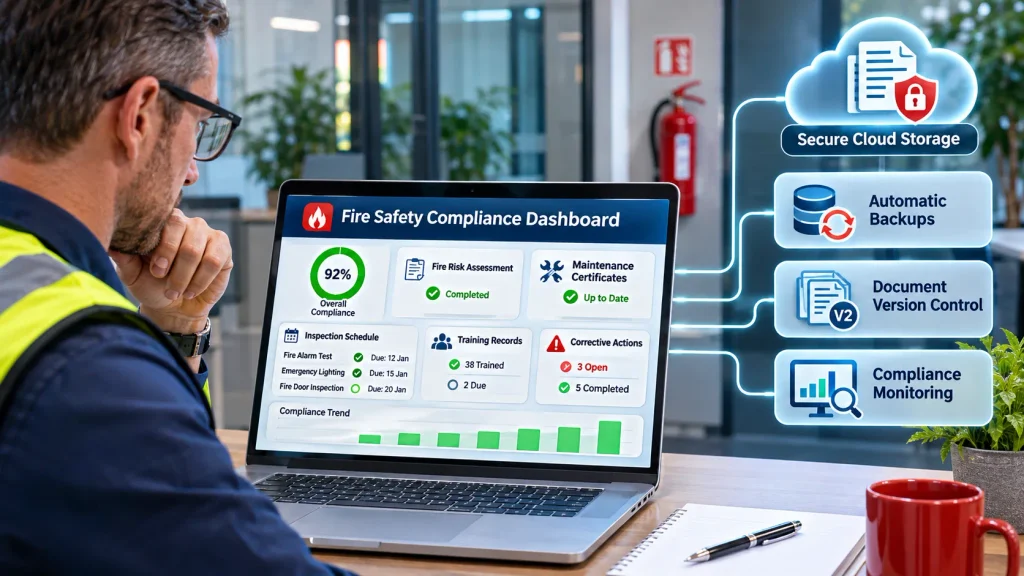
Step 5: Store and Protect Documentation
Fire safety records should be stored in a secure and accessible location.
Businesses may use:
- Dedicated physical fire safety files.
- Electronic document management systems.
- Facilities management software.
- Compliance management platforms.
- Controlled cloud-based document storage.
For electronic systems, organisations should establish appropriate access permissions, backup arrangements, version control and protection against accidental deletion.
Step 6: Review Documentation Regularly
Management should periodically examine the completeness and accuracy of records.
A review should establish whether:
- The latest fire risk assessment is available.
- All significant findings have been addressed.
- Inspection records are current.
- Equipment faults have been resolved.
- Staff training records are complete.
- Emergency plans reflect actual conditions.
- Contractor certificates are available.
- Responsibilities remain clearly allocated.
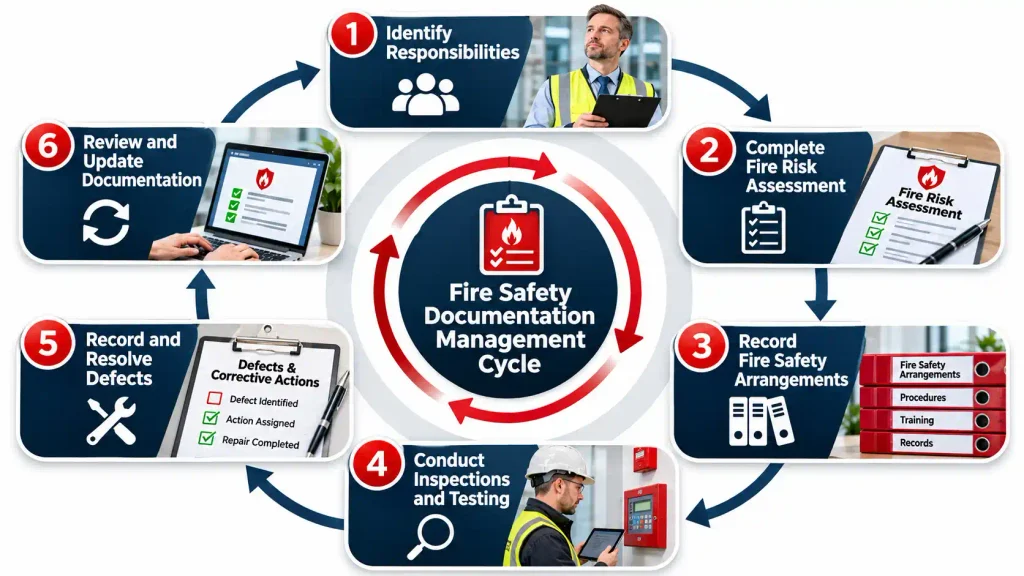
Fire Safety Documentation Management Flowchart
The following process illustrates how a business can manage its fire safety records from initial assessment through ongoing monitoring.
Fire Safety Documentation Management Flowchart
A continuous process for managing, monitoring and reviewing fire safety records.
This process encourages continuous improvement rather than treating fire safety documentation as a one-time administrative exercise.
How Long Should UK Businesses Keep Fire Safety Records?
Record retention is an important part of fire safety documentation management. Businesses often ask whether fire risk assessments, training records, alarm tests and maintenance certificates must be retained for a particular number of years. There is no single universal retention period prescribed by the Regulatory Reform (Fire Safety) Order 2005 for every category of fire safety record.
This means businesses should not assume that all documents can be destroyed after one, three or five years. Retention decisions should consider the applicable legal requirements, the nature of the record, the premises, equipment lifecycle, contractual obligations, insurance considerations and potential investigation needs.
Recommended Fire Safety Record Retention Approach
| Record type | Recommended approach |
|---|---|
| Current fire risk assessment | Keep the current complete assessment accessible |
| Previous risk assessments | Retain superseded versions as an audit history |
| Fire safety arrangements | Keep the current version and relevant revision history |
| Fire alarm testing records | Retain according to the organisation’s documented retention policy |
| Maintenance certificates | Retain throughout the relevant equipment or system lifecycle and as necessary afterwards |
| Fire door inspections | Keep current records and relevant defect and repair history |
| Training records | Retain according to employment, safety and organisational record policies |
| Fire drill records | Retain sufficient history to demonstrate performance and improvements |
| Fire incident reports | Retain according to applicable legal, insurance and investigation requirements |
| Contractor reports | Retain with the relevant system and maintenance history |
These are recommended management practices, not statutory retention periods applying uniformly across the UK.
Factors to Consider When Setting Retention Periods
1. Legal requirements: Check whether specific legislation or sector requirements establish a retention obligation for the particular record.
2. Equipment lifecycle: Installation, commissioning, inspection and servicing records may remain relevant throughout the operational life of a fire protection system.
3. Previous risk assessments: Keeping historical assessments helps demonstrate how hazards and control measures have changed over time.
4. Insurance and contractual requirements: Insurance policies, building management agreements and service contracts may specify documentation requirements.
5. Incident investigations: Records may be important when investigating a fire, an injury, an enforcement matter or an insurance claim.
6. Data protection: Personal information within training, incident and employee records should be retained securely and no longer than necessary for the applicable purpose, taking account of relevant legal obligations.
A documented retention schedule is preferable to deleting records simply because they have reached an arbitrary age.
Common Fire Safety Documentation Mistakes Businesses Should Avoid
Even organisations with established fire safety arrangements can experience documentation problems.
The following mistakes can weaken their ability to demonstrate effective fire safety management.
1. Keeping an Outdated Fire Risk Assessment
An assessment that no longer reflects the building, occupants or work activities may fail to identify current hazards.
Improvement: Review the assessment regularly and whenever significant changes occur.
2. Recording Checks Without Their Results
A logbook entry stating “fire alarm checked” provides limited information about what was tested and whether the system operated correctly.
Improvement: Record the equipment, test location, result, person completing the check and any defects.
3. Failing to Close Corrective Actions
Businesses sometimes identify faults but fail to document repairs or verification.
Improvement: Use a corrective action register with assigned responsibilities and completion dates.
4. Relying Entirely on Contractors
External contractors can perform specialist inspections and maintenance, but businesses should retain the reports and understand the findings.
Improvement: Ensure the Responsible Person or delegated manager reviews relevant contractor documentation.
5. Failing to Update Employee Training Records
New employees, changed responsibilities and new work activities can create additional training needs.
Improvement: Maintain an employee training register and monitor relevant refresher requirements.
6. Confusing Certificates with Complete Compliance
A fire alarm servicing certificate does not demonstrate that evacuation procedures, fire doors, emergency lighting and all other relevant precautions are adequately managed.
Improvement: Maintain a complete documentation system covering the wider fire safety arrangements.
7. Keeping Documents in Disconnected Locations
Important information may be spread across email accounts, contractor portals, paper files and individual computers.
Improvement: Establish a central document register with controlled access and clear ownership.
Fire Safety Documentation Requirements for Different Types of Businesses
The records required in practice depend on the nature of the premises, the activities conducted and the risks identified.
Offices and Commercial Buildings
Office environments should maintain appropriate documentation covering:
- Fire risk assessments.
- Emergency evacuation arrangements.
- Fire alarm and emergency lighting checks.
- Fire door inspections.
- Employee training.
- Fire drill results.
- Maintenance and defect records.
Particular attention should be given to escape routes, electrical equipment, shared areas and visitors.
Warehouses and Industrial Premises
Warehouses and industrial workplaces may have additional fire hazards arising from combustible materials, machinery, charging equipment and flammable substances.
Relevant documentation may include:
- Storage and housekeeping inspections.
- Flammable substance risk assessments.
- Fire protection system maintenance.
- Emergency access arrangements.
- Hot-work permit records where applicable.
- Fire compartmentation inspection reports.
- Training records for employees working in higher-risk areas.
Hotels and Hospitality Businesses
Hotels, restaurants and other hospitality premises may need more extensive evacuation and occupant management arrangements.
Records may include:
- Fire risk assessments.
- Guest evacuation procedures.
- Fire alarm and emergency lighting records.
- Kitchen extraction and relevant fire suppression maintenance.
- Staff fire safety training.
- Fire door inspection records.
- Fire drills and emergency response records.
Healthcare and Care Facilities
Healthcare and care environments may have occupants who cannot evacuate independently.
Their documentation should pay particular attention to:
- Personal emergency evacuation arrangements.
- Resident or patient evacuation procedures.
- Staff responsibilities.
- Fire compartmentation.
- Fire door inspections.
- Staff training and practical evacuation arrangements.
- Maintenance of relevant fire protection systems.
The nature of the occupants and the building’s evacuation strategy should influence the documentation and management arrangements.
How Should Businesses Prepare for a Fire Safety Inspection?
Fire safety documentation should remain accessible throughout the year rather than being assembled only when an inspection is expected. Enforcing authorities may request relevant documents to establish whether the Responsible Person is meeting their duties.
A well-prepared organisation should be able to:
- Identify its Responsible Person and relevant delegated managers.
- Produce the current fire risk assessment.
- Explain how identified risks are being controlled.
- Provide evidence of fire safety arrangements.
- Show relevant inspection and maintenance records.
- Demonstrate that employees receive appropriate information and training.
- Identify outstanding defects and explain the corrective actions being taken.
- Provide relevant information about shared-building responsibilities.
- Demonstrate that important records are current and accessible.
The Northern Ireland Fire and Rescue Service’s published audit guidance, for example, identifies fire risk assessments, logbooks, system installation and maintenance records, training records and fire drill records among the documents that may be examined.
An important principle is that records should match the actual condition of the premises. Documentation cannot compensate for defective equipment, blocked escape routes or inadequate emergency procedures.
Conclusion
Fire safety records and documentation are an essential part of effective workplace fire safety management. They provide evidence that organisations have assessed fire risks, implemented appropriate precautions, maintained protective equipment and provided employees with relevant training.
For UK businesses, maintaining accurate and accessible documentation is not simply an administrative responsibility. It supports legal compliance, strengthens accountability and helps identify weaknesses before they develop into more serious safety problems. The changes introduced through Section 156 of the Building Safety Act 2022 make comprehensive documentation particularly important for Responsible Persons in England and Wales.
Businesses should establish a structured documentation system that includes current fire risk assessments, written fire safety arrangements, inspection records, maintenance certificates, training evidence and corrective action registers. Regular reviews, appropriate record retention and clear responsibilities will help ensure that documentation remains useful and reflects the actual condition of the premises.
Ultimately, effective fire safety management is demonstrated not only by the precautions installed in a building but also by the evidence showing that those precautions are properly maintained and managed.
Image prompts for the article
The following prompts are designed for professional website visuals. Use a consistent realistic corporate photography style, natural lighting, clear compositions and minimal text.
Featured image: Fire Safety Records and Documentation
Fire Safety Compliance Inspection: A Property Manager’s Guide
Filename: fire-safety-records-and-documentation-uk.jpg
Recommended placement: Below the introduction or as the main blog hero image.
Alt text: Fire safety records and documentation maintained by a UK business.
Image generation prompt:
Create a highly realistic, premium-quality corporate photograph illustrating fire safety records and documentation management in a modern UK commercial workplace. Show a professional facilities manager seated at a clean office desk reviewing a fire risk assessment, fire safety inspection checklist, fire alarm maintenance report and employee training register. Include a clipboard, organised document folders, a laptop displaying a fire safety compliance dashboard with simple charts, and a fire extinguisher subtly visible in the background. Use a modern commercial office environment with professional lighting, realistic paperwork and an organised compliance-management atmosphere. Emphasise documentation, workplace safety and regulatory responsibility. Use a sophisticated corporate colour palette, realistic photography, sharp details and balanced composition. Landscape 16:9 format, no logos, minimal readable text.
Image 5: Fire Safety Documentation Management Process
Filename: fire-safety-documentation-management-process.jpg
Placement: Immediately after the documentation management flowchart.
Alt text: Fire safety documentation management process showing assessment, inspection, corrective action and review.
Image generation prompt:
Design a professional corporate process infographic illustrating the continuous fire safety documentation management cycle for UK businesses. Show six connected stages arranged in a circular workflow: Identify Responsibilities, Complete Fire Risk Assessment, Record Fire Safety Arrangements, Conduct Inspections and Testing, Record and Resolve Defects, and Review and Update Documentation. Use clean arrows, professional safety-related illustrations, document icons, inspection equipment and a clear circular progression. Ensure the sequence is logical and easy to follow. Use dark navy, red, white and light grey, with a clean modern infographic layout, consistent iconography and minimal text. Landscape 16:9, high resolution, no logos.
SEO implementation recommendations
1. Internal linking opportunities
Add contextual internal links within the relevant paragraphs rather than placing all links at the end.
| Suggested link placement | Recommended destination |
|---|---|
| Section discussing fire risk assessments | Relevant fire risk assessment course or guide |
| Section discussing employee training | Fire safety training course |
| Section discussing fire doors and maintenance | Fire door safety or inspection article |
| Section discussing UK fire legislation | UK Fire Safety Laws and Regulations article |
| Section discussing fire protection systems | Fire protection and fire prevention article |
| Section discussing Responsible Persons | Fire safety responsibilities guide |
Use descriptive anchor text such as “fire risk assessment training”, “UK fire safety legislation” and “workplace fire safety training”.
2. External linking opportunities
Prioritise the following authoritative resources:
- Regulatory Reform (Fire Safety) Order 2005 – primary legislation.
- Building Safety Act 2022, Section 156 – legislative amendments.
- GOV.UK Section 156 fire safety guidance – explanation of updated responsibilities.
- GOV.UK Fire Risk Assessments – workplace fire risk assessment guidance.
- Fire (Scotland) Act 2005 – Scottish legislation.
- Fire Safety (Scotland) Regulations 2006 – Scottish regulations.
- Northern Ireland Fire and Rescue Service business guidance – Northern Ireland requirements.
3. Recommended schema markup
| Schema | Recommendation |
|---|---|
| Article | Recommended Use Article or BlogPosting |
| BreadcrumbList | Recommended Reflect the website category hierarchy |
| Organization | Use accurate publisher information |
| Person | Include a genuine author or reviewer where applicable |
| FAQPage | FAQ structured data may be added if appropriate, but Google generally restricts FAQ rich results to authoritative government and health websites |
Do not add fabricated author credentials, professional accreditations or review claims.
4. Final SEO quality recommendations
- Keep the primary keyword in the title and introduction.
- Use descriptive image filenames and meaningful alt text.
- Compress images and use WebP where supported.
- Add a table of contents with jump links.
- Include an author and an appropriately qualified technical reviewer where available.
- Add a publication date and genuine last-reviewed date.
- Ensure all legal references are checked before publication.
- Add contextual internal links to related fire safety courses and articles.
- Avoid repeating the exact primary keyword unnaturally.
- Review the article periodically when legislation or official guidance changes.
Final editorial recommendation: The strongest competitive advantage of this article is its combination of legal requirements, practical documentation checklists, record-management procedures, retention guidance and UK jurisdictional distinctions. These elements provide considerably more practical coverage than a basic fire safety logbook article.
Legal accuracy note: This article provides general information, not individual legal advice. Have the final legal wording reviewed against the legislation and current official guidance before publication.
Frequently Asked Questions About Fire Safety Records and Documentation
Find answers to common questions about fire safety records, documentation requirements, legal responsibilities and record management for UK businesses.
1. What fire safety records must a UK business keep?
Businesses should maintain appropriate records covering fire risk assessments, fire safety arrangements, equipment inspections, maintenance, employee training, emergency procedures and corrective actions. Specific legal requirements differ between England and Wales, Scotland and Northern Ireland.
2. Is a fire safety logbook a legal requirement in the UK?
There is no general legal requirement to maintain a document specifically called a fire safety logbook. However, appropriate records of fire safety arrangements, testing, maintenance and training are important for demonstrating compliance. A logbook is a practical way to organise this evidence.
3. Does every business need a written fire risk assessment?
In England and Wales, Responsible Persons must record the fire risk assessment in full under the amended Fire Safety Order. The previous employee-number threshold for recording the assessment no longer applies. Scotland and Northern Ireland have separate recording provisions.
4. What changed in fire safety documentation requirements in October 2023?
Section 156 of the Building Safety Act 2022 strengthened fire safety documentation duties in England and Wales. Responsible Persons must record full fire risk assessments, record fire safety arrangements and identify appointed fire risk assessment support where applicable. The amendments also strengthened cooperation and information-sharing duties.
5. How long should a business keep fire safety records?
There is no single statutory retention period covering every type of fire safety record under the Fire Safety Order. Businesses should establish a documented retention policy based on applicable legal duties, equipment lifecycles, insurance requirements, sector requirements and the continuing evidential value of historical records.
6. Who is responsible for maintaining fire safety documentation?
The Responsible Person holds the relevant legal responsibilities under the applicable fire safety legislation. Day-to-day record management can be delegated to a facilities manager, health and safety officer or another competent employee, but delegation does not automatically remove the Responsible Person’s legal duties.
7. Do small businesses need fire safety documentation?
Yes. Small businesses are not automatically exempt from fire safety duties. In England and Wales, the requirement to record the full fire risk assessment applies regardless of the number of employees. Businesses must maintain arrangements appropriate to their premises and activities.
8. Can fire safety records be kept electronically?
Yes. Electronic documentation can be used where it is accurate, accessible, secure and appropriately maintained. Businesses should implement suitable backups, access controls, version management and procedures for retrieving records when required.
9. What should a fire safety inspection record include?
An inspection record should normally identify the date, equipment or location inspected, person completing the inspection, results, defects identified, corrective actions and completion information.
10. Are fire alarm testing records compulsory?
The precise recording duties depend on the applicable legal and technical requirements. Maintaining documented fire alarm tests, servicing reports and defect records is an important way to demonstrate that the alarm system is being managed and maintained appropriately.
11. What happens if a business cannot produce fire safety records?
Missing records can make it difficult to demonstrate compliance and may contribute to enforcement action where underlying legal duties have not been met. Depending on the circumstances, failures under the applicable legislation can result in enforcement notices, prosecution or financial penalties.
12. Must businesses keep previous fire risk assessments?
Keeping previous assessments is strongly recommended. Historical versions help demonstrate how risks, recommendations and protective measures have changed. They can also support investigations and management reviews.
13. Do landlords and tenants share fire safety responsibilities?
Responsibilities depend on the premises, the extent of control held by each party and the relevant legal framework. Where multiple Responsible Persons have duties, appropriate cooperation, coordination and information sharing are important.
14. Are fire safety training records necessary for every employee?
Employers should maintain appropriate evidence of employee fire safety information and training. Records help demonstrate that staff have received relevant instruction and identify individuals who require additional training following changes in responsibilities or workplace risks.
15. What is the difference between a fire risk assessment and a fire safety audit?
A fire risk assessment identifies fire hazards, evaluates risks and establishes necessary preventive and protective measures. A fire safety audit examines how effectively an organisation manages its fire safety responsibilities, including the implementation of control measures and the quality of its documentation.
16. How often should fire safety documentation be reviewed?
There is no single review interval suitable for every document. Fire risk assessments must be reviewed regularly and when there is reason to suspect they are no longer valid or significant changes occur. Other records should be updated following inspections, maintenance, training, incidents and changes to fire safety arrangements.
17. What is the most important fire safety document for a business?
The fire risk assessment is the foundation of fire safety management because it identifies hazards, people at risk and the protective measures needed. However, it must be supported by current fire safety arrangements, inspection records, maintenance evidence and employee training records.
18. Do businesses need to record fire door inspections?
Businesses should maintain appropriate inspection and maintenance records for fire doors, particularly where they form part of the building’s fire protection and escape arrangements. Records should identify defects and demonstrate that necessary repairs have been addressed.