
Building Safety Act 2022 and Fire Safety: What Property Owners Need to Know
The Building Safety Act 2022 represents a major development in the regulation of building safety in the United Kingdom. Introduced following the Grenfell Tower tragedy, the legislation aims to strengthen building safety standards, improve accountability and ensure that people living and working in buildings receive better protection from fire and structural risks.
For property owners, landlords, freeholders and building managers, understanding the relationship between the Building Safety Act 2022 and fire safety is essential. The legislation introduced significant changes to how certain residential buildings are designed, constructed, maintained and managed. It also amended existing fire safety legislation, placing additional responsibilities on those who control premises.
One of the most important changes is the introduction of stronger responsibilities for people managing higher-risk residential buildings in England. These include identifying building safety risks, maintaining appropriate safety information, cooperating with other dutyholders and ensuring that residents receive relevant information about building safety.
The Act also strengthened fire safety responsibilities through Section 156, which amended the Regulatory Reform (Fire Safety) Order 2005. These amendments introduced additional requirements for documenting fire risk assessments, maintaining fire safety arrangements and sharing information between responsible persons.
However, the legal position is not identical throughout the UK. England and Wales have different building safety arrangements, while Scotland and Northern Ireland operate under their own fire safety frameworks.
This guide explains the main requirements, identifies the responsibilities of property owners and provides practical steps for managing fire safety and building safety obligations.
What is the Building Safety Act 2022?
The Building Safety Act 2022 is legislation introduced to improve building safety, strengthen regulatory oversight and establish clearer responsibilities for those involved in the construction and management of buildings. It received Royal Assent on 28 April 2022 and was developed in response to serious concerns about building safety following the Grenfell Tower fire in June 2017.
The Act introduced a more comprehensive framework covering:
- Building design and construction.
- Building control and regulatory oversight.
- Higher-risk residential buildings.
- Fire and structural safety management.
- Accountability of building owners and managers.
- Information management and the Golden Thread.
- Resident involvement and transparency.
- Protection of qualifying leaseholders from certain remediation costs.
The legislation created the Building Safety Regulator, which oversees the higher-risk building regulatory regime in England.
Its approach is based on ensuring that building safety is considered throughout a building’s lifecycle rather than being treated as a responsibility that ends when construction is completed. For property owners, this means that maintaining a building is not simply about arranging repairs or servicing equipment. It also involves understanding building risks, retaining appropriate information, maintaining fire safety arrangements and ensuring that relevant legal responsibilities are properly allocated.
Who does the Building Safety Act 2022 Apply To?
The Building Safety Act 2022 applies to a wide range of individuals and organisations involved in the ownership, construction, management and maintenance of buildings across the UK. These include property owners, landlords, freeholders, property developers, managing agents, building managers, contractors and other dutyholders responsible for building safety. However, the specific requirements depend on the building type, its location and the relevant legal framework.
The Act introduces its most extensive requirements for higher-risk residential buildings in England, where Accountable Persons and Principal Accountable Persons have specific legal responsibilities for managing fire and structural safety risks. It also strengthens fire safety responsibilities through amendments to the Regulatory Reform (Fire Safety) Order 2005, affecting Responsible Persons in relevant premises across England and Wales. Therefore, anyone involved in building ownership, development or management should understand the legislation and identify the responsibilities that apply to their role and property.
The main groups include:
Property owners and freeholders
Owners may have legal responsibilities for maintaining common parts, managing building safety risks and ensuring that relevant safety information is available.
Landlords
Landlords may have responsibilities under fire safety legislation and, depending on their legal obligations, may also be Accountable Persons for higher-risk residential buildings in England.
Managing agents
Managing agents frequently organise inspections, maintenance, contractor appointments and safety documentation. However, appointing a managing agent does not automatically transfer the legal accountability of an owner or Accountable Person.
Property developers
Developers and other dutyholders involved in relevant higher-risk building projects must comply with the applicable building control, competence, information management and regulatory requirements.
Building managers
Building managers may carry out practical safety management activities, coordinate inspections and communicate with residents.
Responsible Persons
Under the Fire Safety Order, the Responsible Person has duties to assess and manage fire risks in relevant premises.
Accountable Persons
Under Part 4 of the Act, Accountable Persons have specific responsibilities for managing building safety risks in qualifying occupied higher-risk residential buildings in England.
An individual or organisation may hold more than one relevant role, depending on the building and the legal responsibilities involved.
How does the Legal Position Differ Across the UK?
Property owners must identify the legislation applicable to their property’s location rather than assuming that the same building safety requirements apply throughout the United Kingdom.
| Jurisdiction | Main regulatory framework | Important consideration |
|---|---|---|
| England | Building Safety Act 2022 and Fire Safety Order 2005 | Higher-risk building occupation regime and BSR |
| Wales | Fire Safety Order 2005 and Building Safety (Wales) Act 2026 | New Welsh building safety regime being implemented |
| Scotland | Fire (Scotland) Act 2005 and Fire Safety (Scotland) Regulations 2006 | Separate Scottish fire safety framework |
| Northern Ireland | Fire and Rescue Services (Northern Ireland) Order 2006 and Fire Safety Regulations 2010 | Separate Northern Ireland fire safety framework |
England
England operates the higher-risk building occupation regime under Part 4 of the Building Safety Act 2022. The Building Safety Regulator oversees the registration and regulation of qualifying occupied higher-risk residential buildings. Responsible Persons also have duties under the Regulatory Reform (Fire Safety) Order 2005, as amended by Section 156 of the Building Safety Act.
Wales
Wales has historically applied the Regulatory Reform (Fire Safety) Order 2005, including the Section 156 amendments. However, the Building Safety (Wales) Act 2026 has introduced a separate framework for multi-occupied residential buildings. The new legislation establishes regulated building categories, accountable-person responsibilities and a new building safety authority system. The Welsh regime uses different thresholds from the English occupation regime. It identifies certain regulated buildings from 11 metres or five storeys, subject to the relevant definitions.
As at 31 October 2026, the Act has only been partially commenced. Property owners must therefore distinguish between provisions already in force and those awaiting commencement regulations.
Scotland
Scotland has a separate fire safety system based primarily on the Fire (Scotland) Act 2005 and Fire Safety (Scotland) Regulations 2006 for relevant non-domestic premises. Owners, employers and other dutyholders with control over premises must identify fire risks and implement suitable fire safety arrangements. Building standards are also governed by Scottish legislation and technical handbooks.
Northern Ireland
Northern Ireland applies the Fire and Rescue Services (Northern Ireland) Order 2006 and Fire Safety Regulations (Northern Ireland) 2010. The Northern Ireland Fire and Rescue Service is responsible for enforcing relevant fire safety duties in the premises covered by the legislation. Property owners and managers must identify the applicable duties and ensure that appropriate fire safety arrangements are maintained.
What is a Higher-Risk Building Under the Building Safety Act?
A higher-risk building is a building that meets specific legal criteria under the Building Safety Act and associated regulations.
For the occupation regime in England, the general criteria are:
- At least 18 metres in height or at least seven storeys.
- At least two residential units.
A building does not need to meet both the height and storey thresholds. Meeting either threshold, together with the applicable residential-use criteria, may bring it within the higher-risk building regime. Certain building types are excluded, including buildings used entirely as hotels, hospitals, care homes, secure residential institutions and military barracks, subject to the precise statutory provisions. Mixed-use buildings may still qualify. For example, a residential building with retail premises at ground-floor level may fall within the regime if it meets the applicable criteria.
It is important to remember that the definition for the design-and-construction regime differs from the definition for the occupation regime. The design-and-construction regime includes qualifying hospitals and care homes as well as residential buildings, subject to the applicable height, use and exclusion criteria.
Examples of buildings that may qualify
| Building type | Potential application |
|---|---|
| High-rise apartment building | Generally covered if it meets the occupation criteria |
| Mixed-use residential and retail building | May qualify |
| University accommodation | May qualify |
| Supported residential accommodation | May qualify |
| Hospital | Included in relevant design-and-construction criteria; occupation exclusions must be considered |
| Entirely commercial office building | Not normally within the Part 4 residential occupation definition |
Important: Property owners should not determine legal applicability solely from the building’s apparent height. The statutory measurement method, building definition, use and applicable exclusions must also be considered.
Responsibilities of Property Owners Under the Building Safety Act 2022
Property owners must understand their legal responsibilities and establish an effective system for managing building safety. The precise duties depend on the building’s location, type, use and ownership arrangements.
For owners of qualifying higher-risk residential buildings in England, responsibilities can include:
- Identifying and managing building safety risks.
- Ensuring that the building is registered with the Building Safety Regulator before occupation.
- Maintaining relevant building safety information.
- Supporting the preparation and maintenance of the safety case report.
- Establishing resident engagement arrangements.
- Operating appropriate safety management systems.
- Reporting relevant safety occurrences.
- Cooperating with other Accountable Persons.
Property owners also need to understand their separate fire safety responsibilities. Where the Fire Safety Order applies, the Responsible Person must ensure that a suitable and sufficient fire risk assessment is completed, that appropriate preventative and protective measures are maintained and that relevant information is properly recorded. A property owner should therefore establish which responsibilities arise from ownership, which arise from repairing obligations and which arise from actual control of the premises.
Understanding the Responsible Person, Accountable Person and Principal Accountable Person
One of the most important aspects of building safety compliance is understanding who is legally responsible for different safety functions.
These three terms are related, but they do not mean the same thing.
Responsible Person
The Responsible Person is identified under the Regulatory Reform (Fire Safety) Order 2005.
Depending on the premises, this may be:
- An employer.
- A person who has control of the premises.
- The owner, where the relevant legal conditions apply.
- A person with responsibility for maintaining or managing relevant premises.
The Responsible Person must take appropriate steps to protect relevant persons from fire risks. Their duties include conducting fire risk assessments, implementing suitable fire precautions, maintaining relevant fire safety arrangements and providing appropriate information and training.
Accountable Person
Under Part 4 of the Building Safety Act 2022, an Accountable Person is an individual or organisation that holds a legal interest or repairing obligation in relation to the common parts of a qualifying higher-risk building in England. An Accountable Person is responsible for managing the building safety risks associated with the parts of the building for which they are legally responsible.
These risks include:
- Fire and smoke spreading within the building.
- Structural failure.
- Deficiencies in building safety management.
- Risks arising from building alterations and maintenance.
An Accountable Person may be a freeholder, landlord, management company or another organisation meeting the statutory definition.
Principal Accountable Person
The Principal Accountable Person (PAP) is the Accountable Person responsible for the structure and exterior of the building where there are multiple Accountable Persons. Where there is only one Accountable Person, that person will generally also be the PAP. The PAP has additional responsibilities, including preparing the safety case report, maintaining the resident engagement strategy and dealing with relevant Building Safety Regulator requirements.
Importantly, these responsibilities cannot simply be transferred to a managing agent through a management contract. An agent may perform activities on behalf of the responsible organisation, but legal accountability remains with the person or organisation identified under the legislation.
Comparison of the three roles
| Responsibility | Responsible Person | Accountable Person | Principal Accountable Person |
|---|---|---|---|
| Main legislation | Fire Safety Order | Building Safety Act | Building Safety Act |
| Main focus | Fire safety | Fire and structural safety | Overall building safety coordination |
| Fire risk assessment | Yes, where applicable | Manages relevant building safety risks | Oversees relevant building safety management |
| Safety case report | Not automatically | Supports relevant information | Prepares and maintains |
| Resident engagement strategy | Provides required fire safety information | Cooperates and supports | Prepares and maintains |
| Building registration | Not normally this role | Relevant cooperation | Responsible for registration |
| Golden Thread | Shares relevant information where required | Maintains relevant information | Maintains and coordinates relevant information |
A single individual or organisation may hold more than one of these roles. The legal definitions must be checked rather than relying on job titles or management arrangements.
What is Section 156 of the Building Safety Act 2022?
Section 156 is particularly important for property owners because it amended the Regulatory Reform (Fire Safety) Order 2005. These amendments strengthen fire safety documentation, information sharing and cooperation between people responsible for premises. The relevant amendments, except subsection 156(4), came into force on 1 October 2023 in England and Wales. The changes apply to relevant non-domestic premises, including the communal and other non-domestic parts of multi-occupied residential buildings. They do not extend the Fire Safety Order’s requirements into individual domestic premises.
Recording fire risk assessments in full
Previously, the recording requirements under the Fire Safety Order included certain thresholds and limitations. Section 156 changed this approach. Responsible Persons must now record their completed fire risk assessment or review in full, including its findings.
This means property owners and managers should maintain accessible records covering:
- Identified fire hazards.
- People who may be affected.
- Existing preventative and protective measures.
- Assessment findings.
- Recommended corrective actions.
- Fire safety arrangements.
- Relevant review information.
A brief statement confirming that an assessment has been completed is not an adequate substitute for the full record.
Recording fire safety arrangements
Responsible Persons must also record their fire safety arrangements. These arrangements should explain how fire safety is managed within the premises.
They may include:
- Emergency procedures.
- Fire evacuation arrangements.
- Inspection schedules.
- Fire alarm maintenance.
- Emergency lighting maintenance.
- Fire door inspections.
- Fire safety training.
- Responsibilities allocated to employees and contractors.
- Arrangements for monitoring corrective actions.
This documentation helps demonstrate that fire safety is being actively managed rather than treated as a one-off administrative exercise.
Recording assessor information
Where a person assists with preparing or reviewing a fire risk assessment, the Responsible Person must record their identity and, where applicable, their organisation. This helps establish who contributed to the assessment and supports information sharing with residents and incoming Responsible Persons where required. It is important to distinguish this record-keeping duty from the separate statutory requirement under Section 156(4) concerning assessor competence, which has not yet been commenced as at the research date.
Cooperation between Responsible Persons
Buildings may contain several organisations with different areas of control.
For example, an apartment building might involve:
- A freeholder.
- A managing agent.
- A commercial tenant.
- A residential landlord.
- A facilities management contractor.
The relevant Responsible Persons must take reasonably practicable steps to identify other Responsible Persons and cooperate with them. They should exchange information about their respective responsibilities, fire risks and safety arrangements.
Sharing information with residents
Responsible Persons for buildings containing two or more sets of domestic premises must provide residents with relevant fire safety information in a comprehensible format.
This may include:
- Fire risks identified by the assessment.
- Preventative and protective measures.
- The Responsible Person’s name and UK contact address.
- Details of the person who assisted with the fire risk assessment.
- Relevant information about firefighting arrangements.
- Other relevant risks identified by Responsible Persons.
These requirements help residents understand the safety arrangements within their building.
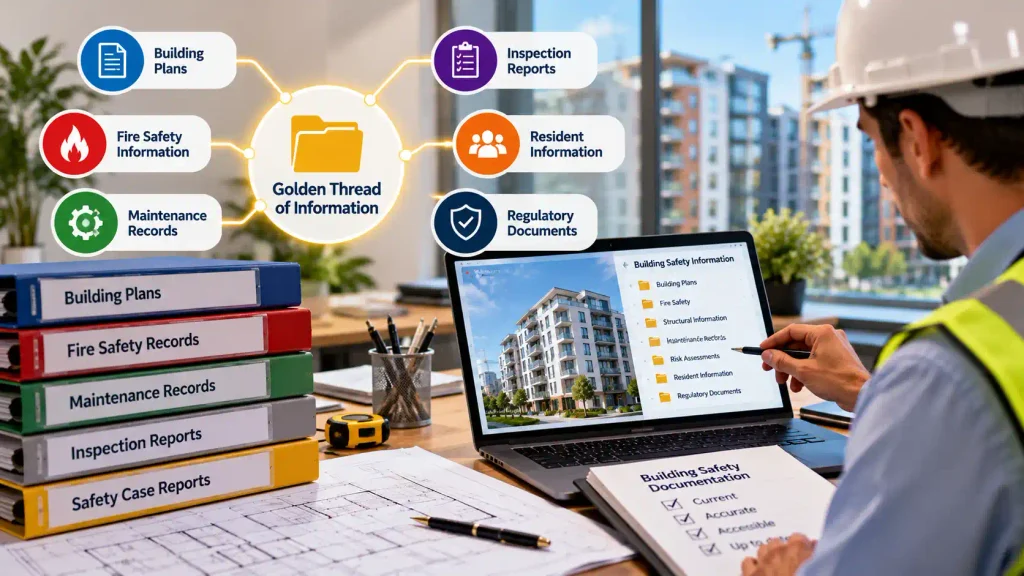
The Golden Thread of Information: Why is it important?
The Golden Thread of Information is a digital record of important information about a building. It is intended to ensure that accurate, relevant and accessible safety information is maintained throughout the building’s lifecycle. For qualifying higher-risk buildings, the Golden Thread is an important legal requirement under the Building Safety Act framework. It supports building owners and Accountable Persons in understanding the building’s design, construction, fire strategy, structural condition and ongoing safety arrangements.
What information should the Golden Thread contain?
Depending on the building and applicable duties, relevant information may include:
| Information category | Examples |
|---|---|
| Building details | Address, age, height and floor plans |
| Construction information | Drawings, materials and construction records |
| Fire safety | Fire strategy and fire risk assessments |
| Structural safety | Structural assessments and inspection reports |
| Building systems | Fire alarms, smoke control and suppression systems |
| Maintenance | Inspection and servicing records |
| Building alterations | Refurbishment and remediation information |
| Emergency arrangements | Emergency plans and relevant procedures |
| Safety management | Safety case report and relevant policies |
| Resident information | Resident engagement strategy |
The information should be maintained digitally, protected from unauthorised access and made available to people who need it.It should also be presented in an understandable format, with appropriate version control and information management arrangements.The Golden Thread is not simply a folder of documents. It should function as a reliable source of building information that supports decisions about safety and maintenance.
Practical example
A building manager discovers that a fire door has been replaced during refurbishment. The Golden Thread should be updated with the relevant replacement information, supporting documentation and inspection records where applicable. This helps future building managers understand what was changed, when it happened and whether the replacement is consistent with the building’s fire safety arrangements.
What Is a Building Safety Case Report?
A Building Safety Case Report is a document prepared by the Principal Accountable Person for a qualifying occupied higher-risk residential building in England. It explains the building’s relevant fire and structural safety risks and demonstrates how those risks are being managed. The report should provide a clear picture of the building’s safety arrangements and the evidence supporting them. The Building Safety Regulator may request the report when requiring the PAP to apply for a building assessment certificate or when otherwise requesting it.
Main components of a safety case report
Building information
The report should identify the building, its location, height, number of storeys, construction history and relevant residential units.
Construction methods and materials
Information should explain relevant construction methods, materials and features that may influence building safety.
Fire safety measures
The report should describe relevant fire safety arrangements, including measures intended to prevent and restrict the spread of fire and smoke.
Structural condition
Relevant information should explain how structural risks are assessed and managed.
Building alterations
Refurbishment, maintenance and remediation work should be considered where relevant to building safety.
Emergency arrangements
The report should explain relevant emergency plans and how risks are managed.
Safety management systems
It should demonstrate how the building’s safety arrangements are monitored, reviewed and improved.
A safety case report is not a replacement for a fire risk assessment. The documents have related but different purposes and should support an integrated approach to building safety.
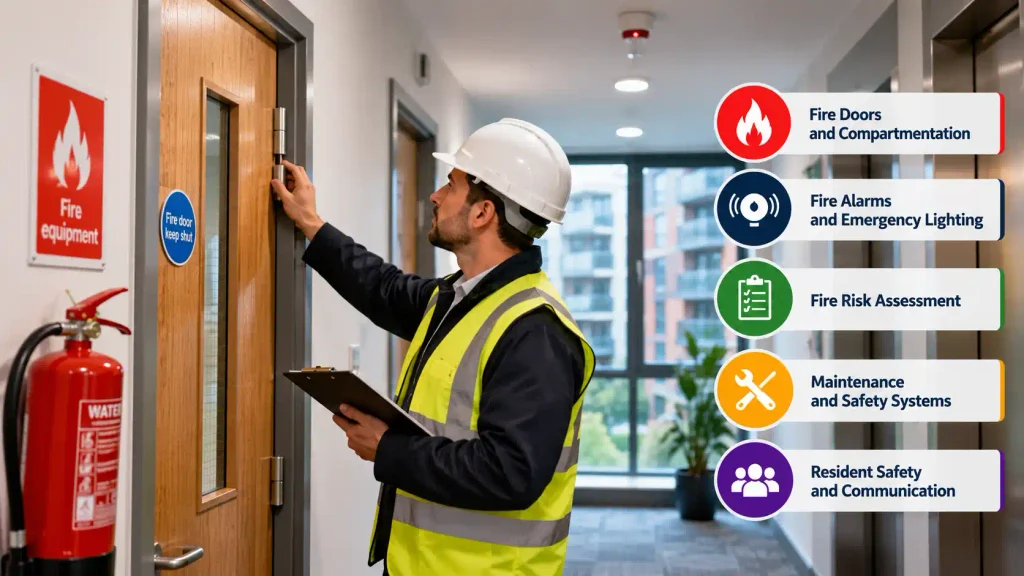
Fire Safety Measures Property Owners Should Manage
The Building Safety Act should be understood alongside the existing fire safety framework. For property owners, the practical priority is to ensure that appropriate fire prevention, protection and emergency arrangements are maintained.
Fire risk assessments
A fire risk assessment identifies potential fire hazards, evaluates who could be harmed and determines the measures required to protect people. It should consider the building’s use, layout, occupants, fire protection systems and emergency arrangements. For relevant premises under the Fire Safety Order, the Responsible Person must ensure that the assessment is suitable and sufficient. An assessment should be reviewed when there is reason to believe it is no longer valid or when significant changes occur.
Fire doors and compartmentation
Fire doors and fire-resistant compartmentation help restrict the spread of fire and smoke. Property owners should ensure that relevant doors and compartmentation arrangements are inspected and maintained.
Important considerations include:
- Door condition.
- Closing mechanisms.
- Seals and intumescent strips.
- Gaps and damage.
- Unauthorised alterations.
- Evidence of defective installation.
- Appropriate maintenance records.
A damaged fire door or poorly sealed service penetration may compromise the intended fire protection of a building.
Fire alarms and detection systems
Fire detection and alarm systems should be appropriate for the building and its fire strategy. Owners and managers should establish suitable arrangements for inspection, testing and maintenance.
Emergency lighting and escape routes
Emergency lighting should support safe evacuation when normal lighting fails. Escape routes should be kept clear, adequately maintained and consistent with the building’s emergency arrangements.
External walls and cladding
External walls and cladding should be considered as part of the overall fire risk assessment where relevant. The Fire Safety Act 2021 clarified the scope of the Fire Safety Order in relation to the structure, external walls and flat entrance doors in relevant multi-occupied residential buildings. Property owners should obtain appropriate professional advice where defects, combustible materials or uncertainty about external wall construction are identified.
How Property Owners Can Maintain Building Safety Compliance
Property owners should establish a systematic approach to managing fire safety and building safety obligations. Compliance should not depend on occasional inspections or responding to problems after they occur. It requires clear responsibilities, suitable documentation, regular monitoring and effective communication.
The following process provides a practical starting point.
Step 1: Identify the applicable legislation
Start by identifying the property’s location, building type, use and ownership arrangements. Determine whether the property falls within the Building Safety Act’s relevant provisions, the Fire Safety Order or another jurisdiction-specific fire safety framework. For higher-risk buildings in England, assess whether the building meets the applicable height, storey and residential-use criteria.
Step 2: Establish who holds legal responsibility
Identify the Responsible Person under the Fire Safety Order where it applies. For qualifying higher-risk buildings in England, establish whether there are one or more Accountable Persons and identify the Principal Accountable Person. Review leases, ownership arrangements, repairing obligations and management agreements. Do not assume that a managing agent automatically becomes the legal dutyholder.
Step 3: Review the fire risk assessment
Check whether a suitable and sufficient fire risk assessment exists.
Review whether it considers:
- Fire hazards.
- Occupant safety.
- Fire detection and alarm arrangements.
- Means of escape.
- Fire doors.
- Compartmentation.
- External walls where relevant.
- Emergency procedures.
- Maintenance requirements.
Record findings and establish an action plan to address deficiencies.
Step 4: Implement preventative and protective measures
Identify the measures needed to control the risks. These may involve repairing defective fire doors, maintaining alarms, improving emergency lighting, restoring fire compartmentation or addressing unsafe storage. Actions should be prioritised according to the severity and urgency of the identified risks.
Step 5: Maintain building safety documentation
Create an organised system for managing fire safety and building safety information. For qualifying higher-risk buildings, ensure that the Golden Thread requirements are met.
Maintain relevant records, including:
- Fire risk assessments.
- Inspection reports.
- Fire alarm maintenance records.
- Emergency lighting test records.
- Fire door inspection records.
- Building alterations.
- Contractor information.
- Safety case documentation where applicable.
- Relevant resident communication records.
Step 6: Communicate with residents and other dutyholders
Ensure that relevant people understand their responsibilities and receive appropriate fire safety information. Establish communication arrangements for reporting hazards, informing residents about safety work and sharing relevant information with other Responsible Persons.
Step 7: Monitor and review compliance
Review the effectiveness of fire safety arrangements regularly. Investigate incidents, defects and changes that could affect building safety. Ensure that outstanding corrective actions are monitored until completed.
Building Safety Act 2022 Compliance Checklist for Property Owners
The following checklist can help property owners and building managers organise their compliance activities.
Building Safety & Fire Safety Compliance Checklist
Review the key fire and building safety responsibilities for your property.
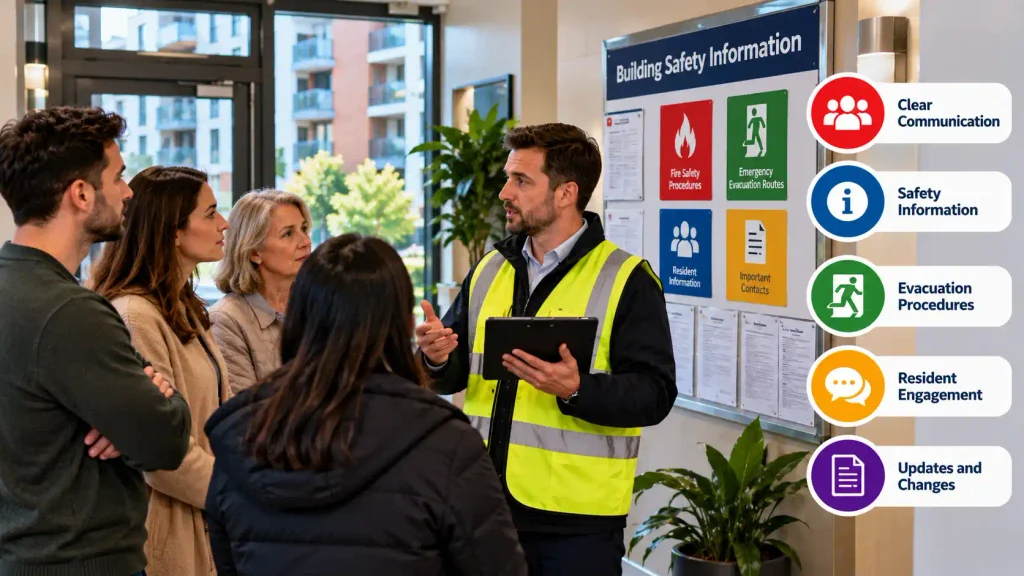
Resident Engagement and Building Safety Communication
Resident engagement is an important element of building safety management. In England, the Principal Accountable Person for a qualifying higher-risk residential building must prepare and maintain a resident engagement strategy. The strategy explains how residents and owners of residential units will be informed about and involved in relevant building safety decisions.It should be appropriate to the building and consider residents’ needs, preferences and circumstances.
What should resident engagement include?
Building safety information
Residents should receive relevant information about building safety risks, protective measures and the arrangements for reporting concerns.
Consultation
Residents should be consulted about relevant building safety decisions in accordance with the applicable requirements.
Communication about safety work
Where significant building work is planned, residents should receive appropriate information about its timing and potential disruption.
Complaints and concerns
Residents should have appropriate routes to raise concerns about building safety and receive information about how their concerns will be handled.
Accessible communication
Information should be communicated in a format that residents can understand.
Effective communication can help property owners identify hazards, reduce misunderstandings and encourage residents to participate in maintaining safer buildings.
Fire Safety Act 2021 and Fire Safety (England) Regulations 2022: How Do They Relate to the Building Safety Act?
The Building Safety Act 2022 should not be considered in isolation. It operates alongside other important fire safety and building regulations.
Fire Safety Act 2021
The Fire Safety Act 2021 clarified the scope of the Fire Safety Order in relation to multi-occupied residential buildings.
It specifically addressed:
- The building’s structure.
- External walls, including cladding.
- Doors between domestic premises and common parts.
This clarification helps ensure that relevant external fire spread risks are considered when assessing fire safety.
Fire Safety (England) Regulations 2022
The Fire Safety (England) Regulations 2022 introduced additional fire safety requirements for Responsible Persons in relevant multi-occupied residential buildings in England.
The requirements vary according to the building’s characteristics.
They include provisions concerning:
- Fire safety instructions for residents.
- Information supplied to fire and rescue services.
- External wall information for relevant buildings over 11 metres.
- Fire door checks in relevant buildings.
- Secure information about building layouts and facilities.
The regulations came into force on 23 January 2023. These regulations are separate from the Building Safety Act but form part of the wider fire safety framework.
Comparison of the three legislative frameworks
| Legislation | Main purpose | Property-owner consideration |
|---|---|---|
| Fire Safety Act 2021 | Clarifies the scope of fire safety legislation | External walls and relevant flat entrance doors |
| Building Safety Act 2022 | Strengthens building safety regulation and accountability | Building safety management and Section 156 amendments |
| Fire Safety (England) Regulations 2022 | Introduces additional duties for relevant multi-occupied buildings in England | Inspections, information and resident instructions |
Owners should consider how these legal requirements interact when preparing their building’s overall fire safety management arrangements.
Common Building Safety Compliance Mistakes Property Owners Should Avoid
Even when property owners understand their legal responsibilities, practical compliance problems can arise through poor management and inadequate documentation.
The following mistakes deserve particular attention.
Assuming the Building Safety Act only applies to high-rise buildings
Some requirements are specifically designed for higher-risk buildings, but Section 156 also amended fire safety responsibilities under the Fire Safety Order for relevant non-domestic premises. Property owners should not assume that smaller buildings are automatically exempt from all relevant fire safety duties.
Confusing the Responsible Person with the Accountable Person
These roles have different legal foundations and responsibilities. A person may hold both roles, but one should not automatically be treated as equivalent to the other.
Treating the fire risk assessment as a one-time document
Fire risks can change following refurbishment, changes in occupancy, building alterations or the discovery of defects. Assessments should be reviewed when necessary and corrective actions should be monitored.
Failing to maintain accurate records
Incomplete records can make it difficult to demonstrate that appropriate safety arrangements exist. Property owners should establish a reliable system for storing and updating relevant documentation.
Delegating everything to managing agents
A managing agent can organise and perform many practical activities, but delegation does not automatically remove the legal responsibilities of the owner or Accountable Person.
Ignoring resident concerns
Residents may identify hazards that are not immediately visible during routine inspections. A suitable communication and reporting system helps ensure that these concerns are considered.
Overlooking building alterations
Even relatively small alterations can affect compartmentation, fire doors, escape routes or other protective measures. Building work should be assessed for its potential impact on fire safety, and relevant information should be updated.
What Are the Consequences of Failing to Meet Building Safety and Fire Safety Duties?
Failure to comply with applicable fire safety and building safety legislation can lead to regulatory action, financial consequences and significant risks to occupants.
Depending on the legal provision involved, consequences may include:
- Enforcement notices.
- Requirements to complete remedial work.
- Restrictions on the use or occupation of buildings.
- Prohibition notices.
- Criminal prosecution.
- Financial penalties.
- Damage to property and business reputation.
- Increased insurance and remediation difficulties.
The Building Safety Regulator has powers under the higher-risk building regime in England, while local fire and rescue authorities remain the primary enforcing bodies for the Fire Safety Order in ordinary circumstances.Other enforcing authorities may have jurisdiction in particular circumstances, including construction sites and certain Crown premises.
Property owners should not wait for an inspection or enforcement notice before addressing known safety deficiencies.A proactive approach is more effective because it identifies problems before they develop into serious risks.
Professional Training and Qualifications for Building and Fire Safety Management
Managing building safety requires appropriate knowledge of fire prevention, risk assessment, building systems, regulatory responsibilities and safety management.Property owners may need to work with competent fire safety professionals, building managers, fire risk assessors and other specialists to ensure that relevant responsibilities are fulfilled.Professional development can help individuals understand the legislation, identify potential hazards and establish effective safety management arrangements.For individuals seeking to develop their knowledge and professional capabilities, several relevant qualifications are available through Inspire College.
Conclusion
The Building Safety Act 2022 has significantly strengthened the approach to building safety and fire safety management, particularly for higher-risk residential buildings in England. It has introduced clearer responsibilities, stronger regulatory oversight and improved requirements for maintaining building safety information.
For property owners, landlords, freeholders and building managers, understanding these responsibilities is essential. They must identify the legislation applicable to their property, establish who holds the relevant legal responsibilities, maintain suitable fire risk assessments and ensure that appropriate preventative and protective measures are implemented.
The Section 156 amendments are particularly important because they strengthen fire safety documentation, information sharing and cooperation between Responsible Persons. For qualifying higher-risk residential buildings, additional requirements concerning Accountable Persons, safety case reports, resident engagement and the Golden Thread must also be considered.
Property owners should also recognise that the legal framework differs across England, Wales, Scotland and Northern Ireland. In particular, the Building Safety (Wales) Act 2026 introduces a separate framework whose implementation must be monitored.
Ultimately, effective building safety management requires more than understanding legislation. It requires consistent risk assessment, competent professional support, accurate records, regular maintenance and a commitment to protecting everyone who lives in, works in or visits a building.
Develop your professional fire safety knowledge with Inspire College. Explore relevant fire safety and risk management qualifications to strengthen your understanding of building safety responsibilities and professional practice.