
Fire Safety Requirements for UK Landlords: A Practical Legal Guide
Fire safety is one of the most important responsibilities of property ownership and rental management. Landlords must ensure that their rental accommodation provides a safe living environment, with appropriate fire detection systems, suitable escape routes, maintained fire protection equipment and effective measures to reduce the risk of fire. Understanding the Fire Safety Requirements for UK Landlords is essential for protecting tenants, meeting legal responsibilities and preventing avoidable property damage.
Across the United Kingdom, fire safety legislation establishes different obligations depending on the property’s location, occupancy arrangements, building design and management responsibilities. A private landlord renting a single-family house may have different requirements from someone managing a House in Multiple Occupation (HMO), a converted block of flats or a multi-storey residential building.
The legal framework also differs between England, Wales, Scotland and Northern Ireland. Consequently, landlords should understand which regulations apply to their properties rather than assuming that one set of requirements covers the entire UK.
This practical guide explains the main UK fire safety laws, landlord responsibilities, smoke and carbon monoxide alarm requirements, fire risk assessments, fire door maintenance, HMO considerations and ongoing compliance procedures. It also provides practical checklists to help landlords manage fire safety requirements for UK rental properties effectively.
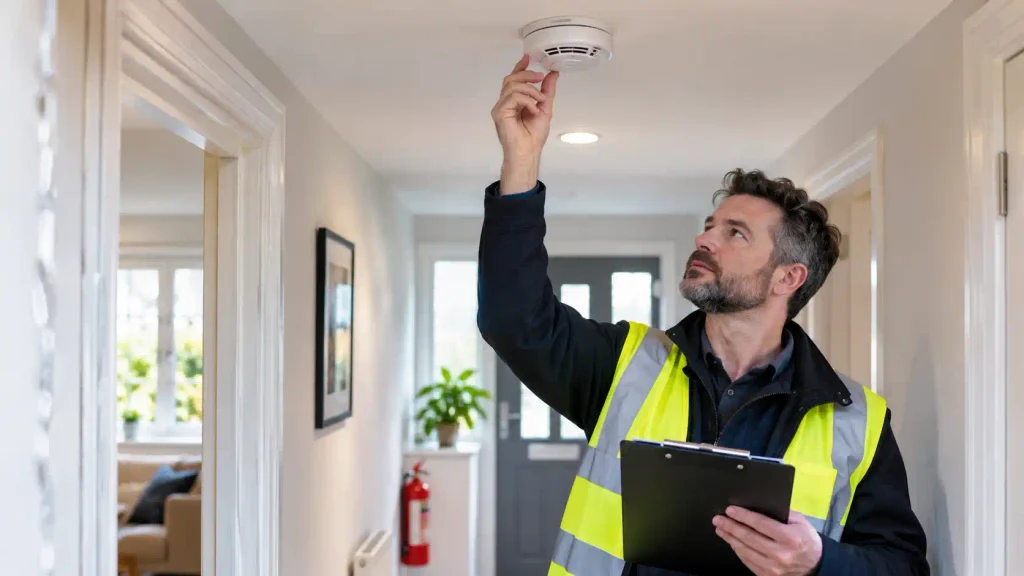
Understanding UK Fire Safety Laws for Landlords
UK landlords must understand the legislation governing residential property safety and fire prevention. Several laws establish responsibilities for preventing fire hazards, maintaining safe accommodation and protecting residents.
The applicable requirements depend on the property’s location and whether the premises include communal or non-domestic areas.
Regulatory Reform (Fire Safety) Order 2005
The Regulatory Reform (Fire Safety) Order 2005 is a major part of the fire safety framework in England and Wales. It places duties on a responsible person to take appropriate general fire precautions and conduct a suitable and sufficient fire risk assessment for premises covered by the Order.
In residential buildings, the Order generally applies to common parts rather than individual private domestic premises. Examples include:
- Shared corridors and hallways.
- Communal staircases and entrance areas.
- Shared facilities and access routes.
- Relevant external walls and structures.
- Other common areas used by residents.
The responsible person may be a building owner, landlord, managing agent or another organisation or individual with sufficient control over the premises. More than one responsible person may have duties, depending on how control is divided.
A landlord should establish who manages the shared areas and ensure that fire safety responsibilities are clearly allocated.
The Order requires a suitable and sufficient assessment of fire risks, appropriate preventive measures, maintained fire precautions and relevant emergency arrangements. It does not automatically require every landlord renting an ordinary single-family dwelling to commission a separate Fire Safety Order assessment.
Official legislation: https://www.legislation.gov.uk/uksi/2005/1541/contents
Fire Safety Act 2021
The Fire Safety Act 2021 clarified the scope of the Fire Safety Order in relation to certain residential buildings containing multiple domestic premises.
In England and Wales, it confirms that the Fire Safety Order applies to the structure and external walls of relevant multi-occupied residential buildings, including doors between domestic premises and common parts.
This is important for landlords and property managers because fire safety cannot always be considered separately from the wider building.
For example, a flat owner or landlord may have responsibilities concerning the condition of an entrance fire door, while the building’s responsible person may have duties relating to the common parts and wider building fire precautions.
Landlords should coordinate with freeholders, managing agents and building managers to establish how responsibilities are divided.
Official legislation: https://www.legislation.gov.uk/ukpga/2021/24/contents
Fire Safety (England) Regulations 2022
The Fire Safety (England) Regulations 2022 introduced additional fire safety duties for responsible persons managing multi-occupied residential buildings in England.
The regulations include requirements relating to:
- Providing residents with fire safety instructions.
- Displaying relevant fire safety information.
- Providing information to fire and rescue services.
- Maintaining information about building design and fire safety equipment.
- Conducting specified fire door checks in buildings above 11 metres.
- Providing residents with information about flat entrance fire doors.
Additional requirements apply to certain high-rise residential buildings, including those at least 18 metres high or with at least seven storeys.
These requirements are particularly relevant to landlords who own flats within larger residential developments and those who manage entire buildings.
The responsible person should understand the building’s height, design, fire protection arrangements and applicable obligations rather than assuming that every requirement applies to every residential property.
Official guidance: https://www.gov.uk/government/publications/fire-safety-england-regulations-2022
Housing Act 2004 and HMO Requirements
The Housing Act 2004 establishes important responsibilities concerning housing conditions, property hazards and Houses in Multiple Occupation.
Landlords operating HMOs must pay particular attention to fire safety because multiple households or unrelated occupants may share facilities and escape routes.
Depending on the property and licensing conditions, fire safety provisions may include:
- Suitable fire detection and warning systems.
- Protected escape routes.
- Appropriate fire-resisting doors.
- Emergency lighting where required.
- Safe electrical installations.
- Adequate fire separation.
- Appropriate fire safety management arrangements.
Local authorities can impose additional licensing conditions and inspect properties to assess compliance.
Landlords should therefore check the applicable HMO licensing requirements and local authority guidance before letting or converting a property into shared accommodation.
What are the Legal Fire Safety Responsibilities of UK Landlords?
The legal responsibilities of landlords extend beyond installing smoke alarms. They must take appropriate steps to ensure that their properties remain safe throughout the tenancy.
The precise duties depend on the applicable housing legislation, fire safety regulations, tenancy arrangements and property characteristics.
Providing Safe Rental Accommodation
Landlords must maintain their rental properties in a safe condition and address hazards that could threaten occupants. Fire hazards may include exposed electrical wiring, defective heating equipment, damaged electrical installations, blocked escape routes and unsuitable storage of combustible materials. Property inspections should identify potential risks before they become serious problems. Landlords should also investigate complaints about fire safety promptly and arrange appropriate repairs or professional inspections when necessary.
Installing and Maintaining Fire Detection Systems
Smoke alarms provide early warning, allowing occupants to respond quickly when a fire develops. Landlords must comply with the alarm requirements applicable to their location and property type.
Their responsibilities may include:
- Installing the required smoke alarms.
- Providing heat alarms where applicable.
- Installing carbon monoxide alarms where legally required.
- Checking prescribed alarms at the beginning of relevant new tenancies.
- Repairing or replacing faulty alarms when notified.
- Ensuring that installed systems remain suitable for the property.
Landlords should retain installation details, inspection records and evidence of repairs.
Maintaining Safe Escape Routes
A suitable escape route allows occupants to leave the building safely during an emergency. Landlords and responsible persons should ensure that corridors, staircases, hallways and exit doors remain accessible.
Common hazards include:
- Furniture obstructing corridors.
- Bicycles stored on staircases.
- Combustible materials placed near exits.
- Locked or obstructed emergency exits.
- Damaged doors and defective closing mechanisms.
- Poorly maintained emergency lighting.
In buildings where a stay-put strategy is part of the fire safety design, landlords should not assume that a single evacuation approach is suitable for every building. Residents should receive information consistent with the building’s fire risk assessment and emergency arrangements.
Providing Fire-Safe Furniture and Furnishings
Landlords supplying upholstered furniture and furnishings must ensure that the relevant products meet applicable UK fire safety requirements. This is particularly important for furnished rental properties and shared accommodation.
Landlords should check that supplied sofas, mattresses, upholstered chairs and other relevant furnishings meet the applicable fire resistance and labelling requirements. They should avoid supplying damaged or unsuitable furniture and retain purchasing information where useful.
Maintaining Electrical and Gas Safety
Electrical and gas-related hazards can contribute to residential fires. Landlords should ensure that electrical installations and supplied appliances are maintained safely. In England, the Electrical Safety Standards in the Private Rented Sector (England) Regulations 2020 establish inspection and testing requirements for relevant private rented properties.
Gas appliances and associated installations must be maintained and checked in accordance with applicable gas safety requirements by appropriately registered engineers.
Important management activities include:
- Arranging required electrical inspections.
- Keeping relevant electrical reports.
- Obtaining annual gas safety checks where required.
- Maintaining boilers and heating equipment.
- Addressing damaged sockets and electrical cables.
- Replacing unsafe electrical appliances.
- Investigating repeated electrical faults.
Informing Tenants About Fire Safety
Tenants should understand how to respond to a fire and how to report fire safety problems.
Landlords should provide clear information about:
- The location and operation of smoke alarms.
- How to test alarms according to manufacturer instructions.
- Emergency exits and escape routes.
- The building’s evacuation arrangements.
- Reporting defective fire doors.
- Avoiding obstruction of communal areas.
- Safe use of heating and electrical equipment.
Good communication helps tenants understand their responsibilities and supports effective fire safety management.
Fire Safety Requirements for Different Rental Properties
Not all rental properties present the same fire risks. A small single-let house may have straightforward escape arrangements, while an HMO or residential block may require more extensive protection.
| Property type | Important fire safety considerations | Management priority |
|---|---|---|
| Single-let house | Smoke alarms, carbon monoxide alarms where required, electrical and gas safety | Maintain a safe individual dwelling |
| HMO | Fire detection, protected escape routes, fire doors and licensing conditions | Manage shared accommodation risks |
| Purpose-built flats | Common parts, flat entrance doors and building fire precautions | Coordinate with building management |
| Converted flats | Fire separation, escape arrangements and shared access | Assess building-specific risks |
| Higher-risk residential buildings | Additional building information, fire doors and fire service access | Meet enhanced building requirements |
Fire Safety for Single-Let Residential Properties
Single-let properties are generally occupied by one household. Landlords should ensure that the property has the required smoke and carbon monoxide alarms, safe electrical installations, properly maintained heating equipment and suitable escape arrangements.
They should also ensure that supplied furniture meets relevant safety requirements. Although an ordinary single-family home is not automatically subject to the Fire Safety Order’s common-parts risk assessment duty, other housing and safety obligations continue to apply.
Fire Safety for Houses in Multiple Occupation (HMOs)
HMOs can present additional fire risks because several occupants may share kitchens, bathrooms, corridors and staircases. A fire in a shared kitchen or communal area can affect multiple residents. For this reason, fire precautions should be appropriate to the building’s occupancy, layout and risk assessment.
HMO landlords should pay particular attention to:
- Suitable fire detection and alarm systems.
- Protected escape routes.
- Appropriate fire-resisting doors.
- Emergency lighting where required.
- Fire separation between relevant areas.
- Safe kitchen and cooking arrangements.
- Clear emergency instructions.
- Regular inspection and maintenance.
The exact specification may depend on the HMO licence, property design, occupancy and local authority standards.
Fire Safety for Flats and Converted Buildings
Landlords who own or rent out flats should understand the difference between the private dwelling and the building’s common parts. The flat itself may be managed by an individual landlord, while communal corridors, staircases, entrance doors and wider building systems may be controlled by a freeholder or managing agent.
The Fire Safety Act 2021 and relevant fire safety regulations make coordination especially important in England and Wales. Landlords should establish who is responsible for inspecting shared areas, maintaining fire doors, managing fire risk assessments and communicating emergency arrangements.
Fire Safety in Higher-Risk Residential Buildings
Higher-rise residential buildings may require additional management arrangements and building safety information. In England, the Fire Safety (England) Regulations 2022 introduce specific duties for relevant multi-occupied residential buildings, with additional requirements for buildings at least 18 metres high or with at least seven storeys. These may include providing floor plans, information about external wall construction and details of relevant firefighting equipment to fire and rescue services.
Landlords should not assume that owning one flat makes them responsible for every building-wide duty. They should establish whether they are the responsible person, an accountable person under applicable building safety legislation, or simply a landlord with duties relating to their own premises.
Fire Alarm and Smoke Detector Requirements for Landlords
Smoke and heat alarms are fundamental components of residential fire protection. However, the number, positioning, power supply and interconnection requirements differ across the UK.
Smoke Alarm Requirements in England
Under the Smoke and Carbon Monoxide Alarm (England) Regulations 2015, as amended, relevant landlords must provide at least one smoke alarm on every storey of a property where there is a room used wholly or partly as living accommodation.
Landlords must also ensure that prescribed alarms are checked and working when a relevant new tenancy begins.
If a tenant reports that a prescribed alarm is faulty and it is found not to be in proper working order, the landlord must arrange repair or replacement as soon as reasonably practicable.
Smoke Alarm Requirements in Wales
In Wales, the Renting Homes (Fitness for Human Habitation) (Wales) Regulations 2022 establish requirements for smoke alarms.
At least one smoke alarm on each storey must be connected to the dwelling’s electrical supply and linked to other smoke alarms in the dwelling that are connected to that supply. Landlords must ensure that the required alarms remain in proper working order throughout the occupation period.
Smoke and Heat Alarm Requirements in Scotland
Scotland has a specific interlinked alarm standard.
A home should have:
- One smoke alarm in the principal living room or the room most frequently used during the day.
- One smoke alarm in every circulation space on each storey, such as hallways and landings.
- One heat alarm in every kitchen.
All required smoke and heat alarms should be ceiling-mounted and interlinked. They may be mains-powered with battery backup or suitable tamper-proof long-life battery models.
Landlords are responsible for ensuring that their rental properties meet the applicable standard.
Smoke and Heat Alarm Requirements in Northern Ireland
The Smoke, Heat and Carbon Monoxide Alarms for Private Tenancies Regulations (Northern Ireland) 2024 establish specific alarm requirements.
For relevant private tenancies, landlords must provide:
- A smoke alarm in the room most frequently used for general daytime living.
- Smoke alarms in circulation spaces on every storey.
- A heat alarm in every kitchen.
- A carbon monoxide alarm in rooms or circulation spaces containing a fixed combustion appliance or flue.
Smoke and heat alarms must be interlinked and may be hardwired, sealed-battery powered or a combination of both. The regulations came into force for new private tenancies from 1 September 2024 and other private tenancies from 1 December 2024.
Carbon Monoxide Alarm Requirements
Carbon monoxide is a dangerous gas produced by the incomplete combustion of fuels. It cannot be reliably identified through smell, taste or sight. Landlords should understand the carbon monoxide alarm requirements applicable to their jurisdiction.
In England, relevant landlords must provide carbon monoxide alarms in rooms used as living accommodation containing fixed combustion appliances, excluding gas cookers.
Wales, Scotland and Northern Ireland have their own applicable requirements and standards. Carbon monoxide alarms should be installed in suitable locations according to manufacturer instructions and maintained in working order.
| UK nation | Main smoke and heat alarm approach | Carbon monoxide considerations |
|---|---|---|
| England | Smoke alarm on each storey used as living accommodation | Required in relevant rooms with fixed combustion appliances, excluding gas cookers |
| Wales | Electrically supplied and interconnected smoke alarm provision on each storey | Requirements apply under Welsh housing fitness standards |
| Scotland | Interlinked smoke alarms in living and circulation areas, plus kitchen heat alarm | Follow applicable Scottish housing standards |
| Northern Ireland | Interlinked smoke alarms and kitchen heat alarms under the 2024 regulations | Required in rooms or circulation spaces containing fixed combustion appliances or a flue |
Important: This comparison summarises the principal residential alarm arrangements. It does not replace checking the detailed legislation, exemptions, tenancy conditions and technical standards applicable to an individual property.
Fire Risk Assessments for Rental Properties
A fire risk assessment is a systematic process for identifying fire hazards, evaluating risks and deciding which precautions are necessary to protect people. It is particularly important for HMOs, multi-occupied residential buildings and premises containing shared or non-domestic areas.
When Is a Fire Risk Assessment Legally Required?
Under the Regulatory Reform (Fire Safety) Order 2005, the responsible person must conduct a suitable and sufficient fire risk assessment for premises covered by the Order.In residential buildings, this generally concerns relevant common parts and other areas within its scope.
Landlords should understand that the requirement does not automatically apply to every individual domestic dwelling. However, landlords may still need fire risk assessments or equivalent risk evaluations under HMO licensing conditions, other applicable housing requirements, management arrangements or professional recommendations.
What Should a Fire Risk Assessment Include?
A suitable assessment should consider the building’s layout, occupancy, fire hazards, existing protection measures and emergency arrangements.
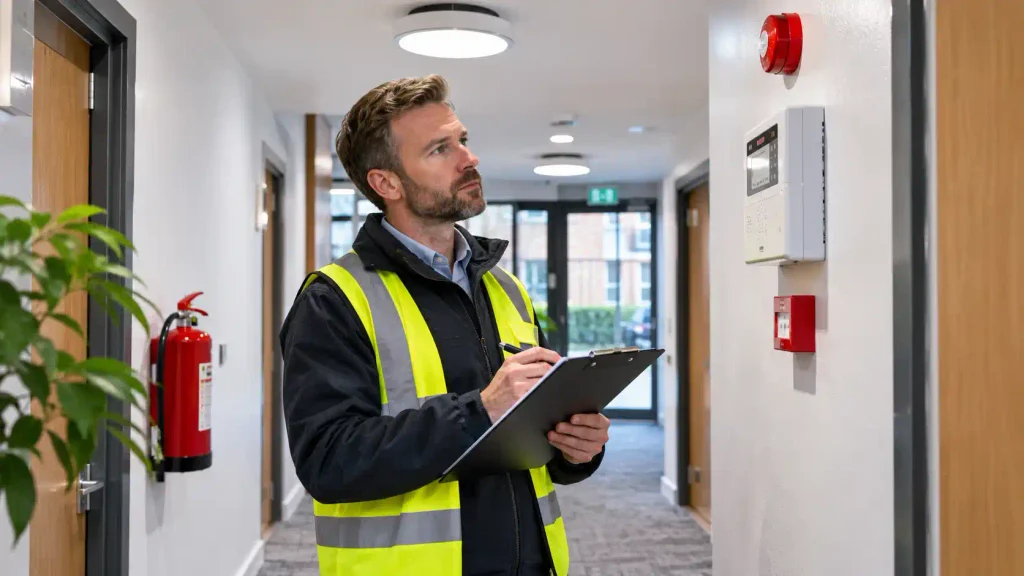
Key areas include:
- Sources of ignition, including electrical equipment and cooking appliances.
- Combustible materials and potential fuel sources.
- People who may be particularly vulnerable during an emergency.
- Smoke detection and warning systems.
- Escape routes and exit arrangements.
- Fire doors and fire-resisting construction.
- Emergency lighting where required.
- Firefighting equipment where appropriate.
- Fire safety management and maintenance arrangements.
The assessment should identify deficiencies and specify suitable corrective actions.
Who Can Carry Out a Fire Risk Assessment?
The responsible person must ensure that the assessment is suitable and sufficient. They may carry it out themselves if they have the necessary knowledge and experience. Where the assessment is complex or specialist knowledge is required, a competent professional fire risk assessor should be appointed.
A competent assessor should understand fire hazards, relevant building characteristics, applicable legal duties and appropriate risk control measures. Landlords should not choose an assessor solely because they offer the cheapest service. Professional competence and experience are more important.
When Should a Fire Risk Assessment Be Reviewed?
A fire risk assessment should be reviewed regularly and whenever significant changes occur.
Examples include:
- Changes to building layout.
- Increased occupancy.
- New fire detection equipment.
- Changes to escape routes.
- Alterations to fire doors or compartmentation.
- Discovery of previously unidentified hazards.
- A fire or serious near-miss incident.
- Changes to the building’s use.
Fire Risk Assessment Process
The following process provides a practical approach to managing fire risks.
Fire Risk Assessment Process
A practical approach to managing fire risks
Review the process again
↶ Return to Step 01Continue monitoring
↓ Maintain ongoing reviewsFire Door Requirements and Maintenance
Fire doors are designed to help restrict the spread of fire and smoke, protecting escape routes and giving occupants additional time to leave safely.
They are particularly important in HMOs, converted buildings and blocks of flats.
Fire Door Requirements in HMOs
HMO fire doors should be appropriate for the building’s fire safety strategy and licensing requirements. Depending on the property, fire-resisting doors may be needed between bedrooms, communal corridors, kitchens and other relevant areas. Their purpose is to help prevent fire and smoke from spreading into protected escape routes. Landlords should obtain competent advice when selecting or replacing fire doors.
Fire Doors in Blocks of Flats
In blocks of flats, flat entrance doors play an important role in containing fire within individual dwellings. The Fire Safety (England) Regulations 2022 require responsible persons to provide information to residents about keeping fire doors shut when not in use, avoiding interference with self-closing devices and reporting defects.
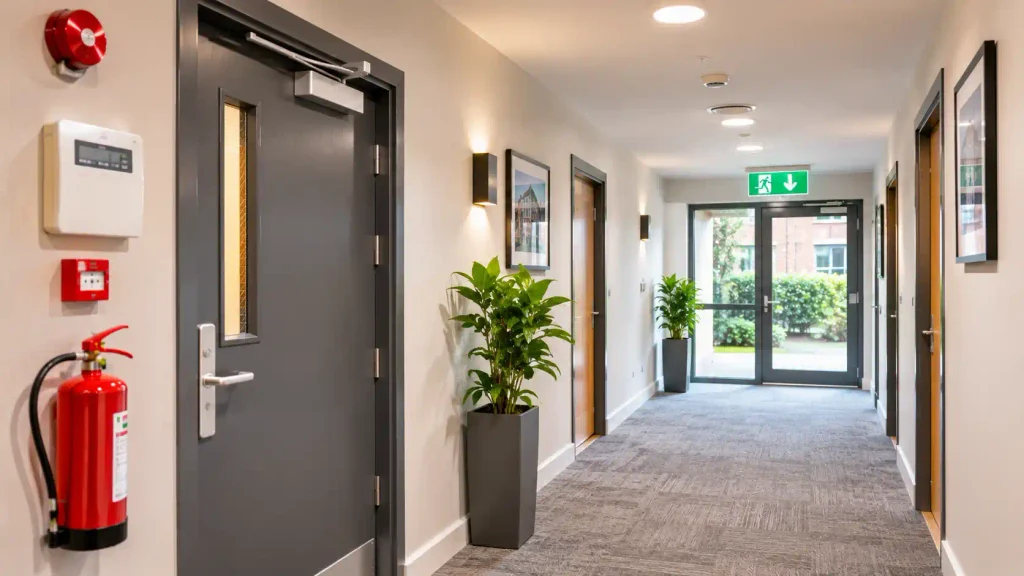
In relevant buildings where the top storey is more than 11 metres above ground level, responsible persons must use best endeavours to check flat entrance fire doors at least every 12 months. Communal fire doors in those buildings must be checked at least every three months.
The government updated its fire door guidance on 8 August 2025 to clarify that these regulations do not automatically require every existing flat entrance door to be replaced simply because it was not manufactured to current new-build standards.
Fire Door Inspection and Maintenance
Landlords and responsible persons should check that fire doors:
- Close properly within their frames.
- Have suitable self-closing devices where required.
- Are free from significant damage.
- Have appropriate seals and hardware.
- Do not have unauthorised alterations.
- Are not wedged open where this compromises protection.
- Have suitable gaps and clearances.
- Remain appropriate for their intended location.
Defects should be investigated and corrected by competent professionals.
Emergency Escape Routes and Fire Protection Measures
A safe escape route is essential to protecting tenants during a fire. Landlords should ensure that occupants can reach a suitable place of safety without unnecessary obstruction or avoidable delay.
Important considerations include:
- Clear corridors and staircases: Shared escape routes should not be used for storing furniture, rubbish, bicycles or other combustible materials.
- Suitable exit arrangements: Doors and access routes should operate in accordance with the building’s fire safety design.
- Emergency lighting: Where required by the risk assessment or applicable standards, emergency lighting should be installed, inspected and maintained.
- Fire safety signage: Relevant buildings should have suitable signage to help occupants understand escape routes and emergency arrangements.
- Firefighting equipment: Fire extinguishers and other equipment should be provided where required by the risk assessment or applicable licensing conditions. They are not universally mandatory in every ordinary rented home.
- Emergency instructions: Tenants should receive appropriate information about the building’s evacuation procedure.
Landlords should never assume that every building should follow the same evacuation strategy. The appropriate approach depends on the building design, fire precautions and professional fire risk assessment.
Electrical, Gas and Furniture Fire Safety Requirements
Electrical faults, unsafe appliances, heating equipment and unsuitable furnishings can create significant fire hazards in rental properties.
Landlords should include these issues within their property management and inspection procedures.
Electrical Safety
Landlords should ensure that electrical installations are safe and maintained appropriately. For relevant private rented properties in England, electrical installations must be inspected and tested at least every five years by a qualified person under the applicable regulations.
Landlords should retain the Electrical Installation Condition Report and address any issues identified within the required timescales. They should also ensure that supplied electrical appliances are safe to use.
Gas Safety
Gas appliances, pipework and flues must be maintained in a safe condition. Where the Gas Safety (Installation and Use) Regulations 1998 apply, landlords must arrange annual gas safety checks by a Gas Safe registered engineer.
The appropriate gas safety record should be provided to tenants within the required timeframe. Defective boilers, damaged flues and poorly maintained gas appliances should be addressed promptly.
Furniture and Furnishings
Landlords supplying relevant upholstered furniture must comply with applicable furniture fire safety requirements. They should check that furniture is appropriately labelled and avoid supplying products that do not meet the relevant standards. This is particularly important in furnished apartments, HMOs and student rental accommodation.
Fire Safety Responsibilities of Landlords and Tenants
Fire safety is a shared responsibility, but landlords retain their legal obligations and cannot simply transfer them to tenants through a tenancy agreement.
| Landlord responsibilities | Tenant responsibilities |
|---|---|
| Install legally required alarms | Avoid damaging or disabling alarms |
| Maintain supplied fire safety equipment | Report faulty alarms promptly |
| Maintain safe escape routes | Keep shared exits clear |
| Address identified hazards | Use electrical equipment safely |
| Maintain required fire doors | Avoid interfering with self-closing devices |
| Provide relevant emergency information | Follow communicated emergency arrangements |
| Arrange required inspections | Report visible damage and defects |
Landlords should communicate expectations clearly and provide practical instructions when tenants move into the property.
Regular communication can reduce misunderstandings and help identify potential hazards before they develop into serious incidents.
Fire Safety Requirements Across the Four UK Nations
Although fire safety shares common objectives throughout the UK, the legal frameworks are not identical.
England: Landlords must follow applicable housing safety requirements, smoke and carbon monoxide alarm legislation, and fire safety duties for relevant common parts and multi-occupied residential buildings. The Fire Safety (England) Regulations 2022 introduce additional duties for qualifying buildings.
Wales: The Regulatory Reform (Fire Safety) Order 2005 and Fire Safety Act 2021 apply to relevant premises and residential common parts. The Renting Homes legislation establishes important housing fitness and alarm requirements.
Scotland: The Fire (Scotland) Act 2005 and Fire Safety (Scotland) Regulations 2006 form part of the fire safety framework for relevant non-domestic premises. Scottish housing standards also establish specific requirements for fire detection and warning systems in rented homes.
Northern Ireland: Fire safety responsibilities are governed by separate legislation, including the Fire and Rescue Services (Northern Ireland) Order 2006 and associated fire safety regulations. Private tenancy alarm requirements are also covered by the 2024 Smoke, Heat and Carbon Monoxide Alarms Regulations.
Landlords operating in multiple UK nations should maintain separate compliance records and check the guidance issued by the relevant government departments and local authorities.
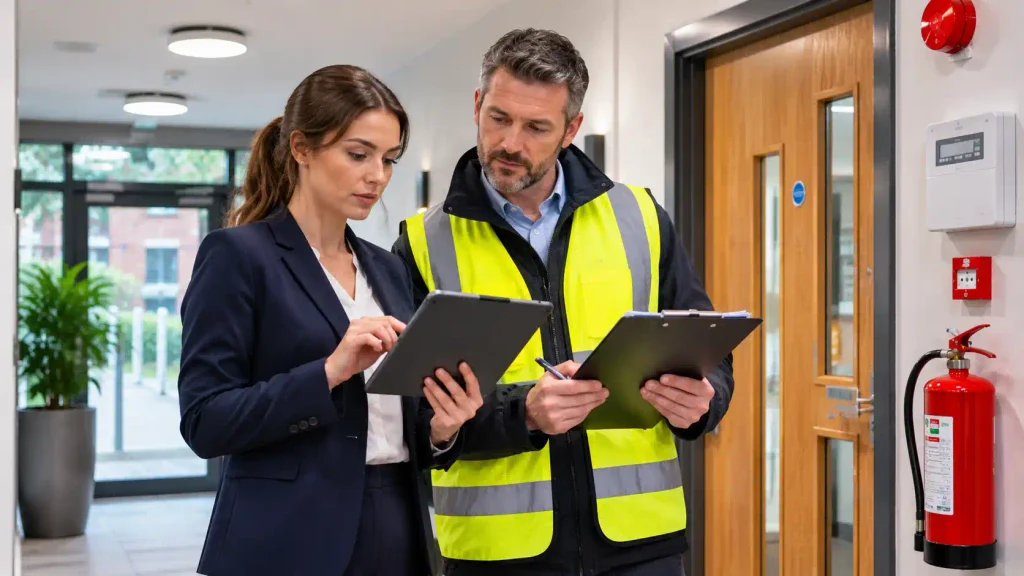
Fire Safety Compliance Checklist for UK Landlords
A practical compliance checklist helps landlords organise inspections, identify outstanding work and maintain evidence of safety arrangements.
The following checklist can be adapted to different residential property types.
Before a New Tenancy
- Check that required smoke alarms are installed.
- Check that required carbon monoxide alarms are installed.
- Test prescribed alarms and confirm they are working.
- Inspect visible electrical installations and report concerns.
- Confirm required gas safety checks have been completed.
- Check relevant fire doors and closing mechanisms.
- Confirm escape routes are clear.
- Check supplied furniture for appropriate fire safety compliance.
- Provide tenants with relevant fire safety information.
- Record the condition of installed fire safety equipment.
During the Tenancy
- Respond promptly to reports of faulty alarms.
- Arrange required repairs and maintenance.
- Monitor communal areas and escape routes.
- Address fire door damage.
- Investigate electrical and heating concerns.
- Review fire safety arrangements after significant property changes.
- Maintain communication with tenants and building managers.
- Retain records of completed inspections and corrective work.
At Regular Management Reviews
- Review relevant fire risk assessments.
- Check whether property occupancy has changed.
- Confirm that fire safety equipment remains suitable.
- Review outstanding maintenance actions.
- Confirm that responsible persons understand their duties.
- Update relevant safety records.
Landlord Fire Safety Compliance Workflow
Fire Risk Assessment Process
A practical approach to managing fire risks
Review the process again
↶ Return to Step 01Continue monitoring
↓ Maintain ongoing reviewsPenalties and Consequences of Fire Safety Non-Compliance
Failure to comply with fire safety obligations can expose landlords and responsible persons to serious consequences. Depending on the relevant legislation and circumstances, enforcement authorities may take action through improvement notices, remedial notices, prohibition notices, civil penalties or prosecution.
Under the Regulatory Reform (Fire Safety) Order 2005, serious breaches can lead to substantial fines and, for certain offences, imprisonment.
In England, local housing authorities can enforce the Smoke and Carbon Monoxide Alarm Regulations. Failure to comply with a remedial notice can result in a penalty of up to £5,000.
Other consequences may include:
- Increased risk of injury or loss of life.
- Damage to rental properties.
- Disruption to tenants.
- Legal disputes and enforcement action.
- Additional repair and remediation costs.
- Potential insurance complications.
The seriousness of enforcement depends on the nature of the breach, the applicable legislation and the circumstances of the case. Landlords should treat fire safety as an ongoing management responsibility rather than something to address only when an inspection is announced.
Common Fire Safety Mistakes UK Landlords Should Avoid
Even landlords who understand their basic obligations can make mistakes that undermine fire safety.
- Assuming every property follows the same rules: England, Wales, Scotland and Northern Ireland have different requirements. Always check the relevant jurisdiction.
- Treating every rented home as subject to the Fire Safety Order: Ordinary private domestic premises and relevant communal areas have different legal treatment.
- Ignoring faulty alarms: A faulty alarm should be investigated and repaired or replaced promptly.
- Blocking escape routes: Storage in corridors, staircases and exits can compromise safe evacuation.
- Ignoring fire door defects: Damaged doors and defective self-closing devices can undermine fire protection.
- Failing to maintain records: Without records, landlords may struggle to demonstrate that inspections and remedial actions have been completed.
- Relying on tenants to manage landlord obligations: Tenants should report problems, but landlords must retain responsibility for their own legal duties.
- Overlooking HMO licensing conditions: Local authorities may impose additional fire safety requirements beyond the general residential alarm rules.
Avoiding these mistakes can significantly improve the management of rental property fire safety.
How to Maintain Fire Safety Compliance Throughout a Tenancy
Fire safety compliance should be treated as a continuous process involving planning, inspection, maintenance, communication and record-keeping. Landlords should establish a documented management system that identifies the property’s fire safety requirements, assigns responsibilities and tracks outstanding actions.
A useful approach is to maintain a property safety file containing:
- Fire risk assessments where required.
- Smoke and heat alarm installation details.
- Carbon monoxide alarm information.
- Alarm testing and repair records.
- Fire door inspection reports.
- Electrical safety reports.
- Gas safety records.
- HMO licences and relevant conditions.
- Emergency arrangements and tenant information.
- Evidence of completed corrective actions.
The following continuous improvement process can help landlords maintain a consistent approach.
Fire Safety Compliance Process
A continuous cycle for maintaining fire safety standards
Landlords managing several properties should consider using a centralised compliance tracking system to monitor inspection dates, maintenance requirements and outstanding safety actions.
Where buildings contain communal areas or complex fire protection arrangements, coordination with competent fire risk assessors and professional property managers can help ensure that appropriate precautions remain in place.
Professional Development in Fire Safety and Risk Management
Understanding fire safety legislation and managing fire risks require appropriate knowledge, practical awareness and professional competence.
Landlords, property managers, facilities professionals and individuals working in building safety can benefit from structured fire safety education.
Professional qualifications can help learners develop knowledge of fire prevention, building risk management, emergency arrangements and workplace safety responsibilities.
Inspire College UK offers relevant learning opportunities, including:
ProQual Level 6 Diploma in Advanced Fire Safety Design and Building Risk Management
This qualification is relevant to professionals seeking advanced knowledge of fire safety design, building risk management and fire protection principles. It can support professional development for individuals working in building safety, fire risk management and related technical roles.
ICTQual Level 3 Diploma in Fire Watcher
The ICTQual Level 3 Diploma in Fire Watcher is relevant to individuals interested in developing practical knowledge of fire prevention, fire hazard identification, workplace monitoring and emergency response responsibilities.
These qualifications provide learning opportunities for individuals interested in developing their fire safety knowledge and professional capabilities. They do not replace statutory landlord responsibilities, property-specific risk assessments or the appointment of competent professionals where required.
Conclusion
Understanding and implementing the Fire Safety Requirements for UK Landlords is essential for protecting tenants, maintaining safe rental accommodation and meeting applicable legal responsibilities.
Landlords must consider the specific requirements of their property, including smoke and carbon monoxide alarms, fire risk assessments, fire doors, escape routes, electrical and gas safety, HMO licensing and ongoing maintenance.
The legal position also differs across England, Wales, Scotland and Northern Ireland, making it important to consult the relevant legislation and official guidance before making compliance decisions.
A proactive approach based on regular inspections, suitable fire protection measures, effective tenant communication and accurate documentation can help landlords manage fire risks throughout a tenancy.
By understanding their obligations and maintaining appropriate safety arrangements, UK landlords can protect occupants, reduce preventable hazards and support safer residential communities.
Legal information disclaimer: This article provides general educational information about fire safety requirements for UK landlords. It is not legal advice or a substitute for a property-specific fire risk assessment. Requirements can vary according to jurisdiction, property type, occupancy, building height, licensing conditions and individual circumstances. Landlords should consult current legislation, official government guidance, their local authority and competent fire safety professionals where appropriate.
Frequently Asked Questions About Fire Safety Requirements for UK Landlords
1. Can a landlord be held responsible for a fire caused by a tenant?
Yes, a landlord may still face legal or financial consequences if a fire occurs because they failed to meet their relevant safety responsibilities. However, responsibility depends on the circumstances, the cause of the fire, the property’s condition and whether the landlord fulfilled their legal duties. Tenants may also be responsible where their actions or negligence contributed to the incident.
2. Does landlord insurance cover fire damage caused by tenant negligence?
Landlord insurance may cover certain types of fire damage caused by tenants, but coverage depends on the policy terms, exclusions and circumstances of the incident. Some policies include malicious damage or accidental damage protection, while others impose specific conditions. Landlords should review their insurance documents and confirm whether tenant-related fire damage is covered.
3. Should UK landlords provide tenants with written fire safety instructions?
Providing tenants with written fire safety information is a valuable precaution, particularly in shared accommodation and buildings with communal facilities. Information can explain emergency contact arrangements, evacuation procedures, the location of escape routes and what tenants should do if they discover a fire. Landlords should ensure the instructions are easy to understand and relevant to the property.
4. What should landlords do if tenants refuse access for fire safety inspections?
Landlords should first communicate the reason for access and arrange a mutually convenient inspection appointment, following the tenancy agreement and applicable legal requirements. They should keep written records of access requests and tenant responses. If access continues to be refused, landlords should seek appropriate legal or professional advice rather than entering unlawfully or ignoring an important safety concern.
5. Are landlords responsible for fire safety in furnished rental properties?
Yes. Landlords who provide furnished accommodation must consider the fire safety of supplied furniture and furnishings. Relevant products should meet applicable fire resistance and labelling requirements. Landlords should also check the condition of upholstered furniture, mattresses, curtains and other supplied items, replacing damaged or unsuitable products where necessary.
6. What fire safety information should landlords provide to property management companies?
Where property management companies or other contractors carry out safety-related duties, landlords should communicate relevant property information, known fire hazards, maintenance arrangements and emergency procedures. Responsibilities should be clearly documented so that inspections, repairs and safety actions are not overlooked. The landlord should also understand which legal duties remain with them and which have been formally assigned to others.
7. How can landlords manage fire risks when carrying out property renovations?
Landlords should consider temporary fire risks before renovation work begins. Contractors should be informed about emergency arrangements, combustible materials should be controlled, and escape routes should remain usable wherever reasonably practicable. Activities involving heat, sparks or open flames may require additional precautions and a suitable hot-work procedure. Fire safety arrangements should be reviewed when building work changes the property’s layout or use.
8. Can landlords use digital records to manage fire safety compliance?
Yes. Digital systems can help landlords organise inspection reports, maintenance records, contractor details, equipment servicing information and corrective actions. A centralised record system can make it easier to identify overdue tasks, track recurring problems and demonstrate how safety issues have been addressed. Records should be accurate, accessible to relevant people and securely maintained.
9. What should landlords consider when renting a property to tenants with additional evacuation needs?
Landlords should consider whether a tenant may need additional assistance to respond to a fire emergency. Relevant considerations include mobility, hearing or visual difficulties, the property’s layout and the availability of suitable evacuation arrangements. Where appropriate, landlords should discuss practical arrangements with the tenant, respect their privacy and seek competent fire safety advice.
10. How should landlords prepare for fire safety checks by local authorities?
Landlords should maintain organised property records, ensure relevant safety equipment is properly maintained and make applicable inspection reports available. They should also be prepared to explain how identified hazards have been addressed and how ongoing maintenance is managed. Requirements and enforcement powers vary across the UK, so landlords should understand the relevant local authority’s role and the rules applying to their property.
11. Do short-term holiday rentals have the same fire safety considerations as long-term tenancies?
Short-term holiday accommodation can involve different occupancy patterns, guest turnover and unfamiliar visitors. Owners and operators should assess the applicable fire safety duties according to the building, its use and the relevant UK jurisdiction. They should pay particular attention to clear emergency instructions, guest information, safe escape arrangements and the maintenance of fire protection equipment.
12. How can landlords demonstrate that fire safety improvements have been completed?
Landlords can retain dated inspection reports, contractor invoices, maintenance certificates, photographs of completed work and written records of corrective actions. These documents help establish what problems were identified, what work was undertaken and when improvements were completed. Keeping an organised compliance history also supports future inspections and property management decisions.