
Fire Safety Act 2021 Explained: What Building Owners and Landlords Need to Know
Understanding the Fire Safety Act 2021 is essential for building owners, landlords, freeholders, property managers, and other people responsible for fire safety in multi-occupied residential buildings. The legislation clarified that fire safety responsibilities under the Regulatory Reform (Fire Safety) Order 2005 extend to important parts of residential buildings, including their structure, external walls, balconies, windows, and flat entrance doors that connect individual homes with communal areas.
These changes are significant because a building’s fire safety depends on more than alarms, extinguishers, and clear escape routes. The materials used on external walls, the condition of fire doors, the integrity of fire-resisting construction, and the way a building is maintained can all influence how fire and smoke spread.
For landlords and property owners, the practical question is how to translate these legal requirements into effective fire risk assessments, suitable maintenance arrangements, accurate records, and clear communication with residents. Understanding the difference between the Fire Safety Act 2021, the Fire Safety (England) Regulations 2022, and other related legislation is equally important.
This guide explains the purpose and scope of the Fire Safety Act 2021, identifies the responsibilities of relevant duty holders, and outlines a practical approach to managing fire safety. It also explains where professional fire risk assessment and fire safety management expertise can support a more systematic approach to compliance.
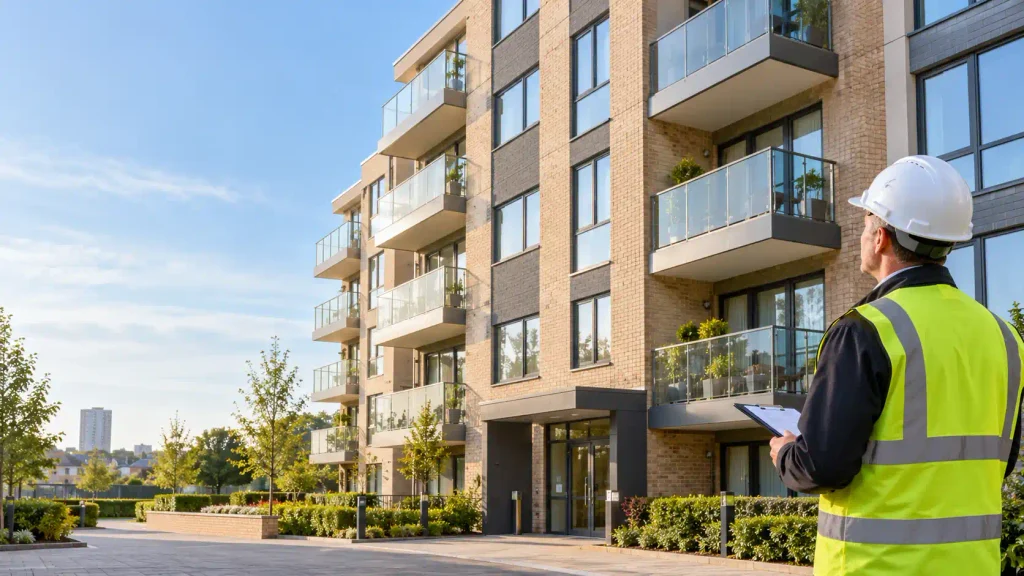
What is the Fire Safety Act 2021?
The Fire Safety Act 2021 is legislation that amends the Regulatory Reform (Fire Safety) Order 2005 to clarify which parts of certain buildings fall within the Fire Safety Order’s scope. For buildings containing two or more sets of domestic premises, it expressly includes the building’s structure and external walls, as well as doors between individual homes and communal areas.
The Act received Royal Assent on 29 April 2021. Its relevant commencement dates differed between England and Wales: section 1 came into force in Wales on 1 October 2021 and in England on 16 May 2022.
The legislation followed the Grenfell Tower fire and the subsequent scrutiny of building fire safety. Its purpose was to remove uncertainty about the application of existing fire safety duties to building elements that can affect the spread of fire and the safety of residents.
The Act does not replace the Fire Safety Order or create a complete standalone fire safety management system. Instead, it clarifies the scope of the existing legal framework. Responsible persons must therefore consider the newly clarified elements as part of their fire risk assessments and take appropriate action where risks are identified.
For building owners and landlords, this means fire safety should be approached as a continuous management responsibility rather than a one-off inspection or document.
Why was the Fire Safety Act 2021 Introduced?
Fire safety legislation in England and Wales has developed through several stages. The Regulatory Reform (Fire Safety) Order 2005 established a framework for managing fire risks in workplaces and relevant common parts of residential buildings. However, uncertainty arose over how the Order applied to the structure and external walls of multi-occupied residential buildings and to flat entrance doors.
The Grenfell Tower fire in June 2017 exposed the devastating consequences that can follow when fire spreads rapidly through a residential building. The subsequent public inquiry and wider government reviews intensified attention on external wall systems, fire doors, compartmentation, and the responsibilities of those who own or manage buildings.
The Fire Safety Act 2021 addressed a specific part of this wider problem by clarifying the scope of the Fire Safety Order.
The main objectives of the legislation
The Act helps to:
- Clarify that building structure and external walls are within the relevant fire safety framework.
- Include balconies, windows, and other items attached to external walls within the scope specified by the legislation.
- Ensure that relevant flat entrance doors are considered in fire risk assessments.
- Support more effective enforcement of fire safety duties.
- Encourage a more comprehensive approach to assessing how fire could spread through a building.
These objectives reinforce an important principle: fire safety assessments must consider how the building functions as a whole, not merely the equipment installed in its communal areas.
Which Buildings Does the Fire Safety Act 2021 Apply To?
The Act clarifies the application of the Fire Safety Order to buildings containing two or more sets of domestic premises. Its scope is not limited to high-rise towers. Relevant buildings may include purpose-built blocks of flats and houses that have been converted into multiple dwellings.
A building’s height can trigger additional requirements under other legislation, but height is not the sole test for whether the Fire Safety Act’s clarification is relevant.
Examples of buildings that may fall within scope
- Blocks containing multiple flats.
- Converted houses containing two or more separate dwellings.
- Residential buildings with communal corridors, staircases, entrance halls, or other shared areas.
- Multi-occupied residential properties where individual dwellings open onto common parts.
The precise duties depend on the building’s use, layout, legal arrangements, and the applicable legislation. A single privately occupied house should not automatically be treated as subject to the same building-wide Fire Safety Order requirements as a block of flats. However, other fire safety and housing requirements may still apply.
Landlords of houses in multiple occupation (HMOs) should also distinguish between duties under the Fire Safety Order and separate obligations under housing legislation, HMO licensing conditions, and applicable alarm regulations.
What parts of the building must be considered?
For buildings covered by the relevant provisions, the Fire Safety Order includes:
- The building’s structure.
- External walls, including relevant cladding systems.
- Windows and doors in external walls.
- Balconies and other items attached to the exterior.
- Doors between individual domestic premises and common parts.
This scope means that an assessment focused exclusively on communal escape routes may be insufficient. The responsible person must consider the building elements relevant to fire risk and ensure that appropriate measures are implemented.
What did the Fire Safety Act 2021 Change?
The most important change is the explicit inclusion of building structure, external walls, and relevant flat entrance doors within the Fire Safety Order’s scope for buildings containing two or more sets of domestic premises.
The distinction is important: the Act clarifies the reach of existing fire safety duties. It does not mean that every building must automatically replace all external wall materials or every flat entrance door simply because the legislation was introduced.
| Building element | What the legislation means in practice | Action for the responsible person |
|---|---|---|
| Building structure | Structural features relevant to fire spread and protection must be considered. | Review construction, compartmentation, and relevant fire-resisting elements. |
| External walls and cladding | The external wall system must be considered as part of the fire risk assessment. | Obtain suitable information and specialist advice where the risk or construction warrants it. |
| Balconies and external attachments | Relevant external features can affect fire spread. | Assess construction, combustible materials, and potential fire pathways. |
| Windows and external-wall doors | These are expressly included within the Act’s definition of external walls. | Consider their relevance to the building’s fire risk. |
| Flat entrance doors | Doors between dwellings and common parts fall within the clarified scope. | Assess their suitability and condition and arrange appropriate checks and remedial work. |
| Common corridors and staircases | Existing fire safety duties continue to apply. | Maintain escape routes, fire doors, signage, and relevant fire precautions. |
The action required in an individual building depends on its assessment findings. A building may need closer investigation of its external wall system, repairs to defective doors, improved records, or changes to its maintenance arrangements. Another building may already have suitable controls in place but need to demonstrate that its assessment adequately covers the relevant elements.
Who is Responsible for Compliance?
The Fire Safety Order uses the term responsible person to identify the person or organisation with the relevant legal duties. Depending on the premises and the arrangements in place, this may be an employer, building owner, landlord, managing agent, or another person who has control of the premises.
The title of a person or company does not, by itself, settle every question about legal responsibility. The relevant facts, control arrangements, and duties under the legislation must be considered. Where several responsible persons have duties in the same building, they must cooperate and coordinate their activities.
Building owners and freeholders
Building owners and freeholders should establish how the legal duties apply to the parts of the building under their control. They may need to arrange assessments, commission technical investigations, maintain relevant systems, and ensure that identified deficiencies are addressed.
They should also understand the division of responsibilities established by leases, management agreements, and other arrangements. Such documents can help coordinate work, but they should not be treated as automatically removing legal obligations that apply to a person.
Landlords
Landlords should identify which fire safety duties apply to their properties and whether they have responsibilities for communal areas, doors, building systems, or other relevant features.
In a block of flats, responsibility may be divided between a freeholder, a managing agent, and other parties. A landlord should therefore establish who controls each relevant area and how fire safety information and maintenance issues are reported.
Landlords should also make sure that residents receive appropriate information and that defects are not ignored simply because repairs involve shared ownership or management arrangements.
Managing agents and property managers
Managing agents often coordinate inspections, contractors, records, resident communication, and remedial work. They can play an important role in making sure that safety measures are implemented and that outstanding issues are followed up.
However, a management agreement should be reviewed alongside the actual control arrangements and legal requirements. A managing agent should not assume that appointing a contractor transfers all the responsible person’s legal duties to that contractor.
Fire risk assessors and specialist contractors
Competent fire risk assessors and specialist contractors provide technical assistance. Their work may include reviewing fire precautions, inspecting relevant doors, assessing particular building features, or investigating external wall construction.
Appointing a professional can help the responsible person make informed decisions, but the appointment does not automatically transfer the responsible person’s legal accountability. The responsible person should ensure that anyone appointed to assist with an assessment is competent for the work being undertaken.
What are the Main Fire Safety Responsibilities of Landlords and Building Owners?
Understanding the legislation is only the starting point. Effective compliance requires responsible persons to assess risks, maintain suitable precautions, address defects, keep appropriate records, and coordinate with other parties who have duties in the building.
Review and update the fire risk assessment
A fire risk assessment should reflect the building as it actually exists, rather than relying on an old report that no longer reflects its construction, condition, or use.
For relevant multi-occupied residential buildings, the assessment must consider the structure, external walls, and flat entrance doors within the clarified scope of the Fire Safety Order. It should also address the other fire hazards and precautions relevant to the premises.
A review should consider:
- Whether the existing assessment covers the relevant building elements.
- Whether external wall construction and available technical information are adequately understood.
- Whether fire doors and compartmentation are suitable and maintained.
- Whether escape routes are usable and adequately protected.
- Whether alarm systems, emergency lighting, signage, and other precautions are appropriate.
- Whether previous recommendations have been completed.
- Whether changes to the building, occupancy, or fire risk require further action.
If an assessment identifies a significant concern, the responsible person should determine what action is needed, how urgently it must be taken, and whether interim precautions are appropriate. Complex external wall or structural issues may require advice from a suitably qualified fire engineer or other relevant specialist.
Inspect and maintain fire doors
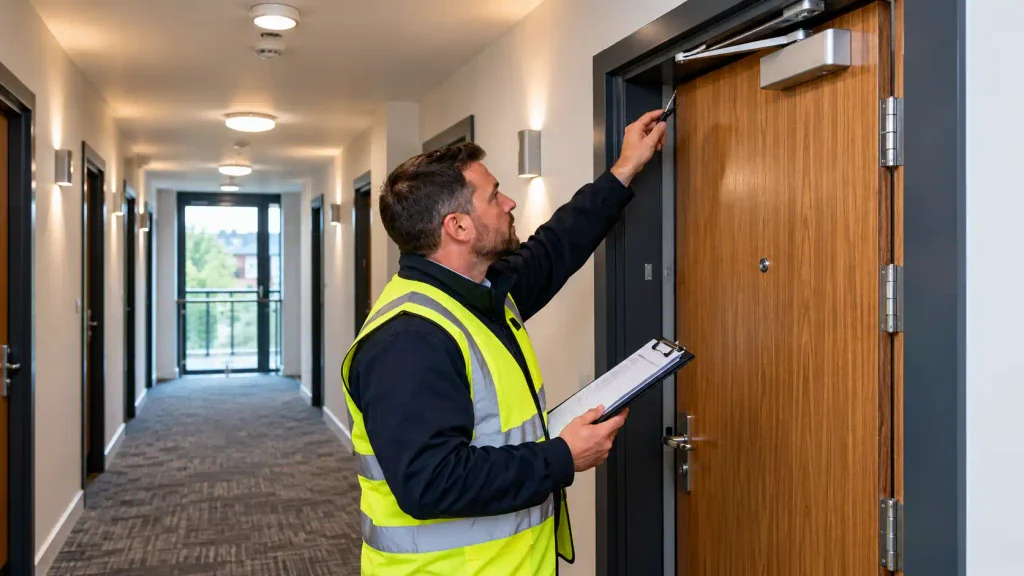
Fire doors help restrict the spread of smoke and fire between flats, corridors, stairwells, and other areas. A damaged door or defective self-closing mechanism can compromise this function.
Relevant checks may include examining the door leaf and frame, checking that the door closes correctly, and identifying visible damage to glazing, seals, or other components where fitted.
The Fire Safety (England) Regulations 2022 introduce specific checking requirements for relevant multi-occupied residential buildings over 11 metres in height. These include quarterly checks of communal fire doors and checks of flat entrance doors at least every 12 months on a best-endeavours basis. These requirements are specific to England; responsible persons must check the legislation applicable to their location.
The requirements should not be misunderstood as a universal instruction to replace every existing flat entrance door. Government guidance updated in August 2025 explains that a door may remain adequate if it provides the required fire performance for its circumstances and is in suitable condition. Its suitability must be assessed in the context of the building’s fire risk.
Assess external walls and cladding
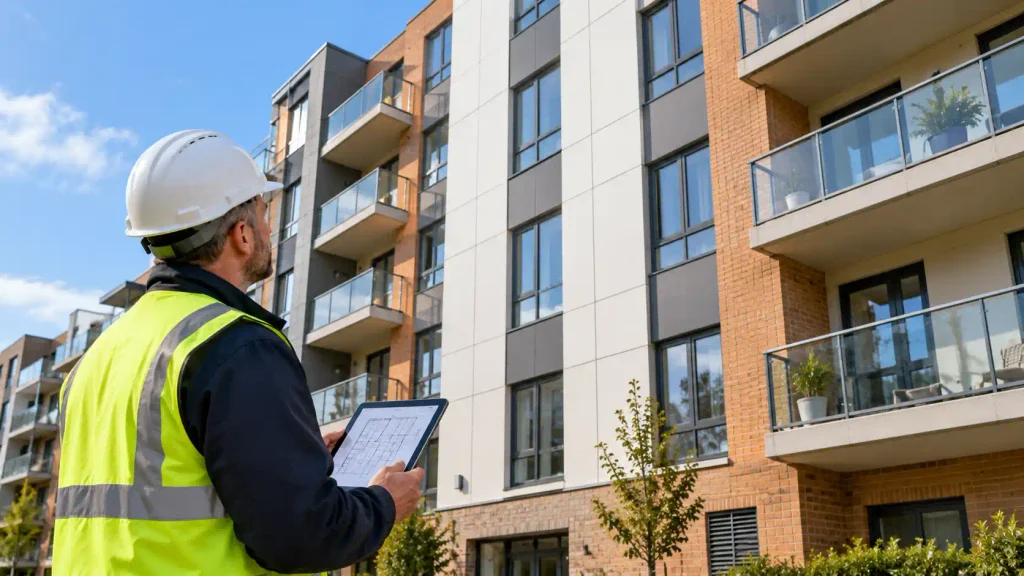
External walls can contain several different materials and components, including cladding, insulation, cavity barriers, fixings, and structural elements. Their combined performance can affect the way fire spreads across a building’s exterior.
The responsible person should gather reliable information about the wall construction and identify any gaps in the available evidence. Depending on the building and the risks identified, this may require specialist surveys or investigations.
It is not appropriate to declare an external wall safe or unsafe solely on the basis of its appearance. Equally, the absence of obvious damage does not establish that the complete wall system presents no fire risk.
Where concerns arise, the responsible person should obtain appropriate technical advice, document the findings, and establish a proportionate action plan. Decisions about remedial works should be based on evidence and the assessed risks rather than assumptions about a single material or building age.
Maintain escape routes and fire precautions
The Act’s clarification of building structure and external walls does not remove the need to manage everyday fire precautions.
Common corridors, staircases, lobbies, and exits must be considered as part of the overall fire safety arrangements. Stored items, damaged doors, failed emergency lighting, defective alarm equipment, or poor maintenance may undermine the safety of residents and visitors.
A suitable maintenance programme should identify who performs checks, how frequently they are undertaken, how faults are reported, and who is responsible for authorising repairs. The precise inspection schedule should follow applicable legal requirements, manufacturer guidance, the fire risk assessment, and the nature of the equipment.
Keep appropriate records
Records help demonstrate what has been assessed, what action was recommended, who completed the work, and how unresolved risks are being managed.
Section 156 of the Building Safety Act 2022 amended the Fire Safety Order, including requirements concerning the recording of fire risk assessments and cooperation between responsible persons. The relevant amendments came into force on 1 October 2023.
A practical record system may include:
- The current fire risk assessment and review history.
- Inspection reports and maintenance records.
- Details of defects and corrective actions.
- Technical reports relating to external walls or building structure.
- Records of fire door checks and attempted access where relevant.
- Contractor appointments and relevant competence information.
- Resident communications and fire safety instructions.
- Outstanding actions, responsible individuals, and target dates.
Good record-keeping is not a substitute for physical safety measures. Its purpose is to support effective management, continuity, and evidence of the work undertaken.
Fire Safety Act 2021 vs Other UK Fire Safety Legislation
One of the most common sources of confusion is treating every fire safety law as if it imposes the same requirements. In practice, the legislation works together, with different provisions addressing the scope of fire safety duties, specific building requirements, and wider building safety responsibilities.
| Legislation | Main purpose | Practical relevance |
|---|---|---|
| Regulatory Reform (Fire Safety) Order 2005 | Establishes the principal fire safety framework for relevant non-domestic premises and common parts of multi-occupied residential buildings in England and Wales. | Risk assessment, responsible-person duties, and general fire precautions. |
| Fire Safety Act 2021 | Clarifies the Fire Safety Order’s application to building structure, external walls, and relevant doors in buildings containing two or more domestic premises. | Ensures these elements are considered within the fire risk assessment. |
| Fire Safety (England) Regulations 2022 | Introduces additional duties for responsible persons in relevant residential buildings in England. | Includes fire door checks, resident information, and further measures for specified taller buildings. |
| Building Safety Act 2022 | Introduces wider building safety reforms and amends the Fire Safety Order through section 156. | Strengthens aspects of recording, cooperation, and information sharing, alongside other building safety requirements. |
| Regulatory and housing requirements applicable to the property | Address additional matters depending on building type, use, occupancy, and location. | May include HMO licensing, smoke and carbon monoxide alarms, and other property-specific duties. |
How do the Fire Safety (England) Regulations 2022 affect landlords?
The Fire Safety (England) Regulations 2022 came into force on 23 January 2023. They introduce additional duties for relevant buildings in England, including requirements relating to fire safety information for residents and specific measures for taller residential buildings.
For all relevant multi-occupied residential buildings covered by the resident-information provisions, responsible persons must provide appropriate fire safety instructions and information about the importance of fire doors.
For buildings over 11 metres, specific fire door checking requirements apply. Additional duties apply to high-rise residential buildings, generally those at least 18 metres high or with at least seven storeys, including requirements relating to information for firefighters, wayfinding signage, and certain firefighting equipment.
These are additional requirements, not a replacement for the general duty to manage fire risks.
Does the Act apply across the whole UK?
No single explanation should assume that every provision applies identically throughout the United Kingdom.
The Fire Safety Order framework and the Fire Safety Act 2021 provisions discussed here concern England and Wales. The Fire Safety (England) Regulations 2022 apply in England. Scotland and Northern Ireland have their own relevant fire safety legislation and guidance. Property owners operating across different UK jurisdictions must verify the requirements applicable to each building.

A Practical Fire Safety Act 2021 Compliance Workflow
A structured workflow can help owners and landlords move from understanding their duties to implementing and reviewing suitable controls.
A Practical Fire Safety Act 2021 Compliance Workflow
Follow these six practical steps to organise fire safety responsibilities, assess risks, implement controls, and maintain ongoing oversight.
-
Establish the Building’s Scope
Identify the property type, location, occupancy, building layout, and relevant legal duties.
-
Identify Responsible Persons
Clarify who has control, establish individual responsibilities, identify contractors, and coordinate relevant duties.
-
Review the Fire Risk Assessment
Consider the building structure, external walls, flat entrance doors, escape routes, and other relevant fire hazards.
-
Prioritise and Implement Actions
Arrange inspections, repairs, specialist investigations, and appropriate interim precautions where necessary.
-
Record and Communicate
Retain evidence of assessments, decisions, completed work, outstanding risks, and relevant resident information.
-
Review and Improve
Monitor fire safety controls and review the assessment when risks, building conditions, or occupancy circumstances change.
Important: This workflow is a practical management aid, not a substitute for applicable legislation, official guidance, or a competent assessment of the premises.
This workflow is a practical management aid, not a substitute for the legislation or a competent assessment of the premises.
Step 1: Establish the building’s legal position
Start by documenting the building’s location, use, height, number of dwellings, communal areas, and management arrangements. Determine which fire safety legislation applies and identify any additional requirements linked to the building’s characteristics.
This step prevents a common mistake: applying a requirement designed for one type of building to another without checking its legal scope.
Step 2: Clarify responsibilities
Prepare a responsibility schedule identifying who arranges assessments, maintains communal areas, inspects relevant doors, commissions specialist advice, communicates with residents, and authorises remedial work.
Where duties overlap, agree how information will be shared and how urgent defects will be escalated.
Step 3: Review the evidence
Examine the current fire risk assessment, previous reports, building plans, construction information, maintenance records, and outstanding recommendations.
Identify where information is missing or unreliable. Do not treat the absence of a documented problem as proof that no problem exists.
Step 4: Prioritise corrective action
Record each identified issue, its assessed risk, the action required, the person responsible, and the target date. Urgent risks should be escalated promptly, with appropriate interim precautions considered where permanent work cannot be completed immediately.
Step 5: Verify completion
Check that repairs and other corrective actions have been completed effectively. Obtain relevant contractor reports, inspection records, or technical evidence and update the action plan.
Step 6: Maintain ongoing oversight
Set review dates, monitor recurring defects, and ensure that important information reaches the people who need it. Revisit the assessment when changes to the building or its use could affect fire safety.
Practical Compliance Checklist for Building Owners and Landlords
The following checklist can help property owners and managers organise their next steps. It is a management tool, not a formal legal certification or a replacement for a building-specific fire risk assessment.
| Compliance area | What to check | Evidence to retain |
|---|---|---|
| Legal responsibilities | Have the applicable duties and responsible persons been identified? | Responsibility schedule and relevant management arrangements. |
| Fire risk assessment | Does the assessment cover the relevant structure, external walls, and flat entrance doors? | Current assessment and review records. |
| External wall systems | Is sufficient information available to understand relevant construction and fire risks? | Technical reports, surveys, and supporting documentation. |
| Fire doors | Are relevant doors inspected, functional, and maintained? | Check records, defect reports, and repair evidence. |
| Escape routes | Are communal escape routes maintained and obstructions addressed? | Inspection records and corrective-action logs. |
| Fire precautions | Are relevant alarms, emergency lighting, signage, and other measures maintained? | Testing and maintenance records. |
| Resident communication | Have applicable fire safety instructions and fire door information been provided? | Copies of instructions and communication records. |
| Action management | Are defects assigned, prioritised, and followed through? | Action plan showing owners, deadlines, and completion status. |
| Cooperation | Do responsible persons share relevant information and coordinate their duties? | Meeting notes, correspondence, and agreed procedures. |
| Review | Are assessments and controls reviewed when necessary? | Review dates, updated assessments, and recorded decisions. |
How to use the checklist effectively
Begin with the current fire risk assessment and identify any gaps in coverage. Then compare the recommendations against the actual condition of the building and the evidence available.
Prioritise urgent safety concerns rather than simply completing tasks in the order they appear on a spreadsheet. Where a technical issue cannot be resolved immediately, document the decision-making process, obtain appropriate advice, and determine whether interim measures are necessary.
Finally, assign a named individual to monitor each action. A recommendation that has been recorded but never completed is still an unresolved issue.
Common Fire Safety Compliance Mistakes to Avoid
Even well-intentioned building owners can misunderstand their duties when several pieces of legislation apply to the same property. The following mistakes are particularly important to avoid.
Assuming the fire risk assessment only needs to cover communal areas
Communal corridors and staircases remain important, but the Fire Safety Act 2021 explicitly clarifies the scope of the Fire Safety Order for the building’s structure, external walls, and relevant flat entrance doors. An assessment should not overlook these elements simply because they are outside a communal corridor.
Replacing every flat entrance door automatically
The law should not be interpreted as requiring the automatic replacement of every existing door. Government guidance explains that existing doors should be assessed in context, taking account of their fire performance, condition, and suitability for the building. Defects and inadequacies should be addressed based on the relevant assessment and requirements.
Assuming a managing agent carries all legal responsibility
A managing agent may carry out important tasks, but legal responsibility depends on the applicable duties and circumstances. Owners and other parties should understand their own roles and establish effective coordination.
Treating documentation as a substitute for corrective work
A detailed report does not make a defective door safe, remove an external wall risk, or clear a blocked escape route. Records must support actual measures to prevent or reduce fire risks.
Confusing English requirements with requirements across the UK
The Fire Safety (England) Regulations 2022 apply in England. Building owners in Wales, Scotland, and Northern Ireland must establish the legal requirements relevant to their properties rather than assume the same detailed rules apply everywhere.
Ignoring resident communication
Residents need to understand the building’s applicable fire safety instructions and the importance of fire doors. In relevant buildings in England, the regulations specify how instructions and information must be provided and refreshed.
What Happens If Fire Safety Responsibilities Are Ignored?
Failing to comply with applicable fire safety duties can result in enforcement action and serious consequences. Depending on the circumstances, fire and rescue authorities may investigate concerns, require improvements, or take other enforcement measures available under the law.
Where a breach constitutes an offence, prosecution and penalties may follow. The precise consequences depend on the duty breached, the facts, and the applicable enforcement provisions. It would be misleading to give one universal fine or penalty for every type of non-compliance.
The wider consequences can include:
- Increased risk to residents, employees, visitors, and contractors.
- Emergency remedial work and disruption to building operations.
- Additional professional fees and repair costs.
- Disputes between owners, managing agents, and other parties.
- Reputational damage and reduced confidence among residents.
- Potential civil or criminal liability where the relevant legal tests are met.
The most effective approach is to identify shortcomings early, obtain suitable advice, and ensure corrective work is monitored through to completion. Waiting until an inspection, complaint, or incident exposes a problem can make effective management more difficult.
The Importance of Competence in Fire Safety Management
Understanding legislation is important, but effective implementation also requires suitable knowledge of fire hazards, building construction, risk assessment, inspection, maintenance, and safety management.
Building owners should appoint people who are competent for the tasks they undertake. The complexity of the building and the nature of the identified risks determine whether additional specialist expertise is needed.
For example, a routine visual check of a communal fire door is different from a detailed investigation into a complex external wall system. The responsible person should recognise the limits of their own competence and seek appropriate professional support where necessary.
Training can help property professionals understand legal responsibilities, recognise common fire hazards, communicate with contractors, and manage corrective actions. It should complement practical experience and the competence required for the specific work.
For professionals seeking to develop their knowledge, Inspire College UK offers relevant learning options, including the ProQual Level 5 Diploma in Fire Safety and Risk Management. This is relevant to readers interested in developing a more systematic understanding of fire safety management.
Those seeking focused knowledge of risk assessment can also explore the ProQual Level 4 Certificate in Fire Risk Assessment.
For wider professional development, the ProQual Level 6 NVQ Diploma in Occupational Health and Safety Practice may be relevant to experienced practitioners whose responsibilities extend beyond fire safety alone.
Readers can also explore the ProQual Accredited Certified Fire Safety Training Course to learn more about available fire safety training. Prospective learners should confirm the course’s current specifications, assessment arrangements, eligibility requirements, and recognition before enrolling.
Training does not automatically establish legal competence for every specialist task or transfer responsibility away from the responsible person. The appropriate qualification and experience depend on the work being undertaken.
Frequently Relevant Internal Resources
Building owners and landlords who want to explore the subject further can use these related resources from Inspire College UK:
- Fire Safety Act 2021 — related background on the legislation.
- UK Fire Safety Compliance — broader information on fire safety duties and compliance.
- ProQual Level 5 Diploma in Fire Safety and Risk Management — relevant professional learning.
- ProQual Level 4 Certificate in Fire Risk Assessment — further learning related to assessing fire risks.
- ProQual Level 6 NVQ Diploma in Occupational Health and Safety Practice — broader occupational health and safety development.
These links should be placed contextually within the published article rather than grouped together in every section. The two related blog links are particularly suitable for readers who want to explore the legislation and wider compliance framework.
Conclusion: Making the Fire Safety Act 2021 Work in Practice
The Fire Safety Act 2021 clarified an important part of fire safety law by confirming that the Fire Safety Order applies to a building’s structure, external walls, and relevant flat entrance doors in buildings containing two or more sets of domestic premises. For building owners, landlords, freeholders, and managing agents, this means taking a broader and more systematic approach to fire risk assessment and management.
Compliance involves more than understanding the legislation. Responsible persons need to establish their duties, assess the building’s actual risks, maintain appropriate fire precautions, address identified defects, keep accurate records, and cooperate with others who have responsibilities for the premises.
They must also understand how the Act interacts with the Fire Safety (England) Regulations 2022 and the wider Building Safety Act 2022 framework, while checking which provisions apply to their property’s location and characteristics.
A proactive approach can help identify problems before they become more serious, improve communication with residents, and provide a clearer record of how fire safety risks are managed.
For professionals who want to strengthen their understanding of fire safety and risk management, relevant training can provide a useful foundation for further development. Explore the fire safety learning options available through Inspire College UK to identify a course that matches your professional responsibilities and development goals.
Second flow diagram: From identified risk to completed action
Place this diagram after the section on fire safety responsibilities or immediately before the compliance checklist. It illustrates the ongoing management process rather than repeating the legal scope diagram.
Fire Safety Risk: From Identification to Resolution
Follow this practical process to assess fire safety concerns, prioritise corrective action, verify completion, and maintain appropriate records.
Fire Safety Concern Identified
Identify a defect, hazard, inspection finding, or reported concern.
Record the Issue and Assess the Risk
Document the concern, evaluate its significance, and determine what action may be required.
Escalate and Protect
Escalate the concern and implement appropriate interim precautions where necessary.
Plan Corrective Action
Plan proportionate corrective measures based on the assessed risk and applicable requirements.
Assign a Responsible Person and Target Date
Identify who will manage the action, establish a suitable timescale, and define the expected outcome.
Arrange Repairs, Inspection or Specialist Advice
Complete the required work, commission specialist investigations, or obtain competent technical advice where needed.
Verify Completion and Retain Evidence
Check the completed work and retain relevant inspection reports, repair records, photographs, and supporting documents.
Return to Risk Assessment
Review the remaining risk, reconsider the action plan, and determine what additional measures are required.
Update Records and Continue Monitoring
Record the outcome, close the action where appropriate, and continue routine monitoring and review.
Important: This diagram is a practical management aid. It does not replace applicable legislation, official guidance, or a competent assessment of the premises.
Editorial note: This is a recommended management workflow, not a statutory procedure prescribed verbatim by the Fire Safety Act 2021.
Authoritative sources for final fact-checking
The following official sources should be retained as the principal legal references when publishing or updating the article.
- Fire Safety Act 2021 — legislation.gov.uk — primary legislation.
- Fire Safety Act 2021 — GOV.UK guidance — official explanation of the Act’s scope and commencement.
- Fire Safety (England) Regulations 2022 — official guidance on the additional duties in England.
- Fire safety legislation and guidance for people with legal duties — wider guidance for responsible persons.
- Building Safety Act 2022, section 156 — amendments to the Fire Safety Order.