
Fire Safety in Communal Areas of Flats: UK Legal Requirements
Fire Safety in Communal Areas of Flats is an essential part of protecting residents, visitors and property in multi-occupied residential buildings across the United Kingdom. Communal areas, including shared corridors, staircases, entrance halls, lobbies and internal access routes, provide essential movement and escape routes during emergencies. If these spaces are poorly maintained, obstructed or exposed to unnecessary fire hazards, a relatively small incident can create serious risks for multiple households.
In the UK, fire safety responsibilities depend on the building’s location, design, occupancy and management arrangements. In England and Wales, the Regulatory Reform (Fire Safety) Order 2005 establishes important duties for responsible persons in relation to communal areas. The Fire Safety Act 2021 clarified the scope of these responsibilities, while the Fire Safety (England) Regulations 2022 introduced additional requirements for residential buildings in England. Scotland and Northern Ireland have separate legislative arrangements.
Understanding these requirements helps landlords, freeholders, managing agents and residents maintain safe shared spaces. Effective fire safety management involves more than installing fire doors or displaying emergency signs. It requires suitable risk assessments, clear escape routes, properly maintained protection systems, resident communication and regular monitoring.
This guide explains the legal framework, responsibilities, inspection procedures, common hazards and practical measures involved in maintaining fire safety in communal areas of flats in the UK.
What Are Communal Areas in Residential Flats?
Communal areas are shared spaces within or around residential buildings that are accessible to multiple residents, visitors or authorised personnel. Unlike private flats, these areas are used collectively and often provide access to emergency exits and essential building facilities.
Common examples include:
| Communal area | Purpose | Main fire safety consideration |
|---|---|---|
| Shared corridors | Connect individual flats | Maintain unobstructed escape routes. |
| Staircases | Provide vertical access and escape | Protect stairways against smoke and fire. |
| Entrance lobbies | Provide access to the building | Maintain clear access and suitable fire protection. |
| Shared hallways | Connect rooms and building sections | Control combustible storage and obstructions. |
| Lift lobbies | Provide access to lifts | Maintain suitable doors and fire separation. |
| Bin storage areas | Store household waste | Control combustible waste and ignition sources. |
| Plant rooms | House building equipment | Control electrical and mechanical hazards. |
| Electrical cupboards | Contain electrical distribution equipment | Maintain appropriate fire separation and secure access. |
| Shared balconies and external walkways | Provide access or outdoor circulation | Prevent unsafe storage and maintain safe access. |
The exact areas covered by fire safety duties depend on the applicable legislation and building arrangements.
In England and Wales, the Fire Safety Order applies to relevant common parts of buildings containing multiple domestic premises. Its scope, as clarified by the Fire Safety Act 2021, also includes relevant external walls, the building structure and flat entrance doors.
Why Is Fire Safety Important in Communal Areas of Flats?
Communal spaces can influence how quickly a fire spreads and whether residents can reach safety. A fire involving discarded furniture, rubbish or an electrical installation can produce smoke that affects shared access routes.
The importance of communal fire safety includes the following:
- Protection of residents: Safe communal areas help people move through the building without unnecessary exposure to fire, smoke or physical obstructions.
- Protection of escape routes: Staircases and corridors must remain suitable for their intended escape function.
- Prevention of fire spread: Properly maintained fire doors, compartmentation and fire-stopping arrangements help limit the movement of fire and smoke.
- Support for emergency services: Clear access, suitable firefighting facilities and accurate building information can assist responding firefighters.
- Protection of property: Effective prevention and maintenance reduce the likelihood of extensive building damage and disruption.
London Fire Brigade’s guidance highlights the risks associated with combustible materials in communal spaces, including incidents involving furniture, discarded items and electric bikes or scooters. Information for External Partners+1
UK Fire Safety Laws and Regulations for Communal Areas
The legal framework depends on where the residential building is located. This distinction is particularly important for landlords and property managers responsible for buildings in different parts of the UK. Property owners should also understand how wider building safety legislation affects their responsibilities. Read our guide to the Building Safety Act 2022 and Fire Safety: What Property Owners Need to Know for further information about building safety duties and property management.
England
The principal legislation includes:
- Regulatory Reform (Fire Safety) Order 2005.
- Fire Safety Act 2021.
- Fire Safety (England) Regulations 2022.
- Relevant provisions of the Building Safety Act 2022.
The Fire Safety Order requires the responsible person to undertake a suitable and sufficient fire risk assessment, implement appropriate precautions and maintain relevant fire safety measures. The Fire Safety Act 2021 clarified that the Fire Safety Order covers the building’s structure, external walls and flat entrance doors where they form part of the relevant building fire safety arrangements. The 2022 Regulations introduced additional requirements, including resident fire safety information and specific fire door checks.
Wales
The Regulatory Reform (Fire Safety) Order 2005, as amended, remains an important part of the fire safety framework for communal areas in Wales. However, Wales has also introduced the Building Safety (Wales) Act 2026. Some provisions commenced on 28 April 2026, while other provisions require further commencement orders and supporting regulations.
The Act establishes a developing building safety regime covering multi-occupied residential buildings and relevant fire safety responsibilities. Property owners and managers should check its commencement arrangements before determining which new duties apply to a particular building.
Scotland
Scotland operates under a separate fire safety framework, including the Fire (Scotland) Act 2005 and associated regulations. An important distinction is that the general fire risk assessment duties under Part 3 of the Fire (Scotland) Act 2005 do not generally apply to the common areas of domestic premises in the same way as the Fire Safety Order applies in England and Wales.
However, specific requirements concerning the maintenance of facilities and equipment provided for firefighters can apply. Scottish Government guidance also recommends fire risk assessments for the common areas of high-rise residential buildings as a matter of responsible building management.
Northern Ireland
Northern Ireland has its own framework, including the Fire and Rescue Services (Northern Ireland) Order 2006 and Fire Safety Regulations (Northern Ireland) 2010. The Northern Ireland Fire and Rescue Service explains that domestic premises and the common areas of private dwellings are generally excluded from its ordinary enforcement powers under the relevant provisions. However, specific requirements apply to maintaining facilities and equipment provided for firefighter protection in blocks of flats.
These include relevant firefighting lifts, firefighting shafts, firefighting stairs, smoke control systems and rising fire mains.
Comparison of UK fire safety frameworks
| UK nation | Main framework | Important consideration |
|---|---|---|
| England | Fire Safety Order 2005, Fire Safety Act 2021 and Fire Safety (England) Regulations 2022 | Detailed duties apply to communal areas and additional requirements depend on building height. |
| Wales | Fire Safety Order 2005 and Building Safety (Wales) Act 2026 | New building safety provisions are being introduced in phases. |
| Scotland | Fire (Scotland) Act 2005 and associated regulations | Domestic common areas have a different legal position from England and Wales. |
| Northern Ireland | Fire and Rescue Services (Northern Ireland) Order 2006 and Fire Safety Regulations (Northern Ireland) 2010 | General enforcement treatment of domestic common areas differs, with specific firefighter-equipment maintenance duties. |
Important: This article provides a UK-wide overview, not a substitute for jurisdiction-specific legal advice. The applicable requirements should always be checked against the building’s location and circumstances.
Who Is Responsible for Fire Safety in Communal Areas of Flats?
Responsibility generally rests with the person or organisation that has legal control over the relevant communal premises and applicable fire safety duties. In England and Wales, this person is commonly referred to as the Responsible Person under the Fire Safety Order.
Depending on the building’s ownership and management arrangements, the responsible person may be:
- A freeholder or building owner.
- A landlord.
- A housing association.
- A property management company.
- Another organisation or person exercising relevant control.
Managing agents may also have responsibilities where duties have been assigned to them or they exercise control over relevant parts of the premises. More than one person can hold fire safety responsibilities, and cooperation is essential.
Responsibilities of building owners
Building owners should ensure that suitable fire safety arrangements exist, including appropriate risk assessments, maintenance programmes and corrective action procedures.
Responsibilities of landlords
Landlords should maintain safe shared facilities, address reported hazards and cooperate with other dutyholders.
Responsibilities of managing agents
Managing agents often coordinate inspections, contractor appointments, maintenance records, resident communication and safety reporting.
Responsibilities of residents
Residents should avoid creating unnecessary hazards, follow building fire instructions, report damaged fire doors and keep shared escape routes clear.
A managing agent cannot automatically remove the legal responsibility of a building owner simply because a management contract exists. The actual allocation of duties and control must be examined.
Fire Risk Assessment Requirements for Communal Areas
A fire risk assessment is a structured evaluation of fire hazards, people at risk and the precautions needed to protect occupants.
In England and Wales, the responsible person must ensure that the assessment is suitable and sufficient and reviewed when necessary. Since the relevant amendments introduced by the Building Safety Act 2022, the findings must be recorded in full.
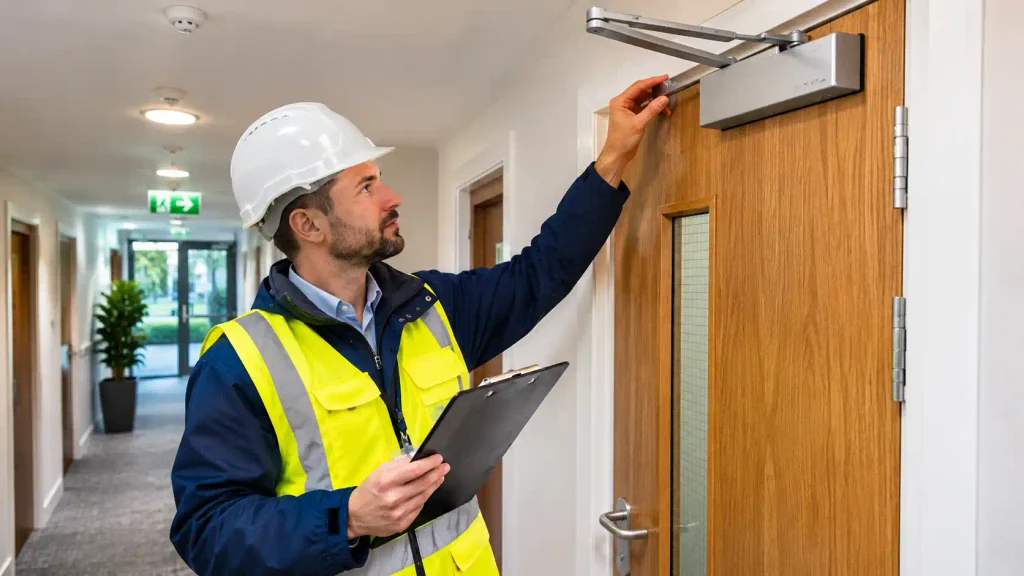
What should a communal-area fire risk assessment cover?
A suitable assessment should consider:
- Fire hazards: Electrical equipment, combustible storage, waste, smoking materials and potential ignition sources.
- People at risk: Residents, visitors, contractors, cleaners and individuals who may need additional assistance.
- Escape arrangements: Corridors, staircases, final exits, access routes and emergency arrangements.
- Fire protection: Fire doors, compartmentation, smoke control and other relevant protective systems.
- Warning arrangements: Appropriate detection, alarms and communication systems.
- Emergency lighting: Whether lighting is required and suitable for the building.
- Management arrangements: Inspection schedules, maintenance responsibilities and emergency procedures.
- Corrective actions: Defects, improvement priorities, responsible persons and completion deadlines.
How frequently should fire risk assessments be reviewed?
There is no universal rule requiring every communal-area fire risk assessment to be renewed annually. In England and Wales, assessments must be reviewed regularly and whenever there is reason to believe they may no longer be valid, including following significant changes, alterations or incidents. A building manager should establish a review programme appropriate to the building’s risks and management arrangements.
For a more detailed understanding of assessment methods, property professionals can explore the ProQual Level 4 Certificate in Fire Risk Assessment.
Fire Safety Requirements for Communal Corridors and Staircases
Communal corridors and staircases are essential parts of residential escape arrangements. Their design and maintenance should allow residents to move towards a place of safety in accordance with the building’s evacuation strategy.
Important precautions include:
- Keep escape routes free from obstructions.
- Maintain suitable fire-resisting doors.
- Prevent unauthorised combustible storage.
- Maintain adequate lighting.
- Ensure final exits can be accessed as intended.
- Report damaged handrails, doors and other safety features.
- Prevent unauthorised alterations to protected escape routes.
Staircases are particularly important because they may provide the primary means of escape from upper floors. Fire doors separating corridors from stairways should be maintained in suitable working condition. Their purpose is to help restrict fire and smoke movement into protected routes.
Fire Safety in Shared Entrances, Lobbies and Hallways
Shared entrances and lobbies should be maintained so that residents and emergency responders can move through the building safely.
Building managers should pay particular attention to:
- Entrance doors and access-control arrangements.
- Fire doors separating lobbies from corridors.
- Electrical installations and equipment.
- Waste and parcel storage.
- Door-closing mechanisms.
- Access to firefighting equipment.
- Signs identifying emergency exits and relevant facilities.
A common mistake is treating entrance lobbies as ordinary storage spaces. Even small quantities of combustible material may introduce unnecessary hazards. The management team should establish clear housekeeping arrangements and ensure that contractors and residents understand the building’s rules.
Fire Doors and Their Importance in Communal Areas
Fire doors are designed to resist fire and restrict the movement of smoke when correctly specified, installed and maintained. They support compartmentation by separating different parts of a building and protecting escape routes.
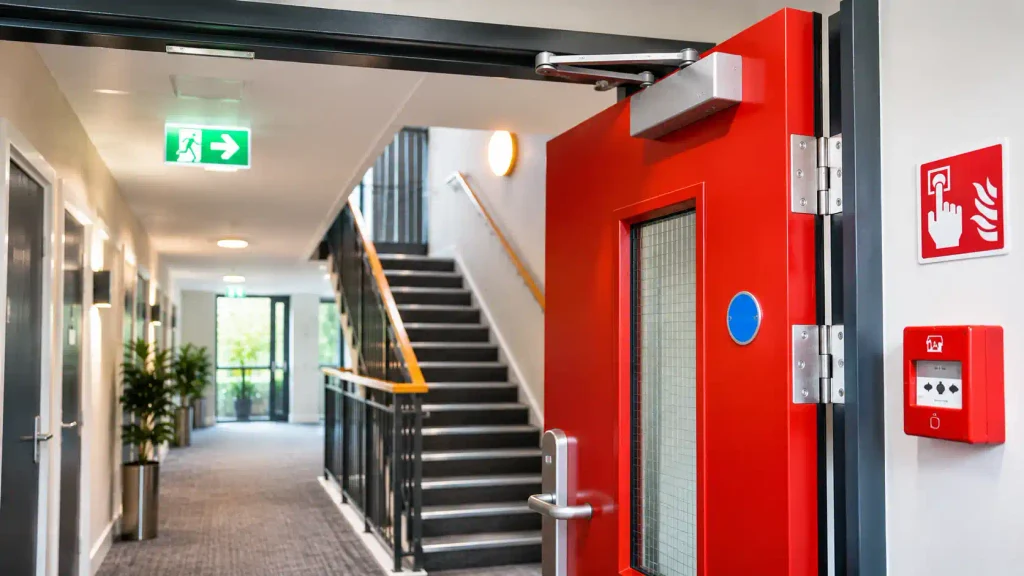
Common examples include:
- Doors between corridors and staircases.
- Cross-corridor fire doors.
- Doors to electrical cupboards.
- Doors to service risers.
- Flat entrance doors opening onto communal areas.
Fire door inspection requirements in England
Under the Fire Safety (England) Regulations 2022, responsible persons must undertake:
| Building type | Fire door inspection requirement |
|---|---|
| Multi-occupied residential buildings above 11 metres | Communal fire doors must be checked at least every three months. |
| Multi-occupied residential buildings above 11 metres | Best endeavours must be used to check flat entrance fire doors at least every 12 months. |
| Other buildings covered by the Fire Safety Order | Appropriate inspection and maintenance arrangements remain necessary under the general fire safety duties. |
The annual flat entrance door checks are subject to a best-endeavours requirement, including recording attempts to obtain access when access is not provided.
What should be checked?
A basic visual and functional inspection should consider:
- Whether the door closes fully.
- Whether the self-closing mechanism operates.
- Whether the door or frame is visibly damaged.
- Whether seals and intumescent strips are damaged or missing.
- Whether there are excessive gaps.
- Whether unauthorised alterations have been made.
A fire door should never be wedged open or modified without appropriate assessment.
Specialist inspection may be necessary where defects are identified or the door’s fire performance is uncertain.
For advanced technical knowledge, the ProQual Level 5 Diploma in Fire Engineering Design is a relevant professional learning resource.
Keeping Communal Escape Routes Clear and Accessible
Escape routes must remain suitable for their intended purpose. Obstructions can delay evacuation, create trip hazards and introduce combustible materials into areas where residents may need to escape.
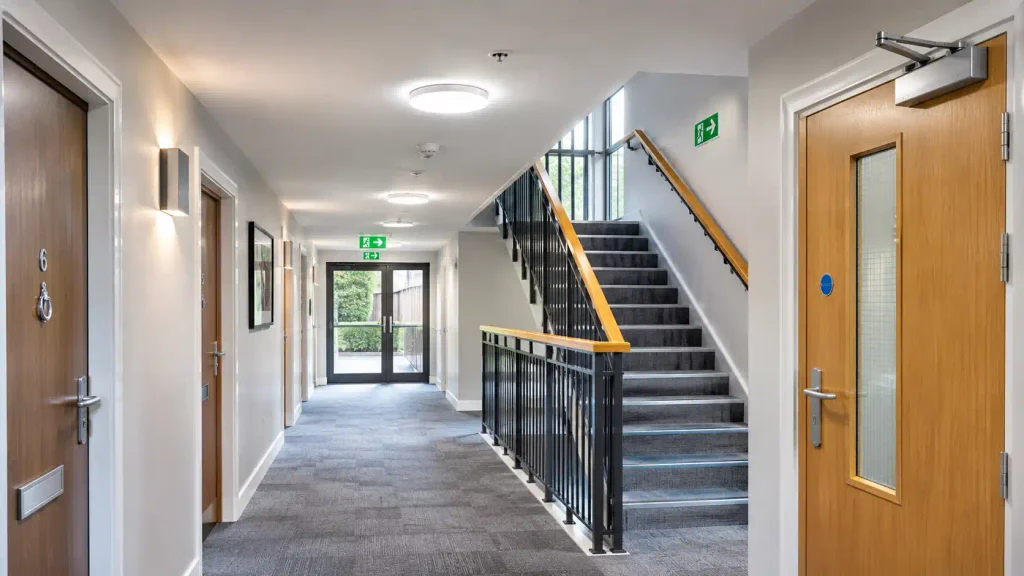
Examples of items that may create hazards include:
- Bicycles and electric scooters.
- Shoes and shoe racks.
- Pushchairs and prams.
- Household furniture.
- Cardboard packaging.
- Waste bags.
- Cleaning products.
- Electrical charging equipment.
A managed or zero-tolerance approach to storage may be appropriate depending on the building’s design and risk assessment. London Fire Brigade highlights the importance of preventing combustible storage and obstructions in communal escape areas. Residents should use designated storage areas instead of corridors and staircases.
Fire Alarm and Emergency Warning Systems in Residential Buildings
Fire alarm requirements in residential flats depend on the building’s design, detection arrangements and evacuation strategy. A common misconception is that every residential block must have a communal fire alarm system.
This is not correct. Many purpose-built blocks use a stay-put strategy supported by compartmentation and fire-resisting construction. In such buildings, installing a communal alarm without suitable justification may conflict with the existing fire safety strategy. Where a communal alarm is required, its design and management should be determined by a competent fire safety professional.
The building’s fire safety arrangements should explain:
- How a fire is detected.
- Whether alarms operate within individual flats or shared areas.
- What happens when an alarm activates.
- Whether residents should evacuate immediately.
- Who should contact the fire and rescue service.
Government guidance explains the relationship between compartmentation, stay-put arrangements and communal fire alarms.
Emergency Lighting and Fire Safety Signage Requirements
Emergency lighting helps people identify escape routes when normal lighting fails. It may be required where an assessment identifies that normal lighting cannot provide sufficient visibility during an emergency.
Depending on the building, suitable arrangements may include:
- Emergency lighting in protected stairways.
- Lighting along internal escape corridors.
- Illuminated exit signs.
- Directional escape signs.
- Signs identifying firefighting facilities.
- Floor identification signs in relevant high-rise buildings.
There is no single emergency-lighting configuration or duration that automatically applies to every block of flats. The required arrangements should be established through the building’s design, applicable standards and fire risk assessment.
In England, certain additional wayfinding and firefighting information requirements apply to high-rise residential buildings under the Fire Safety (England) Regulations 2022.
Fire Extinguishers and Other Fire Protection Equipment in Shared Areas
Fire protection equipment should be selected according to the hazards and the building’s fire safety arrangements.
Possible equipment includes:
- Fire extinguishers in appropriate locations.
- Fire blankets in suitable ancillary facilities.
- Fire detection systems.
- Smoke control systems.
- Firefighting lifts.
- Rising fire mains.
- Dry or wet risers.
- Sprinkler installations where required.
- Emergency communication equipment.
Not every communal corridor requires an extinguisher. Government guidance for small blocks of flats explains that extinguishers are not generally required in common escape routes, although suitable equipment may be necessary in ancillary rooms where specific hazards exist.
Equipment that is provided must be maintained and kept accessible.
Storage of Personal Belongings in Communal Areas: What Is Allowed?
Residents often ask whether they can leave shoes, bicycles, pushchairs or other belongings outside their flats. The answer depends on the building’s arrangements, lease or tenancy conditions, management policy and fire risk assessment. However, residents should not assume that an unused corner of a corridor is automatically suitable for storage.
Common items and their fire safety implications
| Item | Potential concern | Recommended approach |
|---|---|---|
| Shoes and shoe racks | Obstruction and combustible material | Use private or designated storage. |
| Bicycles | Restricted access and combustible components | Use approved cycle storage. |
| E-bikes and scooters | Battery-related fire hazards and charging risks | Follow building restrictions and approved charging arrangements. |
| Pushchairs | Reduced escape-route width | Store in designated areas. |
| Furniture | Additional fire load and obstruction | Do not leave in escape routes. |
| Waste bags | Combustible materials and possible ignition | Use designated waste facilities. |
| Parcel deliveries | Temporary obstruction | Arrange prompt collection and secure delivery areas. |
Residents should follow the building’s specific fire safety policy and seek clarification from the managing agent if uncertain.
Common Fire Safety Hazards in Communal Areas of Flats
Understanding common hazards allows building managers to prioritise preventive action.
| Hazard | Possible consequence | Preventive action |
|---|---|---|
| Electrical faults | Ignition and fire spread | Inspect and maintain electrical installations. |
| Combustible storage | Increased fire load | Establish clear housekeeping rules. |
| Blocked corridors | Delayed evacuation | Conduct regular inspections. |
| Damaged fire doors | Smoke and fire spread | Arrange repair and functional checks. |
| Poor waste management | Increased combustible material | Maintain designated waste arrangements. |
| Unauthorised charging | Battery-related fire risk | Apply suitable charging and storage policies. |
| Damaged emergency lighting | Reduced visibility | Test and maintain lighting systems. |
| Faulty smoke control | Reduced protection from smoke | Arrange competent maintenance. |
| Contractor activities | Accidental ignition | Apply suitable contractor and hot-work controls. |
A good fire safety programme identifies hazards before they develop into serious incidents.
Fire Safety Inspection and Maintenance Responsibilities
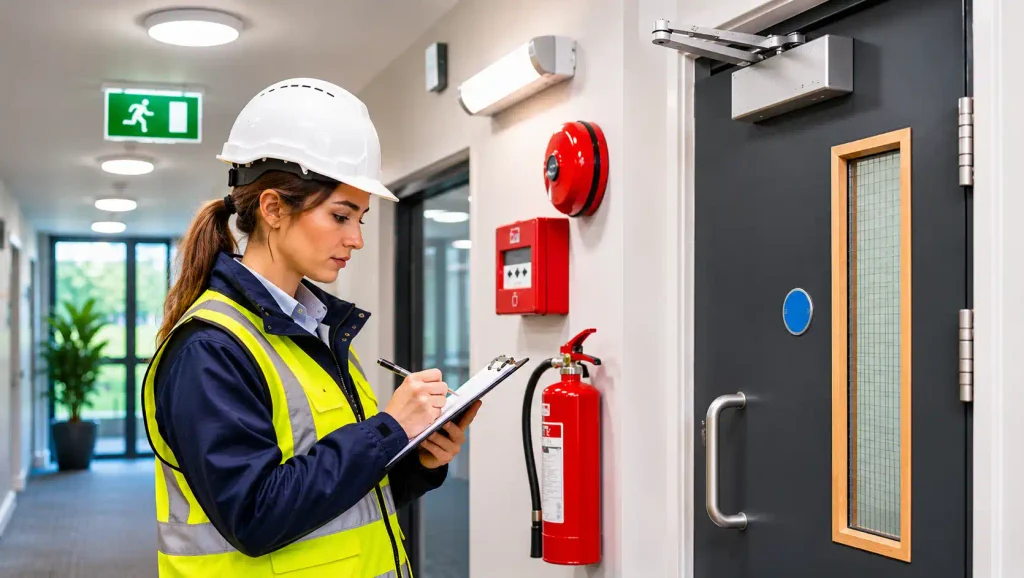
Inspection and maintenance help ensure that the fire safety measures identified in the assessment remain effective. A building manager should implement a documented inspection programme.
Suggested communal-area inspection programme
| Inspection activity | Suggested management frequency | Purpose |
|---|---|---|
| Visual escape-route checks | Frequent routine visits | Identify obstructions and housekeeping problems. |
| Communal fire door checks in England, buildings above 11m | At least quarterly | Meet the specific statutory requirement. |
| Flat entrance fire door checks in England, buildings above 11m | Best endeavours at least annually | Meet the statutory checking requirement. |
| Emergency lighting checks | In accordance with system requirements | Confirm reliable emergency illumination. |
| Fire alarm servicing | According to system design and applicable standards | Maintain warning arrangements. |
| Fire risk assessment review | Regularly and following relevant changes | Keep the assessment valid. |
| Fire safety equipment maintenance | According to manufacturer and applicable requirements | Ensure equipment remains functional. |
Except for specific statutory frequencies, these are management planning recommendations rather than universal legal inspection intervals.
What should an inspection record include?
A useful inspection record should contain:
- Building name and location.
- Date and time of inspection.
- Name of the inspector.
- Area inspected.
- Identified hazards or defects.
- Risk priority.
- Corrective action required.
- Person responsible for the action.
- Target completion date.
- Verification and closure details.
Records help demonstrate that hazards are being identified and addressed. For organisations developing specialist fire risk assessment capabilities, the ProQual Level 4 Award in Advanced Fire Risk Assessment provides a relevant professional learning pathway.
What Should Residents Do in the Event of a Fire?
Residents should understand the evacuation strategy established for their building before an emergency occurs.
There are two common approaches.
- Stay-put strategy: Residents in unaffected flats are generally advised to remain inside their flats when a fire occurs elsewhere, provided the building’s compartmentation and fire safety arrangements support this strategy. Anyone whose flat is affected by fire or smoke should leave if safe to do so and call 999.
- Simultaneous evacuation strategy: Residents are instructed to leave when the building’s alarm or other specified warning is activated.
The correct response depends on the building’s actual strategy. Residents should not assume that every block uses the same arrangements.
Emergency response steps
- Recognise signs of fire, smoke or unusual heat.
- Follow the building’s fire action instructions.
- Call 999 and request the fire and rescue service.
- Avoid lifts unless they are specifically designated for evacuation and the emergency arrangements permit their use.
- Use the designated escape route if evacuation is required and it is safe.
- Close doors behind you where possible.
- Do not re-enter the building until authorised.
Residents should never put themselves at unnecessary risk by attempting to fight a fire or investigate a dangerous area.
Fire Safety Responsibilities of Landlords, Building Owners and Managing Agents
Effective fire safety management requires clear responsibilities and communication.
| Responsible party | Main areas of responsibility |
|---|---|
| Building owner or freeholder | Ensure appropriate building safety arrangements and discharge applicable legal duties. |
| Landlord | Maintain relevant shared facilities and address identified hazards. |
| Managing agent | Coordinate inspections, maintenance, contractors and resident communication where responsible for these functions. |
| Fire risk assessor | Evaluate fire hazards and recommend appropriate precautions within their professional competence. |
| Maintenance contractor | Carry out assigned inspection, testing and repair work competently. |
| Residents | Follow safety instructions and report hazards. |
In England and Wales, the responsible person must ensure that relevant fire precautions are implemented and maintained. Delegating practical work does not automatically remove the underlying legal duties.
Organisations seeking to strengthen their professional fire safety knowledge can also explore the ProQual Level 6 Diploma in Advanced Fire Safety Design and Building Risk Management.
Penalties and Consequences of Failing to Meet Fire Safety Requirements
Failing to maintain appropriate fire safety arrangements can expose responsible parties to enforcement action and other serious consequences.
Depending on the applicable legislation and circumstances, consequences may include:
- Fire safety enforcement notices.
- Requirements to complete remedial work.
- Restrictions on the use of unsafe premises.
- Financial penalties.
- Criminal prosecution.
- Reputational damage.
- Civil claims.
- Increased insurance and property-management costs.
In England and Wales, fire and rescue authorities have enforcement powers under the Fire Safety Order. The seriousness of the breach, the risk to occupants and the relevant legal provisions influence the action taken. GOV.UK+1
For a deeper understanding of enforcement procedures, read Fire Safety Enforcement Notices: What Happens When a Business Fails to Comply?.
Fire Safety Checklist for Communal Areas of Flats
The following checklist can help property managers and responsible persons review important communal fire safety arrangements.
| Inspection point | What to verify |
|---|---|
| Corridors | Clear and suitable for escape. |
| Staircases | Free from obstructions and maintained. |
| Final exits | Accessible and operational. |
| Fire doors | Undamaged and closing correctly. |
| Door closers | Functional and appropriately maintained. |
| Electrical cupboards | Secure and free from inappropriate storage. |
| Waste areas | Properly managed and free from accumulated rubbish. |
| Emergency lighting | Maintained and tested as required. |
| Fire signage | Visible and relevant to the evacuation arrangements. |
| Alarm systems | Suitable for the building’s fire strategy. |
| Smoke control | Maintained where provided. |
| Firefighting equipment | Accessible and maintained. |
| Resident instructions | Available and kept up to date. |
| Risk assessment | Current, recorded and reviewed when required. |
| Corrective actions | Tracked until completed. |
This checklist is a practical management aid, not a substitute for a competent fire risk assessment.
Best Practices for Improving Fire Safety in Shared Residential Buildings
A strong fire safety programme should combine prevention, maintenance, communication and accountability. Property managers can use a structured Fire Safety Compliance Checklist for UK Employers and Commercial Premises to understand how systematic inspections, documentation and corrective actions contribute to effective fire safety management.
Establish a clear communal-area policy
Property managers should provide residents with clear information about permitted storage, waste disposal, charging equipment and escape-route access.
Introduce routine monitoring
Regular visits help identify defects before they become serious hazards. Inspection frequency should reflect the building’s risk profile.
Maintain fire doors and compartmentation
Damaged doors, defective closers and unsealed service penetrations can undermine the building’s fire protection arrangements.
Communicate with residents
Residents should understand their building’s evacuation strategy, reporting procedures and responsibilities.
Manage contractors effectively
Maintenance and refurbishment activities can introduce ignition sources or compromise fire-resisting construction. Contractors should receive suitable instructions and supervision.
Maintain accurate safety records
Risk assessments, inspection reports, maintenance certificates and corrective action records should be organised and accessible to relevant dutyholders.
Use competent fire safety professionals
Where specialist assessment or technical work is required, organisations should appoint people with suitable knowledge, experience and competence.
For individuals interested in developing practical fire prevention skills, the ICTQual Level 3 Diploma in Fire Watcher is a relevant course to explore.
Fire Safety Management Flowchart for Communal Areas of Flats
The following flowchart illustrates a practical management process for identifying, controlling and monitoring fire safety risks in shared residential buildings.
Fire Safety Management Process
This process supports continuous fire safety management rather than treating compliance as a one-time activity.
Conclusion: Maintaining Safe Communal Areas in Residential Buildings
Fire Safety in Communal Areas of Flats is an essential responsibility for anyone involved in residential building ownership, management or occupation. Shared corridors, staircases, entrances and lobbies must be maintained so that residents can access and use escape routes safely.
Effective fire safety requires suitable risk assessments, maintained fire doors, appropriate emergency arrangements, clear communal spaces and regular monitoring. Building owners, landlords and managing agents should understand their responsibilities and establish procedures for identifying hazards, arranging maintenance and recording corrective actions.
Residents also have an important role. Following storage policies, avoiding obstructions and reporting damaged safety equipment can help prevent unnecessary risks to neighbours and visitors.
The legal framework differs across England, Wales, Scotland and Northern Ireland, making it essential to understand the requirements applicable to each building.
For organisations and professionals looking to strengthen their knowledge, developing expertise in fire risk assessment, fire engineering and building fire safety management can support better-informed decisions and more effective safety practices.
8. Authoritative external resources
These are the most useful resources to support the article and help readers verify the legal information.
- GOV.UK – Fire Safety Legislation and Guidance for Those with Legal Duties.
- GOV.UK – Fire Safety (England) Regulations 2022.
- GOV.UK – Fire Safety Act 2021.
- Fire Safety in Purpose-Built Blocks of Flats.
- A Guide to Making Your Small Block of Flats Safe from Fire.
- London Fire Brigade – Fires in Communal Areas.
- Northern Ireland Fire and Rescue Service – Fire Safety Advice for People Living in Flats.
- Welsh Government – Building Safety (Wales) Act 2026.
Frequently Asked Questions About Fire Safety in Communal Areas of Flats
1. Are communal areas of flats covered by UK fire safety regulations?
Yes, but the applicable requirements depend on the UK nation. In England and Wales, the Regulatory Reform (Fire Safety) Order 2005 covers relevant common parts of residential buildings containing multiple domestic premises. Scotland and Northern Ireland have different legal arrangements for domestic communal areas.
2. Who is responsible for fire safety in communal areas of flats?
Responsibility generally rests with the person or organisation having control of the relevant premises and applicable legal duties. This may be a freeholder, landlord, building owner, housing provider or managing agent. The actual responsibilities depend on ownership, control and management arrangements.
3. Can residents store shoes and personal belongings in communal corridors?
Residents should not assume that communal corridors are suitable for personal storage. Shoes, shoe racks, bicycles, furniture and other belongings can obstruct escape routes or introduce combustible materials. Residents should follow the building’s fire safety policy and use designated storage facilities.
4. Are fire doors compulsory in communal areas of flats?
Fire doors are required where necessary to provide the fire protection identified by the building’s design and risk assessment. Doors protecting stairways, separating corridors and enclosing certain service areas can play important roles in preventing fire and smoke spread. Their suitability depends on the building’s fire safety arrangements.
5. Must communal staircases and corridors remain clear?
Yes. Communal escape routes should remain free from obstructions that could prevent safe movement during an emergency. Furniture, bicycles, rubbish and other stored belongings can create unnecessary hazards and should be managed appropriately.
6. How often should communal fire safety inspections be carried out?
Inspection frequency depends on the building’s risk assessment, equipment and legal requirements. In England, communal fire doors in multi-occupied residential buildings above 11 metres must be checked at least every three months. Other inspections should follow suitable maintenance arrangements and applicable standards.
7. Are landlords responsible for fire risk assessments in shared areas?
In England and Wales, the responsible person must ensure that a suitable and sufficient assessment is undertaken for premises covered by the Fire Safety Order. A landlord may be the responsible person, but this depends on the building’s ownership and control arrangements.
8. What fire safety equipment is required in communal areas?
There is no universal equipment list for every residential block. Depending on the building’s fire strategy and risk assessment, provisions may include fire doors, emergency lighting, alarms, smoke control systems, firefighting facilities and suitable signage.
9. What should residents do if they discover a fire hazard in a communal area?
Residents should report the issue promptly to the landlord, building manager or managing agent. Examples include damaged fire doors, blocked corridors, faulty lighting, combustible storage and defective emergency equipment. If there is an immediate fire emergency, residents should call 999.
10. Can managing agents be held responsible for fire safety failures?
Managing agents may have legal responsibilities where they exercise control over relevant premises or have applicable duties under the legislation. Their responsibilities depend on the contractual and operational arrangements. Appointment as a managing agent does not automatically transfer every legal duty from the building owner.
11. Is a fire risk assessment required for every block of flats?
The answer depends on the jurisdiction. In England and Wales, the Fire Safety Order requires suitable fire risk assessments for relevant common parts. Scotland and Northern Ireland have different requirements for domestic premises and their shared areas. Owners should obtain jurisdiction-specific advice.
12. Are communal fire alarm systems mandatory in every block of flats?
No. Communal fire alarm systems are not automatically required in every residential building. The need for an alarm depends on the building’s design, compartmentation, evacuation strategy and fire risk assessment. Some purpose-built blocks operate a stay-put strategy without a communal alarm.
13. Can residents charge electric scooters or e-bikes in communal hallways?
Communal hallways and escape routes are generally unsuitable places for charging electric scooters or e-bikes. Charging equipment and lithium-ion batteries can introduce additional fire hazards. Residents should follow building policies and use only appropriate designated charging arrangements.
14. What happens if a landlord ignores communal fire safety problems?
Depending on the applicable law and the seriousness of the risk, enforcement authorities may investigate, issue notices, require improvements or pursue prosecution. Residents should report concerns to the responsible building manager and, where appropriate, the relevant fire and rescue authority or local authority.
15. Does the Building Safety Act 2022 apply to all blocks of flats?
No. The Building Safety Act 2022 establishes additional requirements, particularly for higher-risk buildings in England. Its provisions should not be confused with the general fire safety duties that apply to relevant communal areas. Wales also has a separate Building Safety (Wales) Act 2026, which is being implemented in phases.