
Regulated Qualifications Framework Level 7 Explained: A Complete Career Guide
The UK education system offers a wide range of qualifications designed to help learners develop specialist knowledge, advance their careers, and pursue higher education. Among these, the Regulated Qualifications Framework (RQF) Level 7 represents one of the highest professional and academic qualification levels before doctoral study. Whether a learner wants to secure a senior management role, transition into a specialist profession, or progress toward a master’s degree, an RQF Level 7 qualification provides a recognised pathway to achieving those goals.
Unlike many articles that simply compare Level 7 qualifications to a master’s degree, this comprehensive guide explains the entire framework, how Level 7 fits within it, why employers value regulated qualifications, and how a Level 7 qualification can support long-term career progression across multiple industries.
If a learner is considering professional development or planning the next step after completing an undergraduate qualification, understanding Regulated Qualifications Framework Level 7 is essential for making an informed decision.
What Is the Regulated Qualifications Framework (RQF)?
The Regulated Qualifications Framework (RQF) is the official framework used in England and Northern Ireland to classify regulated qualifications according to their level of difficulty and complexity. It enables employers, universities, professional bodies, and learners to understand how different qualifications compare and what level of knowledge and skills they represent.
Each qualification within the framework is assigned a level based on learning outcomes rather than study duration. This makes it easier to compare vocational, academic, and professional qualifications while ensuring consistency across awarding organisations regulated by Ofqual (The Office of Qualifications and Examinations Regulation).
Quick Answer
The Regulated Qualifications Framework (RQF) Level 7 is an advanced qualification level equivalent in academic demand to a master’s degree. It is designed for professionals seeking specialist knowledge, leadership skills, and career progression across industries such as business, healthcare, engineering, education, finance, and project management.
Why Does the RQF Matter?
The RQF benefits learners, employers, universities, and awarding organisations by providing a nationally recognised structure for qualifications.
Some of its key advantages include:
- Ensures qualifications meet regulated quality standards.
- Helps employers understand qualification levels.
- Supports progression into higher education.
- Enables comparison between vocational and academic qualifications.
- Improves international recognition of UK qualifications.
- Provides clear learning pathways from entry level to doctoral study.
Because the framework is regulated, employers can confidently assess the value of a qualification without needing detailed knowledge of every awarding body.
Understanding the Regulated Qualifications Framework Levels
The RQF consists of Entry Level followed by Levels 1 to 8. Each level represents increasing complexity, responsibility, and depth of learning.
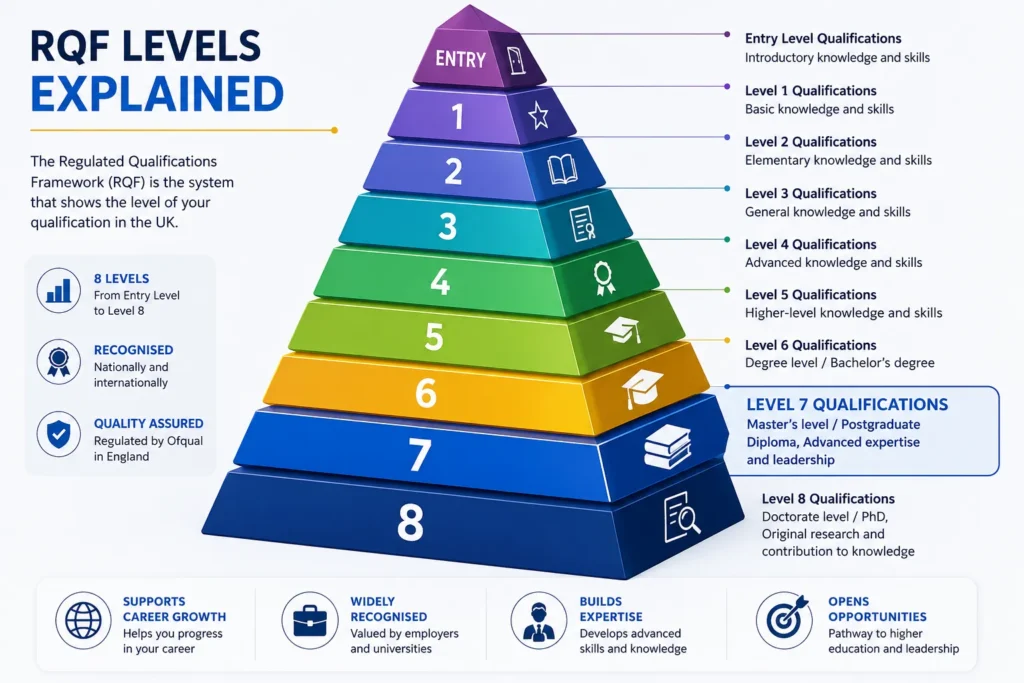
Table 1: Regulated Qualifications Framework (RQF) Levels
| RQF Level | Typical Qualification | Equivalent Academic Level | Primary Focus |
|---|---|---|---|
| Entry Level | Entry Certificates | Foundation Learning | Basic skills |
| Level 1 | GCSE (Grades 3–1) | Introductory | Fundamental knowledge |
| Level 2 | GCSE (Grades 9–4) | Intermediate | Practical skills |
| Level 3 | A Levels, BTEC National | Advanced | University preparation |
| Level 4 | Higher National Certificate (HNC), Certificate of Higher Education | First year undergraduate | Technical knowledge |
| Level 5 | Higher National Diploma (HND), Foundation Degree | Second year undergraduate | Professional practice |
| Level 6 | Bachelor’s Degree, Graduate Diploma | Undergraduate Honours | Advanced professional competence |
| Level 7 | Postgraduate Diploma, Extended Diploma, Professional Diploma | Master’s Level | Strategic leadership and specialist expertise |
| Level 8 | Doctorate (PhD), Professional Doctorate | Doctoral Level | Original research and innovation |
This structured framework allows learners to progress naturally from one qualification level to another while developing increasingly advanced knowledge and professional competencies.
Where Does RQF Level 7 Fit?
Level 7 sits immediately above a bachelor’s degree and directly below doctoral qualifications.
It is intended for professionals who already possess significant academic knowledge or industry experience and wish to develop expertise in strategic leadership, critical thinking, research, and decision-making.
Rather than focusing solely on technical competence, Level 7 qualifications prepare learners to solve complex organisational challenges, manage teams, influence business strategy, and lead organisational change.
Many employers consider an RQF Level 7 qualification evidence of advanced professional capability because it demonstrates the ability to analyse problems, evaluate evidence, and make informed strategic decisions.
What Makes Regulated Qualifications Framework Level 7 Different?
Many people mistakenly assume that every Level 7 qualification is simply another academic course. In reality, Level 7 qualifications combine advanced theoretical learning with practical workplace application.
Typical Level 7 programmes focus on:
- Strategic leadership
- Organisational management
- Critical analysis
- Independent research
- Professional ethics
- Innovation
- Risk management
- Complex problem-solving
- Decision-making
- Industry-specific expertise
Instead of teaching basic concepts, learners are expected to evaluate, interpret, synthesise, and apply advanced knowledge to real-world scenarios.
This higher level of cognitive demand is one of the defining characteristics of RQF Level 7 qualifications.
How Learners Progress Through the RQF
The RQF creates a clear educational pathway that supports lifelong learning and career advancement.
Career Progression Flowchart
Entry Level
↓
Level 1
↓
Level 2
↓
Level 3
↓
Level 4
↓
Level 5
↓
Level 6 (Bachelor’s Degree)
↓
⭐ Level 7 (Postgraduate Diploma / Professional Diploma)
↓
Master’s Top-Up or Full Master’s Degree
↓
Level 8 (Doctorate / PhD)
This progression allows learners to build knowledge gradually while choosing academic or vocational routes that align with their career ambitions.
Key Characteristics of RQF Level 7 Qualifications
RQF Level 7 qualifications are designed for professionals seeking leadership positions or specialist roles. They differ significantly from undergraduate study in terms of learning outcomes, assessment methods, and expected responsibilities.
Table 2: Key Features of RQF Level 7
| Feature | Description |
|---|---|
| Academic Level | Master’s Level |
| Learning Focus | Advanced theory and professional practice |
| Difficulty | High |
| Typical Learners | Graduates and experienced professionals |
| Skills Developed | Leadership, strategic thinking, research, decision-making |
| Assessment | Assignments, projects, case studies, reports, presentations |
| Career Outcome | Senior professional and management roles |
| Progression | Master’s Top-Up, MBA, MSc, MA, Level 8 qualifications |
Unlike entry-level qualifications, Level 7 programmes encourage independent learning, critical reflection, and evidence-based decision-making. This makes graduates better prepared to lead projects, manage organisations, and contribute to long-term strategic objectives.
Why Employers Value RQF Level 7 Qualifications
Modern employers increasingly seek professionals who can adapt to changing business environments, lead multidisciplinary teams, and make informed strategic decisions. An RQF Level 7 qualification demonstrates these capabilities by combining advanced academic knowledge with practical application.
Employers often associate Level 7 graduates with:
- Strong analytical thinking
- Effective leadership and management skills
- Advanced communication abilities
- Strategic planning expertise
- High-level problem-solving capabilities
- Professional credibility
- Commitment to continuous professional development
- Readiness for senior management responsibilities
These attributes make Level 7 qualifications valuable across sectors including business management, finance, healthcare, education, engineering, construction, hospitality, information technology, and public administration.
Is an RQF Level 7 Qualification Right for Every Learner?
An RQF Level 7 qualification is most suitable for individuals who have already established a solid educational or professional foundation and are looking to progress into more senior, specialised, or leadership-focused roles. It is particularly beneficial for learners aiming to deepen their expertise, strengthen strategic decision-making skills, or prepare for postgraduate study.
Choosing Level 7 should align with long-term career goals, industry requirements, and aspirations for professional advancement rather than simply pursuing a higher qualification. In the next section, we will explore how RQF Level 7 compares with a master’s degree, explain credits, Total Qualification Time (TQT), Guided Learning Hours (GLH), Ofqual regulation, and awarding bodies, and examine the career opportunities that make this qualification a valuable investment.
RQF Level 7 vs Master’s Degree: Are They the Same?
One of the most common misconceptions is that an RQF Level 7 qualification and a master’s degree are exactly the same. While they are academically equivalent in terms of learning level, they are not identical qualifications.
Both sit at Level 7 on the Regulated Qualifications Framework, meaning they require advanced analytical skills, independent learning, and critical evaluation. However, they differ in structure, purpose, and progression opportunities.
A Level 7 Diploma is often designed to develop practical leadership and professional expertise within a specific industry, whereas a master’s degree usually combines advanced coursework with a dissertation or research project.
Many universities also recognise Level 7 Diplomas for Master’s Top-Up programmes, allowing learners to earn a full master’s degree by completing a dissertation or additional modules.
Table 3: RQF Level 7 Diploma vs Master’s Degree
| Feature | RQF Level 7 Diploma | Master’s Degree |
|---|---|---|
| RQF Level | Level 7 | Level 7 |
| Academic Standard | Master’s Level | Master’s Level |
| Focus | Professional and vocational expertise | Academic and research-based learning |
| Assessment | Assignments, reports, presentations, case studies | Coursework, exams, dissertation |
| Research Requirement | Usually limited | Extensive dissertation or research project |
| Typical Duration | 6–12 months | 12–24 months |
| Progression | Master’s Top-Up or employment | Doctorate or employment |
| Best For | Career progression and leadership roles | Academic progression and specialist research |
Key Takeaway: An RQF Level 7 Diploma is equivalent to master’s-level study, but it is not automatically a full master’s degree. It provides an excellent route into postgraduate education while offering practical, career-focused learning.
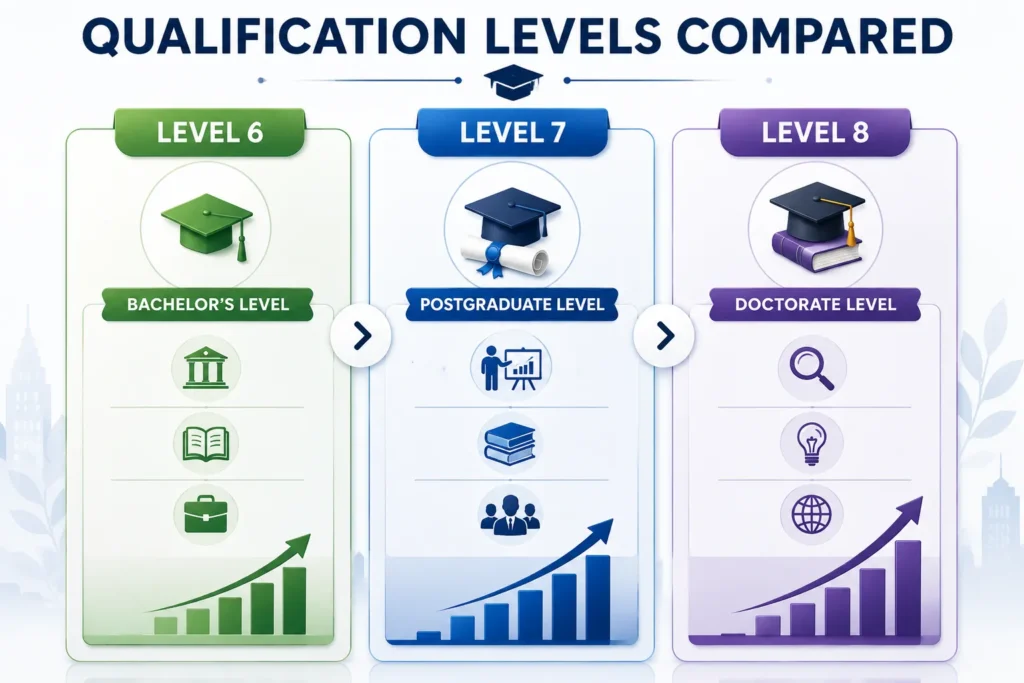
Level 6 vs Level 7 vs Level 8
Understanding how Level 7 compares with the qualifications immediately above and below it helps learners choose the right progression route.
Table 4: Comparing Levels 6, 7 and 8
| Feature | Level 6 | Level 7 | Level 8 |
|---|---|---|---|
| Typical Qualification | Bachelor’s Degree | Postgraduate Diploma / Master’s | Doctorate (PhD) |
| Knowledge Level | Advanced | Highly Advanced | Expert |
| Learning Focus | Professional competence | Strategic leadership and specialist expertise | Original research and innovation |
| Critical Thinking | High | Very High | Exceptional |
| Independent Research | Limited | Extensive | Original contribution to knowledge |
| Career Stage | Professional | Senior Professional / Manager | Academic, Consultant, Research Leader |
As learners move through these levels, the expectation shifts from understanding knowledge to creating solutions, influencing strategy, and leading innovation.
Understanding Credits, TQT and GLH
When exploring Level 7 qualifications, learners often encounter terms such as Credits, Total Qualification Time (TQT), and Guided Learning Hours (GLH). These measurements help indicate the size and learning commitment of a qualification.
Credits
Credits measure the amount of learning completed.
Generally:
- 1 credit represents approximately 10 hours of learning.
- A larger number of credits usually indicates a more comprehensive qualification.
Examples include:
- Level 7 Certificate – typically 20–40 credits
- Level 7 Diploma – often 60–120 credits
- Extended Diplomas – may contain 120 credits or more
Total Qualification Time (TQT)
Total Qualification Time includes all learning activities, such as:
- Classroom learning
- Online study
- Independent reading
- Assignments
- Research
- Assessments
- Revision
TQT provides a realistic estimate of the total effort required to complete a qualification successfully.
Guided Learning Hours (GLH)
Guided Learning Hours refer only to time spent under the guidance of a tutor or trainer, including:
- Lectures
- Workshops
- Live online sessions
- Tutorials
- Practical instruction
GLH does not include self-study or independent research.
Understanding these measures helps learners compare different qualifications and choose a programme that matches their available study time and career objectives.
What Does Ofqual Do?
Many learners see the term “Ofqual Regulated” but are unsure why it matters.
Ofqual (Office of Qualifications and Examinations Regulation) is the independent regulator responsible for maintaining the quality and standards of regulated qualifications in England.
Its role includes:
- Regulating awarding organisations
- Maintaining qualification standards
- Protecting learner interests
- Ensuring assessments are fair and reliable
- Supporting employer confidence in regulated qualifications
When a qualification is regulated by Ofqual, it means the awarding organisation must meet strict quality assurance requirements. This provides reassurance that the qualification has recognised academic value and meets nationally accepted standards.
For employers and universities, Ofqual regulation adds credibility and consistency, making regulated qualifications easier to recognise and compare.
Who Awards RQF Level 7 Qualifications?
An important distinction is that the RQF itself does not award qualifications. Instead, regulated awarding organisations design and deliver qualifications that are placed on the framework.
Some of the most recognised awarding organisations include:
- OTHM
- Qualifi
- ATHE
- CMI (Chartered Management Institute)
- ILM (Institute of Leadership & Management)
- Pearson
- NCFE
- ProQual
- City & Guilds
Each awarding body specialises in different subject areas while following the quality standards required by Ofqual.
This ensures that learners receive qualifications recognised by employers, higher education institutions, and professional organisations.
Skills Developed Through an RQF Level 7 Qualification
Level 7 qualifications are designed to prepare professionals for complex workplace challenges rather than entry-level roles.
Typical skills developed include:
Strategic Leadership
Learners develop the ability to lead teams, manage organisational change, and create long-term business strategies.
Critical Thinking
Instead of memorising information, learners evaluate evidence, identify risks, and recommend practical solutions.
Research Skills
Level 7 programmes strengthen the ability to collect, interpret, and apply research findings to real-world business or professional environments.
Decision-Making
Professionals learn structured approaches for making informed decisions in uncertain and complex situations.
Communication
Advanced written and verbal communication skills are developed through reports, presentations, business proposals, and strategic recommendations.
Project Management
Many Level 7 programmes include planning, budgeting, stakeholder management, and performance evaluation.
Risk Management
Professionals learn to identify organisational risks, evaluate their impact, and develop mitigation strategies.
These transferable skills are highly valued across industries and contribute significantly to career progression.
Industries That Value RQF Level 7 Qualifications
One of the strengths of the RQF Level 7 framework is its versatility. It supports career development across a wide range of sectors rather than being limited to a single profession.
Professionals with Level 7 qualifications are commonly employed in:
- Business and Management
- Accounting and Finance
- Law and Legal Services
- Strategic Marketing
- Healthcare and Health Management
- Construction and Project Management
- Engineering
- Hospitality and Tourism
- Education and Training
- Human Resources
- Information Technology
- Logistics and Supply Chain
- Public Sector Organisations
- Risk and Compliance
- Environmental Management
Because the qualification focuses on leadership, analytical thinking, and strategic decision-making, it remains relevant regardless of industry.
Career Progression Roadmap
An RQF Level 7 qualification is often a stepping stone to senior leadership roles and further academic achievement.
Career Progression Flowchart
Bachelor’s Degree (Level 6)
↓
RQF Level 7 Diploma
↓
Senior Executive / Specialist Role
↓
Department Manager
↓
Operations Manager
↓
Head of Department
↓
Director / Consultant
↓
Master’s Top-Up (MBA, MSc, MA)
↓
Level 8 Doctorate (PhD / Professional Doctorate)
This pathway illustrates that Level 7 is not simply another qualification—it is a bridge between undergraduate education, executive-level careers, and doctoral study.
Why RQF Level 7 Is Increasingly Valued by Employers
Today’s organisations operate in environments shaped by rapid technological change, evolving regulations, global competition, and increasing customer expectations. As a result, employers are looking for professionals who can think strategically, lead teams effectively, and solve complex business challenges.
An RQF Level 7 qualification signals that a learner has developed advanced competencies beyond technical expertise. It demonstrates readiness to contribute at a strategic level, influence organisational performance, and adapt to changing industry demands.
Whether pursuing opportunities in business, finance, law, hospitality, education, or another professional field, completing an RQF Level 7 qualification can strengthen employability, support promotion into leadership positions, and create clear progression routes toward master’s-level study and beyond.
Career Opportunities After Completing an RQF Level 7 Qualification
An RQF Level 7 qualification is recognised by employers as evidence of advanced professional knowledge, leadership capability, and strategic thinking. While the exact career outcome depends on the subject area studied, Level 7 qualifications often open doors to senior management, consultancy, and specialist positions across public and private sectors.
Professionals who complete a Level 7 qualification may progress into roles such as:
- Operations Manager
- Strategic Marketing Manager
- Financial Controller
- Senior Accountant
- Compliance Manager
- Business Consultant
- Project Manager
- Programme Manager
- Human Resources Manager
- Risk Manager
- Hospitality Manager
- Tourism Director
- Legal Consultant
- Training and Development Manager
- Education Manager
- Healthcare Manager
- Quality Assurance Manager
- Procurement Manager
- Supply Chain Manager
- Business Development Director
Unlike entry-level qualifications, Level 7 demonstrates the ability to lead teams, influence organisational strategy, and manage complex business challenges. This makes graduates attractive candidates for leadership and executive positions.
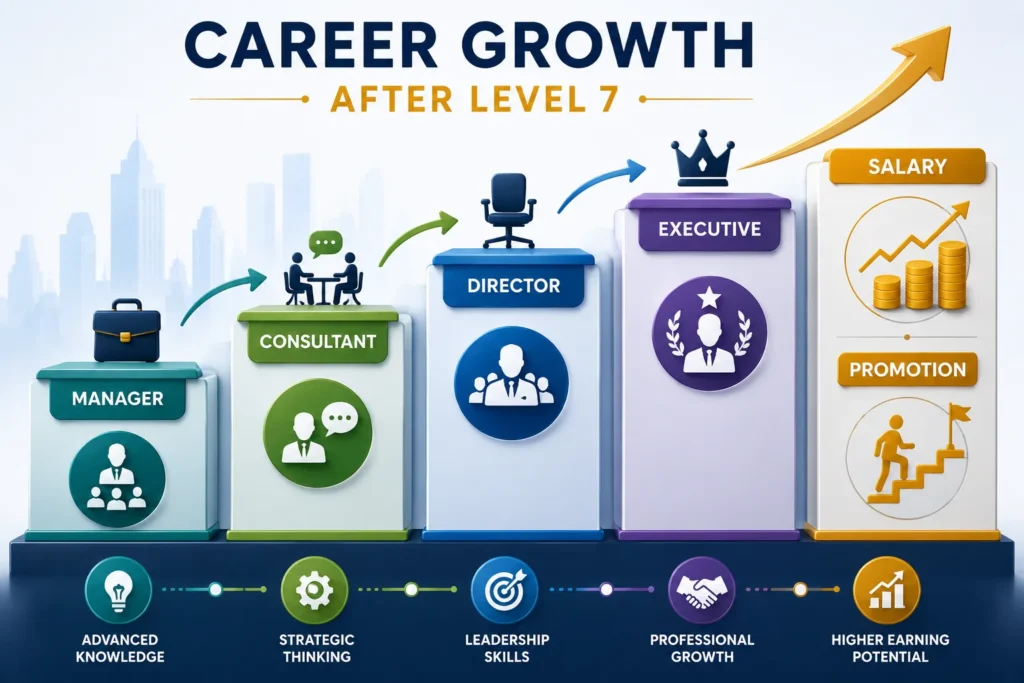
Indicative UK Salary Ranges
Although salaries vary by location, employer, and experience, professionals holding Level 7 qualifications often progress into higher-paying roles.
Table 5: Typical Career Paths and Salary Ranges
| Job Role | Typical UK Salary (Approx.) |
|---|---|
| Operations Manager | £45,000–£70,000 |
| Strategic Marketing Manager | £50,000–£85,000 |
| Financial Controller | £55,000–£90,000 |
| Business Consultant | £45,000–£80,000 |
| Compliance Manager | £50,000–£85,000 |
| Hospitality Operations Manager | £40,000–£70,000 |
| Project Manager | £45,000–£80,000 |
| HR Manager | £45,000–£75,000 |
| Risk Manager | £55,000–£90,000 |
| Programme Director | £70,000–£120,000+ |
These figures are indicative and can vary based on industry, region, qualifications, and professional experience.
The combination of advanced knowledge and leadership skills gained through Level 7 study often supports long-term salary growth and greater career mobility.
Who Should Study an RQF Level 7 Qualification?
An RQF Level 7 qualification is suitable for learners who want to move beyond technical expertise and develop strategic leadership capabilities. It is particularly valuable for professionals who are planning the next stage of their careers.
Level 7 may be the right choice for:
- Graduates seeking postgraduate-level qualifications.
- Professionals aiming for management or leadership roles.
- Individuals preparing for a Master’s Top-Up programme.
- Entrepreneurs who want stronger strategic business knowledge.
- Managers responsible for organisational decision-making.
- Specialists wishing to deepen expertise in a particular discipline.
- Professionals seeking career progression or promotion.
- International learners looking for a recognised UK qualification.
- Individuals planning a future doctorate or research qualification.
- Career changers entering senior professional roles.
Rather than focusing solely on academic achievement, Level 7 qualifications equip learners with practical leadership, analytical, and decision-making skills that can be applied across a wide range of industries.
Is an RQF Level 7 Qualification Recognised Internationally?
Yes. Although the Regulated Qualifications Framework (RQF) is a UK framework, many Level 7 qualifications are recognised internationally because they are awarded by respected UK awarding organisations and regulated by Ofqual.
Recognition may vary depending on local regulations and employer requirements, but Level 7 qualifications are widely valued in:
- United Kingdom
- United Arab Emirates (UAE)
- Saudi Arabia
- Qatar
- Oman
- Bahrain
- Kuwait
- Europe
- South Asia
- Africa
- Australia (subject to local recognition requirements)
International employers often value UK-regulated qualifications because they demonstrate consistent quality standards and advanced professional competence.
Choosing the Right RQF Level 7 Qualification
Selecting the right programme depends on career goals, previous qualifications, and the industry in which a learner wishes to progress.
The following decision guide can help.
Career Decision Flowchart
Do you want to progress into senior management?
│
┌─────────┴─────────┐
│ │
Yes No
│ │
Need industry-specific Looking for broader
leadership expertise? postgraduate study?
│ │
┌────┴────┐ ┌────┴────┐
│ │ │ │
Yes No Yes No
│ │ │ │
Choose a Consider Master’s Professional
Level 7 specialist Top-Up certification
Diploma programme pathway or CPD
This simple roadmap highlights that the best qualification is the one that aligns with long-term professional objectives rather than simply achieving a higher academic level.

Explore Level 7 Qualifications at Inspire College
If you are considering advancing your education with an RQF Level 7 qualification, Inspire College offers several recognised programmes designed to develop strategic leadership and specialist expertise.
Depending on your career aspirations, you may wish to explore:
Business and Marketing
Qualifi Level 7 Diploma in Strategic Marketing
Ideal for professionals who want to strengthen strategic marketing, brand management, customer engagement, and organisational growth.
Law
Qualifi Level 7 Diploma in Law
Designed for learners seeking advanced legal knowledge, critical analysis, and professional progression within legal and corporate environments.
Hospitality and Tourism
Qualifi Level 7 Diploma in Hospitality and Tourism Management
Suitable for professionals aiming to lead hospitality businesses, tourism organisations, and international service operations.
Accounting and Finance
OTHM Level 7 Diploma in Accounting and Finance
An excellent choice for finance professionals seeking advanced expertise in financial management, corporate governance, and strategic decision-making.
These programmes provide learners with industry-relevant knowledge while supporting progression into senior professional roles and further postgraduate study.
Why an RQF Level 7 Qualification Is a Valuable Investment
Higher education is more than obtaining a qualification—it is an investment in long-term career growth. An RQF Level 7 qualification provides advanced knowledge, leadership skills, and recognised professional credibility that can help learners stand out in a competitive employment market.
Key benefits include:
- Master’s-level learning without immediately committing to a full master’s degree.
- Improved career progression opportunities.
- Enhanced leadership and strategic management skills.
- Greater confidence in complex decision-making.
- Access to Master’s Top-Up programmes.
- Recognition by employers and universities.
- Development of transferable professional skills.
- Increased earning potential over time.
- Strong foundation for Level 8 doctoral study.
- Internationally respected UK-regulated qualification.
For many professionals, Level 7 represents the transition from operational responsibility to strategic leadership.
Conclusion
The Regulated Qualifications Framework Level 7 is one of the most respected stages within the UK education system, offering master’s-level learning that bridges academic excellence and professional practice. Whether a learner aims to move into senior management, specialise within a chosen industry, or continue towards a master’s or doctoral qualification, Level 7 provides a structured and recognised pathway for achieving those ambitions.
Unlike many qualifications that focus primarily on theoretical knowledge, RQF Level 7 combines advanced academic understanding with practical leadership, critical thinking, and real-world problem-solving skills. This combination makes it valuable to employers across sectors including business, law, finance, healthcare, hospitality, education, engineering, and public administration.
Choosing an Ofqual-regulated Level 7 qualification also gives learners confidence that their studies meet nationally recognised quality standards while enhancing opportunities for career progression, postgraduate education, and international recognition.
As industries continue to evolve and demand stronger leadership capabilities, professionals with Level 7 qualifications are well positioned to drive organisational success, adapt to change, and make informed strategic decisions. For those seeking meaningful career advancement, an RQF Level 7 qualification is not simply the next academic step—it is a long-term investment in professional growth, leadership potential, and lifelong learning.