
Regulated Qualifications Framework Level 4 Explained: A Complete Guide to Career Success
The Regulated Qualifications Framework (RQF) Level 4 is an important step for learners who want to progress beyond Level 3 qualifications and develop the knowledge, practical skills, and professional competence required for higher education or career advancement. Whether the goal is securing a better job, specialising in a chosen industry, or progressing to RQF Level 5 and beyond, Level 4 provides a recognised pathway that supports long-term academic and professional success.
Many people searching for Regulated Qualifications Framework Level 4 want answers to questions such as: What is RQF Level 4 equivalent to? Is it the same as the first year of a bachelor’s degree? What careers can it lead to? Is it recognised by employers? Understanding these questions is essential because choosing the right qualification can significantly influence future education and employment opportunities.
Unlike many online resources that only provide a brief definition, this comprehensive guide explains how the RQF works, where Level 4 fits within the UK qualification framework, its benefits, progression routes, employer recognition, and why it has become one of the most valuable qualification levels for career development.
Whether a learner is planning to study business, law, logistics, construction, engineering, education, or another professional field, understanding RQF Level 4 is the first step towards making an informed educational decision.
What Is the Regulated Qualifications Framework (RQF)?
The Regulated Qualifications Framework (RQF) is the official system used in England and Northern Ireland to classify regulated qualifications according to their level of difficulty and learning outcomes.
Instead of measuring qualifications solely by the number of study hours, the RQF focuses on the knowledge, understanding, and practical skills a learner is expected to demonstrate after completing a qualification successfully.
The framework enables universities, employers, professional bodies, and awarding organisations to compare qualifications consistently while ensuring they meet recognised national standards.
The RQF is regulated by Ofqual (Office of Qualifications and Examinations Regulation), which maintains quality, consistency, and public confidence in regulated qualifications.
Quick Answer
Regulated Qualifications Framework Level 4 is an advanced qualification level equivalent to the first year of a bachelor’s degree, a Higher National Certificate (HNC), or a Certificate of Higher Education (CertHE). It develops specialist knowledge, practical skills, and professional competence while preparing learners for employment or progression to RQF Level 5 qualifications.
Why Does the Regulated Qualifications Framework Matter?
The Regulated Qualifications Framework provides a clear and structured pathway that supports lifelong learning and professional development.
Its importance includes:
- Establishes nationally recognised qualification standards.
- Helps employers understand qualification levels.
- Supports progression between vocational and academic learning.
- Enables comparison between qualifications from different awarding organisations.
- Improves international recognition of UK qualifications.
- Creates clear learning pathways from Entry Level through Level 8.
Because RQF qualifications are regulated, employers and universities can confidently recognise the level of knowledge and skills a learner has achieved.
Understanding the Regulated Qualifications Framework Levels
The RQF consists of Entry Level followed by Levels 1 to 8. Each level represents increasing complexity, independence, responsibility, and depth of learning.
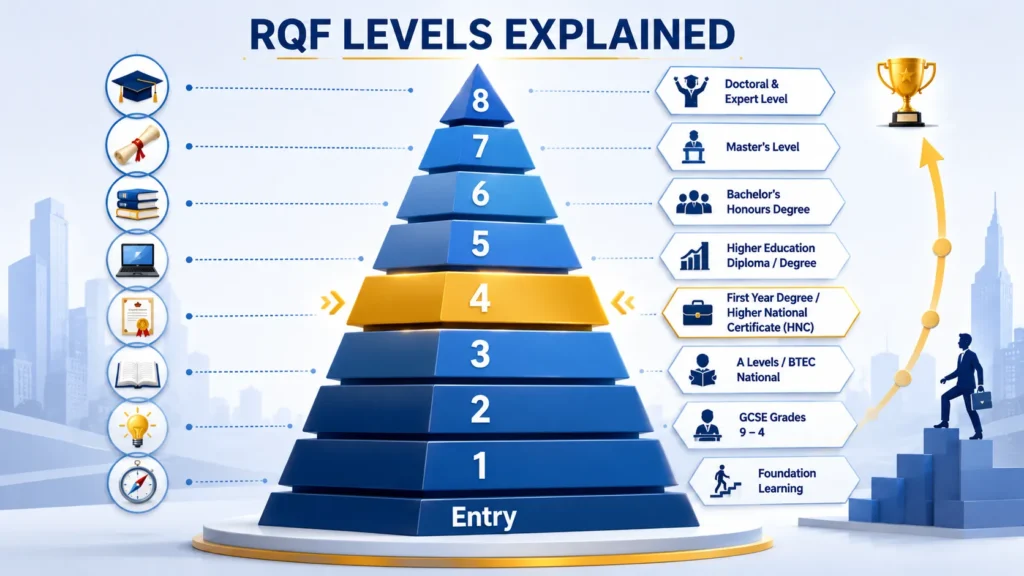
Table 1: Regulated Qualifications Framework Levels
| RQF Level | Typical Qualification | Academic Equivalent | Learning Focus |
|---|---|---|---|
| Entry Level | Entry Certificates | Foundation Learning | Basic knowledge and skills |
| Level 1 | GCSE (Grades 3–1) | Introductory | Fundamental learning |
| Level 2 | GCSE (Grades 9–4) | Intermediate | Practical competence |
| Level 3 | A Levels, BTEC National | Advanced | Preparation for higher education |
| Level 4 | Higher National Certificate (HNC), Certificate of Higher Education (CertHE), Professional Diploma | First Year of Undergraduate Study | Advanced technical knowledge and workplace skills |
| Level 5 | Foundation Degree, HND | Second-Year Undergraduate | Professional expertise |
| Level 6 | Bachelor’s Degree (Honours) | Undergraduate Honours | Specialist knowledge |
| Level 7 | Master’s Degree, Postgraduate Diploma | Postgraduate | Strategic leadership |
| Level 8 | Doctorate (PhD) | Doctoral | Research and innovation |
This framework enables learners to progress systematically while continuously developing their knowledge, technical competence, and professional expertise.
Where Does RQF Level 4 Fit?
RQF Level 4 sits immediately above Level 3 qualifications, such as A Levels and BTEC Nationals, and below RQF Level 5 qualifications.
It represents the transition from advanced school-level education to higher education and professional learning.
At this stage, learners begin developing:
- Independent learning habits.
- Industry-specific knowledge.
- Practical workplace skills.
- Analytical thinking.
- Professional communication.
- Problem-solving abilities.
Unlike Level 3, which focuses primarily on preparing learners for university or employment, Level 4 introduces more specialised knowledge and greater responsibility for independent study.
What Is RQF Level 4?
An RQF Level 4 qualification is designed for learners who want to develop advanced technical knowledge and practical skills within a specific subject or profession.
It combines academic learning with real-world application, helping learners prepare for professional employment or further study.
Typical Level 4 qualifications include:
- Higher National Certificate (HNC)
- Certificate of Higher Education (CertHE)
- Professional Diplomas
- Higher Apprenticeships
- Level 4 NVQs
- Industry-specific Level 4 Diplomas
These qualifications are available across numerous industries, including:
- Business Management
- Law
- Logistics
- Construction
- Engineering
- Healthcare
- Education
- Cyber Security
- Hospitality
- Community Development
- Information Technology
Because of this flexibility, RQF Level 4 is suitable for learners with diverse career ambitions.
Why Choose an RQF Level 4 Qualification?
An RQF Level 4 qualification offers more than academic recognition—it provides practical skills that employers actively seek.
Key benefits include:
- Builds advanced technical knowledge.
- Improves employability.
- Supports career progression.
- Develops professional confidence.
- Encourages independent learning.
- Provides progression to Level 5 qualifications.
- Enhances workplace competence.
- Supports lifelong professional development.
Whether a learner plans to enter employment immediately or continue studying, Level 4 creates a strong foundation for future success.
Key Characteristics of RQF Level 4 Qualifications
Compared with lower qualification levels, Level 4 places greater emphasis on applying knowledge to practical situations and solving professional challenges.
Typical learning outcomes include:
- Critical analysis of workplace situations.
- Application of theoretical knowledge.
- Professional communication.
- Independent research.
- Project planning.
- Problem-solving.
- Ethical decision-making.
- Team collaboration.
- Digital literacy.
- Continuous professional development.
These learning outcomes help prepare learners for both higher education and increasingly responsible workplace roles.
Table 2: Key Features of RQF Level 4
| Feature | Description |
|---|---|
| Academic Level | First-Year Undergraduate |
| Difficulty | Advanced |
| Learning Focus | Technical knowledge and professional skills |
| Typical Learners | Level 3 graduates and working professionals |
| Assessment Methods | Assignments, projects, reports, presentations, case studies |
| Career Outcome | Professional employment and career development |
| Further Progression | RQF Level 5 qualifications |
Unlike introductory qualifications, Level 4 encourages learners to become more independent while developing practical knowledge that can be applied immediately within professional environments.
How Learners Progress Through the RQF
One of the greatest strengths of the Regulated Qualifications Framework is its structured progression pathway, enabling learners to continue building their knowledge throughout their careers.
Learning Progression Flowchart
Entry Level
↓
Level 1
↓
Level 2
↓
Level 3
↓
⭐ RQF Level 4
↓
Level 5
↓
Level 6
↓
Level 7
↓
Level 8
This structured progression allows learners to move confidently from foundational education to advanced professional qualifications and postgraduate study.
Why Employers Value RQF Level 4 Qualifications
Modern employers increasingly seek professionals who can combine technical knowledge with practical workplace skills.
An RQF Level 4 qualification demonstrates that a learner has progressed beyond basic education and can contribute effectively within a professional environment.
Employers often associate Level 4 graduates with:
- Strong communication skills.
- Practical problem-solving.
- Professional competence.
- Independent working.
- Critical thinking.
- Team collaboration.
- Adaptability.
- Continuous learning.
These qualities are valuable across industries such as business, law, logistics, engineering, education, healthcare, construction, cyber security, hospitality, and public services.
An RQF Level 4 qualification not only improves employability but also provides a strong foundation for future leadership and specialist roles.
Is RQF Level 4 Equivalent to the First Year of a Bachelor’s Degree?
One of the most frequently asked questions about Regulated Qualifications Framework (RQF) Level 4 is whether it is equivalent to the first year of a bachelor’s degree.
The answer is yes. An RQF Level 4 qualification is academically equivalent to the first year of an undergraduate degree in terms of learning level. However, equivalent does not mean identical.
A university bachelor’s degree follows a structured academic programme leading to an honours qualification, whereas an RQF Level 4 Diploma, HNC, or CertHE may be awarded by an Ofqual-recognised awarding organisation and often focuses on developing practical workplace competence alongside academic knowledge.
Both qualification routes demonstrate that learners have reached the same level of learning, analytical ability, and professional understanding expected at Level 4.
For employers, the most important consideration is whether the qualification is regulated, recognised, and relevant to the role.
Quick Answer
RQF Level 4 is equivalent to the first year of a bachelor’s degree, a Higher National Certificate (HNC), and a Certificate of Higher Education (CertHE). It develops advanced knowledge and practical skills while providing progression to RQF Level 5 qualifications or professional employment.
Types of RQF Level 4 Qualifications
RQF Level 4 includes several qualification types designed for different educational and career objectives.
Higher National Certificate (HNC)
The Higher National Certificate (HNC) is a vocational qualification that combines technical knowledge with practical workplace skills. It is highly valued by employers and often leads to employment or progression to an HND or bachelor’s degree.
Certificate of Higher Education (CertHE)
A Certificate of Higher Education (CertHE) is an academic qualification representing the first year of undergraduate study. Many learners use it as a pathway towards completing a full bachelor’s degree.
Professional Diplomas
Professional Level 4 Diplomas are available across many industries, including business, law, logistics, healthcare, education, engineering, and information technology. These qualifications emphasise career-focused learning and workplace application.
Higher Apprenticeships
Higher Apprenticeships combine employment with structured learning, enabling learners to gain recognised qualifications while developing practical experience in the workplace.
Level 4 NVQs
National Vocational Qualifications (NVQs) at Level 4 assess occupational competence within professional work environments and are particularly valuable for experienced practitioners.
Each qualification type supports different career pathways while remaining aligned with the same Level 4 learning standard.
Level 3 vs Level 4 vs Level 5
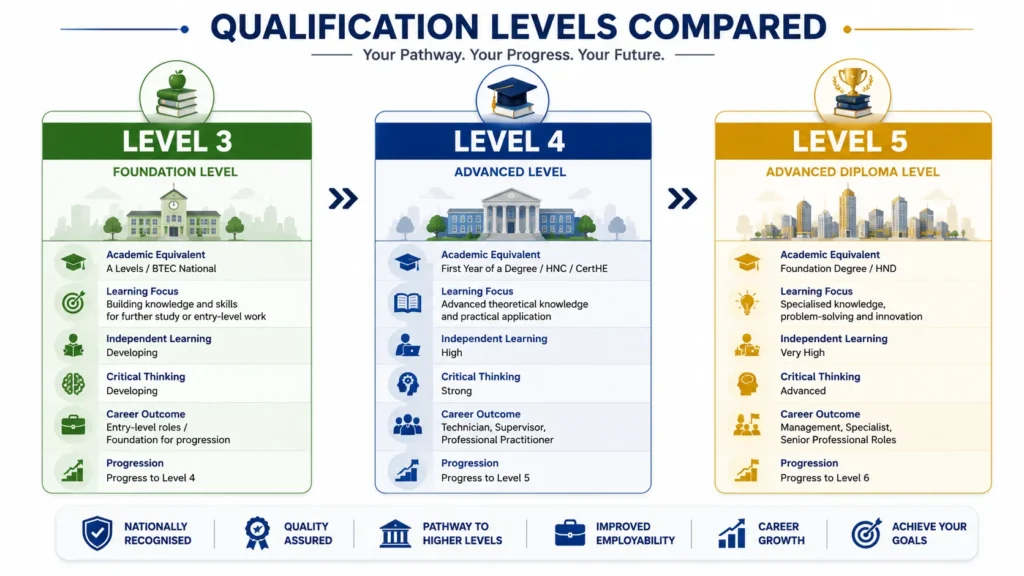
Understanding how these qualification levels compare helps learners choose the most appropriate progression route.
Table 3: Level 3 vs Level 4 vs Level 5 Comparison
| Feature | Level 3 | Level 4 | Level 5 |
|---|---|---|---|
| Academic Equivalent | A Levels / BTEC National | First-Year Undergraduate | Foundation Degree / HND |
| Learning Focus | Preparation for higher education | Advanced technical and professional learning | Advanced professional expertise |
| Independent Learning | Moderate | High | Very High |
| Critical Thinking | Developing | Strong | Advanced |
| Typical Qualifications | A Levels, BTEC, NVQ Level 3 | HNC, CertHE, Professional Diploma | Foundation Degree, HND, Level 5 Diploma |
| Career Outcome | Entry-level employment | Technician, Supervisor, Professional Practitioner | Professional and Management Roles |
| Progression | Level 4 | Level 5 | Level 6 |
As learners move from Level 3 to Level 5, expectations increase significantly. Level 4 introduces independent study, professional responsibility, and industry-specific expertise that prepare learners for more advanced education and employment.
Credits, TQT and GLH Explained
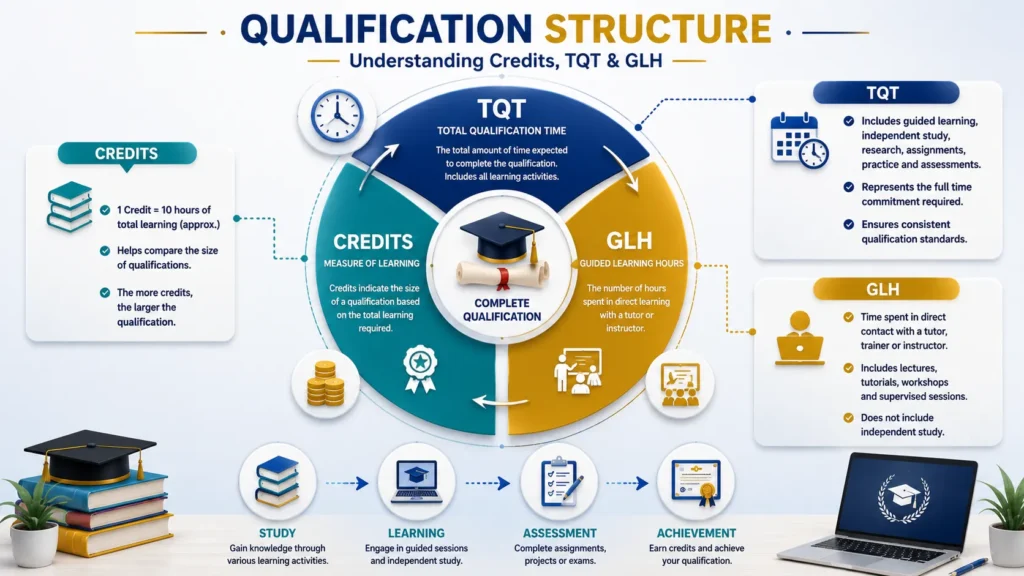
When researching Level 4 qualifications, learners frequently encounter terms such as Credits, Total Qualification Time (TQT), and Guided Learning Hours (GLH). Understanding these measurements helps compare qualifications offered by different awarding organisations.
Credits
Credits measure the overall volume of learning required for a qualification.
As a general guide:
- One credit represents approximately 10 hours of total learning.
- Qualifications with more credits generally involve broader learning outcomes and greater study requirements.
Credits provide a simple way to compare different qualifications within the RQF.
Total Qualification Time (TQT)
Total Qualification Time estimates the overall time required to complete a qualification successfully.
It includes:
- Classroom learning
- Online learning
- Independent study
- Reading and research
- Assignments
- Practical activities
- Assessment preparation
TQT helps learners understand the full commitment required to complete a qualification.
Guided Learning Hours (GLH)
Guided Learning Hours represent the time spent receiving direct support from tutors or trainers.
Examples include:
- Classroom lessons
- Online lectures
- Tutorials
- Workshops
- Practical demonstrations
Unlike TQT, GLH does not include independent study completed outside guided sessions.
Understanding these terms enables learners to compare programmes accurately and select one that matches their available study time.
What Does Ofqual Do?
Many learners notice the phrase “Ofqual Regulated” but are unsure why it matters.
Ofqual (Office of Qualifications and Examinations Regulation) is the independent regulator responsible for maintaining the quality and standards of regulated qualifications in England.
Its responsibilities include:
- Regulating awarding organisations.
- Monitoring qualification standards.
- Ensuring fair and reliable assessment.
- Protecting learner interests.
- Maintaining employer confidence.
- Supporting national consistency.
Choosing an Ofqual-regulated qualification provides confidence that the qualification meets recognised UK quality standards.
Who Awards RQF Level 4 Qualifications?
The Regulated Qualifications Framework does not issue qualifications directly. Instead, regulated qualifications are developed and awarded by recognised organisations approved by Ofqual.
Well-known awarding organisations include:
- Qualifi
- OTHM
- ABMA Education
- ProQual
- Pearson
- ATHE
- NCFE
- City & Guilds
- CMI (Chartered Management Institute)
- ILM (Institute of Leadership & Management)
Each awarding organisation specialises in different sectors while ensuring qualifications meet nationally recognised standards.
Skills Developed Through RQF Level 4
An RQF Level 4 qualification develops a broad range of transferable professional skills that support both employment and further study.
Key skills include:
Communication
Learners strengthen written, verbal, and professional communication skills that are essential in modern workplaces.
Critical Thinking
Level 4 encourages learners to evaluate information, identify problems, and make informed decisions.
Problem-Solving
Assignments and case studies develop practical approaches to resolving workplace challenges.
Research
Independent research improves analytical thinking while preparing learners for higher-level study.
Teamwork
Many Level 4 programmes encourage collaborative learning and professional cooperation.
Leadership
Learners begin developing supervisory and leadership capabilities appropriate for professional environments.
Digital Literacy
Modern qualifications often include the use of digital tools, online resources, and workplace technologies.
Professional Practice
Practical application of knowledge ensures learners are prepared for real workplace responsibilities.
These skills remain valuable across numerous industries and support continuous professional development.
Industries That Value RQF Level 4 Qualifications
Because Level 4 combines academic knowledge with practical workplace competence, it is recognised across a wide variety of industries.
Common sectors include:
- Business Management
- Law
- Shipping and Logistics
- Construction
- Engineering
- Education
- Healthcare
- Hospitality
- Information Technology
- Cyber Security
- Community Development
- Manufacturing
- Public Administration
- Finance
- Environmental Management
This broad industry recognition makes RQF Level 4 an excellent choice for learners seeking flexible career opportunities.
Career Progression Roadmap
One of the biggest advantages of an RQF Level 4 qualification is the opportunity it provides for both career advancement and continued education.
Career Progression Flowchart
Level 3 Qualification
↓
RQF Level 4
↓
Professional Employment
↓
Career Development
↓
RQF Level 5
↓
Management
↓
Senior Leadership
This progression pathway demonstrates how Level 4 serves as an important stepping stone towards higher qualifications, greater workplace responsibility, and long-term career success.
Why Employers Continue to Value Level 4 Professionals
Employers increasingly need professionals who can apply knowledge effectively while adapting to changing workplace demands.
An RQF Level 4 qualification demonstrates that a learner can:
- Apply technical knowledge in professional settings.
- Work independently with minimal supervision.
- Solve workplace challenges effectively.
- Communicate professionally.
- Contribute to organisational objectives.
- Continue progressing through higher-level qualifications.
These capabilities make Level 4 graduates valuable across numerous industries and provide a strong foundation for future professional growth.
Career Opportunities After Completing an RQF Level 4 Qualification
Completing an RQF Level 4 qualification demonstrates that a learner has developed advanced technical knowledge, practical workplace skills, and the ability to perform independently in professional environments. These qualities are highly valued by employers across a wide range of industries.
Depending on the chosen subject area, an RQF Level 4 qualification can open the door to supervisory, technical, and specialist roles while also providing a strong foundation for future career progression.
Popular career opportunities include:
- Business Executive
- Business Development Officer
- Logistics Coordinator
- Supply Chain Supervisor
- Legal Executive
- Compliance Officer
- Operations Supervisor
- Project Coordinator
- Office Manager
- Team Leader
- Customer Success Manager
- Procurement Officer
- Transport Planner
- Warehouse Operations Supervisor
- Administrative Manager
- Sales Executive
- HR Officer
- Facilities Coordinator
- Training Coordinator
- Public Sector Officer
Many learners use Level 4 as a stepping stone into professional employment before progressing to RQF Level 5 and eventually senior management positions.
Indicative UK Salary Ranges
Salary expectations vary depending on industry, employer, location, and experience. However, an RQF Level 4 qualification can improve earning potential by preparing learners for more skilled and responsible roles.
Table 4: Career Opportunities and Indicative UK Salaries
| Career Role | Typical UK Salary (Approx.) |
|---|---|
| Business Executive | £28,000–£45,000 |
| Business Development Officer | £30,000–£50,000 |
| Logistics Coordinator | £30,000–£45,000 |
| Supply Chain Supervisor | £32,000–£50,000 |
| Legal Executive | £32,000–£50,000 |
| Compliance Officer | £32,000–£50,000 |
| Operations Supervisor | £30,000–£48,000 |
| Project Coordinator | £30,000–£45,000 |
| Office Manager | £30,000–£48,000 |
| Procurement Officer | £32,000–£50,000 |
Salary ranges are indicative only and may vary depending on industry, employer, location, experience, and additional qualifications.
As professionals gain workplace experience and continue progressing through the RQF, salary potential generally increases.
Who Should Study an RQF Level 4 Qualification?
An RQF Level 4 qualification is suitable for learners who want to strengthen their professional knowledge, improve employability, or prepare for higher-level study.
It is particularly beneficial for:
- Learners progressing from Level 3 qualifications.
- Professionals seeking promotion into supervisory roles.
- Individuals changing careers.
- School or college graduates entering higher education.
- Business owners wanting stronger management skills.
- Professionals preparing for RQF Level 5.
- Learners seeking recognised UK qualifications.
- International learners looking for globally respected education.
- Individuals pursuing continuous professional development.
- Professionals aiming to improve long-term career prospects.
Selecting the right Level 4 qualification should be based on career objectives, industry requirements, and future progression plans.
Is an RQF Level 4 Qualification Recognised Internationally?
Yes. Although the Regulated Qualifications Framework (RQF) is a UK qualification framework, many Level 4 qualifications awarded by Ofqual-recognised awarding organisations are respected internationally.
These qualifications are commonly recognised by employers, colleges, universities, and professional organisations in countries including:
- United Kingdom
- United Arab Emirates (UAE)
- Saudi Arabia
- Qatar
- Oman
- Bahrain
- Kuwait
- European countries
- South Asia
- Africa
- Australia (subject to local recognition requirements)
Recognition may vary according to local regulations and institutional policies, but UK-regulated qualifications are widely respected for their quality and consistency.
Choosing the Right RQF Level 4 Qualification
Choosing the most suitable qualification depends on personal interests, career aspirations, and the industry in which a learner wishes to develop expertise.
Qualification Decision Flowchart
Completed Level 3?
│
┌────┴────┐
│ │
Yes No
│
Choose Your Career Goal
│
┌──────┼──────────────┐
│ │ │
Business Law Shipping & Logistics
│ │ │
Choose an RQF Level 4 Qualification
│
Employment or Progression to Level 5
This simple roadmap helps learners identify a qualification that supports both immediate employment opportunities and future academic progression.

Explore RQF Level 4 Qualifications at Inspire College
Inspire College offers a range of RQF Level 4 qualifications designed to develop advanced professional knowledge, practical workplace skills, and industry-specific expertise.
Business Management
Qualifi Level 4 Diploma in Business Management
Develop practical management, organisational leadership, communication, and decision-making skills that prepare learners for modern business environments.
Law
Qualifi Level 4 Diploma in Law
Build a strong foundation in legal principles, professional practice, and legal systems while preparing for higher-level legal study and career progression.
Shipping and Logistics
ABMA Level 4 Diploma in Shipping and Logistics (RQF)
Develop specialist knowledge in shipping operations, logistics management, supply chain processes, and international trade within one of the world’s fastest-growing industries.
These qualifications combine academic learning with practical workplace application, helping learners build recognised skills that employers value across multiple sectors.
Why an RQF Level 4 Qualification Is a Smart Investment
An RQF Level 4 qualification offers more than an educational credential—it provides a strong platform for career development, professional confidence, and lifelong learning.
Key benefits include:
- Nationally recognised UK qualification.
- Equivalent to the first year of undergraduate study.
- Strong progression pathway to RQF Level 5.
- Improved employability across multiple industries.
- Development of advanced technical and professional skills.
- Greater confidence in workplace decision-making.
- Better promotion opportunities.
- Practical knowledge that can be applied immediately.
- Enhanced earning potential.
- Flexible progression into higher education and professional qualifications.
For learners who want to strengthen their careers while maintaining flexibility for future study, RQF Level 4 is an excellent investment.
Conclusion
The Regulated Qualifications Framework Level 4 represents an important milestone in higher education and professional development. Equivalent to the first year of a bachelor’s degree, an HNC, or a Certificate of Higher Education (CertHE), it equips learners with the technical knowledge, practical skills, and professional competence required to succeed in today’s competitive job market.
Whether a learner wants to begin a professional career, gain specialist expertise, or continue towards RQF Level 5 and beyond, Level 4 provides a recognised and flexible pathway for long-term success.
Unlike qualifications that focus solely on theory, RQF Level 4 combines academic learning with practical application, preparing learners to solve workplace challenges, contribute confidently within organisations, and continue progressing throughout their careers.
For learners seeking a respected UK qualification that supports career growth, academic progression, and lifelong professional development, an RQF Level 4 qualification is a valuable investment in future success.