
Ultimate Regulated Qualifications Framework Level 1 Guide: Qualifications, Career Success & Future Opportunities
Starting your educational journey or developing new workplace skills begins with choosing the right qualification. In the UK, qualifications are organised through the Regulated Qualifications Framework (RQF), making it easier for learners, employers, universities, and training providers to understand qualification levels and progression pathways.
One of the most important starting points within this framework is Regulated Qualifications Framework Level 1. Designed for beginners and individuals developing fundamental knowledge and practical skills, RQF Level 1 provides the confidence and competence needed to progress towards higher qualifications, apprenticeships, and employment opportunities.
Whether you are leaving school, returning to education after a break, changing careers, or looking to improve your workplace skills, an RQF Level 1 qualification can provide a solid foundation for long-term academic and professional success.
Although many websites explain the Regulated Qualifications Framework in general, very few focus specifically on Regulated Qualifications Framework Level 1. This comprehensive guide explores everything learners need to know about Level 1 qualifications, including how the framework works, qualification types, who should study at this level, career opportunities, progression routes, employer benefits, and future learning pathways.
By the end of this guide, you will have a clear understanding of how Regulated Qualifications Framework Level 1 can support your educational journey, improve your employability, and open the door to lifelong learning and career development.
What Is the Regulated Qualifications Framework (RQF)?
The Regulated Qualifications Framework (RQF) is the official system used in England and Northern Ireland to classify regulated qualifications according to their level of difficulty and expected learning outcomes. It provides a consistent structure that enables learners, employers, universities, and training providers to compare qualifications offered by different awarding organisations.
Rather than measuring qualifications solely by the amount of study time involved, the RQF focuses on the knowledge, understanding, and practical skills that learners are expected to demonstrate after successfully completing a qualification.
The framework is regulated by Ofqual (Office of Qualifications and Examinations Regulation), the independent regulator responsible for maintaining qualification standards in England. Qualifications that are regulated by Ofqual are recognised nationally and are trusted by employers, education providers, and professional organisations.
The RQF covers qualifications across a broad range of industries and disciplines, including:
- Business and Management
- Health and Social Care
- Education and Training
- Construction
- Engineering
- Information Technology
- Fire Safety
- Health and Safety
- Hospitality and Tourism
- Customer Service
- Leadership and Management
- Quality Assurance and Quality Control
Each qualification is assigned an RQF level that reflects the complexity of learning, making it easier for learners to understand progression opportunities and choose qualifications that align with their career aspirations.
Understanding Regulated Qualifications Framework Level 1
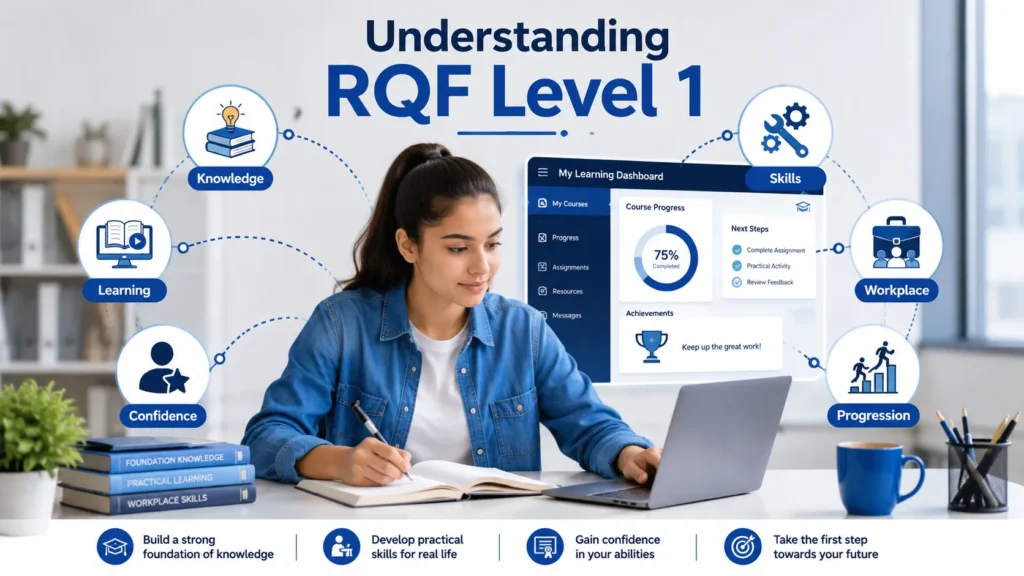
Regulated Qualifications Framework Level 1 is designed for learners who are beginning to develop subject knowledge, practical skills, and workplace confidence. It introduces learners to the fundamental concepts required for further education, vocational training, apprenticeships, and entry-level employment.
Unlike Entry Level qualifications, which focus on basic learning, RQF Level 1 requires learners to demonstrate greater independence, apply knowledge to simple tasks, and develop practical competence within structured learning environments.
Level 1 qualifications provide an excellent starting point for individuals who have limited previous qualifications or who wish to build confidence before progressing to more advanced levels.
Key Characteristics of Regulated Qualifications Framework Level 1
Learners completing an RQF Level 1 qualification are typically expected to:
- Develop basic subject knowledge.
- Apply learning to straightforward practical situations.
- Complete routine tasks with guidance where required.
- Build confidence in workplace and learning environments.
- Improve communication and teamwork skills.
- Demonstrate responsibility for their own learning.
- Develop problem-solving abilities appropriate to their level.
- Prepare for progression to RQF Level 2 qualifications.
Because these qualifications combine knowledge with practical application, they provide a valuable starting point for lifelong learning and career development.
Understanding the Regulated Qualifications Framework Levels
The Regulated Qualifications Framework provides a clear progression pathway from introductory learning through to doctoral-level qualifications. Each level represents increasing knowledge, skills, responsibility, and professional competence.
| RQF Level | Typical Equivalent | Primary Learning Focus | Typical Progression |
|---|---|---|---|
| Entry Level | Entry Certificates | Foundation skills | Level 1 |
| Level 1 | GCSE Grades 3–1 (D–G) | Basic knowledge and practical skills | Level 2, Apprenticeships, Employment |
| Level 2 | GCSE Grades 9–4 (A*–C) | Intermediate knowledge | Level 3 |
| Level 3 | A Levels, BTEC Nationals, NVQ Level 3 | Advanced knowledge | Level 4 |
| Level 4 | Higher National Certificate (HNC) | Specialist technical knowledge | Level 5 |
| Level 5 | Higher National Diploma (HND), Foundation Degree | Higher professional competence | Level 6 |
| Level 6 | Bachelor’s Degree | Advanced academic knowledge | Level 7 |
| Level 7 | Master’s Degree | Strategic expertise | Level 8 |
| Level 8 | Doctorate (PhD) | Research and innovation | Professional practice |
Understanding this progression helps learners plan long-term educational and career pathways with confidence.
Why Is Regulated Qualifications Framework Level 1 Important?
Every successful career begins with a strong foundation. RQF Level 1 qualifications provide that foundation by helping learners build essential knowledge, workplace behaviours, and transferable skills that can be developed further through higher-level qualifications and professional experience.
For many learners, Level 1 represents the first recognised step towards achieving career goals. It encourages confidence, independence, and practical competence while introducing learners to industry expectations and professional standards.
Employers also value Level 1 because it demonstrates that candidates have developed the basic skills required to learn, communicate effectively, and contribute positively within workplace environments.
Benefits of Completing Regulated Qualifications Framework Level 1
Completing an RQF Level 1 qualification offers numerous advantages, including:
- Builds confidence in learning and employment.
- Develops practical workplace skills.
- Improves communication and teamwork.
- Creates a pathway to Level 2 qualifications.
- Supports entry into apprenticeships.
- Enhances employability.
- Develops responsibility and independence.
- Encourages lifelong learning.
- Introduces industry-specific knowledge.
- Provides nationally recognised qualifications.
These benefits make Level 1 an excellent starting point for learners who want to progress academically or professionally.
Who Should Study Regulated Qualifications Framework Level 1?
One of the greatest strengths of RQF Level 1 is its accessibility. These qualifications are designed to support learners with different educational backgrounds, learning experiences, and career aspirations.
Regulated Qualifications Framework Level 1 may be suitable for:
- School leavers beginning their learning journey.
- Individuals progressing from Entry Level qualifications.
- Adults returning to education after a break.
- Career changers developing new skills.
- Job seekers improving employability.
- Apprentices preparing for vocational training.
- International learners studying UK-recognised qualifications.
- Individuals improving English or mathematics skills.
- Learners building confidence before studying Level 2.
- Professionals wishing to gain introductory knowledge in a new subject.
Because Level 1 qualifications are available across numerous industries, learners can choose programmes that align with their interests and long-term career goals.
Types of Regulated Qualifications Framework Level 1 Qualifications
The RQF provides flexibility by offering Level 1 qualifications in several different formats. Although these qualifications are all positioned at Level 1, they differ in size, depth, and intended purpose.
Level 1 Award
An Award is typically the smallest qualification at Level 1. It focuses on introducing specific knowledge or practical skills and is suitable for learners seeking Continuing Professional Development (CPD), compliance training, or an introduction to a new subject.
Level 1 Certificate
A Certificate provides broader coverage than an Award and develops both theoretical understanding and practical competence. Certificates are ideal for learners preparing for employment or progression to Level 2.
Level 1 Diploma
A Diploma offers more comprehensive learning by covering multiple subject areas in greater depth. It prepares learners for vocational careers, apprenticeships, or further education.
Other Common Level 1 Qualifications
Learners may also encounter:
- NVQ Level 1
- Functional Skills Level 1
- Vocational Certificates
- Technical Qualifications
- Foundation Learning Programmes
These qualifications all contribute towards developing the essential knowledge and practical skills required for further learning and employment.
Regulated Qualifications Framework Level 1 vs Entry Level
Many learners wonder whether they should study Entry Level or progress directly to Level 1. While both are designed for learners developing foundational skills, Level 1 introduces greater independence and prepares learners for vocational and academic progression.
| Feature | Entry Level | RQF Level 1 |
|---|---|---|
| Learning Difficulty | Foundation | Beginner |
| Knowledge Required | Very basic | Basic understanding |
| Practical Skills | Simple activities | Structured practical tasks |
| Independence | High level of support | Increasing independence |
| Progression | Level 1 | Level 2 |
| Workplace Readiness | Initial preparation | Entry-level competence |
For many learners, Level 1 represents the first significant step towards recognised qualifications and long-term career development.
Why Employers Value Regulated Qualifications Framework Level 1
Although Level 1 is an introductory qualification, employers recognise its importance because it demonstrates a learner’s commitment to education, personal development, and workplace readiness.
Beyond technical knowledge, Level 1 qualifications help learners develop essential transferable skills that are valuable across almost every industry.
These include:
- Communication
- Teamwork
- Time management
- Reliability
- Organisation
- Customer service
- Health and safety awareness
- Digital literacy
- Problem-solving
- Professional behaviour
These competencies provide a strong platform for progression into Level 2 qualifications, apprenticeships, and entry-level employment while supporting long-term career growth.
Regulated Qualifications Framework Level 1 vs GCSE
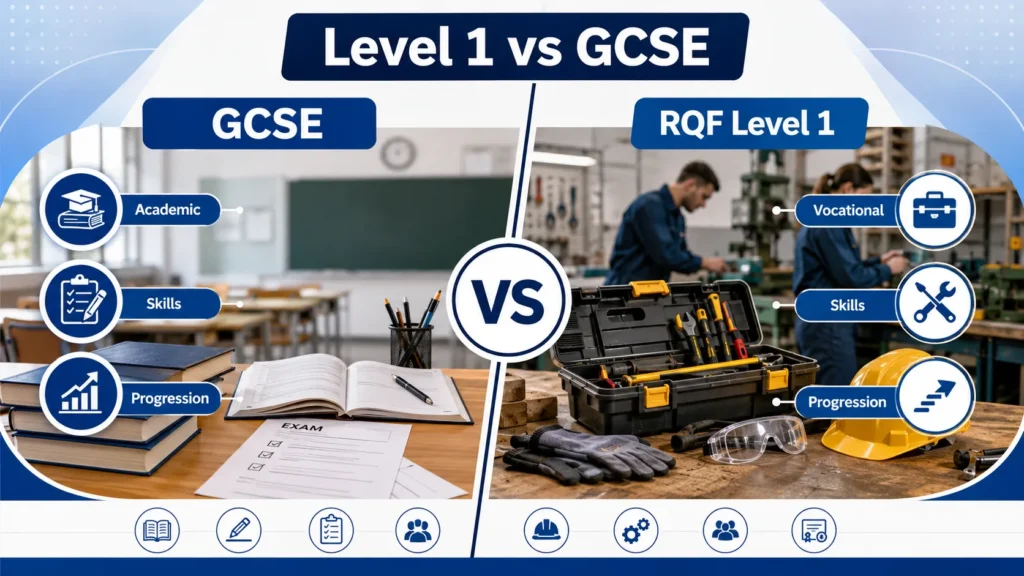
One of the most common questions learners ask is whether a Regulated Qualifications Framework Level 1 qualification is the same as a GCSE. While many Level 1 qualifications are broadly comparable to GCSE Grades 3–1 (previously D–G) in terms of learning level, they are not identical in content, teaching methods, or assessment.
GCSEs generally focus on academic subjects and prepare learners for further education, whereas many RQF Level 1 qualifications emphasise practical skills, workplace readiness, and vocational learning.
For learners who prefer hands-on learning or wish to enter employment sooner, an RQF Level 1 qualification can provide an excellent alternative pathway.
RQF Level 1 vs GCSE Comparison
| Feature | RQF Level 1 | GCSE |
|---|---|---|
| Learning Style | Vocational and practical | Mainly academic |
| Assessment | Assignments, portfolios, practical tasks, projects | Mostly written examinations |
| Skills Focus | Workplace skills and practical competence | Subject knowledge and academic understanding |
| Best For | Career preparation and progression | Academic progression |
| Progression | RQF Level 2, apprenticeships, employment | Level 2 or Level 3 qualifications |
The right choice depends on the learner’s goals, preferred learning style, and future career plans.
Career Opportunities After Completing a Regulated Qualifications Framework Level 1 Qualification
An RQF Level 1 qualification is often the first recognised step towards employment. While many learners continue to Level 2, others use Level 1 to secure entry-level roles and gain valuable workplace experience.
Employers appreciate candidates who possess recognised qualifications because they demonstrate commitment, reliability, and a willingness to develop professionally.
Depending on the chosen subject, Level 1 can support entry into various industries.
Career Opportunities
| Industry | Example Job Roles | Future Progression |
|---|---|---|
| Business Administration | Office Assistant, Reception Assistant | Administrator, Office Supervisor |
| Customer Service | Customer Service Assistant | Customer Service Advisor, Team Leader |
| Retail | Retail Assistant, Sales Assistant | Store Supervisor, Retail Manager |
| Hospitality | Kitchen Assistant, Hotel Assistant | Hospitality Supervisor |
| Construction | Construction Labourer, Site Assistant | Skilled Trades, Site Supervisor |
| Warehousing | Warehouse Assistant | Warehouse Supervisor |
| Health & Social Care | Care Support Assistant | Healthcare Assistant, Senior Care Worker |
| Engineering | Workshop Assistant | Engineering Technician |
| Information Technology | IT Assistant | IT Support Technician |
| Fire Safety | Fire Safety Assistant | Fire Safety Officer |
Although these are entry-level opportunities, they provide valuable experience that supports future progression.
Industries That Value Regulated Qualifications Framework Level 1
Many industries actively recruit individuals who possess Level 1 qualifications because they demonstrate basic workplace competence and a commitment to learning.
Business and Administration
Organisations value learners who have developed communication, organisation, and customer service skills.
Retail
Retail businesses require employees who can communicate effectively, assist customers, and work efficiently within teams.
Hospitality
Hotels, restaurants, and tourism organisations recognise Level 1 qualifications as evidence of workplace readiness.
Construction
Construction employers appreciate candidates who understand basic health and safety, teamwork, and site responsibilities.
Health and Social Care
Level 1 provides an excellent introduction to healthcare careers by developing communication, safeguarding awareness, and professional behaviour.
Engineering
Engineering employers seek motivated individuals with practical skills who are willing to continue developing through higher qualifications.
Information Technology
Level 1 IT qualifications help learners develop essential digital literacy and technical skills needed in today’s workplaces.
Transferable Skills Developed Through Regulated Qualifications Framework Level 1
Beyond technical knowledge, Level 1 qualifications help learners develop essential transferable skills that remain valuable across almost every profession.
These include:
- Effective communication
- Team collaboration
- Time management
- Organisation
- Customer service
- Digital literacy
- Problem-solving
- Professional behaviour
- Adaptability
- Confidence
- Workplace responsibility
- Health and safety awareness
These skills continue to benefit learners as they progress through higher qualifications and throughout their careers.
Typical Salary Expectations
Salary depends on the industry, employer, location, and experience. While Level 1 qualifications generally lead to entry-level positions, they provide a valuable foundation for career progression and increased earning potential.
The following figures provide indicative UK salary ranges.
| Career | Approximate UK Salary Range |
|---|---|
| Retail Assistant | £22,000–£28,000 |
| Customer Service Assistant | £22,000–£30,000 |
| Warehouse Assistant | £23,000–£30,000 |
| Office Assistant | £22,000–£29,000 |
| Hospitality Assistant | £22,000–£29,000 |
| Construction Labourer | £24,000–£32,000 |
| Healthcare Support Assistant | £23,000–£31,000 |
| IT Assistant | £24,000–£32,000 |
| Engineering Workshop Assistant | £24,000–£33,000 |
| Fire Safety Assistant | £24,000–£32,000 |
With experience and progression to higher-level qualifications, many professionals move into supervisory, technical, and management roles with significantly higher salaries.
How Are Regulated Qualifications Framework Level 1 Qualifications Assessed?
Assessment methods vary according to the qualification, awarding organisation, and subject area. Many modern Level 1 programmes focus on demonstrating practical skills rather than relying entirely on examinations.
Common assessment methods include:
Written Assignments
Learners complete structured assignments that demonstrate their understanding of key concepts.
Practical Assessments
Vocational programmes often require learners to complete practical activities that reflect real workplace tasks.
Portfolio of Evidence
Many qualifications require learners to compile evidence of completed work, projects, and achievements throughout the course.
Workplace Observation
Where appropriate, assessors may observe learners performing practical tasks in workplace or simulated environments.
Projects
Projects enable learners to apply their knowledge to realistic scenarios while developing planning and problem-solving skills.
Online Assessments
Some providers use secure online assessments to evaluate learners’ theoretical understanding.
How Long Does a Regulated Qualifications Framework Level 1 Qualification Take?
The duration depends on the qualification type, delivery method, and individual learning pace.
Generally:
- Awards may take a few days or weeks.
- Certificates often require several weeks or a few months.
- Diplomas typically involve several months of structured study.
Flexible online, blended, part-time, and classroom learning options enable many learners to study alongside work or family commitments.
What Comes After Regulated Qualifications Framework Level 1?

One of the greatest advantages of completing Level 1 is the opportunity to continue progressing through the Regulated Qualifications Framework.
Typical progression routes include:
- Regulated Qualifications Framework Level 2
- Apprenticeships
- Technical Certificates
- Vocational Diplomas
- Industry-Specific Training
- Professional Development Programmes
Learning Progression Flowchart
Entry Level
│
▼
★★★★★ RQF LEVEL 1 ★★★★★
│
├────────────► Employment
├────────────► Apprenticeship
├────────────► Vocational Training
├────────────► RQF Level 2
▼
Higher Qualifications & Career Development
This structured pathway enables learners to build confidence while steadily increasing their knowledge, qualifications, and career opportunities.
Regulated Qualifications Framework Level 1 vs Regulated Qualifications Framework Level 2
Many learners ask whether they should stop at Level 1 or continue to Level 2. The answer depends on their personal goals, career ambitions, and the requirements of their chosen industry.
| Feature | RQF Level 1 | RQF Level 2 |
|---|---|---|
| Learning Level | Beginner | Intermediate |
| Typical Equivalent | GCSE Grades 3–1 | GCSE Grades 9–4 |
| Knowledge | Foundation | Broader occupational knowledge |
| Practical Skills | Basic workplace skills | Increased technical competence |
| Independence | Guided learning | Greater responsibility |
| Progression | Level 2 | Level 3 |
| Employment | Entry-level roles | Skilled entry-level positions |
For many learners, Level 2 is the natural next step because it expands knowledge, strengthens workplace competence, and improves long-term career prospects.
Why Continuing Beyond Level 1 Matters
Completing an RQF Level 1 qualification is an important achievement, but it should be viewed as the beginning of a lifelong learning journey rather than the final destination. As industries evolve and employer expectations continue to rise, progressing to higher-level qualifications can open doors to more specialised roles, greater responsibilities, and improved earning potential.
Each qualification level builds upon the previous one, allowing learners to develop deeper subject knowledge, stronger practical skills, and greater confidence. By continuing to Level 2, Level 3, and beyond, learners position themselves for long-term career growth while remaining competitive in an increasingly dynamic job market.
Benefits of Regulated Qualifications Framework Level 1
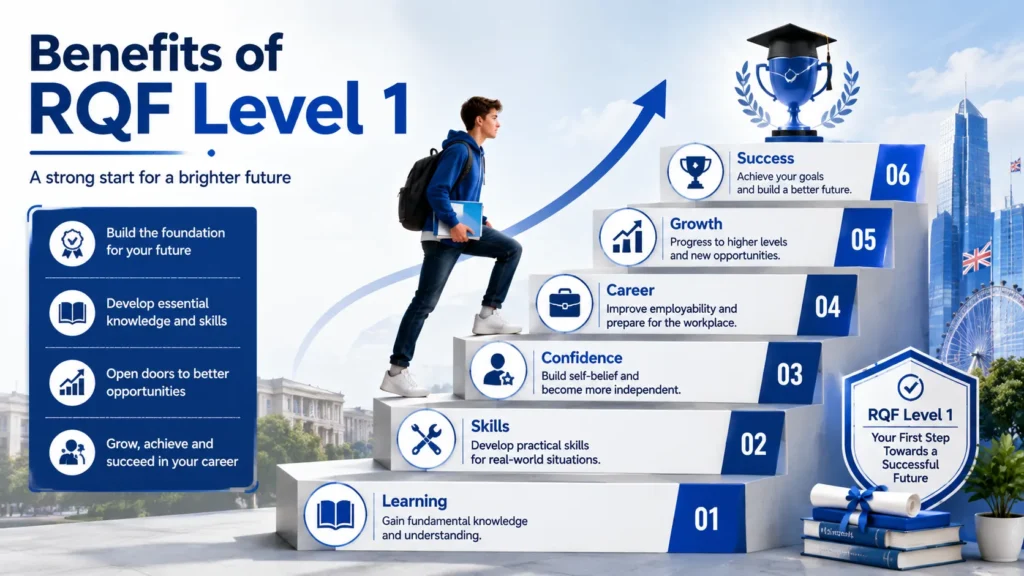
A Regulated Qualifications Framework Level 1 qualification is much more than an introductory certificate. It provides learners with the confidence, practical knowledge, and transferable skills needed to begin building a successful educational and professional future.
For many individuals, Level 1 represents the first recognised qualification that demonstrates commitment to learning, personal development, and career progression. It also establishes the foundation required to progress through higher qualification levels and gain industry-specific expertise.
Some of the key benefits of completing an RQF Level 1 qualification include:
- Develops essential workplace knowledge and practical skills.
- Builds confidence in learning and professional environments.
- Improves communication and teamwork abilities.
- Supports progression to Regulated Qualifications Framework Level 2.
- Enhances employability across multiple industries.
- Introduces professional behaviour and workplace responsibilities.
- Encourages independent learning and problem-solving.
- Provides nationally recognised qualifications regulated by Ofqual.
- Helps learners identify suitable career pathways.
- Creates opportunities for lifelong learning and career advancement.
These benefits make Level 1 an excellent starting point for learners who are preparing for employment, apprenticeships, or further education.
Why Employers Value Regulated Qualifications Framework Level 1
Employers understand that every skilled professional starts by developing fundamental knowledge and workplace behaviours. While Level 1 is an introductory qualification, it demonstrates that a learner has taken the first step towards building recognised skills and professional competence.
Recruiters often view Level 1 positively because it reflects qualities that are highly valued in the workplace, including motivation, reliability, willingness to learn, and the ability to follow instructions.
An RQF Level 1 qualification shows that a learner can:
- Understand basic workplace expectations.
- Communicate effectively with colleagues and customers.
- Complete routine tasks responsibly.
- Work safely within established procedures.
- Demonstrate punctuality and professionalism.
- Develop practical skills through structured learning.
- Build a strong foundation for future qualifications.
These characteristics make Level 1 learners attractive candidates for apprenticeships, trainee positions, and entry-level employment across many sectors.
Future Opportunities After Regulated Qualifications Framework Level 1
The UK employment market continues to evolve as technology, digital transformation, sustainability, and changing workforce demands reshape industries. Employers increasingly seek individuals who demonstrate recognised qualifications, practical skills, and a commitment to continuous learning.
Completing an RQF Level 1 qualification allows learners to begin this journey with confidence while preparing for future opportunities in growing sectors such as:
- Business Administration
- Customer Service
- Healthcare
- Health and Social Care
- Construction
- Engineering
- Information Technology
- Cyber Security
- Fire Safety
- Hospitality
- Logistics and Supply Chain
- Manufacturing
- Quality Assurance
- Environmental Sustainability
- Education Support
As learners continue progressing through higher qualification levels, their opportunities for career advancement, leadership responsibilities, and professional recognition continue to grow.
Continuous Professional Development (CPD)
Learning should not end after completing a Level 1 qualification. Continuous Professional Development (CPD) enables individuals to update their knowledge, strengthen existing skills, and remain competitive in changing industries.
Many learners continue their professional development by progressing to:
- Regulated Qualifications Framework Level 2
- Regulated Qualifications Framework Level 3
- Apprenticeships
- Vocational Diplomas
- Technical Certificates
- Industry-Specific Professional Qualifications
- Leadership and Management Programmes
Lifelong learning supports career progression while helping professionals adapt to new technologies, regulations, and workplace expectations.
Why Choose an Ofqual-Regulated Qualification?
When selecting a qualification, it is important to ensure that it is regulated by Ofqual. Regulated qualifications are developed against nationally recognised standards, giving learners and employers confidence in their quality and credibility.
Choosing an Ofqual-regulated RQF Level 1 qualification offers several advantages:
- National recognition throughout England.
- Consistent learning outcomes.
- Trusted by employers.
- Supports progression to higher qualifications.
- Quality-assured assessment standards.
- Improved employability.
- Greater confidence in qualification value.
For learners beginning their educational journey, choosing a regulated qualification provides a reliable pathway towards long-term success.
Explore More Courses and Qualifications at Inspire College
If you are considering a Regulated Qualifications Framework Level 1 qualification, you may also wish to explore related courses and educational resources available through Inspire College. Linking these pages strengthens topical authority while helping learners discover progression opportunities.
- Level 1 Certificate in Customer Service
- Level 1 Award in Work Skills
- Level 1 Award in Employability Skills
- Level 1 Award in Health and Safety in the Workplace
- Level 1 Award in Fire Safety Awareness
Final Thoughts
The Regulated Qualifications Framework Level 1 is the ideal starting point for learners who want to build confidence, develop essential workplace skills, and create a strong foundation for future education and employment. Although it represents the first recognised level within the Regulated Qualifications Framework, its value should not be underestimated.
By introducing learners to practical skills, professional behaviours, and structured learning, Level 1 provides the confidence needed to progress towards Level 2, apprenticeships, vocational training, and long-term career development. It also helps individuals identify their interests and career aspirations while preparing them for more advanced qualifications.
Whether you are beginning your education, returning to learning after a break, or exploring a new career direction, an RQF Level 1 qualification offers a flexible and recognised pathway towards achieving your goals.
Conclusion
The Regulated Qualifications Framework Level 1 is the first important milestone within the UK’s nationally recognised qualification framework. It equips learners with fundamental knowledge, practical skills, and workplace confidence that support both immediate opportunities and long-term progression.
Throughout this guide, we have explored how the RQF works, what Level 1 qualifications involve, qualification types, assessment methods, career opportunities, progression pathways, and the benefits they offer learners and employers alike. Understanding these pathways allows individuals to make informed decisions about their education and future careers.
Whether your ambition is to secure your first job, begin an apprenticeship, return to education, or continue progressing through the Regulated Qualifications Framework, Level 1 provides the essential foundation needed for success.
At Inspire College, learners can explore a wide range of career-focused qualifications designed to support academic progression, professional development, and lifelong learning. By choosing the right qualification today and continuing to build your knowledge over time, you can develop the skills, confidence, and recognised credentials needed to achieve lasting career success in an increasingly competitive world.