
The Ultimate Guide to the Regulated Qualifications Framework (RQF)
Choosing the right qualification is one of the most important decisions for anyone looking to build new skills, progress academically, or advance their career. In the UK, many nationally recognised qualifications are organised within the Regulated Qualifications Framework (RQF), a structured system that helps learners, employers, education providers, and universities understand the level, complexity, and value of different qualifications.
Whether you are planning to study a professional diploma, vocational certificate, health and safety qualification, business course, or higher education programme, understanding the Regulated Qualifications Framework (RQF) makes it easier to compare qualifications, choose the right learning pathway, and make informed career decisions.
The RQF is regulated by Ofqual in England and provides a consistent framework for recognising qualifications from Entry Level through to Level 8. It ensures that regulated qualifications meet defined quality standards while giving learners confidence that their achievements are recognised by employers, professional bodies, and education providers.
This comprehensive guide explains how the Regulated Qualifications Framework (RQF) works, why it was introduced, how qualification levels are structured, and how learners can use the framework to plan their educational and professional development.
What is the Regulated Qualifications Framework (RQF)?
The Regulated Qualifications Framework (RQF) is the official framework used to classify regulated qualifications in England according to their level of difficulty and learning outcomes. Rather than measuring how long a qualification takes to complete, the RQF focuses on the complexity of the knowledge, skills, and understanding that a learner is expected to achieve.
Introduced to create a more flexible and transparent qualification system, the RQF helps learners compare different qualifications and understand how they relate to one another. It also enables employers, universities, and training providers to recognise qualification levels more consistently.
The framework includes qualifications across a wide range of sectors, including:
- Health and Safety
- Business Management
- Construction
- Engineering
- Education and Training
- Information Technology
- Leadership and Management
- Healthcare
- Environmental Management
- Quality Assurance
- Fire Safety
- Project Management
- Hospitality
- Customer Service
Each regulated qualification is assigned an RQF level that reflects its learning complexity rather than the subject area or duration of study.
Why was the RQF Introduced?
Before the introduction of the Regulated Qualifications Framework, learners often found it difficult to compare qualifications offered by different awarding organisations. Although qualifications varied in size and subject, there was no simple way to understand their relative difficulty or progression opportunities.
The RQF was introduced to make qualifications more transparent, flexible, and easier to understand.
Its main objectives include:
- Creating a consistent qualification structure.
- Helping learners compare qualifications.
- Supporting lifelong learning.
- Improving employer confidence.
- Encouraging progression between qualification levels.
- Ensuring qualifications meet recognised quality standards.
- Supporting career development.
- Promoting transferable skills.
The framework also allows awarding organisations greater flexibility when designing qualifications while maintaining consistent national standards.
How does the Regulated Qualifications Framework (RQF) Work?
The RQF organises qualifications into different levels based on learning complexity. As learners progress through the framework, they are expected to demonstrate increasingly advanced knowledge, practical skills, problem-solving abilities, and professional competence.
Unlike older qualification frameworks, the RQF focuses on learning outcomes rather than prescribing specific qualification structures. This allows awarding organisations to develop qualifications that better meet industry needs while remaining regulated.
Every regulated qualification within the framework is assigned:
- An RQF Level
- Learning outcomes
- Assessment criteria
- Total Qualification Time (TQT)
- Guided Learning Hours (GLH), where applicable
- Qualification type
Together, these elements help learners understand both the academic level and expected learning commitment.
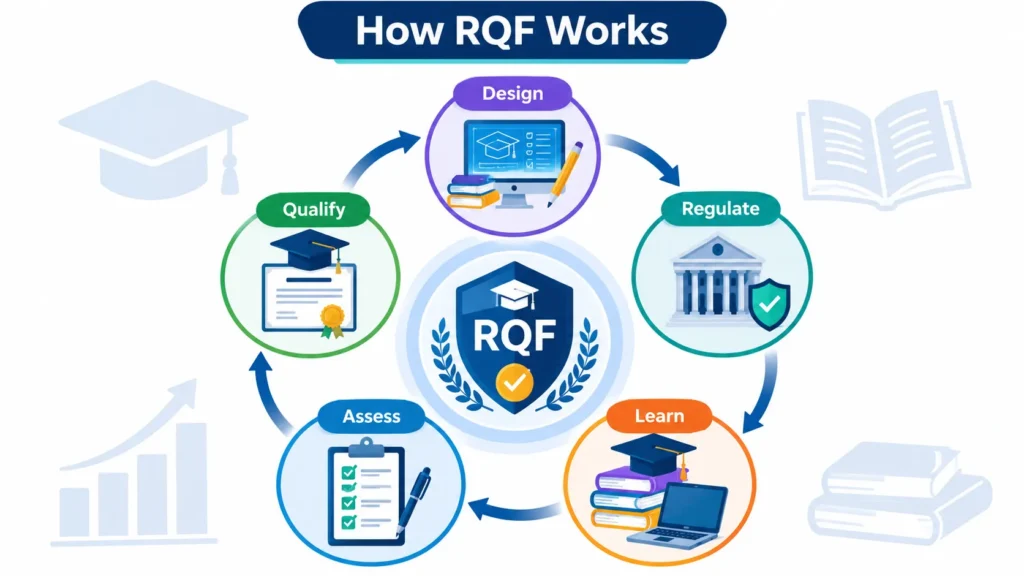
How the RQF Works
The following process illustrates how the framework supports qualification development and learner progression.
Awarding Organisation Designs Qualification
↓
Qualification Submitted for Regulation
↓
Quality Assurance Review
↓
Qualification Approved
↓
Assigned an RQF Level
↓
Delivered by Approved Training Provider
↓
Learner Completes Assessment
↓
Qualification Awarded
↓
Progression to Higher Study or Employment
This structured process helps maintain consistency and quality across regulated qualifications.
Who regulates RQF Qualifications?
In England, regulated qualifications within the RQF are overseen by the Office of Qualifications and Examinations Regulation (Ofqual).
Ofqual is an independent regulator responsible for ensuring that awarding organisations maintain appropriate standards, develop reliable assessment methods, and issue qualifications that accurately reflect learner achievement.
Ofqual’s responsibilities include:
- Regulating awarding organisations.
- Monitoring qualification quality.
- Setting regulatory requirements.
- Protecting qualification standards.
- Supporting public confidence in regulated qualifications.
- Investigating regulatory concerns.
- Maintaining qualification integrity.
This regulatory oversight helps ensure that learners receive qualifications that are credible, reliable, and recognised across different industries.
What Types of Qualifications Are Included in the RQF?
The Regulated Qualifications Framework covers a broad range of academic, vocational, and professional qualifications designed to meet the needs of learners at different stages of education and employment.
Examples include:
- Awards
- Certificates
- Diplomas
- Technical qualifications
- Vocational qualifications
- Professional qualifications
- Apprenticeship-related qualifications
- Health and Safety qualifications
- Leadership qualifications
- Business qualifications
- Construction qualifications
- Quality Management qualifications
This wide range of qualifications allows learners to develop practical skills, gain recognised credentials, and progress toward higher levels of education or employment.
Key Features of the Regulated Qualifications Framework
The RQF offers several important benefits that distinguish it from previous qualification frameworks.
| Feature | Description |
|---|---|
| Nationally Regulated | Qualifications meet recognised regulatory standards. |
| Level-Based Structure | Qualifications are organised according to learning complexity. |
| Flexible Learning | Supports academic, vocational, and professional qualifications. |
| Employer Recognition | Helps employers understand qualification levels. |
| Career Progression | Enables learners to move to higher-level qualifications. |
| Quality Assurance | Qualifications are regulated through Ofqual. |
| Transferable Skills | Supports lifelong learning and professional development. |
| Consistent Standards | Maintains comparable qualification levels across awarding organisations. |
These features make the RQF one of the most widely recognised qualification frameworks in the UK.
Who Benefits from the RQF?
The Regulated Qualifications Framework benefits a wide range of stakeholders by creating a shared understanding of qualification levels and learning outcomes.
Learners
The RQF helps learners:
- Choose appropriate qualifications.
- Understand progression routes.
- Compare qualifications.
- Build recognised skills.
- Plan long-term career development.
Employers
Employers use RQF levels to:
- Evaluate job applicants.
- Identify appropriate qualification requirements.
- Support workforce development.
- Plan employee training.
- Improve recruitment decisions.
Training Providers
Education providers benefit by:
- Delivering nationally recognised qualifications.
- Meeting regulatory requirements.
- Supporting learner progression.
- Maintaining quality assurance.
Universities
Higher education institutions use RQF levels to:
- Assess entry requirements.
- Recognise prior learning.
- Compare applicant qualifications.
- Support academic progression.
Why Understanding the RQF Matters
Whether you are leaving school, changing careers, seeking professional development, or planning higher education, understanding the Regulated Qualifications Framework helps you make more informed decisions about your future.
Instead of selecting qualifications based solely on their title, learners can evaluate:
- Qualification level.
- Expected learning outcomes.
- Career relevance.
- Progression opportunities.
- Employer recognition.
- Academic equivalence.
This knowledge enables individuals to choose qualifications that align with both their current abilities and long-term goals.
Understanding RQF Levels
The Regulated Qualifications Framework (RQF) is organised into Entry Level and Levels 1 to 8, with each level representing a progressively higher standard of knowledge, skills, responsibility, and professional competence. As learners move up the framework, they are expected to demonstrate more advanced critical thinking, problem-solving abilities, technical expertise, and independent decision-making.
One of the biggest advantages of the RQF is that it provides a common reference point for comparing qualifications across different awarding organisations and industries. This helps learners understand where a qualification sits within the UK education system and what progression opportunities it may offer.
It is important to remember that an RQF level indicates the complexity of learning, not the length of time required to complete the qualification.
Complete RQF Levels Explained
Entry Level
Entry Level qualifications provide a foundation for learners who are beginning their educational journey or developing basic knowledge and practical skills.
Typical qualifications include:
- Entry Level Awards
- Entry Level Certificates
- Functional Skills Entry Level
These qualifications help prepare learners for progression to Level 1.
RQF Level 1
Level 1 introduces learners to basic theoretical knowledge and practical workplace skills.
Typical examples include:
- GCSE (Grades 1–3 / D–G under the previous grading system)
- Level 1 Award
- Level 1 Certificate
- Level 1 Diploma
Suitable for:
- School leavers
- Beginners
- Individuals entering a new industry
RQF Level 2
Level 2 develops broader knowledge and greater workplace competence.
Typical examples include:
- GCSE (Grades 4–9 / A*–C under the previous grading system)
- Level 2 Award
- Level 2 Certificate
- Level 2 Diploma
Suitable for:
- Entry-level employees
- Apprentices
- Individuals developing occupational competence
RQF Level 3
Level 3 represents advanced learning and prepares learners for higher education or skilled employment.
Typical examples include:
- A Levels
- Level 3 Diploma
- Advanced Apprenticeships
- Access qualifications
Suitable for:
- Technical professionals
- Supervisors
- Learners progressing toward university
RQF Level 4
Level 4 introduces higher education-level learning with greater responsibility and analytical thinking.
Examples include:
- Higher National Certificate (HNC)
- Level 4 Diploma
- Professional Certificates
Suitable for:
- Team leaders
- Supervisors
- Technical specialists
RQF Level 5
Level 5 focuses on advanced technical and managerial competence.
Examples include:
- Higher National Diploma (HND)
- Foundation Degree
- Level 5 Diploma
Suitable for:
- Managers
- Senior technicians
- Professional practitioners
RQF Level 6
Level 6 represents undergraduate-level education requiring critical analysis, problem-solving, and independent learning.
Examples include:
- Bachelor’s Degree
- Graduate Diplomas
- Level 6 Professional Diplomas
Suitable for:
- Graduate professionals
- Department managers
- Specialist practitioners
RQF Level 7
Level 7 reflects postgraduate-level learning with advanced research, leadership, and strategic decision-making.
Examples include:
- Master’s Degree
- Postgraduate Diploma
- Level 7 Diploma
Suitable for:
- Senior managers
- Consultants
- Strategic leaders
RQF Level 8
Level 8 represents the highest level within the RQF and focuses on original research, innovation, and expert professional practice.
Examples include:
- Doctorate (PhD)
- Professional Doctorate
- Level 8 Award
Suitable for:
- Researchers
- Academic professionals
- Industry experts
- Senior executives
Complete RQF Levels Comparison Table
The following table provides an overview of each RQF level and its approximate academic equivalent.
| RQF Level | Typical Qualification | Typical Progression |
|---|---|---|
| Entry Level | Entry Certificate | Foundation Learning |
| Level 1 | GCSE (Grades 1–3), Award, Certificate | Level 2 |
| Level 2 | GCSE (Grades 4–9), Diploma | Level 3 |
| Level 3 | A Levels, Advanced Diploma | Level 4 or University |
| Level 4 | HNC, Level 4 Diploma | Level 5 |
| Level 5 | HND, Foundation Degree | Level 6 |
| Level 6 | Bachelor’s Degree, Professional Diploma | Level 7 |
| Level 7 | Master’s Degree, Postgraduate Diploma | Level 8 |
| Level 8 | Doctorate (PhD), Professional Doctorate | Research or Specialist Leadership |
This structured progression helps learners understand how qualifications build upon one another throughout their educational and professional journey.
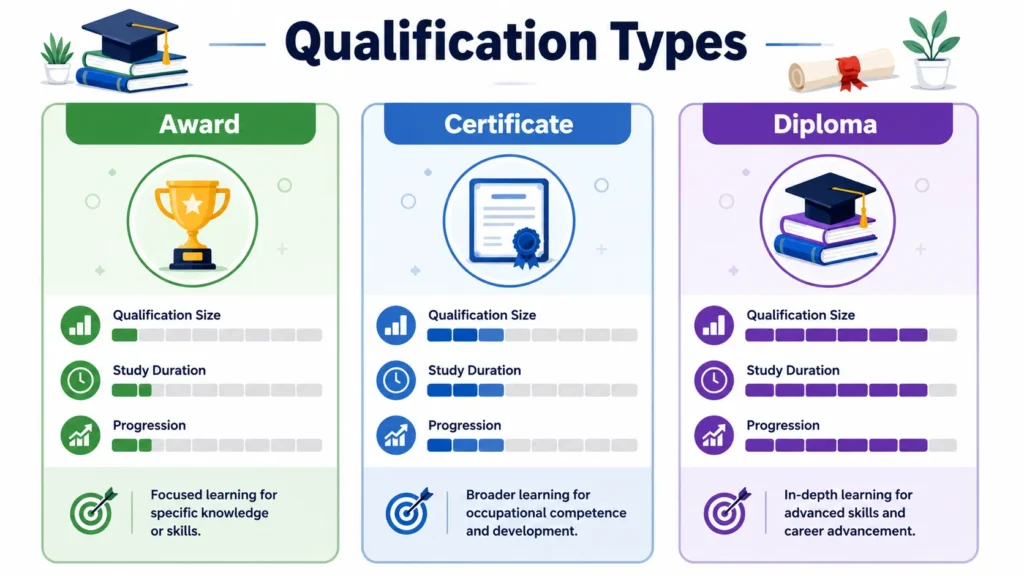
Award vs Certificate vs Diploma
A common misconception is that an Award, Certificate, and Diploma represent different academic levels. In reality, these qualification types may exist at the same RQF level. The main difference is the size and learning volume, not the difficulty.
For example:
- A Level 3 Award
- A Level 3 Certificate
- A Level 3 Diploma
are all Level 3 qualifications, but they differ in the amount of learning and assessment required.
Award
An Award is generally the smallest qualification and is designed to provide focused knowledge or specific occupational skills.
Awards are ideal for:
- Short professional development
- CPD
- Introductory training
- Skill updates
Certificate
Certificates involve a broader programme of study than Awards and develop more comprehensive knowledge and practical competence.
Certificates are suitable for:
- Career progression
- Occupational competence
- Professional development
- Technical skills
Diploma
Diplomas are the largest qualification type within the RQF and involve the greatest amount of learning.
Diplomas typically prepare learners for:
- Professional practice
- Management roles
- Technical specialisation
- Career advancement
Award vs Certificate vs Diploma Comparison
| Qualification Type | Learning Size | Typical Purpose |
|---|---|---|
| Award | Small | Introduction or CPD |
| Certificate | Medium | Occupational knowledge and skills |
| Diploma | Large | Comprehensive professional competence |
Understanding these differences helps learners choose qualifications that best match their learning objectives and available study time.
RQF Qualification Progression Flowchart
The RQF provides clear progression pathways that allow learners to build their knowledge gradually throughout their careers.
Entry Level
↓
Level 1
↓
Level 2
↓
Level 3
↓
Level 4
↓
Level 5
↓
Level 6
↓
Level 7
↓
Level 8
↓
Professional Career Development
This progression demonstrates that learning is a continuous journey rather than a series of isolated qualifications.
How to Choose the Right RQF Level
Selecting the most appropriate qualification depends on your current education, work experience, and career aspirations.
When choosing an RQF qualification, consider:
Current Qualifications
Identify the highest qualification you already hold. This provides a starting point for selecting an appropriate progression route.
Career Goals
Different professions require different qualification levels. Research industry expectations before enrolling on a programme.
Work Experience
Some higher-level qualifications recognise relevant workplace experience alongside formal education.
Learning Objectives
Ask yourself whether you want to:
- Gain introductory knowledge
- Develop occupational competence
- Progress into management
- Meet professional body requirements
- Prepare for higher education
Future Progression
Choose qualifications that support long-term academic and career development rather than focusing only on immediate employment needs.
Why RQF Levels Matter to Employers
Employers frequently use RQF levels to assess whether applicants possess the knowledge and competence required for specific roles.
Rather than relying solely on qualification titles, employers can compare candidates using nationally recognised qualification levels.
RQF qualifications help employers:
- Understand applicant competence.
- Compare qualifications from different awarding organisations.
- Identify appropriate training requirements.
- Support employee development.
- Meet regulatory or industry standards.
Because the framework is regulated and widely recognised, it provides employers with greater confidence when evaluating qualifications during recruitment and workforce planning.
RQF vs NVQ vs QCF
Many learners confuse the Regulated Qualifications Framework (RQF) with National Vocational Qualifications (NVQs) and the Qualifications and Credit Framework (QCF). Although these terms are closely related, they represent different aspects of the UK’s education and qualification system.
The RQF is the current framework used to regulate qualifications in England. NVQs are vocational qualifications that can be placed within the RQF, while the QCF was the previous framework that has now been replaced by the RQF.
Understanding the differences helps learners choose qualifications with confidence and better understand qualification terminology.
Regulated Qualifications Framework (RQF)
The RQF is a national framework that classifies regulated qualifications according to their level of complexity and learning outcomes.
It:
- Organises qualifications from Entry Level to Level 8.
- Is regulated by Ofqual.
- Supports academic, vocational, and professional qualifications.
- Provides consistent qualification standards.
- Enables clear progression pathways.
National Vocational Qualifications (NVQs)
NVQs are work-based qualifications that assess occupational competence in real workplace environments.
Many NVQs are regulated within the RQF, meaning they have an assigned RQF level.
NVQs focus on:
- Practical skills.
- Workplace competence.
- Occupational performance.
- Evidence-based assessment.
Qualifications and Credit Framework (QCF)
The QCF was introduced to organise qualifications using credit values and qualification sizes.
It has now been replaced by the RQF, which offers greater flexibility while maintaining clear qualification levels and regulatory standards.
Although some people still refer to QCF qualifications, the RQF is the framework currently used for newly regulated qualifications in England.
RQF vs NVQ vs QCF Comparison
| Feature | RQF | NVQ | QCF |
|---|---|---|---|
| Framework or Qualification | Framework | Qualification | Former Framework |
| Current Status | Current | Current (within RQF) | Replaced |
| Regulated by Ofqual | Yes | Yes | Yes (historically) |
| Covers Academic Qualifications | Yes | No | Yes |
| Covers Vocational Qualifications | Yes | Yes | Yes |
| Focus | Qualification Levels | Workplace Competence | Credits and Qualification Structure |
| Progression Routes | Yes | Yes | Yes |
This comparison shows that the RQF is not a qualification itself—it is the framework that organises regulated qualifications, including many vocational programmes such as NVQs.
Benefits of RQF Qualifications
The Regulated Qualifications Framework (RQF) benefits learners, employers, education providers, and professional organisations by creating a transparent and consistent qualification system.
Benefits for Learners
RQF qualifications help learners:
- Understand qualification levels.
- Compare different study options.
- Progress into higher education.
- Improve employability.
- Develop practical and professional skills.
- Plan long-term career pathways.
- Gain nationally recognised qualifications.
Benefits for Employers
Employers use RQF qualifications to:
- Evaluate job applicants.
- Compare qualifications from different awarding organisations.
- Recruit competent professionals.
- Identify training needs.
- Support employee development.
- Meet industry and regulatory requirements.
Benefits for Education Providers
Training providers benefit because the RQF:
- Provides nationally recognised standards.
- Supports quality assurance.
- Enables consistent programme development.
- Improves learner progression.
- Enhances employer confidence.
Benefits for Professional Development
Professionals can use RQF qualifications to:
- Update existing skills.
- Achieve career progression.
- Meet continuing professional development (CPD) objectives.
- Transition into new industries.
- Prepare for leadership positions.
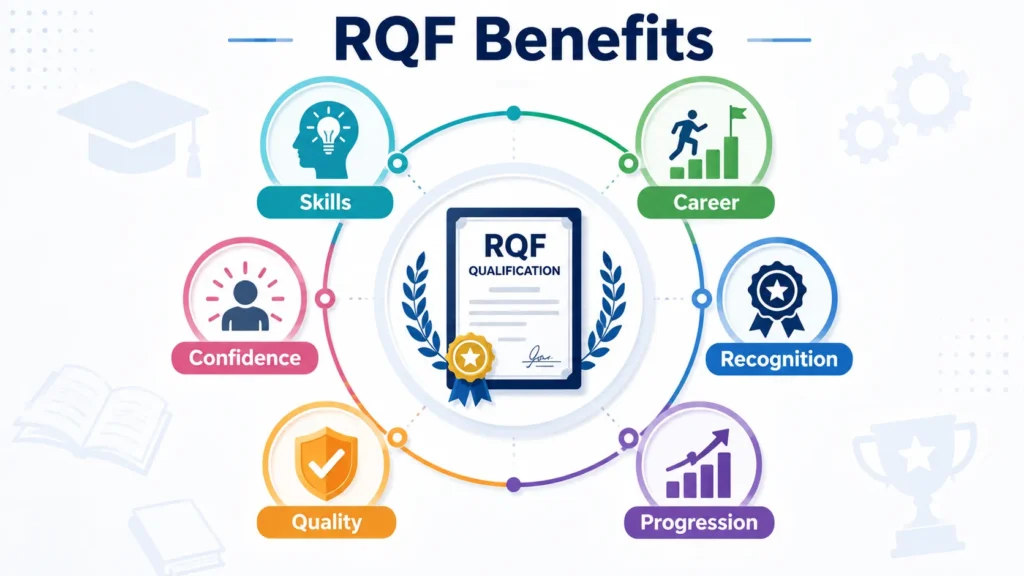
How Employers Use RQF Qualifications
Employers increasingly rely on RQF levels when recruiting new employees and planning workforce development.
Rather than comparing qualification titles alone, employers can use RQF levels to understand the complexity of learning and expected occupational competence.
For example:
- Entry-level roles may require Level 2 qualifications.
- Supervisory positions may require Level 3 or Level 4 qualifications.
- Management positions often seek Level 5 or Level 6 qualifications.
- Senior leadership roles may value Level 7 qualifications.
This consistent structure simplifies recruitment and professional development planning.
International Recognition of RQF Qualifications
One of the strengths of the Regulated Qualifications Framework is its international reputation for quality and consistency.
Although recognition depends on the destination country, institution, or employer, RQF qualifications are widely respected because they are regulated by Ofqual, the recognised qualifications regulator in England.
Many international employers and universities consider:
- Qualification level.
- Learning outcomes.
- Awarding organisation.
- Professional relevance.
This makes regulated qualifications attractive to learners seeking global career opportunities or further study.
However, learners planning to study or work overseas should always check local recognition requirements, as equivalency processes vary between countries.
Common Misconceptions About the RQF
Despite its widespread use, there are still several misconceptions about the Regulated Qualifications Framework.
“RQF is a qualification.”
This is incorrect.
The RQF is the framework that organises regulated qualifications—it is not a qualification itself.
“Higher RQF levels always take longer to complete.”
Not necessarily.
RQF levels measure learning complexity rather than study duration. Two qualifications at the same level may require different amounts of learning.
“All UK courses are regulated within the RQF.”
No.
Only qualifications approved by recognised awarding organisations and regulated by Ofqual appear within the framework.
“Awards, Certificates, and Diplomas are different levels.”
This is another common misunderstanding.
These qualification types can all exist at the same RQF level. Their difference relates mainly to qualification size rather than academic difficulty.
“RQF replaced NVQs.”
No.
The RQF replaced the QCF, not NVQs.
Many NVQs continue to exist as regulated vocational qualifications within the RQF.
Understanding these distinctions helps learners make informed decisions when selecting qualifications.
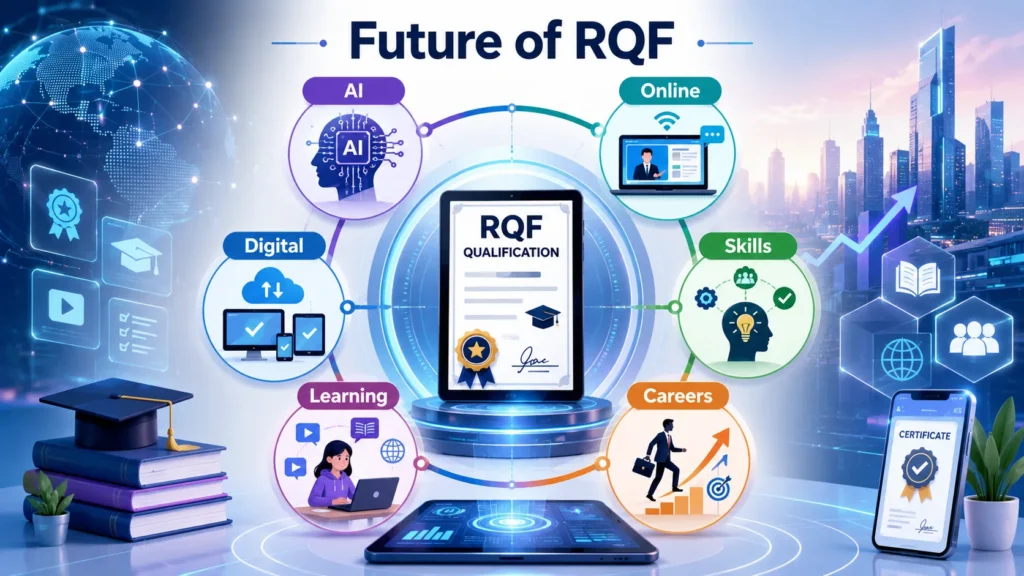
The Future of the Regulated Qualifications Framework
Education continues to evolve alongside changes in technology, employment, and industry requirements. The Regulated Qualifications Framework provides the flexibility needed to support modern learning while maintaining nationally recognised standards.
Future developments are expected to include:
- Digital qualifications and certificates.
- Secure digital credential verification.
- Increased flexible and online learning opportunities.
- Skills-based education pathways.
- Greater employer collaboration.
- Lifelong learning initiatives.
- Recognition of emerging industries and technologies.
- Integration of artificial intelligence into learning and assessment support.
These developments will help ensure that the RQF continues to meet the changing needs of learners, employers, and education providers.
Explore RQF Qualifications at Inspire College
Whether you are beginning your educational journey, changing careers, or pursuing professional development, Inspire College offers a wide range of regulated qualifications designed to support academic progression and workplace success.
Explore programmes such as:
- Level 2 Certificate In Customer Service
- Level 4 Diploma in Business Management
- Level 4 Diploma in Shipping and Logistics
- Level 1 Award in Health and Safety in the Workplace
Conclusion
The Regulated Qualifications Framework (RQF) provides a clear, structured, and nationally recognised system for organising qualifications in England. By classifying qualifications according to learning complexity rather than study duration, it enables learners, employers, and education providers to compare qualifications with confidence and understand progression opportunities.
Whether you are pursuing an Award, Certificate, Diploma, vocational qualification, or higher-level professional programme, understanding the RQF helps you choose the right learning pathway, plan your career development, and gain qualifications that are recognised across industries.
As education and workforce requirements continue to evolve, the RQF remains a vital part of the UK’s qualification system, supporting lifelong learning, professional competence, and career progression for learners at every stage.