Quality Assurance vs Quality Control: Key Differences Explained
In today’s competitive global marketplace, quality is no longer a competitive advantage—it is an essential requirement for business success. Whether an organisation manufactures consumer products, develops software, constructs buildings, provides healthcare services, or produces pharmaceuticals, delivering consistent quality is fundamental to maintaining customer trust, regulatory compliance, and long-term growth.
Modern customers expect products and services that are reliable, safe, and fit for purpose. Even a single quality failure can lead to customer dissatisfaction, financial losses, reputational damage, regulatory penalties, and reduced market competitiveness. As industries become increasingly regulated and customer expectations continue to rise, organisations must implement structured quality management systems that prevent defects, improve operational efficiency, and support continuous improvement.
This is where Quality Assurance (QA) and Quality Control (QC) play a critical role.
Although these two terms are frequently used interchangeably, they represent different functions within a quality management system. Quality Assurance focuses on designing and improving processes to prevent defects before they occur, while Quality Control focuses on inspecting and testing products or services to identify defects before they reach the customer. Together, they create a comprehensive framework that helps organisations consistently deliver high-quality outcomes while reducing costs, improving productivity, and strengthening customer confidence.
Quality Assurance and Quality Control are applied across almost every industry, including manufacturing, construction, healthcare, pharmaceuticals, food production, engineering, information technology, logistics, aviation, education, and energy. Regardless of the sector, organisations that invest in effective quality management are better positioned to achieve operational excellence, comply with international standards, and adapt to changing market demands.
As digital transformation, automation, Artificial Intelligence (AI), and Industry 4.0 continue to reshape global industries, the importance of robust quality management practices has never been greater. Businesses increasingly require skilled quality professionals who understand international standards, risk management, auditing techniques, process improvement methodologies, and modern quality technologies.
This comprehensive guide explains everything you need to know about Quality Assurance and Quality Control, including their key differences, relationship within quality management, practical applications, industry examples, essential skills, international standards, career opportunities, certifications, and future trends. Whether you are a student, aspiring quality professional, manager, or business owner, this guide will help you develop a clear understanding of how QA and QC contribute to organisational success.
QUALITY MANAGEMENT
↓
QUALITY ASSURANCE
↓
QUALITY CONTROL
↓
CONTINUOUS IMPROVEMENT
What is Quality Management?
Before understanding the difference between Quality Assurance and Quality Control, it is important to understand the broader concept of Quality Management.
Quality Management is the coordinated system of policies, processes, procedures, responsibilities, and continuous improvement activities that enable an organisation to consistently deliver products and services that meet customer expectations, legal requirements, and industry standards.
Rather than focusing solely on the final product, Quality Management aims to improve every stage of an organisation’s operations—from planning and design to production, delivery, monitoring, and continual improvement.
A well-designed Quality Management System (QMS) helps organisations:
- Deliver consistent quality products and services
- Improve customer satisfaction
- Reduce operational risks
- Prevent costly defects and rework
- Increase productivity and efficiency
- Support evidence-based decision-making
- Strengthen regulatory compliance
- Promote continual improvement
- Build long-term customer confidence
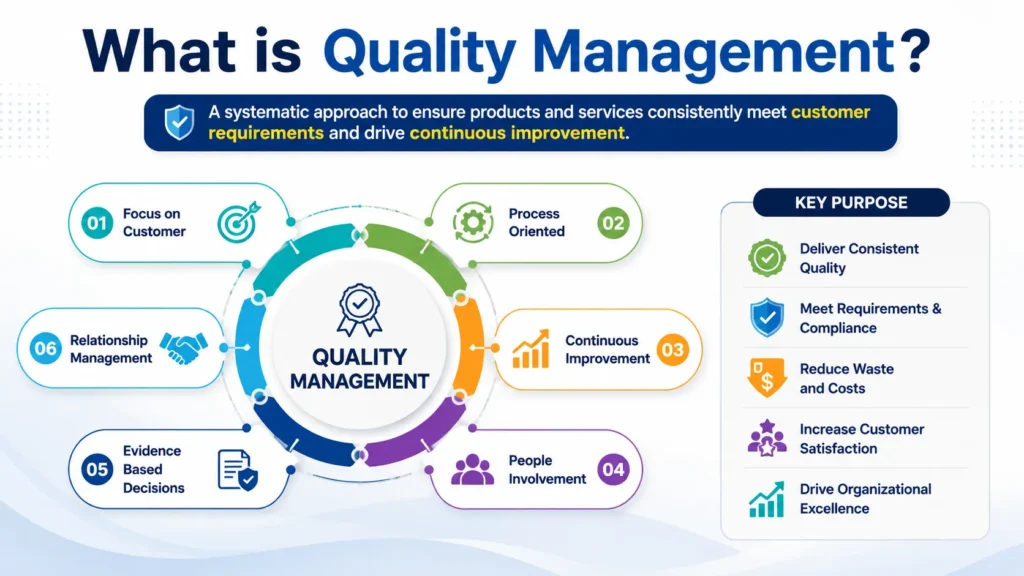
International standards such as ISO 9001 provide organisations with a recognised framework for implementing effective Quality Management Systems that support sustainable business performance.
The Five Pillars of Quality Management
Quality Management consists of five interconnected components that work together to ensure consistent quality throughout an organisation.
| Component | Purpose |
|---|---|
| Quality Planning | Defines quality objectives, standards, resources, and processes required to achieve desired outcomes. |
| Quality Assurance | Establishes systems and procedures that prevent defects before they occur. |
| Quality Control | Verifies that products or services meet specified quality requirements through inspection and testing. |
| Quality Improvement | Continuously enhances processes, products, and organisational performance. |
| Quality Leadership | Creates a culture where quality is embedded throughout the organisation through effective leadership and employee engagement. |
These five components create a structured quality framework that enables organisations to improve performance while consistently meeting customer expectations.
Understanding the Relationship Between Quality Management, QA, and QC
Many people assume that Quality Assurance and Quality Control are separate systems. In reality, they are complementary functions operating within a single Quality Management System.
The relationship can be understood as follows:
Customer Requirements
│
▼
Quality Planning
│
▼
Quality Assurance
(Process Design & Prevention)
│
▼
Production / Service Delivery
│
▼
Quality Control
(Inspection & Testing)
│
▼
Continuous Improvement
│
▼
Customer Satisfaction
In this framework:
- Quality Planning establishes objectives and requirements.
- Quality Assurance designs reliable processes.
- Production follows those established processes.
- Quality Control verifies that the outputs meet specifications.
- Continuous Improvement uses lessons learned to strengthen future performance.
This cycle creates a culture where quality is continuously monitored, measured, and improved.
What is Quality Assurance (QA)?
Quality Assurance (QA) is a proactive, systematic, and process-oriented approach to quality management that focuses on preventing defects before they occur. Rather than inspecting finished products for problems, Quality Assurance aims to design reliable systems, procedures, and workflows that consistently produce high-quality outcomes.
The central principle of Quality Assurance is simple:
Build quality into the process instead of trying to inspect quality into the final product.
Quality Assurance involves developing documented procedures, standard operating procedures (SOPs), quality policies, employee training programmes, risk management strategies, internal audits, supplier evaluations, and continuous improvement initiatives. These activities ensure that every stage of production or service delivery follows defined standards and best practices.
QA is not limited to manufacturing. It is equally important in healthcare, software development, construction, pharmaceuticals, education, food production, engineering, logistics, and many other industries where consistency, compliance, and customer satisfaction are essential.
Primary Objectives of Quality Assurance
- Prevent defects before production begins
- Standardise organisational processes
- Improve operational efficiency
- Ensure compliance with regulations and international standards
- Reduce waste and rework
- Strengthen risk management
- Support continual improvement
- Increase customer confidence
- Build a culture of quality across the organisation
Common Quality Assurance Activities
- Developing Standard Operating Procedures (SOPs)
- Implementing ISO 9001 Quality Management Systems
- Conducting internal quality audits
- Risk identification and assessment
- Employee competency training
- Supplier quality management
- Process validation
- Documentation control
- Corrective and Preventive Action (CAPA)
- Continuous improvement programmes
What is Quality Control (QC)?
Quality Control (QC) is a reactive, product-oriented function that focuses on identifying, measuring, and correcting defects in products or services before they are delivered to customers. Unlike Quality Assurance, which aims to prevent problems through effective processes, Quality Control verifies whether the final output meets the required specifications.
QC activities involve inspection, testing, measurement, sampling, verification, and analysis. These checks help organisations identify non-conformities, minimise customer complaints, reduce product recalls, and ensure compliance with quality standards.
Quality Control acts as the final verification step before products or services reach the customer.
Primary Objectives of Quality Control
- Detect defects and non-conformities
- Verify compliance with specifications
- Improve product reliability
- Reduce customer complaints
- Minimise product failures
- Support regulatory compliance
- Protect organisational reputation
- Reduce rework and waste
Common Quality Control Activities
- Incoming material inspection
- In-process inspection
- Finished product inspection
- Laboratory testing
- Performance testing
- Calibration verification
- Dimensional measurements
- Sampling inspections
- Product acceptance testing
- Quality reporting
Quality Assurance vs Quality Control: Key Differences
Although Quality Assurance (QA) and Quality Control (QC) share the common objective of delivering high-quality products and services, they differ significantly in their purpose, timing, methodology, and responsibilities. Understanding these differences is essential for organisations seeking to implement an effective Quality Management System (QMS) and for professionals pursuing a career in quality management.
A common misconception is that QA and QC are interchangeable. In reality, they perform complementary roles within the quality lifecycle. Quality Assurance establishes the processes that prevent defects from occurring, while Quality Control evaluates the final output to ensure those processes have produced the desired results.
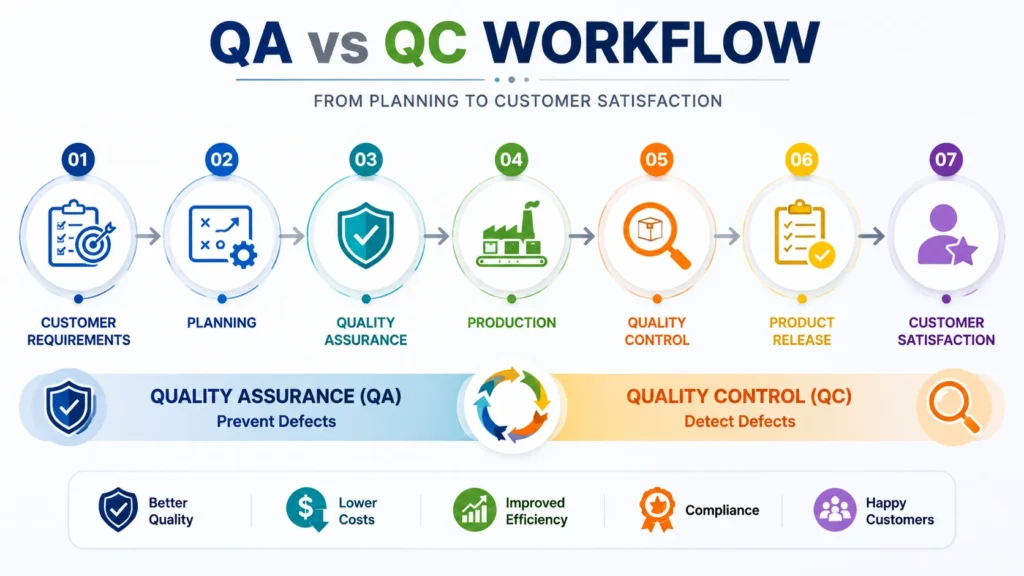
Simply put:
- Quality Assurance asks: How can we prevent defects?
- Quality Control asks: Does the finished product meet the required quality standards?
An organisation that relies only on Quality Control may repeatedly identify the same defects without addressing their root causes. Conversely, an organisation that focuses only on Quality Assurance without verifying outputs risks allowing defects to reach customers. The most successful organisations integrate both functions into a unified quality management strategy.
Quality Assurance vs Quality Control Comparison Table
| Aspect | Quality Assurance (QA) | Quality Control (QC) |
|---|---|---|
| Primary Focus | Processes | Products or Services |
| Objective | Prevent defects | Detect defects |
| Approach | Preventive | Corrective |
| Timing | Before and during production | During and after production |
| Orientation | Process-oriented | Product-oriented |
| Responsibility | Entire organisation | Inspection and testing teams |
| Activities | Audits, SOPs, training, process improvement | Inspection, testing, measurements, verification |
| Documentation | Procedures, policies, quality manuals | Inspection reports, test reports, checklists |
| Success Measure | Stable and capable processes | Conforming products |
| Outcome | Fewer defects and improved efficiency | Verified product quality |
| Customer Impact | Long-term quality consistency | Immediate product acceptance |
| Continuous Improvement | Core responsibility | Provides feedback for improvement |
Quick Comparison
| Quality Assurance | Quality Control |
|---|---|
| Improves the process | Verifies the product |
| Prevents problems | Finds problems |
| Proactive | Reactive |
| Builds quality | Checks quality |
| Long-term improvement | Immediate verification |
Understanding the Difference Through a Real-Life Example
Imagine a company that manufactures electrical safety helmets for construction workers.
Quality Assurance Activities
Before production begins, the organisation:
- Develops manufacturing procedures
- Creates Standard Operating Procedures (SOPs)
- Trains production staff
- Qualifies raw material suppliers
- Calibrates machinery
- Conducts internal audits
- Implements ISO 9001 requirements
All these activities are designed to prevent defects before manufacturing starts.
This is Quality Assurance.
Quality Control Activities
Once helmets are manufactured, inspectors:
- Measure dimensions
- Test impact resistance
- Verify colour consistency
- Check product labelling
- Inspect for visible defects
- Approve or reject finished products
These activities verify whether the products meet specifications.
This is Quality Control.
Another Simple Example
Consider a restaurant.
Quality Assurance
The restaurant:
- Creates food preparation procedures
- Trains chefs
- Defines hygiene standards
- Selects approved suppliers
- Implements cleaning schedules
These systems reduce the chance of poor-quality food.
Quality Control
Before serving a meal, staff check:
- Food temperature
- Presentation
- Portion size
- Taste
- Correct order
This confirms the customer receives the expected quality.
Software Development Example
Quality management is equally important in software development.
Quality Assurance
QA teams:
- Define coding standards
- Review software requirements
- Establish testing strategies
- Conduct code reviews
- Implement DevOps processes
- Create documentation
Quality Control
QC teams:
- Execute software tests
- Identify bugs
- Verify functionality
- Perform security testing
- Conduct performance testing
- Validate user acceptance
Healthcare Example
Healthcare organisations depend heavily on both QA and QC.
Quality Assurance
Hospitals:
- Develop clinical protocols
- Train healthcare professionals
- Establish infection control procedures
- Maintain accreditation requirements
- Conduct internal quality audits
Quality Control
Healthcare professionals:
- Monitor patient outcomes
- Test laboratory samples
- Verify medication dosages
- Inspect medical equipment
- Review diagnostic accuracy
Construction Industry Example
Construction projects require rigorous quality management.
Quality Assurance
Construction companies:
- Review engineering designs
- Develop inspection plans
- Train contractors
- Approve construction methods
- Monitor compliance
Quality Control
Inspectors:
- Test concrete strength
- Inspect welding quality
- Verify structural dimensions
- Check reinforcement
- Conduct site inspections
Pharmaceutical Industry Example
The pharmaceutical industry is one of the most quality-sensitive sectors in the world.
Quality Assurance
QA teams ensure:
- GMP compliance
- Controlled manufacturing processes
- Supplier qualification
- Documentation management
- Validation activities
- Regulatory compliance
Quality Control
QC laboratories perform:
- Raw material testing
- Microbiological analysis
- Stability testing
- Finished product testing
- Packaging inspection
Manufacturing Example
Manufacturing illustrates the relationship between QA and QC particularly well.
Before Production
QA activities include:
- Machine calibration
- Production planning
- Staff competency assessments
- Risk analysis
- Process validation
During Production
QC activities include:
- Dimensional inspection
- Sampling
- Visual inspection
- Process measurements
- Statistical monitoring
After Production
QC performs:
- Final inspection
- Product testing
- Packaging verification
- Shipping approval
Why QA Alone Is Not Enough
Even the best-designed processes cannot eliminate every possible variation.
Equipment failures, supplier issues, human error, environmental conditions, and material inconsistencies can still introduce defects.
Without Quality Control, these defects could reach customers unnoticed.
Why QC Alone Is Not Enough
Some organisations rely heavily on inspection.
This approach creates several problems:
- Higher inspection costs
- Increased waste
- More rework
- Customer complaints
- Product recalls
- Repeated defects
Inspection identifies problems, but it does not eliminate the causes behind them.
Quality Assurance addresses those root causes.
How Quality Assurance and Quality Control Complement Each Other
Rather than competing, QA and QC work together throughout the quality lifecycle.
Quality Assurance establishes the framework for success, while Quality Control verifies that the framework is working effectively.
This continuous feedback loop enables organisations to improve quality over time rather than simply correcting defects after they occur.
The Quality Feedback Loop
An effective Quality Management System does not stop after product inspection.
Instead, inspection results are analysed to answer questions such as:
- Why did the defect occur?
- Which process failed?
- Was employee training sufficient?
- Were supplier materials compliant?
- Should procedures be updated?
- Can automation reduce future defects?
The answers are used to improve Quality Assurance activities, creating a cycle of continual improvement.
Common Myths About QA and QC
Myth 1: QA and QC Are the Same
Reality:
They are different functions with different objectives.
Myth 2: Inspection Creates Quality
Reality:
Inspection identifies defects.
Quality is created through effective processes.
Myth 3: QA Is Only Documentation
Reality:
Documentation supports QA, but Quality Assurance also includes leadership, training, risk management, auditing, process improvement, supplier management, and organisational culture.
Myth 4: QC Is Only Visual Inspection
Reality:
Modern QC includes:
- Laboratory testing
- Statistical Process Control (SPC)
- Performance testing
- Dimensional measurement
- Digital inspection systems
- Automated vision inspection
- Data analytics
Myth 5: Only Manufacturing Needs QA and QC
Reality:
Quality management is essential across:
- Healthcare
- Construction
- Pharmaceuticals
- Software Development
- Food Production
- Education
- Aviation
- Logistics
- Energy
- Telecommunications
- Financial Services
- Government Organisations
Key Takeaways
The distinction between Quality Assurance and Quality Control is fundamental to understanding modern quality management.
Quality Assurance focuses on building reliable systems that prevent defects, while Quality Control ensures that the final products or services meet established requirements. Neither function can replace the other. Organisations that integrate QA and QC within a structured Quality Management System achieve greater efficiency, improved compliance, reduced costs, enhanced customer satisfaction, and stronger long-term business performance.
Why Quality Assurance and Quality Control Matter
Quality is one of the most valuable assets an organisation can offer its customers. Regardless of whether a business manufactures products, delivers healthcare services, develops software, constructs infrastructure, or provides professional services, consistent quality directly influences customer satisfaction, operational efficiency, regulatory compliance, and long-term profitability.
In today’s highly competitive global economy, organisations are expected to meet increasingly demanding customer expectations while complying with complex regulatory requirements. Even minor quality failures can lead to financial losses, damaged reputations, legal consequences, and reduced customer confidence.
This is why Quality Assurance (QA) and Quality Control (QC) have become strategic business functions rather than operational activities. Together, they help organisations establish reliable processes, identify opportunities for improvement, minimise risks, and consistently deliver products and services that meet or exceed expectations.
Rather than simply detecting defects, modern quality management focuses on preventing problems, improving organisational performance, and creating sustainable value for customers and stakeholders.
Why Every Organisation Needs QA and QC
Every organisation, regardless of its size or industry, benefits from implementing structured quality management practices.
Effective QA and QC systems help organisations:
- Deliver consistent products and services
- Improve customer satisfaction
- Reduce operational risks
- Minimise production waste
- Increase efficiency
- Lower operating costs
- Strengthen regulatory compliance
- Improve employee performance
- Support innovation
- Build long-term business sustainability
Quality management is no longer limited to manufacturing. Today, it plays an equally important role in healthcare, construction, pharmaceuticals, software development, food production, education, logistics, aviation, energy, telecommunications, finance, and many other sectors.
Benefits of Quality Assurance and Quality Control
1. Improved Customer Satisfaction
Customer satisfaction is the foundation of business success. Customers expect products and services that consistently meet their expectations in terms of quality, safety, reliability, and performance.
Quality Assurance helps organisations establish reliable processes that consistently produce high-quality outcomes, while Quality Control verifies that the final product meets the required specifications before it reaches the customer.
When customers consistently receive quality products and services, organisations benefit from:
- Increased customer loyalty
- Positive reviews and recommendations
- Higher customer retention
- Stronger brand trust
- Increased repeat business
Satisfied customers become long-term advocates for an organisation, contributing significantly to sustainable growth.
2. Reduced Operational Costs
Poor quality is expensive.
Organisations that lack effective quality management often experience:
- Product recalls
- Customer complaints
- Warranty claims
- Rework
- Scrap materials
- Production delays
- Increased labour costs
- Lost business opportunities
Quality Assurance reduces these costs by preventing defects through well-designed processes, while Quality Control identifies issues before products are delivered to customers.
Reducing quality-related failures allows organisations to allocate more resources toward innovation, growth, and customer service.
3. Higher Productivity and Efficiency
Standardised processes eliminate unnecessary variation and improve operational consistency.
Quality management helps organisations:
- Streamline workflows
- Reduce process bottlenecks
- Improve resource utilisation
- Increase production efficiency
- Shorten production cycles
- Improve decision-making
Efficient processes enable organisations to produce higher-quality products with fewer resources.
4. Better Regulatory Compliance
Many industries operate under strict national and international regulations.
Examples include:
- Healthcare
- Pharmaceuticals
- Food manufacturing
- Aviation
- Construction
- Medical devices
- Automotive manufacturing
- Energy production
Quality systems help organisations comply with regulatory requirements by ensuring:
- Accurate documentation
- Controlled processes
- Employee competency
- Traceability
- Risk management
- Internal auditing
- Continuous monitoring
Compliance reduces the risk of legal penalties, product recalls, and reputational damage.
5. Improved Risk Management
Every organisation faces operational risks.
Potential risks include:
- Human error
- Equipment failure
- Supplier issues
- Process variation
- Cybersecurity threats
- Material defects
- Environmental conditions
Quality Assurance incorporates risk-based thinking into organisational processes, allowing businesses to identify and address potential problems before they occur.
This proactive approach significantly reduces operational uncertainty.
6. Increased Employee Performance
Clearly documented procedures improve employee confidence and consistency.
Quality systems provide employees with:
- Standard Operating Procedures (SOPs)
- Training programmes
- Defined responsibilities
- Performance expectations
- Continuous feedback
Employees who understand quality expectations are more productive and make fewer mistakes.
7. Stronger Brand Reputation
Quality directly influences public perception.
Organisations recognised for delivering consistently high-quality products often enjoy:
- Greater customer confidence
- Stronger market position
- Increased competitiveness
- Better supplier relationships
- Higher stakeholder trust
Conversely, repeated quality failures can permanently damage a company’s reputation.
8. Continuous Improvement
One of the greatest strengths of quality management is its emphasis on continuous improvement.
Rather than accepting current performance levels, quality-focused organisations continuously seek opportunities to improve:
- Processes
- Products
- Services
- Customer experience
- Employee performance
- Operational efficiency
Continuous improvement enables organisations to remain competitive in rapidly changing markets.
The Eight Principles of Quality Management
Modern Quality Management Systems are built upon internationally recognised management principles that promote organisational excellence.
These principles underpin standards such as ISO 9001 and provide a framework for sustainable success.
1. Customer Focus
Every quality initiative begins with understanding customer needs.
Organisations should strive not only to meet customer expectations but also to exceed them.
Customer-focused organisations:
- Understand customer requirements
- Monitor customer satisfaction
- Analyse customer feedback
- Improve products continuously
Without customers, quality has no purpose.
2. Leadership
Strong leadership establishes a culture where quality becomes everyone’s responsibility.
Effective leaders:
- Define organisational vision
- Establish quality objectives
- Promote accountability
- Allocate necessary resources
- Encourage innovation
Leadership commitment is essential for maintaining an effective Quality Management System.
3. Engagement of People
Employees play a critical role in quality management.
When employees are engaged, organisations benefit from:
- Greater innovation
- Better teamwork
- Increased ownership
- Improved communication
- Higher productivity
Quality should never be viewed as the responsibility of a single department.
4. Process Approach
Successful organisations understand that consistent results come from managing interconnected processes rather than isolated activities.
A process approach enables organisations to:
- Improve efficiency
- Reduce variation
- Increase consistency
- Optimise resources
- Improve performance measurement
Every process contributes to overall organisational quality.
5. Continuous Improvement
Improvement is not a one-time project.
It is an ongoing organisational commitment.
Continuous improvement includes:
- Reviewing performance
- Identifying opportunities
- Implementing improvements
- Monitoring results
- Standardising successful changes
This philosophy helps organisations remain competitive.
6. Evidence-Based Decision Making
Effective decisions should be based on facts rather than assumptions.
Quality professionals rely on:
- Performance data
- Statistical analysis
- Audit findings
- Inspection results
- Customer feedback
- Risk assessments
Using objective evidence improves decision quality and organisational performance.
7. Relationship Management
Organisations depend on suppliers, contractors, regulators, customers, and other stakeholders.
Strong relationships improve:
- Supply chain reliability
- Communication
- Product quality
- Innovation
- Long-term sustainability
Quality extends beyond organisational boundaries.
8. Risk-Based Thinking
Modern quality management incorporates risk into every stage of decision-making.
Rather than reacting to problems, organisations proactively identify:
- Potential failures
- Process weaknesses
- Operational risks
- Customer impacts
Risk-based thinking strengthens resilience and supports continual improvement.
International Quality Standards
Quality management is supported by internationally recognised standards that establish best practices across industries.
Understanding these standards is essential for quality professionals seeking global career opportunities.
ISO 9001 – Quality Management Systems
ISO 9001 is the world’s most widely adopted Quality Management System standard.
It provides organisations with a framework for:
- Customer satisfaction
- Process management
- Risk management
- Internal auditing
- Continuous improvement
- Leadership
- Evidence-based decision-making
ISO 9001 is applicable to organisations of every size and industry.
ISO 13485 – Medical Devices
ISO 13485 specifies Quality Management System requirements for organisations involved in medical device design, production, installation, and servicing.
Key focus areas include:
- Patient safety
- Risk management
- Regulatory compliance
- Traceability
- Validation
- Sterility controls
IATF 16949 – Automotive Quality Management
IATF 16949 builds upon ISO 9001 and defines quality requirements for automotive manufacturers and suppliers.
Its objectives include:
- Defect prevention
- Supply chain improvement
- Product consistency
- Customer satisfaction
- Manufacturing excellence
Good Manufacturing Practice (GMP)
GMP ensures that pharmaceutical, biotechnology, cosmetics, and food manufacturers consistently produce safe and effective products.
Core GMP requirements include:
- Controlled manufacturing environments
- Qualified personnel
- Equipment validation
- Documentation
- Hygiene
- Product traceability
- Change control
HACCP (Hazard Analysis and Critical Control Points)
HACCP is a preventive food safety management system used throughout the global food industry.
It focuses on:
- Hazard identification
- Critical control points
- Monitoring procedures
- Corrective actions
- Verification activities
- Record keeping
HACCP significantly reduces food safety risks.
ISO 22000 – Food Safety Management Systems
ISO 22000 combines Quality Management principles with food safety requirements.
It enables food businesses to:
- Improve food safety
- Manage risks
- Strengthen supply chains
- Meet regulatory requirements
- Build customer confidence
ISO/IEC 17025 – Testing and Calibration Laboratories
ISO/IEC 17025 ensures that laboratories produce technically valid and reliable testing and calibration results.
It is widely adopted by:
- Analytical laboratories
- Calibration facilities
- Research organisations
- Inspection bodies
How International Standards Work Together
Different industries adopt different standards depending on their operational requirements.
| Standard | Primary Industry | Main Purpose |
|---|---|---|
| ISO 9001 | All industries | Quality Management System |
| ISO 13485 | Medical Devices | Medical device quality |
| IATF 16949 | Automotive | Automotive manufacturing quality |
| GMP | Pharmaceuticals | Safe manufacturing practices |
| HACCP | Food Industry | Food safety risk control |
| ISO 22000 | Food Industry | Food Safety Management System |
| ISO/IEC 17025 | Laboratories | Testing and calibration competence |
Quality Management Lifecycle
Quality management is not a single activity—it is a continuous lifecycle that supports ongoing organisational improvement.
The lifecycle typically follows these stages:
Customer Requirements
↓
Quality Planning
↓
Process Design
↓
Quality Assurance
↓
Production / Service Delivery
↓
Quality Control
↓
Performance Measurement
↓
Corrective Actions
↓
Preventive Actions
↓
Continuous Improvement
↓
Customer Satisfaction
Each stage builds upon the previous one, creating a structured framework that enables organisations to deliver consistent quality while continually improving their products, services, and processes.
Key Takeaways
Quality Assurance and Quality Control deliver far more than defect prevention—they drive operational excellence, customer satisfaction, regulatory compliance, and sustainable business growth. By embracing the eight principles of quality management and implementing internationally recognised standards such as ISO 9001, GMP, HACCP, and ISO/IEC 17025, organisations create robust systems capable of adapting to changing customer expectations and industry requirements.
Strong quality management is therefore not merely a compliance exercise but a strategic investment that improves performance, strengthens competitiveness, and builds long-term organisational success.
Essential Tools and Techniques Used in Quality Assurance and Quality Control
Effective Quality Assurance (QA) and Quality Control (QC) rely on a wide range of methodologies, analytical tools, and management techniques to maintain consistency, reduce defects, improve efficiency, and support continuous improvement. These tools enable organisations to monitor performance, solve problems systematically, manage risks, and make informed decisions based on objective evidence.
No single quality tool can solve every challenge. Instead, successful organisations use a combination of quality methodologies depending on their industry, operational requirements, and business objectives. Whether the goal is reducing variation, preventing failures, improving customer satisfaction, or achieving regulatory compliance, these tools form the foundation of modern quality management systems.
Below are the most widely recognised QA and QC tools used across manufacturing, healthcare, pharmaceuticals, construction, food production, engineering, software development, and many other industries.
1. PDCA Cycle (Plan–Do–Check–Act)
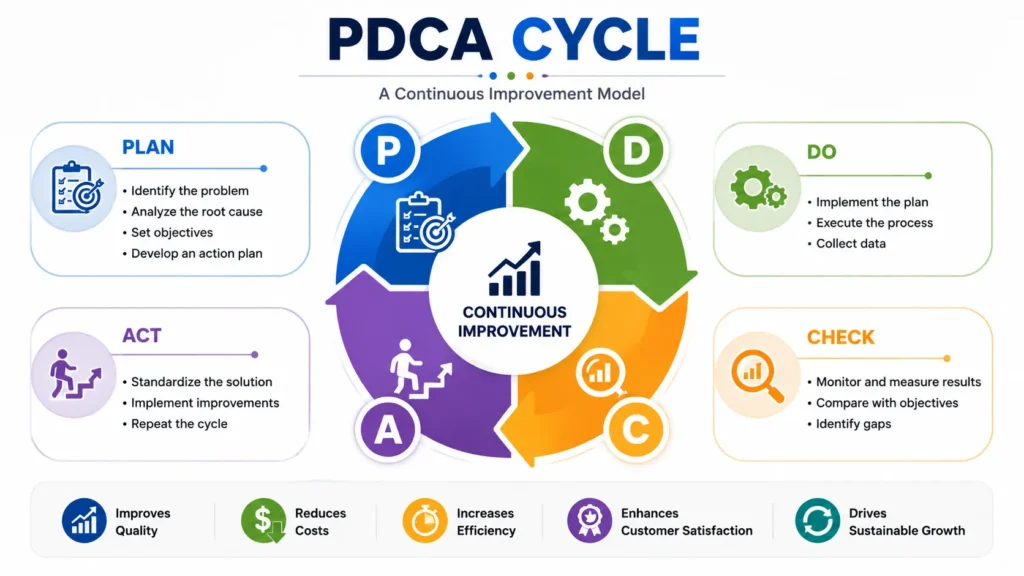
The PDCA Cycle, also known as the Deming Cycle, is one of the most widely used continuous improvement frameworks in quality management. It provides a simple yet highly effective method for testing improvements, evaluating outcomes, and standardising successful changes.
The four stages include:
Plan
Identify a problem, analyse the current situation, define objectives, and develop an improvement strategy.
Do
Implement the planned solution on a small scale while documenting observations and collecting performance data.
Check
Measure results, compare outcomes against objectives, and determine whether the improvement achieved the desired effect.
Act
If successful, standardise the improvement across the organisation. If not, refine the approach and repeat the cycle.
Benefits of PDCA
- Supports continuous improvement
- Encourages evidence-based decision-making
- Reduces process variation
- Improves organisational learning
- Enhances operational efficiency
PDCA is applicable to organisations of every size and industry.
2. Six Sigma
Six Sigma is a structured, data-driven methodology designed to improve quality by reducing defects, process variation, and operational inefficiencies.
Its primary objective is to achieve near-perfect process performance through statistical analysis and disciplined problem-solving.
Six Sigma commonly follows the DMAIC framework:
- Define
- Measure
- Analyse
- Improve
- Control
Benefits of Six Sigma
- Reduces defects
- Improves productivity
- Enhances customer satisfaction
- Supports data-driven decision-making
- Reduces operational costs
- Improves process capability
Many organisations value Six Sigma certifications such as Green Belt, Black Belt, and Master Black Belt.
3. Lean Management
Lean Management focuses on delivering maximum customer value while eliminating activities that do not add value.
Rather than increasing resources, Lean seeks to improve efficiency by removing waste from organisational processes.
Common types of waste include:
- Overproduction
- Waiting time
- Excess transportation
- Unnecessary movement
- Excess inventory
- Defects
- Over-processing
- Underutilised talent
Benefits of Lean
- Faster production
- Lower operating costs
- Reduced waste
- Improved workflow
- Better customer value
- Increased productivity
Lean principles are widely used in manufacturing, healthcare, logistics, construction, and service industries.
4. Statistical Process Control (SPC)
Statistical Process Control (SPC) is a quality control methodology that uses statistical techniques to monitor process performance and identify variations before defects occur.
Instead of waiting until finished products fail inspection, SPC continuously monitors production data to maintain stable and capable processes.
Common SPC tools include:
- Control Charts
- Histograms
- Process Capability Analysis
- Scatter Diagrams
- Check Sheets
Benefits of SPC
- Early defect detection
- Improved process stability
- Reduced waste
- Better decision-making
- Consistent product quality
5. Root Cause Analysis (RCA)
Root Cause Analysis is a structured method used to identify the underlying causes of problems rather than simply correcting their symptoms.
Instead of asking:
“What happened?”
Quality professionals ask:
“Why did it happen?”
Finding the true cause prevents recurring issues.
Common RCA Techniques
- 5 Whys
- Fishbone Diagram
- Pareto Analysis
- Fault Tree Analysis
- Cause-and-Effect Analysis
Benefits
- Permanent solutions
- Reduced recurring defects
- Better decision-making
- Improved process reliability
6. Fishbone (Ishikawa) Diagram
The Fishbone Diagram visually identifies possible causes of a quality problem by grouping them into categories.
Typical categories include:
- People
- Methods
- Machines
- Materials
- Measurements
- Environment
This tool helps quality teams brainstorm systematically before implementing corrective actions.
7. Pareto Analysis
Pareto Analysis is based on the 80/20 Principle, which suggests that a relatively small number of causes are responsible for the majority of problems.
By identifying the “vital few” causes, organisations can prioritise improvement efforts where they will have the greatest impact.
Benefits
- Better prioritisation
- Faster improvement
- Efficient resource allocation
- Reduced recurring issues
8. Failure Mode and Effects Analysis (FMEA)
Failure Mode and Effects Analysis (FMEA) is a proactive risk assessment tool used to identify potential failures before they occur.
For each potential failure, teams evaluate:
- What could fail?
- Why could it fail?
- What would be the impact?
- How likely is it to occur?
- How can it be prevented?
Benefits
- Early risk identification
- Improved product reliability
- Enhanced process safety
- Reduced recalls
- Better preventive planning
FMEA is widely used in automotive, aerospace, healthcare, engineering, and manufacturing industries.
9. Corrective and Preventive Action (CAPA)
CAPA is a structured quality management process used to investigate non-conformities, eliminate root causes, and prevent recurrence.
Corrective Action
Addresses an existing problem.
Preventive Action
Prevents a potential problem before it occurs.
A typical CAPA process includes:
- Problem identification
- Investigation
- Root cause analysis
- Action planning
- Implementation
- Verification of effectiveness
CAPA is a core requirement in many regulated industries, particularly pharmaceuticals and medical devices.
10. Internal Quality Audits
Internal audits evaluate whether organisational processes comply with established procedures, standards, and regulatory requirements.
Audits help organisations:
- Verify compliance
- Identify improvement opportunities
- Assess process effectiveness
- Reduce organisational risks
- Prepare for external certification audits
Regular audits strengthen quality culture and promote continual improvement.
Common Quality Assurance Documents
Quality Assurance relies heavily on documented information to ensure consistency, traceability, and compliance.
Common QA documents include:
- Quality Policy
- Quality Manual
- Standard Operating Procedures (SOPs)
- Work Instructions
- Process Flowcharts
- Quality Plans
- Risk Assessment Reports
- Training Records
- Internal Audit Reports
- CAPA Reports
- Supplier Evaluation Reports
- Management Review Minutes
- Change Control Records
- Validation Protocols
These documents ensure that quality processes are standardised and consistently followed across the organisation.
Common Quality Control Documents
Quality Control focuses on documenting inspections, testing, and product verification.
Typical QC documents include:
- Incoming Material Inspection Reports
- In-Process Inspection Reports
- Final Inspection Reports
- Test Certificates
- Material Test Certificates (MTCs)
- Laboratory Test Reports
- Calibration Certificates
- Non-Conformance Reports (NCRs)
- Product Release Forms
- Sampling Records
- Inspection Checklists
- Product Verification Records
These records provide objective evidence that products meet specified quality requirements.
Key Quality Performance Indicators (KPIs)
Measuring quality performance helps organisations monitor progress and identify opportunities for improvement.
Common QA and QC KPIs include:
| KPI | Purpose |
|---|---|
| Defect Rate | Measures the percentage of defective products or services. |
| First Pass Yield (FPY) | Indicates how many products meet requirements without rework. |
| Customer Complaint Rate | Tracks customer-reported quality issues. |
| Rework Rate | Measures the amount of work requiring correction. |
| Scrap Rate | Evaluates waste generated during production. |
| Audit Findings | Assesses compliance with quality standards. |
| CAPA Closure Time | Measures how quickly quality issues are resolved. |
| Supplier Defect Rate | Monitors the quality performance of suppliers. |
| On-Time Delivery | Reflects operational reliability and customer service. |
| Customer Satisfaction Score | Indicates overall customer perception of quality. |
Regular monitoring of these KPIs enables organisations to make informed, data-driven decisions and continuously improve quality performance.
Best Practices for Effective Quality Management
Organisations with mature Quality Management Systems often share several common practices:
- Establish clear quality objectives aligned with business goals.
- Develop and maintain documented procedures.
- Provide ongoing employee training and competency development.
- Engage leadership in quality initiatives.
- Conduct regular internal audits and management reviews.
- Use data and KPIs to drive decision-making.
- Apply risk-based thinking throughout operations.
- Encourage open communication and employee involvement.
- Collaborate closely with suppliers and stakeholders.
- Foster a culture of continual improvement rather than fault-finding.
Adopting these practices helps organisations achieve consistent performance, regulatory compliance, and long-term customer trust.
Common Quality Management Mistakes to Avoid
Even organisations with established quality systems can undermine performance by making avoidable mistakes.
Some of the most common pitfalls include:
- Treating quality as the responsibility of only the QA or QC department.
- Relying solely on inspection rather than improving processes.
- Failing to document procedures and maintain accurate records.
- Ignoring customer feedback and complaint trends.
- Providing insufficient training for employees.
- Neglecting supplier quality management.
- Delaying corrective actions after identifying defects.
- Collecting performance data without analysing it for improvement opportunities.
- Viewing audits as compliance exercises rather than learning opportunities.
- Resisting change and continuous improvement initiatives.
Avoiding these mistakes helps organisations build a stronger quality culture and achieve sustainable operational excellence.
Key Takeaways
Quality management tools and techniques provide the practical framework for preventing defects, improving processes, and delivering consistent results. Methodologies such as PDCA, Six Sigma, Lean, SPC, Root Cause Analysis, FMEA, CAPA, and Internal Audits enable organisations to identify risks, solve problems systematically, and support continual improvement. When combined with robust documentation, meaningful performance indicators, and industry best practices, these tools transform Quality Assurance and Quality Control from routine compliance activities into strategic drivers of business success.
Quality Assurance and Quality Control Across Different Industries
Quality Assurance (QA) and Quality Control (QC) are fundamental to almost every industry. Although the core principles remain consistent, their implementation varies depending on the products, services, regulatory requirements, operational risks, and customer expectations within each sector.
As industries continue to embrace digital transformation, automation, and international quality standards, the demand for skilled quality professionals continues to grow. Below are some of the major industries where QA and QC play a critical role.
Manufacturing Industry
Manufacturing is one of the largest employers of quality professionals. Product defects can result in customer complaints, warranty claims, recalls, production delays, and significant financial losses.
Quality Assurance Activities
- Developing manufacturing procedures
- Machine calibration programmes
- Employee competency training
- Supplier qualification
- Process validation
- Production planning
- Internal quality audits
Quality Control Activities
- Incoming material inspection
- In-process inspection
- Finished product testing
- Dimensional measurements
- Sampling inspections
- Product verification
- Packaging inspection
Benefits
- Improved product consistency
- Reduced manufacturing defects
- Lower production costs
- Higher customer satisfaction
- Increased productivity
Healthcare Industry
Healthcare organisations depend on quality management to protect patient safety and improve clinical outcomes.
QA Activities
- Clinical governance
- Healthcare protocols
- Staff competency programmes
- Infection prevention procedures
- Internal audits
- Regulatory compliance
QC Activities
- Laboratory testing
- Medical equipment inspection
- Patient record reviews
- Medication verification
- Clinical performance monitoring
Benefits
- Improved patient safety
- Better treatment outcomes
- Reduced medical errors
- Regulatory compliance
- Increased public confidence
Pharmaceutical Industry
Pharmaceutical manufacturing requires some of the strictest quality systems in the world.
QA Activities
- Good Manufacturing Practice (GMP)
- Validation
- Change control
- Documentation
- Supplier qualification
- Risk management
QC Activities
- Chemical testing
- Microbiological testing
- Stability studies
- Batch release testing
- Raw material verification
Benefits
- Safe medicines
- Regulatory compliance
- Product consistency
- Reduced recalls
- Improved patient safety
Construction Industry
Construction projects require quality throughout planning, execution, and project completion.
QA Activities
- Design reviews
- Contractor qualification
- Method statements
- Inspection planning
- Risk assessment
QC Activities
- Concrete testing
- Welding inspection
- Reinforcement inspection
- Material verification
- Site inspections
Benefits
- Safer structures
- Compliance with engineering standards
- Reduced rework
- Better project quality
- Increased client satisfaction
Information Technology Industry
Quality management is equally important in software development.
QA Activities
- Coding standards
- Development methodology
- Requirement reviews
- Process documentation
- Security planning
QC Activities
- Software testing
- Functional testing
- Performance testing
- Security testing
- User acceptance testing
Benefits
- Better software quality
- Improved customer experience
- Reduced software bugs
- Faster product releases
- Enhanced cybersecurity
Food and Beverage Industry
Consumers expect food products that are safe, hygienic, and consistent.
QA Activities
- HACCP implementation
- Hygiene procedures
- Supplier approval
- Food safety management
- Process validation
QC Activities
- Product sampling
- Laboratory analysis
- Packaging inspection
- Shelf-life testing
- Temperature monitoring
Benefits
- Consumer safety
- Regulatory compliance
- Reduced contamination
- Increased customer trust
Aviation Industry
Even the smallest quality failure can have serious consequences.
QA Activities
- Maintenance procedures
- Regulatory compliance
- Documentation control
- Safety management
QC Activities
- Aircraft inspections
- Equipment testing
- Maintenance verification
- Operational monitoring
Benefits
- Passenger safety
- Improved reliability
- Reduced operational risk
- International compliance
Engineering Industry
Engineering organisations rely heavily on QA and QC throughout design, manufacturing, installation, and commissioning.
Typical activities include:
- Material inspection
- Welding quality
- Mechanical testing
- Design verification
- Process validation
- Final inspection
Logistics and Supply Chain
Quality management extends beyond production.
Logistics companies use QA and QC to improve:
- Inventory accuracy
- Warehouse operations
- Packaging quality
- Delivery performance
- Supplier management
Essential Skills for Quality Professionals
Successful Quality Assurance and Quality Control professionals combine technical expertise with strong interpersonal skills.
Employers increasingly seek individuals who can analyse complex data, solve problems systematically, communicate effectively, and drive organisational improvement.
Technical Skills
Modern quality professionals should possess knowledge of:
- ISO 9001 Quality Management Systems
- Internal auditing
- Risk assessment
- Statistical Process Control (SPC)
- Root Cause Analysis (RCA)
- CAPA
- FMEA
- Six Sigma
- Lean Management
- Process mapping
- Documentation management
- Data analysis
- Regulatory compliance
- Quality planning
- Supplier quality management
- Validation
- Inspection techniques
- Measurement systems
- Report writing
Soft Skills
Technical expertise alone is not enough.
Successful quality professionals also demonstrate
Daily Responsibilities of a Quality Assurance Professional
Quality Assurance professionals focus on preventing problems before they occur.
Typical responsibilities include
- Developing SOPs
- Conducting internal audits
- Managing Quality Management Systems
- Reviewing documentation
- Monitoring compliance
- Employee training
- Supplier evaluations
- Risk assessments
- Process improvement
- CAPA management
Daily Responsibilities of a Quality Control Professional
Quality Control professionals verify that products meet specifications.
Their responsibilities include:
- Product inspections
- Laboratory testing
- Sampling
- Measurements
- Inspection reporting
- Product acceptance
- Calibration verification
- Non-conformance reporting
- Final inspections
- Customer complaint investigations
Career Opportunities in Quality Assurance and Quality Control
Quality professionals are employed across virtually every industry.
Popular career opportunities include:
- Quality Assurance Officer
- Quality Control Inspector
- Quality Engineer
- Manufacturing Quality Engineer
- Supplier Quality Engineer
- Process Improvement Specialist
- Quality Auditor
- Internal Auditor
- Compliance Officer
- Validation Specialist
- GMP Officer
- Laboratory Quality Officer
- Regulatory Affairs Specialist
- Quality Systems Coordinator
- CAPA Specialist
- Food Safety Officer
- Medical Device Quality Engineer
- Construction QA/QC Engineer
- Welding Inspector
- Quality Manager
- Head of Quality
- Director of Quality
Typical Career Progression
A quality career often follows this progression:
Quality Technician
↓
Quality Inspector
↓
Quality Assurance Officer
↓
Quality Engineer
↓
Senior Quality Engineer
↓
Quality Manager
↓
Head of Quality
↓
Quality Director
With experience, professionals may also move into consultancy, auditing, operations management, regulatory affairs, or executive leadership.
International Certifications for Quality Professionals
Professional certifications demonstrate competence, enhance credibility, and improve career prospects.
Widely recognised certifications include:
ISO 9001 Lead Auditor
Develops expertise in auditing Quality Management Systems against ISO 9001 requirements.
ISO 9001 Internal Auditor
Ideal for professionals responsible for internal audits and compliance monitoring.
Six Sigma Green Belt
Focuses on process improvement using statistical techniques and the DMAIC methodology.
Six Sigma Black Belt
An advanced certification for professionals leading complex improvement projects and organisational transformation.
Lean Management Certification
Provides practical skills for improving efficiency, reducing waste, and increasing customer value.
Certified Quality Engineer (CQE)
Recognised internationally for engineers responsible for quality planning, process improvement, and quality system implementation.
Certified Quality Auditor (CQA)
Designed for professionals responsible for conducting and managing quality audits.
Certified Manager of Quality and Organisational Excellence (CMQ/OE)
Suitable for experienced managers leading quality programmes and organisational improvement initiatives.
Industry-Specific Certifications
Depending on the sector, professionals may also pursue certifications in:
- Good Manufacturing Practice (GMP)
- HACCP
- ISO 13485
- IATF 16949
- ISO/IEC 17025
- Food Safety Management
- Medical Device Quality
- Construction Quality Management
- Pharmaceutical Quality Systems
How to Start a Career in Quality Assurance and Quality Control
Building a successful career in quality management requires continuous learning, practical experience, and professional development.
A recommended pathway includes:
Step 1
Develop a solid understanding of quality management principles.
Step 2
Learn internationally recognised standards such as ISO 9001.
Step 3
Study quality improvement methodologies including Lean, Six Sigma, PDCA, CAPA, and Root Cause Analysis.
Step 4
Develop strong analytical and problem-solving skills.
Step 5
Gain practical experience through internships, entry-level positions, or project work.
Step 6
Complete internationally recognised professional certifications.
Step 7
Stay updated with emerging technologies, industry standards, and regulatory developments.
Continuous professional development is essential, as quality management continues to evolve alongside advances in technology, automation, and global compliance requirements.
Which Career Is Right for You?
Choosing between Quality Assurance and Quality Control depends on your interests and strengths.
| If You Enjoy… | Career Path |
|---|---|
| Improving processes and systems | Quality Assurance |
| Product inspection and testing | Quality Control |
| Solving business problems | Process Improvement |
| Auditing organisations | Quality Auditor |
| Risk management and compliance | Compliance Officer |
| Leading improvement initiatives | Quality Manager |
| Working with statistics and data | Quality Engineer |
| Ensuring regulatory compliance | Regulatory Affairs Specialist |
Both career paths offer excellent opportunities across multiple industries, and many professionals transition between QA and QC roles as they gain experience.
Key Takeaways
Quality Assurance and Quality Control offer rewarding and globally relevant career opportunities across manufacturing, healthcare, pharmaceuticals, construction, food production, information technology, aviation, engineering, logistics, and many other industries. Organisations increasingly value professionals who possess strong technical expertise, analytical thinking, and internationally recognised certifications.
By combining practical experience with continuous professional development and a commitment to quality excellence, aspiring professionals can build successful careers that contribute to safer products, more efficient processes, improved customer satisfaction, and long-term organisational success.
Future Trends in Quality Management
Quality management is undergoing a significant transformation. Traditionally, organisations relied heavily on manual inspections, paper-based documentation, and reactive quality processes. Today, advances in digital technologies are reshaping how businesses monitor, control, and improve quality.
Artificial Intelligence (AI), automation, cloud computing, the Internet of Things (IoT), predictive analytics, and Industry 4.0 technologies are enabling organisations to move from reactive quality management to predictive and preventive quality systems.
Rather than simply identifying defects after they occur, modern quality management focuses on anticipating potential issues, analysing large volumes of operational data, and implementing intelligent solutions that improve quality, reduce waste, and optimise organisational performance.
Professionals who understand these emerging technologies will be well positioned for future career opportunities across manufacturing, healthcare, pharmaceuticals, engineering, logistics, construction, and digital industries.
1. Artificial Intelligence (AI)
Artificial Intelligence is transforming quality management by enabling organisations to analyse vast amounts of data and identify patterns that would be difficult for humans to detect.
AI applications in quality management include:
- Automated visual inspections
- Defect detection using computer vision
- Predictive quality analysis
- Intelligent document review
- Root cause identification
- Quality forecasting
- Smart audit support
AI helps organisations make faster, more accurate, and evidence-based decisions while reducing manual effort.
2. Machine Learning
Machine Learning allows systems to learn from historical data and continuously improve prediction accuracy.
Quality professionals use Machine Learning to:
- Predict equipment failures
- Detect abnormal process behaviour
- Forecast product quality
- Improve process capability
- Identify hidden quality trends
This enables proactive quality management rather than reactive problem-solving.
3. Industry 4.0
Industry 4.0 integrates digital technologies into manufacturing and industrial operations.
Key components include:
- Smart factories
- Connected machines
- Digital production systems
- Real-time monitoring
- Intelligent automation
- Integrated quality management
Quality professionals increasingly work alongside digital technologies rather than relying solely on manual inspection methods.
4. Internet of Things (IoT)
IoT devices continuously collect operational data from equipment, production lines, laboratories, and facilities.
Examples include:
- Temperature monitoring
- Pressure monitoring
- Equipment vibration analysis
- Environmental monitoring
- Production tracking
- Energy monitoring
Real-time monitoring enables organisations to detect quality issues before they affect production.
5. Predictive Analytics
Traditional quality systems often respond to problems after they occur.
Predictive analytics changes this approach by using historical and real-time data to predict future quality risks.
Benefits include:
- Reduced downtime
- Fewer production defects
- Improved maintenance planning
- Better resource utilisation
- Lower operational costs
6. Digital Quality Management Systems (eQMS)
Many organisations are replacing paper-based systems with electronic Quality Management Systems (eQMS).
An eQMS centralises quality activities such as:
- Document control
- CAPA management
- Audit management
- Change control
- Risk management
- Training records
- Supplier quality management
Digital systems improve traceability, accessibility, collaboration, and compliance.
7. Automation and Robotics
Automation continues to improve quality by reducing human error and increasing consistency.
Examples include:
- Automated inspection systems
- Robotic assembly
- Vision inspection cameras
- Automated testing
- Robotic laboratory systems
- Smart packaging inspection
Automation complements Quality Assurance and Quality Control by improving accuracy and efficiency.
8. Sustainability and Quality
Modern organisations increasingly integrate quality management with sustainability initiatives.
Quality systems now support:
- Waste reduction
- Resource efficiency
- Sustainable manufacturing
- Responsible sourcing
- Environmental compliance
- Circular economy practices
Quality and sustainability are becoming closely linked business priorities.
Future Skills Every Quality Professional Should Develop
As technology evolves, employers increasingly seek professionals with both traditional quality expertise and digital capabilities.
Future-focused skills include:
- Artificial Intelligence fundamentals
- Data analytics
- Risk-based thinking
- Statistical analysis
- Digital Quality Management Systems
- Automation technologies
- Cybersecurity awareness
- Business intelligence
- Process optimisation
- Leadership and change management
Combining these skills with strong knowledge of Quality Assurance and Quality Control will significantly enhance career opportunities.
Common Quality Assurance and Quality Control Interview Questions
Preparing for interviews is an important step for anyone pursuing a career in quality management. The following questions are commonly asked by employers across manufacturing, healthcare, pharmaceuticals, construction, food production, and engineering sectors.
General Questions
- What is the difference between Quality Assurance and Quality Control?
- Why is quality important in an organisation?
- What is a Quality Management System (QMS)?
- What are the principles of quality management?
- How do QA and QC work together?
Technical Questions
- What is ISO 9001?
- What is CAPA?
- Explain the PDCA Cycle.
- What is Root Cause Analysis?
- What is Statistical Process Control (SPC)?
- What is FMEA?
- What is Six Sigma?
- What is Lean Management?
- What is a Non-Conformance Report (NCR)?
- How do you conduct an internal audit?
Scenario-Based Questions
- Describe a quality problem you solved.
- How would you handle a recurring defect?
- What would you do if a supplier repeatedly delivered non-conforming materials?
- How would you investigate a customer complaint?
- How do you prioritise corrective actions?
Preparing thoughtful answers to these questions demonstrates both technical knowledge and problem-solving ability.
Final Thoughts
Quality Assurance and Quality Control are essential pillars of effective quality management. While Quality Assurance focuses on building reliable processes that prevent defects, Quality Control ensures that products and services consistently meet defined quality requirements. Together, they help organisations improve efficiency, maintain compliance, reduce costs, strengthen customer trust, and achieve long-term business success.
As industries continue to evolve through digital transformation, automation, and data-driven decision-making, quality professionals who combine technical expertise with continuous learning will remain highly valued. Understanding international standards, adopting modern quality tools, and embracing emerging technologies such as Artificial Intelligence and predictive analytics will enable organisations and professionals alike to meet future challenges with confidence.
Whether your goal is to improve organisational performance, enhance product quality, or build a rewarding career in quality management, developing a strong foundation in Quality Assurance and Quality Control is a valuable investment that delivers long-term benefits.
Start Your Quality Management Journey with Inspire College
If you are looking to develop practical skills and internationally recognised knowledge in Quality Assurance, Quality Control, auditing, compliance, or quality management systems, Inspire College offers a range of professional training programmes designed to support learners at different stages of their careers.
Our quality management courses combine industry-relevant knowledge with practical applications to help learners understand international standards, improve organisational processes, and develop the competencies required by employers across manufacturing, healthcare, construction, engineering, food production, pharmaceuticals, and many other sectors.
Explore our Quality Management courses and take the next step towards building a successful career in quality and continuous improvement.