How Quality Control Improves Product Safety and Customer Satisfaction
In today’s competitive global marketplace, quality is no longer a competitive advantage—it is a business necessity. Customers expect products that are safe, reliable, durable, and consistently meet their expectations. Whether purchasing food, medicines, electronics, vehicles, construction materials, or consumer goods, buyers place their trust in organisations to deliver products that perform as promised without compromising safety or quality.
To meet these expectations, organisations across manufacturing, healthcare, pharmaceuticals, construction, food production, automotive, aerospace, engineering, and many other industries rely on effective Quality Control (QC) systems. Quality Control is a structured process that ensures products meet established quality standards before they reach customers. Through inspections, testing, measurements, and continuous monitoring, organisations can identify defects, minimise risks, maintain compliance, and deliver products that consistently satisfy customer requirements.
Beyond improving product quality, Quality Control plays a vital role in protecting public safety. Defective products can lead to equipment failures, financial losses, regulatory penalties, product recalls, reputational damage, and even serious injuries. By detecting and correcting issues early in the production process, Quality Control helps organisations reduce these risks while improving operational efficiency and customer confidence.
Customer satisfaction is equally influenced by the effectiveness of Quality Control. Consumers are more likely to remain loyal to brands that consistently deliver reliable products. Fewer defects, reduced returns, improved product performance, and consistent quality all contribute to stronger customer relationships, positive reviews, and long-term business success.
As industries continue adopting advanced technologies such as automation, artificial intelligence, smart manufacturing, and digital quality management systems, the role of Quality Control is becoming even more strategic. Modern quality professionals are no longer responsible solely for inspecting finished products—they actively contribute to process improvement, risk management, operational excellence, and continuous improvement throughout the entire product lifecycle.
In this guide, you’ll discover how Quality Control improves product safety, enhances customer satisfaction, supports regulatory compliance, reduces operational costs, and helps organisations build a strong reputation for quality. Whether you’re a learner exploring quality management or a professional looking to understand the importance of Quality Control, this article provides practical insights into one of the most valuable disciplines in modern industry.
Quality Standards
↓
Inspection
↓
Testing
↓
Defect Detection
↓
Product Approval
↓
Customer Satisfaction
What Is Quality Control?
Quality Control (QC) is the systematic process of inspecting, testing, measuring, and monitoring products to ensure they meet defined quality standards before reaching customers. It focuses on identifying defects, inconsistencies, or non-conformities during or after production so that corrective action can be taken before products are released to the market.
The primary objective of Quality Control is to ensure that every product consistently meets customer expectations, regulatory requirements, and organisational quality standards.
Rather than relying on assumptions, Quality Control uses measurable criteria to verify that products comply with specifications for performance, safety, durability, dimensions, appearance, and functionality.
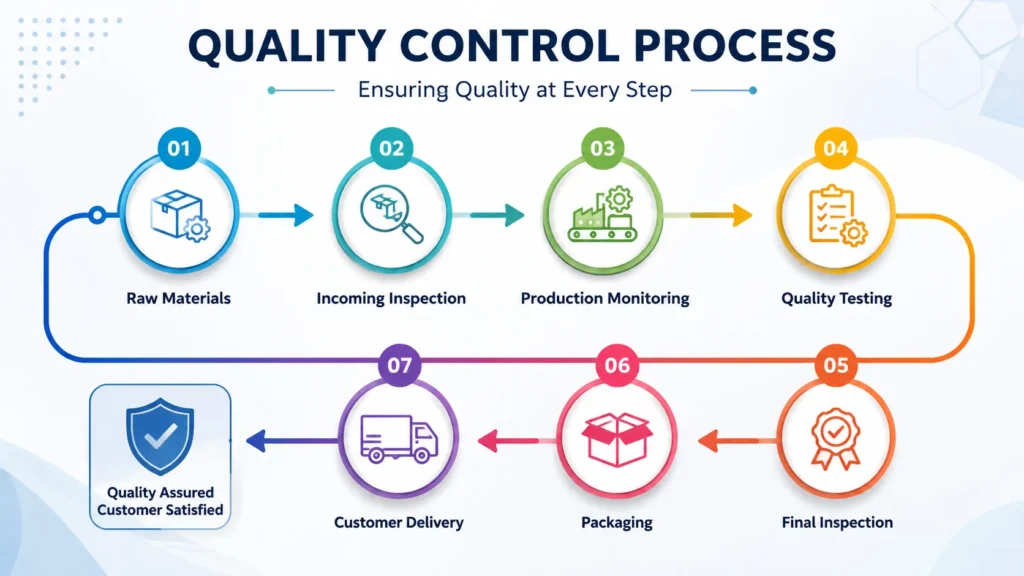
Typical Quality Control activities include:
- Inspecting incoming raw materials
- Monitoring production processes
- Testing finished products
- Measuring product dimensions
- Verifying compliance with specifications
- Recording inspection results
- Identifying defects and non-conformities
- Supporting corrective and preventive actions
- Monitoring product consistency
- Approving products before shipment
By implementing these activities throughout production, organisations can detect problems early, reduce waste, and prevent defective products from reaching customers.
The Difference Between Quality Control and Quality Assurance
Although the terms are often used interchangeably, Quality Control and Quality Assurance have different objectives. Understanding the distinction helps organisations build stronger quality management systems.
| Quality Control | Quality Assurance |
|---|---|
| Focuses on products | Focuses on processes |
| Detects defects | Prevents defects |
| Inspection-based | Planning-based |
| Reactive approach | Proactive approach |
| Product testing | Process improvement |
| Verifies quality | Builds quality into operations |
In simple terms, Quality Assurance creates the system, while Quality Control verifies that the system is producing quality products. Together, they form the foundation of an effective Quality Management System.
Why Quality Control Matters in Modern Industries
As industries become more competitive and customer expectations continue to rise, organisations can no longer rely on end-of-production inspections alone. Quality must be maintained throughout every stage of product development, manufacturing, packaging, storage, and delivery.
Effective Quality Control provides significant benefits for businesses, employees, and customers alike.
Protects Product Safety
Product safety is one of the most important objectives of Quality Control. A single defective product can result in customer injuries, product recalls, legal claims, regulatory action, and lasting damage to an organisation’s reputation.
Quality Control helps identify unsafe materials, manufacturing errors, contamination, faulty components, and performance issues before products reach the market.
For example:
- A pharmaceutical manufacturer tests every batch of medicine to ensure it meets safety and dosage requirements.
- A food producer inspects products for contamination before packaging and distribution.
- An automotive manufacturer verifies the quality of braking systems before vehicles leave the production line.
- An electronics company tests electrical components to reduce the risk of malfunction or fire hazards.
By preventing unsafe products from reaching consumers, Quality Control plays a critical role in protecting public health and safety.
Builds Customer Trust
Customers expect products to perform consistently every time they make a purchase. Receiving defective or unreliable products can quickly erode confidence in a brand.
Effective Quality Control helps organisations deliver products that consistently meet customer expectations by:
- Reducing product defects
- Improving product reliability
- Maintaining consistent quality
- Preventing manufacturing errors
- Delivering products that perform as intended
When customers consistently receive high-quality products, they are more likely to make repeat purchases, recommend the brand to others, and develop long-term loyalty.
Reduces Operational Costs
Many organisations mistakenly believe that Quality Control increases production costs. In reality, effective Quality Control often reduces overall operating expenses by identifying problems before they become expensive.
Quality Control helps reduce costs associated with:
- Product rework
- Scrap materials
- Warranty claims
- Product recalls
- Customer complaints
- Returns and replacements
- Production downtime
- Emergency corrective actions
Preventing defects early in the production process is almost always less expensive than correcting problems after products have been manufactured or delivered.
Supports Regulatory Compliance
Many industries operate under strict legal and regulatory requirements designed to protect consumers and ensure product safety.
Quality Control helps organisations demonstrate compliance by:
- Maintaining accurate inspection records
- Verifying product specifications
- Supporting regulatory audits
- Monitoring manufacturing consistency
- Meeting customer contractual requirements
- Ensuring products satisfy applicable standards
Strong Quality Control systems reduce the risk of regulatory penalties while strengthening customer confidence.
Improves Manufacturing Efficiency
Quality Control is not limited to identifying defective products. It also provides valuable data that organisations can use to improve production processes.
Inspection results often reveal patterns that indicate:
- Equipment problems
- Process variations
- Supplier issues
- Material inconsistencies
- Training requirements
- Opportunities for process improvement
Addressing these issues helps organisations increase productivity, reduce waste, improve resource utilisation, and maintain consistent product quality.
Strengthens Brand Reputation
A company’s reputation is built on the quality of its products and the trust of its customers.
Organisations known for consistent quality often enjoy:
- Stronger customer loyalty
- Positive online reviews
- Higher customer retention
- Increased market share
- Greater competitive advantage
- Improved business growth
Conversely, poor Quality Control can lead to damaged reputations that may take years to rebuild.
Encourages Continuous Improvement
Modern Quality Control supports a culture of continuous improvement rather than simply identifying defects.
Inspection findings provide valuable insights that help organisations:
- Improve production processes
- Enhance product design
- Reduce operational risks
- Increase efficiency
- Improve employee performance
- Deliver greater value to customers
Continuous improvement enables organisations to remain competitive while adapting to changing customer expectations and technological advancements.
The Business Impact of Effective Quality Control
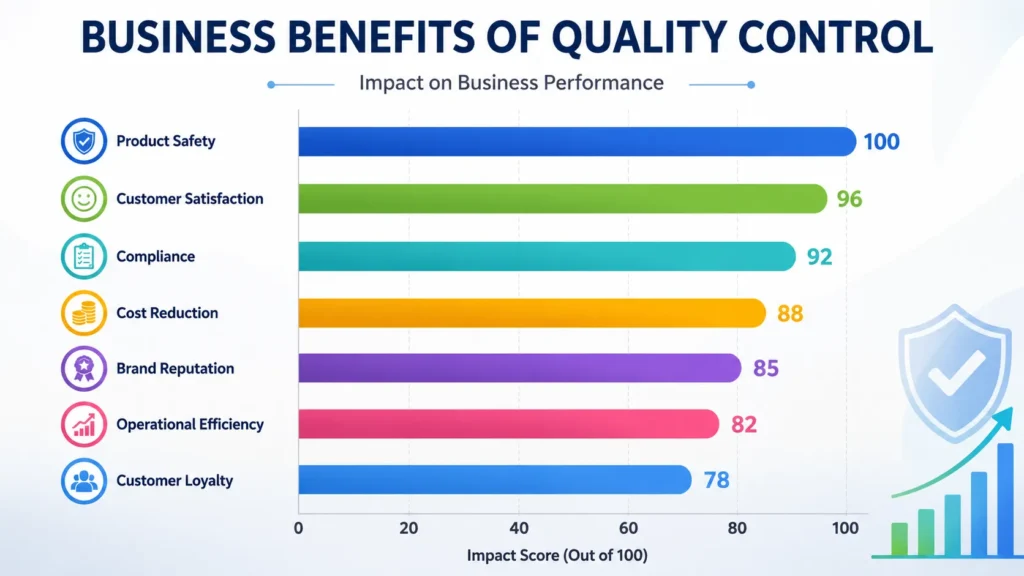
The benefits of Quality Control extend beyond the production floor. It influences every aspect of organisational performance, from customer satisfaction and operational efficiency to financial performance and long-term sustainability.
Businesses that invest in robust Quality Control systems are better positioned to:
- Deliver safer products
- Build stronger customer relationships
- Reduce manufacturing costs
- Improve operational efficiency
- Achieve regulatory compliance
- Strengthen supplier performance
- Minimise business risks
- Increase profitability
- Support sustainable growth
- Enhance brand reputation
Rather than viewing Quality Control as a cost, successful organisations recognise it as a strategic investment that creates long-term value for both the business and its customers.
How Quality Control Improves Product Safety
Product safety is one of the most important objectives of Quality Control. Every product placed on the market should perform as intended without creating unnecessary risks for customers. Whether it is a medical device, packaged food, construction material, electrical appliance, pharmaceutical product, or vehicle component, safety must be built into every stage of production.
Quality Control helps organisations identify defects, verify compliance with specifications, and ensure products meet both customer expectations and regulatory requirements before they reach the end user.
Detecting Defects Before Products Reach Customers
One defective product can have serious consequences, including product recalls, financial losses, legal claims, reputational damage, and customer injuries. Effective Quality Control prevents these risks by identifying defects as early as possible.
Quality professionals carry out activities such as:
- Inspecting raw materials
- Monitoring manufacturing processes
- Testing finished products
- Verifying product dimensions
- Checking product functionality
- Confirming compliance with specifications
Early detection allows organisations to correct problems before defective products are distributed, protecting both customers and the business.
Ensuring Compliance with Safety Standards
Many industries operate under strict quality and safety regulations. Organisations must demonstrate that their products comply with recognised standards and legal requirements before they can be sold.
Quality Control supports compliance by:
- Performing routine inspections
- Maintaining quality records
- Conducting laboratory testing
- Monitoring production consistency
- Verifying product specifications
- Supporting internal and external audits
This systematic approach helps organisations reduce regulatory risks while ensuring products are safe for their intended use.
Preventing Manufacturing Errors
Even highly automated production systems can experience equipment failures, material inconsistencies, or human errors. Without proper Quality Control, these issues may go unnoticed until products reach customers.
Routine inspections help identify problems such as:
- Incorrect measurements
- Assembly defects
- Material contamination
- Damaged components
- Packaging errors
- Labelling mistakes
- Equipment calibration issues
Addressing these issues during production significantly reduces the likelihood of defective products entering the market.
Improving Product Reliability
Customers expect products to perform consistently throughout their intended lifespan. Quality Control ensures that products not only meet safety requirements but also deliver reliable performance.
Reliability testing may include:
- Functional testing
- Performance verification
- Durability testing
- Stress testing
- Environmental testing
- Load testing
- Electrical safety testing
By verifying product performance before distribution, organisations increase customer confidence and reduce warranty claims.
Supporting Risk Management
Quality Control contributes directly to organisational risk management by identifying potential failures before they become major problems.
Examples include:
- Detecting faulty raw materials
- Identifying supplier quality issues
- Preventing contaminated products
- Reducing equipment failures
- Monitoring process variation
- Controlling production consistency
Managing these risks helps organisations protect customers while maintaining operational stability.
Real-World Examples of Product Safety Through Quality Control
Understanding how Quality Control is applied across different industries demonstrates its importance in protecting consumers.
Manufacturing
Manufacturers inspect raw materials before production begins to ensure they meet required specifications. During production, inspectors monitor machinery, measure product dimensions, and perform final inspections before products are packaged.
This process helps reduce defects, improve consistency, and prevent unsafe products from reaching customers.
Food and Beverage
Food manufacturers rely heavily on Quality Control to maintain hygiene, prevent contamination, and ensure food safety.
Quality professionals monitor:
- Raw ingredients
- Processing conditions
- Temperature controls
- Packaging quality
- Expiry dates
- Storage conditions
These inspections help protect consumers while ensuring compliance with food safety regulations.
Pharmaceutical Industry
Medicines must meet strict quality requirements before being released for public use.
Quality Control teams conduct:
- Batch testing
- Laboratory analysis
- Stability testing
- Packaging verification
- Documentation reviews
These activities ensure medicines remain safe, effective, and compliant with regulatory standards.
Automotive Industry
Vehicle safety depends on thousands of components functioning correctly.
Quality Control supports product safety by inspecting:
- Brake systems
- Steering components
- Electrical systems
- Engine parts
- Airbag assemblies
- Structural components
Comprehensive inspections help reduce safety risks while improving vehicle reliability.
Construction
Construction materials and completed structures must meet engineering specifications and safety requirements.
Quality Control professionals inspect:
- Concrete strength
- Steel quality
- Welding integrity
- Structural dimensions
- Installation quality
- Building materials
These inspections help ensure structures remain safe throughout their operational life.
How Quality Control Enhances Customer Satisfaction
While product safety protects customers, customer satisfaction determines whether they return to purchase again. Organisations that consistently deliver high-quality products earn stronger customer trust, positive reviews, and long-term loyalty.
Quality Control plays a direct role in creating positive customer experiences by ensuring products consistently meet or exceed expectations.
Delivering Consistent Product Quality
Customers expect consistency regardless of when or where they purchase a product.
Effective Quality Control ensures:
- Uniform product quality
- Consistent product performance
- Reliable functionality
- Accurate specifications
- Professional appearance
- Reliable packaging
Consistency builds confidence and encourages repeat business.
Reducing Customer Complaints
Every customer complaint represents an opportunity for improvement but also signals that expectations were not fully met.
Quality Control reduces complaints by preventing issues such as:
- Manufacturing defects
- Incorrect assembly
- Product damage
- Missing components
- Poor packaging
- Performance failures
Fewer complaints allow organisations to focus more on innovation and customer service rather than resolving recurring quality issues.
Minimising Product Returns
Product returns create additional costs for organisations while reducing customer confidence.
Effective Quality Control helps minimise returns by ensuring products are thoroughly inspected before shipment.
Benefits include:
- Lower replacement costs
- Reduced warranty claims
- Improved customer confidence
- Better operational efficiency
- Higher customer retention
Reducing returns benefits both businesses and customers.
Building Brand Trust
Customers naturally associate consistent quality with trustworthy brands.
When organisations consistently deliver products that perform as expected, customers are more likely to:
- Purchase again
- Recommend products to others
- Leave positive reviews
- Develop long-term loyalty
- Choose the brand over competitors
Trust takes years to build but can be lost quickly through poor product quality. Effective Quality Control helps protect that trust.
Supporting Continuous Improvement
Customer feedback provides valuable information that organisations can use to improve products and processes.
Quality Control teams analyse:
- Customer complaints
- Inspection reports
- Warranty claims
- Return data
- Production records
- Supplier performance
This information helps organisations identify recurring issues and implement improvements that enhance future customer satisfaction.
Quality Control Throughout the Product Lifecycle
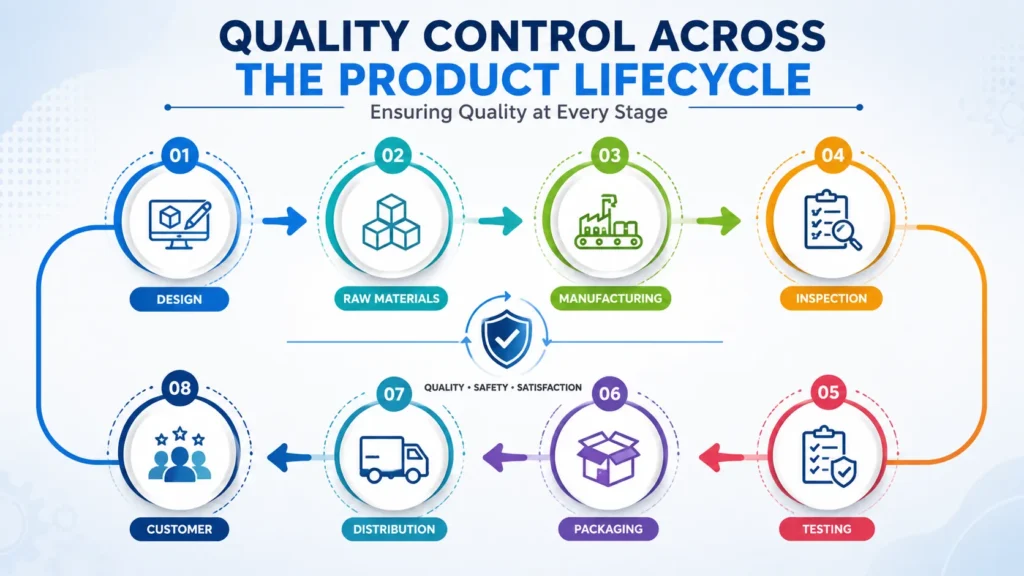
Quality Control is not a single inspection at the end of production. It supports quality at every stage of a product’s lifecycle, from the initial concept to final delivery.
Product Design
Quality begins during the design stage. Engineers and quality professionals work together to ensure products are designed for safety, functionality, and manufacturability.
Activities include:
- Design reviews
- Risk assessments
- Material selection
- Prototype evaluation
- Performance testing
Identifying potential issues during design helps prevent costly problems later in production.
Raw Material Inspection
Product quality depends heavily on the quality of incoming materials.
Quality Control professionals inspect raw materials to verify:
- Dimensions
- Material properties
- Supplier compliance
- Certification documents
- Physical condition
Rejecting unsuitable materials prevents defects from entering the production process.
In-Process Inspection
During manufacturing, inspectors continuously monitor production activities to ensure processes remain within acceptable quality limits.
Typical inspections include:
- Machine calibration
- Dimensional measurements
- Process monitoring
- Sampling inspections
- Visual inspections
- Functional testing
Continuous monitoring allows corrective action to be taken before problems escalate.
Finished Product Testing
Before products leave the factory, comprehensive inspections verify compliance with all quality requirements.
Testing may include:
- Functional testing
- Visual inspection
- Performance evaluation
- Safety verification
- Packaging inspection
- Product labelling review
Only products that satisfy defined quality standards proceed to distribution.
Packaging and Distribution
Even high-quality products can be damaged if packaging and transportation are not properly controlled.
Quality Control ensures:
- Packaging integrity
- Correct labelling
- Safe storage conditions
- Secure transportation
- Distribution accuracy
Proper handling throughout the supply chain protects product quality until it reaches the customer.
Why End-to-End Quality Control Matters
Implementing Quality Control throughout the entire product lifecycle provides significant business advantages.
Organisations can:
- Prevent defects rather than simply detect them
- Improve product safety
- Reduce production waste
- Minimise customer complaints
- Increase operational efficiency
- Strengthen regulatory compliance
- Improve customer satisfaction
- Protect brand reputation
- Support continuous improvement
- Achieve long-term business success
By integrating Quality Control into every stage of operations, businesses create a proactive quality culture that delivers safer products, happier customers, and stronger organisational performance.
Industry-Wise Applications of Quality Control
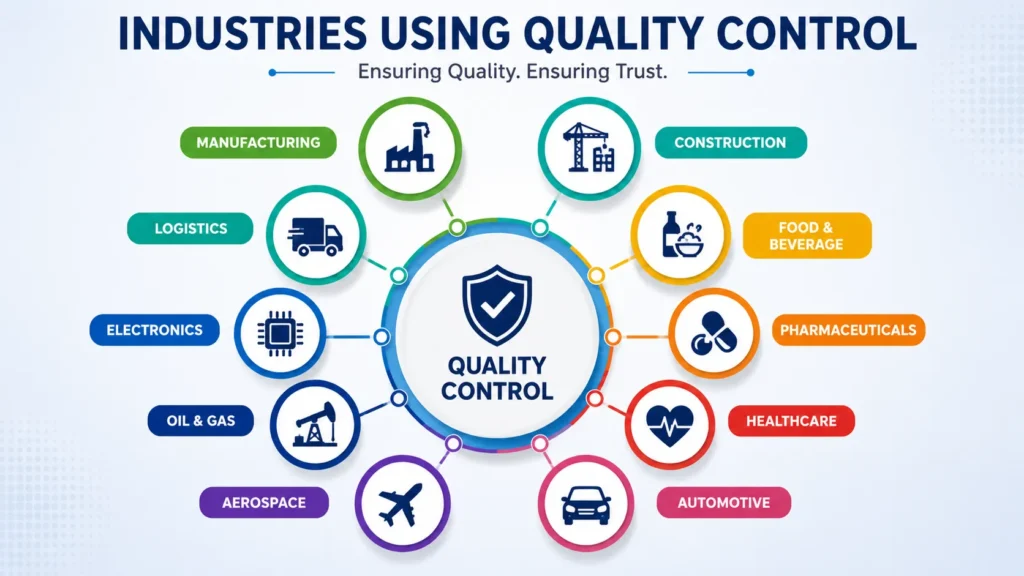
Quality Control is not limited to manufacturing. It is an essential function across numerous industries where product quality, customer safety, regulatory compliance, and operational efficiency are critical. Although the products and processes may differ, the objective remains the same—delivering consistent, safe, and reliable outcomes.
Manufacturing
Manufacturing organisations depend on Quality Control to ensure every product meets design specifications and customer expectations. Quality professionals monitor production processes, inspect finished goods, and identify opportunities for continuous improvement.
Common Quality Control activities include:
- Raw material inspection
- In-process quality checks
- Final product inspection
- Equipment calibration
- Process monitoring
- Defect analysis
- Production reporting
By maintaining consistent quality, manufacturers reduce waste, improve productivity, and strengthen customer confidence.
Food and Beverage Industry
Food safety is one of the most regulated areas of quality management. Consumers expect food products to be safe, hygienic, and consistently produced.
Quality Control teams monitor:
- Ingredient quality
- Hygiene standards
- Processing conditions
- Temperature control
- Packaging integrity
- Shelf-life testing
- Product labelling
These activities help prevent contamination, maintain compliance with food safety regulations, and protect public health.
Pharmaceutical Industry
Pharmaceutical products directly affect human health, making Quality Control a critical component of medicine production.
Quality professionals perform:
- Raw material verification
- Laboratory testing
- Batch inspection
- Stability testing
- Packaging verification
- Documentation review
- Product release approval
Strict Quality Control ensures medicines are safe, effective, and manufactured according to regulatory requirements.
Healthcare and Medical Devices
Hospitals, laboratories, and medical device manufacturers rely on Quality Control to maintain patient safety and operational reliability.
Quality activities include:
- Equipment inspection
- Sterility testing
- Device performance verification
- Calibration checks
- Clinical documentation review
- Regulatory compliance monitoring
Effective Quality Control reduces medical risks while supporting high standards of patient care.
Construction and Infrastructure
Construction projects require continuous quality monitoring to ensure buildings and infrastructure remain safe, durable, and compliant with engineering specifications.
Quality Control professionals inspect:
- Construction materials
- Concrete strength
- Structural steel
- Welding quality
- Site workmanship
- Installation accuracy
- Project documentation
Consistent inspections help prevent structural failures and improve long-term project performance.
Automotive Industry
Automotive manufacturers maintain rigorous Quality Control systems because even minor defects can compromise vehicle safety.
Quality inspections cover:
- Engine components
- Brake systems
- Electrical assemblies
- Suspension systems
- Airbag performance
- Paint quality
- Final vehicle testing
Maintaining high quality standards protects customers while strengthening brand reputation.
Aerospace Industry
The aerospace sector operates with exceptionally high quality expectations due to the critical nature of aircraft safety.
Quality Control activities include:
- Precision measurement
- Material verification
- Component inspection
- Non-destructive testing
- Assembly verification
- Documentation control
- Regulatory compliance
Every inspection contributes to ensuring aircraft components perform safely under demanding operating conditions.
Oil and Gas Industry
Oil and gas operations involve complex equipment operating in challenging environments where quality failures can have significant safety and environmental consequences.
Quality Control supports:
- Pipeline inspections
- Pressure testing
- Welding inspections
- Material verification
- Equipment certification
- Corrosion monitoring
- Maintenance quality
Strong Quality Control reduces operational risks while improving equipment reliability.
Electronics Manufacturing
Modern electronic products contain highly sensitive components that require precise manufacturing and inspection.
Quality Control focuses on:
- Circuit board inspection
- Component verification
- Functional testing
- Software validation
- Assembly inspection
- Packaging quality
This helps manufacturers deliver reliable products while reducing warranty claims.
Essential Quality Control Tools and Techniques
Quality Control relies on proven tools and techniques to identify problems, analyse data, and support continuous improvement. These methods help organisations make objective decisions based on measurable evidence rather than assumptions.
Inspection
Inspection is the most widely recognised Quality Control technique.
It involves examining products or processes to verify compliance with specifications through:
- Visual inspection
- Dimensional measurement
- Functional testing
- Performance verification
- Sampling inspection
Regular inspections help identify defects before products reach customers.
Statistical Process Control (SPC)
Statistical Process Control uses data to monitor manufacturing processes and detect variations before they produce defective products.
Benefits include:
- Early problem detection
- Reduced process variation
- Improved consistency
- Better production efficiency
- Lower defect rates
SPC enables organisations to make data-driven quality decisions.
Check Sheets
Check sheets provide a simple method for collecting and organising quality data during inspections.
They help organisations:
- Record defects
- Identify recurring problems
- Monitor production trends
- Support improvement initiatives
Pareto Analysis
Pareto Analysis helps quality professionals identify the small number of causes responsible for the majority of quality problems.
By focusing improvement efforts on the most significant issues, organisations can achieve better results using fewer resources.
Fishbone Diagram (Cause-and-Effect Diagram)
The Fishbone Diagram is widely used for Root Cause Analysis.
It helps teams investigate possible causes of problems by examining factors such as:
- People
- Processes
- Materials
- Machinery
- Environment
- Measurement
This structured approach supports effective problem-solving and continuous improvement.
Root Cause Analysis (RCA)
Rather than correcting symptoms, Root Cause Analysis identifies the underlying reason why a problem occurred.
Common techniques include:
- 5 Whys
- Fishbone Diagram
- Process Mapping
- Failure Analysis
Eliminating root causes helps prevent recurring defects.
Control Charts
Control Charts monitor process stability over time.
They help organisations determine whether process variation remains within acceptable limits or whether corrective action is required.
Process Flowcharts
Flowcharts provide a visual representation of production or service processes.
Benefits include:
- Better process understanding
- Easier identification of bottlenecks
- Improved communication
- Enhanced process standardisation
Quality Control vs Quality Assurance
Although Quality Control and Quality Assurance work together, they serve different purposes within a Quality Management System.
| Quality Control | Quality Assurance |
|---|---|
| Product-focused | Process-focused |
| Detects defects | Prevents defects |
| Inspection and testing | Planning and system development |
| Reactive approach | Proactive approach |
| Product verification | Process improvement |
| Measures product quality | Builds quality into processes |
| Conducted during and after production | Implemented before and throughout production |
| Ensures products meet specifications | Ensures processes consistently produce quality products |
An effective organisation combines both approaches. Quality Assurance establishes robust systems and procedures, while Quality Control confirms those systems are producing products that meet required standards.
The Cost of Poor Quality (COPQ)
Poor Quality Control can have far-reaching consequences that extend well beyond defective products. Failures in quality management affect customer confidence, financial performance, operational efficiency, and organisational reputation.
Collectively, these impacts are often referred to as the Cost of Poor Quality (COPQ).
Increased Product Recalls
Defective products that reach customers may require large-scale recalls to protect public safety.
Product recalls often result in:
- Financial losses
- Production interruptions
- Regulatory investigations
- Negative media attention
- Customer dissatisfaction
Effective Quality Control significantly reduces the likelihood of costly recalls.
Higher Warranty Claims
Products that fail during normal use generate warranty claims, repair costs, and replacement expenses.
Strong inspection processes reduce these unnecessary costs while improving customer satisfaction.
Production Waste
Poor process control frequently results in:
- Scrap materials
- Rework
- Additional labour
- Machine downtime
- Increased material consumption
Reducing defects improves resource efficiency and lowers operating costs.
Customer Complaints
Defective products create frustration for customers and increase pressure on customer service teams.
Common consequences include:
- Negative online reviews
- Lost repeat business
- Lower customer confidence
- Reduced brand loyalty
Delivering consistent quality helps build stronger customer relationships.
Legal and Regulatory Risks
Organisations that fail to maintain product quality may face:
- Regulatory penalties
- Legal action
- Compliance investigations
- Product liability claims
- Market restrictions
Effective Quality Control supports compliance while protecting organisational credibility.
Damage to Brand Reputation
Reputation is one of a company’s most valuable assets.
Poor quality can quickly damage years of brand-building through:
- Negative publicity
- Social media criticism
- Declining customer trust
- Reduced market share
Maintaining consistent product quality helps organisations protect their reputation and remain competitive.
How Effective Quality Control Creates Business Value
When Quality Control becomes part of an organisation’s culture rather than simply an inspection activity, it delivers measurable benefits across the business.
Effective Quality Control helps organisations:
- Improve product safety
- Increase customer satisfaction
- Reduce operational costs
- Strengthen regulatory compliance
- Improve production efficiency
- Reduce waste and rework
- Support continuous improvement
- Build stronger supplier relationships
- Protect brand reputation
- Increase long-term profitability
Rather than viewing Quality Control as an operational expense, successful organisations recognise it as a strategic investment that improves both business performance and customer confidence.
The Future of Quality Control
Quality Control continues to evolve as industries adopt advanced technologies, stricter regulatory frameworks, and higher customer expectations. While traditional inspection methods remain important, modern organisations increasingly use digital tools to improve accuracy, efficiency, and decision-making throughout the production process.
For quality professionals, this evolution presents exciting opportunities to develop new skills and contribute to organisational success in more strategic ways.
Artificial Intelligence in Quality Control
Artificial Intelligence (AI) is transforming how organisations identify defects and monitor product quality. AI-powered systems can analyse vast amounts of production data, detect patterns that may indicate quality issues, and support faster decision-making.
Some common applications include:
- Automated visual inspections
- Defect detection using machine learning
- Predictive quality analysis
- Image recognition for product testing
- Intelligent quality reporting
Rather than replacing quality professionals, AI enhances their ability to identify risks earlier and focus on continuous improvement initiatives.
Automation and Smart Manufacturing
Modern production facilities increasingly rely on automation to improve consistency and reduce human error. Automated inspection equipment, robotic production lines, and smart sensors provide real-time quality data that helps organisations maintain high standards.
Benefits include:
- Faster inspections
- Improved accuracy
- Reduced production delays
- Better process consistency
- Lower defect rates
- Enhanced productivity
Quality professionals now play an important role in interpreting this data and ensuring automated systems continue to operate effectively.
Data-Driven Quality Management
Today’s organisations generate large volumes of production and inspection data. Modern Quality Control uses this information to identify trends, measure performance, and support evidence-based decision-making.
Data-driven quality management enables organisations to:
- Monitor quality performance in real time
- Identify recurring defects
- Improve process stability
- Reduce production variation
- Support continuous improvement
Professionals who can analyse and interpret quality data are becoming increasingly valuable across multiple industries.
Digital Quality Management Systems
Many organisations are replacing paper-based documentation with integrated digital quality management systems.
These systems simplify:
- Inspection records
- Audit management
- Corrective actions
- Document control
- Risk assessments
- Supplier quality management
- Compliance monitoring
Digital systems improve efficiency while making quality information more accessible across the organisation.
Sustainability and Quality
Sustainability has become an important consideration for modern businesses. Effective Quality Control supports sustainable operations by reducing waste, improving resource utilisation, and increasing production efficiency.
Quality initiatives contribute to sustainability by:
- Minimising defective products
- Reducing material waste
- Improving energy efficiency
- Supporting responsible manufacturing
- Extending product lifespan
- Improving recycling opportunities
Organisations that combine quality excellence with sustainable practices strengthen both their operational performance and corporate reputation.
Best Practices for Building an Effective Quality Control System
An effective Quality Control system requires more than inspections. It depends on consistent processes, skilled employees, reliable data, and a culture focused on continuous improvement.
Organisations seeking to strengthen their Quality Control systems should consider the following best practices.
Establish Clear Quality Standards
Every product should have clearly defined quality requirements based on customer expectations, industry regulations, and organisational objectives.
Clear standards help employees understand exactly what is expected throughout production.
Standardise Inspection Procedures
Using consistent inspection methods reduces variability and improves the reliability of inspection results.
Standard operating procedures should define:
- Inspection methods
- Testing frequency
- Acceptance criteria
- Documentation requirements
- Reporting procedures
Train Employees Regularly
Employees are one of the most important contributors to product quality.
Regular training helps staff:
- Understand quality standards
- Follow inspection procedures
- Recognise defects
- Apply corrective actions
- Maintain compliance with organisational requirements
Continuous learning supports consistent performance across all production activities.
Monitor Performance Continuously
Quality should be monitored throughout production rather than only at the final inspection stage.
Key performance indicators may include:
- Defect rate
- First-pass yield
- Customer complaints
- Product returns
- Rework percentage
- Inspection accuracy
- Process capability
Tracking these indicators enables organisations to identify improvement opportunities before problems become significant.
Encourage Continuous Improvement
Quality Control should support ongoing improvement rather than simply identifying problems.
Successful organisations encourage employees to:
- Report quality concerns
- Suggest process improvements
- Participate in problem-solving
- Share best practices
- Learn from quality data
A culture of continuous improvement strengthens long-term organisational performance.
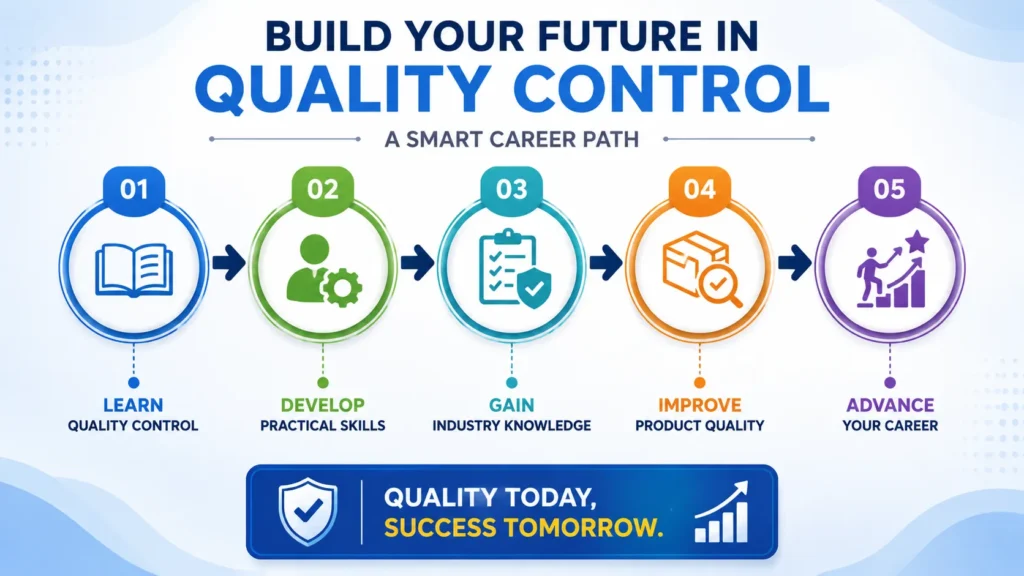
Why Learning Quality Control Is a Smart Career Choice
As businesses continue to prioritise quality, compliance, efficiency, and customer satisfaction, the demand for skilled Quality Control professionals continues to grow across numerous industries.
Quality Control offers excellent career opportunities because its principles apply across manufacturing, engineering, construction, healthcare, pharmaceuticals, food production, logistics, energy, automotive, aerospace, and many other sectors.
Developing Quality Control knowledge helps professionals understand how organisations:
- Maintain product quality
- Improve operational efficiency
- Protect customer safety
- Meet regulatory requirements
- Reduce production costs
- Drive continuous improvement
- Build stronger customer relationships
These transferable skills make Quality Control one of the most versatile and valuable professional disciplines in today’s global economy.
Why Choose Inspire College for Quality Control Education?
Selecting the right training provider is an important step towards building a successful career in quality management.
At Inspire College, Quality Control programmes are designed to provide learners with practical knowledge, industry-relevant skills, and an understanding of internationally recognised quality management principles. The curriculum focuses on real-world applications, helping learners understand how quality systems operate across manufacturing, engineering, construction, healthcare, food production, and other sectors.
Learners develop knowledge in areas such as quality inspection, quality management systems, process improvement, compliance, documentation, risk management, and continuous improvement. This practical approach helps prepare them to contribute effectively within modern workplaces where quality, safety, and customer satisfaction are business priorities.
Whether beginning a new career or strengthening existing professional skills, Quality Control education provides a strong foundation for long-term career development in an increasingly quality-focused global marketplace.
Conclusion
Quality Control is far more than a final inspection before products reach customers. It is a comprehensive approach that helps organisations maintain consistent quality, protect product safety, meet regulatory requirements, and deliver exceptional customer experiences.
Throughout the product lifecycle—from design and raw material inspection to production, testing, packaging, and distribution—Quality Control helps identify risks, prevent defects, and ensure products consistently meet established standards. This proactive approach reduces operational costs, minimises waste, improves efficiency, and protects organisations from costly recalls, warranty claims, and reputational damage.
The benefits extend beyond the production environment. Effective Quality Control strengthens customer confidence by delivering reliable products that consistently meet expectations. Satisfied customers are more likely to remain loyal, recommend trusted brands, and contribute to long-term business growth. For organisations operating in highly competitive markets, maintaining consistent quality has become a key factor in achieving sustainable success.
As technology continues to reshape modern industries, Quality Control will become even more important. Artificial intelligence, automation, smart manufacturing, digital quality management systems, and data-driven decision-making are transforming how organisations monitor quality and improve performance. Professionals who understand both traditional quality principles and emerging technologies will be well positioned to support innovation and operational excellence.
For learners and professionals alike, developing expertise in Quality Control is an investment in a future-ready career. It equips individuals with practical knowledge, analytical skills, and a quality-focused mindset that are valued across diverse industries worldwide. As businesses continue to place greater emphasis on safety, reliability, compliance, and customer satisfaction, Quality Control will remain at the heart of delivering products and services that people can trust.