How QA and QC Ensure Safety and Compliance in Manufacturing
Manufacturing is one of the most quality-driven industries in the world. Whether producing food, pharmaceuticals, medical devices, automotive components, construction materials, electronics, or consumer goods, manufacturers are expected to deliver products that are safe, reliable, compliant, and consistently meet customer expectations. A single manufacturing defect can result in product recalls, financial losses, regulatory penalties, damaged brand reputation, and, in some cases, serious risks to public health and safety.
To prevent these issues, organisations rely on two essential quality management functions: Quality Assurance (QA) and Quality Control (QC). Although these terms are often used interchangeably, they serve different but complementary purposes. Quality Assurance focuses on developing robust systems and processes that prevent defects before production begins, while Quality Control verifies that finished products meet established quality standards through inspection, testing, and measurement.
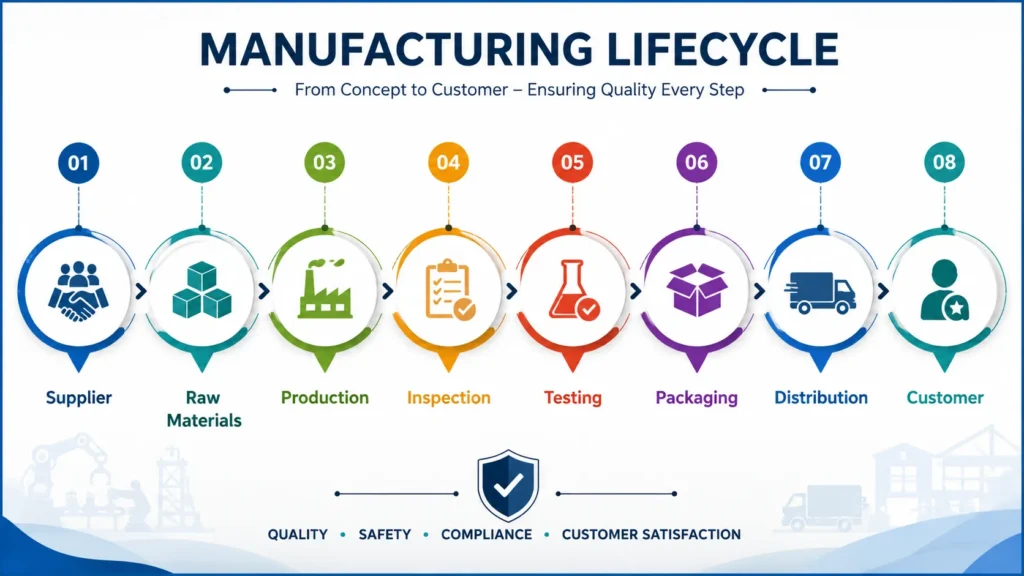
Together, QA and QC create a comprehensive quality management approach that helps manufacturers maintain product consistency, improve operational efficiency, reduce waste, comply with industry regulations, and build long-term customer confidence. Rather than being isolated activities, QA and QC work continuously throughout the manufacturing lifecycle—from product design and supplier selection to production, testing, packaging, distribution, and post-market monitoring.
In today’s manufacturing environment, safety and compliance have become more important than ever. Governments, regulatory authorities, and customers expect manufacturers to demonstrate compliance with recognised standards while maintaining safe working environments and delivering products that perform reliably. Effective QA and QC systems help organisations meet these expectations by identifying risks early, preventing defects, ensuring traceability, and supporting continuous improvement.
Advances in technology are also reshaping modern manufacturing. Artificial intelligence, automation, smart factories, digital quality management systems, machine vision, and real-time data analytics are enabling manufacturers to detect quality issues more quickly and improve decision-making throughout production. Despite these technological advancements, the fundamental principles of Quality Assurance and Quality Control remain central to ensuring manufacturing excellence.
This guide explores how QA and QC work together to improve manufacturing safety, maintain regulatory compliance, protect customers, and support continuous improvement. Whether you are a learner exploring quality management, a manufacturing professional, or someone considering a career in QA and QC, this article provides practical insights into one of the most important disciplines in modern industry.
Quality Assurance
↓
Standard Processes
↓
Controlled Production
↓
Quality Control
↓
Inspection & Testing
↓
Safe & Compliant Products
What Are Quality Assurance (QA) and Quality Control (QC)?
Quality Assurance and Quality Control are two key components of a successful Quality Management System (QMS). While both focus on delivering high-quality products, they achieve this objective in different ways.
What Is Quality Assurance?
Quality Assurance is a proactive process that focuses on preventing defects by designing effective systems, procedures, and standards before production begins.
Instead of inspecting finished products for faults, QA concentrates on ensuring that manufacturing processes are capable of consistently producing products that meet quality requirements.
Quality Assurance activities typically include:
- Developing standard operating procedures (SOPs)
- Creating quality management systems
- Conducting process risk assessments
- Supplier qualification and evaluation
- Employee training and competency development
- Internal quality audits
- Process validation
- Documentation control
- Continuous improvement initiatives
- Corrective and preventive action planning
By establishing robust quality systems, Quality Assurance reduces variability within manufacturing processes and minimises the likelihood of defects occurring.
What Is Quality Control?
Quality Control is a reactive process that focuses on identifying defects through inspection, testing, and measurement during and after production.
Its primary objective is to verify that products comply with defined specifications before they are released to customers.
Quality Control activities commonly include:
- Raw material inspection
- In-process inspection
- Product sampling
- Dimensional measurement
- Functional testing
- Visual inspection
- Laboratory testing
- Packaging inspection
- Final product verification
- Documentation of inspection results
Quality Control provides the evidence that manufacturing processes are producing products that satisfy quality, safety, and compliance requirements.
QA vs QC: Understanding the Difference
Although QA and QC share the same goal of delivering high-quality products, their responsibilities differ significantly.
| Quality Assurance (QA) | Quality Control (QC) |
|---|---|
| Process-focused | Product-focused |
| Prevents defects | Detects defects |
| Proactive approach | Reactive approach |
| Develops systems | Inspects products |
| Establishes standards | Verifies compliance |
| Improves processes | Tests finished products |
| Continuous throughout operations | Applied during and after production |
| Focuses on prevention | Focuses on detection |
A simple way to understand the relationship is:
Quality Assurance builds quality into the manufacturing process, while Quality Control confirms that quality has been achieved.
Neither function is effective on its own. Manufacturing organisations achieve the best results when Quality Assurance and Quality Control operate together as part of an integrated quality management strategy.
Why Safety and Compliance Matter in Manufacturing
Modern manufacturing operates within a highly regulated environment where safety, quality, and compliance are fundamental business requirements rather than optional objectives.
Customers expect products that are safe to use, governments enforce strict regulatory standards, and organisations must demonstrate that their manufacturing processes consistently meet recognised quality requirements.
QA and QC help manufacturers satisfy these expectations while supporting operational efficiency and business growth.
Protecting Product Safety
Every manufactured product has the potential to affect customer safety.
Examples include:
- Automotive brake systems
- Electrical equipment
- Medical devices
- Pharmaceutical products
- Packaged food
- Construction materials
- Consumer electronics
If these products fail because of manufacturing defects, the consequences may include injuries, product recalls, legal action, and reputational damage.
Quality Assurance reduces these risks by establishing controlled manufacturing processes, while Quality Control verifies that every product complies with safety requirements before distribution.
Supporting Regulatory Compliance
Manufacturers must comply with numerous industry regulations and recognised quality standards depending on the products they produce.
Compliance often involves demonstrating that manufacturing processes are properly documented, controlled, monitored, and continuously improved.
QA supports compliance by:
- Establishing documented procedures
- Managing quality records
- Conducting internal audits
- Implementing corrective actions
- Maintaining process consistency
QC supports compliance by:
- Inspecting products
- Performing laboratory testing
- Recording inspection results
- Verifying product specifications
- Confirming compliance before release
Together, QA and QC provide objective evidence that products satisfy regulatory and customer requirements.
Building Customer Confidence
Customers expect products to perform safely and consistently every time they make a purchase.
Strong QA and QC systems help manufacturers:
- Deliver consistent quality
- Reduce product defects
- Improve product reliability
- Increase customer satisfaction
- Strengthen brand reputation
- Encourage repeat business
Consistently meeting customer expectations creates long-term trust that supports sustainable business growth.
Reducing Manufacturing Risks
Manufacturing operations involve numerous risks that can affect product quality, operational efficiency, and business performance.
Common risks include:
- Poor-quality raw materials
- Equipment failures
- Human error
- Process variation
- Supplier inconsistencies
- Documentation errors
- Inadequate training
- Ineffective inspections
Quality Assurance identifies and manages these risks before production begins, while Quality Control monitors production outputs to ensure problems are detected before products reach customers.
Improving Operational Efficiency
Effective QA and QC contribute directly to manufacturing efficiency.
Benefits include:
- Reduced waste
- Lower rework costs
- Fewer production delays
- Improved resource utilisation
- Better supplier performance
- Increased process consistency
- Higher productivity
- Reduced operational costs
Rather than slowing production, well-designed quality systems enable manufacturers to operate more efficiently while maintaining high standards.
Strengthening Business Reputation
Quality is closely linked to organisational reputation.
Manufacturers recognised for delivering safe and reliable products are more likely to:
- Retain customers
- Win new business
- Strengthen supplier relationships
- Expand into international markets
- Improve profitability
Conversely, repeated quality failures can damage customer confidence and create long-term reputational challenges that are difficult to overcome.
Supporting Continuous Improvement
Modern manufacturing is built on the principle of continuous improvement.
Quality Assurance and Quality Control generate valuable data that organisations use to improve:
- Manufacturing processes
- Product design
- Inspection methods
- Employee performance
- Supplier quality
- Customer satisfaction
By analysing quality data and implementing corrective actions, manufacturers continuously improve both operational performance and product quality.
Why QA and QC Are Essential for Modern Manufacturing
Manufacturing today is more complex than ever before. Products are increasingly sophisticated, supply chains are global, customer expectations continue to rise, and regulatory requirements are becoming more stringent.
In this environment, Quality Assurance and Quality Control are no longer limited to inspection departments. They influence every stage of manufacturing—from planning and supplier selection to production, testing, distribution, and customer feedback.
Organisations that integrate QA and QC into their daily operations benefit from safer products, stronger compliance, greater operational efficiency, improved customer satisfaction, and a competitive advantage in both domestic and international markets.
How Quality Assurance Ensures Manufacturing Safety
Quality Assurance is the foundation of a safe and efficient manufacturing operation. Rather than identifying problems after products have been manufactured, QA focuses on designing systems that prevent defects from occurring in the first place. This proactive approach reduces operational risks, improves consistency, and ensures manufacturing processes remain compliant with quality and safety requirements.
Every stage of production benefits from Quality Assurance, from product design and supplier selection to employee training and process validation.
Establishing Standard Operating Procedures (SOPs)
Consistency is essential in manufacturing. Without clearly documented procedures, production methods may vary between operators, departments, or manufacturing sites, increasing the likelihood of defects and safety issues.
Quality Assurance develops Standard Operating Procedures (SOPs) that define how every manufacturing activity should be performed.
These procedures typically cover:
- Raw material handling
- Equipment operation
- Production methods
- Inspection requirements
- Cleaning procedures
- Maintenance schedules
- Packaging processes
- Documentation practices
Following standardised procedures reduces variability and helps ensure products are manufactured safely and consistently.
Managing Manufacturing Risks
Risk management is a core responsibility of Quality Assurance. Before production begins, QA professionals identify potential hazards that could affect product quality, employee safety, or regulatory compliance.
Common manufacturing risks include:
- Incorrect material selection
- Equipment malfunction
- Human error
- Process variation
- Supplier inconsistencies
- Environmental contamination
- Inadequate documentation
- Process failures
By identifying these risks early, organisations can implement preventive measures before they affect production.
Supplier Qualification and Material Verification
Product quality begins long before manufacturing starts. Poor-quality raw materials can compromise product performance regardless of how effective the production process may be.
Quality Assurance helps manufacturers evaluate suppliers by reviewing:
- Supplier certifications
- Manufacturing capabilities
- Quality management systems
- Material specifications
- Performance history
- Regulatory compliance
Approved suppliers are monitored regularly to ensure they continue meeting organisational quality requirements.
Employee Training and Competence
Even the most advanced manufacturing systems depend on skilled employees.
Quality Assurance ensures personnel receive appropriate training in areas such as:
- Manufacturing procedures
- Product specifications
- Inspection methods
- Safety requirements
- Equipment operation
- Documentation practices
- Regulatory compliance
Well-trained employees are more likely to identify potential issues early, follow established procedures, and contribute to a culture of quality.
Process Validation
Before full-scale production begins, manufacturers validate production processes to confirm they consistently produce products that meet quality requirements.
Validation activities may include:
- Trial production runs
- Equipment qualification
- Process capability studies
- Performance testing
- Documentation reviews
Successful validation provides confidence that manufacturing processes are stable, repeatable, and capable of delivering consistent results.
Internal Audits
Quality Assurance teams conduct regular internal audits to verify compliance with organisational procedures and industry standards.
Internal audits help organisations:
- Identify process weaknesses
- Verify procedural compliance
- Evaluate documentation accuracy
- Monitor corrective actions
- Prepare for external audits
- Support continual improvement
Rather than identifying faults, audits provide opportunities to strengthen manufacturing systems and improve overall performance.
How Quality Control Verifies Product Quality and Compliance
While Quality Assurance establishes the systems, Quality Control confirms that products manufactured within those systems actually meet required specifications.
Quality Control is responsible for monitoring products throughout production and ensuring only compliant products reach customers.
Incoming Material Inspection
Manufacturing quality begins with the inspection of incoming materials.
Quality Control professionals verify that materials meet predefined specifications before they enter production.
Inspection activities may include:
- Visual examination
- Dimensional measurement
- Material testing
- Certificate verification
- Sampling inspections
- Packaging condition checks
Rejecting unsuitable materials prevents defects from entering the manufacturing process.
In-Process Inspection
Waiting until production is complete before identifying defects can result in significant waste and increased costs.
Quality Control inspectors monitor production continuously by performing:
- Dimensional checks
- Equipment monitoring
- Product sampling
- Process verification
- Functional testing
- Visual inspections
Early detection allows corrective action to be taken before defects affect larger production batches.
Product Testing
Testing confirms that products perform safely and meet customer expectations.
Depending on the industry, Quality Control testing may include:
- Functional testing
- Mechanical testing
- Electrical testing
- Chemical analysis
- Pressure testing
- Performance evaluation
- Environmental testing
- Durability testing
Testing provides objective evidence that products satisfy defined quality and safety requirements.
Final Product Inspection
Before products are packaged and distributed, Quality Control performs final inspections to verify compliance.
Final inspection typically includes:
- Product appearance
- Measurements
- Functional performance
- Labelling accuracy
- Packaging quality
- Documentation verification
Only products meeting established acceptance criteria are approved for release.
Non-Conformance Management
When products fail inspection, Quality Control initiates procedures to prevent defective items from reaching customers.
This includes:
- Identifying non-conforming products
- Segregating defective items
- Recording inspection findings
- Supporting root cause investigations
- Verifying corrective actions
Managing non-conformities effectively helps organisations reduce recurring defects and improve future production performance.
How QA and QC Work Together Throughout the Manufacturing Lifecycle
Quality Assurance and Quality Control are most effective when integrated across the entire manufacturing process rather than operating as separate functions.
Together they create multiple layers of quality protection that support safe production, regulatory compliance, and customer satisfaction.
Product Design
Quality begins during product development.
Quality Assurance contributes by:
- Reviewing product requirements
- Identifying potential risks
- Establishing quality objectives
- Developing manufacturing procedures
Quality Control supports design verification through:
- Prototype inspections
- Performance testing
- Validation measurements
This collaboration ensures products are designed for both quality and manufacturability.
Supplier Selection
Reliable suppliers are essential for consistent manufacturing.
Quality Assurance evaluates supplier systems and capabilities, while Quality Control verifies the quality of incoming materials through inspections and testing.
This combined approach reduces supply chain risks before production begins.
Raw Material Inspection
Before production starts:
QA establishes inspection procedures and acceptance criteria.
QC performs:
- Material inspections
- Sampling
- Measurements
- Verification testing
Only approved materials proceed to manufacturing.
Manufacturing Operations
During production:
Quality Assurance monitors process stability through:
- SOP compliance
- Process audits
- Employee competency
- Documentation reviews
Quality Control performs:
- In-process inspections
- Product measurements
- Functional testing
- Equipment checks
Working together ensures both the manufacturing process and its outputs remain under control.
Finished Product Verification
At the end of production:
QA confirms manufacturing procedures were followed correctly.
QC verifies that finished products satisfy:
- Technical specifications
- Customer requirements
- Safety standards
- Regulatory expectations
Only compliant products proceed to packaging and distribution.
Distribution and Customer Feedback
Quality management continues even after products leave the factory.
Quality Assurance analyses:
- Customer complaints
- Audit findings
- Warranty claims
- Corrective actions
Quality Control reviews:
- Product return data
- Defect trends
- Inspection records
This information supports continuous improvement and strengthens future manufacturing performance.
Benefits of Integrating QA and QC
When Quality Assurance and Quality Control operate as a unified system, manufacturers gain significant operational and commercial advantages.
Key benefits include:
- Improved product safety
- Stronger regulatory compliance
- Reduced manufacturing defects
- Lower production costs
- Fewer product recalls
- Better supplier performance
- Improved operational efficiency
- Increased customer satisfaction
- Greater employee accountability
- Enhanced brand reputation
Instead of functioning independently, QA and QC complement one another by combining preventive quality management with effective product verification.
Why Integrated Quality Management Is Essential
Today’s manufacturers face increasing pressure to deliver safe, compliant, and high-quality products while maintaining operational efficiency.
An integrated QA and QC approach enables organisations to achieve these objectives by ensuring quality is built into every stage of manufacturing rather than relying solely on final inspections.
By preventing defects, verifying product quality, managing risks, and supporting continual improvement, QA and QC help manufacturers remain competitive while meeting the expectations of customers, regulators, and international markets.
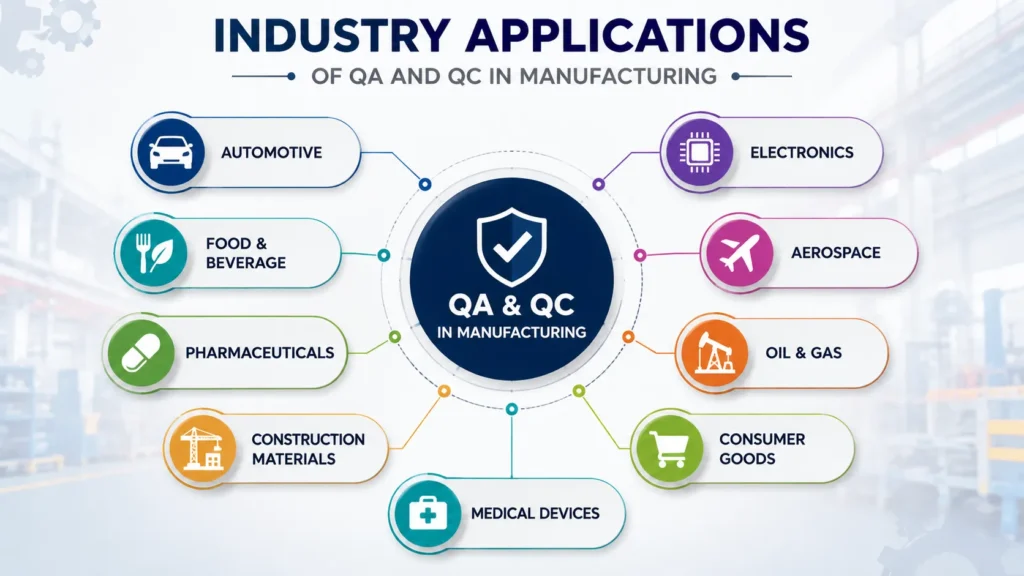
Industry Applications of QA and QC in Manufacturing
Quality Assurance and Quality Control are essential across every manufacturing sector. While production methods differ from one industry to another, the objective remains the same: to produce safe, reliable, compliant, and high-quality products that consistently meet customer and regulatory expectations.
Below are some of the industries where QA and QC play a critical role.
Automotive Manufacturing
The automotive industry demands exceptionally high quality standards because product failures can directly affect road safety.
Quality Assurance focuses on:
- Manufacturing process validation
- Supplier quality management
- Process standardisation
- Risk assessment
- Documentation control
Quality Control verifies:
- Brake system performance
- Engine component quality
- Electrical system functionality
- Paint quality
- Vehicle assembly accuracy
- Final vehicle inspection
Together, QA and QC help manufacturers deliver vehicles that are safe, reliable, and compliant with industry regulations.
Food and Beverage Manufacturing
Food safety depends on maintaining strict quality controls throughout production.
Quality Assurance establishes:
- Hygiene procedures
- Food safety management systems
- Cleaning schedules
- Supplier approval processes
- Documentation requirements
Quality Control performs:
- Ingredient inspections
- Temperature monitoring
- Contamination testing
- Packaging inspections
- Shelf-life verification
- Product sampling
These combined activities help protect consumers while maintaining compliance with food safety regulations.
Pharmaceutical Manufacturing
The pharmaceutical industry requires rigorous quality management because products directly affect patient health.
Quality Assurance manages:
- Good Manufacturing Practice (GMP) procedures
- Process validation
- Documentation systems
- Risk management
- Internal audits
Quality Control conducts:
- Laboratory testing
- Batch verification
- Stability testing
- Sterility testing
- Packaging inspection
- Product release testing
This integrated approach ensures medicines are safe, effective, and consistently manufactured.
Construction Materials Manufacturing
Manufacturers producing cement, steel, concrete, insulation materials, and structural components rely heavily on QA and QC to maintain product integrity.
Quality Assurance ensures:
- Manufacturing consistency
- Approved production methods
- Equipment maintenance
- Supplier compliance
Quality Control verifies:
- Material strength
- Dimensional accuracy
- Load-bearing capacity
- Surface quality
- Product specifications
Reliable construction materials contribute directly to safer buildings and infrastructure.
Electronics Manufacturing
Electronic products require precision manufacturing because even minor defects can affect performance and safety.
Quality Assurance supports:
- Controlled manufacturing environments
- Process validation
- Supplier quality
- Standardised assembly procedures
Quality Control performs:
- Circuit board inspection
- Functional testing
- Software validation
- Electrical safety testing
- Component verification
These inspections reduce failure rates and improve customer confidence.
Aerospace Manufacturing
Aerospace products operate under some of the world’s strictest quality requirements.
Quality Assurance manages:
- Manufacturing documentation
- Risk assessment
- Process control
- Regulatory compliance
Quality Control verifies:
- Precision measurements
- Material integrity
- Non-destructive testing
- Functional performance
- Assembly verification
This helps ensure aircraft components meet demanding operational and safety standards.
Medical Device Manufacturing
Medical devices must perform reliably because they directly affect patient safety.
QA and QC work together to ensure:
- Regulatory compliance
- Device validation
- Sterility assurance
- Functional performance
- Packaging integrity
- Product traceability
Maintaining consistent quality helps protect healthcare professionals and patients alike.
Essential QA and QC Tools and Techniques
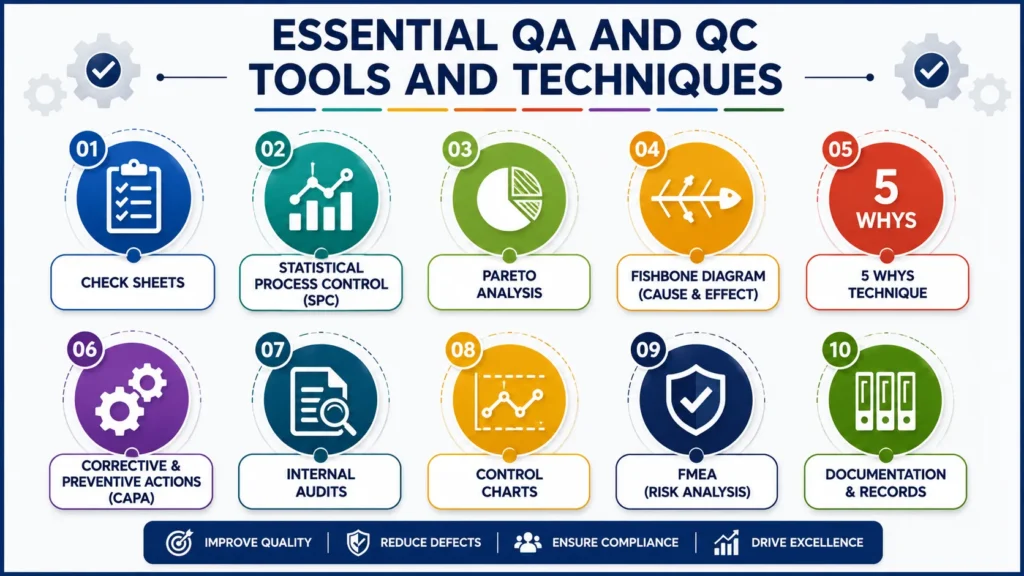
Modern manufacturing depends on structured quality tools that help organisations identify problems, monitor performance, analyse data, and improve processes.
Standard Operating Procedures (SOPs)
SOPs provide detailed instructions for performing manufacturing activities consistently.
Benefits include:
- Standardised operations
- Reduced process variation
- Improved employee performance
- Better regulatory compliance
Check Sheets
Check sheets provide a structured method for collecting inspection data during production.
They help organisations:
- Record defects
- Identify recurring issues
- Monitor inspection results
- Support process improvement
Statistical Process Control (SPC)
SPC uses statistical methods to monitor production processes and detect variation before defects occur.
Advantages include:
- Early problem detection
- Improved process stability
- Lower defect rates
- Better manufacturing consistency
Pareto Analysis
Pareto Analysis helps identify the small number of issues responsible for the majority of quality problems.
By focusing improvement efforts on high-impact issues, organisations achieve faster and more effective results.
Fishbone Diagram (Cause-and-Effect Analysis)
The Fishbone Diagram supports structured Root Cause Analysis by examining possible causes under categories such as:
- People
- Machines
- Materials
- Methods
- Measurement
- Environment
This helps quality teams identify the true source of recurring problems.
Root Cause Analysis (RCA)
Root Cause Analysis goes beyond correcting immediate defects by identifying why problems occurred.
Common RCA techniques include:
- 5 Whys
- Fishbone Diagram
- Failure investigations
- Process mapping
Removing root causes reduces the likelihood of future quality failures.
Corrective and Preventive Actions (CAPA)
CAPA is one of the most important quality improvement tools.
Corrective actions eliminate existing problems, while preventive actions reduce the likelihood of future defects.
An effective CAPA system strengthens compliance and supports continual improvement.
Internal Audits
Internal audits verify whether manufacturing processes continue to comply with organisational procedures and quality standards.
Audits help organisations:
- Identify improvement opportunities
- Verify documentation
- Monitor compliance
- Prepare for external certification audits
Common Manufacturing Compliance Standards
Manufacturers must comply with recognised standards and regulatory requirements to demonstrate product quality, safety, and operational excellence.
Although requirements vary by industry, several standards are widely recognised internationally.
ISO 9001 – Quality Management Systems
ISO 9001 provides a globally recognised framework for developing effective Quality Management Systems.
It promotes:
- Customer focus
- Risk-based thinking
- Process management
- Leadership commitment
- Continual improvement
- Evidence-based decision-making
Quality Assurance establishes systems aligned with ISO 9001, while Quality Control verifies product conformity within those systems.
Good Manufacturing Practice (GMP)
GMP establishes requirements for consistently producing safe and high-quality products.
It is widely used within:
- Pharmaceuticals
- Medical devices
- Food manufacturing
- Cosmetics
GMP focuses on:
- Personnel competence
- Documentation
- Equipment control
- Hygiene
- Production procedures
- Product traceability
QA ensures GMP procedures are implemented, while QC verifies products comply with GMP requirements.
ISO 45001
Manufacturing safety depends not only on product quality but also on protecting employees.
ISO 45001 promotes:
- Occupational health and safety
- Hazard identification
- Risk assessment
- Safe working environments
- Incident prevention
Quality Assurance often works alongside health and safety teams to support integrated management systems.
ISO 14001
Environmental compliance is becoming increasingly important in manufacturing.
ISO 14001 supports:
- Environmental management
- Waste reduction
- Pollution prevention
- Sustainable manufacturing
- Regulatory compliance
Quality Assurance contributes by integrating environmental requirements into manufacturing processes.
The Cost of Poor Quality and Non-Compliance
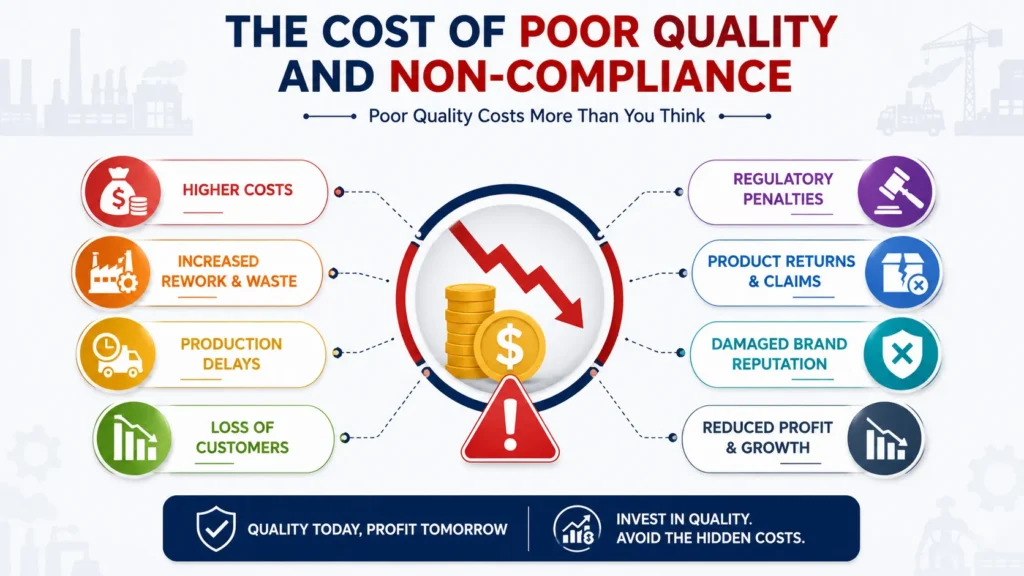
When QA and QC systems are ineffective, organisations experience significant operational and financial consequences.
These impacts are commonly referred to as the Cost of Poor Quality (COPQ).
Product Recalls
Defective products reaching customers may require large-scale recalls.
Product recalls often result in:
- Financial losses
- Regulatory investigations
- Customer dissatisfaction
- Production interruptions
- Reputational damage
Strong QA and QC systems reduce the likelihood of these costly events.
Increased Rework and Scrap
Poor process control frequently results in:
- Damaged products
- Manufacturing waste
- Additional labour
- Material losses
- Production delays
Preventing defects is significantly less expensive than correcting them after production.
Customer Complaints
Product failures reduce customer confidence and negatively affect brand reputation.
Consequences include:
- Product returns
- Warranty claims
- Negative reviews
- Lost repeat business
- Reduced customer loyalty
Consistent quality helps organisations build long-term customer relationships.
Regulatory Penalties
Manufacturers failing to comply with quality regulations may face:
- Compliance notices
- Product restrictions
- Financial penalties
- Certification issues
- Legal action
Maintaining robust QA and QC systems helps organisations demonstrate ongoing compliance.
Damage to Business Reputation
A strong reputation takes years to build but can be damaged quickly by repeated quality failures.
Maintaining effective quality management helps organisations:
- Strengthen customer trust
- Win larger contracts
- Expand internationally
- Improve competitiveness
- Protect long-term profitability
Why Strong QA and QC Systems Create Competitive Advantage
Manufacturers that integrate Quality Assurance and Quality Control into their organisational culture gain advantages that extend far beyond product inspection.
These organisations typically achieve:
- Safer products
- Higher customer satisfaction
- Better regulatory compliance
- Reduced operational costs
- Stronger supplier relationships
- Improved manufacturing efficiency
- Lower defect rates
- Enhanced employee accountability
- Increased customer loyalty
- Sustainable business growth
By preventing problems before they occur and verifying product quality at every stage, QA and QC become strategic tools that support operational excellence and long-term success.
The Future of QA and QC in Manufacturing
Manufacturing is undergoing rapid transformation as organisations adopt advanced technologies to improve productivity, reduce defects, and strengthen regulatory compliance. While the principles of Quality Assurance and Quality Control remain unchanged, the methods used to achieve quality excellence continue to evolve.
Modern manufacturers are moving beyond manual inspections and paper-based quality systems towards intelligent, data-driven quality management. This shift enables organisations to identify risks earlier, improve decision-making, and maintain higher levels of product consistency.
Professionals who understand both traditional QA/QC principles and modern manufacturing technologies will be well positioned for long-term career success.
Artificial Intelligence and Machine Learning
Artificial Intelligence (AI) is reshaping quality management by enabling faster and more accurate inspection processes.
AI-powered systems can:
- Detect product defects automatically
- Analyse inspection images
- Predict quality trends
- Identify production anomalies
- Reduce human error
- Support predictive quality management
Rather than replacing quality professionals, AI allows them to focus on process improvement, root cause analysis, and strategic quality initiatives.
Smart Manufacturing and Industry 4.0
Industry 4.0 integrates automation, robotics, sensors, cloud computing, and real-time analytics into manufacturing operations.
Within this environment, QA and QC benefit from:
- Real-time production monitoring
- Automated inspection systems
- Connected production equipment
- Digital quality reporting
- Faster corrective actions
- Improved traceability
These technologies enable manufacturers to identify quality issues before they become costly production problems.
Internet of Things (IoT)
IoT devices continuously collect data from manufacturing equipment and production lines.
Quality teams use this information to monitor:
- Machine performance
- Environmental conditions
- Equipment calibration
- Production consistency
- Process variation
Continuous monitoring supports proactive quality management rather than reactive inspection.
Digital Quality Management Systems
Many organisations are replacing paper documentation with integrated digital Quality Management Systems (QMS).
Digital systems improve:
- Document control
- Audit management
- Inspection records
- CAPA tracking
- Risk management
- Supplier quality management
- Compliance reporting
This improves efficiency while providing complete traceability throughout the manufacturing lifecycle.
Predictive Quality Analytics
Modern manufacturers increasingly use production data to predict quality issues before they occur.
Predictive analytics helps organisations:
- Reduce unexpected defects
- Improve production planning
- Optimise maintenance schedules
- Increase equipment reliability
- Improve operational performance
This data-driven approach supports continuous improvement and more informed business decisions.
Sustainable Manufacturing
Quality management also plays an important role in supporting environmental sustainability.
Effective QA and QC help organisations:
- Reduce production waste
- Improve resource efficiency
- Minimise product rejects
- Lower energy consumption
- Improve recycling opportunities
- Support environmentally responsible manufacturing
Combining quality excellence with sustainability strengthens both business performance and corporate responsibility.
Best Practices for Effective QA and QC in Manufacturing
Successful manufacturers understand that quality is not the responsibility of a single department. It is a shared organisational commitment supported by leadership, employees, suppliers, and continuous improvement.
The following best practices help organisations maintain effective QA and QC systems.
Establish Clear Quality Objectives
Every organisation should define measurable quality objectives aligned with customer expectations, regulatory requirements, and business goals.
Clear objectives help ensure consistent decision-making throughout production.
Maintain Comprehensive Documentation
Accurate documentation provides evidence that manufacturing processes are properly controlled.
Important records include:
- Standard Operating Procedures
- Inspection reports
- Test results
- Audit findings
- Training records
- CAPA reports
- Calibration records
Well-maintained documentation supports traceability and regulatory compliance.
Invest in Employee Development
Manufacturing quality depends heavily on employee competence.
Regular training ensures personnel understand:
- Quality requirements
- Inspection techniques
- Manufacturing procedures
- Safety practices
- Regulatory expectations
- Continuous improvement methods
Skilled employees contribute significantly to reducing errors and improving overall product quality.
Monitor Performance Using Quality Metrics
Performance measurement enables organisations to evaluate the effectiveness of their quality systems.
Useful quality indicators include:
- Defect rate
- First-pass yield
- Customer complaint rate
- Product return rate
- Rework percentage
- Process capability
- Supplier performance
- Audit findings
Monitoring these indicators supports informed decision-making and continuous improvement.
Promote a Quality Culture
A strong quality culture encourages everyone within the organisation to take responsibility for product quality and customer satisfaction.
Characteristics of a quality-focused organisation include:
- Leadership commitment
- Open communication
- Continuous learning
- Employee involvement
- Problem-solving mindset
- Commitment to improvement
When quality becomes part of organisational culture, long-term operational excellence becomes easier to achieve.
Why Learn QA and QC at Inspire College?
As industries continue to prioritise safety, compliance, and operational excellence, the demand for professionals with Quality Assurance and Quality Control expertise continues to grow.
Learning QA and QC provides practical knowledge that can be applied across numerous industries, including manufacturing, construction, engineering, pharmaceuticals, food production, healthcare, automotive, oil and gas, aerospace, and consumer goods.
At Inspire College, quality management programmes are designed to develop industry-relevant knowledge aligned with internationally recognised quality principles and modern manufacturing practices.
Learners gain an understanding of:
- Quality Assurance principles
- Quality Control techniques
- Inspection methods
- Quality Management Systems
- Risk management
- Internal auditing
- Process improvement
- Regulatory compliance
- Documentation control
- Continuous improvement
This practical knowledge helps prepare professionals to contribute effectively to organisations that value quality, safety, compliance, and operational excellence.
Better Processes
↓
Fewer Defects
↓
Safer Products
↓
Regulatory Compliance
↓
Customer Trust
↓
Business Growth
Conclusion
Quality Assurance and Quality Control are fundamental to achieving safe, compliant, and efficient manufacturing operations. While Quality Assurance focuses on designing robust systems that prevent defects, Quality Control verifies that products consistently meet quality requirements through inspection, testing, and measurement. Together, they create an integrated quality management approach that protects customers, supports regulatory compliance, and improves overall manufacturing performance.
From supplier qualification and process validation to product inspection and final verification, QA and QC influence every stage of the manufacturing lifecycle. Their combined efforts help organisations reduce defects, minimise waste, improve operational efficiency, strengthen customer confidence, and maintain compliance with internationally recognised quality standards.
As manufacturing continues to evolve through artificial intelligence, automation, smart factories, and digital quality management systems, the importance of QA and QC will only continue to grow. Organisations that embrace innovation while maintaining strong quality management principles will be better equipped to respond to changing customer expectations, regulatory requirements, and global market demands.
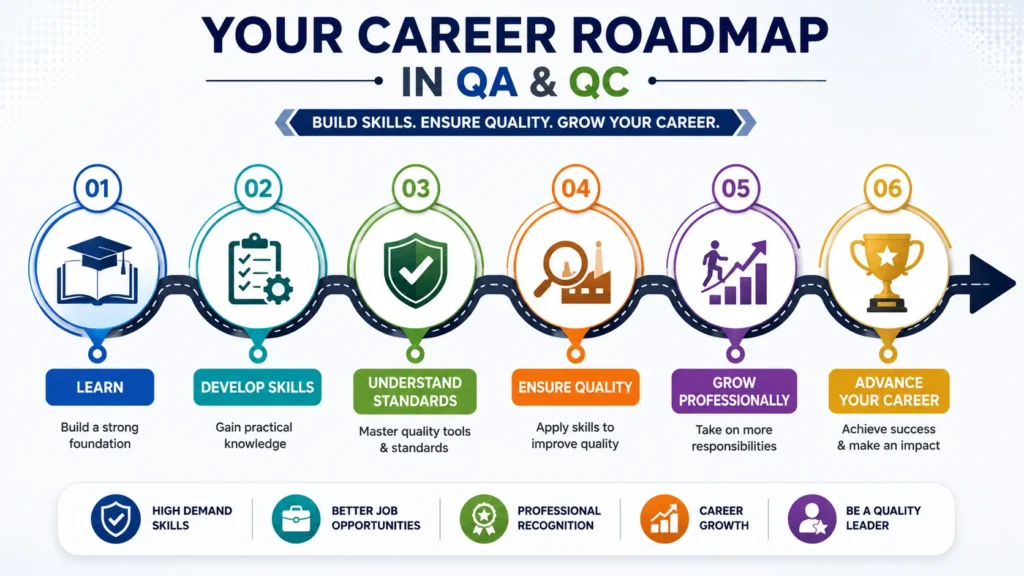
For professionals seeking long-term career opportunities, expertise in Quality Assurance and Quality Control remains highly valuable. These disciplines develop analytical thinking, problem-solving abilities, attention to detail, and a commitment to continuous improvement—skills that are transferable across a wide range of industries worldwide. By investing in QA and QC knowledge, organisations and individuals alike can contribute to safer products, stronger compliance, greater customer satisfaction, and sustainable business success.
Recommended Inspire College Courses
To strengthen topical authority and improve internal SEO, link this blog to relevant course pages across your website.
Quality Management Courses
ISO Training Courses
Manufacturing and Engineering Courses
Health, Safety and Compliance Courses
Auditing and Compliance Courses
Related Knowledge Hub Articles
Build a strong content cluster by linking to articles such as:
- What Is Quality Assurance? A Complete Guide
- What Is Quality Control? A Complete Guide
- Quality Assurance vs Quality Control: Key Differences Explained
- How Quality Control Improves Product Safety and Customer Satisfaction
- Career Opportunities After Earning a Quality Assurance Certification
- Quality Assurance and Quality Control in the Pharmaceutical Industry
This internal linking structure creates a comprehensive Quality Management topical cluster, helping search engines recognise Inspire College as an authoritative resource on QA, QC, manufacturing quality, compliance, and professional training.