Career Opportunities After Earning a Quality Assurance Certification
In today’s highly competitive global marketplace, quality has become a defining factor for business success. Whether an organisation manufactures products, delivers professional services, develops software, or operates within healthcare, construction, engineering, food production, or logistics, maintaining consistent quality standards is essential. As industries continue to prioritise customer satisfaction, regulatory compliance, operational efficiency, and continuous improvement, the demand for skilled quality assurance (QA) professionals continues to grow.
Earning a Quality Assurance Certification is more than simply adding a qualification to a CV—it demonstrates a professional commitment to maintaining quality standards, preventing defects, improving organisational performance, and supporting continual improvement initiatives. Employers increasingly seek certified professionals who understand internationally recognised quality principles, industry regulations, inspection techniques, auditing processes, documentation requirements, and risk management practices.
One of the greatest advantages of obtaining a Quality Assurance Certification is the wide range of career opportunities it opens across multiple industries. Unlike many specialised professions that are limited to a single sector, quality assurance skills are highly transferable. Certified QA professionals are needed in manufacturing, construction, oil and gas, pharmaceuticals, healthcare, food production, automotive, aerospace, renewable energy, logistics, electronics, and many other industries where quality and compliance are business priorities.
The career potential extends well beyond entry-level inspection roles. With the right combination of certification, practical experience, technical expertise, and continuous professional development, professionals can progress into positions such as Quality Engineer, Compliance Officer, Internal Auditor, Quality Manager, Continuous Improvement Specialist, Supplier Quality Engineer, Operations Manager, or even Director of Quality.
This guide explores the career opportunities available after earning a Quality Assurance Certification, explains how certification enhances employability, highlights the industries actively recruiting certified professionals, and outlines the skills, career progression, and future trends shaping the quality profession. Whether you are beginning your career, changing industries, or looking to advance into leadership, understanding the opportunities available can help you make informed decisions about your professional future.
Why Quality Assurance Is One of the Fastest-Growing Career Fields
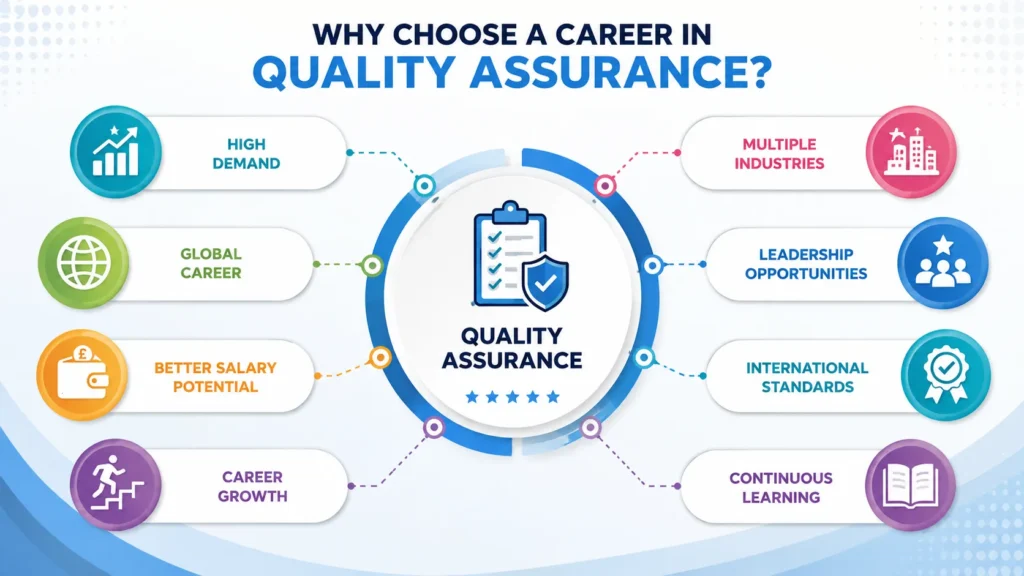
Quality assurance has evolved significantly over the past two decades. It is no longer viewed as a department responsible only for identifying defects at the end of production. Instead, modern quality assurance focuses on preventing problems before they occur, improving processes, reducing waste, enhancing customer satisfaction, and supporting long-term organisational success.
As businesses become increasingly focused on operational excellence, the need for qualified quality professionals continues to increase worldwide.
Growing Focus on International Standards
Many organisations operate according to internationally recognised standards such as ISO 9001 and industry-specific quality management systems. These standards require organisations to establish effective quality processes, conduct regular audits, manage risks, and demonstrate continual improvement.
Certified QA professionals possess the knowledge required to help organisations implement and maintain these systems, making them valuable assets across a wide range of industries.
Increased Regulatory Requirements
Governments and regulatory authorities continue to introduce stricter compliance requirements across sectors including:
- Manufacturing
- Pharmaceuticals
- Healthcare
- Food production
- Construction
- Aviation
- Energy
- Environmental management
Failure to meet quality and compliance requirements can result in financial losses, legal penalties, damaged reputations, and customer dissatisfaction. Consequently, organisations invest in qualified quality assurance professionals who can minimise risks and ensure compliance.
Quality Drives Business Performance
Quality assurance directly contributes to improved business outcomes by helping organisations:
- Reduce production errors
- Minimise product defects
- Lower operational costs
- Improve customer satisfaction
- Increase productivity
- Strengthen supplier performance
- Enhance operational efficiency
- Support continual improvement
- Reduce waste
- Protect organisational reputation
Because quality impacts nearly every aspect of business performance, skilled QA professionals play an increasingly strategic role rather than simply carrying out inspections.
Industry 4.0 and Digital Transformation
The adoption of Industry 4.0 technologies has transformed quality management across modern organisations. Businesses now use digital inspection systems, automated testing, artificial intelligence, predictive analytics, smart sensors, cloud-based quality management software, and real-time data monitoring to improve quality performance.
This shift has increased demand for professionals who understand both traditional quality principles and modern digital quality management practices.
Professionals who combine quality assurance knowledge with digital skills are becoming increasingly valuable in today’s workforce.
Global Career Opportunities
Unlike many occupations that are limited to specific industries or geographic regions, quality assurance offers international career mobility.
Certified professionals can pursue opportunities within:
- Multinational manufacturers
- Engineering companies
- Construction firms
- Healthcare organisations
- Pharmaceutical companies
- Automotive manufacturers
- Aerospace organisations
- Food production companies
- Energy providers
- Government agencies
- Certification bodies
- Inspection companies
- Supply chain organisations
This broad applicability makes quality assurance an attractive long-term career choice for professionals seeking both stability and growth.
How a Quality Assurance Certification Improves Your Career Prospects
A certification demonstrates far more than technical knowledge. It provides employers with confidence that a candidate understands recognised quality principles, follows industry best practices, and is committed to professional standards.
For many organisations, certification serves as evidence that an individual possesses practical knowledge that can be applied immediately within the workplace.
1. Enhances Professional Credibility
Employers receive hundreds of applications for quality-related positions. A recognised Quality Assurance Certification helps distinguish candidates by demonstrating verified competence and commitment to professional development.
Recruiters often view certified candidates as better prepared to contribute to quality initiatives from the outset.
2. Expands Employment Opportunities
Certified quality professionals are not restricted to one industry. The same quality management principles apply across numerous sectors, allowing professionals to explore diverse career paths.
Examples include:
- Manufacturing
- Engineering
- Construction
- Pharmaceuticals
- Medical devices
- Oil and gas
- Food processing
- Electronics
- Logistics
- Renewable energy
- Government projects
- Consultancy
This flexibility provides greater career resilience and more opportunities for long-term growth.
3. Supports Faster Career Progression
Many professionals begin their careers as Quality Inspectors or QA Assistants. Certification provides a strong foundation for progressing into increasingly responsible positions.
Typical progression may include:
Quality Assistant
↓
Quality Inspector
↓
Quality Assurance Technician
↓
Quality Engineer
↓
Senior Quality Engineer
↓
Quality Supervisor
↓
Quality Manager
↓
Head of Quality
↓
Director of Quality
As professionals gain experience alongside recognised qualifications, opportunities for leadership and strategic roles become increasingly accessible.
4. Demonstrates Commitment to Continuous Improvement
One of the core principles of quality management is continual improvement. Employers value professionals who actively invest in expanding their knowledge and developing new competencies.
Completing a Quality Assurance Certification demonstrates initiative, a willingness to learn, and a commitment to maintaining high professional standards—qualities that are highly regarded by employers across all industries.
5. Builds Practical Problem-Solving Skills
Quality assurance professionals are responsible for identifying problems, analysing root causes, implementing corrective actions, and preventing recurring issues.
Certification programmes typically develop practical competencies such as:
- Process analysis
- Root cause investigation
- Risk assessment
- Quality documentation
- Inspection planning
- Internal auditing
- Corrective and preventive actions (CAPA)
- Continuous improvement techniques
- Data interpretation
- Performance monitoring
These transferable skills remain valuable throughout a professional’s career, regardless of industry or job title.
6. Increases Employer Confidence
Hiring managers seek professionals who can contribute to organisational goals with minimal supervision.
A recognised Quality Assurance Certification signals that a candidate has invested time in understanding:
- Quality management systems
- Industry standards
- Inspection methods
- Documentation practices
- Compliance requirements
- Audit preparation
- Process improvement
- Customer quality expectations
This often strengthens a candidate’s position during recruitment and internal promotion processes.
7. Creates Opportunities Beyond Traditional QA Roles
One of the most overlooked benefits of quality assurance expertise is its versatility.
Many experienced quality professionals later transition into careers such as:
- Internal Auditor
- Compliance Officer
- Process Improvement Specialist
- Operations Manager
- Health and Safety Professional
- Supply Chain Quality Manager
- Production Manager
- Risk Management Specialist
- Business Improvement Consultant
- ISO Management System Consultant
These career pathways demonstrate that a Quality Assurance Certification is not merely a qualification for inspection roles—it can serve as the foundation for a broad and rewarding professional career across multiple business functions.
QA Assistant
↓
Quality Inspector
↓
QA Technician
↓
Quality Engineer
↓
Senior QA Engineer
↓
Quality Supervisor
↓
Quality Manager
↓
Head of Quality
↓
Director of Quality
Top 12 Career Opportunities After Earning a Quality Assurance Certification
One of the biggest advantages of earning a Quality Assurance Certification is the diversity of career opportunities it unlocks. Quality assurance is a core business function across almost every industry because organisations rely on skilled professionals to ensure products, services, and processes consistently meet customer expectations and regulatory requirements.
Whether you are entering the workforce, changing careers, or seeking professional advancement, a recognised QA qualification can prepare you for a variety of rewarding roles. Below are some of the most sought-after career opportunities for certified quality assurance professionals.
1. Quality Assurance Inspector
A Quality Assurance Inspector is often the starting point for many quality professionals. This role involves inspecting products, materials, and processes to ensure they meet specified quality standards before reaching customers.
Typical responsibilities include:
- Conducting visual and dimensional inspections
- Recording inspection findings accurately
- Identifying defects and non-conformities
- Verifying compliance with specifications
- Preparing quality inspection reports
- Working closely with production teams to resolve quality issues
This position provides valuable hands-on experience and builds a strong understanding of quality control processes, making it an excellent foundation for future career progression.
Industries hiring QA Inspectors include manufacturing, construction, automotive, food production, electronics, engineering, and logistics.
2. Quality Assurance Technician
Quality Assurance Technicians play a broader role by monitoring production activities, testing materials, reviewing documentation, and ensuring quality systems operate effectively throughout the production process.
Common responsibilities include:
- Performing product and process testing
- Monitoring production quality
- Maintaining quality records
- Supporting internal audits
- Investigating quality issues
- Assisting with corrective actions
- Calibrating inspection equipment
This role is ideal for professionals who enjoy combining practical inspections with technical analysis and process improvement.
3. Quality Assurance Engineer
Quality Assurance Engineers focus on improving manufacturing and operational processes to prevent defects before they occur. Rather than simply identifying problems, they design systems that consistently produce high-quality outcomes.
Typical responsibilities include:
- Developing quality assurance plans
- Performing process validation
- Conducting root cause analysis
- Implementing corrective and preventive actions (CAPA)
- Analysing quality performance data
- Collaborating with production and engineering teams
- Supporting continuous improvement initiatives
Employers value QA Engineers who can balance technical expertise with strong analytical and problem-solving skills.
4. Quality Control Engineer
Although quality assurance and quality control are closely related, Quality Control Engineers primarily focus on inspecting products and verifying compliance through testing and measurement.
Their responsibilities often include:
- Conducting product testing
- Verifying material specifications
- Monitoring inspection procedures
- Preparing quality reports
- Ensuring compliance with industry standards
- Reviewing supplier quality
- Supporting production quality improvements
Quality Control Engineers are particularly in demand within manufacturing, oil and gas, mechanical engineering, civil engineering, and industrial production.
5. Internal Quality Auditor
Organisations certified to recognised management system standards require regular internal audits to ensure compliance and identify opportunities for improvement.
An Internal Quality Auditor evaluates organisational processes against quality management requirements and provides recommendations for improvement.
Typical duties include:
- Planning internal audits
- Reviewing documented procedures
- Interviewing employees
- Assessing compliance with quality standards
- Identifying non-conformities
- Preparing audit reports
- Following up on corrective actions
Professionals with auditing knowledge often progress into senior compliance or management positions due to their broad understanding of organisational operations.
6. Compliance Officer
Compliance Officers ensure organisations meet legal, regulatory, contractual, and industry-specific requirements. While quality assurance focuses on maintaining standards, compliance ensures these standards align with applicable laws and regulations.
Responsibilities commonly include:
- Monitoring regulatory changes
- Reviewing organisational policies
- Conducting compliance assessments
- Supporting regulatory inspections
- Managing compliance documentation
- Advising management on regulatory risks
- Coordinating corrective actions
Compliance roles are available across healthcare, pharmaceuticals, finance, manufacturing, energy, aviation, and public sector organisations.
7. Supplier Quality Engineer
Modern organisations depend heavily on suppliers to maintain product quality. Supplier Quality Engineers work directly with vendors to ensure purchased materials and components meet required specifications.
Their responsibilities include:
- Evaluating supplier performance
- Conducting supplier audits
- Reviewing supplier documentation
- Investigating supplier-related quality issues
- Supporting supplier improvement programmes
- Managing supplier corrective actions
- Monitoring supplier quality metrics
This role requires strong communication, analytical thinking, and relationship management skills.
8. Continuous Improvement Specialist
Many organisations actively seek professionals who can improve productivity, reduce waste, and optimise business processes.
Continuous Improvement Specialists use quality management principles alongside improvement methodologies to enhance operational performance.
Their work typically involves:
- Analysing business processes
- Identifying improvement opportunities
- Measuring performance indicators
- Leading improvement projects
- Reducing operational waste
- Increasing efficiency
- Supporting organisational excellence initiatives
This career path suits professionals who enjoy solving complex operational challenges and driving measurable business improvements.
9. Quality Manager
After gaining experience in quality assurance, many professionals progress into management positions where they oversee the organisation’s entire quality management system.
Quality Managers have responsibility for developing quality strategies, managing teams, maintaining compliance, and supporting continual improvement.
Typical responsibilities include:
- Managing quality assurance teams
- Developing quality policies
- Reviewing organisational performance
- Leading internal and external audits
- Managing customer quality issues
- Reporting quality metrics to senior leadership
- Driving continual improvement initiatives
Leadership, communication, decision-making, and strategic planning become increasingly important at this level.
10. Operations and Production Manager
Many experienced quality professionals transition into operational leadership because they possess a deep understanding of production processes, risk management, efficiency, and continuous improvement.
Operations Managers oversee daily business activities while ensuring quality objectives remain aligned with organisational goals.
Typical responsibilities include:
- Managing production operations
- Improving operational efficiency
- Coordinating cross-functional teams
- Monitoring productivity
- Managing budgets and resources
- Supporting quality improvement projects
- Ensuring customer satisfaction
Quality assurance experience provides a strong foundation for operational leadership roles.
11. ISO Management System Consultant
Organisations implementing international management system standards often require expert guidance. ISO consultants help businesses establish, improve, and maintain effective management systems that comply with recognised standards.
Their work may involve:
- Developing management system documentation
- Conducting gap analyses
- Delivering staff training
- Preparing organisations for certification audits
- Advising on process improvements
- Supporting continual compliance
- Monitoring management system effectiveness
This career offers opportunities to work with organisations across a wide range of industries while developing specialist expertise.
12. Director of Quality
The Director of Quality represents one of the highest levels of career progression within the quality profession.
This senior leadership role involves shaping the organisation’s quality strategy, supporting business objectives, managing organisational risk, and fostering a culture of continuous improvement.
Typical responsibilities include:
- Developing long-term quality strategies
- Leading multidisciplinary quality teams
- Advising executive leadership
- Overseeing enterprise-wide quality initiatives
- Managing regulatory compliance
- Driving organisational excellence
- Representing quality during strategic decision-making
Professionals who reach this level often combine extensive industry experience with advanced qualifications, leadership capabilities, and a proven record of delivering business improvements.
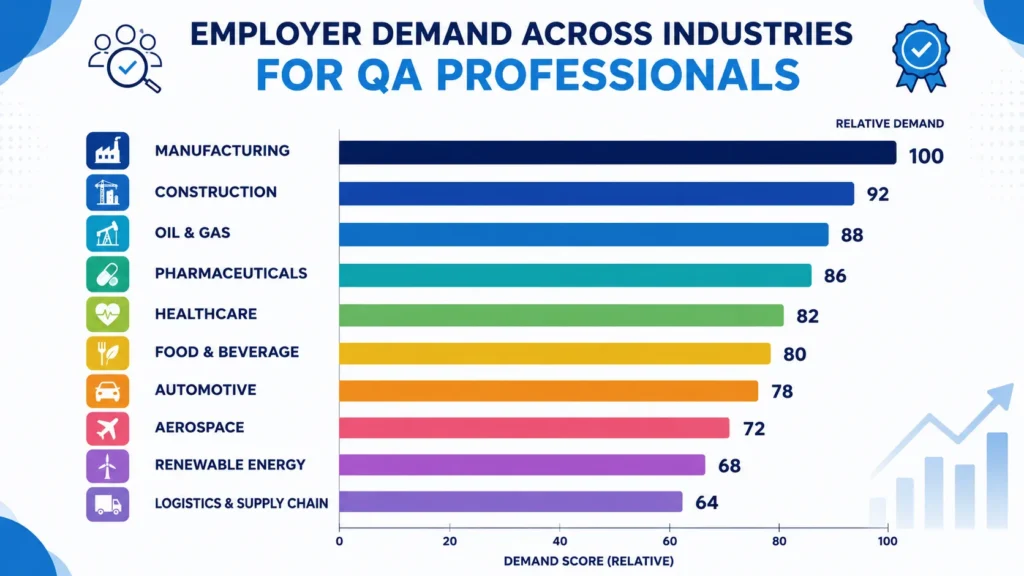
Industries That Actively Recruit Certified Quality Assurance Professionals
One of the strongest advantages of a Quality Assurance Certification is its relevance across multiple sectors. Because quality management principles are applicable to virtually every industry, certified professionals enjoy a wide range of employment opportunities.
Industries with consistent demand for QA professionals include:
- Manufacturing
- Construction and Infrastructure
- Mechanical and Electrical Engineering
- Oil and Gas
- Pharmaceutical Manufacturing
- Healthcare and Medical Devices
- Food and Beverage Production
- Automotive Manufacturing
- Aerospace and Aviation
- Electronics and Semiconductor Manufacturing
- Logistics and Supply Chain Management
- Renewable Energy
- Utilities
- Chemical Processing
- Government and Public Sector Organisations
- Certification and Inspection Bodies
This cross-industry demand provides excellent career flexibility and allows professionals to transfer their expertise between sectors while continuing to build valuable experience.
Industry-Wise Career Opportunities for Certified Quality Assurance Professionals
One of the greatest strengths of a Quality Assurance Certification is its versatility. Unlike many qualifications that are specific to a single profession, quality assurance skills are valued across a broad range of industries. Every organisation that aims to deliver consistent products or services, meet regulatory requirements, and improve customer satisfaction needs qualified professionals to manage and maintain quality standards.
Below are some of the industries where certified QA professionals are in high demand.
Manufacturing
Manufacturing remains one of the largest employers of quality assurance professionals. From raw material inspections to final product testing, manufacturers rely on QA teams to ensure every stage of production meets defined quality standards.
Common roles include:
- Quality Assurance Inspector
- Quality Control Engineer
- Production Quality Engineer
- Process Quality Specialist
- Manufacturing Quality Manager
- Supplier Quality Engineer
Professionals in this sector often work with production teams to reduce defects, improve efficiency, minimise waste, and support continuous improvement initiatives.
Construction and Infrastructure
Quality assurance plays a critical role in construction projects, where compliance with engineering specifications, safety regulations, and contractual requirements is essential.
Career opportunities include:
- Construction Quality Inspector
- Site Quality Engineer
- QA/QC Engineer
- Materials Inspector
- Civil Quality Manager
- Project Quality Coordinator
Certified professionals help ensure that construction materials, workmanship, and completed structures meet regulatory and client requirements.
Oil and Gas
The oil and gas industry operates in highly regulated environments where equipment reliability and operational safety are essential. Quality assurance professionals support compliance with technical standards throughout exploration, production, transportation, and maintenance activities.
Typical positions include:
- QA/QC Engineer
- Welding Inspector
- Pipeline Quality Inspector
- Supplier Quality Specialist
- Inspection Coordinator
- Quality Manager
Experience in quality systems and inspection processes is highly valued in this industry.
Pharmaceutical and Healthcare
Healthcare and pharmaceutical organisations require rigorous quality management to ensure patient safety, regulatory compliance, and product effectiveness.
Career opportunities include:
- Pharmaceutical Quality Officer
- Validation Specialist
- GMP Compliance Officer
- Medical Device Quality Engineer
- Regulatory Compliance Specialist
- Quality Systems Manager
Professionals working in this sector contribute to maintaining strict quality controls throughout manufacturing, testing, storage, and distribution.
Food and Beverage Industry
Food manufacturers depend on quality assurance professionals to maintain food safety, product consistency, and compliance with national and international standards.
Common roles include:
- Food Quality Inspector
- Food Safety Officer
- Quality Assurance Coordinator
- HACCP Coordinator
- Production Quality Supervisor
- Food Compliance Manager
Daily responsibilities often involve monitoring hygiene standards, conducting inspections, reviewing documentation, and supporting food safety management systems.
Automotive Industry
The automotive sector demands exceptionally high quality standards due to safety, reliability, and customer expectations.
Career opportunities include:
- Automotive Quality Engineer
- Supplier Quality Engineer
- Production Quality Manager
- Process Improvement Specialist
- Quality Auditor
Professionals support continuous improvement initiatives while ensuring components and finished vehicles meet stringent quality requirements.
Aerospace and Aviation
The aerospace industry maintains some of the strictest quality requirements in the world. Every component must comply with detailed engineering specifications and regulatory standards.
Typical careers include:
- Aerospace Quality Engineer
- Inspection Specialist
- Manufacturing Quality Manager
- Compliance Auditor
- Supplier Quality Engineer
Attention to detail, documentation accuracy, and risk management are especially important within this sector.
Renewable Energy
As renewable energy projects continue to expand worldwide, organisations require quality professionals to ensure equipment reliability, installation quality, and operational efficiency.
Career opportunities include:
- Wind Farm Quality Inspector
- Solar Quality Engineer
- Renewable Energy Compliance Officer
- Project Quality Coordinator
- Operations Quality Manager
Professionals contribute to delivering reliable and sustainable energy solutions while supporting compliance with industry standards.
Logistics and Supply Chain
Quality assurance is equally important throughout supply chains, where organisations seek to minimise errors, improve supplier performance, and maintain customer satisfaction.
Typical roles include:
- Supply Chain Quality Specialist
- Supplier Performance Analyst
- Warehouse Quality Coordinator
- Distribution Quality Manager
- Procurement Quality Engineer
Professionals help maintain consistent quality across procurement, storage, transportation, and delivery operations.
Quality Assurance Career Progression Roadmap
A Quality Assurance Certification provides an excellent starting point, but long-term career success is achieved through continuous learning, practical experience, and professional development.
A typical career progression may follow this pathway:
Entry Level
- Quality Assistant
- QA Trainee
- Quality Technician
- Inspection Assistant
At this stage, professionals develop practical inspection skills, understand quality documentation, and learn organisational procedures.
Early Career
- Quality Inspector
- QA Technician
- Quality Control Inspector
- Process Inspector
Professionals become responsible for inspections, testing, reporting, and identifying non-conformities.
Mid-Level Career
- Quality Engineer
- QA/QC Engineer
- Internal Auditor
- Supplier Quality Engineer
- Compliance Officer
At this level, professionals analyse quality data, conduct audits, implement corrective actions, and improve organisational processes.
Senior Career
- Senior Quality Engineer
- Quality Supervisor
- Continuous Improvement Manager
- Lead Auditor
- Production Quality Manager
Leadership responsibilities increase, including supervising teams, managing projects, and driving strategic quality initiatives.
Leadership Roles
- Quality Manager
- Head of Quality
- Director of Quality
- Operations Manager
- Quality Consultant
Senior professionals influence organisational strategy, manage enterprise-wide quality systems, and contribute directly to business performance and customer satisfaction.
This structured progression demonstrates that quality assurance is not simply an entry-level occupation but a profession offering long-term career development and leadership opportunities.
Skills Employers Look for in Certified Quality Assurance Professionals
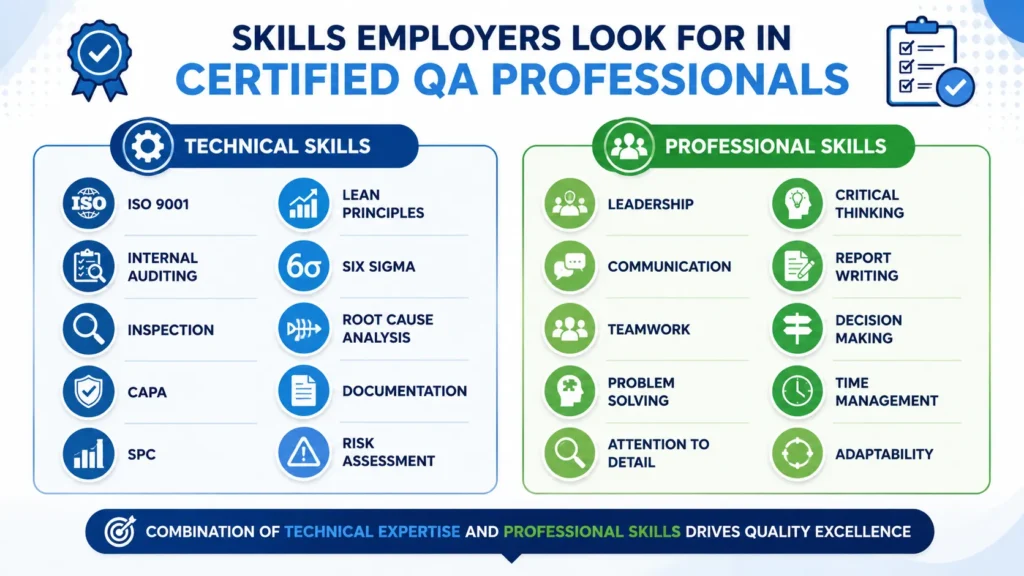
While certification demonstrates technical knowledge, employers also seek candidates who can apply that knowledge effectively in real-world environments. Developing both technical and interpersonal skills significantly improves employability and supports career advancement.
Technical Skills
Certified professionals should aim to strengthen expertise in the following areas:
- Quality Management Systems (QMS)
- ISO 9001 principles and requirements
- Inspection and testing techniques
- Root Cause Analysis (RCA)
- Corrective and Preventive Actions (CAPA)
- Statistical Process Control (SPC)
- Risk assessment and mitigation
- Internal auditing
- Process mapping
- Quality documentation and reporting
- Non-conformance management
- Continuous improvement methodologies
- Lean principles
- Six Sigma concepts
- Data analysis and performance measurement
Employers value candidates who can combine theoretical knowledge with practical application to solve quality-related challenges.
Digital Skills
Modern quality management increasingly relies on digital technologies. Professionals who understand these tools often have a competitive advantage.
Useful digital competencies include:
- Quality Management Software (QMS platforms)
- Electronic document control systems
- Microsoft Excel for quality reporting
- Data visualisation tools
- Digital inspection applications
- ERP systems
- Manufacturing execution systems
- Basic data analytics
- AI-assisted quality monitoring
- Cloud-based collaboration platforms
As organisations embrace Industry 4.0, digital literacy is becoming an essential component of quality assurance careers.
Professional Skills
Successful quality professionals also demonstrate strong workplace competencies, including:
- Analytical thinking
- Problem-solving
- Attention to detail
- Communication skills
- Report writing
- Team collaboration
- Time management
- Decision-making
- Leadership potential
- Adaptability
- Ethical judgement
- Customer focus
These skills enable professionals to work effectively with production teams, suppliers, auditors, regulators, and senior management.
Certification vs Experience: Which Matters More?
A common question among aspiring quality professionals is whether certification or experience carries greater value in the job market.
The reality is that employers value both, as they complement one another.
A Quality Assurance Certification provides evidence that a professional understands recognised quality principles, international standards, auditing practices, inspection methods, and continuous improvement techniques. It demonstrates commitment to professional development and provides a strong theoretical foundation.
Practical experience, however, allows professionals to apply these principles in real workplace situations. Experience develops judgement, technical confidence, communication skills, and the ability to solve complex quality challenges under operational conditions.
Rather than viewing certification and experience as alternatives, employers generally consider them complementary. Certification often helps candidates secure interviews and entry-level opportunities, while practical experience supports long-term career progression into supervisory, managerial, and leadership positions.
Professionals who continue learning, gain industry experience, and regularly update their knowledge are typically the most competitive candidates in today’s evolving quality assurance profession.
The Future of Quality Assurance Careers
Quality assurance is evolving rapidly as organisations embrace new technologies, stricter regulatory requirements, and higher customer expectations. The role of a quality professional is no longer limited to identifying defects or completing inspections. Today’s employers expect QA professionals to contribute to business strategy, operational excellence, innovation, and continuous improvement.
Professionals who invest in continuous learning and stay informed about industry developments will be well positioned to take advantage of emerging career opportunities.
Digital Quality Management
Many organisations are replacing paper-based quality systems with digital platforms that streamline inspections, document control, audit management, and reporting. These systems provide real-time visibility into quality performance and enable faster decision-making.
Certified QA professionals who are comfortable working with digital quality management systems are becoming increasingly valuable across industries.
Artificial Intelligence and Automation
Artificial intelligence (AI) and automation are transforming how organisations monitor and improve quality. AI-powered systems can analyse large volumes of data, identify trends, detect potential defects, and support predictive quality management.
Rather than replacing quality professionals, these technologies enhance their ability to make informed decisions and focus on higher-value activities such as process improvement, risk management, and strategic planning.
Professionals who understand both quality management principles and emerging technologies will have a competitive advantage in the future job market.
Greater Focus on Risk-Based Thinking
Modern quality management systems place significant emphasis on identifying and managing risks before they affect products, services, or customers.
Employers increasingly seek professionals who can:
- Identify operational risks
- Evaluate process vulnerabilities
- Implement preventive measures
- Support business continuity
- Improve organisational resilience
Risk-based thinking is now an essential competency for quality professionals across manufacturing, healthcare, engineering, construction, and many other sectors.
Sustainability and Responsible Business Practices
Organisations are increasingly integrating sustainability into their quality management strategies. Reducing waste, improving resource efficiency, and supporting environmentally responsible operations have become important business objectives.
Quality assurance professionals contribute by:
- Improving process efficiency
- Reducing material waste
- Supporting sustainable manufacturing
- Monitoring environmental compliance
- Encouraging continuous improvement initiatives
As sustainability becomes a strategic priority, quality professionals who understand environmental and operational excellence principles will be well placed for future leadership roles.
Common Mistakes That Slow Career Growth
Earning a Quality Assurance Certification is an important achievement, but career progression depends on how effectively professionals continue developing their knowledge and skills. Avoiding the following mistakes can help accelerate long-term career success.
Relying Only on Certification
Certification provides an excellent foundation, but employers also value practical experience. Professionals should actively seek opportunities to apply quality principles in real workplace situations.
Neglecting Continuous Learning
Quality standards, technologies, and industry regulations continue to evolve. Professionals who regularly update their knowledge remain more competitive and better prepared for career advancement.
Ignoring Soft Skills
Technical expertise alone is not enough for leadership positions. Strong communication, teamwork, leadership, negotiation, and report-writing skills are essential for managing projects, leading audits, and working with cross-functional teams.
Focusing Only on Inspection
Modern quality assurance is proactive rather than reactive. Employers increasingly value professionals who prevent quality issues through process improvement, risk management, and continuous improvement rather than simply identifying defects after they occur.
Limited Knowledge of International Standards
Understanding internationally recognised standards such as ISO-based management systems significantly improves employability, particularly within organisations that operate globally or work with international clients.
Avoiding New Technologies
Digital quality tools, automation, data analytics, and AI are becoming part of everyday quality management. Professionals who embrace these technologies are more likely to progress into senior and strategic roles.
How to Maximise the Value of Your Quality Assurance Certification
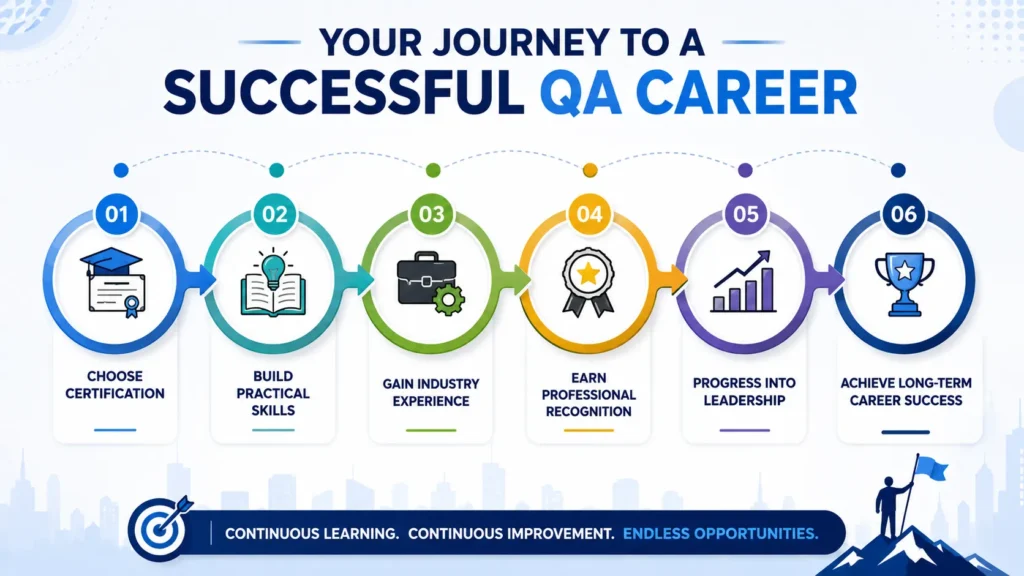
A certification is the beginning of your professional journey rather than the final destination. The following strategies can help you maximise its value and build a successful long-term career.
Gain Practical Experience
Look for opportunities to participate in inspections, audits, quality improvement projects, process reviews, or compliance activities. Practical experience reinforces theoretical knowledge and demonstrates capability to employers.
Develop Industry Knowledge
Every industry has its own quality requirements and regulatory expectations. Understanding the specific challenges within your chosen sector can make you a stronger candidate for specialised roles.
Strengthen Digital Competencies
Learning to use quality management software, spreadsheet analysis tools, document control systems, and data reporting applications can improve productivity and increase career opportunities.
Build Professional Networks
Attending industry events, participating in professional associations, joining webinars, and engaging with quality communities can help expand your knowledge and expose you to new career opportunities.
Continue Professional Development
Quality management is a lifelong learning profession. Pursuing additional qualifications in auditing, process improvement, risk management, Lean methodologies, Six Sigma, or operational excellence can support continued career progression.
Demonstrate a Continuous Improvement Mindset
Employers value professionals who actively seek opportunities to improve efficiency, reduce waste, solve problems, and enhance customer satisfaction. Showing initiative and contributing ideas for improvement can distinguish you from other candidates.
Why Choose Inspire College for Your Quality Assurance Education?
Choosing the right training provider is an important step towards building a successful career in quality assurance. A high-quality learning experience not only develops technical knowledge but also prepares professionals to meet the expectations of modern employers.
At Inspire College, quality assurance programmes are designed to provide learners with practical knowledge, industry-relevant skills, and an understanding of internationally recognised quality management principles. The curriculum focuses on developing competencies that can be applied across a wide range of industries, helping learners prepare for real workplace challenges.
Whether your goal is to begin a career in quality assurance, strengthen your existing skills, or progress into leadership positions, a recognised quality qualification can provide a strong foundation for long-term professional growth.
Conclusion
Quality assurance has become one of the most valuable and versatile professions in today’s global economy. Organisations across manufacturing, engineering, construction, healthcare, pharmaceuticals, food production, logistics, energy, and many other industries depend on skilled professionals to maintain standards, improve processes, and ensure customer satisfaction.
Earning a Quality Assurance Certification can significantly enhance your employability by demonstrating your knowledge of quality management principles, inspection techniques, compliance requirements, and continuous improvement practices. More importantly, it opens the door to a wide variety of career opportunities ranging from Quality Assurance Inspector and Quality Engineer to Internal Auditor, Compliance Officer, Quality Manager, and Director of Quality.
Long-term success, however, depends on more than certification alone. Combining professional qualifications with practical experience, technical expertise, digital skills, and a commitment to continuous learning will position you for sustained career growth in an increasingly competitive job market.
As organisations continue investing in quality, operational excellence, and innovation, certified quality assurance professionals will remain in high demand. Whether you are starting your career or planning your next professional move, investing in quality assurance education can be a valuable step towards a rewarding and future-focused career.