How Quality Assurance and Quality Control Improve Business Performance
In today’s highly competitive global marketplace, delivering consistent quality is no longer a competitive advantage—it is a business necessity. Customers expect reliable products, exceptional services, and seamless experiences, while regulatory bodies demand compliance with recognised standards. Organisations that fail to meet these expectations often face increased operational costs, customer complaints, reputational damage, and lost business opportunities.
This is where Quality Assurance (QA) and Quality Control (QC) become fundamental to sustainable business success. Although these terms are often used interchangeably, they serve distinct yet complementary roles within an organisation’s quality management system. Quality Assurance focuses on preventing defects by establishing effective processes and quality standards, whereas Quality Control identifies and corrects defects before products or services reach customers.
Businesses that successfully integrate QA and QC into their operations benefit from improved efficiency, reduced waste, enhanced customer satisfaction, stronger regulatory compliance, and increased profitability. Whether operating in manufacturing, healthcare, construction, engineering, education, information technology, logistics, hospitality, or professional services, a structured quality management approach enables organisations to consistently deliver value while adapting to changing market demands.
This comprehensive guide explores the differences between Quality Assurance and Quality Control, explains how they work together to improve business performance, and demonstrates why organisations that invest in quality consistently outperform those that do not.
What is Quality Assurance (QA)?
Quality Assurance (QA) is a proactive and systematic approach to ensuring that products, services, and operational processes consistently meet defined quality standards. Rather than identifying defects after they occur, QA focuses on preventing them through effective planning, process design, documentation, training, monitoring, and continuous improvement.
At its core, Quality Assurance answers a simple question:
“Are we using the right processes to achieve consistent quality?”
QA establishes a framework that enables every department to follow standardised procedures, reducing variation and ensuring consistent outcomes across projects, products, and services.
Key Objectives of Quality Assurance
Effective Quality Assurance aims to:
- Prevent defects before they occur.
- Standardise operational processes.
- Improve organisational efficiency.
- Ensure compliance with regulatory and industry requirements.
- Reduce operational risks.
- Enhance customer satisfaction.
- Promote continuous improvement.
- Build a culture of quality across the organisation.
Common Quality Assurance Activities
Quality Assurance involves a wide range of planned activities, including:
- Developing quality policies and procedures
- Creating Standard Operating Procedures (SOPs)
- Employee training and competency development
- Process mapping and documentation
- Risk assessment and mitigation
- Internal quality audits
- Supplier quality management
- Performance monitoring
- Corrective and preventive actions (CAPA)
- Continuous process improvement initiatives
These activities help organisations maintain consistency while reducing the likelihood of costly errors and rework.
Why Quality Assurance Matters
Quality Assurance shifts an organisation from a reactive mindset to a preventive approach. Instead of repeatedly fixing the same problems, businesses identify root causes, improve processes, and create systems that minimise future defects.
For example, a construction company may implement detailed inspection checklists and staff training before a project begins. By ensuring that every process follows established standards, the company significantly reduces the likelihood of structural defects, project delays, and costly rework.
Similarly, a software development company uses Quality Assurance through coding standards, peer reviews, automated testing frameworks, and development methodologies to minimise software bugs before release.
What is Quality Control (QC)?
Quality Control (QC) is the operational process of inspecting, testing, measuring, and verifying products or services to ensure they meet established quality requirements before reaching customers.
Unlike Quality Assurance, which focuses on improving processes, Quality Control concentrates on evaluating outputs.
Quality Control answers the question:
“Does the final product or service meet the required quality standards?”
QC acts as the final checkpoint that verifies whether products or services conform to specifications, customer expectations, and regulatory requirements.
Key Objectives of Quality Control
The primary objectives of Quality Control include:
- Detect defects and non-conformities
- Verify compliance with specifications
- Reduce customer complaints
- Minimise defective products reaching the market
- Ensure product reliability
- Protect organisational reputation
- Support continuous quality improvement
Common Quality Control Activities
Quality Control activities typically include:
- Visual inspections
- Product testing
- Dimensional measurements
- Functional testing
- Sampling inspections
- Laboratory testing
- Calibration of equipment
- Final product verification
- Documentation of inspection results
- Non-conformance reporting
These activities provide measurable evidence that products and services satisfy predetermined quality standards.
Why Quality Control Matters
Even organisations with highly effective Quality Assurance systems require Quality Control. Unexpected issues can arise due to equipment failures, supplier inconsistencies, environmental conditions, or human error. QC helps identify these issues before products or services are delivered to customers.
For instance, in a food manufacturing facility, Quality Assurance establishes hygiene procedures, supplier approval processes, and production standards. Quality Control then verifies that each production batch meets food safety, packaging, and quality specifications before distribution.
Likewise, in healthcare, QA develops clinical procedures and patient safety protocols, while QC verifies laboratory results, calibrates medical equipment, and monitors service accuracy.
Quality Assurance vs Quality Control: Understanding the Difference
Although Quality Assurance and Quality Control work towards the same goal of delivering high-quality outcomes, they differ significantly in purpose, timing, and approach.
| Aspect | Quality Assurance (QA) | Quality Control (QC) |
|---|---|---|
| Primary Focus | Preventing defects | Detecting defects |
| Approach | Proactive | Reactive |
| Objective | Improve processes | Verify products or services |
| Timing | Before and during production or service delivery | During and after production or service delivery |
| Method | Process-oriented | Product-oriented |
| Responsibility | Management and all employees | Inspectors, technicians, quality professionals |
| Activities | Audits, training, documentation, SOPs, process improvement | Inspection, testing, measurement, verification |
| Outcome | Consistent operational excellence | Conforming products and services |
A Simple Example
Imagine a car manufacturer.
Quality Assurance involves:
- Designing standardised manufacturing processes
- Training assembly line workers
- Qualifying suppliers
- Documenting production procedures
- Conducting internal audits
Quality Control involves:
- Inspecting engine components
- Testing brake performance
- Measuring paint thickness
- Verifying safety systems
- Conducting final vehicle inspections
Both functions are essential. QA ensures the manufacturing process is capable of producing quality vehicles consistently, while QC confirms that every finished vehicle meets safety and performance standards.
Why Every Business Needs Both QA and QC
Some organisations mistakenly believe that Quality Control alone is sufficient to achieve quality. Others focus exclusively on Quality Assurance without adequately verifying final outputs. In reality, sustainable business success depends on integrating both disciplines.
Quality Assurance builds reliable processes that reduce the likelihood of errors, while Quality Control validates that those processes consistently produce acceptable outcomes. Together, they create a comprehensive quality management framework that drives operational excellence.
Businesses that implement both QA and QC benefit from:
- Greater operational consistency
- Reduced process variation
- Lower defect rates
- Improved regulatory compliance
- Enhanced customer confidence
- Stronger supplier relationships
- Better resource utilisation
- Reduced waste and rework
- Increased employee accountability
- Sustainable business growth
Customer Requirements
↓
Planning
↓
Quality Assurance
↓
Production / Service Delivery
↓
Quality Control
↓
Customer Delivery
↓
Customer Feedback
↓
Continuous Improvement
How QA and QC Work Together
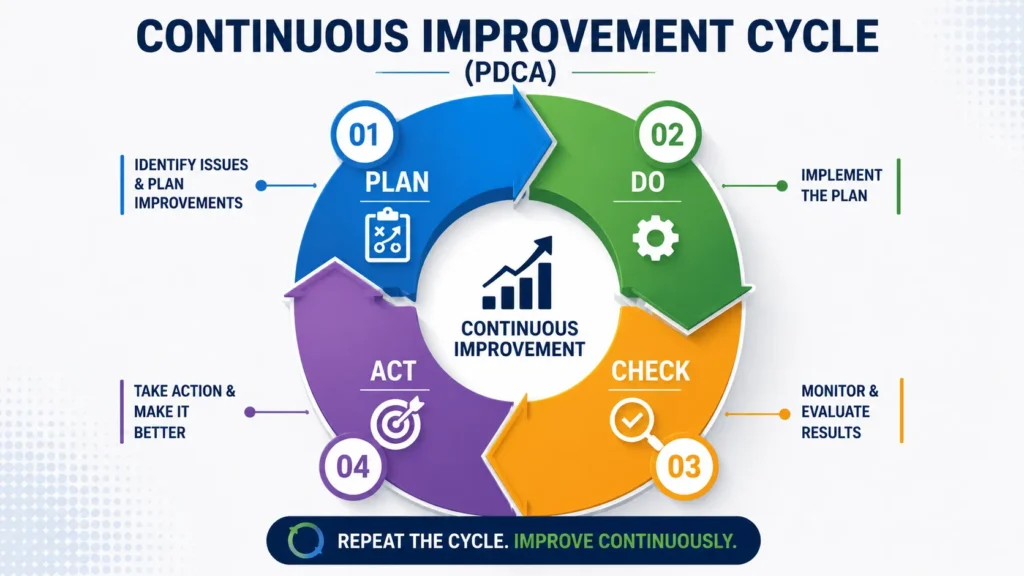
Rather than operating independently, QA and QC reinforce one another through a continuous cycle of improvement.
- Customer requirements are identified.
- Quality Assurance establishes standards, procedures, and controls.
- Teams follow documented processes during operations.
- Quality Control inspects and tests outputs.
- Any defects or non-conformities are recorded.
- Root causes are investigated.
- Quality Assurance updates processes to prevent recurrence.
- The cycle repeats, driving continuous improvement.
This integrated approach enables organisations to move beyond simply correcting mistakes and towards building systems that consistently prevent them.
The Foundation of High-Performing Organisations
Leading organisations recognise that quality is not the responsibility of a single department. Instead, it is embedded throughout the entire organisation—from strategic planning and procurement to production, customer service, and continuous improvement.
When Quality Assurance and Quality Control become part of an organisation’s culture, quality evolves from a compliance requirement into a strategic business asset. This foundation supports innovation, strengthens customer trust, enhances operational resilience, and positions businesses for long-term success in increasingly competitive markets.
How Quality Assurance Improves Business Performance
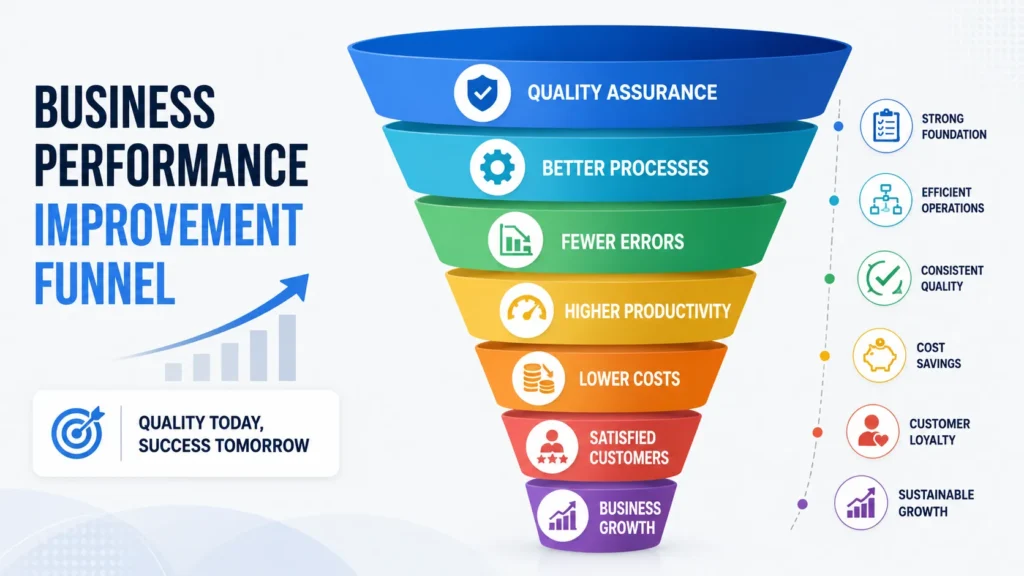
Quality Assurance is much more than a compliance function—it is a strategic business practice that helps organisations achieve operational excellence and long-term success. By focusing on prevention rather than correction, QA creates reliable processes that minimise errors, improve consistency, and support sustainable growth.
When quality is built into every stage of an operation, businesses spend less time resolving problems and more time delivering value to customers. This proactive approach strengthens productivity, reduces unnecessary costs, and enables organisations to respond confidently to changing market demands.
1. Improves Operational Efficiency
Efficient operations are built on well-defined processes. Quality Assurance establishes standard operating procedures, clear responsibilities, and documented workflows that reduce confusion and eliminate unnecessary variations.
When every employee follows consistent procedures, organisations experience:
- Faster workflow execution
- Reduced process delays
- Better coordination between departments
- Improved resource utilisation
- Increased productivity
Efficient processes also make it easier to scale operations while maintaining consistent quality standards.
2. Reduces Errors and Rework
One of the greatest hidden costs for any business is rework. Correcting mistakes consumes time, labour, materials, and financial resources that could otherwise be invested in growth.
Quality Assurance identifies potential risks before they become costly problems by implementing preventive measures such as employee training, process monitoring, risk assessments, and internal audits.
Reducing errors results in:
- Lower operational costs
- Faster project completion
- Improved profitability
- Better customer experiences
- Greater employee confidence
3. Enhances Customer Satisfaction
Customers expect products and services that consistently meet their expectations. Organisations that deliver reliable quality build stronger customer relationships and encourage repeat business.
Quality Assurance supports customer satisfaction by ensuring that every stage of product development or service delivery follows established quality standards.
Satisfied customers are more likely to:
- Become loyal clients
- Recommend the business to others
- Leave positive reviews
- Strengthen the organisation’s reputation
- Increase long-term revenue
4. Supports Regulatory Compliance
Many industries operate under strict legal, regulatory, and industry-specific requirements. Failure to comply can result in financial penalties, legal disputes, operational disruptions, and reputational damage.
Quality Assurance helps organisations establish documented procedures that align with applicable regulations and recognised standards, making compliance easier to maintain during inspections and external audits.
Examples include:
- ISO management system standards
- Health and safety regulations
- Environmental requirements
- Healthcare quality standards
- Construction regulations
- Food safety management systems
5. Encourages Continuous Improvement
High-performing organisations never assume their processes are perfect. Instead, they regularly evaluate performance, analyse data, identify improvement opportunities, and implement corrective actions.
Quality Assurance promotes a culture of continuous improvement by encouraging organisations to:
- Review performance indicators
- Conduct internal audits
- Analyse customer feedback
- Investigate root causes
- Update procedures
- Measure improvement outcomes
This ongoing cycle helps businesses remain competitive in rapidly changing industries.
6. Strengthens Risk Management
Every business faces operational risks, including supplier failures, equipment breakdowns, human error, cybersecurity threats, and changing regulatory requirements.
Quality Assurance incorporates risk-based thinking into decision-making by identifying vulnerabilities before they impact operations.
Proactive risk management helps organisations:
- Prevent costly disruptions
- Protect business continuity
- Improve decision-making
- Reduce operational uncertainty
- Increase organisational resilience
7. Builds a Strong Quality Culture
Successful quality management extends beyond policies and procedures. It becomes part of an organisation’s culture.
Quality Assurance encourages employees at every level to take ownership of quality by promoting accountability, collaboration, continuous learning, and problem-solving.
A strong quality culture leads to:
- Higher employee engagement
- Improved teamwork
- Greater innovation
- Better communication
- Increased organisational performance
How Quality Control Improves Business Performance
While Quality Assurance focuses on preventing defects, Quality Control ensures that products and services meet established quality requirements before they reach customers.
QC provides objective evidence that outputs conform to specifications, reducing the likelihood of defective products entering the market and protecting the organisation’s reputation.
1. Detects Defects Before Delivery
Quality Control inspections identify issues before products or services reach customers. Early detection prevents defective outputs from causing complaints, warranty claims, product recalls, or contractual disputes.
This protects both customers and the organisation’s reputation.
2. Improves Product and Service Reliability
Consistent inspection and testing ensure that products perform as intended and services meet agreed standards.
Reliable products increase customer confidence, strengthen brand credibility, and reduce after-sales support costs.
3. Reduces Customer Complaints
Every customer complaint represents additional costs in investigation, replacement, refunds, and reputational risk.
Quality Control helps minimise complaints by verifying that outputs meet quality specifications before delivery.
Lower complaint rates contribute to:
- Better customer retention
- Improved online reputation
- Higher customer confidence
- Increased referrals
- Stronger brand image
4. Supports Better Decision-Making
Quality Control generates valuable performance data that helps management understand operational trends.
Inspection reports, defect analysis, testing results, and quality metrics provide insights into recurring issues, allowing leadership to prioritise improvement initiatives based on evidence rather than assumptions.
5. Improves Supplier Performance
Quality problems often originate within the supply chain.
By inspecting incoming materials and monitoring supplier quality, organisations can identify recurring issues, evaluate supplier performance, and work collaboratively to improve quality standards.
This reduces production disruptions and improves overall operational reliability.
6. Protects Brand Reputation
A single defective product or poor customer experience can significantly damage an organisation’s reputation in today’s digital marketplace.
Quality Control acts as a safeguard by preventing non-conforming products and services from reaching customers, protecting brand credibility and maintaining customer trust.
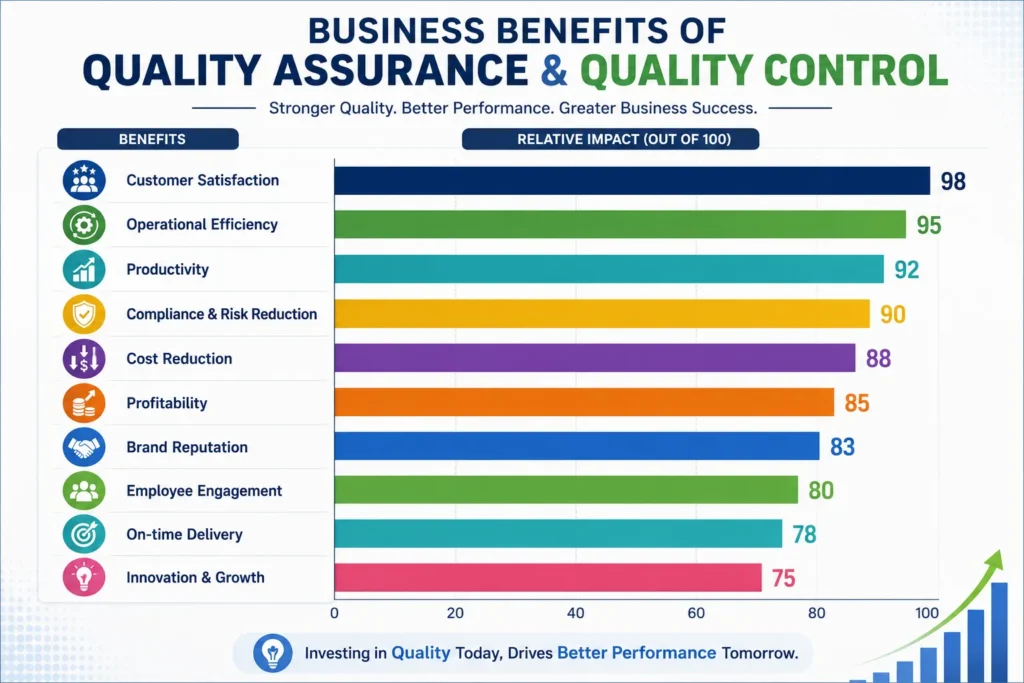
10 Ways Quality Assurance and Quality Control Increase Business Profitability
Quality should never be viewed as an expense. Instead, it is a strategic investment that delivers measurable financial returns through increased efficiency, reduced waste, and stronger customer relationships.
The following are ten practical ways QA and QC contribute directly to improved business profitability.
1. Reduce Operational Costs
Preventing defects is significantly less expensive than correcting them after production or service delivery. Effective quality management reduces unnecessary spending on rework, repairs, replacements, and warranty claims.
2. Increase Productivity
Standardised processes enable employees to complete tasks more efficiently with fewer interruptions, allowing organisations to produce more using existing resources.
3. Reduce Waste
Quality management minimises material waste, production errors, duplicated work, and inefficient resource utilisation, improving both financial and environmental performance.
4. Improve Customer Retention
Retaining existing customers is generally more cost-effective than acquiring new ones. Consistently delivering quality products and services encourages repeat business and long-term customer loyalty.
5. Enhance Competitive Advantage
Businesses recognised for consistent quality often win more contracts, strengthen client relationships, and differentiate themselves in highly competitive markets.
6. Improve Employee Performance
Clear procedures, regular training, and defined quality expectations enable employees to perform confidently and consistently while reducing workplace errors.
7. Increase Revenue Opportunities
Organisations with strong quality systems are better positioned to enter new markets, secure larger contracts, and meet customer requirements that demand recognised quality standards.
8. Strengthen Supplier Relationships
Quality-focused organisations collaborate with suppliers to improve consistency, reliability, and overall supply chain performance, reducing costly production disruptions.
9. Reduce Business Risks
Preventing quality failures helps organisations avoid legal claims, regulatory penalties, contractual disputes, and reputational damage that can affect long-term profitability.
10. Drive Sustainable Business Growth
When operational excellence, customer satisfaction, employee engagement, and financial performance improve together, organisations create a strong foundation for sustainable growth and long-term success.
Understanding the Cost of Poor Quality (COPQ)
Many organisations underestimate how much poor quality affects profitability. While some costs are immediately visible, others remain hidden within day-to-day operations.
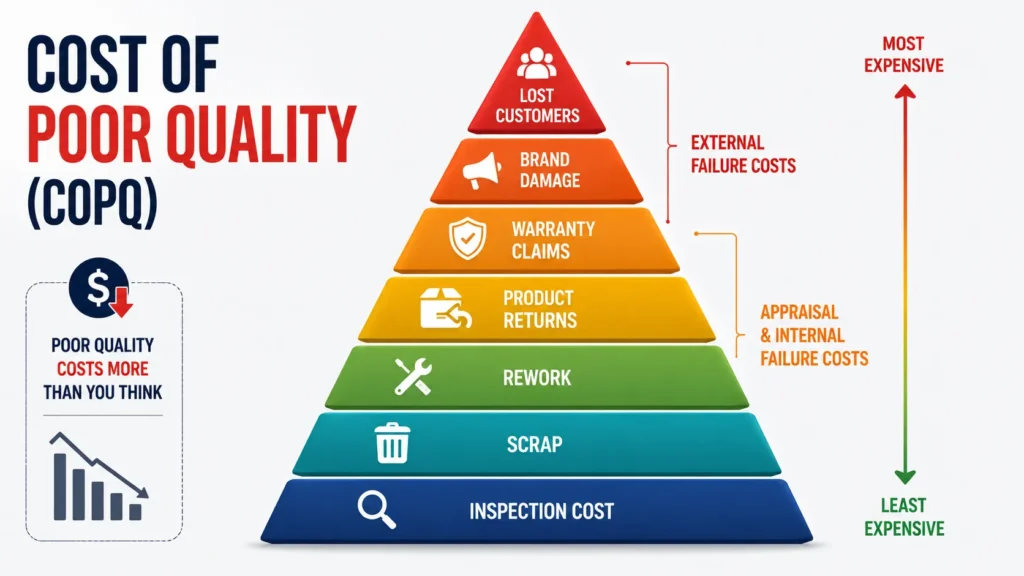
The Cost of Poor Quality (COPQ) refers to the total financial impact of defects, inefficiencies, failures, and non-conforming products or services.
These costs can quickly reduce profitability and limit an organisation’s ability to invest in innovation and growth.
Common Examples of COPQ
Internal costs include:
- Rework
- Scrap materials
- Production delays
- Equipment downtime
- Additional labour
- Process inefficiencies
External costs include:
- Customer complaints
- Product returns
- Warranty claims
- Contract penalties
- Product recalls
- Lost customers
- Damage to brand reputation
For many businesses, the hidden costs of poor quality are significantly greater than the investment required to establish an effective Quality Assurance and Quality Control system.
Key Business Performance Indicators Improved by QA and QC
One of the greatest strengths of Quality Assurance and Quality Control is that their impact can be measured. Organisations that invest in quality management often see improvements across a wide range of key performance indicators (KPIs).
Important KPIs influenced by effective QA and QC include:
| Business KPI | Impact of Effective QA and QC |
|---|---|
| Defect Rate | Fewer production and service errors |
| Customer Satisfaction | Higher satisfaction scores and positive feedback |
| Customer Retention | Increased repeat business and loyalty |
| Productivity | More efficient workflows and higher output |
| Rework Percentage | Significant reduction in corrective work |
| Operational Costs | Lower waste and reduced process inefficiencies |
| First Pass Yield | Higher percentage of outputs meeting standards the first time |
| Delivery Performance | More consistent on-time delivery |
| Employee Efficiency | Better adherence to procedures and improved performance |
| Profit Margin | Increased profitability through cost reduction and improved quality |
Monitoring these indicators enables organisations to evaluate the effectiveness of their quality management initiatives and identify opportunities for continuous improvement.
How QA and QC Improve Performance Across Different Industries
Although the principles of Quality Assurance and Quality Control remain consistent, their practical application varies across industries.
In manufacturing, QA establishes production standards and process controls, while QC inspects raw materials, monitors production quality, and verifies finished products before shipment.
In construction, QA focuses on project planning, documentation, supplier evaluation, and compliance with building standards, whereas QC includes material inspections, site testing, structural verification, and final project inspections.
In healthcare, QA develops clinical governance frameworks, patient safety procedures, and treatment protocols. QC verifies laboratory results, medical equipment calibration, medication accuracy, and service quality to ensure safe patient care.
Within information technology, QA includes software development methodologies, coding standards, security requirements, and testing strategies. QC validates software functionality, performance, usability, and security before deployment.
For education and training providers, QA supports curriculum development, assessment quality, learner support, instructor competence, and regulatory compliance. QC reviews assessment outcomes, internal verification processes, learner feedback, and overall educational quality.
Regardless of industry, organisations that integrate Quality Assurance and Quality Control into their daily operations are better equipped to improve efficiency, reduce risk, satisfy customers, and achieve stronger business performance.
The Role of ISO 9001 in Improving Business Performance
A well-implemented Quality Management System (QMS) provides the foundation for consistent quality, operational efficiency, and continual improvement. Among the various quality management standards available worldwide, ISO 9001 is the most widely recognised framework for helping organisations establish, maintain, and improve effective quality management practices.
Rather than prescribing how a business should operate, ISO 9001 provides a flexible framework that enables organisations of all sizes and sectors to develop processes that consistently deliver products and services meeting customer and regulatory requirements.
The standard is based on several quality management principles, including:
- Customer focus
- Leadership and strategic direction
- Engagement of people
- Process approach
- Continuous improvement
- Evidence-based decision making
- Relationship management
When organisations align their Quality Assurance and Quality Control activities with these principles, they create a structured environment where quality becomes part of everyday operations rather than an isolated function.
Customer Requirements
↓
ISO 9001 QMS
↓
Quality Assurance
↓
Quality Control
↓
Customer Satisfaction
↓
Continual Improvement
How ISO 9001 Supports Quality Assurance
Quality Assurance plays a central role within an ISO 9001 Quality Management System by helping organisations:
- Develop documented procedures and work instructions
- Standardise operational processes
- Manage organisational risks and opportunities
- Conduct internal quality audits
- Implement corrective and preventive actions
- Monitor performance against quality objectives
- Promote continual improvement
These activities ensure that quality is built into processes from the beginning rather than relying solely on inspections at the end.
How ISO 9001 Supports Quality Control
Quality Control complements ISO 9001 by verifying that products and services consistently meet established requirements.
Typical QC activities within an ISO 9001 framework include:
- Product inspections
- Testing and measurement
- Equipment calibration
- Monitoring non-conforming outputs
- Recording inspection results
- Verifying corrective actions
Together, Quality Assurance and Quality Control create a balanced approach that combines prevention with verification, enabling organisations to deliver consistent quality while continuously improving performance.
How Artificial Intelligence and Digital Technologies Are Transforming Quality Management
Technology is changing the way organisations manage quality. Traditional paper-based inspections and manual reporting are increasingly being replaced by digital systems that provide real-time visibility, faster decision-making, and more accurate performance monitoring.
Artificial Intelligence (AI), automation, cloud-based quality management platforms, and advanced data analytics are helping organisations identify quality issues earlier and improve operational efficiency.
Predictive Quality Management
AI-powered systems can analyse historical production data, inspection records, equipment performance, and customer feedback to identify patterns that may indicate future quality issues.
Instead of waiting for defects to occur, businesses can take preventive action before problems affect products, services, or customers.
Automated Inspection Systems
Modern inspection technologies use machine vision, sensors, and automated testing equipment to inspect products with greater speed and consistency than manual inspections.
Benefits include:
- Improved inspection accuracy
- Faster quality verification
- Reduced human error
- Higher production efficiency
- Better traceability
Real-Time Performance Monitoring
Digital dashboards allow managers to monitor quality performance across multiple departments and locations.
Key metrics such as defect rates, customer complaints, production efficiency, supplier performance, and audit findings can be tracked in real time, enabling quicker responses to emerging issues.
Data-Driven Decision Making
Modern quality management relies on accurate data rather than assumptions.
Digital quality systems help organisations:
- Identify recurring problems
- Analyse root causes
- Prioritise improvement initiatives
- Measure the effectiveness of corrective actions
- Support strategic planning
By combining Quality Assurance, Quality Control, and digital technologies, businesses can create smarter, more resilient operations that continuously improve over time.
Common Quality Assurance and Quality Control Mistakes Businesses Should Avoid
Even organisations with established quality systems can experience performance issues if common mistakes are overlooked. Recognising these challenges is the first step towards building a stronger quality culture.
Treating Quality as the Responsibility of One Department
Quality should never be viewed as the responsibility of the quality department alone. Every employee, from senior management to frontline staff, contributes to delivering consistent quality.
Focusing Only on Inspection
Inspecting finished products without improving the underlying processes often results in recurring defects. Businesses achieve better long-term results when Quality Assurance and Quality Control work together.
Ignoring Root Cause Analysis
Correcting the immediate problem without understanding why it occurred increases the likelihood of repeated failures. Effective root cause analysis helps organisations eliminate recurring issues permanently.
Inadequate Employee Training
Even the best procedures cannot deliver consistent results if employees lack the knowledge and skills required to apply them correctly.
Regular training ensures that staff understand quality expectations, operational procedures, and organisational objectives.
Poor Documentation
Outdated or incomplete documentation creates inconsistency, confusion, and compliance risks.
Organisations should regularly review and update quality manuals, procedures, work instructions, and inspection records.
Weak Supplier Quality Management
Quality problems often begin within the supply chain.
Evaluating suppliers, monitoring performance, and maintaining clear quality expectations help reduce disruptions and improve product consistency.
Ignoring Customer Feedback
Customer feedback provides valuable information about product performance, service quality, and improvement opportunities.
Businesses that actively analyse customer feedback are better positioned to improve satisfaction and strengthen long-term relationships.
Measuring Too Few Performance Indicators
Without meaningful quality metrics, organisations struggle to evaluate performance and identify improvement opportunities.
Regularly monitoring key performance indicators enables informed decision-making and continuous improvement.
Failing to Conduct Internal Audits
Internal audits help identify weaknesses before they become significant business risks.
Routine audits also encourage compliance, improve accountability, and strengthen organisational performance.
Viewing Quality as a Cost Instead of an Investment
One of the most common misconceptions is that quality management increases operational costs.
In reality, effective Quality Assurance and Quality Control reduce waste, improve productivity, minimise business risks, and generate long-term financial benefits that far exceed the initial investment.
Building a Quality-Driven Business Culture
High-performing organisations understand that sustainable quality cannot be achieved through procedures alone. It requires a culture where quality is embedded in everyday decision-making and supported by every employee.
Creating a quality-driven culture begins with leadership. Senior management must demonstrate a clear commitment to quality by setting measurable objectives, allocating appropriate resources, and encouraging continuous improvement across all departments.
Employees should feel empowered to identify potential risks, suggest improvements, report non-conformities, and contribute to organisational success without fear of blame.
A strong quality culture is characterised by:
- Clear leadership commitment
- Well-defined quality objectives
- Effective communication
- Continuous employee development
- Cross-functional collaboration
- Evidence-based decision making
- Recognition of improvement initiatives
- Customer-focused thinking
- Commitment to continual improvement
Organisations that successfully develop this culture often experience greater innovation, stronger employee engagement, improved operational resilience, and higher customer confidence.
Conclusion
Quality Assurance and Quality Control are no longer optional practices reserved for large manufacturing organisations. They are essential business disciplines that enable organisations of every size and industry to improve efficiency, reduce operational risks, enhance customer satisfaction, and achieve sustainable growth.
While Quality Assurance focuses on building reliable systems that prevent problems before they occur, Quality Control ensures that products and services consistently meet established standards through effective inspection and verification. Together, they create a comprehensive quality management approach that strengthens every stage of business operations.
Organisations that invest in robust QA and QC practices benefit from lower costs, improved productivity, stronger regulatory compliance, better decision-making, and enhanced organisational resilience. They are also better positioned to adapt to technological advancements, changing customer expectations, and increasingly competitive global markets.
Ultimately, quality is not simply about meeting specifications—it is about creating lasting value for customers, employees, stakeholders, and the organisation itself. Businesses that make quality a strategic priority are more likely to build trust, protect their reputation, and achieve long-term business success in an ever-evolving marketplace.