Best Quality Assurance and Quality Control Certifications to Boost Your Career
Quality has become one of the most valuable assets for organisations operating in today’s competitive global economy. Businesses across manufacturing, construction, engineering, healthcare, pharmaceuticals, food production, logistics, information technology, and many other industries rely on skilled quality professionals to maintain standards, improve efficiency, reduce operational risks, and ensure customer satisfaction. As organisations continue to adopt internationally recognised quality management systems and pursue operational excellence, the demand for qualified Quality Assurance (QA) and Quality Control (QC) professionals continues to grow.
However, gaining practical experience alone is no longer enough to stand out in a competitive job market. Employers increasingly seek professionals who possess recognised certifications that validate their technical knowledge, auditing skills, understanding of international standards, and commitment to continuous professional development. A globally recognised QA or QC certification not only enhances professional credibility but also demonstrates competence in quality management principles, regulatory compliance, risk management, process improvement, and continual improvement.
Whether an individual is starting a career in quality management, progressing into supervisory or managerial roles, or seeking international employment opportunities, choosing the right certification can significantly influence career progression. The challenge is that there are numerous certifications available, each designed for different industries, experience levels, and career objectives. Selecting the most appropriate qualification requires a clear understanding of personal career goals, industry requirements, and employer expectations.
This comprehensive guide explores the best Quality Assurance and Quality Control certifications recognised across industries, explains their career benefits, compares their suitability for different professionals, and provides practical guidance on selecting the certification that best supports long-term career growth.
Why Quality Assurance and Quality Control Certifications Matter
Quality Assurance and Quality Control play a vital role in ensuring that products, services, and business processes consistently meet customer expectations and regulatory requirements. Organisations invest heavily in quality management because poor quality can lead to increased costs, operational inefficiencies, customer dissatisfaction, regulatory penalties, and reputational damage.
Professional certifications provide evidence that an individual possesses the knowledge and practical understanding required to contribute effectively to an organisation’s quality objectives. Rather than simply demonstrating theoretical knowledge, recognised certifications confirm that professionals understand internationally accepted quality principles, structured quality management practices, auditing techniques, inspection methods, and continuous improvement methodologies.
In today’s employment market, certified quality professionals often enjoy greater career opportunities because employers value individuals who can help improve operational performance, maintain compliance, reduce business risks, and support organisational growth.
A recognised certification can also provide confidence when working with international clients, multinational organisations, and industries that operate under strict quality and regulatory requirements.
Beginner
↓
QA/QC Fundamentals
↓
ISO 9001 QMS
↓
Internal Auditor
↓
Lead Auditor
↓
Quality Manager
↓
Head of Quality
Key Benefits of Professional QA and QC Certifications
Investing in a recognised Quality Assurance or Quality Control certification offers benefits that extend far beyond obtaining a qualification. These certifications help professionals build technical expertise, improve career prospects, and remain competitive in an evolving global workforce.
Improve Career Opportunities
Many employers actively prioritise certified professionals when recruiting for quality-related roles. Certifications demonstrate commitment to professional development and reassure employers that candidates possess recognised industry knowledge.
Professionals with relevant certifications are often considered for positions such as:
- Quality Assurance Officer
- Quality Control Inspector
- QA/QC Engineer
- Quality Coordinator
- Internal Auditor
- Lead Auditor
- Compliance Officer
- Quality Supervisor
- Quality Manager
- Continuous Improvement Specialist
As organisations continue to strengthen their quality management systems, certified professionals are increasingly viewed as valuable assets capable of improving operational performance and customer satisfaction.
Increase Professional Credibility
Professional certifications establish credibility by validating an individual’s knowledge against recognised industry standards.
Whether working in engineering, healthcare, manufacturing, construction, food production, pharmaceuticals, or information technology, certified professionals demonstrate that they understand quality management principles and best practices that can be applied across diverse operational environments.
This credibility often strengthens relationships with employers, clients, auditors, suppliers, and regulatory authorities.
Enhance Practical Knowledge and Skills
Modern quality certifications extend beyond theoretical concepts by introducing professionals to practical techniques used in real workplace environments.
Depending on the certification, learners may develop expertise in:
- Quality planning
- Inspection techniques
- Process monitoring
- Internal auditing
- Root cause analysis
- Risk assessment
- Corrective and preventive actions
- Process improvement
- Documentation control
- Performance measurement
These practical skills enable professionals to contribute more effectively to organisational success.
Support International Career Mobility
Quality management principles are recognised worldwide, making many QA and QC certifications valuable across international markets.
Professionals with internationally recognised qualifications often find greater opportunities to work with multinational organisations, global supply chains, international construction projects, manufacturing facilities, engineering companies, healthcare providers, and certification bodies.
For individuals seeking overseas employment or international career progression, globally recognised quality certifications can significantly strengthen professional profiles.
Increase Promotion Opportunities
Employers frequently seek individuals who can take responsibility for quality management activities, lead improvement initiatives, conduct audits, and manage compliance requirements.
Holding recognised certifications demonstrates readiness for increased responsibility and leadership roles, making certified professionals more competitive when promotion opportunities arise.
Strengthen Organisational Value
Certified quality professionals contribute directly to organisational performance by helping businesses:
- Improve operational efficiency
- Reduce defects and rework
- Maintain regulatory compliance
- Improve customer satisfaction
- Reduce operational risks
- Support continuous improvement
- Strengthen supplier quality
- Improve business performance
As organisations increasingly focus on operational excellence, professionals who possess recognised quality qualifications become valuable contributors to long-term business success.
How to Choose the Right Quality Assurance or Quality Control Certification
With so many certifications available, selecting the right qualification can appear overwhelming. Rather than choosing the most popular certification, professionals should evaluate qualifications based on their current experience, career ambitions, industry requirements, and long-term professional goals.
The right certification should complement existing skills while supporting future career development.
Consider Your Career Stage
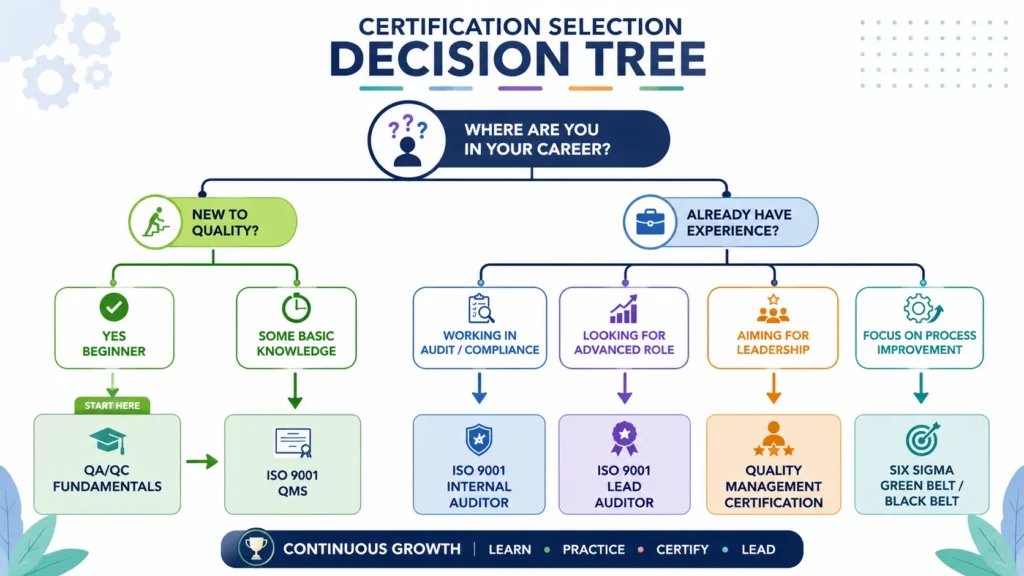
Different certifications are designed for different levels of experience.
Individuals beginning a career in quality management often benefit from foundation-level certifications that introduce quality principles, inspection methods, documentation, and quality management systems.
Professionals with several years of experience may choose certifications that develop auditing, process improvement, leadership, or quality management expertise.
Experienced managers and senior professionals may pursue advanced certifications focused on strategic quality management, organisational improvement, and leadership.
Selecting a certification appropriate to current experience helps build knowledge progressively and supports long-term career development.
Choose a Certification Relevant to Your Industry
Although many quality management principles are universal, some industries require specialised knowledge.
For example:
- Manufacturing professionals often benefit from certifications covering production quality, statistical process control, and process improvement.
- Construction professionals typically require expertise in inspection procedures, project quality management, and ISO-based quality systems.
- Healthcare professionals frequently work with quality standards related to patient safety, clinical governance, and regulatory compliance.
- Food industry professionals may require certifications aligned with food safety and quality management systems.
- Software professionals often focus on software quality assurance, testing methodologies, and application lifecycle quality.
Choosing an industry-relevant certification improves career relevance and employer recognition.
Consider Global Recognition
Internationally recognised certifications often provide greater career flexibility than qualifications recognised only within a single region.
Globally recognised certifications demonstrate competence that can be applied across multinational organisations and international industries.
Professionals planning to work overseas or collaborate with international clients should prioritise certifications that are respected worldwide and aligned with recognised quality management standards.
Evaluate Learning Outcomes
Before enrolling, review the certification syllabus carefully.
A high-quality programme should develop both technical knowledge and practical workplace skills, including:
- Quality management principles
- Process improvement
- Auditing techniques
- Inspection methods
- Risk-based thinking
- Corrective actions
- Continuous improvement
- Documentation management
- Performance monitoring
Understanding learning outcomes helps ensure that the certification aligns with career objectives.
Assess Career Progression Opportunities
Rather than viewing certification as a one-time achievement, professionals should consider how each qualification supports future career development.
An ideal certification pathway enables progression from operational roles into supervisory, auditing, management, and leadership positions.
Building knowledge gradually through increasingly advanced certifications provides a structured route towards senior quality management responsibilities.
Select Flexible Learning Options
Modern professionals often balance learning alongside full-time employment.
Flexible study options such as online learning, blended delivery, and self-paced programmes enable professionals to continue developing their knowledge without interrupting their careers.
When selecting a certification provider, consider learning flexibility, tutor support, assessment methods, and professional recognition.
Characteristics of High-Quality QA and QC Certifications
Not every certification delivers the same level of professional value. High-quality programmes share several characteristics that distinguish them from short awareness courses or unrecognised qualifications.
When evaluating a certification, look for programmes that offer:
- Industry-recognised curriculum
- Practical workplace application
- International relevance
- Experienced trainers and assessors
- Clear learning outcomes
- Alignment with recognised quality standards
- Skills that support career progression
- Assessment methods that demonstrate competence
- Strong employer recognition
- Opportunities for continuous professional development
Choosing a certification with these characteristics helps ensure that the investment delivers long-term professional value rather than short-term recognition.
In the next section, we will explore the best Quality Assurance and Quality Control certifications available today, compare their strengths, identify who they are best suited for, and explain how each certification can support career progression across different industries and professional levels.
Top Quality Assurance and Quality Control Certifications to Boost Your Career
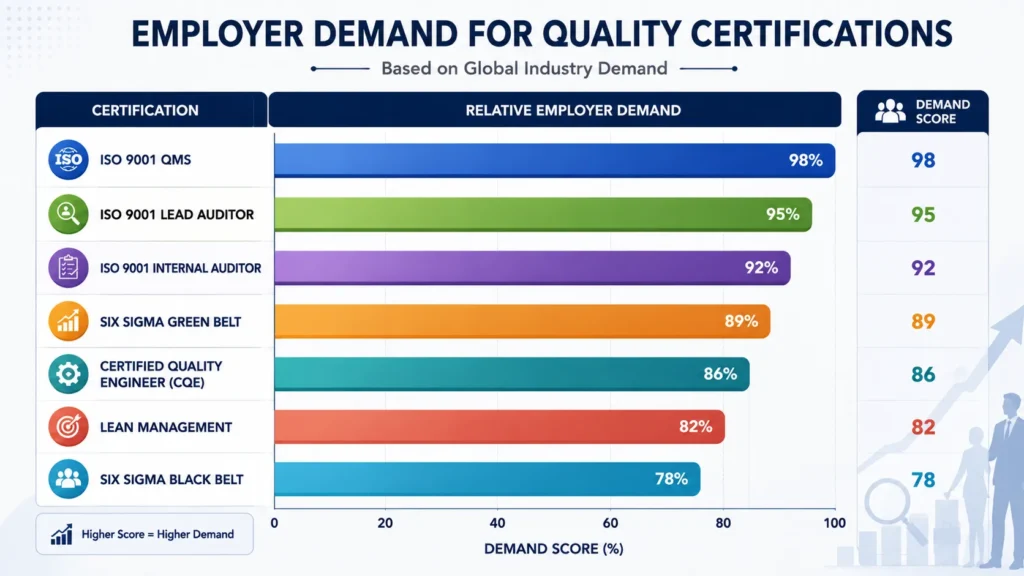
Choosing the right certification is one of the most important career decisions for quality professionals. The best certification depends on an individual’s experience, industry, career goals, and the type of role they wish to pursue. Some certifications focus on quality management systems and auditing, while others specialise in process improvement, inspection, engineering quality, or statistical quality control.
The following certifications are among the most recognised and valuable for professionals seeking to build or advance a successful career in Quality Assurance and Quality Control.
1. ISO 9001:2015 Quality Management System (QMS) Certification
ISO 9001 is the world’s most recognised quality management standard. Organisations across manufacturing, construction, healthcare, engineering, logistics, education, and professional services use ISO 9001 to establish effective Quality Management Systems (QMS).
Professionals who understand ISO 9001 are highly valued because they can help organisations improve processes, maintain compliance, enhance customer satisfaction, and support continual improvement.
Best for:
- Beginners
- Quality Coordinators
- QA Officers
- QC Inspectors
- Supervisors
- Managers
Key Skills Developed
- Quality Management Systems
- Process-based thinking
- Risk management
- Documentation control
- Continuous improvement
- Customer focus
- Performance evaluation
2. ISO 9001 Lead Auditor Certification
The ISO 9001 Lead Auditor certification prepares professionals to plan, conduct, report, and manage first-party, second-party, and third-party quality audits.
Lead Auditors play an essential role in evaluating organisational compliance, identifying improvement opportunities, and supporting continual improvement initiatives.
This certification is particularly valuable for professionals responsible for quality management, supplier audits, certification audits, or regulatory compliance.
Best for:
- QA Managers
- Internal Auditors
- Compliance Managers
- Consultants
- Senior Quality Professionals
Key Skills Developed
- Audit planning
- Audit reporting
- Interview techniques
- Evidence collection
- Non-conformity reporting
- Corrective action evaluation
- ISO 19011 auditing principles
3. ISO 9001 Internal Auditor Certification
Internal auditing is a critical component of every effective Quality Management System.
Internal Auditor certification develops the skills required to evaluate organisational processes, identify non-conformities, verify compliance, and recommend improvements before external audits take place.
It is often considered one of the best stepping stones towards becoming a Lead Auditor.
Best for:
- Quality Officers
- Supervisors
- Process Owners
- Compliance Teams
- QA Engineers
Key Skills Developed
- Internal auditing
- Audit checklists
- Process evaluation
- Root cause analysis
- Corrective actions
- Audit documentation
4. Certified Quality Engineer (CQE)
Quality Engineers play an important role in improving manufacturing processes, analysing quality data, reducing defects, and enhancing operational performance.
A Certified Quality Engineer qualification develops technical knowledge related to quality engineering principles, statistical methods, process capability, reliability engineering, and quality planning.
This certification is particularly valuable within engineering and manufacturing environments.
Best for:
- Mechanical Engineers
- Industrial Engineers
- Manufacturing Engineers
- Production Engineers
- Process Engineers
Key Skills Developed
- Statistical quality control
- Process capability
- Reliability engineering
- Failure analysis
- Process improvement
- Quality planning
5. Six Sigma Green Belt
Six Sigma Green Belt focuses on reducing process variation and improving operational efficiency using data-driven improvement methodologies.
Green Belt professionals lead improvement projects, analyse business processes, identify waste, and implement measurable improvements that increase productivity while reducing operational costs.
Best for:
- Quality Engineers
- Production Supervisors
- Operations Professionals
- Manufacturing Teams
- Continuous Improvement Specialists
Key Skills Developed
- DMAIC methodology
- Process improvement
- Root cause analysis
- Statistical analysis
- Data interpretation
- Waste reduction
6. Six Sigma Black Belt
Six Sigma Black Belt is an advanced qualification designed for professionals leading complex organisational improvement initiatives.
Black Belt professionals typically manage cross-functional projects, mentor Green Belts, and drive strategic business improvements using advanced analytical techniques.
Best for:
- Quality Managers
- Operations Managers
- Plant Managers
- Business Improvement Leaders
- Senior Consultants
Key Skills Developed
- Advanced process improvement
- Leadership
- Project management
- Statistical modelling
- Organisational improvement
- Strategic decision-making
7. Certified Manager of Quality
Quality management requires more than technical expertise. Managers must also lead teams, develop quality strategies, manage organisational risks, and align quality objectives with business goals.
A Certified Manager of Quality qualification prepares professionals for leadership responsibilities within quality management departments.
Best for:
- Senior QA Professionals
- Quality Managers
- Department Heads
- Operations Managers
Key Skills Developed
- Strategic quality management
- Leadership
- Risk management
- Performance measurement
- Business improvement
- Change management
8. Lean Manufacturing Certification
Lean principles focus on maximising customer value while eliminating activities that do not contribute to operational performance.
Lean certification complements Quality Assurance by improving workflow efficiency, reducing waste, shortening production cycles, and increasing productivity.
Best for:
- Manufacturing Professionals
- Production Managers
- Process Engineers
- Continuous Improvement Teams
Key Skills Developed
- Lean principles
- Waste reduction
- Process mapping
- Value stream analysis
- Workflow optimisation
- Continuous improvement
9. Quality Assurance and Quality Control (QA/QC) Professional Certification
QA/QC professional certifications provide practical knowledge covering inspection techniques, documentation, quality planning, process control, reporting, quality standards, and workplace best practices.
These qualifications are particularly suitable for professionals entering quality-related roles within construction, engineering, manufacturing, and industrial sectors.
Best for:
- Beginners
- Engineers
- Inspectors
- Site Supervisors
- Technicians
Key Skills Developed
- Inspection procedures
- Quality documentation
- Material verification
- Process monitoring
- Quality reporting
- Compliance
10. Statistical Process Control (SPC) Certification
Statistical Process Control enables organisations to monitor production processes using statistical methods rather than relying solely on inspection.
Professionals trained in SPC help organisations improve consistency, identify process variations, and prevent quality problems before they occur.
Best for:
- Manufacturing Engineers
- Production Supervisors
- Quality Engineers
- Industrial Professionals
Key Skills Developed
- Control charts
- Process capability
- Statistical analysis
- Data interpretation
- Process stability
- Variation analysis
11. Root Cause Analysis Certification
Many quality failures occur because organisations address symptoms instead of identifying underlying causes.
Root Cause Analysis certification teaches structured investigation methods that help organisations solve recurring quality issues and improve long-term operational performance.
Best for:
- Quality Professionals
- Auditors
- Engineers
- Supervisors
- Maintenance Teams
Key Skills Developed
- Problem-solving
- Investigation techniques
- Fishbone diagrams
- Five Whys methodology
- Corrective actions
- Preventive actions
12. Continuous Improvement Certification
Continuous Improvement certifications help professionals develop systematic approaches for improving productivity, quality, efficiency, customer satisfaction, and organisational performance.
These certifications combine elements of Lean thinking, quality management, process improvement, and performance measurement.
Best for:
- Managers
- Supervisors
- Improvement Specialists
- Quality Leaders
- Operations Teams
Key Skills Developed
- Continuous improvement
- Performance analysis
- Team leadership
- Operational excellence
- Process optimisation
- Change implementation
Certification Comparison Table
| Certification | Best For | Experience Level | Industry Recognition | Career Opportunities |
|---|---|---|---|---|
| ISO 9001 QMS | Quality Professionals | Beginner | Excellent | QA Officer, QC Inspector |
| ISO 9001 Internal Auditor | Auditing Professionals | Intermediate | Excellent | Internal Auditor, Compliance Officer |
| ISO 9001 Lead Auditor | Senior Professionals | Advanced | Excellent | Lead Auditor, QA Manager |
| Certified Quality Engineer | Engineers | Intermediate | High | Quality Engineer |
| Six Sigma Green Belt | Process Improvement | Intermediate | High | Process Improvement Specialist |
| Six Sigma Black Belt | Leadership | Advanced | Excellent | Continuous Improvement Manager |
| Certified Manager of Quality | Management | Advanced | Excellent | Quality Manager |
| Lean Manufacturing | Manufacturing | Intermediate | High | Lean Specialist |
| QA/QC Professional Certification | Technical Roles | Beginner | High | QA/QC Engineer |
| SPC Certification | Manufacturing | Intermediate | High | Process Engineer |
| Root Cause Analysis | Problem Solving | Intermediate | High | Quality Specialist |
| Continuous Improvement | Operations | Intermediate | High | Business Improvement Specialist |
Best Certifications by Career Level
Selecting certifications according to career stage helps professionals build knowledge progressively while preparing for greater responsibilities.
Entry-Level Professionals
Individuals beginning a career in quality management should first develop a strong understanding of quality principles, inspection methods, documentation, and quality management systems.
Recommended certifications include:
- ISO 9001 Quality Management System
- QA/QC Professional Certification
- Basic Quality Control
- Quality Fundamentals
- Statistical Process Control
These certifications establish the technical foundation required for future career growth.
Mid-Level Professionals
After gaining workplace experience, professionals should focus on certifications that develop auditing skills, process improvement capabilities, and operational leadership.
Recommended certifications include:
- ISO 9001 Internal Auditor
- Certified Quality Engineer
- Six Sigma Green Belt
- Lean Manufacturing
- Root Cause Analysis
These qualifications prepare professionals for supervisory and specialist positions.
Senior Professionals
Professionals progressing into management and leadership roles require certifications focused on organisational improvement, strategic planning, leadership, and advanced auditing.
Recommended certifications include:
- ISO 9001 Lead Auditor
- Six Sigma Black Belt
- Certified Manager of Quality
- Continuous Improvement Certification
These qualifications support career progression into senior management positions.
Best Certifications by Industry
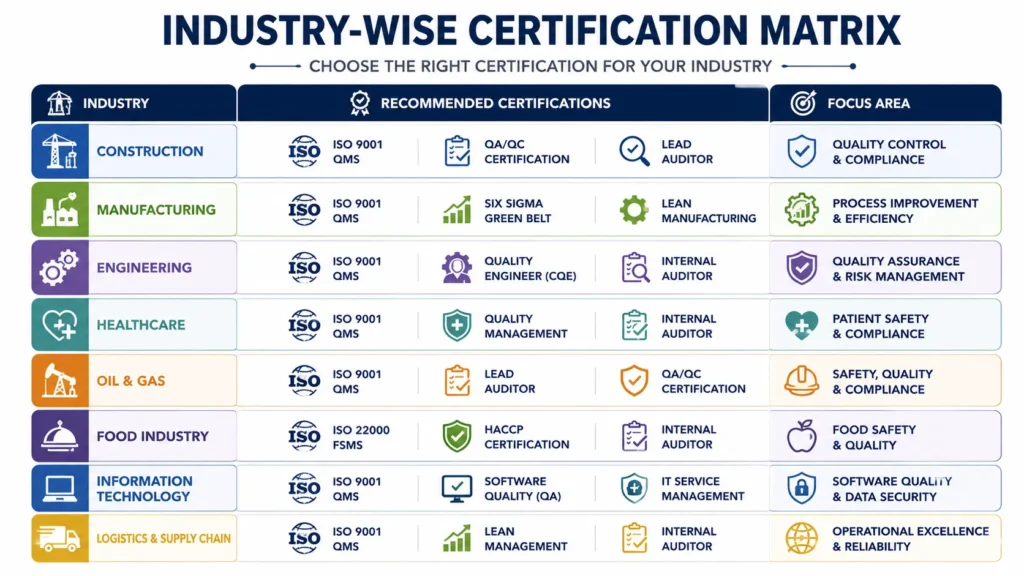
Different industries prioritise different quality competencies. Selecting certifications aligned with industry requirements significantly improves career opportunities.
| Industry | Recommended Certifications |
|---|---|
| Manufacturing | ISO 9001, CQE, Six Sigma, Lean Manufacturing |
| Construction | QA/QC Professional Certification, ISO 9001, Lead Auditor |
| Engineering | Quality Engineer, QA/QC Certification, SPC |
| Healthcare | ISO 9001, Internal Auditor, Quality Management |
| Food Manufacturing | ISO 9001, HACCP, Continuous Improvement |
| Oil & Gas | QA/QC Certification, ISO 9001, Lead Auditor |
| Pharmaceuticals | ISO 9001, Quality Management, Internal Auditor |
| Logistics | ISO 9001, Lean, Continuous Improvement |
| Education | ISO 9001, Internal Auditor, Quality Management |
| Information Technology | Software QA, ISO 9001, Process Improvement |
Choosing certifications that align with industry expectations helps professionals develop relevant expertise while improving employability, supporting career advancement, and preparing for leadership opportunities in increasingly competitive global industries.
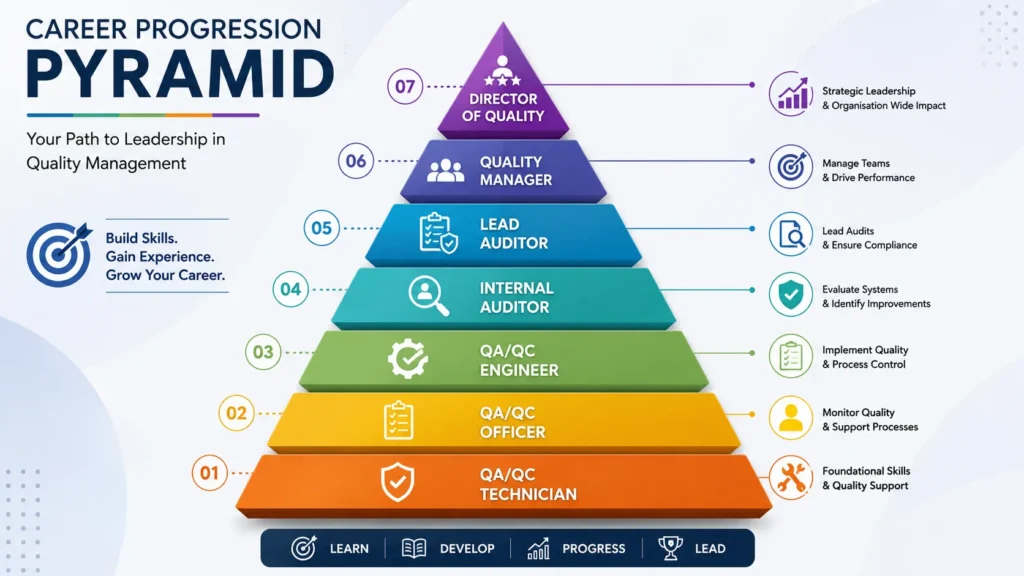
QA and QC Career Roadmap: A Step-by-Step Professional Journey
Building a successful career in Quality Assurance and Quality Control requires more than obtaining a single certification. The most successful professionals continuously develop their knowledge, gain practical experience, and earn advanced qualifications that prepare them for greater responsibilities.
The following roadmap provides a structured progression for professionals at every stage of their career.
Stage 1: Build a Strong Foundation
The first step is to understand the fundamental principles of quality management, inspection procedures, documentation, and process control. Foundation-level certifications help professionals develop the essential knowledge required for entry-level quality roles.
Typical career opportunities include:
- Quality Assistant
- QA Technician
- QC Inspector
- Production Quality Assistant
- Documentation Assistant
Stage 2: Develop Practical Quality Skills
Once the fundamentals are established, professionals should focus on developing practical workplace competencies such as internal auditing, inspection techniques, process monitoring, quality documentation, and corrective action management.
This stage enables professionals to work independently while contributing to organisational quality objectives.
Typical career opportunities include:
- Quality Assurance Officer
- Quality Control Officer
- QA/QC Engineer
- Process Quality Specialist
- Compliance Officer
Stage 3: Become an Internal Auditor
Internal auditing is one of the most valuable skills within quality management. Professionals who understand auditing principles can evaluate business processes, identify improvement opportunities, and support continual improvement across departments.
Developing auditing expertise also prepares professionals for future leadership positions.
Typical career opportunities include:
- Internal Auditor
- Quality Auditor
- Compliance Auditor
- Supplier Quality Auditor
Stage 4: Progress into Leadership
As experience grows, professionals should develop leadership, strategic planning, and quality management capabilities. Advanced certifications prepare individuals to manage teams, improve business performance, and lead organisational quality initiatives.
Typical career opportunities include:
- Quality Manager
- QA Manager
- QC Manager
- Continuous Improvement Manager
- Operational Excellence Manager
Stage 5: Become a Strategic Quality Leader
Senior quality professionals contribute directly to organisational strategy by developing quality policies, improving operational performance, managing business risks, and supporting long-term organisational growth.
Leadership roles often include responsibility for multiple departments, supplier quality, compliance management, and organisational performance improvement.
Typical career opportunities include:
- Head of Quality
- Director of Quality
- Quality Consultant
- Business Excellence Manager
- Corporate Compliance Director
Following a structured certification pathway allows professionals to build confidence, expand technical expertise, and achieve sustainable career progression.
Foundation
↓
ISO 9001
↓
Internal Auditor
↓
Lead Auditor
↓
Six Sigma
↓
Quality Manager
↓
Director
Skills Employers Look for in Certified Quality Professionals
Professional certifications provide valuable technical knowledge, but employers increasingly seek individuals who can apply that knowledge to improve organisational performance.
The most successful quality professionals combine technical competence with strong interpersonal and leadership skills.
Quality Management Knowledge
Employers expect professionals to understand quality management principles, quality management systems, process standardisation, documentation control, and continual improvement practices.
A strong understanding of internationally recognised quality frameworks enables professionals to contribute effectively across different industries.
Analytical Thinking
Quality professionals regularly analyse inspection results, process data, audit findings, and performance indicators to identify trends and improvement opportunities.
Strong analytical skills enable professionals to make informed decisions supported by evidence rather than assumptions.
Problem-Solving Ability
Quality management is fundamentally focused on identifying and solving problems.
Employers value professionals who can investigate non-conformities, perform root cause analysis, implement corrective actions, and prevent recurring quality issues.
Communication Skills
Quality professionals interact with production teams, engineers, managers, suppliers, customers, auditors, and regulatory authorities.
Clear communication helps ensure that quality expectations, audit findings, improvement recommendations, and compliance requirements are understood throughout the organisation.
Attention to Detail
Maintaining high quality standards requires careful attention to documentation, inspections, measurements, specifications, and regulatory requirements.
Professionals who consistently identify small issues before they become major problems provide significant value to organisations.
Leadership and Teamwork
Quality improvement depends on collaboration.
Employers appreciate professionals who can lead improvement initiatives, motivate teams, support colleagues, and encourage a culture of quality throughout the organisation.
Risk Management
Modern quality management incorporates risk-based thinking into everyday operations.
Professionals who can identify operational risks, evaluate their potential impact, and recommend preventive measures help organisations improve resilience and business continuity.
Adaptability
Industries continue to evolve due to new technologies, changing regulations, and increasing customer expectations.
Quality professionals who embrace learning and adapt to changing business environments remain valuable throughout their careers.
Future Trends Shaping Careers in Quality Assurance and Quality Control
The quality profession is evolving rapidly as organisations adopt digital technologies, automation, and data-driven decision-making. Professionals who understand these emerging trends will be better positioned for future career opportunities.
Artificial Intelligence in Quality Management
Artificial Intelligence is transforming quality management by analysing large volumes of operational data, identifying patterns, predicting defects, and supporting faster decision-making.
AI-powered quality systems enable organisations to improve consistency while reducing manual inspections and operational costs.
Professionals who understand AI-assisted quality management will become increasingly valuable across manufacturing, healthcare, engineering, logistics, and other sectors.
Automation and Smart Inspection
Modern organisations are replacing many manual inspection activities with automated inspection systems that use sensors, robotics, and machine vision technologies.
These systems improve inspection accuracy, reduce human error, and provide real-time quality monitoring throughout production processes.
Quality professionals who understand automated inspection technologies will have a competitive advantage as smart manufacturing continues to expand.
Digital Quality Management Systems
Traditional paper-based quality systems are rapidly being replaced by cloud-based digital platforms that improve collaboration, documentation control, audit management, and performance monitoring.
Digital Quality Management Systems enable organisations to access quality information instantly, improve traceability, and manage compliance more efficiently.
Professionals familiar with digital quality tools are increasingly sought after by employers implementing digital transformation initiatives.
Data Analytics and Performance Measurement
Modern quality management relies heavily on data analysis to improve decision-making.
Quality professionals are expected to interpret performance metrics, monitor key quality indicators, analyse trends, and recommend improvement initiatives based on measurable evidence.
Developing analytical skills alongside technical quality knowledge significantly enhances career prospects.
Sustainability and Responsible Business Practices
Quality management is becoming more closely connected with environmental responsibility, sustainable operations, and ethical business practices.
Organisations increasingly seek professionals who understand how quality management supports efficient resource utilisation, waste reduction, regulatory compliance, and long-term organisational sustainability.
Global Standards and International Collaboration
Businesses now operate within international supply chains that require consistent quality standards across multiple countries and regions.
Professionals with knowledge of internationally recognised quality standards, auditing principles, and regulatory compliance are well positioned to work on global projects and within multinational organisations.
Why Continuous Professional Development Matters
Obtaining a certification should not mark the end of professional learning. The quality profession continues to evolve as new technologies, international standards, regulatory requirements, and customer expectations emerge.
Continuous Professional Development (CPD) enables quality professionals to maintain technical competence, expand industry knowledge, and remain competitive in an increasingly demanding employment market.
Professionals who regularly update their knowledge through advanced certifications, workshops, seminars, industry conferences, and practical experience are more likely to adapt successfully to changing workplace requirements and secure long-term career progression.
Employers also recognise the value of professionals who demonstrate an ongoing commitment to learning and continuous improvement, as these individuals are better equipped to support innovation, improve operational performance, and contribute to organisational success.
Conclusion
Quality Assurance and Quality Control have become essential disciplines across virtually every industry, creating strong demand for professionals who possess recognised knowledge, practical skills, and internationally respected certifications. Whether working in manufacturing, construction, engineering, healthcare, logistics, education, or information technology, certified quality professionals play a vital role in improving efficiency, maintaining compliance, reducing operational risks, and enhancing customer satisfaction.
Selecting the right certification is an important investment in long-term career success. Rather than choosing a qualification based solely on popularity, professionals should consider their current experience, career aspirations, industry requirements, and the competencies employers value most. Building expertise through a structured certification pathway allows individuals to progress confidently from entry-level positions to specialist, managerial, and leadership roles.
As organisations continue to embrace digital transformation, automation, Artificial Intelligence, and international quality standards, the opportunities for qualified Quality Assurance and Quality Control professionals will continue to expand. Those who combine recognised certifications with practical experience, analytical thinking, leadership skills, and a commitment to continuous professional development will be well positioned to succeed in a rapidly evolving global workplace.
Investing in professional quality certifications is more than achieving a recognised qualification—it is a strategic step towards greater career opportunities, stronger professional credibility, higher earning potential, and long-term success in one of the world’s most essential and rewarding professions.