
Essential Guide to Identifying Fire Hazards Before They Become Serious Emergencies
Fire hazards exist in almost every workplace, yet many remain unnoticed until they lead to dangerous incidents, costly property damage, business disruption, or injuries. Identifying fire hazards at an early stage is one of the most effective ways to prevent workplace fires and protect people, property, and business operations. From overloaded electrical circuits and poorly maintained equipment to combustible materials and blocked escape routes, even minor hazards can quickly escalate into serious emergencies if they are not identified and controlled promptly.
According to UK fire safety legislation, preventing fires is not simply about installing alarms and fire extinguishers. It begins with identifying fire hazards before they develop into life-threatening situations. Early hazard identification enables organisations to eliminate risks, implement effective control measures, protect employees and visitors, and demonstrate compliance with legal responsibilities under the Regulatory Reform (Fire Safety) Order 2005.
For employers, landlords, facilities managers, and the Responsible Person, fire hazard identification forms the foundation of every Fire Risk Assessment. Without understanding where hazards exist and how they could cause a fire, it is impossible to implement suitable preventive measures or develop an effective emergency plan.
Modern workplaces also face new and evolving fire risks. Lithium-ion battery charging stations, electric vehicle charging points, renewable energy systems, server rooms, and increasingly complex electrical installations have introduced hazards that many traditional fire safety guides fail to address. Businesses therefore need a structured approach that considers both conventional and emerging fire risks.
This comprehensive guide explains how to identify workplace fire hazards before they become serious emergencies. It covers UK fire safety legislation, the responsibilities of the Responsible Person, practical hazard identification techniques, common and hidden workplace hazards, risk prioritisation, inspection processes, and modern technologies that improve fire prevention. Whether you manage an office, warehouse, retail store, hotel, healthcare facility, school, or construction site, this guide will help you strengthen workplace safety, improve compliance, and reduce the likelihood of fire incidents.
What are Fire Hazards?
A fire hazard is anything with the potential to start a fire, contribute to the spread of fire, increase the severity of a fire, or place people at greater risk during an emergency. Fire hazards may be physical objects, unsafe conditions, work activities, poor maintenance practices, or human behaviours that create opportunities for ignition.
Many organisations associate fire hazards only with obvious dangers such as exposed electrical wiring or flammable liquids. However, hazards often develop gradually through poor housekeeping, inadequate maintenance, unsafe storage practices, or changes to workplace activities.
Examples of workplace fire hazards include:
- Faulty electrical equipment.
- Overloaded extension leads.
- Flammable liquids.
- Combustible waste.
- Hot work activities.
- Poor housekeeping.
- Blocked emergency exits.
- Damaged fire doors.
- Portable heaters.
- Smoking materials.
- Gas cylinders.
- Poorly maintained machinery.
- Improper battery charging.
- Combustible dust.
Fire hazards should be viewed as dynamic rather than static. A workplace that is safe today may develop new hazards tomorrow due to equipment upgrades, building alterations, increased occupancy, seasonal storage, or operational changes. Regular inspections and reviews are therefore essential.
Why early Fire Hazard Identification Matters
The most effective way to reduce fire risk is to identify hazards before they lead to an incident. Early detection allows organisations to implement preventive measures while hazards remain manageable, reducing the likelihood of fire, limiting potential damage, and improving overall workplace safety.
Fire hazard identification supports organisations in several ways.
Protects People
The primary objective of identifying fire hazards is to protect employees, contractors, visitors, and members of the public.
By recognising hazards early, organisations can:
- Prevent fires from occurring.
- Reduce injuries and fatalities.
- Improve evacuation safety.
- Protect vulnerable occupants.
- Strengthen emergency preparedness.
Supports Legal Compliance
UK fire safety legislation requires organisations to assess fire risks and implement appropriate preventive measures.
Hazard identification provides the evidence needed to demonstrate that risks have been considered and managed appropriately.
Reduces Business Disruption
Even a relatively small workplace fire can interrupt operations for weeks or months.
Early identification helps organisations avoid:
- Production delays.
- Property damage.
- Loss of equipment.
- Supply chain disruption.
- Financial losses.
- Reputational damage.
Improves Fire Risk Assessments
A Fire Risk Assessment can only be effective if hazards are accurately identified.
The quality of the assessment depends upon understanding:
- Ignition sources.
- Fuel sources.
- Oxygen availability.
- People at risk.
- Existing control measures.
- Additional improvements required.
Supports Continuous Improvement
Fire hazard identification should not be treated as a one-time exercise.
Regular inspections enable organisations to:
- Monitor changing risks.
- Review existing controls.
- Improve safety procedures.
- Update emergency plans.
- Strengthen workplace safety culture.
Understanding the Fire Triangle
Every fire requires three essential elements to ignite and continue burning. This relationship is commonly known as the Fire Triangle.
The three elements are:
- Heat.
- Fuel.
- Oxygen.
If any one of these elements is removed, a fire cannot start or continue burning.
Understanding the Fire Triangle helps organisations identify fire hazards more effectively because every inspection should consider where these three elements might come together.
Heat Sources
Common workplace heat sources include:
- Electrical equipment.
- Portable heaters.
- Welding equipment.
- Grinding operations.
- Cutting equipment.
- Cooking appliances.
- Friction from machinery.
- Overheated motors.
Fuel Sources
Fuel may include:
- Paper and cardboard.
- Wooden pallets.
- Packaging materials.
- Flammable liquids.
- Cleaning chemicals.
- Waste materials.
- Furniture.
- Plastics.
- Textiles.
- Gas cylinders.
Oxygen Sources
Although oxygen is naturally present in the atmosphere, additional oxygen may be introduced through:
- Medical oxygen cylinders.
- Industrial oxygen supplies.
- Ventilation systems.
- Oxidising chemicals.
During hazard identification, organisations should evaluate how heat, fuel, and oxygen could combine to create a fire.
UK Fire Safety Legislation
Fire hazard identification is not simply good practice—it is a legal requirement for many workplaces across the UK.
Several pieces of legislation establish responsibilities for preventing fires and protecting building occupants.
Regulatory Reform (Fire Safety) Order 2005
The Regulatory Reform (Fire Safety) Order 2005 is the primary fire safety legislation for non-domestic premises in England and Wales.
The legislation requires the Responsible Person to:
- Identify fire hazards.
- Assess fire risks.
- Protect people from fire.
- Maintain fire safety equipment.
- Provide employee training.
- Develop emergency procedures.
- Review Fire Risk Assessments regularly.
Fire hazard identification is therefore one of the first and most important stages of legal compliance.
Fire Safety Act 2021
The Fire Safety Act strengthens fire safety responsibilities by clarifying that Fire Risk Assessments for multi-occupied residential buildings should consider:
- External walls.
- Cladding systems.
- Flat entrance doors.
- Structural elements affecting fire safety.
This reinforces the importance of identifying hazards beyond the immediate workplace environment.
Health and Safety at Work etc. Act 1974
Employers also have a general duty to protect employees and others affected by workplace activities.
Effective fire hazard identification supports broader health and safety management by reducing foreseeable risks and promoting safer working environments.
Duties of the Responsible Person
One of the most important concepts within UK fire safety legislation is the Responsible Person.
The Responsible Person may be:
- The employer.
- Business owner.
- Landlord.
- Building owner.
- Managing agent.
- Facilities manager.
- Any individual with control over part or all of the premises.
Although specific tasks may be delegated to competent employees or external contractors, overall legal responsibility remains with the Responsible Person.
Responsibilities Relating to Fire Hazard Identification
The Responsible Person should ensure that:
- Workplace fire hazards are identified.
- Fire Risk Assessments are completed.
- Fire prevention measures are implemented.
- Hazard inspections are conducted regularly.
- Fire safety equipment is maintained.
- Employees receive fire safety training.
- Significant findings are recorded.
- Fire Risk Assessments are reviewed after major changes.
This proactive approach reduces fire risks while demonstrating compliance with legal duties.
Common Workplace Fire Hazard Sources
The following table highlights some of the most common workplace fire hazards and explains why they require attention.
| Fire Hazard Source | Typical Examples | Why It Is Dangerous |
|---|---|---|
| Electrical Systems | Damaged cables, overloaded sockets, faulty appliances | Can generate excessive heat and electrical faults leading to ignition |
| Heating Equipment | Portable heaters, boilers, radiators | May ignite nearby combustible materials |
| Flammable Liquids | Paints, solvents, fuels, cleaning chemicals | Produce vapours that ignite easily |
| Combustible Materials | Paper, cardboard, packaging, textiles | Accelerate fire growth and spread |
| Hot Work | Welding, grinding, soldering, cutting | Creates sparks and high temperatures capable of igniting nearby materials |
| Poor Housekeeping | Waste accumulation, cluttered storage | Increases available fuel and obstructs safe evacuation |
| Smoking Materials | Cigarettes, matches, lighters | Common source of accidental fires where smoking controls are inadequate |
| Machinery | Overheating motors, friction, poor maintenance | Mechanical failures can create ignition sources |
Understanding these hazard categories provides a structured foundation for workplace inspections and Fire Risk Assessments.
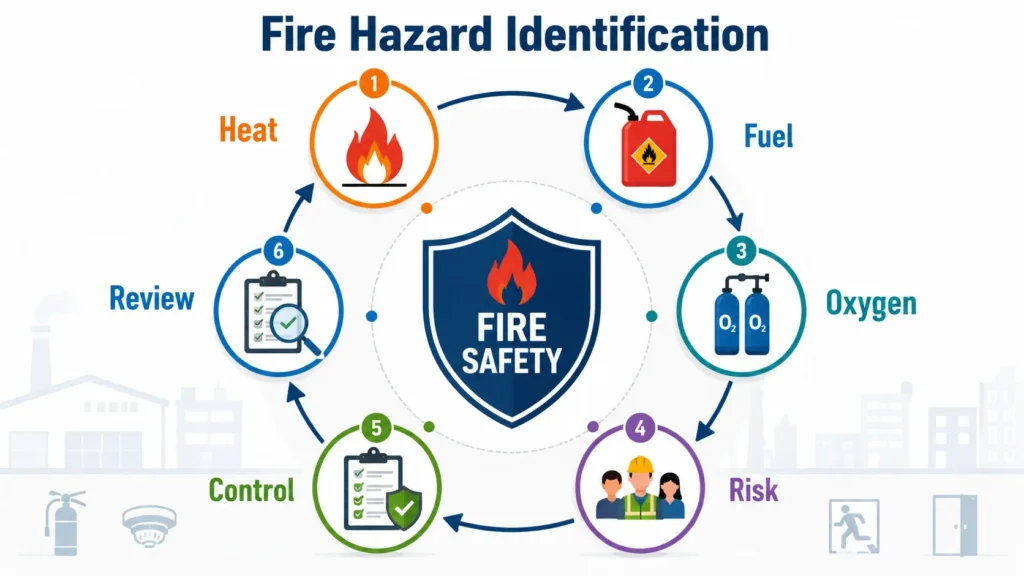
Fire Hazard Identification Process
Fire hazard identification should follow a consistent methodology rather than relying on visual observations alone.
The following workflow illustrates a practical process used by many fire safety professionals.
Prepare Workplace Inspection
│
▼
Identify Heat Sources
│
▼
Identify Fuel Sources
│
▼
Identify Oxygen Sources
│
▼
Identify People at Risk
│
▼
Evaluate Existing Controls
│
▼
Record Significant Findings
│
▼
Implement Control Measures
│
▼
Review and Monitor Regularly
Following a structured process ensures that inspections remain thorough, consistent, and aligned with the principles of effective Fire Risk Assessment.
Common Fire Hazards in UK Workplaces
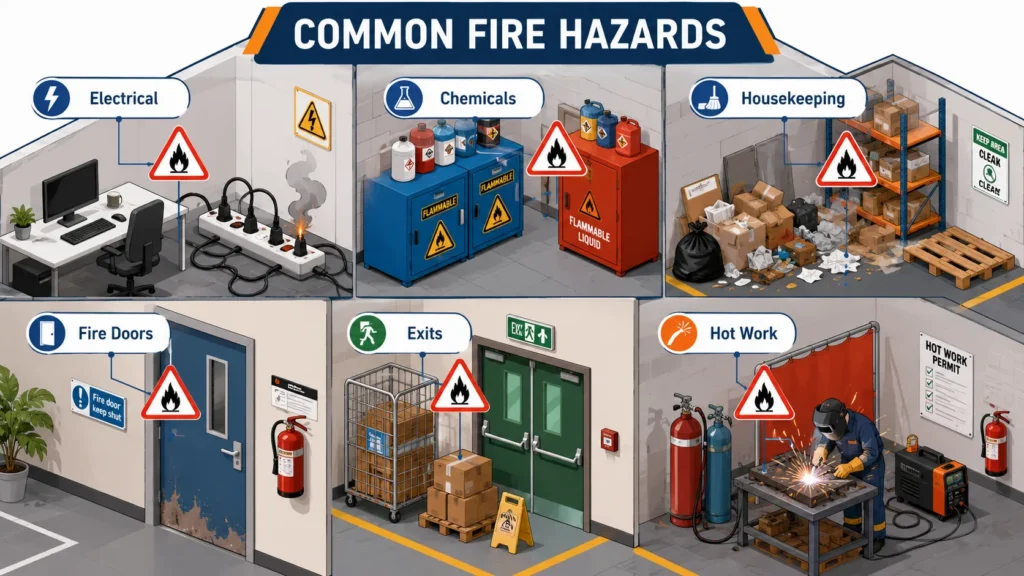
Every workplace presents unique fire risks, but certain hazards appear consistently across multiple industries. Identifying these hazards during routine inspections enables organisations to reduce the likelihood of fire, improve compliance, and protect both people and property.
Rather than focusing only on obvious ignition sources, inspections should consider the interaction between workplace activities, equipment, storage arrangements, and human behaviour.
Electrical Hazards
Electrical faults remain one of the leading causes of workplace fires.
Common hazards include:
- Overloaded extension leads.
- Damaged power cables.
- Loose electrical connections.
- Faulty sockets.
- Defective portable appliances.
- Improper use of extension reels.
- Poorly maintained distribution boards.
During inspections, check for signs of overheating, damaged insulation, scorch marks, unusual odours, and unauthorised electrical modifications.
Flammable Liquids and Chemicals
Many workplaces store fuels, solvents, paints, adhesives, aerosols, and cleaning products that ignite easily.
Inspectors should verify:
- Correct storage cabinets.
- Proper labelling.
- Adequate ventilation.
- Separation from ignition sources.
- Spill control arrangements.
- Safe quantities stored.
Improper storage significantly increases fire risk.
Poor Housekeeping
Poor housekeeping contributes to numerous workplace fires by allowing combustible materials to accumulate.
Typical examples include:
- Waste cardboard.
- Packaging materials.
- Paper storage.
- Dust accumulation.
- Uncontrolled rubbish.
- Cluttered work areas.
Maintaining tidy workplaces reduces available fuel and improves evacuation.
Blocked Escape Routes
Emergency exits should remain clear at all times.
Common problems include:
- Stored equipment.
- Deliveries.
- Waste containers.
- Temporary storage.
- Locked exits.
Escape routes should be inspected daily.
Damaged Fire Doors
Fire doors slow the spread of fire and smoke.
Inspectors should check:
- Self-closing devices.
- Intumescent strips.
- Smoke seals.
- Door gaps.
- Physical damage.
- Wedged-open doors.
Fire doors that fail to close properly cannot provide effective compartmentation.
Heating Equipment
Portable heaters and fixed heating systems frequently become ignition sources.
Common hazards include:
- Heaters positioned near combustible materials.
- Damaged heating appliances.
- Poor ventilation.
- Lack of maintenance.
- Overheating equipment.
Maintain appropriate clearances around all heating appliances.
Hot Work Activities
Activities involving heat or sparks require additional controls.
Examples include:
- Welding.
- Cutting.
- Grinding.
- Brazing.
- Soldering.
Hot work should always be controlled through permit systems, supervision, and post-work fire monitoring.
Hidden Fire Hazards Many Businesses Miss
Some of the most serious workplace fires originate from hazards that receive little attention during routine inspections.
Modern workplaces continue to introduce new technologies that require updated inspection procedures.
Lithium-Ion Battery Charging
Battery charging areas now present significant risks in many industries.
Examples include:
- Electric forklifts.
- Power tools.
- Electric bicycles.
- Warehouse equipment.
- Portable electronics.
Inspect for:
- Damaged batteries.
- Overcharging.
- Poor ventilation.
- Unapproved chargers.
- Combustible storage nearby.
Electric Vehicle Charging Points
As organisations adopt electric vehicles, charging infrastructure creates additional fire considerations.
Inspectors should review:
- Charging equipment condition.
- Cable management.
- Ventilation.
- Vehicle parking arrangements.
- Electrical protection systems.
Server Rooms
Server rooms contain continuous electrical loads.
Potential hazards include:
- Overheating equipment.
- Dust accumulation.
- Inadequate cooling.
- Poor cable management.
- Uninterruptible Power Supply (UPS) systems.
Routine maintenance is essential.
Renewable Energy Systems
Solar photovoltaic installations introduce additional electrical risks.
Inspect:
- Inverters.
- Isolators.
- Cabling.
- Roof penetrations.
- Maintenance access.
False Ceilings and Service Voids
Hidden spaces often contain:
- Electrical wiring.
- Communication cables.
- Pipework.
- Insulation.
These areas should not be overlooked during inspections.
Combustible Dust
Manufacturing industries often generate combustible dust.
Examples include:
- Wood dust.
- Grain dust.
- Textile fibres.
- Food processing dust.
- Metal dust.
Accumulated dust can contribute to rapid fire development or explosions under certain conditions.
Step-by-Step Fire Hazard Identification Process
Professional fire safety inspections follow a structured methodology rather than relying on visual observations alone.
Step 1: Prepare for the Inspection
Before entering the workplace:
- Review previous Fire Risk Assessments.
- Examine maintenance records.
- Study building layouts.
- Identify high-risk areas.
- Gather inspection checklists.
Preparation improves inspection quality.
Step 2: Identify Potential Ignition Sources
Inspect all potential heat-producing equipment.
Examples include:
- Electrical systems.
- Machinery.
- Cooking equipment.
- Heating systems.
- Hot work activities.
Step 3: Identify Fuel Sources
Determine whether combustible materials are present.
Review:
- Storage areas.
- Waste accumulation.
- Chemicals.
- Furniture.
- Packaging.
- Textiles.
Step 4: Identify Oxygen Sources
Although atmospheric oxygen cannot be removed, additional oxygen sources should be identified.
Examples include:
- Medical oxygen.
- Industrial gases.
- Ventilation systems.
- Oxidising substances.
Step 5: Identify People at Risk
Consider everyone who may be affected.
Examples include:
- Employees.
- Contractors.
- Visitors.
- Customers.
- Vulnerable persons.
- Disabled occupants.
Step 6: Evaluate Existing Controls
Review current fire prevention measures.
Examples include:
- Fire alarms.
- Fire extinguishers.
- Emergency lighting.
- Fire doors.
- Housekeeping standards.
- Staff training.
Step 7: Record Findings
Documentation should include:
- Hazards identified.
- Risk levels.
- Existing controls.
- Recommended improvements.
- Completion dates.
- Responsible persons.
Step 8: Monitor Improvements
Hazard identification should continue throughout the year.
Regular inspections help ensure corrective actions remain effective.
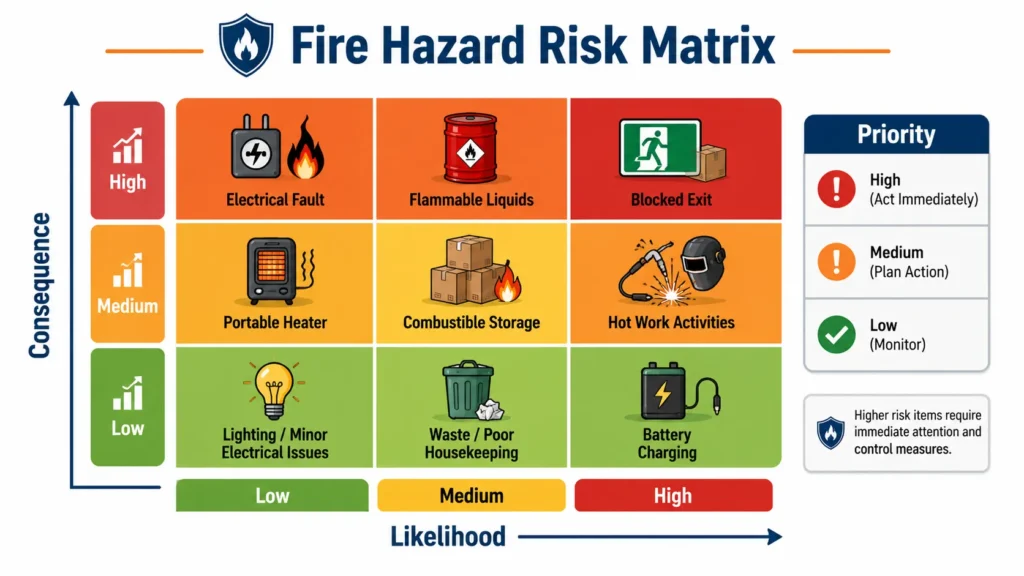
Fire Hazard Risk Ranking Matrix
Not every hazard presents the same level of risk. Prioritising hazards helps organisations allocate resources efficiently and address the most significant risks first.
| Hazard | Likelihood | Consequence | Priority |
|---|---|---|---|
| Blocked emergency exit | High | High | Immediate |
| Overloaded electrical sockets | High | High | Immediate |
| Damaged extension leads | High | Medium | High |
| Poor housekeeping | Medium | Medium | High |
| Improper flammable liquid storage | Medium | High | High |
| Portable heater near combustible materials | Medium | High | High |
| Faulty emergency lighting | Low | High | Medium |
| Missing fire door seals | Medium | Medium | Medium |
| Combustible waste accumulation | Medium | Medium | Medium |
| Minor cable management issues | Low | Low | Low |
Using a risk ranking matrix allows organisations to focus corrective actions where they will have the greatest impact on workplace safety.
Industry-Specific Fire Hazards
Although many hazards are common across all workplaces, each industry presents unique fire risks that require specialised attention.
Offices
Common hazards include:
- Overloaded power strips.
- Portable heaters.
- Paper archives.
- Kitchen appliances.
- Damaged office equipment.
- Cable congestion beneath desks.
Warehouses
Warehouse inspections should focus on:
- High-piled storage.
- Pallet stacking.
- Forklift battery charging.
- Packaging materials.
- Waste accumulation.
- Sprinkler clearance.
Manufacturing Facilities
Manufacturing environments often contain:
- Hot work.
- Combustible dust.
- Machinery friction.
- Flammable chemicals.
- Hydraulic systems.
- Process heating.
Hotels and Hospitality
Inspect:
- Commercial kitchens.
- Laundry facilities.
- Guest electrical appliances.
- Decorative materials.
- Escape routes.
- Storage rooms.
Healthcare Facilities
Healthcare buildings present additional hazards including:
- Medical oxygen.
- Electrical medical equipment.
- Pharmaceutical storage.
- Patient evacuation challenges.
- Laundry operations.
Schools and Educational Premises
Potential hazards include:
- Science laboratories.
- Art rooms.
- Electrical equipment.
- Storage areas.
- Assembly halls.
- Temporary classroom equipment.
Retail Premises
Retail inspections should review:
- Seasonal displays.
- Stockrooms.
- Customer exits.
- Electrical signage.
- Decorative lighting.
- Packaging waste.
Construction Sites
Construction sites require close attention to:
- Temporary electrical installations.
- Gas cylinders.
- Hot work.
- Temporary heating.
- Timber storage.
- Site security.
Fire Hazard Reporting Process
Hazard identification is only valuable if identified risks are reported and resolved promptly.
Every organisation should establish a clear reporting procedure.
Employee Identifies Hazard
│
▼
Report to Supervisor
│
▼
Risk Assessment
│
▼
Assign Corrective Action
│
▼
Implement Controls
│
▼
Verify Completion
│
▼
Update Fire Risk Assessment
│
▼
Close Hazard Report
This structured reporting process ensures that hazards are not simply identified but also managed effectively, supporting legal compliance and continuous improvement.
Workplace Fire Hazard Inspection Checklist
Routine inspections are one of the most effective ways to identify fire hazards before they develop into serious emergencies. A structured checklist helps ensure that important areas are not overlooked and provides evidence that the organisation is actively managing fire risks.
The following checklist can be used during regular workplace inspections or before reviewing a Fire Risk Assessment.
| Inspection Area | Check | Action Required |
|---|---|---|
| Electrical equipment is free from damage | ✓ / ✗ | __________ |
| Extension leads are not overloaded | ✓ / ✗ | __________ |
| Fire alarm system appears operational | ✓ / ✗ | __________ |
| Emergency lighting is functional | ✓ / ✗ | __________ |
| Fire extinguishers are accessible and serviced | ✓ / ✗ | __________ |
| Escape routes are unobstructed | ✓ / ✗ | __________ |
| Fire doors close correctly and are undamaged | ✓ / ✗ | __________ |
| Combustible waste is removed regularly | ✓ / ✗ | __________ |
| Flammable liquids are stored safely | ✓ / ✗ | __________ |
| Portable heaters are positioned safely | ✓ / ✗ | __________ |
| Battery charging areas are managed correctly | ✓ / ✗ | __________ |
| Hot work activities are controlled by permits | ✓ / ✗ | __________ |
| Fire safety signs are clearly visible | ✓ / ✗ | __________ |
| Staff understand emergency procedures | ✓ / ✗ | __________ |
| Fire Risk Assessment reflects current workplace conditions | ✓ / ✗ | __________ |
Completing this checklist at scheduled intervals helps identify hazards early, maintain compliance, and create a safer working environment.
Technology Improving Fire Hazard Identification
Technology is transforming the way organisations identify, monitor, and manage fire hazards. Digital tools enable businesses to detect risks earlier, improve record keeping, and respond more effectively to changing workplace conditions.
Smart Fire Detection Systems
Modern fire detection systems do more than activate alarms. Many intelligent systems continuously monitor environmental conditions and can detect changes before a fire develops.
Features may include:
- Multi-sensor smoke detection.
- Heat monitoring.
- Carbon monoxide detection.
- Remote monitoring.
- Automatic fault reporting.
These systems help organisations respond more quickly to developing risks.
Thermal Imaging Cameras
Thermal imaging technology identifies abnormal heat before equipment fails or ignites.
Applications include:
- Electrical distribution boards.
- Motors.
- Switchgear.
- Production machinery.
- Battery charging stations.
Routine thermal inspections can reveal overheating components that would otherwise remain hidden.
Internet of Things (IoT) Sensors
IoT technology enables continuous monitoring of workplace conditions.
Examples include sensors monitoring:
- Temperature.
- Smoke.
- Humidity.
- Electrical load.
- Gas leaks.
- Equipment performance.
Real-time alerts enable maintenance teams to intervene before hazards become emergencies.
Digital Fire Safety Inspections
Many organisations now replace paper inspection forms with digital inspection platforms.
Benefits include:
- Mobile inspections.
- Automatic reminders.
- Cloud storage.
- Photographic evidence.
- Faster reporting.
- Corrective action tracking.
Digital systems also simplify compliance by maintaining organised inspection records.
QR Code Asset Management
Fire safety equipment can be labelled with QR codes that provide instant access to maintenance histories and inspection records.
Examples include:
- Fire extinguishers.
- Fire doors.
- Emergency lighting.
- Fire alarm devices.
This improves inspection efficiency while supporting accurate documentation.
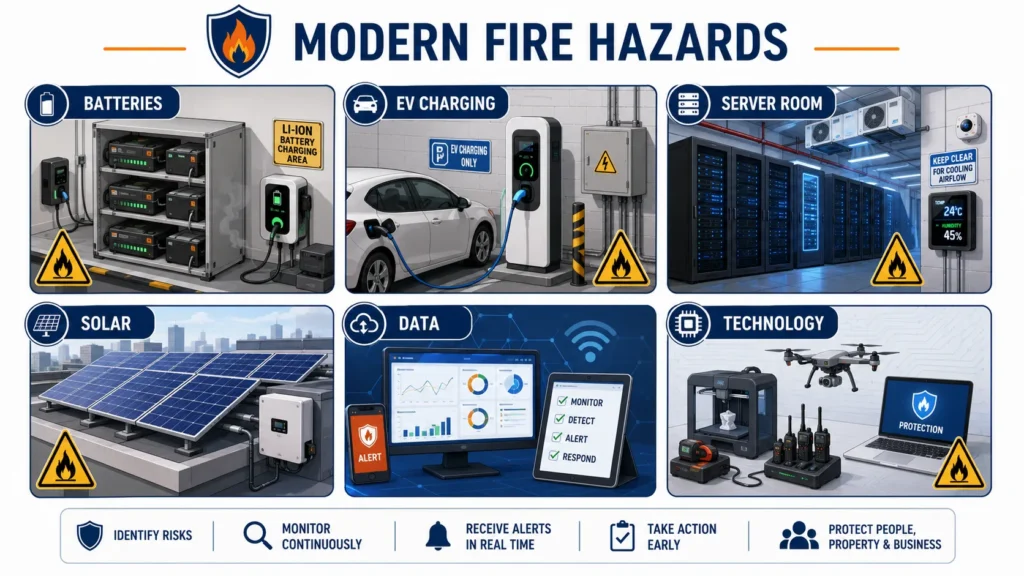
Emerging Fire Risks in Modern Workplaces
As workplaces adopt new technologies and working practices, fire hazard identification must evolve accordingly. Emerging risks often require different control measures from traditional fire hazards.
Lithium-Ion Battery Storage and Charging
Lithium-ion batteries power many workplace devices, including laptops, power tools, forklifts, electric bicycles, and energy storage systems.
Potential hazards include:
- Thermal runaway.
- Damaged battery cells.
- Incorrect charging practices.
- Incompatible chargers.
- Overheating.
- Physical damage.
Organisations should establish designated charging areas, use manufacturer-approved charging equipment, and regularly inspect batteries for signs of damage.
Electric Vehicle Charging Infrastructure
Many workplaces now provide electric vehicle charging facilities for employees and fleet vehicles.
Fire hazard identification should include:
- Charging cable condition.
- Electrical protection devices.
- Adequate ventilation.
- Charging bay housekeeping.
- Safe separation from combustible materials.
Routine inspections help ensure charging equipment remains safe throughout its service life.
Renewable Energy Installations
Solar photovoltaic (PV) systems and battery energy storage systems introduce additional electrical hazards.
Inspectors should review:
- Inverters.
- Isolation switches.
- Cabling.
- Roof access.
- Maintenance records.
- Warning signage.
Specialist maintenance should be carried out by competent professionals.
Data Centres and Server Rooms
Server rooms often operate continuously, increasing electrical loads and heat generation.
Potential hazards include:
- Overheating servers.
- Poor airflow.
- Dust accumulation.
- Overloaded circuits.
- Cable congestion.
Preventive maintenance and environmental monitoring are essential.
Flexible and Hybrid Workspaces
Modern office layouts change more frequently than traditional workplaces.
Hazard identification should consider:
- Temporary workstations.
- Additional extension leads.
- Portable electrical equipment.
- Shared charging stations.
- Increased battery-powered devices.
Regular workplace inspections should reflect these evolving working environments.
Continuous Fire Hazard Management Cycle
Fire hazard identification should form part of an ongoing safety management system rather than being treated as an annual exercise.
The following cycle demonstrates how organisations can continuously improve workplace fire safety.
Identify Fire Hazards
│
▼
Assess Fire Risks
│
▼
Implement Control Measures
│
▼
Train Employees
│
▼
Inspect Workplace
│
▼
Monitor Performance
│
▼
Review Fire Risk Assessment
│
▼
Improve Fire Safety
│
▼
Repeat Continuously
Embedding this cycle into everyday operations supports legal compliance and helps organisations respond proactively to changing workplace conditions.
Develop Your Fire Safety Skills with Inspire College
Identifying fire hazards effectively requires more than experience. It demands an understanding of fire science, legislation, workplace inspections, risk assessment methodologies, and practical fire prevention strategies.
Professional training helps individuals develop the competence needed to identify hazards accurately, implement effective controls, and contribute to safer workplaces.
Inspire College offers a range of qualifications designed to support fire safety professionals, facilities managers, supervisors, employers, and anyone responsible for workplace fire safety.
| Inspire College Course | Why It Is Relevant |
|---|---|
| Level 4 Certificate in Fire Risk Assessment | Develops practical skills in identifying hazards, assessing fire risks, and implementing control measures |
| Level 4 Diploma in Fire Safety | Covers advanced fire safety legislation, compliance, fire risk management, and organisational responsibilities |
| Level 3 Award in the Inspection and Testing of Fire Stopping Installations | Builds competence in inspecting and testing passive fire protection systems |
| Fire Marshal Training | Prepares Fire Marshals to support workplace inspections and emergency evacuations |
Creating a Proactive Fire Safety Culture
Effective fire hazard identification is not solely the responsibility of the Responsible Person or health and safety team. Every employee has a role in recognising hazards, reporting unsafe conditions, and following workplace fire safety procedures.
Organisations can strengthen their fire safety culture by:
- Encouraging hazard reporting.
- Providing regular refresher training.
- Conducting routine workplace inspections.
- Reviewing Fire Risk Assessments after significant changes.
- Maintaining fire protection equipment.
- Sharing lessons learned from inspections and incidents.
- Recognising proactive safety behaviours.
When fire hazard identification becomes part of everyday workplace behaviour, organisations are better equipped to prevent emergencies before they occur.
Conclusion
Fire hazards rarely develop without warning. In most cases, they begin as small issues such as damaged electrical equipment, poor housekeeping, blocked escape routes, or unsafe storage practices. Identifying these hazards early is one of the most effective ways to prevent fires, protect people, and maintain business continuity.
Under the Regulatory Reform (Fire Safety) Order 2005, the Responsible Person has a legal duty to identify fire hazards, assess fire risks, implement suitable control measures, and review those arrangements regularly. A structured approach to hazard identification, supported by routine inspections, accurate documentation, competent staff, and continuous monitoring, enables organisations to meet these responsibilities with confidence.
Modern workplaces must also prepare for emerging risks associated with lithium-ion batteries, electric vehicle charging, renewable energy systems, server rooms, and increasingly complex electrical infrastructure. By combining traditional fire prevention principles with modern technology and ongoing professional development, businesses can build a resilient fire safety management system that protects employees, visitors, assets, and operations.
Fire safety is most effective when hazard identification becomes a continuous process rather than a periodic compliance exercise. Organisations that actively identify, report, assess, and eliminate fire hazards create safer workplaces, strengthen legal compliance, and significantly reduce the likelihood of serious emergencies.