
Complete Guide to Fire Safety Training Requirements Every Employee Must Know
Fire safety is a shared responsibility that begins with awareness and is strengthened through proper training. Regardless of the industry, every employee should understand how to identify fire hazards, respond effectively during an emergency, and contribute to creating a safer workplace. Fire safety training is not only a legal requirement in the UK but also a vital investment that protects lives, property, and business continuity.
Many workplace fires are preventable. Common causes such as faulty electrical equipment, improper storage of flammable materials, blocked fire exits, and human error can lead to devastating consequences when employees are unprepared. A well-designed fire safety training programme equips staff with the knowledge and confidence to prevent incidents, respond calmly during emergencies, and support safe evacuations.
UK employers have a legal duty to provide appropriate fire safety information, instruction, and training to employees. However, effective training goes beyond meeting compliance requirements. It helps build a proactive safety culture where every member of the workforce understands their role in reducing fire risks and protecting colleagues, customers, and visitors.
Whether you manage an office, warehouse, healthcare facility, school, retail store, hospitality business, or construction site, understanding fire safety training requirements is essential. Different workplaces present different fire hazards, and training should reflect those specific risks while ensuring all employees receive a consistent foundation in fire prevention and emergency procedures.
This comprehensive guide explains everything employers and employees need to know about workplace fire safety training in the UK. From legal responsibilities and mandatory training requirements to industry-specific guidance and best practices, this resource will help organisations create safer workplaces while supporting compliance with current fire safety legislation.
What is Fire Safety Training?
Fire safety training is a structured programme that teaches employees how to prevent fires, recognise potential fire hazards, respond appropriately during emergencies, and evacuate buildings safely. It combines legal compliance with practical skills to minimise the risk of fire-related injuries, fatalities, and property damage.
A comprehensive fire safety training programme covers much more than operating a fire extinguisher. It helps employees understand how fires start, how they spread, what actions should be taken during an emergency, and how individual responsibilities contribute to workplace safety.
The Primary Objectives of Fire Safety Training
Every workplace fire safety programme should aim to:
- Prevent workplace fires through increased awareness
- Help employees identify common fire hazards
- Reduce the likelihood of human error causing fires
- Ensure safe and organised evacuation procedures
- Protect employees, visitors, and business assets
- Support compliance with UK fire safety legislation
- Improve emergency preparedness across the organisation
When employees understand these principles, they become active participants in maintaining a safe working environment rather than simply reacting during emergencies.
What Employees Typically Learn During Fire Safety Training
Although training content varies depending on the workplace and level of risk, most programmes include the following core areas:
| Training Topic | Purpose |
|---|---|
| Fire prevention | Identify and reduce common workplace fire hazards |
| Fire detection systems | Understand alarms, detectors, and warning signals |
| Emergency evacuation | Follow designated escape routes and assembly procedures |
| Fire extinguisher awareness | Recognise extinguisher types and appropriate uses |
| Fire emergency reporting | Know how and when to report incidents |
| Workplace responsibilities | Understand individual roles during emergencies |
| Safe housekeeping | Reduce fire risks through good workplace practices |
| Emergency planning | Support business continuity and emergency response |
This knowledge enables employees to respond quickly and confidently while reducing panic during real emergencies.
Why Fire Safety Training Is Essential in Every Workplace
Fire safety training is one of the most effective ways to reduce workplace fire risks. Even the most advanced fire protection systems cannot replace a workforce that understands how to prevent fires and react appropriately when an emergency occurs.
A single fire incident can have far-reaching consequences, including injuries, operational disruption, legal penalties, financial losses, insurance complications, and long-term reputational damage. Proper training significantly reduces these risks.
Protecting Lives
The primary objective of workplace fire safety training is to protect people.
Employees who understand emergency procedures can:
- Recognise warning signs early
- Activate emergency alarms correctly
- Evacuate safely without panic
- Assist vulnerable individuals when appropriate
- Avoid dangerous decisions during emergencies
Quick, informed action often makes the difference between a controlled incident and a major disaster.
Reducing Workplace Fire Risks
Most workplace fires begin with preventable hazards such as:
- Faulty electrical equipment
- Overloaded extension leads
- Poor housekeeping
- Improper storage of combustible materials
- Unsafe use of heating equipment
- Hot work activities
- Human error
Fire safety training teaches employees how to recognise these hazards before they develop into serious incidents.
Supporting Legal Compliance
UK employers must provide appropriate fire safety instruction and training for employees as part of their legal responsibilities.
Failure to deliver suitable training may result in:
- Enforcement notices
- Prosecution
- Significant financial penalties
- Business interruption
- Increased insurance costs
- Reputational damage
Regular training demonstrates that an organisation is taking reasonable steps to protect employees and comply with fire safety legislation.
Improving Emergency Response
During an emergency, every second counts.
Employees who have completed appropriate fire safety training can:
- Raise the alarm immediately
- Follow evacuation procedures without confusion
- Avoid blocked or unsafe escape routes
- Report missing persons accurately
- Assemble safely at designated meeting points
An organised response reduces evacuation time and improves overall safety.
Creating a Positive Safety Culture
Fire safety should not be viewed as a one-time compliance exercise.
Organisations that invest in ongoing fire safety education often develop stronger workplace safety cultures where employees:
- Report hazards proactively
- Take ownership of workplace safety
- Encourage safe behaviours among colleagues
- Support continuous improvement
- Participate confidently in fire drills
A positive safety culture benefits every aspect of workplace health and safety.
UK Fire Safety Laws Every Employer and Employee Should Know
Understanding workplace fire safety begins with understanding the legal framework that governs fire prevention and emergency preparedness in the UK. Employers are legally responsible for protecting employees, visitors, contractors, and anyone who may be affected by workplace fire risks.
Fire safety training forms a key part of meeting these legal obligations.
Regulatory Reform (Fire Safety) Order 2005
The Regulatory Reform (Fire Safety) Order 2005 is the principal fire safety legislation for non-domestic premises in England and Wales.
Under this legislation, the Responsible Person must take reasonable steps to reduce fire risks and ensure occupants can evacuate safely.
Key responsibilities include:
- Conducting suitable fire risk assessments
- Providing adequate fire safety measures
- Maintaining fire protection equipment
- Developing emergency procedures
- Delivering appropriate fire safety training
- Informing employees about workplace fire risks
Training must be relevant to the specific hazards employees may encounter in their working environment.
Health and Safety at Work etc. Act 1974
This legislation places a general duty on employers to protect the health, safety, and welfare of employees.
Fire safety is an essential component of workplace health and safety, making appropriate training an important part of overall risk management.
Fire Safety Act 2021
The Fire Safety Act 2021 strengthens existing legislation by clarifying responsibilities relating to fire risks within multi-occupied residential buildings.
Although primarily aimed at residential premises, it reinforces the importance of effective fire risk management and competent fire safety practices.
Building Safety Act 2022
The Building Safety Act 2022 introduces additional measures to improve building safety, particularly in higher-risk buildings.
It promotes stronger accountability, improved safety management, and greater emphasis on ongoing competence across the built environment.
Why Legal Compliance Alone Is Not Enough
Meeting minimum legal requirements should never be the ultimate goal.
The most successful organisations go beyond compliance by:
- Providing role-specific training
- Conducting regular refresher sessions
- Reviewing emergency procedures annually
- Learning from fire drills
- Updating training following workplace changes
- Encouraging continuous employee engagement
This proactive approach not only reduces risk but also demonstrates genuine commitment to employee wellbeing.
Who Must Receive Fire Safety Training?
A common misconception is that fire safety training is only necessary for managers or designated fire wardens. In reality, every employee has a role to play in preventing fires and responding safely during emergencies.
The level and frequency of training should reflect each person’s responsibilities, work environment, and exposure to fire risks.
Employees
Every employee should receive fire safety training as part of their workplace induction and whenever significant changes occur. Training should cover emergency procedures, evacuation routes, fire prevention measures, alarm systems, reporting procedures, and individual responsibilities.
Managers and Supervisors
Managers require additional knowledge to coordinate emergency responses, support evacuations, ensure compliance, and reinforce safe working practices within their teams.
Fire Marshals
Employees appointed as Fire Marshals require enhanced training that includes:
- Leading evacuations
- Sweeping designated areas
- Assisting vulnerable occupants
- Liaising with emergency services
- Reporting evacuation status
- Monitoring fire safety compliance
Temporary and Agency Workers
Temporary staff should receive the same essential fire safety information as permanent employees before beginning work. Even short-term workers must understand emergency procedures and evacuation arrangements.
Contractors
Contractors working on-site should receive relevant fire safety information specific to the premises, particularly if their activities involve hot works, electrical installations, or other higher-risk operations.
Visitors
Although visitors do not require formal fire safety training, they should receive clear information about emergency exits, alarm procedures, and assembly points when appropriate.
By ensuring that everyone on-site understands their responsibilities, organisations create a coordinated and effective response to fire emergencies.
Fire Safety Training Requirements by Industry
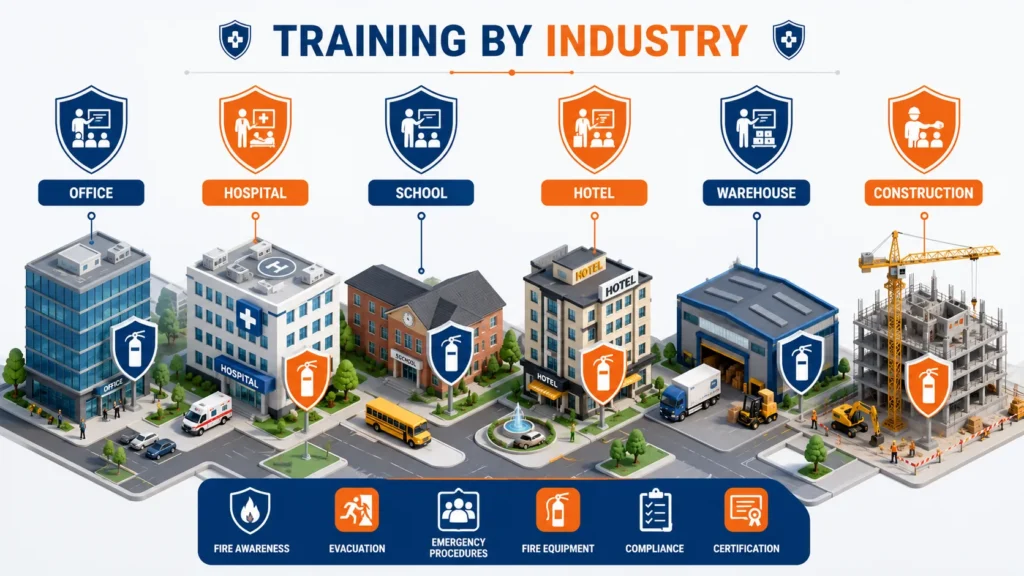
While every employee should receive fundamental fire safety training, the level and focus of training should reflect the specific hazards associated with each workplace. A one-size-fits-all approach rarely provides sufficient protection because fire risks vary significantly across industries.
Employers should tailor training programmes based on the findings of their fire risk assessment, the nature of work activities, occupancy levels, and the presence of vulnerable individuals.
Industry-Specific Fire Safety Training Requirements
| Industry | Common Fire Risks | Recommended Training Focus |
|---|---|---|
| Offices | Electrical equipment, overloaded sockets, portable heaters | Fire awareness, evacuation procedures, electrical safety, reporting hazards |
| Construction | Hot works, temporary electrics, combustible materials, fuel storage | Hot work permits, fire watch procedures, temporary site evacuation, extinguisher awareness |
| Healthcare & Care Homes | Oxygen equipment, medical devices, patients with limited mobility | Progressive evacuation, patient assistance, compartmentation, emergency coordination |
| Education | Laboratories, kitchens, large occupancy buildings | Student evacuation, assembly management, classroom fire procedures |
| Hospitality | Commercial kitchens, guest accommodation, laundry facilities | Kitchen fire prevention, guest evacuation, emergency communication |
| Warehousing & Logistics | High storage racks, lithium batteries, forklifts, packaging materials | Storage safety, battery charging procedures, sprinkler awareness, evacuation planning |
| Manufacturing | Machinery, welding, flammable liquids, dust explosions | Process fire prevention, hazardous materials handling, emergency shutdown procedures |
| Retail | High customer footfall, electrical displays, storage rooms | Customer evacuation, alarm response, stockroom fire prevention |
Organisations that customise fire safety training to their operational risks are more likely to reduce incidents and improve emergency preparedness.
High-Risk Workplaces Require Enhanced Training
Some environments require additional training because of elevated fire risks or complex evacuation challenges. These include:
- Chemical processing facilities
- Oil and gas operations
- Pharmaceutical manufacturing
- Data centres
- Laboratories
- Airports
- High-rise commercial buildings
- Large entertainment venues
Employees working in these environments may require advanced instruction on specialist fire suppression systems, hazardous materials, confined spaces, or emergency shutdown procedures.
Training Should Reflect Workplace Changes
Fire safety training should evolve whenever there are significant workplace changes, such as:
- Office relocations
- Building renovations
- Installation of new machinery
- Introduction of hazardous substances
- Changes to emergency exits
- Increased workforce size
- Changes to fire alarm systems
Reviewing training after organisational changes ensures employees remain familiar with updated emergency procedures and potential hazards.
Core Topics Every Fire Safety Training Programme Should Cover
An effective fire safety training programme should provide employees with the knowledge and practical skills needed to prevent fires and respond confidently during emergencies.
Training should be engaging, relevant to the workplace, and regularly refreshed to maintain competence.
Fire Prevention
Prevention is the first line of defence against workplace fires. Employees should understand how daily activities can either reduce or increase fire risks.
Training should cover:
- Safe electrical practices
- Proper storage of combustible materials
- Housekeeping standards
- Smoking policies
- Safe use of heating equipment
- Safe handling of flammable substances
- Reporting unsafe conditions
Employees who can identify hazards early play a vital role in preventing incidents before they occur.
Fire Hazard Recognition
Employees should be able to recognise common workplace fire hazards, including:
- Damaged electrical cables
- Overloaded extension leads
- Blocked fire exits
- Combustible waste accumulation
- Faulty appliances
- Improper chemical storage
- Fire doors wedged open
Hazard recognition encourages proactive reporting and continuous improvement.
Fire Detection and Alarm Systems
Every employee should know:
- What the fire alarm sounds like
- How to activate a manual call point
- What different alarm signals mean
- Where alarm call points are located
- Who should be notified during an emergency
Prompt activation of alarms can significantly reduce evacuation times.
Emergency Evacuation Procedures
Employees should understand:
- Primary escape routes
- Alternative escape routes
- Assembly point locations
- Evacuation responsibilities
- Procedures for assisting vulnerable persons
- Rules regarding lifts during fire emergencies
- Roll call procedures
Regular fire drills reinforce this knowledge and improve confidence.
Fire Extinguisher Awareness
While employees are not generally expected to fight fires, they should understand:
- Different types of extinguishers
- Which extinguisher is suitable for different fire classes
- Situations when extinguisher use is appropriate
- When immediate evacuation is the safest option
Training should always emphasise personal safety over property protection.
Emergency Communication
Employees should know how to:
- Report fires immediately
- Contact emergency services if required
- Communicate hazards clearly
- Follow instructions from Fire Wardens
- Assist emergency responders with relevant information
Effective communication reduces confusion during emergencies.
Employee Fire Safety Training Journey
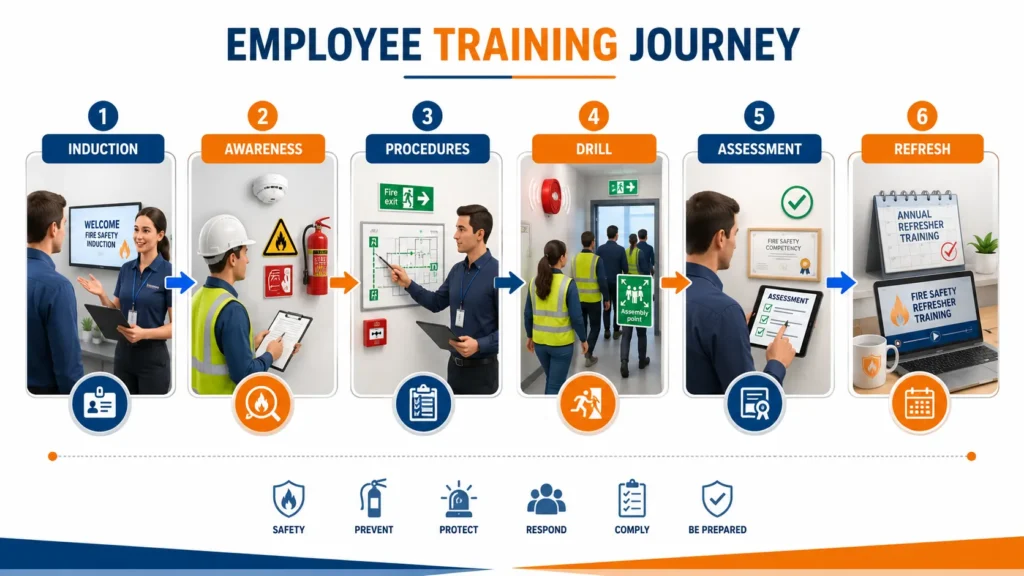
Fire safety training should not be treated as a single induction session. Instead, organisations should adopt a structured learning journey that reinforces knowledge throughout an employee’s time with the company.
Employee Fire Safety Training Flowchart
New Employee Joins
↓
Fire Safety Induction
↓
Introduction to Workplace Fire Risks
↓
Emergency Procedures and Escape Routes
↓
Fire Alarm and Reporting Procedures
↓
Fire Extinguisher Awareness
↓
Practical Fire Drill Participation
↓
Competency Assessment
↓
Role-Specific Training (if required)
↓
Annual Refresher Training
↓
Additional Training Following Workplace Changes
This continuous learning approach ensures employees remain confident and prepared throughout their employment.
The Importance of Practical Learning
The most effective fire safety programmes combine classroom learning with practical exercises.
Examples include:
- Evacuation drills
- Hazard identification exercises
- Fire alarm simulations
- Emergency communication practice
- Scenario-based decision making
Practical experiences improve knowledge retention and help employees respond more effectively during real emergencies.
Fire Safety Training vs Fire Risk Assessment
Fire safety training and fire risk assessments are closely linked, but they serve different purposes. Many organisations mistakenly assume that completing a fire risk assessment alone is sufficient to meet legal responsibilities.
In reality, both are essential components of an effective fire safety management system.
Comparison Table
| Fire Safety Training | Fire Risk Assessment |
|---|---|
| Educates employees about fire safety | Identifies workplace fire hazards |
| Builds employee competence | Evaluates existing fire risks |
| Focuses on behaviour and emergency response | Focuses on risk identification and control measures |
| Conducted during induction and refresher sessions | Reviewed regularly and whenever significant changes occur |
| Helps employees respond effectively during emergencies | Helps employers reduce the likelihood of fires occurring |
| Supports a positive workplace safety culture | Supports legal compliance and ongoing risk management |
How They Work Together
A fire risk assessment identifies hazards and recommends appropriate control measures.
Fire safety training ensures employees understand:
- Why those control measures exist
- How to follow emergency procedures
- How to reduce workplace fire risks
- How to respond safely if a fire occurs
Without training, even the most comprehensive fire risk assessment cannot achieve its intended outcomes.
Responsibilities of Employers and Employees
Fire safety is a shared responsibility. Employers are responsible for providing safe systems of work, while employees must follow procedures and contribute to maintaining a safe workplace.
When both parties understand their responsibilities, fire prevention becomes part of everyday workplace culture.
Employer Responsibilities
Employers should:
- Conduct suitable and sufficient fire risk assessments.
- Provide appropriate fire safety training during induction.
- Deliver refresher training at suitable intervals.
- Maintain fire alarms, extinguishers, emergency lighting, and other fire protection systems.
- Keep escape routes clear and accessible.
- Develop and communicate emergency evacuation procedures.
- Appoint competent Fire Wardens where necessary.
- Maintain accurate records of fire safety training.
- Review fire safety arrangements whenever significant workplace changes occur.
- Promote a positive fire safety culture across the organisation.
Employers should also ensure training is understandable, accessible, and relevant to each employee’s role and workplace environment.
Employee Responsibilities
Employees also play a critical role in workplace fire safety. Every member of staff should:
- Attend all required fire safety training sessions.
- Follow workplace fire safety procedures at all times.
- Familiarise themselves with emergency exits and assembly points.
- Report fire hazards immediately.
- Avoid actions that could increase fire risks.
- Participate fully in fire drills.
- Follow instructions given by Fire Wardens or emergency services.
- Never interfere with fire protection equipment unless authorised.
- Help maintain good housekeeping standards.
- Encourage colleagues to follow safe working practices.
Taking personal responsibility for fire safety helps create a workplace where hazards are identified early, risks are reduced, and everyone is better prepared to respond effectively in an emergency.
Fire Marshal and Advanced Fire Safety Training
While every employee should receive basic fire safety training, some individuals require additional instruction because of their responsibilities during an emergency. Fire Wardens, Fire Marshals, supervisors, and managers play an important role in coordinating evacuations, monitoring fire safety standards, and supporting emergency services.
Advanced training helps these individuals develop the knowledge and confidence needed to lead others during potentially stressful situations.
Who Needs Advanced Fire Safety Training?
Additional fire safety training is recommended for:
- Fire Wardens and Fire Marshals
- Supervisors and Team Leaders
- Facilities Managers
- Health and Safety Officers
- Building Managers
- Security Personnel
- Maintenance Teams
- Employees responsible for high-risk activities
The level of training should always reflect the risks identified within the workplace fire risk assessment.
What Does Advanced Fire Safety Training Include?
In addition to basic fire awareness, advanced programmes often cover:
- Fire safety legislation and legal responsibilities
- Conducting workplace fire inspections
- Fire compartmentation principles
- Evacuation leadership techniques
- Assisting disabled or vulnerable occupants
- Liaising with the Fire and Rescue Service
- Fire drill planning and evaluation
- Incident reporting and post-incident reviews
- Monitoring fire protection equipment
- Supporting ongoing fire safety compliance
Well-trained Fire Marshals strengthen workplace preparedness by leading safe evacuations, assisting occupants during emergencies, and helping organisations maintain effective fire safety procedures and compliance.
Common Workplace Fire Hazards Every Employee Should Recognise
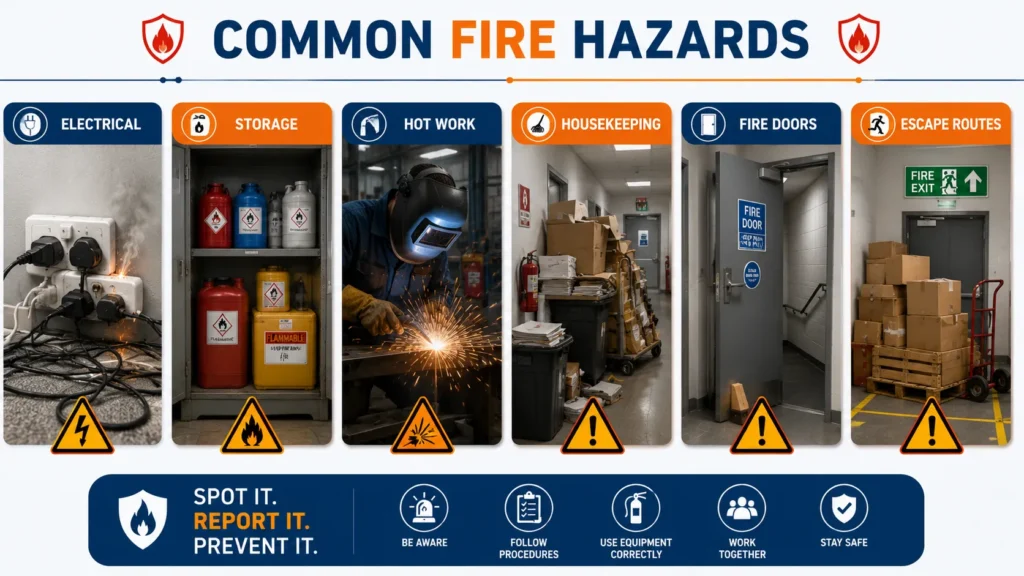
Preventing fires starts with recognising the hazards that exist in everyday working environments. Many workplace fires result from routine activities rather than unexpected events.
Employees who understand these risks can help prevent incidents before they occur.
Electrical Hazards
Electrical faults remain one of the leading causes of workplace fires.
Common examples include:
- Overloaded sockets
- Damaged extension leads
- Faulty appliances
- Poorly maintained equipment
- Improper charging of batteries
- Exposed electrical wiring
Regular inspections and responsible equipment use significantly reduce electrical fire risks.
Poor Housekeeping
Untidy workplaces create unnecessary fire hazards.
Examples include:
- Accumulated cardboard and paper
- Waste stored near heat sources
- Clutter blocking escape routes
- Dust build-up around machinery
- Combustible materials stored incorrectly
Good housekeeping should be part of every employee’s daily routine.
Improper Storage of Flammable Materials
Many workplaces use flammable liquids, gases or chemicals.
Employees should understand:
- Approved storage methods
- Ventilation requirements
- Separation distances
- Spill response procedures
- Safe disposal methods
Proper storage reduces both fire and explosion risks.
Hot Work Activities
Activities such as welding, grinding and cutting generate sparks capable of igniting combustible materials.
Employers should ensure:
- Hot work permits are used where appropriate
- Fire watches are implemented
- Combustible materials are removed
- Suitable extinguishers are available
Training is particularly important in construction, manufacturing and engineering environments.
Blocked Escape Routes
Emergency exits must always remain clear.
Employees should never:
- Store equipment in escape routes
- Block fire doors
- Lock emergency exits
- Wedge fire doors open
Keeping evacuation routes unobstructed is one of the simplest but most important fire safety responsibilities.
How Technology Is Transforming Fire Safety Training
Modern technology is changing the way organisations deliver fire safety training. Digital learning solutions make training more engaging, accessible and measurable while helping employers maintain accurate compliance records.
Technology should complement practical exercises rather than replace them.
Online Learning Platforms
Many organisations now deliver fire safety awareness training through Learning Management Systems (LMS).
Benefits include:
- Flexible learning schedules
- Consistent training delivery
- Progress tracking
- Automatic certification
- Refresher reminders
- Centralised training records
Virtual Reality (VR) Training
Virtual Reality enables employees to experience realistic emergency scenarios without exposure to actual danger.
VR training can simulate:
- Office fires
- Warehouse evacuations
- Kitchen fires
- Industrial incidents
- Smoke-filled escape routes
Immersive learning improves confidence and decision-making during emergencies.
Artificial Intelligence and Smart Learning
Artificial Intelligence is helping organisations personalise training by:
- Identifying knowledge gaps
- Recommending refresher modules
- Tracking learner performance
- Automating compliance reporting
- Analysing workplace safety trends
As AI continues to evolve, fire safety training is becoming more data-driven and proactive.
Smart Building Integration
Many modern buildings include intelligent fire safety systems such as:
- Networked smoke detectors
- Smart fire alarm panels
- Occupancy monitoring
- Digital evacuation guidance
- Remote fire system monitoring
Employees should understand how these technologies support emergency response while recognising that human awareness remains essential.
Common Mistakes That Reduce Fire Safety Effectiveness
Even organisations with formal fire safety programmes can undermine their effectiveness through avoidable mistakes.
Recognising these issues helps employers continuously improve their fire safety management.
Treating Training as a One-Time Activity
Fire safety knowledge declines over time if it is not reinforced.
Regular refresher training helps employees remain familiar with emergency procedures and changing workplace risks.
Ignoring Role-Specific Risks
Different roles require different levels of training.
For example:
- Reception staff manage visitors.
- Maintenance teams work with electrical systems.
- Warehouse employees operate around combustible storage.
- Kitchen staff work near cooking equipment.
Training should reflect these differences.
Failing to Conduct Practical Fire Drills
Theory alone cannot prepare employees for real emergencies.
Practical drills allow organisations to:
- Test evacuation times
- Identify weaknesses
- Improve communication
- Increase employee confidence
Poor Record Keeping
Training records provide evidence of compliance and help organisations monitor refresher requirements.
Accurate documentation supports audits, inspections and continuous improvement.
Not Updating Training After Workplace Changes
Training should always be reviewed following:
- Office relocations
- Building refurbishments
- New equipment installation
- Process changes
- Staffing increases
- Legislative updates
Current information is essential for effective emergency preparedness.
How Often Should Fire Safety Training Be Refreshed?
Fire safety training is an ongoing process rather than a single event. Although UK legislation does not specify an exact refresher interval for every workplace, employers are expected to provide training whenever it is necessary to maintain competence.
Training should be reviewed based on workplace risks, employee responsibilities and organisational changes.
Recommended Fire Safety Training Schedule
| Training Activity | Recommended Timing |
|---|---|
| New employee induction | Before or immediately after starting work |
| Role-specific fire safety training | Before undertaking relevant duties |
| Fire drills | At least annually or more frequently where appropriate |
| Refresher fire safety training | Every 12 months or sooner if risks change |
| Training after significant workplace changes | As soon as changes are introduced |
| Fire Marshal refresher training | Regularly according to organisational policy and risk assessment |
Regular reviews ensure employees remain confident and prepared to respond effectively.
Benefits of Investing in Employee Fire Safety Training
Organisations that prioritise fire safety training gain advantages that extend far beyond legal compliance.
Improved Employee Safety
Employees are better equipped to prevent fires, recognise hazards and respond appropriately during emergencies.
Stronger Regulatory Compliance
Comprehensive training supports compliance with UK fire safety legislation and demonstrates a proactive approach to workplace safety.
Reduced Business Disruption
Preventing fires helps minimise downtime, operational delays and financial losses.
Enhanced Organisational Reputation
A visible commitment to safety strengthens trust among employees, customers, clients and regulatory authorities.
Better Insurance Outcomes
Effective risk management and documented training may support insurance requirements and demonstrate responsible organisational practices.
Stronger Safety Culture
Employees who understand fire safety become active contributors to continuous improvement rather than passive observers.
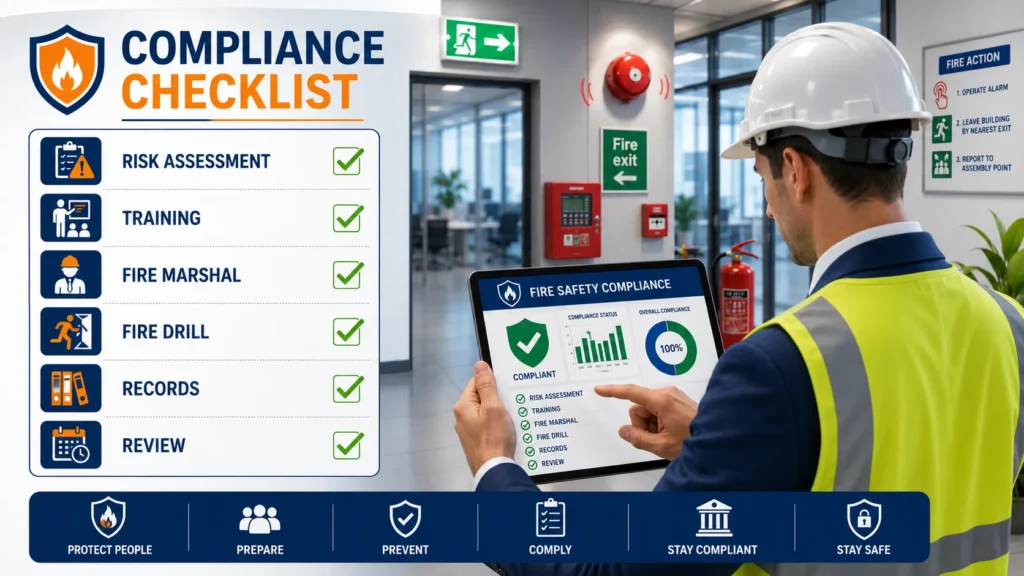
Employee Fire Safety Training Checklist
The following checklist can help organisations evaluate whether their fire safety programme addresses essential requirements.
| Checklist Item | Status |
|---|---|
| Fire risk assessment completed | ✓ |
| Fire safety induction provided | ✓ |
| Emergency procedures communicated | ✓ |
| Escape routes clearly identified | ✓ |
| Fire alarm systems explained | ✓ |
| Fire extinguisher awareness delivered | ✓ |
| Fire Wardens appointed where required | ✓ |
| Practical fire drills conducted | ✓ |
| Refresher training scheduled | ✓ |
| Training records maintained | ✓ |
| Training reviewed after workplace changes | ✓ |
| Continuous improvement programme established | ✓ |
Using a structured checklist helps maintain consistency across the organisation and supports ongoing compliance.
Career Opportunities After Fire Safety Training
Fire safety training provides valuable knowledge for employees across every sector, but it can also serve as the foundation for a rewarding career in health and safety, compliance or risk management.
As organisations continue to strengthen workplace safety standards, demand for competent fire safety professionals continues to grow.
Career pathways include:
- Fire Risk Assessor
- Fire Safety Advisor
- Fire Safety Officer
- Fire Marshal
- Health and Safety Officer
- Compliance Officer
- Building Safety Manager
- Facilities Manager
- Health and Safety Consultant
- Risk Management Specialist
Developing recognised qualifications alongside practical experience can enhance career progression and open opportunities across public and private sectors.
Continue Your Fire Safety Journey with Inspire College
Learning should not stop after basic workplace fire safety training. Individuals seeking to expand their knowledge or progress into specialist roles can benefit from recognised fire safety and health and safety qualifications.
Consider exploring these related courses and resources available through Inspire College to strengthen your skills and support your professional development:
Fire Safety and Risk Assessment
Conclusion
Fire safety training is one of the most effective investments an organisation can make in protecting its people, property and long-term success. While legislation requires employers to provide suitable fire safety information, instruction and training, the real value lies in creating a workplace where every employee understands how to prevent fires and respond confidently when emergencies occur.
An effective fire safety programme combines legal compliance with practical learning, regular refresher training and continuous improvement. Employees who understand fire hazards, evacuation procedures, emergency communication and their individual responsibilities contribute to a safer working environment for everyone.
Employers should ensure that fire safety training is tailored to workplace risks, supported by regular fire risk assessments and reinforced through practical drills and ongoing education. As workplaces evolve and technology advances, maintaining current knowledge is essential to protecting lives and ensuring business continuity.
Whether you are an employer looking to strengthen workplace compliance or an individual seeking to develop professional expertise, investing in fire safety training is an investment in safety, confidence and long-term resilience.
By combining comprehensive training, proactive fire prevention and a strong safety culture, organisations can significantly reduce fire risks while creating workplaces where employees feel informed, prepared and protected.