
Fire Safety in Schools and Educational Facilities
Fire safety in schools is essential for protecting pupils, teachers, support staff, visitors and educational buildings from the potentially devastating effects of fire. Schools present distinctive fire safety challenges because they accommodate large numbers of people, include occupants of different ages and abilities, and often contain higher-risk areas such as science laboratories, kitchens, workshops, IT rooms and storage spaces.
Effective fire safety in schools and educational facilities involves much more than installing fire alarms and extinguishers. Educational premises need suitable fire risk assessments, clear escape routes, effective fire detection and warning systems, trained staff, well-planned evacuation procedures and arrangements for people who may require additional assistance.
In England, fire safety responsibilities for most non-domestic premises are principally governed by the Regulatory Reform (Fire Safety) Order 2005. Educational organisations must identify fire hazards, assess who may be at risk and implement proportionate measures to reduce those risks.
A strong school fire safety strategy therefore combines four essential elements:
Prevention → Protection → Evacuation → Education
This guide explains the main fire hazards found in educational premises, legal responsibilities, fire risk assessments, evacuation planning, fire protection equipment, staff training and practical measures schools can use to create a safer learning environment.
What Is Fire Safety in Schools?
Fire safety in schools is the systematic process of identifying, controlling and managing fire risks to protect pupils, staff, visitors and educational premises. It includes fire prevention, risk assessment, detection and warning systems, safe escape routes, evacuation planning, staff training, equipment maintenance and regular review.
School fire safety should be treated as an ongoing management responsibility rather than a one-time inspection.
Educational premises can include:
- Primary and secondary schools
- Academies
- Colleges
- Universities
- Nurseries and early-years settings
- Special educational settings
- Adult education centres
- Training centres
- Music and performing arts schools
- Boarding accommodation associated with education
Although the hazards vary between buildings, the fundamental objective remains the same: prevent fires where reasonably practicable and ensure occupants can reach safety if a fire occurs.
Why is Fire Safety Important in Schools and Educational Facilities?
A fire in an educational facility can threaten life within minutes. Young children may have limited understanding of emergencies, while some pupils may need physical assistance, additional instructions or individual evacuation arrangements.
Schools can also contain significant combustible materials, including paper, books, furniture, artwork, displays, chemicals and teaching resources.
Good fire safety helps educational organisations to:
- Protect pupils, staff and visitors
- Reduce the likelihood of fire
- Limit the spread of fire and smoke
- Maintain safe evacuation routes
- Protect buildings and educational resources
- Reduce disruption to education
- Support legal compliance
- Improve emergency preparedness
- Create greater staff awareness
- Strengthen overall safety culture
The consequences of inadequate fire safety can extend beyond physical damage. A serious incident may interrupt teaching, damage records and specialist equipment, close facilities and create significant operational and financial consequences.
Who is Responsible for Fire Safety in a School?
Under the Regulatory Reform (Fire Safety) Order 2005, duties fall on the Responsible Person and, where applicable, others who have control of premises or relevant responsibilities.
Depending on how an educational organisation is structured, responsibilities may involve employers, academy trusts, governing bodies, local authorities, proprietors or other organisations and individuals with control over the premises.
Day-to-day fire safety activities may also involve:
| Role | Typical Fire Safety Contribution |
|---|---|
| Senior management | Establishes arrangements, resources and responsibilities |
| Headteacher or principal | Supports implementation of school procedures |
| Facilities/premises team | Coordinates inspections, maintenance and building controls |
| Fire marshals/wardens | Assist with evacuation and local checks |
| Teachers | Guide pupils safely during emergencies |
| Support staff | Assist evacuation and people requiring additional support |
| Contractors | Follow site fire precautions and permit arrangements |
Legal responsibility should not simply be assumed from a person’s job title. Schools should clearly establish who holds relevant duties and who is responsible for each operational task.
UK Fire Safety Requirements for Educational Premises
For educational premises in England, the Regulatory Reform (Fire Safety) Order 2005 provides the principal fire safety framework.
The legislation requires appropriate fire precautions based on risk. The Responsible Person must ensure that a suitable and sufficient fire risk assessment is carried out and that necessary preventive and protective measures are implemented.
The UK Government also provides specific fire safety risk assessment guidance for educational premises, designed to help organisations understand how fire safety duties apply within educational environments.
Important areas include:
- Fire risk assessment
- Emergency routes and exits
- Fire detection and warning
- Firefighting equipment where appropriate
- Emergency procedures
- Staff information and training
- Maintenance of fire precautions
- Consideration of people particularly at risk
- Cooperation and coordination where premises are shared
Schools should use current official guidance and obtain competent professional advice where the premises, risks or evacuation arrangements are complex.
Common Fire Hazards in Schools
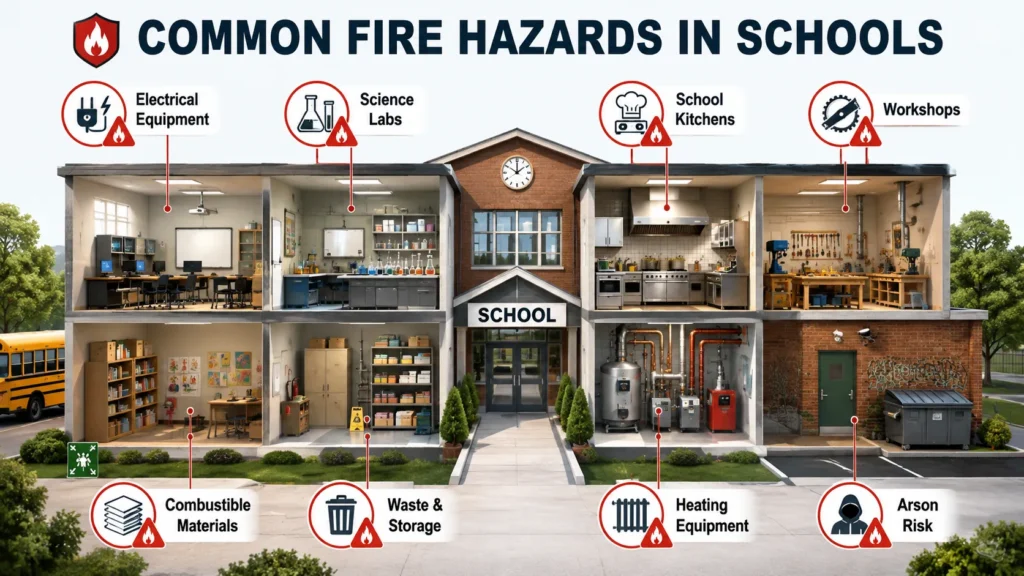
Educational facilities can contain several ignition sources and combustible materials. Recognising them is the first stage of effective fire prevention.
Electrical Equipment and Overloaded Sockets
Computers, projectors, printers, interactive displays, chargers and portable electrical equipment are common throughout modern schools.
Damaged equipment, unsuitable extension arrangements, overloaded sockets or poor maintenance can increase fire risk.
Electrical equipment should be appropriately selected, used and maintained, while defective items should be removed from service.
Science Laboratories
Science laboratories can introduce additional risks through chemicals, flammable substances, burners, electrical apparatus and experiments involving heat.
Good controls include appropriate storage, supervision, segregation of incompatible substances and suitable emergency procedures.
School Kitchens
Commercial-style cooking equipment, oils, heat sources and electrical appliances can make school kitchens higher-risk areas.
Cooking equipment and extraction systems should be properly maintained, and combustible materials should be kept away from heat sources.
Design and Technology Workshops
Workshops may contain machinery, electrical tools, timber, dust, adhesives, paints and other combustible materials.
Housekeeping, equipment maintenance, safe storage and appropriate supervision are particularly important.
Combustible Classroom Materials
Paper, artwork, decorations, books and teaching displays can contribute to fire growth if poorly managed, particularly around heat sources, escape routes or fire safety equipment.
IT and Server Rooms
IT equipment can operate continuously and generate heat. Electrical faults, poor ventilation and inappropriate storage can increase risk.
Waste and Storage Areas
Accumulated packaging, paper, furniture and waste increase the available fire load. External waste storage may also create opportunities for deliberate ignition.
Arson and Deliberate Fire Setting
Security should form part of school fire prevention. External bins, waste, unsecured storage and poorly controlled access can increase vulnerability to deliberate fires.
Contractors and Maintenance Work
Maintenance, refurbishment and construction can introduce temporary hazards, including hot work, isolated alarm systems, combustible materials and obstructed escape routes.
Contractor activities should therefore be incorporated into the school’s fire safety management arrangements.
Fire Risk Assessment in Schools
A school fire risk assessment is a structured examination of the premises, people and fire hazards to determine whether existing fire precautions are suitable and what further measures may be necessary.
A practical process can be represented as:
Identify Fire Hazards
↓
Identify People at Risk
↓
Evaluate, Remove or Reduce Risks
↓
Record Findings and Plan Emergency Arrangements
↓
Review and Update
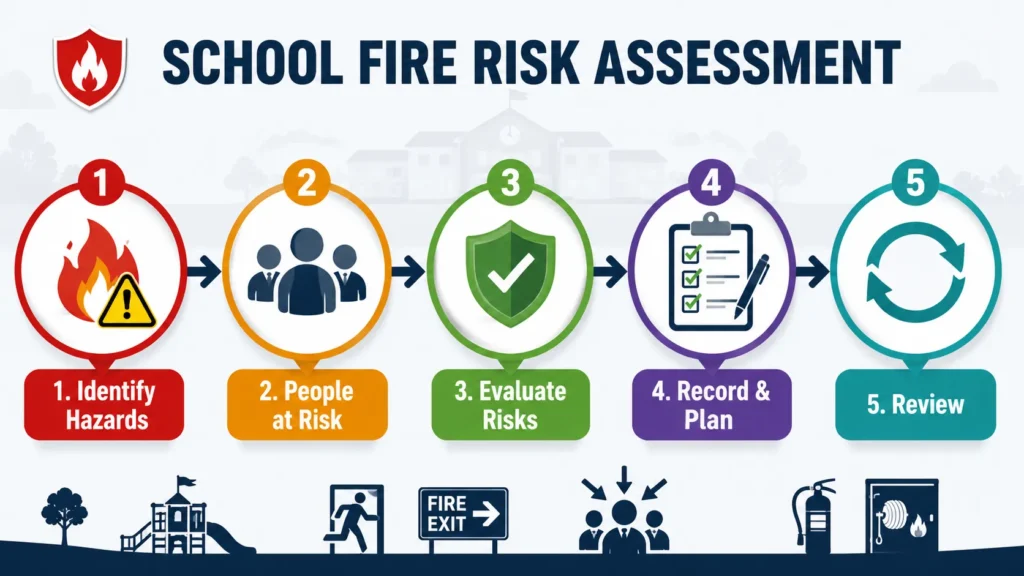
Step 1: Identify Fire Hazards
Consider potential ignition sources, combustible materials and circumstances that could allow a fire to develop.
Step 2: Identify People at Risk
Consider everyone who could be affected, including pupils, employees, contractors and visitors.
Particular attention may be required for people who cannot evacuate quickly or independently.
Step 3: Evaluate and Reduce the Risks
Assess the likelihood and potential consequences of fire.
Where practicable, hazards should be removed. Where removal is not possible, risks should be reduced and appropriate fire precautions maintained.
Step 4: Record, Plan and Inform
Significant findings and necessary arrangements should be recorded as required. Emergency plans should clearly explain what occupants and staff must do.
Step 5: Review the Assessment
Fire risk assessment is not a static document. It should remain under review and be updated when it may no longer be valid or when significant changes affect the premises or risks.
Readers who need a broader explanation can also explore Inspire College’s Fire Risk Assessment Explained: A Complete Beginner’s Guide and The 5 Essential Steps of Fire Risk Assessment Explained
People Who May Need Additional Evacuation Support
Not everyone can respond to an alarm or use an escape route in the same way.
Schools should consider people who may need additional assistance, including:
- Younger children
- Pupils with SEND
- Wheelchair users
- People with mobility limitations
- People with hearing or visual impairments
- Individuals who may have difficulty understanding emergency instructions
- Visitors unfamiliar with the building
- Temporary or agency staff
Where necessary, appropriate individual arrangements such as a Personal Emergency Evacuation Plan (PEEP) may be used to establish how a person will reach safety.
The important principle is that additional evacuation needs should be planned before an emergency occurs.
Essential Fire Safety Equipment in Schools
Fire protection measures should reflect the findings of the fire risk assessment and characteristics of the premises.
| Fire Safety Measure | Main Purpose | School Application |
|---|---|---|
| Fire alarm system | Warn occupants | Enables prompt evacuation |
| Fire detection | Detect signs of fire | Supports early warning |
| Fire doors | Resist fire/smoke spread | Protects routes and compartments |
| Emergency lighting | Provides illumination | Supports escape during power failure |
| Fire extinguishers | First-aid firefighting | Provided according to assessed need |
| Fire safety signs | Communicate safety information | Identifies routes and equipment |
Equipment alone does not create a safe school. It must be appropriately located, maintained and supported by effective procedures and trained people.
Creating an Effective School Fire Evacuation Plan
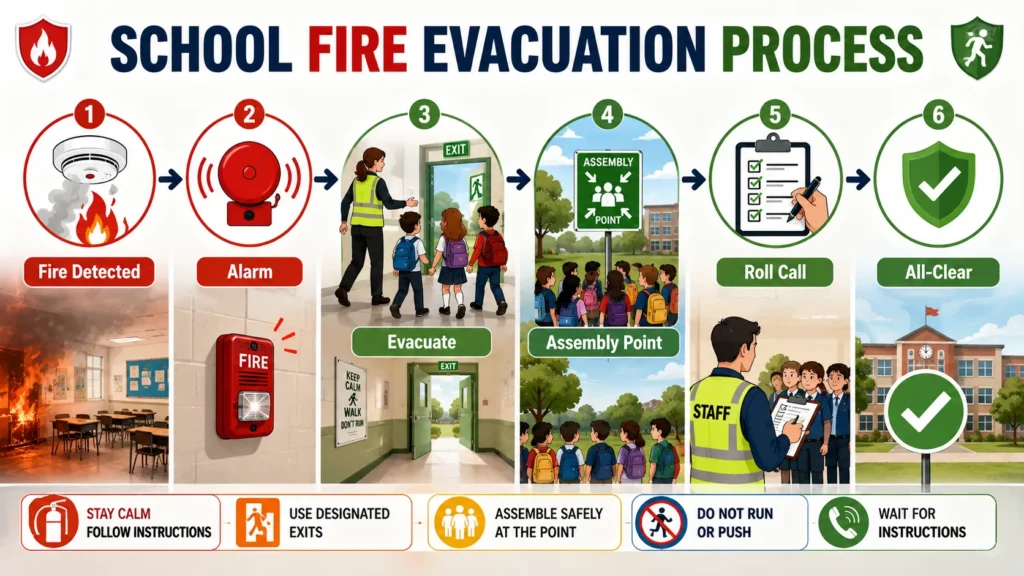
Every educational facility should have emergency arrangements appropriate to its building, occupants and identified risks.
A simple evacuation sequence is:
Fire Detected
↓
Alarm Raised
↓
Staff Direct Evacuation
↓
Occupants Use Designated Escape Routes
↓
Proceed to Assembly Point
↓
Account for Pupils, Staff and Visitors
↓
Report Relevant Information to Emergency Services
↓
Do Not Re-enter Until Authorised
Staff should know their responsibilities before an emergency occurs.
Teachers may need to guide pupils along predetermined routes, while nominated personnel may have additional duties relating to areas, information or evacuation assistance.
Personal belongings should not delay evacuation.
Fire Evacuation Procedures for Pupils with SEND
Inclusive evacuation planning is a critical component of school fire safety.
A standard procedure may not adequately support every pupil. Schools should consider individual mobility, communication, sensory and cognitive needs when developing emergency arrangements.
Measures may include:
- Individual evacuation planning
- Suitable communication methods
- Identified staff assistance
- Accessible escape arrangements
- Appropriate evacuation aids where necessary
- Alternative arrangements where particular routes cannot be used
Staff responsible for providing assistance should understand their role and receive suitable instruction or training.
Inclusive fire safety means emergency planning accounts for how people actually respond and move, rather than assuming everyone can evacuate independently.
How Often Should Schools Conduct Fire Drills?
Fire drills help test whether emergency procedures work effectively in practice.
Their frequency and organisation should reflect applicable requirements, official guidance, the fire risk assessment, building characteristics and the needs of occupants.
A drill can help schools evaluate:
- Staff response to alarms
- Pupil behaviour
- Escape route suitability
- Evacuation times
- Assembly arrangements
- Accountability procedures
- Support for people needing assistance
- Communication between responsible staff
The value of a drill comes from reviewing what happened afterwards.
Conduct Drill → Observe Performance → Record Issues → Correct Weaknesses → Update Procedures → Repeat
If pupils or staff become confused, routes become congested or accountability takes too long, those findings should inform improvements.
Fire Safety Training for Teachers and School Staff
Fire protection systems cannot compensate for staff who do not understand emergency procedures.
Staff fire safety training should be relevant to their responsibilities and workplace risks.
Training may cover:
- How to raise the alarm
- Recognising common fire hazards
- Emergency escape routes
- Assembly points
- Evacuation responsibilities
- Supporting pupils
- Arrangements for people requiring assistance
- Fire door awareness
- Reporting defective equipment
- Basic extinguisher awareness where relevant
- Procedures for visitors and contractors
New staff should receive appropriate fire safety information as part of induction, while training and instructions should remain current as arrangements change.
For wider workplace safety principles, readers can explore Inspire College’s Health and Safety: Complete Guide to Workplace Safety, Risk Management and Best Practices.
Fire Safety Responsibilities of Students
Fire safety education should also help pupils understand how to behave safely without placing responsibility for fire management on them.
Age-appropriate education can teach pupils to:
- Recognise the fire alarm
- Follow teacher instructions
- Leave the building calmly
- Use the designated route
- Never hide during an emergency
- Avoid collecting personal belongings
- Go directly to the assembly point
- Remain with their class or group
- Never re-enter a building without permission
- Report observed hazards to staff
Regular education helps emergency behaviour become familiar rather than confusing.
Managing Fire Safety in High-Risk School Areas
Different parts of an educational facility require different controls.
| Area | Typical Hazards | Important Controls |
|---|---|---|
| Science laboratory | Chemicals, flames, experiments | Storage, supervision, risk controls |
| Kitchen | Cooking oils, heat, appliances | Cleaning, maintenance, safe storage |
| Workshop | Machinery, dust, timber, electrical tools | Housekeeping and equipment controls |
| IT/server room | Electrical equipment, heat | Maintenance and ventilation |
| Storage room | High combustible load | Controlled storage and housekeeping |
| Boiler/plant room | Heat, equipment, services | Restricted access and maintenance |
| Assembly hall | High occupancy | Clear exits and crowd management |
Risk controls should therefore be based on the actual use of each area rather than applying identical precautions everywhere.
School Fire Safety Inspection and Maintenance
Fire safety measures must remain effective after installation.
Schools should establish suitable inspection, testing and maintenance arrangements for relevant systems and equipment.
This can include:
Fire Alarm
↓
Emergency Lighting
↓
Fire Doors
↓
Escape Routes
↓
Firefighting Equipment
↓
Safety Signage
↓
Record Findings and Correct Defects
Escape routes should remain clear and usable. Fire doors should not be routinely wedged open unless an appropriate approved system is in place, and damaged fire safety equipment should be reported promptly.
Records can also help demonstrate that inspections, maintenance, training and corrective actions are being actively managed.
Practical School Fire Safety Checklist
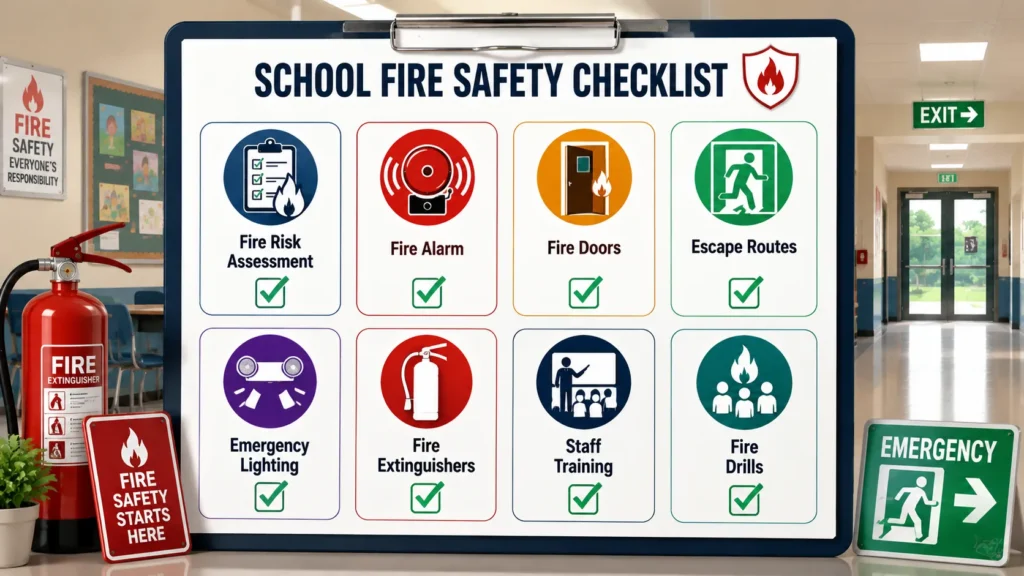
School fire safety becomes easier to manage when routine checks are systematic.
Fire Prevention
☐ Electrical equipment appears safe and properly maintained
☐ Combustible materials are appropriately stored
☐ Waste does not accumulate unnecessarily
☐ Higher-risk rooms are properly managed
☐ Contractors follow site fire precautions
☐ External waste and storage areas are controlled
Fire Protection
☐ Alarm and detection arrangements are operational
☐ Fire doors are maintained and usable
☐ Escape routes remain unobstructed
☐ Emergency lighting is maintained
☐ Fire safety signs remain visible
☐ Firefighting equipment receives appropriate maintenance
Emergency Preparedness
☐ Staff understand evacuation procedures
☐ Assembly points are clearly established
☐ Pupil, staff and visitor accountability is planned
☐ Additional evacuation needs are considered
☐ Fire drills are conducted and reviewed
☐ Relevant emergency information is accessible
Management
☐ Fire risk assessment remains current
☐ Significant changes trigger appropriate review
☐ Staff training records are maintained
☐ Defects and corrective actions are recorded
☐ Fire safety responsibilities are clearly allocated
A checklist should support—not replace—a suitable fire risk assessment and competent fire safety management.
Building a Strong Fire Safety Culture in Schools
The most effective educational facilities integrate fire safety into normal school management.
A positive fire safety culture means hazards are reported rather than ignored, escape routes are kept clear, fire doors are respected, emergency procedures are understood and changes to the building are assessed before they create additional risk.
The process becomes continuous:
Awareness → Prevention → Reporting → Corrective Action → Training → Review → Improved Safety
Senior leadership also has an important role. When management treats fire safety as a routine operational priority, staff are more likely to follow procedures consistently.
Fire safety should also connect with broader occupational health and safety, risk management, safeguarding and business continuity arrangements.
Fire Safety Training and Professional Development
Managing fire risk effectively requires appropriate knowledge and competence, particularly for people responsible for assessments, compliance, inspections or specialist fire safety functions.
Those seeking to develop professional knowledge can explore relevant Inspire College programmes and resources.
Relevant Fire Safety Courses
ProQual Level 4 Certificate in Fire Risk Assessment
Suitable for developing structured knowledge of fire risk assessment and professional fire safety practice.
ProQual Level 6 Diploma in Advanced Fire Safety Design and Building Risk Management
Relevant to those seeking advanced knowledge of fire safety design, building risk and higher-level professional responsibilities.
Related Health and Safety Learning
Health and Safety Training Courses
Useful for developing wider workplace safety, hazard identification and risk-management knowledge.
Final Thoughts
Fire safety in schools and educational facilities depends on much more than alarms, extinguishers and emergency signs. Effective protection comes from understanding how fires could start, identifying who may be affected, controlling hazards, maintaining appropriate fire precautions and ensuring everyone knows how to respond during an emergency.
Educational organisations should maintain a suitable fire risk assessment, provide safe escape arrangements, manage higher-risk areas, maintain fire protection systems and ensure staff receive appropriate information and training. Particular consideration should also be given to younger pupils, people with SEND and anyone who may require additional assistance during evacuation.
The most effective approach can be summarised simply:
Identify Risks → Prevent Fires → Protect Escape Routes → Prepare People → Practise Evacuation → Review and Improve
When prevention, protection, evacuation and education operate together, schools are better positioned to protect life, reduce property damage and maintain a safe, resilient learning environment.
Fire safety is therefore not merely a compliance exercise. It is an ongoing responsibility that should remain integrated into the everyday management and safety culture of every educational facility.