
Emergency Evacuation Planning: A Complete Guide
Every workplace should be prepared for emergencies, but preparation goes beyond installing fire alarms and displaying emergency exit signs. A well-designed emergency evacuation plan provides clear procedures that help employees, visitors, contractors, and emergency responders act quickly and safely when an incident occurs. Whether the emergency involves a fire, gas leak, chemical spill, structural failure, severe weather, or another unforeseen event, having an organised evacuation strategy can significantly reduce risks to life and property.
Emergency evacuation planning is a legal and practical responsibility for organisations across the United Kingdom. Employers have a duty to identify potential hazards, establish safe escape procedures, train employees, and regularly review evacuation arrangements. An effective plan not only supports compliance with UK health and safety legislation but also strengthens business continuity, protects organisational assets, and promotes a culture of safety.
Many organisations develop emergency procedures only to satisfy regulatory requirements, but the most resilient businesses view evacuation planning as an ongoing process. Workplace layouts change, staffing levels fluctuate, new equipment is introduced, and operational risks evolve over time. As a result, evacuation plans must be regularly updated, communicated, and tested to remain effective.
Every workplace presents unique challenges. An office building may require coordinated evacuation across multiple floors, while hospitals must consider patients with limited mobility. Warehouses, hotels, construction sites, educational institutions, manufacturing facilities, and retail environments each have distinct risks that require tailored emergency planning.
This complete guide explains everything employers, managers, Fire Marshals, and employees need to know about emergency evacuation planning. From understanding legal responsibilities and developing evacuation procedures to designing escape routes and conducting effective drills, this resource provides practical guidance for creating safer workplaces while supporting long-term compliance with UK fire safety and health and safety regulations.
What is Emergency Evacuation Planning?
Emergency evacuation planning is the process of developing, implementing, and maintaining procedures that enable people to leave a building or workplace safely during an emergency. It establishes a structured approach for responding to incidents that threaten life, health, or property while minimising confusion and reducing the likelihood of injuries.
A comprehensive evacuation plan outlines how occupants should respond, who is responsible for coordinating the evacuation, where people should assemble after leaving the building, and how emergency services can access the site efficiently.
Unlike emergency response plans that may address multiple types of incidents, an emergency evacuation plan focuses specifically on the safe movement of people from danger to a designated place of safety.
The Main Objectives of an Emergency Evacuation Plan
An effective emergency evacuation plan should aim to:
- Protect employees, visitors, and contractors from harm.
- Enable rapid and orderly evacuation.
- Reduce panic during emergencies.
- Support emergency services with accurate information.
- Minimise business disruption.
- Protect property where safe to do so.
- Ensure compliance with UK legislation.
- Strengthen organisational resilience.
These objectives help organisations respond consistently to emergencies while improving overall workplace safety.
Emergencies That May Require Evacuation
Although fire is the most common reason for workplace evacuation, organisations should prepare for a wide range of emergency situations, including:
- Fire and smoke incidents
- Gas leaks
- Chemical spills
- Explosions
- Structural collapse
- Flooding
- Severe weather
- Bomb threats
- Security incidents
- Utility failures
- Hazardous material releases
Risk assessments should determine which emergencies are relevant to each workplace and ensure evacuation procedures reflect those risks.
Key Components of an Emergency Evacuation Plan
Every emergency evacuation plan should clearly identify:
| Component | Purpose |
|---|---|
| Emergency procedures | Provide clear instructions during an emergency |
| Escape routes | Guide occupants safely out of the building |
| Emergency exits | Ensure safe and accessible means of escape |
| Assembly points | Account for everyone after evacuation |
| Fire Marshal responsibilities | Coordinate safe evacuation procedures |
| Emergency contacts | Facilitate communication with emergency services |
| Training programme | Prepare employees for emergencies |
| Fire drills | Test the effectiveness of evacuation procedures |
| Review process | Keep the plan accurate and up to date |
These elements work together to create a structured evacuation system that can be implemented quickly during an emergency.
Why Emergency Evacuation Planning Is Essential
Emergencies rarely occur without warning, but they often develop faster than expected. A delayed or disorganised evacuation can place lives at unnecessary risk and increase the severity of an incident. Emergency evacuation planning helps organisations respond efficiently by ensuring everyone understands what actions to take before an emergency occurs.
Planning ahead reduces uncertainty, improves coordination, and increases confidence among employees and emergency responders.
Protecting Lives
The primary purpose of emergency evacuation planning is to safeguard people.
When employees understand evacuation procedures, they are more likely to:
- Leave the building promptly.
- Use designated escape routes.
- Avoid unsafe behaviour.
- Assist vulnerable individuals where appropriate.
- Follow instructions from Fire Marshals and emergency services.
Clear procedures reduce confusion and improve evacuation times.
Reducing Panic During Emergencies
Panic often results from uncertainty rather than the emergency itself.
Employees who have received appropriate training are more likely to:
- Recognise alarm signals.
- Follow established procedures.
- Communicate effectively.
- Remain calm under pressure.
- Support colleagues during evacuation.
Confidence developed through planning and regular drills contributes significantly to workplace safety.
Supporting Business Continuity
Emergency evacuation planning is closely linked to business continuity.
Organisations that prepare effectively are better positioned to:
- Protect critical operations.
- Reduce operational downtime.
- Safeguard important records.
- Minimise financial losses.
- Resume business activities more quickly.
Planning for emergencies strengthens long-term organisational resilience.
Improving Legal Compliance
UK employers have legal duties to provide safe workplaces and establish suitable emergency procedures.
A documented evacuation plan demonstrates that an organisation has taken reasonable steps to protect employees and visitors.
Failure to establish effective emergency arrangements may result in:
- Enforcement action.
- Financial penalties.
- Increased liability.
- Insurance complications.
- Reputational damage.
- Operational disruption.
Building a Strong Safety Culture
Emergency planning encourages organisations to view safety as an ongoing responsibility rather than a one-time exercise.
Employees become more engaged when they:
- Participate in fire drills.
- Report hazards.
- Understand evacuation responsibilities.
- Support colleagues.
- Contribute to continuous improvement.
A positive safety culture strengthens every aspect of workplace risk management.
UK Legal Requirements for Emergency Evacuation Planning
Emergency evacuation planning is supported by several pieces of UK legislation that require employers to protect employees, visitors, and others who may be affected by workplace activities.
Understanding these legal responsibilities helps organisations develop evacuation procedures that meet recognised standards while protecting people effectively.
Regulatory Reform (Fire Safety) Order 2005
The Regulatory Reform (Fire Safety) Order 2005 is the principal fire safety legislation for non-domestic premises in England and Wales.
Under this legislation, the Responsible Person must:
- Carry out suitable and sufficient fire risk assessments.
- Identify emergency escape routes.
- Maintain fire safety equipment.
- Establish emergency procedures.
- Provide appropriate information and training.
- Ensure occupants can evacuate safely.
Emergency evacuation planning forms a fundamental part of meeting these responsibilities.
Health and Safety at Work etc. Act 1974
This legislation requires employers to ensure, so far as is reasonably practicable, the health, safety, and welfare of employees.
Emergency planning contributes directly to fulfilling this duty by preparing workplaces for foreseeable emergencies.
Management of Health and Safety at Work Regulations 1999
These regulations require employers to:
- Assess workplace risks.
- Develop emergency procedures.
- Provide relevant information.
- Coordinate emergency arrangements.
- Train employees appropriately.
The regulations emphasise that emergency planning should reflect the specific risks present within each workplace.
Fire Safety Act 2021
The Fire Safety Act strengthens fire safety responsibilities for certain buildings and reinforces the importance of effective fire risk management.
Although its primary focus is higher-risk residential premises, it highlights the importance of comprehensive emergency planning and ongoing safety management.
Building Safety Act 2022
The Building Safety Act introduces enhanced accountability for higher-risk buildings and promotes stronger safety management throughout a building’s lifecycle.
Organisations responsible for these buildings should ensure evacuation procedures remain current and effective.
Why Compliance Should Go Beyond Legal Requirements
Meeting legal obligations provides a strong foundation, but organisations should strive for continuous improvement by:
- Reviewing evacuation plans regularly.
- Learning from fire drills.
- Updating procedures following workplace changes.
- Investing in employee training.
- Incorporating new safety technologies.
- Encouraging employee feedback.
Proactive organisations often achieve better safety outcomes than those focusing solely on minimum legal compliance.
Who is Responsible for an Emergency Evacuation Plan?
Emergency evacuation planning is a shared responsibility, although overall accountability usually rests with the employer or the person legally responsible for fire safety within the premises.
Clearly defined responsibilities help ensure evacuation procedures are implemented consistently during emergencies.
The Responsible Person
Under UK fire safety legislation, the Responsible Person has overall responsibility for emergency evacuation planning.
Their duties typically include:
- Completing fire risk assessments.
- Developing evacuation procedures.
- Maintaining emergency exits.
- Ensuring emergency lighting functions correctly.
- Providing employee training.
- Reviewing evacuation arrangements regularly.
- Coordinating with emergency services when required.
Employers
Employers should ensure:
- Emergency procedures are documented.
- Employees understand evacuation arrangements.
- Fire drills are conducted regularly.
- Emergency equipment is maintained.
- Visitors and contractors receive appropriate information.
- Evacuation plans are reviewed after significant changes.
Fire Marshals
Fire Marshals play an essential operational role by supporting the implementation of evacuation procedures.
Their responsibilities may include:
- Assisting with evacuations.
- Checking designated areas where safe to do so.
- Directing occupants towards assembly points.
- Reporting evacuation status.
- Communicating with emergency responders.
Advanced Fire Marshal responsibilities will be explored in greater detail later in this guide.
Employees
Every employee contributes to successful emergency evacuation planning by:
- Following evacuation procedures.
- Attending emergency training sessions.
- Participating in drills.
- Reporting hazards.
- Keeping escape routes unobstructed.
- Following Fire Marshal instructions during emergencies.
Emergency evacuation planning is most effective when everyone understands both their own responsibilities and how they contribute to protecting others.
Step-by-Step Emergency Evacuation Planning Framework
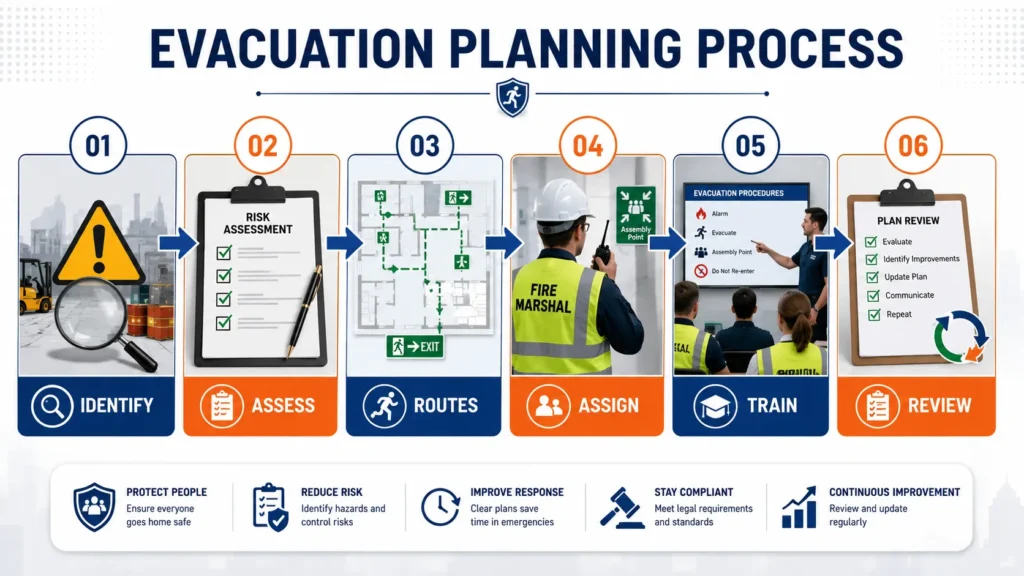
Developing an effective emergency evacuation plan requires more than identifying emergency exits and displaying evacuation maps. It involves a structured process that considers workplace hazards, building design, occupant needs, communication systems, and continuous improvement.
The following framework provides a practical approach that organisations of all sizes can use to develop or enhance their emergency evacuation procedures.
Step 1: Identify Workplace Hazards
Every evacuation plan should begin with a thorough assessment of potential hazards that could require occupants to leave the premises.
Common workplace hazards include:
- Fire and smoke
- Electrical faults
- Gas leaks
- Chemical spills
- Explosions
- Structural damage
- Severe weather
- Flooding
- Security threats
- Hazardous material releases
Understanding these risks allows organisations to develop emergency procedures that reflect their specific operating environment.
Step 2: Conduct a Fire Risk Assessment
A fire risk assessment helps identify:
- Sources of ignition
- Combustible materials
- Vulnerable occupants
- Existing fire protection measures
- Escape route suitability
- Areas requiring additional controls
The findings should directly influence the design of the emergency evacuation plan.
Step 3: Assess Building Occupants
An evacuation plan should consider everyone who may be inside the building, including:
- Employees
- Visitors
- Contractors
- Agency workers
- Customers
- Delivery personnel
- Individuals with disabilities
- Pregnant employees
- Older occupants
Different groups may require different levels of assistance during an emergency.
Step 4: Design Safe Escape Routes
Escape routes should enable occupants to leave the building quickly and safely.
Routes should:
- Be clearly identified.
- Remain unobstructed.
- Lead directly to a place of safety.
- Include alternative exits where possible.
- Be suitable for expected occupancy levels.
Well-designed escape routes significantly improve evacuation efficiency.
Step 5: Assign Emergency Responsibilities
Clearly defined responsibilities reduce confusion during emergencies.
Responsibilities may include:
- Fire Marshals
- Incident Controllers
- First Aiders
- Reception staff
- Security personnel
- Facilities managers
- Floor coordinators
Each person should understand their duties before an emergency occurs.
Step 6: Train Employees
Every employee should receive appropriate training covering:
- Alarm recognition
- Evacuation procedures
- Escape routes
- Assembly points
- Emergency reporting
- Fire prevention responsibilities
Training should be role-specific where necessary.
Step 7: Conduct Fire Drills
Regular evacuation drills help organisations:
- Measure evacuation times.
- Identify bottlenecks.
- Test communication systems.
- Improve employee confidence.
- Evaluate Fire Marshal performance.
Lessons learned should be incorporated into future planning.
Step 8: Review and Improve
Emergency evacuation planning is a continuous process.
Plans should be reviewed following:
- Fire drills
- Building alterations
- New equipment installation
- Staffing changes
- Legislative updates
- Fire incidents
- Near misses
Continuous improvement helps maintain effective emergency preparedness.
Emergency Evacuation Planning Flowchart
The following workflow illustrates how organisations should approach emergency evacuation planning.
Identify Workplace Hazards
↓
Conduct Fire Risk Assessment
↓
Assess Occupants and Visitors
↓
Design Escape Routes
↓
Assign Fire Marshal Responsibilities
↓
Install Fire Safety Measures
↓
Train Employees
↓
Conduct Fire Drills
↓
Review Results
↓
Update Emergency Evacuation Plan
Following this structured approach ensures every stage of emergency preparedness supports the next, creating a robust evacuation strategy.
Emergency Evacuation Planning by Industry
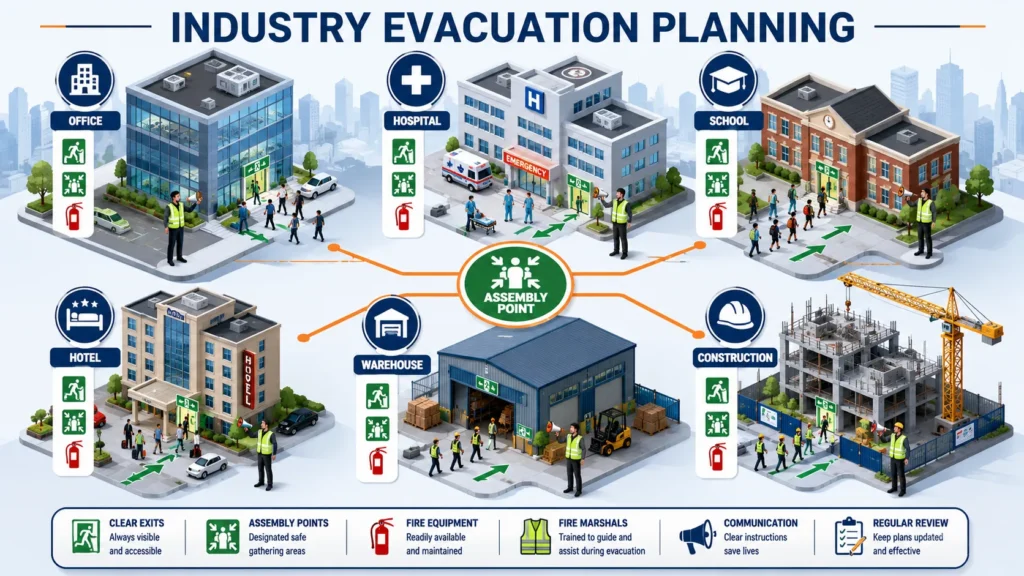
Although the principles of emergency evacuation remain consistent, each industry presents unique risks and operational challenges. Evacuation plans should reflect these differences to ensure occupants can respond safely and efficiently.
Industry-Specific Emergency Evacuation Requirements
| Industry | Key Evacuation Considerations |
|---|---|
| Office | Multi-floor evacuation, visitor management, lift restrictions, assembly point accountability |
| Hospital & Care Home | Patient evacuation, mobility assistance, medical equipment, compartmental evacuation |
| School & College | Student supervision, classroom accountability, safeguarding procedures, visitor registers |
| Hotel | Guest communication, night-time evacuation, multilingual instructions, assembly coordination |
| Warehouse | High storage racks, forklift operations, hazardous goods, large open spaces |
| Construction | Temporary exits, changing site layouts, plant equipment, hot work activities |
| Manufacturing | Machinery shutdown, hazardous substances, confined spaces, emergency isolation procedures |
| Retail | Customer evacuation, cash handling, crowded public areas, stockroom fire risks |
Tailoring evacuation procedures to operational risks improves both safety and compliance.
Why Industry-Specific Planning Matters
A generic evacuation plan rarely addresses the practical challenges faced by different workplaces.
For example:
- Hospitals must safely evacuate patients receiving treatment.
- Construction sites often have changing escape routes.
- Hotels must account for sleeping guests unfamiliar with the building.
- Warehouses require procedures for large storage areas and vehicle movements.
- Educational settings must ensure student accountability.
Industry-specific planning enables organisations to manage these unique challenges effectively.
Emergency Evacuation Route Design Principles
Escape routes form the backbone of every evacuation plan. Poorly designed routes can delay evacuation, increase confusion, and place occupants at unnecessary risk.
Organisations should ensure escape routes are designed with both safety and accessibility in mind.
Characteristics of Effective Escape Routes
Escape routes should:
- Be clearly marked with compliant signage.
- Remain free from obstructions.
- Lead directly to a place of safety.
- Be wide enough for expected occupancy levels.
- Include emergency lighting.
- Remain usable during power failures.
- Provide alternative routes where practicable.
Employees should become familiar with both primary and secondary escape routes through regular training.
Emergency Exit Signage
Effective signage should:
- Be visible from all occupied areas.
- Remain illuminated where required.
- Clearly indicate travel direction.
- Be positioned consistently throughout the building.
- Comply with relevant UK safety standards.
Clear signage reduces uncertainty during emergencies.
Assembly Points
Assembly points should be:
- Located at a safe distance from the building.
- Easily accessible.
- Large enough for expected occupancy.
- Clearly identified.
- Away from emergency vehicle access routes.
Attendance checks should be completed as soon as practical after evacuation.
Personal Emergency Evacuation Plans (PEEPs)
Not everyone can evacuate a building in the same way. Some individuals may require additional assistance because of physical disabilities, sensory impairments, temporary injuries, medical conditions, or other factors.
Personal Emergency Evacuation Plans (PEEPs) help ensure these individuals can evacuate safely and with dignity.
What Is a PEEP?
A Personal Emergency Evacuation Plan is an individualised plan that identifies:
- Specific assistance requirements.
- Preferred evacuation methods.
- Assigned helpers where appropriate.
- Refuge areas.
- Evacuation equipment requirements.
- Communication arrangements.
PEEPs should be developed in consultation with the individual concerned.
Who May Need a PEEP?
A PEEP may be appropriate for:
- Wheelchair users
- Individuals with reduced mobility
- People with visual impairments
- People with hearing impairments
- Pregnant employees
- Individuals recovering from injury
- Temporary mobility restrictions
Every organisation should consider accessibility as part of its evacuation planning process.
Reviewing PEEPs
PEEPs should be reviewed whenever:
- Workplace layouts change.
- The individual’s needs change.
- Equipment changes.
- Fire risk assessments are updated.
- Emergency procedures are revised.
Regular reviews help ensure plans remain suitable.
Fire Marshal Responsibilities During an Emergency Evacuation
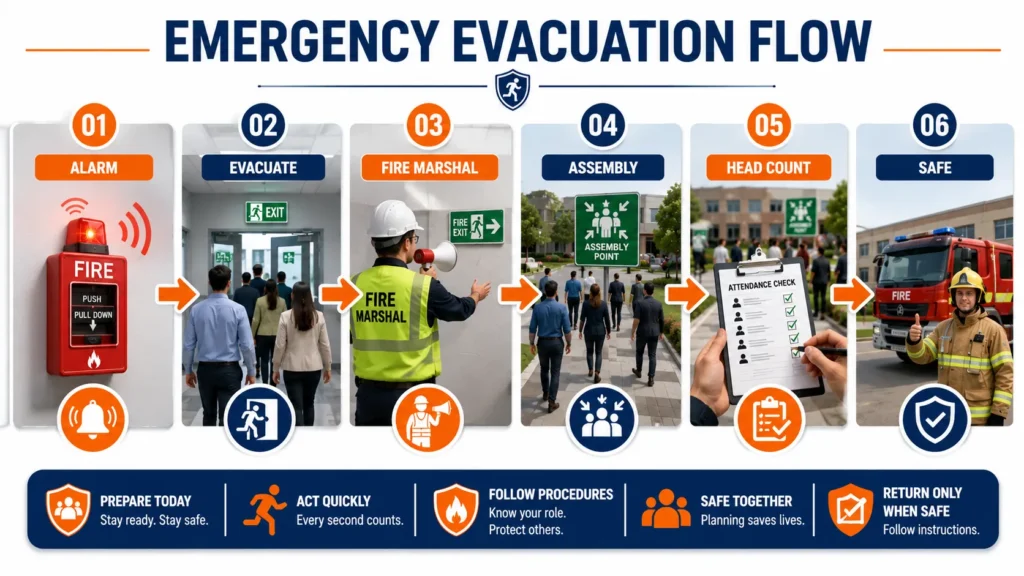
Fire Marshals play a vital role in helping organisations implement emergency evacuation procedures safely and efficiently.
Their responsibilities begin long before an emergency occurs and continue until the building has been declared safe.
Before an Emergency
Fire Marshals help organisations prepare by:
- Participating in evacuation planning.
- Monitoring fire safety standards.
- Reporting hazards.
- Assisting with fire drills.
- Promoting employee awareness.
- Familiarising themselves with escape routes.
- Understanding the needs of vulnerable occupants.
Preparation is one of the most important aspects of the role.
During an Emergency
When an emergency occurs, Fire Marshals may:
- Encourage calm evacuation.
- Direct occupants towards designated exits.
- Check allocated areas where safe to do so.
- Assist individuals requiring support.
- Prevent re-entry into the building.
- Guide occupants to assembly points.
- Report evacuation progress to the Incident Controller or emergency services.
Fire Marshals should never place themselves in unnecessary danger while carrying out these responsibilities.
After Evacuation
Following evacuation, Fire Marshals may assist by:
- Confirming area clearance where possible.
- Reporting missing persons.
- Supporting attendance checks.
- Providing information to emergency responders.
- Participating in post-incident reviews.
- Identifying opportunities for improvement.
Their observations often help organisations strengthen future evacuation planning.
Continuous Professional Development for Fire Marshals
Fire Marshals should receive ongoing training to remain familiar with:
- Updated legislation.
- Workplace changes.
- Revised evacuation procedures.
- New fire safety equipment.
- Lessons learned from drills and incidents.
Continuous development supports confidence, competence, and organisational resilience.
Modern Technologies Transforming Emergency Evacuation Planning
Technology is changing the way organisations prepare for and respond to workplace emergencies. While clear procedures and employee training remain essential, modern digital solutions help improve communication, reduce evacuation times, and strengthen overall emergency preparedness.
Organisations that combine traditional evacuation planning with innovative technology are better equipped to protect occupants and maintain business continuity.
Smart Fire Alarm Systems
Modern fire alarm systems do much more than sound an alarm.
Advanced systems can:
- Detect fire and smoke more quickly.
- Identify the exact location of an incident.
- Activate voice evacuation messages.
- Integrate with emergency lighting systems.
- Notify building managers remotely.
- Automatically contact monitoring centres where appropriate.
Early detection gives occupants valuable time to evacuate safely.
Digital Evacuation Maps
Interactive evacuation maps are replacing traditional paper floor plans in many workplaces.
Digital systems can:
- Display the safest escape routes.
- Update automatically when building layouts change.
- Highlight blocked exits.
- Guide occupants to alternative evacuation routes.
- Improve accessibility through mobile devices.
These systems are particularly valuable in large commercial buildings and complex facilities.
Mass Notification Systems
Communication is one of the most critical aspects of emergency management.
Mass notification systems enable organisations to send emergency alerts through:
- SMS messages
- Mobile applications
- Email notifications
- Voice announcements
- Desktop alerts
- Digital signage
Rapid communication helps ensure employees receive accurate information regardless of their location.
Artificial Intelligence and Smart Buildings
Artificial Intelligence (AI) is becoming an important part of modern emergency planning.
AI-powered systems can:
- Monitor occupancy levels.
- Predict evacuation bottlenecks.
- Analyse evacuation drill performance.
- Identify high-risk areas.
- Recommend improvements based on real-time data.
Combined with smart building technology, AI supports faster decision-making during emergencies.
QR Code Emergency Information
Many organisations now place QR codes throughout their premises to provide instant access to:
- Evacuation maps
- Emergency contacts
- Fire procedures
- Building information
- Assembly point locations
- Safety instructions
This approach ensures employees and visitors can quickly access important information using their smartphones.
Common Emergency Evacuation Planning Mistakes
Even organisations with documented evacuation procedures can compromise safety by overlooking critical details. Identifying and correcting these common mistakes helps improve emergency preparedness and strengthens compliance.
Treating the Evacuation Plan as a One-Time Document
An evacuation plan should be a living document.
Many organisations develop a plan during initial compliance activities but fail to review it regularly.
Plans should always be updated after:
- Building alterations
- Department relocations
- Staff increases
- Fire risk assessment reviews
- Fire drills
- Emergency incidents
Inadequate Employee Training
Employees cannot follow procedures they do not understand.
Common training issues include:
- No induction training
- Irregular refresher sessions
- Lack of practical exercises
- Failure to train temporary workers
- Limited awareness of assembly points
Training should be continuous rather than occasional.
Ignoring Visitors and Contractors
Many emergency plans focus exclusively on permanent employees.
However, organisations should also establish procedures for:
- Contractors
- Delivery drivers
- Agency workers
- Customers
- Visitors
- Maintenance personnel
Everyone on the premises should know how to evacuate safely.
Poor Fire Drill Participation
Fire drills provide valuable opportunities to test emergency arrangements.
Mistakes include:
- Conducting predictable drills.
- Failing to record evacuation times.
- Not reviewing performance.
- Ignoring employee feedback.
- Repeating the same scenarios.
Each drill should contribute to continuous improvement.
Blocked Emergency Exits
One of the most preventable evacuation failures involves obstructed escape routes.
Regular inspections should ensure:
- Fire exits remain clear.
- Corridors are free from storage.
- Fire doors operate correctly.
- Emergency lighting functions properly.
- Exit signage remains visible.
Good housekeeping is fundamental to effective evacuation planning.
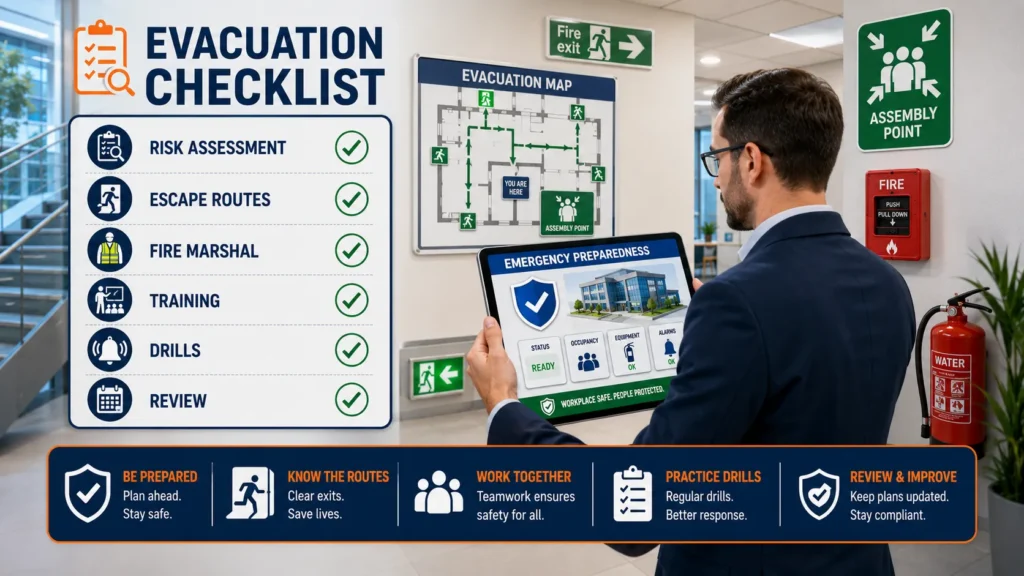
Emergency Evacuation Planning Checklist
A structured checklist helps organisations evaluate whether all essential elements of an emergency evacuation plan are in place.
| Emergency Planning Requirement | Status |
|---|---|
| Fire Risk Assessment completed | ✓ |
| Emergency evacuation plan documented | ✓ |
| Escape routes identified | ✓ |
| Emergency exits clearly signed | ✓ |
| Assembly points designated | ✓ |
| Fire Marshals appointed | ✓ |
| Personal Emergency Evacuation Plans (PEEPs) completed where required | ✓ |
| Employees trained | ✓ |
| Visitors and contractors included | ✓ |
| Fire drills conducted | ✓ |
| Emergency contact list updated | ✓ |
| Plan reviewed regularly | ✓ |
Using a checklist helps organisations maintain consistency and identify areas requiring improvement.
Emergency Evacuation Plan Review Schedule
An effective evacuation plan should evolve alongside the workplace.
Regular reviews help ensure procedures remain accurate, practical, and legally compliant.
| Event | Review Required |
|---|---|
| Annual safety review | Yes |
| Building refurbishment | Yes |
| Office relocation | Yes |
| Introduction of new equipment | Yes |
| Significant staffing changes | Yes |
| Updated fire risk assessment | Yes |
| Following a fire drill | Yes |
| Following an emergency incident | Immediate |
| Legislative changes | Yes |
| Changes to emergency exits or escape routes | Yes |
Organisations should document every review and communicate significant updates to employees.
Real Workplace Emergency Evacuation Scenarios
Planning becomes more effective when procedures are tested against realistic workplace situations.
The following examples illustrate how evacuation plans may differ across industries.
Office Building Fire
An electrical fault causes smoke to spread through an open-plan office.
Employees:
- Activate the fire alarm.
- Evacuate using designated stairwells.
- Report to the assembly point.
- Fire Marshals confirm floor clearance.
- Emergency services investigate before re-entry.
Warehouse Battery Fire
A lithium-ion battery ignites in a storage area.
Employees:
- Stop warehouse operations.
- Evacuate using designated exits.
- Isolate the affected area if safe.
- Prevent vehicle movement.
- Await emergency responders.
Hotel Kitchen Fire
A commercial kitchen fire occurs during peak service.
Staff:
- Raise the alarm.
- Guide guests calmly towards emergency exits.
- Assist individuals requiring support.
- Conduct guest accountability procedures.
- Coordinate with emergency services.
School Science Laboratory Incident
A chemical reaction produces smoke during a practical lesson.
Teachers:
- Follow laboratory emergency procedures.
- Supervise student evacuation.
- Conduct attendance checks at the assembly point.
- Prevent re-entry until authorised.
Construction Site Emergency
Hot work ignites combustible materials.
Site supervisors:
- Stop work immediately.
- Direct workers to designated assembly areas.
- Account for contractors and visitors.
- Prevent access to hazardous zones.
- Assist emergency responders with site information.
Scenario-based planning helps organisations prepare for emergencies before they occur.
How Emergency Evacuation Planning Supports Business Continuity
Emergency evacuation planning protects far more than people.
It also supports long-term organisational resilience by reducing operational disruption and enabling faster recovery.
Protecting Business Operations
Well-prepared organisations can:
- Reduce downtime.
- Resume operations more quickly.
- Protect critical infrastructure.
- Safeguard important records.
- Minimise supply chain disruption.
Strengthening Organisational Reputation
Effective emergency management demonstrates professionalism and commitment to employee welfare.
Clients, customers, regulators, and insurers are more likely to trust organisations that prioritise workplace safety.
Supporting Regulatory Compliance
Comprehensive evacuation planning helps organisations demonstrate compliance with UK fire safety and health and safety legislation while reducing the likelihood of enforcement action.
Building Employee Confidence
Employees who understand emergency procedures feel more confident and secure at work.
This contributes to:
- Higher engagement.
- Improved morale.
- Better safety awareness.
- Stronger organisational culture.
Continue Your Learning with Inspire College
Emergency evacuation planning is closely connected to broader fire safety and health and safety management. Expanding your knowledge through recognised qualifications can improve workplace competence and support career progression.
- Fire Safety Training
- Fire Risk Assessment Training
- Fire Marshal Training
- Diploma in Naked Flame, Hot work and Fire Watcher
Conclusion
Emergency evacuation planning is one of the most important elements of workplace safety and organisational resilience. A well-designed evacuation plan enables employees, visitors, contractors, and emergency responders to act quickly and confidently during unexpected incidents, helping to protect lives while reducing disruption to business operations.
Effective planning goes beyond simply identifying emergency exits. It requires organisations to assess workplace risks, develop clear procedures, assign responsibilities, provide regular employee training, conduct realistic fire drills, and continuously review emergency arrangements as workplaces evolve. Incorporating Personal Emergency Evacuation Plans (PEEPs), supporting Fire Marshals, and using modern technologies such as smart alarm systems and digital evacuation tools further strengthens preparedness.
Employers who invest in comprehensive emergency evacuation planning not only meet their legal obligations under UK fire safety and health and safety legislation but also create safer, more resilient workplaces. Regular reviews, practical exercises, and a proactive safety culture ensure evacuation procedures remain effective when they are needed most.
Whether you manage an office, school, healthcare facility, warehouse, hotel, construction site, or manufacturing plant, emergency evacuation planning should remain an ongoing priority. By combining careful planning, continuous training, and regular improvement, organisations can build confidence, protect people, and respond effectively to emergencies while supporting long-term compliance and business continuity.