
What is the CSP®? Complete Guide to the Certified Safety Professional Credential
The Certified Safety Professional® (CSP®) is one of the most recognised professional credentials for experienced occupational safety, health and environmental (SH&E) practitioners. Awarded by the Board of Certified Safety Professionals (BCSP), the CSP® demonstrates that a professional has met the applicable education, experience and credential requirements and successfully passed the CSP examination.
For safety professionals planning long-term career progression, the CSP® can represent an important professional milestone. It is relevant to professionals working across industries such as construction, oil and gas, manufacturing, energy, engineering, transportation, chemicals and other sectors where effective safety management is essential.
Important: BCSP requirements, accepted credentials, fees and policies may change. Always verify the latest information directly with BCSP before applying.
What is the CSP®?
The Certified Safety Professional® (CSP®) is a professional certification for qualified safety, health and environmental practitioners who meet BCSP’s applicable requirements.
In simple terms:
Education + Professional SH&E Experience + Qualified Credential + CSP Examination → CSP®
The CSP® is designed for experienced professionals whose work involves broad, professional-level safety responsibilities. BCSP describes the credential as providing safety practitioners with a path to greater recognition and career opportunities.
Quick Answer: What Are the Requirements for the CSP®?
Under the current BCSP requirements, CSP® applicants must meet applicable requirements relating to:
- Education
- Professional SH&E experience
- A BCSP qualified credential
- Passing the CSP examination
- Maintaining the certification
BCSP currently states that CSP candidates need at least a bachelor’s degree in any field and four years of qualifying SH&E experience, with at least 50% of the work being preventative, professional-level work involving breadth and depth of safety duties.
| Requirement | Key Point |
|---|---|
| Education | Bachelor’s Degree |
| Experience | 4 Years of SH&E Experience |
| Safety Work | Preventative Professional Work |
| Credential | BCSP Qualified Credential |
| Examination | CSP® Examination |
| Maintenance | Ongoing Requirements |
Who Awards the CSP® Credential?
The CSP® credential is awarded by the Board of Certified Safety Professionals (BCSP).
BCSP administers a range of professional credentials for safety, health and environmental practitioners at different career stages.
The CSP® is one of the organisation’s advanced professional credentials and is intended for professionals who have developed substantial experience and competence in the SH&E field.
What Does a Certified Safety Professional Do?
A CSP® may work in a wide range of professional and leadership roles.
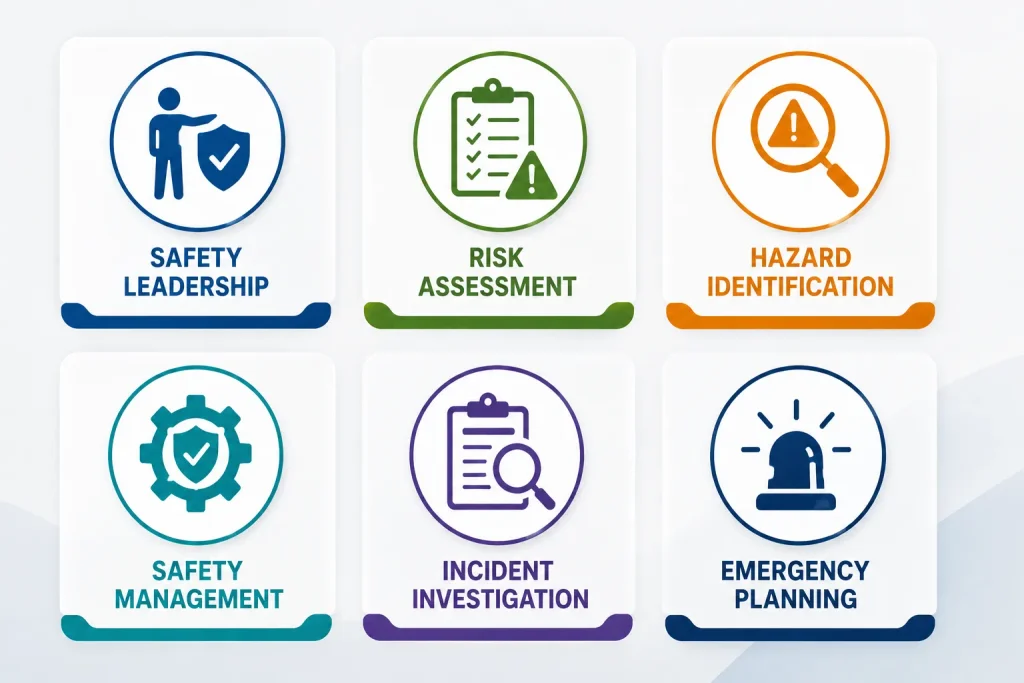
Depending on their position and industry, their responsibilities may include:
- Developing safety management systems
- Identifying workplace hazards
- Conducting risk assessments
- Supporting risk control strategies
- Investigating incidents
- Developing safety procedures
- Supporting emergency preparedness
- Managing occupational health and safety programmes
- Advising management and operational teams
- Supporting regulatory and organisational compliance
- Developing safety culture initiatives
- Managing environmental, health and safety responsibilities
The exact role of a CSP® depends on the individual’s employer, experience, industry and professional responsibilities.
A credential does not automatically determine a person’s job title or legal authority. Employers and jurisdictions may have separate requirements for specific roles.
CSP® Certification Requirements
Understanding the requirements is one of the most important parts of planning your CSP® journey.
CSP® Requirements at a Glance
| Requirement | Current General Requirement |
|---|---|
| Education | Minimum of a bachelor’s degree in any field |
| SH&E Experience | Four years of qualifying safety, health and environmental experience |
| Professional Safety Work | At least 50% preventative, professional-level work with breadth and depth of safety duties |
| Qualified Credential | Hold an applicable BCSP qualified credential |
| Examination | Pass the CSP® examination |
| Maintenance | Meet applicable renewal and recertification requirements |
These requirements should always be checked against the latest official BCSP guidance before applying.
1. CSP® Education Requirement
BCSP currently requires candidates pursuing the CSP® to hold a minimum bachelor’s degree in any field.
This is important because the degree does not necessarily have to be specifically in occupational safety and health.
For example, a professional may hold a degree in:
- Engineering
- Business
- Environmental science
- Construction
- Chemistry
- Management
- Another academic discipline
However, meeting the education requirement alone does not make someone eligible for the CSP®.
The candidate must also meet the applicable experience, credential and examination requirements.
International Degree Holders
BCSP states that degrees obtained from colleges outside the United States are evaluated for U.S. equivalency during the application process. Documentation requirements should be checked directly with BCSP.
2. CSP® Professional Experience Requirement
Professional experience is a major part of CSP® eligibility.
BCSP currently requires four years of safety, health and environmental experience that meets its applicable criteria.
At least 50% of the work must be preventative, professional-level work, with breadth and depth of safety duties.
What Does Preventative Safety Work Mean?
Preventative work generally focuses on identifying and controlling risks before incidents occur.
Examples may include:
- Hazard identification
- Risk assessment
- Safety programme development
- Safety management system implementation
- Workplace inspections
- Incident prevention strategies
- Emergency preparedness
- Safety training and communication
- Compliance monitoring
- Safety performance improvement
Whether a particular role or activity satisfies BCSP’s experience requirements is determined according to BCSP’s applicable criteria.
Do not assume that every job with the word “safety” in its title automatically qualifies.
3. What is a BCSP Qualified Credential?
One of the most commonly misunderstood CSP® requirements is the qualified credential requirement.
Before pursuing the CSP® examination, candidates must hold an applicable credential recognised by BCSP for this purpose.
Depending on the candidate’s pathway and current BCSP policies, qualifying credentials may include recognised credentials such as:
- ASP® – Associate Safety Professional®
- GSP® – Graduate Safety Practitioner®
- TSP® – Transitional Safety Practitioner
- Other credentials accepted by BCSP under its current requirements
The complete and current list should always be verified directly with BCSP because accepted credentials and policies can change.
Understanding the Main CSP® Pathways
There is no single route that suits every safety professional.
Your pathway depends on your:
- Education
- Existing qualifications
- Professional experience
- Career stage
- Current BCSP eligibility status
Below are some common progression routes.
Pathway 1: ASP® → CSP®
The Associate Safety Professional® (ASP®) is a professional certification that can serve as a pathway towards the CSP®.
BCSP states that the ASP® meets the credential requirement for the CSP®. ASP® candidates have separate education, experience and examination requirements.
Typical progression:
Education → SH&E Experience → ASP® → Additional Qualifying Experience → CSP®
This route may be relevant to professionals who are building their careers and want to demonstrate knowledge of fundamental SH&E principles before progressing towards the CSP®.
Pathway 2: GSP® → CSP®
The Graduate Safety Practitioner® (GSP®) designation is associated with eligible academic programmes under BCSP’s programme framework.
Graduates of an eligible programme may be able to obtain the GSP® designation and subsequently work towards meeting the remaining CSP® requirements.
Potential pathway:
Eligible Academic Programme → GSP® → Required Experience → CSP®
The specific eligibility period and programme requirements should always be confirmed with BCSP.
Pathway 3: TSP® → CSP®
The Transitional Safety Practitioner® (TSP®) designation provides another potential pathway.
The TSP® is associated with BCSP’s Qualified Equivalent Program (QEP) framework.
A Learner who completes an eligible qualification through an applicable QEP may be able to obtain TSP® status, subject to the relevant programme and BCSP requirements.
Potential pathway:
Eligible QEP Qualification → TSP® → Required CSP® Experience → CSP®
BCSP explains that individuals holding eligible GSP® or TSP® designations can pursue the CSP® without necessarily obtaining the ASP®, provided they meet the remaining applicable CSP requirements.
Which CSP® Pathway May Be Right for You?
| Your Situation | Possible Direction |
|---|---|
| Early-career safety professional | Explore ASP® eligibility |
| Graduate of an eligible academic programme | Explore GSP® eligibility |
| Graduate of an eligible QEP | Explore TSP® eligibility |
| Experienced professional with another recognised credential | Check whether your credential satisfies BCSP requirements |
| Experienced SH&E professional | Review all CSP® requirements directly with BCSP |
Your individual pathway depends on your circumstances.
Always verify your eligibility before investing time or money in an examination or professional designation.
How to Become a Certified Safety Professional®
Although every professional’s journey is different, the general process can be understood in the following steps.
Step 1: Meet the Education Requirement
Ensure that you hold the required academic qualification.
BCSP currently requires at least a bachelor’s degree in any field for the CSP®.
Step 2: Gain Qualifying SH&E Experience
Build the required professional safety, health and environmental experience.
The experience must meet BCSP’s applicable criteria, including the requirements relating to preventative and professional-level work.
Step 3: Obtain a Qualified Credential
Depending on your background, this may involve obtaining:
- ASP®
- GSP®
- TSP®
- Another BCSP-recognised credential
Always check the current official requirements.
Step 4: Submit Your Application
BCSP reviews applications to determine whether candidates meet the applicable eligibility requirements.
Supporting documentation may be required.
For international degree holders, BCSP may require documentation to evaluate academic qualifications for U.S. equivalency.
Step 5: Prepare for the CSP® Examination
Once eligible, candidates should prepare according to the current CSP examination blueprint and official BCSP guidance.
Preparation should focus on understanding the knowledge areas assessed by the examination.
Step 6: Pass the CSP® Examination
Candidates who meet the applicable requirements and successfully pass the examination can achieve CSP® certification.
Step 7: Maintain Your Certification
Achieving the CSP® is not necessarily the final stage of professional development.
BCSP requires credential holders to meet applicable renewal and recertification requirements.
BCSP currently describes recertification as involving professional development activities and required recertification points within a five-year cycle.
How Long Does It Take to Become a CSP®?
There is no single answer.
The timeline depends on:
- Whether you already have a bachelor’s degree
- How much qualifying SH&E experience you already possess
- Whether you already hold a qualified credential
- Your chosen pathway
- Your examination preparation and scheduling
For many professionals, the four-year qualifying experience requirement is a major factor in the overall timeline.
Example Pathway
A professional may follow a journey such as:
Bachelor’s Degree → Early SH&E Career → ASP® or Other Eligible Credential → Four Years of Qualifying Experience → CSP® Examination
However, individual circumstances vary.
Does TSP® Automatically Make You a CSP®?
No.
The TSP® and CSP® are different professional designations.
The TSP® may satisfy the qualified credential requirement for progression towards the CSP®, but it does not automatically award the CSP®.
A TSP® holder must still meet the other applicable CSP requirements, including:
- The education requirement
- The required professional experience
- Other applicable eligibility requirements
- Passing the CSP® examination
The exact requirements should always be confirmed with BCSP.
CSP® vs ASP®: What Is the Difference?
| Feature | ASP® | CSP® |
|---|---|---|
| Career Stage | Developing safety professionals | More experienced safety professionals |
| Experience Requirement | Separate BCSP requirements apply | Four years of qualifying SH&E experience |
| Main Purpose | Demonstrates foundational SH&E knowledge | Demonstrates advanced professional progression |
| CSP Pathway | Can satisfy the CSP qualified credential requirement | Advanced professional certification |
| Examination | ASP® examination | CSP® examination |
BCSP describes the ASP® as a credential for safety practitioners who have demonstrated knowledge of SH&E fundamentals, while the CSP® is aimed at professionals meeting more advanced experience and eligibility requirements.
CSP® vs TSP®: What Is the Difference?
| TSP® | CSP® |
|---|---|
| Transitional designation | Professional certification |
| Linked to eligible QEP pathways | Awarded after meeting CSP requirements |
| May support progression towards CSP® | Represents achievement of the CSP credential |
| Does not require the CSP examination itself | Requires passing the CSP examination |
The TSP® can form part of a professional progression route, but it should not be confused with the CSP® itself.
Benefits of Becoming a CSP®
The value of any professional credential depends on the individual, employer and industry.
However, CSP® certification may offer several potential benefits.
1. Professional Recognition
The CSP® demonstrates that the certificant has met applicable BCSP requirements and passed the certification examination.
2. Career Development
The credential may support progression into roles involving:
- Safety management
- HSE leadership
- Risk management
- Corporate safety
- EHS management
- Safety consultancy
3. Professional Credibility
Professional certification can help demonstrate commitment to continuing development and recognised standards within the SH&E profession.
4. Broader Career Opportunities
Some employers may prefer or require recognised professional safety credentials for certain senior or specialist positions.
Requirements vary between employers.
5. Continuing Professional Development
Maintaining certification encourages professionals to remain engaged with professional development and changes in professional practice.
Career Opportunities for CSP® Professionals
The CSP® can support progression towards a variety of professional roles.

Potential positions include:
- Health and Safety Manager
- HSE Manager
- EHS Manager
- Safety Manager
- Corporate Safety Manager
- Safety Director
- HSE Director
- Risk Manager
- Occupational Safety Specialist
- Safety Consultant
- Environmental Health and Safety Manager
- Process Safety Professional
- Safety Engineering Manager
A professional credential does not guarantee employment or a particular salary. Career outcomes depend on experience, qualifications, location, industry demand and employer requirements.
Industries Where CSP® Professionals Work
CSP® professionals may work across many industries, including:
Construction
Managing occupational risks, contractor safety and project safety systems.
Oil and Gas
Supporting process safety, operational risk management and workforce safety.
Energy and Utilities
Managing complex operational and infrastructure risks.
Manufacturing
Supporting machine safety, industrial hygiene and safety management systems.
Chemical and Petrochemical Industries
Managing hazardous processes and workplace risks.
Transportation and Logistics
Supporting operational safety and risk management.
Corporate and Professional Services
Developing organisation-wide safety policies and management programmes.

Is the CSP® Recognised Internationally?
The CSP® is known internationally and may be recognised by employers operating across global industries.
However, recognition is not the same as legal authorisation to practise a regulated profession in every country.
Employment and professional requirements can vary according to:
- Country
- Employer
- Industry
- Government regulations
- Project requirements
- Professional licensing frameworks
International Learners should check the requirements applicable to the country and industry where they intend to work.
Can International Professionals Apply for the CSP®?
International professionals may pursue BCSP credentials if they meet the applicable requirements.
BCSP states that degrees obtained outside the United States are evaluated for U.S. equivalency during the application process when an education requirement applies.
International applicants should carefully review:
- Academic documentation requirements
- Experience documentation
- Credential requirements
- Examination arrangements
- Current BCSP application procedures
BCSP examinations are delivered through testing arrangements that include locations around the world, subject to availability.
Understanding the CSP® Examination
The CSP® examination is an important part of the certification process.
BCSP provides an official examination blueprint and other preparation resources to help candidates understand the examination framework.
The current BCSP Credentials At-A-Glance information lists an examination time of 5.5 hours, but examination policies and details should always be verified through current BCSP guidance.
Preparation Tips
Candidates should:
- Review the current official CSP examination blueprint.
- Identify areas where further knowledge development is required.
- Use reliable and relevant study materials.
- Develop a structured study schedule.
- Practise applying safety concepts rather than relying only on memorisation.
- Review current professional principles and methodologies.
Completing a preparation course does not guarantee that a candidate will pass the examination. BCSP makes this clear in relation to its own exam preparation resources.
Maintaining CSP® Certification
Professional development continues after certification.
BCSP requires credential holders to meet applicable:
- Annual renewal requirements
- Recertification requirements
BCSP currently requires CSP credential holders to earn recertification points during the applicable five-year cycle. The current requirements and categories should be checked directly with BCSP.
This approach helps encourage continuing professional development throughout a safety professional’s career.
Is the CSP® Right for You?
The CSP® may be suitable if you:
✔ Work professionally in occupational safety, health or environmental management
✔ Have or are working towards the required academic qualifications
✔ Are building substantial professional SH&E experience
✔ Want to progress towards senior safety responsibilities
✔ Meet or plan to meet the qualified credential requirement
✔ Are prepared to undertake a professional certification examination
✔ Value continuing professional development
It may be useful to plan your journey early, particularly if you are currently studying an occupational health and safety qualification.
Planning Your CSP® Career Pathway
A long-term professional development plan may look like this:
Stage 1: Build Your Knowledge
Occupational Health & Safety Education
↓
Stage 2: Develop Professional Experience
Preventative and Professional-Level SH&E Responsibilities
↓
Stage 3: Obtain an Eligible Credential
ASP® / GSP® / TSP® / Other Applicable Credential
↓
Stage 4: Meet CSP® Eligibility Requirements
Education + Experience + Qualified Credential
↓
Stage 5: Pass the Examination
CSP® Certification
↓
Stage 6: Continue Professional Development
Renewal and Recertification
Important: A Qualification is Not Automatically a CSP® Certification
This distinction is essential.
Completing a diploma, degree or occupational health and safety qualification can support your professional development and may contribute to a pathway towards professional recognition.
However:
Completing a qualification does not automatically award the CSP® certification.
The CSP® is awarded by BCSP to candidates who meet the applicable requirements and successfully complete the certification process.
Before choosing a qualification specifically because of a potential BCSP pathway, Learners should verify:
- Whether the programme has an applicable BCSP relationship
- Whether the specific programme is currently eligible
- Whether the provider is included where required
- Whether completion dates or eligibility periods apply
- Whether all other BCSP requirements will be met