
What is BCSP QEP? Complete Guide to BCSP Qualified Equivalent Programs
If you are researching BCSP TSP® qualifications, occupational health and safety diplomas, or a pathway towards the Certified Safety Professional® (CSP®), you may have come across the term Qualified Equivalent Program (QEP).
But QEP can be confusing. Does a Level 6 qualification automatically qualify? Is QEP a certification? What is the difference between QEP and TSP®? How does a QEP programme connect with CSP®? And most importantly, how can you check whether a particular qualification is actually recognised under the BCSP QEP framework?
A BCSP Qualified Equivalent Programs is a curriculum-based certificate or diploma programme in the safety, health and environmental field that has been reviewed by the Board of Certified Safety Professionals (BCSP) and found to substantially match the applicable Associate Safety Professional® (ASP®) examination blueprint. Eligible graduates of QEP programmes can apply for the Transitional Safety Practitioner® (TSP®) designation, which can then satisfy the qualifying-credential requirement for CSP®, provided the other CSP® requirements are met.
What Does BCSP Qualified Equivalent Programs Mean?
QEP stands for Qualified Equivalent Program.
Unlike a professional certification, QEP refers to a programme, not a person.
BCSP describes a QEP as a curriculum-based certificate or diploma programme in the EHS field whose required curriculum has been reviewed against the ASP® examination blueprint and found to substantially match it.
In simple terms:
A QEP is a qualifying safety, health and environmental certificate or diploma programme recognised within BCSP’s QEP framework.
This distinction matters because the words qualification, QEP and TSP® should not be treated as interchangeable.
Think of it this way:
Qualification/Programme
↓
QEP recognition
↓
Eligible graduate
↓
TSP® application
↓
TSP® designation
↓
Potential CSP® progression
The exact eligibility of an individual depends on the current BCSP requirements and the applicable programme information.
Why is QEP Important for Occupational Health and Safety Professionals?
For someone planning a long-term career in occupational health and safety, HSE or safety management, the value of a programme is not limited to its academic level.
A Learner may also want to know whether the qualification can support a recognised professional pathway.
This is where QEP becomes particularly relevant.
BCSP states that graduates from QEP programmes are eligible to apply for TSP®, while TSP® satisfies the qualified-credential requirement for CSP®.
That creates a potential progression route:
QEP → TSP® → CSP®
However, this is a pathway, not an automatic award.
Completing a QEP programme does not automatically make someone a TSP®, and holding TSP® does not automatically make someone a CSP®.
QEP vs TSP®: What Is the Difference?
This is one of the most important distinctions for anyone researching the BCSP pathway.
| QEP | TSP® |
|---|---|
| Qualified Equivalent Program | Transitional Safety Practitioner® |
| Refers to a programme | Refers to an individual designation |
| Applies to qualifying certificate/diploma programmes | Applies to eligible graduates |
| Programme curriculum is reviewed under the QEP framework | Individual applies for the designation |
| Can provide a route towards TSP® | Can satisfy the qualifying-credential requirement for CSP® |
BCSP’s current information confirms that TSP® is available to graduates of certificate or diploma programmes that meet QEP standards.
The easiest way to remember it:
QEP = the programme
TSP® = the professional designation
How Does a Programme Become a BCSP QEP?
A programme does not become a QEP merely because its title contains terms such as:
- Occupational Health and Safety
- Health and Safety
- HSE
- Safety Management
- Environmental Health and Safety
- Risk Management
The programme must meet the applicable QEP framework.
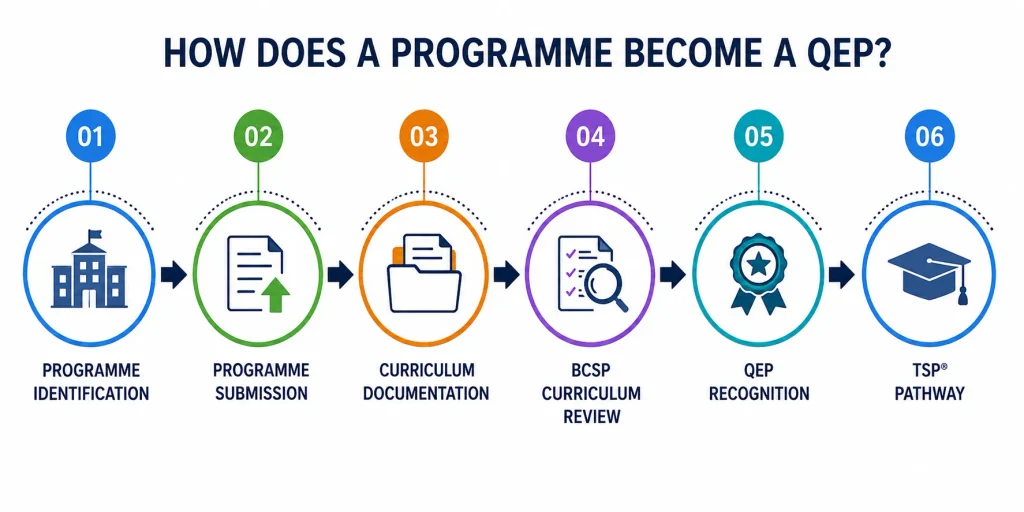
According to BCSP, curriculum-based EHS certificate and diploma programmes can request a review against the current ASP® examination blueprint. The institution provides programme information, required courses and detailed syllabi for review.
The process can therefore be understood as:
1. Programme Development
An institution delivers a curriculum-based EHS certificate or diploma programme.
2. Programme Submission
The institution submits the relevant programme information to BCSP.
3. Curriculum Documentation
Required courses and corresponding detailed syllabi are provided.
4. Curriculum Review
BCSP reviews the programme against the applicable ASP® examination blueprint.
5. QEP Classification
Where the programme meets the relevant standards, it can be included within the QEP framework.
6. Continued Alignment
BCSP states that the review process is repeated when the ASP® examination blueprint is revised.
This last point is particularly important because it means QEP information should be checked using current BCSP sources rather than relying on an old list found elsewhere online.
What Does BCSP Look at When Reviewing a QEP?
The key factor is the required curriculum.
BCSP does not describe QEP simply as a designation based on the qualification level. Instead, its current QEP information focuses on whether the required curriculum substantially matches the ASP® examination blueprint.
This means there is an important difference between:
“This is a Level 6 safety qualification.”
and
“This specific programme meets the applicable BCSP QEP standards.”
The second statement requires programme-specific evidence.
Does Every Level 6 Safety Qualification Qualify as a QEP?
No.
This is a common misunderstanding.
A qualification being Level 6 does not automatically establish QEP status.
The same principle applies to Level 7 qualifications.
For example, two different Level 6 occupational health and safety qualifications may have different curricula, awarding arrangements and professional pathways.
Therefore, Learners should never assume:
Level 6 = QEP = TSP®
Instead, the correct approach is:
Check the specific programme and current BCSP information.
BCSP’s TSP® information specifically connects eligibility with programmes that meet QEP standards.
Does a QEP Give You TSP® Automatically?
No.
This is another important distinction.
Completing a programme that qualifies under the QEP framework can make an eligible graduate able to apply for TSP®. It does not mean that TSP® is automatically awarded when the qualification is completed.
The relationship is:
Complete eligible QEP programme
↓
Meet applicable BCSP requirements
↓
Apply for TSP®
↓
Receive TSP® if the application requirements are satisfied
This distinction is important when evaluating marketing claims about “TSP-approved qualifications” or “TSP qualifications.”
What Are the Main Benefits of the QEP/TSP® Route?
The QEP framework can be particularly valuable for Learners who want their education to connect with a recognised professional safety pathway.
1. A Route Towards TSP®
Graduates of qualifying QEP programmes can apply for the Transitional Safety Practitioner® designation, subject to the applicable BCSP requirements.
2. CSP® Qualifying Credential
BCSP states that TSP® satisfies the qualifying-credential requirement for CSP®.
3. Professional Recognition
TSP® provides recognition of an individual’s preparation for professional safety practice.
4. Digital Professional Credential
BCSP lists a TSP® digital certificate and digital badge among the benefits associated with the designation.
5. Credential Directory
TSP® holders can have their names included in the BCSP Credential Holder Directory.
6. Career Resources
BCSP also provides TSP® holders access to its Career Center for resume posting and viewing career opportunities.
Can QEP Replace the ASP® Route to CSP®?
For the qualified-credential requirement, BCSP provides the QEP/TSP® route as an alternative pathway.
BCSP states that the QEP route provides the opportunity to achieve a qualifying credential for CSP® without first sitting for and passing the ASP® examination.
However, this should be understood correctly.
It does not mean:
“Complete a QEP and automatically become a CSP®.”
Instead:
QEP → TSP® → satisfies CSP® qualified-credential requirement
The candidate must still satisfy the other applicable CSP® requirements.
What Are the CSP® Requirements After TSP®?
The current BCSP CSP® requirements include:
- At least a bachelor’s degree
- At least four years of qualifying SH&E professional experience
- At least 50% of that experience involving preventative, professional-level work with breadth and depth of safety duties
- A BCSP-approved credential
- Passing the CSP® examination
- Maintaining the certification requirements
TSP® is one of the BCSP-approved credentials that can satisfy the credential component.
Therefore, a realistic long-term pathway may look like:
QEP Programme
→ TSP®
→ Qualifying Professional Experience
→ Meet CSP® Education & Experience Requirements
→ CSP® Application
→ CSP® Examination
QEP vs QAP: What Is the Difference?
Another term that often appears in BCSP research is QAP.
QAP means Qualified Academic Program.
The distinction is relatively straightforward.
| Name | QEP | QAP |
|---|---|---|
| Full name | Qualified Equivalent Program | Qualified Academic Program |
| Programme type | Certificate or diploma | Degree |
| Field | EHS | EHS |
| Related designation | TSP® | GSP® |
| CSP® pathway | TSP® can satisfy the qualifying-credential requirement | GSP® can satisfy the qualifying-credential requirement |
BCSP describes QAPs as bachelor’s, master’s or doctorate EHS degree programmes whose curriculum has been reviewed against the ASP® examination blueprint. Graduates of QAPs may apply for GSP®.
So the simple distinction is:
QEP
Certificate/Diploma → TSP®
QAP
Degree → GSP®
Both can connect to the CSP® pathway through their respective BCSP designations.
How Can You Check If a Programme Is a QEP?
This is one of the most useful questions for prospective Learners.
Before choosing a qualification because it is advertised as “TSP pathway” or “QEP”, check the following.
1. Check the Exact Programme Name
Do not rely on the qualification level alone.
2. Check the Provider
Confirm which institution is actually delivering the programme.
3. Check Current BCSP Information
Use BCSP’s current QEP information and programme listing.
BCSP has stated that QEP and QAP information is updated periodically, so an old third-party list may not accurately reflect current programme status.
4. Check Applicable Dates
If the programme has applicable dates associated with its QEP status, make sure your circumstances fall within the relevant period.
5. Check Your Individual Eligibility
Programme recognition and individual TSP® eligibility are related but are not exactly the same thing.
6. Check CSP® Requirements Separately
Even after obtaining TSP®, you still need to meet the other CSP® requirements.
Why Should You Avoid Relying on Old QEP Lists?
This is an important issue when researching QEP qualifications online.
You may find:
- Old PDF documents
- Forum discussions
- Social media posts
- Blog articles
- Screenshots
- Historical QEP lists
These can be useful for research, but they should not automatically be treated as current eligibility evidence.
BCSP has stated that QEP and QAP listings are updated quarterly, while its QEP framework also involves review when the ASP® examination blueprint is revised.
Best practice:
Use historical sources for background.
Use current BCSP information for eligibility decisions.
This is especially important if you are investing time and money in an occupational health and safety qualification specifically because of its intended TSP® pathway.
is QEP the Same as BCSP Accreditation?
Not necessarily.
The safest way to understand QEP is as a BCSP programme classification based on curriculum review.
BCSP’s own description focuses on whether the programme’s required curriculum substantially matches the ASP® examination blueprint.
Therefore, Learners should distinguish between:
- Awarding-body recognition
- Qualification regulation
- Institutional approval
- Professional membership
- BCSP QEP classification
These are different concepts.
A qualification may have one form of recognition without automatically having another.
Who Should Consider a QEP-Related Qualification?
A QEP-related pathway may be worth researching if you are:
- Building a career in occupational health and safety
- Working in HSE
- Moving into safety management
- Developing an international safety career
- Working in construction or engineering safety
- Working in oil and gas or energy
- Moving towards senior HSE responsibilities
- Planning a future CSP® application
- Looking for a professional safety pathway beyond a conventional diploma
The most important consideration is your long-term professional objective, rather than simply choosing the highest qualification level available.
What Should You Look for When Choosing a QEP Pathway?
Before enrolling, compare programmes using more than the qualification title.
Curriculum
Does the programme cover the safety, health and environmental knowledge relevant to your career?
Qualification Level
Is the qualification appropriate for your existing education and professional experience?
Awarding Organisation
Who awards the qualification?
Delivery Institution
Who actually delivers and supports the programme?
QEP Status
Is the specific programme recognised under the applicable BCSP QEP framework?
Applicable Dates
Are the relevant dates appropriate to your planned completion and application?
Future Progression
Can the qualification support your intended professional pathway?
Current BCSP Requirements
Have you checked the latest requirements directly from BCSP?
This approach is much more reliable than selecting a course based only on the words “TSP” or “CSP” appearing on a website.
BCSP QEP Pathway Explained in One Diagram
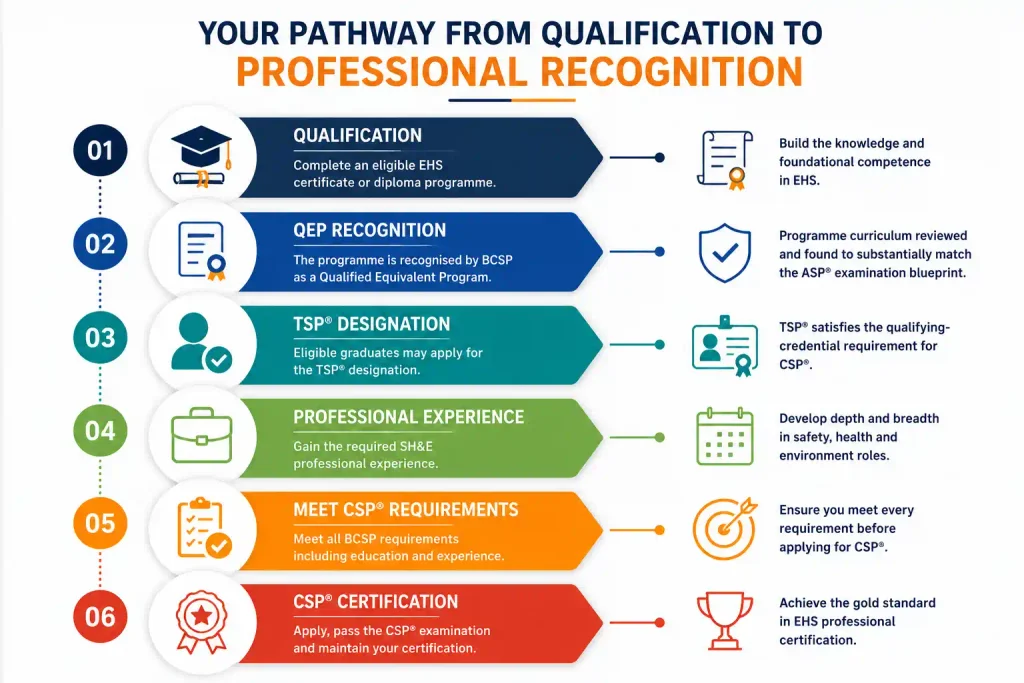
The complete concept can be simplified into five stages:
01 — Choose an Eligible Programme
Select a certificate or diploma programme that meets the applicable QEP standards.
↓
02 — Complete the Programme
Successfully complete the relevant qualification.
↓
03 — Progress Towards TSP®
Eligible graduates can apply for the TSP® designation.
↓
04 — Build Professional Experience
Develop the qualifying SH&E experience required for CSP®.
↓
05 — Progress Towards CSP®
Meet the remaining CSP® requirements and complete the CSP® examination process.
In short:
QEP → TSP® → Professional Experience → CSP®
BCSP confirms that TSP® satisfies the qualified-credential component for CSP®, while other CSP® eligibility requirements remain applicable.
Qualifications We Offer for the BCSP TSP® Pathway
At Inspire College of Technologies UK, we provide a range of occupational health and safety and HSE qualifications for Learners exploring professional development and potential progression through the BCSP TSP® pathway.
Our qualification portfolio includes:
OTHM Level 6 Diploma in Occupational Health and Safety
A Level 6 qualification focused on occupational health and safety knowledge, workplace risk management and professional safety development.
ProQual Level 6 NVQ Diploma in Occupational Health and Safety Practice
A Level 6 vocational qualification focused on occupational health and safety practice and professional development.
Qualifi Level 7 Diploma in Occupational Health and Safety Management
An advanced qualification focused on occupational health and safety management and higher-level safety responsibilities.
Qualifi Level 6 Diploma in Occupational Health and Safety Management
A Level 6 programme focused on safety management, workplace risk and occupational health and safety systems.
NOCN Level 6 NVQ Diploma in Occupational Health and Safety Practice
A Level 6 vocational programme focused on occupational health and safety practice and workplace safety responsibilities.
OAL Level 6 Diploma in Occupational Health and Safety Management
A Level 6 qualification focused on occupational health and safety management and organisational safety performance.
OAL Endorsed Programme in Level 7 Diploma in Health, Safety & Environmental Engineering
An advanced HSE-focused programme combining health, safety and environmental knowledge with engineering applications.
ICTQual Level 8 Professional Diploma in Health, Safety and Environmental Engineering
An advanced professional qualification designed for experienced Learners seeking high-level knowledge in HSE engineering, strategic safety management, environmental management and senior professional development.
Important Notice
TSP® eligibility should never be assumed solely from the qualification title or level. Eligibility depends on the specific programme, applicable BCSP QEP recognition, applicable dates, provider/programme arrangements and current BCSP requirements. Learners should verify the current position with BCSP before making an application.
You can explore our qualification pathway here:
Final Takeaway: QEP Is About the Programme, Not Just the Qualification Level
The most important point to remember is simple:
A Level 6 or Level 7 safety qualification is not automatically a BCSP QEP.
QEP status relates to the specific programme and its curriculum under BCSP’s QEP framework.
For an eligible programme, the professional pathway can potentially look like:
QEP Programme
↓
TSP®
↓
Meet CSP® Experience & Other Requirements
↓
CSP®
BCSP’s current information confirms that QEP programmes are curriculum-based certificate or diploma programmes reviewed against the ASP® examination blueprint, and that graduates of qualifying QEP programmes can apply for TSP®. TSP® satisfies the qualified-credential requirement for CSP®, but the remaining CSP® requirements still apply.
For that reason, anyone considering a qualification for the BCSP TSP® pathway should look beyond marketing claims and verify the specific programme, current QEP status, applicable dates and current BCSP requirements.