
What is the ASP®? Complete Guide to the Associate Safety Professional Credential
Occupational health and safety professionals often look for recognised credentials that demonstrate their knowledge, support career development and create a pathway towards advanced professional certification. One of the most recognised credentials in this area is the Associate Safety Professional® (ASP®).
The ASP® is a professional safety certification awarded by the Board of Certified Safety Professionals (BCSP). It is designed for safety practitioners who can demonstrate knowledge of safety, health and environmental (SH&E) fundamentals. For many professionals, the ASP® is also an important step towards the Certified Safety Professional® (CSP®) credential.
Important: BCSP requirements, fees, examination details and policies may change. Learners should always verify the latest information directly with BCSP before applying.
What Does ASP® Stand For?
ASP® stands for Associate Safety Professional®.
It is a professional certification for safety practitioners who have demonstrated knowledge of fundamental safety, health and environmental principles and practices.
The ASP® is awarded by the Board of Certified Safety Professionals (BCSP). It is important not to confuse the ASP® credential with other organisations or uses of the abbreviation “ASP”.
What is the ASP®?
The Associate Safety Professional® (ASP®) is a certification for professionals working in or developing careers within occupational safety, health and environmental practice.
According to BCSP, ASP® practitioners may work at technical or programme-management levels and may contribute to activities such as:
- Coordinating safety activities
- Conducting basic safety analyses
- Identifying hazardous situations
- Supporting risk reduction measures
- Recommending or overseeing safety controls
- Contributing to project, operational or design teams
- Supporting workplace safety programmes
The credential demonstrates that a professional has met BCSP’s applicable education, experience and examination requirements.
ASP® at a Glance
| Feature | ASP® |
|---|---|
| Full Name | Associate Safety Professional® |
| Credential Type | Professional Certification |
| Awarding Organisation | BCSP |
| Main Focus | Safety, Health and Environmental Fundamentals |
| Minimum Experience | 1 year of qualifying SH&E experience |
| Examination | ASP® Examination Required |
| CSP® Pathway | Meets the CSP® credential requirement |
| Continuing Requirements | Renewal and recertification requirements apply |
The information above reflects BCSP’s current published requirements and should be checked before application.
Who Awards the ASP® Certification?
The ASP® certification is awarded by the Board of Certified Safety Professionals (BCSP).
BCSP offers a range of professional safety credentials for people working at different stages of their careers, including:
- Associate Safety Professional® (ASP®)
- Certified Safety Professional® (CSP®)
- Transitional Safety Practitioner® (TSP®)
- Graduate Safety Practitioner® (GSP®)
- Occupational Hygiene and Safety Technician® (OHST®)
- Construction Health and Safety Technician® (CHST®)
Each credential has its own purpose and eligibility requirements.
is ASP® a Certification or a Designation?
The ASP® is a professional certification.
This is an important distinction because the ASP® and TSP® are sometimes incorrectly described as the same type of credential.
ASP®
Professional Certification
The ASP® requires applicants to meet the applicable requirements and pass the ASP® examination.
TSP®
Professional Designation
The TSP® follows a different route connected with BCSP’s applicable Qualified Equivalent Programme framework.
Understanding this distinction is important when planning a long-term professional safety pathway.
What Does an Associate Safety Professional Do?
An ASP® certification does not represent one specific job title. Instead, professionals holding the credential may work across different occupational safety and health roles.
Depending on their experience, industry and employer, an ASP® professional may contribute to:
Hazard Identification
Identifying workplace hazards and contributing to the assessment of safety risks.
Safety Analysis
Supporting safety studies, investigations and analyses designed to improve workplace conditions.
Risk Reduction
Participating in the selection, implementation or monitoring of risk control measures.
Safety Coordination
Helping coordinate safety activities across projects, departments or work locations.
Safety Programme Support
Supporting the implementation and improvement of workplace safety programmes.
Professional Safety Practice
Applying technical and professional safety knowledge within operational, engineering, construction, manufacturing or other working environments.
BCSP notes that ASP® practitioners may work at technical or programme-management levels and may contribute to safety analyses, hazard identification and risk reduction.
Who Should Consider ASP® Certification?
The ASP® may be relevant for professionals who want to demonstrate their knowledge of safety fundamentals and develop their professional safety careers.
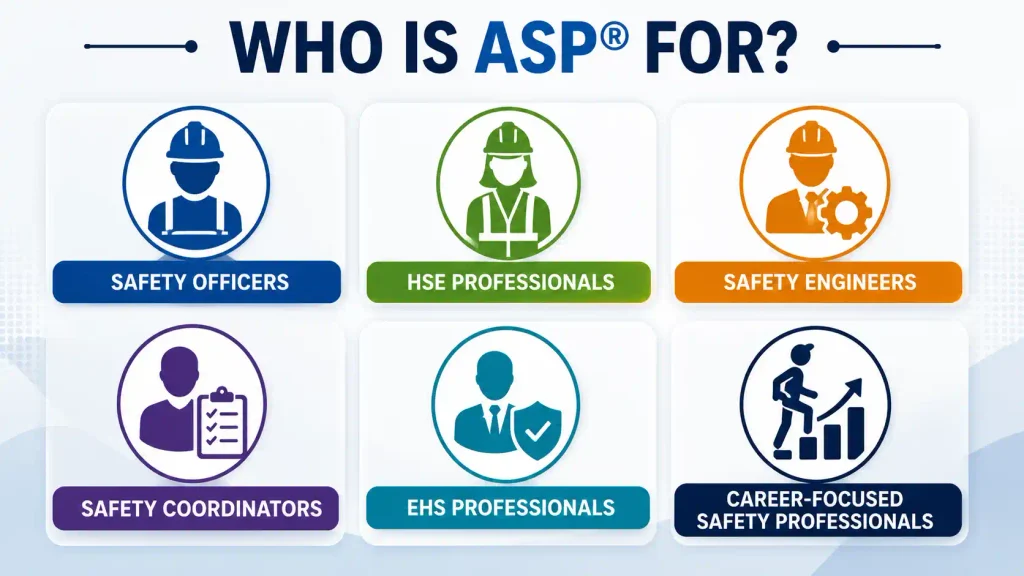
It may be particularly relevant for:
- Safety Officers
- HSE Officers
- Safety Coordinators
- Occupational Health and Safety Practitioners
- Safety Engineers
- HSE Engineers
- EHS Professionals
- Risk and Compliance Professionals
- Safety Supervisors with qualifying professional responsibilities
- Early-career safety professionals
- Professionals planning a future pathway towards CSP® certification
However, holding a particular job title does not automatically guarantee eligibility. Applicants must meet BCSP’s applicable requirements.
Why is the ASP® Important for Safety Professionals?
The ASP® can provide professional value in several ways.
1. Demonstrates Professional Knowledge
The credential demonstrates that the holder has met BCSP’s requirements relating to SH&E knowledge and professional practice.
2. Supports Professional Recognition
Professional certifications can help individuals demonstrate their commitment to continuing development and recognised standards of professional practice.
3. Supports Career Development
The ASP® may strengthen a professional profile when pursuing safety-related responsibilities and career opportunities.
4. Creates a CSP® Progression Route
One of the most significant features of the ASP® is that it meets the credential requirement for the CSP® pathway.
This does not mean that earning ASP® automatically awards CSP® status. Candidates must still meet all other applicable CSP® requirements.
ASP® Certification Requirements
To become an ASP®, applicants must meet BCSP’s applicable requirements.
The main areas include:
- Education
- Safety, Health and Environmental Experience
- Passing the ASP® Examination
- Maintaining the Certification
Let’s examine each requirement.
1. ASP® Education Requirements
According to BCSP’s current published requirements, an applicant must have at least:
- A bachelor’s degree in any field, or
- An associate degree in safety, health or the environment, subject to the specified SH&E coursework requirements.
For an associate degree route, BCSP specifies coursework requirements related to the safety, health and environmental domains covered by the ASP® examination blueprint.
Important for International Applicants
If an applicant holds a degree from a college outside the United States, BCSP states that the degree will be evaluated for U.S. equivalency as part of the applicable process.
Important: Completing a short safety training course or certificate programme should not automatically be assumed to meet the academic requirement.
Always check your individual qualification against BCSP’s current requirements before applying.
2. ASP® Work Experience Requirements
BCSP currently requires:
One year of Safety, Health and Environmental (SH&E) experience
In addition, BCSP states that at least 50% of the qualifying work must be preventative, professional-level work with appropriate breadth and depth of safety duties.
What Does Preventative Safety Work Mean?
Preventative safety work generally focuses on reducing the likelihood of incidents, injuries and occupational harm before they occur.
Examples may include activities such as:
- Hazard identification
- Risk assessment
- Developing safety controls
- Conducting safety analyses
- Supporting safety management systems
- Reviewing workplace safety procedures
- Monitoring preventive safety programmes
The specific eligibility of an applicant’s work experience is determined under BCSP’s applicable requirements.
3. Passing the ASP® Examination
Applicants must pass the ASP® examination to achieve the certification.
The examination is designed to assess knowledge relevant to safety, health and environmental practice.
BCSP provides an official:
- ASP® Examination Blueprint
- ASP® Examination References
- Certification guidance
- Official preparation resources
Candidates should use the current BCSP examination blueprint when planning their preparation because examination content and policies can change over time.
4. Maintaining ASP® Certification
Achieving the ASP® is not simply a one-time process.
BCSP requires credential holders to maintain their certification through applicable:
- Annual renewal requirements
- Recertification requirements
- Professional development activities
BCSP states that credential holders are required to earn and report recertification points within the applicable five-year cycle.
How to Become an ASP®: Step-by-Step
The general pathway can be understood through the following steps.
Step 1: Review Your Education
Check whether your academic qualification meets the current BCSP education requirements.
International degree holders should review the process for evaluating qualifications for U.S. equivalency where applicable.
Step 2: Gain Qualifying SH&E Experience
Develop professional experience involving meaningful safety, health and environmental responsibilities.
Remember that BCSP evaluates the nature of the work, including the preventative and professional-level elements of the experience.
Step 3: Create Your BCSP Profile and Apply
Applications are submitted through BCSP’s online system.
BCSP reviews the application and supporting information against the applicable eligibility requirements.
Step 4: Prepare for the ASP® Examination
Use the current examination blueprint to identify the areas you need to study.
A structured preparation plan may include:
- Reviewing fundamental safety concepts
- Studying relevant technical principles
- Practising problem-solving
- Reviewing weak knowledge areas
- Using appropriate examination preparation resources
Step 5: Take and Pass the Examination
Once eligibility and examination arrangements are confirmed, candidates take the computer-based examination through BCSP’s applicable examination delivery process.
BCSP states that approved candidates have a defined eligibility period to take and pass the examination.
Step 6: Maintain Your Certification
After becoming an ASP® certificant, continue meeting the applicable renewal and recertification requirements.
Professional development is an important part of maintaining a current safety credential.
The ASP® Professional Pathway
A simplified pathway looks like this:
EDUCATION
↓
QUALIFYING SH&E EXPERIENCE
↓
ASP® APPLICATION
↓
ASP® EXAMINATION
↓
ASP® CERTIFICATION
↓
FUTURE PROFESSIONAL DEVELOPMENT
↓
CSP® PATHWAY, WHERE APPLICABLE
The exact route depends on the individual candidate’s qualifications, experience and professional objectives.
Can International Professionals Apply for ASP®?
International professionals may apply, provided they meet BCSP’s applicable requirements.
For applicants with degrees earned outside the United States, BCSP states that the degree will be evaluated for U.S. equivalency as part of the applicable process.
This is particularly relevant for professionals from countries such as:
- Pakistan
- United Arab Emirates
- Saudi Arabia
- Qatar
- India
- Philippines
- Malaysia
- South Africa
- Nigeria
- Other international locations
The country where a professional works does not, by itself, determine eligibility.
The key considerations include:
- Academic qualification
- Qualification evaluation where applicable
- Professional SH&E experience
- Examination requirements
- Other BCSP policies
Important
A qualification with a particular title or level should not automatically be assumed to qualify someone for ASP® certification.
Each applicant should verify their individual circumstances with BCSP.
ASP® vs TSP®: What Is the Difference?
ASP® and TSP® are both connected with professional safety progression, but they are not the same credential.
| Feature | ASP® | TSP® |
|---|---|---|
| Credential Type | Certification | Designation |
| Examination | ASP® exam required | Different pathway requirements |
| Work Experience | 1 year of qualifying SH&E experience | TSP® has its own eligibility route |
| Main Route | BCSP certification process | Applicable QEP pathway |
| CSP® Credential Requirement | Can meet the requirement | Can meet the requirement |
The ASP® and TSP® represent different routes that may support progression towards CSP® certification, subject to the full requirements applicable to each candidate.
The Simple Difference
ASP® → Examination-based professional certification
TSP® → Designation connected with an applicable qualified programme pathway
Neither credential should be described as automatically equivalent to the other.
ASP® vs CSP®: What Is the Difference?
The ASP® and CSP® are both professional safety credentials, but they represent different stages and requirements.
| Feature | ASP® | CSP® |
|---|---|---|
| Full Name | Associate Safety Professional® | Certified Safety Professional® |
| Credential Type | Certification | Certification |
| Experience | 1 year of qualifying SH&E experience | 4 years of qualifying SH&E experience |
| Education | Applicable ASP® requirements | Minimum bachelor’s degree under current requirements |
| Examination | ASP® examination | CSP® examination |
| CSP® Credential Requirement | ASP® itself can meet this requirement | Not applicable |
BCSP currently states that the CSP® requires a minimum bachelor’s degree, four years of qualifying SH&E experience, an approved credential and successful completion of the CSP® examination.
Which Comes First: ASP® or CSP®?
For professionals following the ASP® route towards CSP®, the typical progression is:
ASP®
↓
Additional Professional Experience and Other CSP® Requirements
↓
CSP® Application
↓
CSP® Examination
↓
CSP®
However, not every professional must first earn the ASP®.
BCSP recognises multiple qualifying credentials that may meet the CSP® credential requirement. Therefore, the most suitable pathway depends on the individual’s qualifications and professional circumstances.
Does ASP® Automatically Make You a CSP®?
No.
Earning the ASP® does not automatically award CSP® certification.
The ASP® meets the CSP® credential requirement, but a candidate must still meet the other applicable CSP® requirements, including:
- Required education
- Required professional SH&E experience
- Other eligibility conditions
- Passing the CSP® examination
This distinction is extremely important when planning a professional safety career pathway.
Does ASP® Lead to CSP®?
Yes, ASP® can support progression towards CSP® certification.
BCSP states that the ASP® meets the credential requirement for the CSP®.
However:
ASP® is one component of the CSP® pathway, not an automatic award of CSP® certification.
A candidate must independently satisfy all applicable CSP® requirements.
What Comes After ASP®?
The answer depends on your professional career goals.
Possible next steps may include:
1. Progress Towards CSP®
Professionals who meet the additional requirements may pursue CSP® certification.
2. Develop Specialist Expertise
Safety professionals may continue developing expertise in areas such as:
- Process safety
- Environmental management
- Industrial hygiene
- Construction safety
- Risk management
- Fire safety
- Occupational health
- Safety management systems
3. Move into Senior Safety Roles
As professional experience develops, individuals may progress towards more senior responsibilities.
Potential roles may include:
- HSE Manager
- Safety Manager
- EHS Manager
- Safety Engineer
- Risk Manager
- Corporate Safety Professional
- HSE Consultant
Actual career progression depends on experience, industry requirements, employer needs and individual competence.
4. Continue Professional Development
Professional development may include:
- Additional certifications
- Specialist technical qualifications
- Advanced academic study
- Professional memberships
- Leadership development
Is the ASP® Suitable for HSE Professionals?
The ASP® may be suitable for HSE professionals whose education and work experience meet BCSP’s applicable requirements.
It can be particularly relevant for professionals who want to:
- Validate their fundamental SH&E knowledge
- Develop a recognised professional profile
- Build towards advanced certification
- Pursue structured professional development
Eligibility must always be assessed against the current BCSP requirements.
Common Misconceptions About ASP®
| MYTH | FACT |
|---|---|
| ASP® is just a course | ASP® is a professional certification |
| Any safety qualification guarantees ASP® | Individual eligibility must be assessed |
| ASP® automatically gives CSP® | Additional CSP® requirements apply |
| ASP® and TSP® are the same | They are different credentials |
Misconception 1: ASP® Is Just a Training Course
Reality
ASP® is a professional certification. Applicants must meet the applicable requirements and pass the ASP® examination.
Misconception 2: Any Safety Diploma Automatically Gives ASP®
Reality
Completing a safety-related qualification does not automatically award ASP® certification.
Applicants must meet BCSP’s complete eligibility requirements.
Misconception 3: ASP® Automatically Makes You a CSP®
Reality
The ASP® meets the CSP® credential requirement, but candidates must still meet all other CSP® requirements and pass the CSP® examination.
Misconception 4: ASP® and TSP® Are the Same
Reality
They are different credentials with different routes and requirements.
ASP® is a certification requiring an examination, while TSP® follows a different designation pathway.
Misconception 5: ASP® Guarantees Employment
Reality
No professional credential can guarantee a specific job, salary or promotion.
However, recognised credentials can support professional development and help demonstrate knowledge and commitment to the profession.
Career Opportunities After ASP® Certification
The ASP® does not limit a professional to one job title.
Depending on education, experience and industry, professionals may work in areas such as:
- Occupational Health and Safety
- HSE Management
- Environmental Health and Safety
- Safety Engineering
- Construction Safety
- Manufacturing Safety
- Oil and Gas Safety
- Energy Sector Safety
- Infrastructure Safety
- Risk Management
- Safety Consultancy
- Workplace Compliance
Industries where professional safety expertise may be required include:
- Construction
- Oil and gas
- Manufacturing
- Energy
- Petrochemicals
- Engineering
- Transportation
- Logistics
- Mining
- Infrastructure
- Utilities

Career opportunities depend on local regulations, employer requirements and the individual’s complete professional profile.
is the ASP® Worth It?
Whether the ASP® is worthwhile depends on your career objectives.
The certification may be valuable if you want to:
Build Professional Credibility
The ASP® demonstrates that you have met an established set of eligibility and examination requirements.
Develop Your Safety Career
It can support professional progression within occupational safety and health.
Prepare for Advanced Certification
The ASP® meets the CSP® credential requirement under BCSP’s current framework.
Strengthen Your Professional Development Plan
Preparing for the credential can encourage structured learning across important safety and SH&E knowledge areas.
However, professionals should consider:
- Their current education
- Their work experience
- Their long-term career objectives
- Examination preparation requirements
- Certification and maintenance costs
- The recognition required in their target industry or country
How Should You Prepare for the ASP® Examination?
A structured approach is generally more effective than random study.
Review the Official Blueprint
Start with BCSP’s current ASP® Examination Blueprint.
This helps you understand the areas assessed and organise your preparation.
Identify Knowledge Gaps
Evaluate which areas require additional study.
Focus more time on weaker areas while maintaining your strengths.
Build a Study Plan
A good study plan should include:
- Regular study sessions
- Topic-by-topic revision
- Practice questions
- Technical problem-solving
- Revision of difficult concepts
Use Reliable Resources
Prioritise:
- Official BCSP resources
- The current examination blueprint
- Recognised professional reference materials
- Reputable preparation resources
Do not rely solely on outdated notes or unverified online content.
Practise Applying Knowledge
Professional safety examinations require more than memorising definitions.
Candidates should develop the ability to:
- Analyse workplace situations
- Identify hazards
- Understand risk controls
- Apply safety principles
- Interpret technical information
ASP® Benefits at a Glance
Professional Recognition
Demonstrates commitment to professional safety practice.
Knowledge Validation
Shows that the holder has met the applicable certification and examination requirements.
Career Development
Can support progression in occupational safety and HSE careers.
CSP® Pathway
Meets the CSP® credential requirement under BCSP’s current framework.
Continuing Development
Encourages ongoing learning and professional development through certification maintenance requirements.
ASP® Pathway vs TSP® Pathway
There is no single pathway that is automatically best for every safety professional.
ASP® Route
Qualifying Education
↓
Qualifying SH&E Experience
↓
ASP® Examination
↓
ASP® Certification
↓
Potential CSP® Progression
TSP® Route
Participating Qualified Programme
↓
Applicable TSP® Requirements
↓
TSP® Designation
↓
Potential CSP® Progression
The correct route depends on the candidate’s qualifications and eligibility under BCSP’s current policies.
Important Advice for International Learners
International Learners should be particularly careful when planning an ASP® pathway.
Before enrolling in any programme based on claims about ASP® eligibility, check:
1. Your Academic Qualification
Determine whether your education may meet the applicable BCSP requirements.
2. Qualification Evaluation
Check how BCSP handles qualifications earned outside the United States.
3. Your Work Experience
Review whether your professional responsibilities align with the current SH&E experience requirements.
4. The Latest BCSP Policies
Requirements can change.
5. Marketing Claims
Do not rely solely on a training provider’s statement that a course or qualification will automatically make you eligible.
The final determination of eligibility rests with the applicable certification body and its current requirements.
Final Thoughts
The Associate Safety Professional® (ASP®) is an important professional safety certification for practitioners who want to demonstrate knowledge of safety, health and environmental fundamentals and develop their careers in occupational safety.
The ASP® can support professional recognition, career development and future progression towards the Certified Safety Professional® (CSP®). However, it is important to understand that ASP® is a separate certification with its own education, experience, examination and maintenance requirements.
For professionals considering the credential, the best approach is to:
Understand the requirements → assess your eligibility → build qualifying experience → prepare systematically → apply through the official process.
Most importantly, always verify the latest eligibility requirements directly with BCSP’s official ASP® information page before making a professional or financial decision.