
BCSP TSP® vs CSP®: What is the Difference and Which Comes First?
If you are researching professional qualifications in occupational health and safety, you may have encountered both BCSP Transitional Safety Practitioner® (TSP®) and Certified Safety Professional® (CSP®).
Although the two credentials are connected, TSP® and CSP® are not the same thing.
The TSP® is a designation that can provide a pathway towards CSP®, while the CSP® is BCSP’s professional certification for safety practitioners who meet its education, experience, credential and examination requirements. BCSP currently states that TSP® satisfies the qualified-credential requirement for CSP®, allowing a TSP® holder to apply for CSP® once the remaining requirements are met.
The short answer
For the QEP route, TSP® comes before CSP®.
The simplified pathway is:
QEP Programme → TSP® → Meet CSP® Requirements → CSP®
But there is an important distinction: completing a QEP programme does not automatically award TSP®, and obtaining TSP® does not automatically award CSP®.
BCSP TSP vs CSP at a Glance
Before going into detail, here is the simplest comparison:
| Feature | TSP® | CSP® |
|---|---|---|
| Full name | Transitional Safety Practitioner® | Certified Safety Professional® |
| Credential type | Designation | Professional certification |
| Awarding organisation | BCSP | BCSP |
| Main purpose | Recognises eligible graduates on a pathway towards CSP® | Demonstrates professional-level safety competence |
| Programme route | Participating QEP programme | CSP® eligibility requirements |
| Examination | No TSP® examination | CSP® examination required |
| Professional experience | No experience required for TSP® | Four years of qualifying SH&E experience |
| Bachelor’s degree | Not listed as the TSP® minimum education requirement | Minimum bachelor’s degree |
| CSP® qualifying credential | TSP® satisfies this requirement | It is the certification being pursued |
| Long-term role | Transitional/pathway credential | Professional certification |
BCSP currently lists TSP® as requiring a credential from a participating QEP programme and no work experience for TSP® itself, while CSP® requires at least a bachelor’s degree and four years of qualifying SH&E experience plus a BCSP-approved credential.
What is TSP®?
TSP® stands for Transitional Safety Practitioner®.
It is a BCSP designation available to graduates of curriculum-based certificate or diploma programmes in safety, health and environmental fields that meet the applicable Qualified Equivalent Program (QEP) standards.
The important point is that TSP® is connected to the programme someone completes.
A Learner does not simply become TSP® because they have completed any occupational health and safety qualification.
The programme must meet the applicable QEP requirements, and the individual must apply for the TSP® designation within the relevant programme’s applicable dates.
In simple terms:
Eligible QEP programme → TSP® application → TSP® designation
What is CSP®?
CSP® stands for Certified Safety Professional®.
It is a BCSP professional certification designed for safety practitioners who meet the required education, professional experience and credential requirements and successfully complete the CSP® examination.
BCSP describes CSP® as a leading professional SH&E certification and states that it provides safety practitioners with recognition and career opportunities.
For the current CSP® requirements, BCSP lists:
- A minimum bachelor’s degree in any field
- Four years of qualifying safety, health and environmental experience
- At least 50% of that experience involving preventative, professional-level work with breadth and depth of safety duties
- A BCSP-approved credential
- Passing the CSP® examination
Therefore, CSP® represents a significantly more demanding professional certification stage than simply completing a safety qualification.
Which Comes First: TSP® or CSP®?
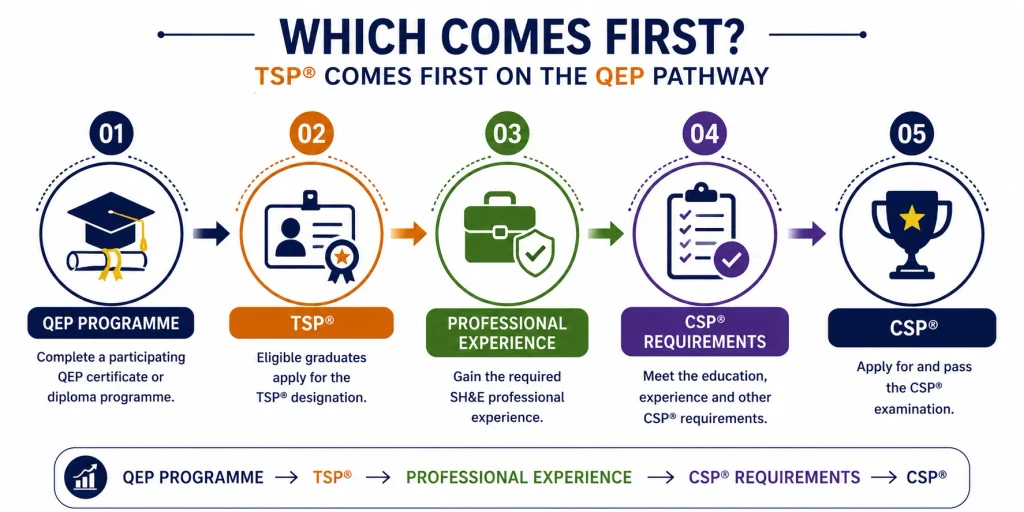
TSP® comes first on the QEP pathway.
If you are following the QEP route, the typical sequence is:
1. Complete a Participating QEP Programme
The programme must meet the applicable BCSP QEP standards.
↓
2. Apply for TSP®
Eligible graduates can apply for the Transitional Safety Practitioner® designation.
↓
3. Develop the Required Professional Experience
Build the qualifying SH&E experience needed for CSP®.
↓
4. Meet the Remaining CSP® Requirements
Meet BCSP’s education, experience and credential requirements.
↓
5. Apply for and Pass the CSP® Examination
Progress to CSP® certification.
BCSP explicitly states that TSP® satisfies the qualified-credential requirement for CSP®, allowing TSP® holders to apply for CSP® once they meet the other requirements.
is TSP® a Lower Version of CSP®?
Not exactly.
It is better to think of TSP® as a transitional professional designation and pathway credential, rather than simply calling it a “lower CSP®.”
The two serve different purposes.
TSP®
Recognises an eligible Learner’s preparation through a qualifying QEP programme and provides a pathway towards CSP®.
CSP®
Recognises a safety professional who has met the broader CSP® requirements, including professional experience and the CSP® examination.
So:
TSP® = pathway designation
CSP® = professional certification
Does TSP® Require an Examination?
No TSP® examination is listed by BCSP.
BCSP’s current credentials information lists no examination fee or examination requirement for TSP®. Instead, TSP® eligibility is based on holding a credential from a participating QEP programme and meeting the applicable requirements.
This is one of the major differences between TSP® and CSP®.
TSP®
QEP credential → Application → TSP®
CSP®
Eligibility → Application → CSP® Examination → CSP®
Does CSP® Require an Examination?
Yes.
The CSP® pathway includes the CSP® examination.
BCSP’s current credentials information lists a 5.5-hour examination for CSP®.
Therefore, a Learner should not confuse the TSP® application process with CSP® certification.
Obtaining TSP® can satisfy the qualified-credential requirement, but the CSP® examination remains part of the CSP® certification process.
Does TSP® Replace ASP®?
This is one of the most frequently misunderstood aspects of the pathway.
For the CSP® qualifying credential, TSP® provides an alternative route.
BCSP states that TSP® satisfies the qualified-credential requirement for CSP®. Its earlier explanation of the pathway describes TSP® as an alternate route for qualified individuals pursuing CSP®, rather than requiring them to use ASP® as the qualifying credential.
However, saying that “TSP® replaces ASP® completely” would be misleading.
A better explanation is:
TSP® can satisfy the BCSP qualified-credential requirement for CSP®, allowing an eligible TSP® holder to progress towards CSP® without using ASP® as that qualifying credential.
The Learner must still satisfy the other CSP® requirements.
TSP® vs ASP® vs CSP®
It is useful to understand where ASP® fits into the picture.
| Credential | Main role | Examination? | CSP® qualifying credential? |
|---|---|---|---|
| ASP® | Safety practitioner credential demonstrating SH&E fundamentals | Yes | Yes |
| TSP® | QEP-based pathway designation | No TSP® exam | Yes |
| CSP® | Professional safety certification | Yes | Final certification |
BCSP states that ASP® meets the credential requirement for CSP®, while TSP® also meets the qualified-credential requirement.
This means there are different routes into the CSP® pathway.
One route can involve:
ASP® → CSP®
Another can involve:
QEP → TSP® → CSP®
The right route depends on the individual’s education, experience, qualifications and professional goals.
What Are the Education Requirements?
The difference becomes clearer when comparing the minimum education requirements.
TSP®
BCSP lists the minimum education requirement for TSP® as:
A credential from a participating QEP programme.
CSP®
BCSP currently lists:
Minimum bachelor’s degree in any field.
This means the two credentials should not be treated as having identical education requirements.
A QEP qualification can provide the educational basis for the TSP® route, but a Learner planning to progress to CSP® must also consider the CSP® education requirement.
What Are the Experience Requirements?
This is another major difference.
TSP®
BCSP currently lists:
No work experience required for TSP®.
However, the designation holder must achieve CSP® within the applicable eligibility period once the CSP® experience requirement is met.
CSP®
BCSP currently requires:
Four years of qualifying SH&E experience, with at least 50% involving preventative, professional-level work with breadth and depth of safety duties.
Therefore:
TSP®
No experience required to obtain TSP®
CSP®
Four years of qualifying SH&E experience
This is one of the clearest reasons why TSP® can be viewed as a transitional pathway rather than the final certification.
How Long Can You Hold TSP® Before CSP®?
This is an important detail that is often missed in general TSP® articles.
BCSP currently states that TSP® designation holders must apply for and pass the CSP® examination within six years from the date the TSP® is awarded.
This means TSP® should be treated as a time-bound pathway.
A Learner should therefore plan their professional development rather than obtaining TSP® and leaving the CSP® progression indefinitely.
Simplified timeline:
TSP® Awarded
↓
Build qualifying experience
↓
Meet CSP® requirements
↓
Apply for CSP®
↓
Pass CSP® examination
BCSP states that TSP® holders pay an annual renewal fee to maintain the designation.
What Happens If TSP® Expires?
This is another question that deserves attention.
TSP® is not intended to remain a permanent alternative to CSP®.
The purpose is to provide a pathway towards CSP®.
BCSP’s current information states that TSP® holders must progress to the CSP® examination within the six-year period.
Therefore, anyone obtaining TSP® should think about:
- Their bachelor’s degree status
- Their SH&E experience
- Their CSP® eligibility
- Their professional development
- The six-year TSP® timeframe
This makes early planning important.
Does TSP® Automatically Make You Eligible for CSP®?
No.
TSP® satisfies the qualified-credential requirement for CSP®, but it does not remove the other CSP® requirements.
For example, BCSP currently lists a minimum bachelor’s degree and four years of qualifying SH&E experience for CSP®.
So the pathway is not:
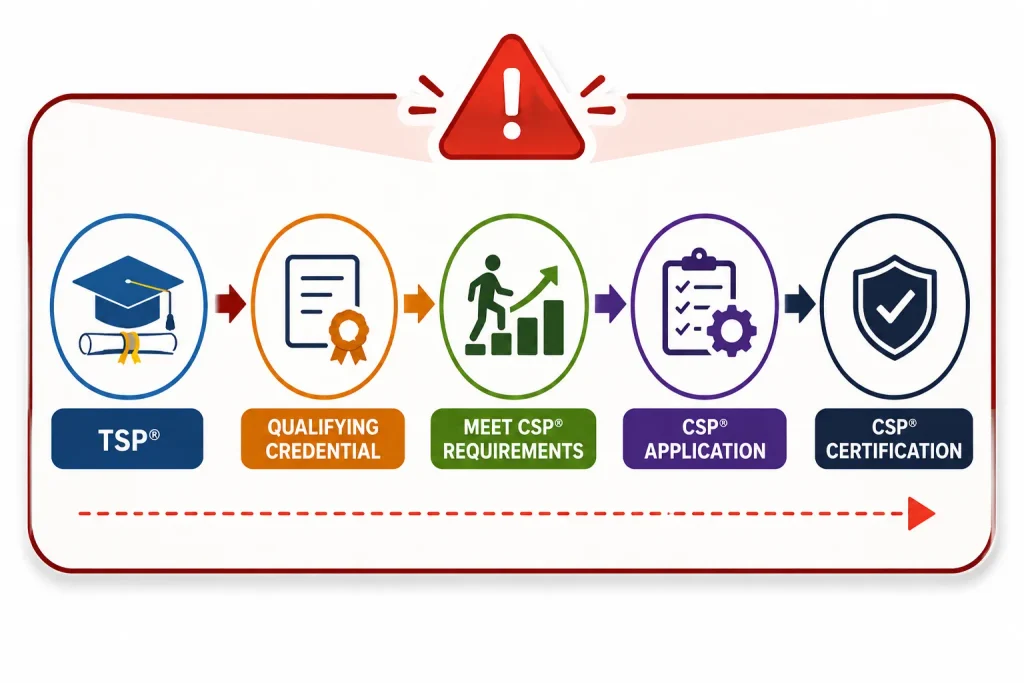
TSP® → Automatic CSP®
It is:
TSP® → Meet remaining CSP® requirements → Apply → Pass CSP® examination
That distinction should be clear to every Learner considering this route.
TSP® vs CSP®: Which Is Better?
This is not necessarily the right question.
The better question is:
Which credential is appropriate for your current stage of professional development?
TSP® may be relevant if you:
- Have completed a participating QEP programme
- Are beginning or developing your professional safety career
- Want a pathway towards CSP®
- Need a BCSP qualified credential for CSP®
- Have not yet accumulated the CSP® experience requirement
CSP® may be your target if you:
- Meet the education requirement
- Have the required professional SH&E experience
- Hold an acceptable BCSP qualified credential
- Are ready for the CSP® examination
- Want to achieve the professional certification itself
In other words:
TSP® can be part of the journey.
CSP® is the longer-term professional certification goal for eligible candidates.
Can an International Occupational Health and Safety Qualification Lead to TSP®?
Potentially, but the qualification title alone is not enough.
BCSP’s current TSP® information states that the designation is available to graduates from curriculum-based certificate or diploma programmes that meet QEP standards.
Therefore, an international Learner should verify:
- The exact qualification
- The exact programme/provider
- Whether it is included within the applicable QEP framework
- Applicable dates
- Individual TSP® requirements
- Future CSP® requirements
This is particularly important because a qualification being described as “international”, “Level 6”, “Level 7” or “occupational health and safety” does not automatically establish TSP® eligibility.
TSP® vs CSP®: Which Comes First for a QEP Graduate?
For someone following the QEP pathway, the answer is straightforward:
TSP® comes first.
The pathway is:
Qualification
Complete an applicable QEP programme.
↓
TSP®
Apply for the Transitional Safety Practitioner® designation.
↓
Professional Experience
Develop the required SH&E experience.
↓
CSP® Eligibility
Meet education, experience and credential requirements.
↓
CSP®
Apply for and pass the CSP® examination.
This pathway is consistent with BCSP’s current explanation that TSP® satisfies the qualified-credential requirement for CSP®.
TSP® vs CSP® Career Perspective
Both credentials can be relevant to safety professionals, but their position in a career journey is different.
TSP® can support:
- Professional recognition
- Safety career development
- Progression towards CSP®
- Recognition of preparation for professional safety practice
- Access to BCSP career resources
- Digital professional credentials
BCSP lists the TSP® digital badge, digital certificate, Credential Holder Directory and Career Center among its benefits.
CSP® can support:
- Professional recognition at the certification level
- Career advancement
- Demonstration of professional SH&E competence
- Long-term professional development
BCSP describes CSP® as a leading SH&E certification and a credential associated with recognition and career opportunities.
TSP® vs CSP®: The Simplest Explanation
If you need to explain the difference in one sentence:
TSP® is a BCSP designation available through qualifying QEP programmes and provides a pathway towards CSP®, while CSP® is BCSP’s professional safety certification requiring the applicable education, professional experience, qualified credential and examination requirements.
And if you want to remember the pathway:
QEP → TSP® → Experience → CSP®
What Should You Do If Your Goal Is CSP®?
If CSP® is your long-term objective, start by identifying which pathway fits your circumstances.
Route 1 — QEP/TSP® Pathway
QEP Programme → TSP® → CSP®
This can be relevant to Learners completing a participating QEP certificate or diploma programme.
Route 2 — ASP® Pathway
ASP® → CSP®
BCSP recognises ASP® as a credential that satisfies the CSP® credential requirement.
Route 3 — Other BCSP-Approved Credentials
BCSP maintains a broader list of approved credentials that can satisfy the CSP® credential requirement.
The best option depends on your education, professional experience, current qualifications and career objectives.
Qualifications We Offer for the BCSP TSP® Pathway
For Learners researching the QEP/TSP® route, Inspire College of Technologies UK offers a range of occupational health and safety and HSE qualifications.
These include:
- OTHM Level 6 Diploma in Occupational Health and Safety
- ProQual Level 6 NVQ Diploma in Occupational Health and Safety Practice
- Qualifi Level 7 Diploma in Occupational Health and Safety Management
- Qualifi Level 6 Diploma in Occupational Health and Safety Management
- NOCN Level 6 NVQ Diploma in Occupational Health and Safety Practice
- OAL Level 6 Diploma in Occupational Health and Safety Management
- OAL Endorsed Programme in Level 7 Diploma in Health, Safety & Environmental (HSE) Engineering
- ICTQual Level 8 Professional Diploma in Health, Safety and Environmental Engineering
Final Verdict: TSP® or CSP®?
If you are following the QEP route, the answer is:
TSP® comes first. CSP® comes later.
TSP® is designed to recognise eligible graduates of qualifying QEP programmes and provide a route towards CSP®. CSP® is the broader professional certification that requires additional education, professional experience, a qualifying credential and successful completion of the CSP® examination.
The simplest way to remember the relationship is:
QEP → TSP® → Professional Experience → CSP®
TSP® is therefore not the final destination for a Learner whose goal is CSP®. It can be an important bridge between a qualifying safety qualification and the CSP® certification pathway.
For anyone considering this route, the most important step is to verify the specific programme’s current QEP status, applicable dates and BCSP requirements rather than relying solely on a qualification title or marketing statement.