
What is BCSP TSP®? Complete Guide to Transitional Safety Practitioner
For occupational health and safety professionals, choosing the right qualification is only one part of building a long-term professional career. Understanding how an academic qualification can connect with recognised professional credentials is equally important. One pathway that attracts attention from safety, health and environmental (SH&E) professionals is the BCSP Transitional Safety Practitioner® (TSP®) designation.
Quick answer: BCSP TSP® (Transitional Safety Practitioner®) is a professional designation available to graduates of eligible curriculum-based safety, health and environmental programmes that meet BCSP’s Qualified Equivalent Program (QEP) standards. TSP® satisfies the qualified-credential requirement for CSP® eligibility, but candidates must still meet the other CSP® requirements.
What Is BCSP TSP®?
TSP® stands for Transitional Safety Practitioner®. It is a designation offered by the Board of Certified Safety Professionals (BCSP) to eligible graduates of qualifying safety, health and environmental programmes.
The key point is that TSP® is a designation, not a certification. It recognises that an individual has completed a programme that meets BCSP’s QEP standards and represents a pathway towards the CSP® certification.
BCSP describes TSP® as being available to graduates from curriculum-based certificate or diploma programmes in the safety, health and environmental field that meet the standards of a Qualified Equivalent Program (QEP).
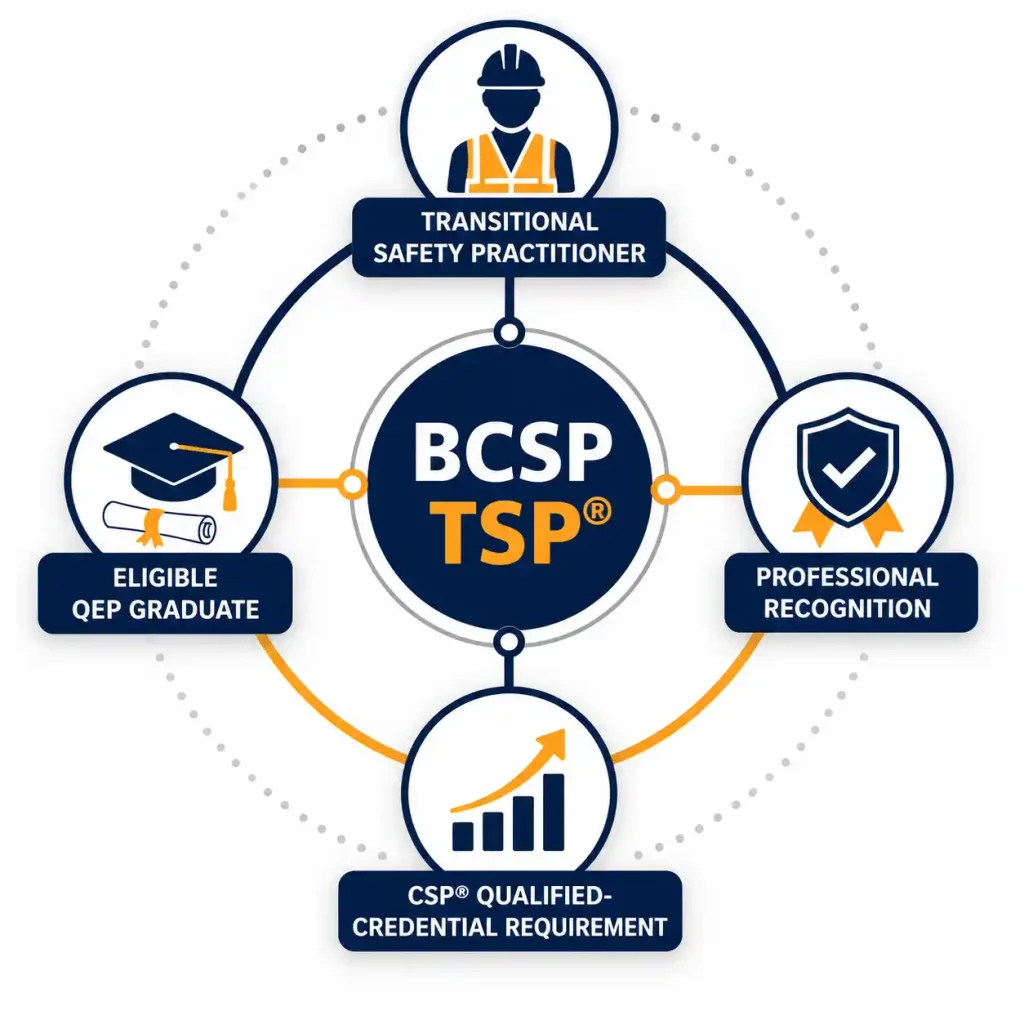
For learners researching advanced occupational health and safety qualifications, this distinction is important:
Qualification → Eligible QEP programme → TSP® designation → CSP® pathway
However, completing a qualification with a suitable title or level does not automatically mean that the learner is eligible for TSP®. The specific programme must satisfy BCSP’s applicable QEP requirements.
What Does TSP® Mean for a Safety Professional?
TSP® provides formal recognition of an individual’s preparation for professional safety practice and establishes a recognised credential pathway towards CSP®.
According to BCSP, a TSP® designation:
- Meets the qualified-credential requirement for CSP®.
- Recognises the individual’s preparation for professional safety practice.
- Provides a TSP® digital certificate.
- Provides a digital badge.
- Includes the individual’s name in the BCSP Credential Holder Directory.
- Provides access to the BCSP Career Center for resumes and safety career opportunities.
For professionals developing careers in occupational health and safety, HSE, safety management and related SH&E disciplines, these benefits can add professional recognition to an appropriate academic or vocational qualification.
What Is a BCSP Qualified Equivalent Program (QEP)?
A Qualified Equivalent Program (QEP) is central to understanding TSP® eligibility.
BCSP defines a QEP as a curriculum-based certificate or diploma programme in the environmental, health and safety (EHS) field whose required curriculum has been reviewed by BCSP and found to substantially match the current Associate Safety Professional® (ASP®) examination blueprint.
In simple terms, BCSP reviews the curriculum of a programme rather than simply looking at the qualification title.
This means there is an important difference between:
“I have a Level 6 occupational health and safety qualification.”
and:
“I have completed a programme that is recognised as a BCSP QEP and falls within its applicable dates.”
The second situation is what creates the TSP® eligibility pathway.
Why Does QEP Status Matter?
BCSP states that individuals who complete a programme from a QEP are eligible to apply for TSP®, and TSP® meets the qualifying-credential requirement for CSP®.
BCSP also explains that QEP status involves curriculum review against the current ASP® examination blueprint. Because examination blueprints can change, QEP information is maintained and updated by BCSP.
Does Every Occupational Health and Safety Qualification Qualify for TSP®?
No.
This is one of the most important points learners should understand before enrolling in a qualification specifically for a BCSP TSP® pathway.
A Level 6, Level 7 or Level 8 qualification does not automatically provide TSP® eligibility simply because it is in occupational health and safety, HSE or safety engineering.
BCSP states that TSP® is available to graduates from programmes that meet QEP standards. The current QEP list and applicable dates therefore need to be checked for the specific programme.
Before Choosing a Qualification, Check:
- Is the specific programme a BCSP Qualified Equivalent Program?
- Is the awarding programme/provider arrangement the one recognised by BCSP?
- Does the learner’s completion date fall within the QEP’s applicable dates?
- Does the learner meet BCSP’s current application requirements?
- Has the programme’s QEP status changed following a curriculum or ASP blueprint update?
This is why learners should verify the current BCSP QEP information rather than relying solely on a course provider’s marketing statement.
Who Can Apply for TSP®?
The basic eligibility pathway begins with holding a credential from a participating QEP programme.
BCSP’s current TSP information states that a credential from a participating QEP programme is the minimum education credential for TSP®, and its current credentials overview indicates that no work experience is required for the TSP® designation itself.
However, this should not be confused with CSP® eligibility.
TSP® is one component of the overall CSP® pathway. A person who holds TSP® must still satisfy the applicable CSP® requirements before applying for and earning the CSP® certification.
What Are the Benefits of BCSP TSP®?
1. It Satisfies the CSP® Qualified-Credential Requirement
One of the most significant benefits of TSP® is that it satisfies the qualified-credential requirement for CSP®.
This means an eligible TSP® holder does not need to obtain the ASP® as the qualifying credential before pursuing CSP®, provided all other CSP® requirements are met. BCSP specifically identifies TSP® as a credential that meets the CSP® qualified-credential requirement.
2. Professional Recognition
TSP® recognises an individual’s preparation for professional safety practice following completion of an eligible QEP programme.
3. Digital Credential
TSP® holders receive a digital certificate and digital badge, providing a convenient way to demonstrate their designation.
4. BCSP Credential Holder Directory
BCSP includes TSP® holders in its online Credential Holder Directory.
5. Career Resources
TSP® holders can access the BCSP Career Center to post a resume and explore career opportunities.
CSP®
PATHWAY
Satisfies the qualified-credential requirement for CSP®.
01PROFESSIONAL
RECOGNITION
Recognition of preparation for professional safety practice.
02DIGITAL
CREDENTIAL
Receive a digital certificate and digital badge.
03CREDENTIAL
DIRECTORY
Your name listed in the BCSP Credential Holder Directory.
04CAREER
RESOURCES
Access to the BCSP Career Center for resumes and job opportunities.
05TSP® vs ASP® vs CSP®: What Is the Difference?
Understanding the difference between these three BCSP credentials can make the professional pathway much easier to understand.
| Credential | What It Is | Main Pathway |
|---|---|---|
| ASP® | Associate Safety Professional® certification | Safety practitioners demonstrate foundational SH&E knowledge through BCSP’s ASP pathway |
| TSP® | Transitional Safety Practitioner® designation | Available through eligible QEP programmes |
| CSP® | Certified Safety Professional® certification | Advanced professional safety certification |
The TSP® pathway is particularly relevant to learners completing an eligible QEP because the designation satisfies the qualified-credential requirement for CSP®.
TSP® Is Not the Same as CSP®
TSP® should not be presented as equivalent to CSP®.
TSP® is a designation and pathway credential.
CSP® is a professional certification.
The TSP® can satisfy one of the CSP® eligibility requirements, but the individual must still meet the remaining CSP® requirements and successfully complete the CSP® process.
TSP® to CSP®: How Does the Pathway Work?
A simplified pathway looks like this:
Step 1 — Choose an Eligible QEP Programme
Select a curriculum-based safety, health and environmental certificate or diploma programme that is recognised as a BCSP QEP.
↓
Step 2 — Complete the Programme
Successfully complete the applicable QEP programme and obtain the required credential.
↓
Step 3 — Apply for TSP®
Eligible graduates can apply to BCSP for the TSP® designation within the programme’s applicable dates.
↓
Step 4 — Develop the Required Professional Experience
Continue developing the professional safety experience required for CSP® eligibility.
↓
Step 5 — Meet CSP® Requirements
Satisfy the applicable education, professional safety experience and credential requirements.
↓
Step 6 — Apply for CSP®
Once the applicable requirements have been met, the TSP® holder can proceed with the CSP® application and examination process.
BCSP currently lists the CSP® requirement as including a minimum bachelor’s degree, four years of qualifying SH&E experience and a BCSP-approved credential.
TSP® vs ASP® vs CSP® Comparison
| Feature | ASP® | TSP® | CSP® |
|---|---|---|---|
| Type | Certification | Designation | Certification |
| Main purpose | Foundational safety credential | QEP-based professional designation | Advanced safety certification |
| QEP route | No | Yes | TSP® can satisfy qualified-credential requirement |
| Exam | ASP® examination | No TSP® examination | CSP® examination |
| Professional experience | Applicable requirements | Not required for TSP® itself | Applicable experience required |
| Career progression | Safety career development | Pathway towards CSP® | Advanced professional recognition |
Note: Requirements and pathways are subject to current BCSP rules and should be verified directly with BCSP.
Do You Need to Take the ASP® Exam Before TSP®?
No, not as the TSP® pathway itself.
The QEP/TSP® route exists as an alternative way to satisfy the qualified-credential requirement for CSP®.
BCSP explains that completing a qualifying QEP allows an individual to apply for TSP®, and TSP® satisfies the qualified-credential requirement for CSP®. This means the TSP® route can remove the need to first use the ASP® as the qualifying credential for CSP®.
However, this does not mean that TSP® automatically gives someone CSP® eligibility. The other CSP® requirements still apply.
How to Apply for BCSP TSP®
Once an individual has completed an eligible QEP programme, the application process begins with BCSP.
BCSP states that individuals holding a credential from a QEP may apply for TSP® within the Applicable Dates specified for the programme on the QEP list. Applications are submitted through the BCSP online system.
A simplified process is:
- Confirm that the completed programme is an applicable QEP.
- Check the programme’s applicable dates.
- Review the current BCSP TSP® requirements.
- Log in to the relevant BCSP application system.
- Submit the TSP® application.
- Provide the required information and documentation.
- Complete the applicable application process.
- Maintain the designation according to BCSP requirements.
Learners should always verify the current application requirements directly with BCSP because programme lists, dates, fees and policies can change.
How Long Do You Have to Progress from TSP® to CSP®?
BCSP currently states that TSP® designation holders must apply for and pass the CSP® examination within six years of the date the TSP® is awarded.
This makes it important for TSP® holders to plan their professional development rather than treating TSP® as the final destination.
A sensible long-term approach is:
Complete QEP → Obtain TSP® → Build qualifying experience → Meet CSP® requirements → Apply for CSP®
The exact timing will depend on an individual’s education, professional experience and ability to meet the current CSP® eligibility requirements.
Does TSP® Require Work Experience?
For the TSP® designation itself, BCSP’s current credentials information states that no work experience is required.
However, professional experience becomes important when progressing towards CSP®.
BCSP currently lists four years of qualifying safety, health and environmental experience for CSP® applicants, with at least 50% of the experience involving preventative, professional-level work with breadth and depth of safety duties.
Therefore:
No experience is required for TSP® itself, but TSP® holders must still meet the applicable CSP® experience requirements before pursuing CSP®.
Why Are Occupational Health and Safety Qualifications Important for TSP®?
A strong occupational health and safety qualification can provide the academic foundation needed to develop knowledge across areas such as:
- Workplace health and safety
- Risk assessment
- Hazard identification
- Risk control
- Safety management systems
- Occupational health
- Environmental management
- Incident investigation
- Safety legislation and compliance
- Emergency management
- HSE leadership
- Safety performance improvement
For learners specifically interested in a BCSP pathway, however, the title and level of a qualification should not be the only selection criteria.
The critical question is whether the specific programme is recognised as an applicable QEP.
How Should You Choose a Qualification for a TSP® Pathway?
If your objective is professional safety progression, consider the following before enrolling:
1. Check the Qualification
Understand the awarding organisation, qualification level, curriculum, assessment structure and learning outcomes.
2. Check the Provider
Confirm exactly which institution is delivering the programme and under what awarding arrangement.
3. Check BCSP QEP Status
Do not rely solely on statements such as “TSP eligible”. Check the current BCSP QEP listing for the specific programme.
4. Check Applicable Dates
BCSP states that TSP® applications must be made within the applicable dates associated with the QEP programme.
5. Check Your Long-Term Goal
If your goal is CSP®, understand the full CSP® eligibility requirements rather than focusing only on TSP®.
6. Confirm Current Requirements
Professional credential requirements can change. Always verify current requirements directly with BCSP before making an enrolment or application decision.
BCSP TSP® Qualifications for Occupational Health and Safety Professionals
Learners researching a TSP® pathway may encounter a range of UK occupational health and safety and HSE qualifications, including Level 6, Level 7 and higher-level programmes.
These qualifications can be relevant to professional safety career development, but a qualification should only be described as providing TSP® eligibility where the specific programme meets BCSP’s current QEP requirements and applicable dates.
If you are comparing occupational health and safety qualifications with the goal of understanding potential professional progression, you can explore our dedicated:
The page provides an overview of qualifications and professional progression considerations for learners exploring the BCSP TSP® pathway.
TSP® and International Safety Careers
The TSP® pathway can be particularly relevant to professionals planning long-term careers in occupational health and safety, HSE and safety management.
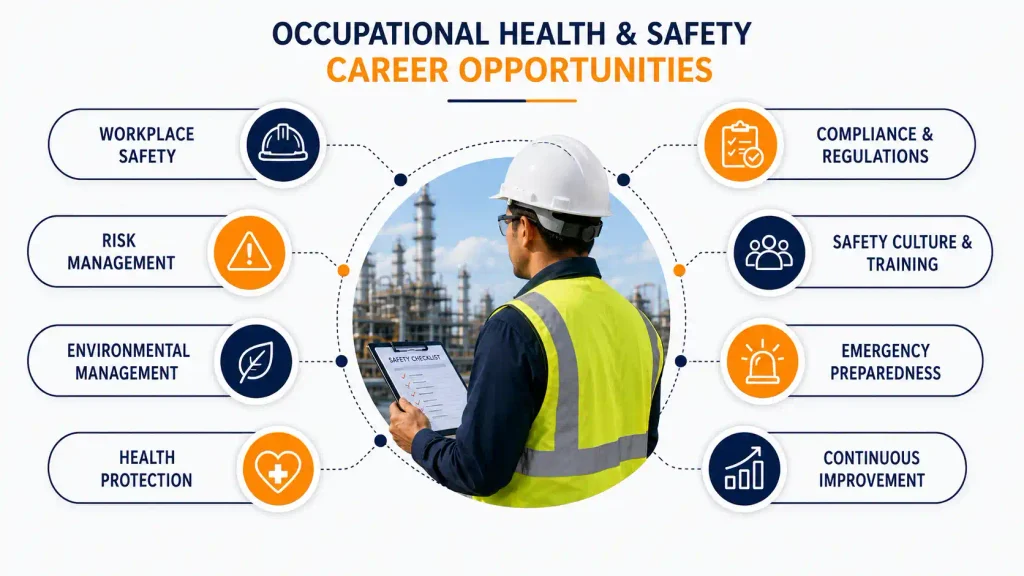
Potential career areas include:
- Occupational Health and Safety
- HSE Management
- Safety Management
- Construction Safety
- Engineering Safety
- Oil and Gas HSE
- Manufacturing Safety
- Energy and Utilities
- Environmental, Health and Safety
- Risk Management
- Safety Consultancy
- Workplace Compliance
Professional progression, however, depends on more than one credential. Employers may consider qualifications, professional experience, technical competence, industry knowledge and additional certifications or designations relevant to the specific role.
TSP® vs GSP®: What Is the Difference?
TSP® and GSP® are both BCSP designations connected with pathways towards CSP®, but they apply to different types of qualifying programmes.
TSP® is associated with graduates of curriculum-based certificate or diploma programmes that meet QEP standards.
GSP® is associated with graduates of degree programmes that meet QAP (Qualified Academic Program) standards.
This distinction is useful when researching professional safety education because the appropriate BCSP pathway depends on the type and recognition of the programme completed.
Qualifications We Offer for the BCSP TSP® Pathway
Inspire College of Technologies UK offers a range of advanced occupational health and safety and HSE qualifications for Learners exploring professional development and potential progression towards the BCSP Transitional Safety Practitioner® (TSP®) pathway. The qualifications cover occupational health and safety practice, safety management and HSE engineering at Levels 6, 7 and 8.
Conclusion: Is BCSP TSP® Worth Understanding for Safety Professionals?
The BCSP Transitional Safety Practitioner® (TSP®) provides an important professional pathway for eligible graduates of qualifying safety, health and environmental programmes.
Its most significant feature is that TSP® satisfies the qualified-credential requirement for CSP®, allowing eligible TSP® holders to progress towards CSP® without using the ASP® as that qualifying credential. However, TSP® is not itself CSP®, and completing an ordinary occupational health and safety qualification does not automatically make someone eligible for TSP®.
For anyone considering a BCSP TSP® pathway, the most important step is therefore to look beyond the qualification title. Check the specific programme’s QEP status, applicable dates and current BCSP requirements before enrolling or applying.