
What is the GSP Certification? A Complete Guide for Health and Safety Professionals
If you are building a career in occupational health and safety, you may have come across the term GSP certification. GSP stands for Graduate Safety Practitioner, a professional designation awarded by the Board of Certified Safety Professionals (BCSP).
Although many people search for the term “GSP certification”, it is important to understand that the Graduate Safety Practitioner (GSP) is officially a professional designation rather than a certification. The GSP is designed for eligible graduates of safety, health and environmental degree programmes that meet BCSP Qualified Academic Program (QAP) standards.
For aspiring safety professionals, the GSP can provide an important pathway towards advanced professional recognition. It meets the qualified credential requirement for the Certified Safety Professional (CSP), meaning GSP holders may apply for the CSP once they meet the other applicable CSP requirements.
What Does GSP Stand For?
GSP stands for Graduate Safety Practitioner.
The Graduate Safety Practitioner designation is offered by the Board of Certified Safety Professionals (BCSP) to eligible graduates of academic programmes that meet BCSP Qualified Academic Program standards.
The designation recognises academic preparation for professional safety practice and provides a pathway towards further professional credentials.
In simple terms, the GSP is designed to recognise graduates who have completed an eligible safety, health and environmental academic programme and who wish to progress within the professional safety field.
What is the GSP Certification?
The Graduate Safety Practitioner (GSP) is commonly referred to online as a “GSP certification”. However, the GSP is officially a professional designation, not a certification.
The GSP is available to graduates from safety, health and environmental degree programmes that meet BCSP Qualified Academic Program standards.
A key benefit of the GSP is that it satisfies the qualified credential requirement for the Certified Safety Professional (CSP). This allows a GSP holder to apply for the CSP once they meet the other applicable requirements, including the required education and professional experience.
The GSP therefore serves as an important professional pathway for eligible graduates who intend to progress towards advanced recognition in occupational safety and health.
Is GSP a Certification or a Professional Designation?
The GSP is a professional designation.
This distinction is important because many learners and safety professionals use the term “GSP certification” when searching online.
GSP is a designation
The Graduate Safety Practitioner designation recognises eligible graduates of BCSP Qualified Academic Programs.
GSP is not an examination-based certification
The GSP itself does not require candidates to sit for a separate GSP examination.
GSP can support progression towards CSP
The designation meets the qualified credential requirement for the CSP. However, holding the GSP alone does not automatically make an individual a CSP.
A GSP holder must still meet all other applicable CSP requirements and pass the CSP examination.
| Feature | GSP |
|---|---|
| Full Name | Graduate Safety Practitioner |
| Credential Type | Professional designation |
| Awarded By | BCSP |
| Separate GSP Exam | No |
| Main Eligibility Route | Eligible QAP graduate |
| Career Purpose | Professional development and CSP pathway |
Understanding this difference helps learners choose the correct professional pathway and avoid assuming that all safety credentials follow the same examination process.
Who Awards the GSP Designation?
The Graduate Safety Practitioner designation is awarded by the Board of Certified Safety Professionals (BCSP).
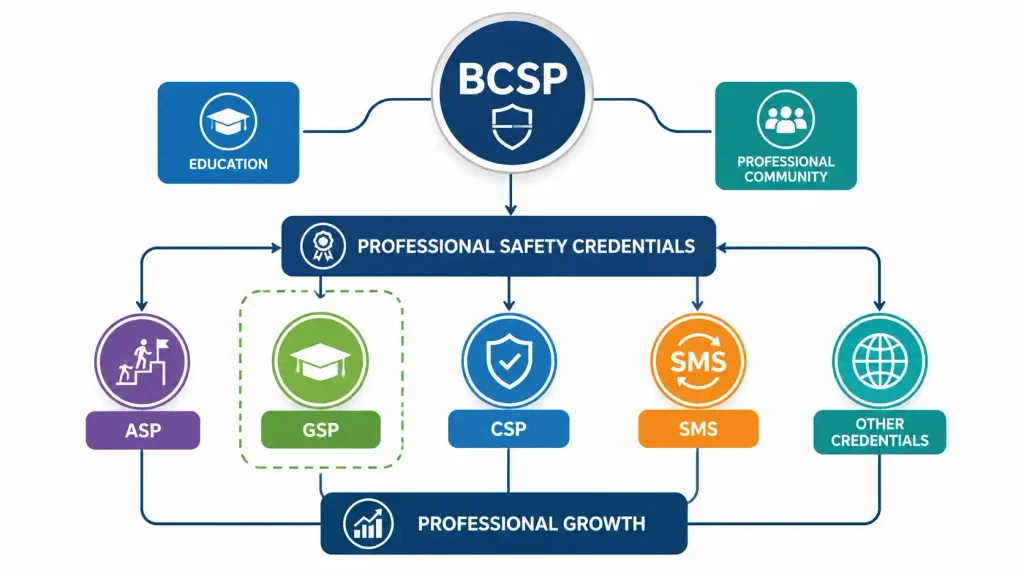
BCSP is a professional organisation that offers credentials for safety, health and environmental practitioners at different stages of their careers.
Its credentials are designed to recognise professional knowledge, education and experience within the safety profession.
For individuals considering the GSP pathway, BCSP should be treated as the primary source for current information about eligibility, applications, fees, Qualified Academic Programs and progression requirements.
Who is Eligible for the GSP?
GSP eligibility is primarily linked to the academic programme from which an individual graduates.
The GSP is available to eligible graduates of safety, health and environmental programmes that meet BCSP Qualified Academic Program standards.
In general, learners should consider the following areas.
Graduation from a Qualified Academic Program
The most important requirement is graduating from an academic programme that is recognised by BCSP as a Qualified Academic Program.
Not every occupational safety, health or environmental degree automatically qualifies a graduate for the GSP.
The specific programme must meet BCSP QAP standards.
Relevant degree level
BCSP identifies Qualified Academic Programs as eligible bachelor’s, master’s or doctorate degree programmes in the environmental, health and safety field.
The current requirements and programme listings should always be checked directly with BCSP before applying.
Applicable programme dates
Graduates must apply for the GSP within the programme’s applicable dates listed by BCSP.
This is particularly important for graduates who completed their programme several years ago.
A programme’s current status does not automatically mean that every past graduate is eligible. The applicable dates associated with the programme must be checked carefully.
Application requirements
Applicants are required to complete the relevant GSP application process through BCSP.
Supporting academic documentation may also be required as part of the application and verification process.
What is a BCSP Qualified Academic Program (QAP)?
A Qualified Academic Program, commonly known as a QAP, is an academic degree programme in safety, health and environmental practice that meets BCSP standards.
BCSP reviews the required curriculum of a programme to determine whether it substantially matches the current Associate Safety Professional examination blueprint.
The purpose of the QAP system is to recognise academic programmes that provide a strong foundation for professional safety practice.
Why is the QAP important?
The QAP is important because the GSP is linked directly to graduation from an eligible programme.
This means that having a degree with the words “safety”, “health” or “environment” in its title may not automatically make a graduate eligible for the GSP.
The programme itself must be recognised as a Qualified Academic Program by BCSP.
Can international universities have QAP programmes?
Yes, BCSP information indicates that non-US environmental, health and safety degree programmes may also be eligible to become Qualified Academic Programs if they meet the applicable standards.
This is particularly relevant for universities and health and safety professionals outside the United States.
However, international recognition of a university alone should not be assumed to mean that its programme qualifies for the GSP. The specific programme should be verified through the current BCSP QAP information.
How to Become a Graduate Safety Practitioner (GSP)
The journey towards becoming a GSP generally follows a structured academic and professional pathway.
Step 1: Choose an eligible academic programme
If you are planning your education, identify whether the degree programme you intend to study is listed as a BCSP Qualified Academic Program.
Check the specific programme rather than relying only on the university’s general reputation or course title.
Step 2: Complete your degree
Successfully complete the required academic programme and obtain your degree.
The programme should fall within the applicable recognition period established by BCSP.
Step 3: Verify your programme eligibility
Before applying, confirm that:
- Your exact degree programme is recognised as a QAP.
- Your graduation date falls within the programme’s applicable dates.
- You meet the current application requirements.
Step 4: Create or access your BCSP profile
Applicants generally use the BCSP online system to manage applications and credential information.
Follow the current application instructions provided by BCSP.
Step 5: Submit the GSP application
Complete the required application and provide the requested information and documentation.
Applicants should ensure that all academic information is accurate and complete.
Step 6: Maintain your GSP status
GSP holders are required to maintain their designation in accordance with BCSP requirements, including applicable annual renewal requirements.
Step 7: Progress towards the CSP
The GSP can form part of a longer professional development pathway.
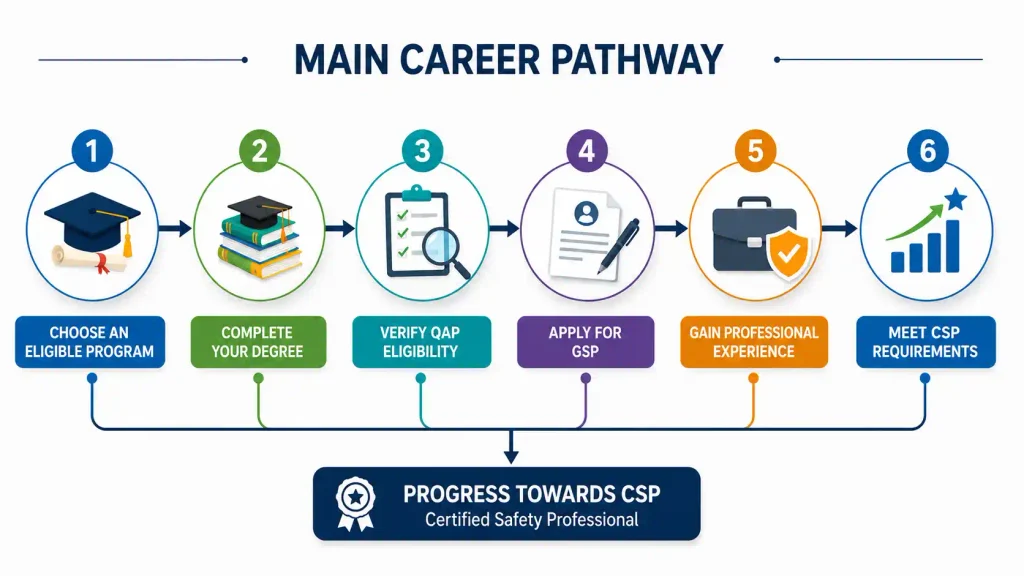
Once a GSP holder meets the other requirements for the Certified Safety Professional credential, they may apply for the CSP and complete the required certification process.
Does the GSP Require Work Experience?
The GSP itself does not require professional safety work experience as an eligibility requirement in the same way that more advanced credentials may require documented professional experience.
This makes the GSP particularly relevant to eligible graduates who are at the beginning of their professional safety careers.
However, the GSP should not be confused with the CSP.
The Certified Safety Professional credential has its own education, professional experience and examination requirements.
A GSP holder who plans to progress towards CSP must gain the required professional experience and meet all other applicable requirements.
Does the GSP Require an Examination?
The GSP itself does not require a separate GSP examination.
The designation is based on graduation from an eligible Qualified Academic Program and successful completion of the applicable BCSP application process.
This is one of the major differences between the GSP designation and examination-based professional certifications.
However, a GSP holder who later applies for the CSP must meet the applicable CSP requirements, including passing the CSP examination.
What Are the Benefits of the GSP Designation?
The Graduate Safety Practitioner designation offers several potential professional benefits for eligible graduates.
1. Recognition of academic preparation
The GSP provides recognition of an individual’s academic preparation for professional safety practice.
For new graduates, this can help demonstrate that their education has followed a programme recognised under BCSP QAP standards.
2. A pathway towards the CSP
One of the most significant benefits of the GSP is its role in the CSP pathway.
The GSP meets the qualified credential requirement for the CSP.
This means that an eligible GSP holder does not need to obtain another qualifying credential solely to meet that part of the CSP eligibility pathway.
3. Professional career development
The designation can support long-term career planning for individuals working towards professional safety roles.
It may be particularly valuable for graduates entering occupational safety, health and environmental careers.
4. Eligibility for additional BCSP credentials
BCSP identifies the GSP as providing eligibility towards certain additional professional credential pathways, subject to the relevant requirements.
Candidates should always review the specific eligibility requirements for each credential they intend to pursue.
5. Professional recognition and digital credentials
BCSP provides GSP holders with professional recognition features, including a digital badge, digital certificate and inclusion in the BCSP Credential Holder Directory.
6. Career development resources
GSP holders may also access BCSP career-related resources available to credential holders and status holders.
How Does the GSP Help You Progress Towards the CSP?
The Graduate Safety Practitioner designation is often discussed because of its relationship with the Certified Safety Professional pathway.
The GSP satisfies the qualified credential requirement for the CSP.
However, this does not mean that a GSP holder automatically becomes eligible for the CSP immediately after graduation.
A CSP candidate must still meet all other applicable requirements.
These include the required education, qualifying professional safety, health and environmental experience and successful completion of the CSP examination.
The general progression pathway
A simplified pathway may look like this:
Eligible QAP Degree → GSP Designation → Required Professional Experience → Meet Other CSP Requirements → Pass CSP Examination → CSP Certification
This pathway can help graduates plan their professional development from university education towards more advanced professional recognition.
What is the GSP Six-Year Time Limit?
Time limits are an important part of the GSP pathway.
BCSP states that GSP designation holders must sit for and pass the CSP examination within six years of the date the GSP is awarded.
This means that learners considering the GSP should understand it as part of a planned professional progression pathway rather than as a permanent substitute for advanced certification.
GSP holders should monitor their eligibility timeline carefully and plan their professional experience and CSP preparation accordingly.
If requirements or policies change, the current BCSP rules should always take priority.
GSP vs ASP vs CSP: What is the Difference?
The GSP, ASP and CSP represent different stages and pathways within professional safety credential development.
| Feature | GSP | ASP | CSP |
|---|---|---|---|
| Full name | Graduate Safety Practitioner | Associate Safety Professional | Certified Safety Professional |
| Credential type | Professional designation | Professional certification | Professional certification |
| Main target group | Eligible graduates | Developing safety professionals | Experienced safety professionals |
| Separate examination | No GSP examination | Yes | Yes |
| Academic pathway | Graduation from an eligible QAP | Must meet current BCSP eligibility requirements | Bachelor’s degree or higher under current requirements |
| Work experience for credential | No experience required for GSP eligibility | Subject to current BCSP requirements | Four years of qualifying SH&E experience under current BCSP requirements |
| Role in CSP pathway | Meets qualified credential requirement | Meets qualified credential requirement | Advanced professional certification |
Important note about comparisons
Professional credential requirements can change.
Before making a career or financial decision, always check the latest requirements, examination rules and eligibility criteria directly with BCSP.
GSP vs CSP: Which One is Right for You?
The GSP and CSP are not competing credentials in the traditional sense.
They generally represent different stages of professional development.
The GSP may be suitable if:
- You are graduating from an eligible BCSP Qualified Academic Program.
- You are beginning your career in occupational safety and health.
- You want to establish a pathway towards professional certification.
- You do not yet have the professional experience required for the CSP.
The CSP may be suitable if:
- You meet the applicable educational requirements.
- You have the required qualifying professional safety experience.
- You hold a BCSP qualified credential.
- You are ready to meet the examination and certification requirements.
For many eligible graduates, the GSP can be an early step on the journey towards the CSP.
Is the GSP Worth It for Health and Safety Professionals?
The value of the GSP depends on an individual’s academic background and long-term career goals.
For a graduate of an eligible Qualified Academic Program, the designation can provide a structured route towards professional development.
It may be particularly valuable for those who intend to build a long-term career in occupational safety, health and environmental practice.
The strongest potential value comes from understanding how the GSP fits into a broader professional development strategy.
Rather than viewing the GSP as a stand-alone qualification, many professionals may view it as part of a pathway involving:
- Academic education.
- Entry-level professional experience.
- Continued learning.
- Professional development.
- Advanced certification.
No professional designation can guarantee employment, promotion or a specific salary. Career outcomes depend on professional experience, location, industry, employer requirements and individual competence.
Can International Health and Safety Professionals Apply for the GSP?
The GSP pathway can be relevant to international health and safety professionals, but eligibility depends on the specific academic programme and BCSP requirements.
BCSP information recognises that non-US environmental, health and safety programmes may be considered within the QAP system if they meet the applicable standards.
This means that international learners should not assume that:
- Every international safety degree qualifies.
- Every recognised university has a QAP.
- A degree’s title alone determines GSP eligibility.
Instead, the correct approach is to verify the exact programme against the current BCSP Qualified Academic Program information.

GSP for professionals in Pakistan
Health and safety professionals in Pakistan who are considering the GSP should first determine whether their exact academic programme is recognised within the BCSP QAP system.
The location of the learner is not, by itself, the main eligibility factor.
The relevant issue is whether the academic programme meets the applicable BCSP requirements and whether the graduate falls within the programme’s applicable dates.
GSP for professionals in the Middle East
The GSP may also be of interest to occupational safety and health professionals working in the UAE, Saudi Arabia, Qatar, Oman, Kuwait and other Middle Eastern countries.
However, local employment requirements may differ between employers and countries.
A professional designation should therefore be considered alongside:
- Local legal requirements.
- Employer requirements.
- Industry-specific competence expectations.
- Academic qualifications.
- Professional experience.
GSP for international graduates
International graduates should review BCSP’s current QAP information and contact the relevant institution or BCSP where necessary to confirm their individual pathway.
Common Misconceptions About the GSP
Misconception 1: Any safety degree automatically qualifies for the GSP
This is not necessarily correct.
The specific academic programme must meet BCSP Qualified Academic Program standards.
Always check the current QAP listing and applicable programme dates.
Misconception 2: GSP and CSP are the same
The GSP and CSP are different professional credentials.
The GSP is a designation linked to eligible academic programmes.
The CSP is a professional certification with its own education, experience, credential and examination requirements.
Misconception 3: GSP holders automatically become CSPs
Holding the GSP does not automatically award the CSP.
GSP holders must still meet the other applicable CSP requirements and pass the CSP examination.
Misconception 4: The GSP requires a separate GSP examination
The GSP itself does not require a separate GSP examination.
Eligibility is linked to graduation from an eligible QAP and completion of the relevant application process.
Misconception 5: The GSP guarantees a job
No professional designation can guarantee employment.
The GSP may support professional recognition and career development, but employment outcomes depend on many factors.
Misconception 6: International graduates cannot follow the GSP pathway
International location alone does not prevent a graduate from exploring the GSP pathway.
The key factor is whether the specific academic programme meets the applicable BCSP QAP requirements.
How to Check Whether Your Degree is Eligible for the GSP
If you want to determine whether your degree may lead to the GSP designation, follow these steps.
Step 1: Identify your exact degree programme
Record:
- University name.
- Exact degree title.
- Campus, where relevant.
- Graduation date.
Step 2: Review the BCSP QAP information
Check whether your specific programme appears on the current Qualified Academic Program listing.
Step 3: Check the applicable dates
Confirm that your graduation date falls within the applicable dates listed for the programme.
Step 4: Review current BCSP requirements
Credential rules, fees and application procedures may change.
Always review the latest official information before applying.
Step 5: Seek clarification if necessary
If your programme information is unclear, contact the relevant university department or BCSP through its official channels.
Do not rely solely on information from social media, unofficial training providers or outdated blog posts.
How Much Does the GSP Cost?
BCSP fees may change over time.
BCSP’s current Credentials At-A-Glance information should be consulted for the latest application, renewal and other applicable fees.
Applicants should also consider any additional costs associated with obtaining academic documents, credential verification or later professional certification examinations.
Because fees can change, it is best to verify the current amount directly with BCSP before making financial plans.
Does the GSP Need to Be Renewed?
BCSP states that GSP holders pay an annual renewal fee to maintain their designation.
The GSP is also connected to a progression timeline towards the CSP.
Holders should review current renewal requirements and time limits directly through BCSP and maintain awareness of any changes to credential policies.
What Happens After You Become a GSP?
Becoming a GSP can be the beginning of a longer professional development journey.
After receiving the designation, many professionals focus on:
Building professional experience
Gain experience in safety, health and environmental roles that support future professional progression.
Developing practical competence
Apply academic knowledge to real workplace environments.
This may involve:
- Hazard identification.
- Risk assessment.
- Safety management systems.
- Incident prevention.
- Safety inspections.
- Training and communication.
- Emergency preparedness.
Continuing professional development
Keep professional knowledge current through relevant learning and development activities.
Preparing for advanced credentials
When the required professional experience and other requirements are met, eligible GSP holders may pursue the CSP.
A Suggested Career Path for Health and Safety Graduates
There is no single career path for every safety professional.
However, an eligible graduate may follow a progression similar to the following:
Stage 1: Academic preparation
Complete a safety, health or environmental degree programme.
Stage 2: GSP eligibility
Graduate from an eligible Qualified Academic Program and apply within the applicable dates.
Stage 3: Entry-level professional development
Begin gaining relevant workplace experience and practical competence.
Stage 4: Professional experience
Develop broader responsibilities in occupational safety, health and environmental practice.
Stage 5: Advanced credential preparation
Meet the applicable requirements for advanced professional credentials.
Stage 6: CSP progression
Apply for the CSP when all current eligibility requirements are met and prepare for the required examination.
This structured approach can help graduates connect academic education with long-term professional goals.
Why Professional Safety Credentials Matter
Professional safety credentials can help individuals demonstrate commitment to professional development and recognised standards of practice.
However, credentials should not replace practical competence.
Effective health and safety professionals need a combination of:
- Relevant education.
- Practical experience.
- Technical knowledge.
- Communication skills.
- Ethical judgement.
- Risk awareness.
- Continuous professional development.
The GSP can form one part of this broader professional development framework.
Conclusion
The Graduate Safety Practitioner (GSP) is an important professional designation for eligible graduates who want to build a structured career in occupational safety, health and environmental practice.
Although commonly searched as the “GSP certification”, it is officially a designation awarded by the Board of Certified Safety Professionals to graduates of academic programmes that meet BCSP Qualified Academic Program standards.
One of the GSP’s most important benefits is its role in the pathway towards the Certified Safety Professional credential. It meets the qualified credential requirement for the CSP, allowing GSP holders to focus on gaining the required professional experience and meeting the remaining eligibility requirements.
For health and safety graduates in the United States, Pakistan, the Middle East, India and other parts of the world, the most important step is to verify the exact academic programme and graduation dates against the current BCSP QAP requirements.
The best approach is to view the GSP as part of a long-term professional development strategy. Combine recognised academic education with practical workplace experience, continuous learning and professional competence to build a strong and sustainable career in health and safety.
Before applying, always review the latest information directly from BCSP, as eligibility criteria, programme listings, fees and professional credential requirements may change.