
Office Fire Safety: Protecting Employees and Assets
Office fire safety is an essential part of creating a safe, compliant, and resilient workplace. Although offices may appear to be relatively low-risk environments, everyday equipment and activities can create serious fire hazards. Electrical devices, overloaded sockets, portable heaters, office kitchens, combustible materials, lithium-ion batteries, server rooms, and blocked escape routes can all increase the likelihood or impact of a fire.
Effective office fire safety involves much more than installing fire extinguishers or displaying emergency exit signs. It requires a systematic approach to fire prevention, fire risk assessment, employee training, emergency planning, evacuation, fire protection equipment, and regular review.
For UK employers and organisations responsible for non-domestic premises, fire safety also carries important legal responsibilities. Appropriate precautions must be established to protect employees, visitors, contractors, property, equipment, information, and business operations.
This guide explains the most common office fire hazards, UK fire safety responsibilities, essential protection measures, emergency procedures, employee training, asset protection, and practical steps organisations can take to build a stronger fire safety culture.
What is Office Fire Safety?
Office fire safety is the combination of policies, risk controls, equipment, training, and emergency procedures used to prevent fires and protect people and property if a fire occurs.
A comprehensive approach generally includes:
- identifying potential fire hazards
- assessing who may be at risk
- controlling ignition and fuel sources
- maintaining safe escape routes
- providing suitable fire detection and warning systems
- installing appropriate fire-fighting equipment
- developing emergency evacuation procedures
- training employees
- conducting fire drills
- maintaining fire doors and emergency lighting
- reviewing fire risk assessments when circumstances change
The objective is not simply to respond effectively once a fire starts. Good fire safety aims to reduce the likelihood of a fire occurring in the first place while limiting its consequences if prevention measures fail.
Why Office Fire Safety Matters
A workplace fire can develop quickly and affect far more than the immediate area where it starts. Smoke, heat, toxic gases, power failures, damaged escape routes, and panic can turn a relatively small incident into a serious emergency.
Office fire safety therefore protects several areas simultaneously.
Protecting Employees and Visitors
Life safety is the first priority. Employees, visitors, contractors, customers, and other occupants must be able to recognise an emergency and reach a place of safety.
People unfamiliar with the building may be particularly vulnerable because they may not know alternative escape routes or assembly procedures.
Protecting Property and Equipment
Modern offices contain expensive computers, telecommunications systems, furniture, specialist equipment, electrical installations, and other assets.
Fire prevention and early detection can reduce the likelihood of extensive physical damage.
Protecting Business Information
Many organisations depend on servers, digital infrastructure, documents, records, and communication systems.
Damage to critical information or IT infrastructure can disrupt operations long after the physical fire has been extinguished.
Maintaining Business Continuity
A serious fire may make an office inaccessible for days, weeks, or considerably longer.
Preventive measures, emergency planning, backups, alternative working arrangements, and recovery planning can help reduce operational downtime.
Supporting Legal Compliance
Fire safety is also a legal responsibility. Organisations responsible for workplaces must understand which duties apply to their premises and implement suitable precautions.
| Area Protected | Potential Fire Impact | Key Protection Approach |
|---|---|---|
| Employees | Injury, smoke exposure, fatalities | Training, alarms and evacuation |
| Visitors | Confusion during emergencies | Instructions and supervised evacuation |
| Property | Structural and contents damage | Prevention, detection and compartmentation |
| IT and data | System failure and data loss | Detection, protection and backups |
| Operations | Business interruption | Emergency and continuity planning |
| Reputation | Loss of stakeholder confidence | Effective fire safety management |
Who is Responsible for Fire Safety in a UK Office?
In England and Wales, workplace fire safety responsibilities are principally governed by the Regulatory Reform (Fire Safety) Order 2005.
The person with responsibility is commonly referred to as the Responsible Person.
Depending on the premises and working arrangements, responsibility may fall to:
- an employer
- an owner
- a landlord
- an occupier
- a facilities manager
- a building manager
- another person with control over the premises
More than one person can have responsibilities, particularly in shared buildings.
Shared and Co-Working Offices
Modern workplaces increasingly operate from multi-occupancy buildings, serviced offices, and co-working environments.
In these circumstances, different organisations may control different areas or fire safety measures.
For example, a landlord or building management company may manage common escape routes and central alarm systems, while an employer remains responsible for risks created by activities within its own office.
Clear communication and coordination between responsible parties are therefore essential.
UK Office Fire Safety Legal Requirements
Fire safety requirements vary according to the nature, size, occupancy, layout, and risks associated with a workplace. However, a core requirement is the completion and ongoing review of an appropriate fire risk assessment.
The Responsible Person must ensure suitable fire precautions are established.
These can include:
- carrying out and reviewing a fire risk assessment
- identifying people who may be particularly at risk
- providing appropriate fire precautions
- maintaining safe escape routes
- providing suitable fire detection and warning
- establishing emergency procedures
- providing appropriate fire-fighting equipment
- maintaining relevant fire safety systems
- giving employees fire safety information and instruction
- providing appropriate fire safety training
Organisations should use current official guidance applicable to their location and premises when establishing compliance arrangements.
Most Common Fire Hazards in Offices
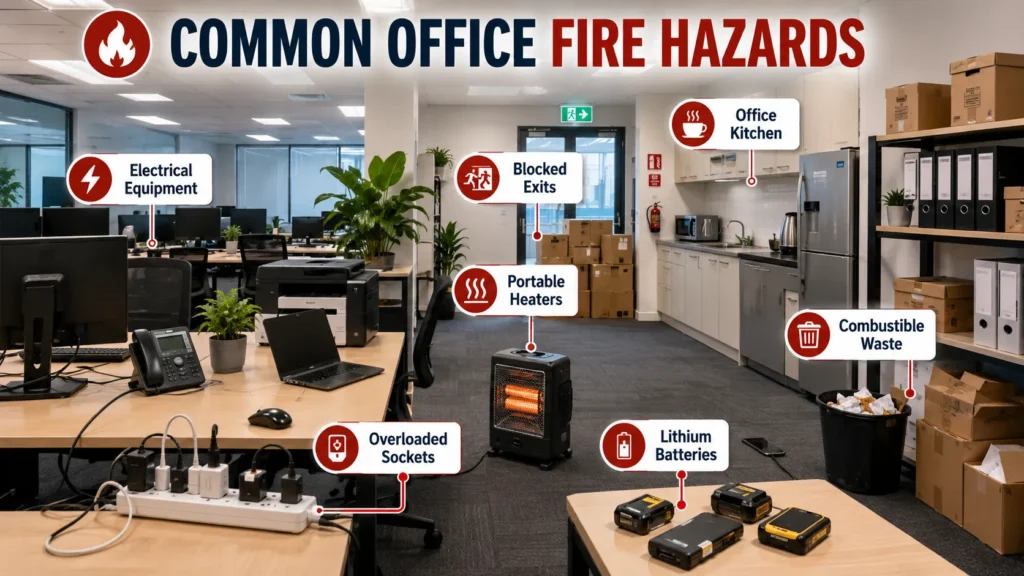
Many office fires originate from ordinary equipment or routine activities. Recognising these hazards is an important part of prevention.
Electrical Equipment
Modern offices depend heavily on electrical devices, including:
- desktop computers
- laptops
- monitors
- printers
- photocopiers
- chargers
- extension leads
- kitchen appliances
- networking equipment
Damaged cables, defective equipment, inappropriate connections, and overloaded electrical systems can increase fire risk.
Employees should report damaged plugs, exposed wiring, unusual smells, excessive heat, sparks, or other signs of electrical faults.
Overloaded Sockets and Extension Leads
Connecting too many appliances to a single outlet can cause overheating.
Extension leads should not be treated as a permanent substitute for sufficient fixed electrical outlets.
Daisy-chaining extension leads should also be avoided.
Portable Heaters
Portable heaters can become dangerous when positioned close to paper, cardboard, furniture, curtains, clothing, or other combustible materials.
Where heaters are permitted, suitable controls should determine where and how they can be used.
Office Kitchens
Kitchens and break rooms introduce several additional ignition sources.
Potential hazards include:
- microwaves
- kettles
- coffee machines
- toasters
- cooking equipment
- damaged appliances
- unattended heating
Appliances should be maintained appropriately, and combustible materials should not accumulate around heat-producing equipment.
Paper, Cardboard and Combustible Waste
Offices can accumulate significant quantities of combustible material.
Paper files, packaging, cardboard boxes, waste bins, furniture, and storage materials can provide fuel that allows a fire to spread rapidly.
Good housekeeping is therefore a basic but important fire prevention measure.
Lithium-Ion Batteries and Charging Devices
Laptops, smartphones, tablets, power banks, cordless equipment, and other rechargeable devices have made battery management increasingly relevant to modern office fire safety.
Damaged, swollen, overheating, or defective batteries should not be ignored.
Charging equipment should be suitable for the device and used according to manufacturer instructions.
Server and IT Rooms
Server rooms can contain concentrated electrical loads and valuable equipment.
Poor ventilation, electrical faults, inappropriate storage, and inadequate maintenance can increase risk.
Server and communications rooms should not become general storage spaces for cardboard boxes, paperwork, cleaning products, or other combustible items.
Blocked Escape Routes
Escape routes must remain available when needed.
Corridors, stairways, doorways, and final exits should not be obstructed by:
- furniture
- deliveries
- storage boxes
- waste
- equipment
- temporary displays
A safe route during normal working conditions may become dangerous during a smoke-filled emergency, making good housekeeping particularly important.
Fire Doors Being Wedged Open
Fire doors form part of a building’s fire protection strategy.
Wedging a fire door open can allow smoke and fire to spread beyond the area where they originate and undermine compartmentation.
Office Fire Hazard Control Flowchart
Identify Hazard
↓
Determine Who Could Be Harmed
↓
Remove the Hazard Where Possible
↓
Introduce Fire Prevention Controls
↓
Provide Detection and Protection Measures
↓
Train Employees
↓
Inspect, Monitor and Review
Office Fire Risk Assessment: The Foundation of Prevention
A fire risk assessment is a systematic examination of fire hazards, people at risk, existing controls, and additional precautions required to maintain an appropriate level of safety.
It should reflect the actual workplace rather than being treated as a generic administrative document.
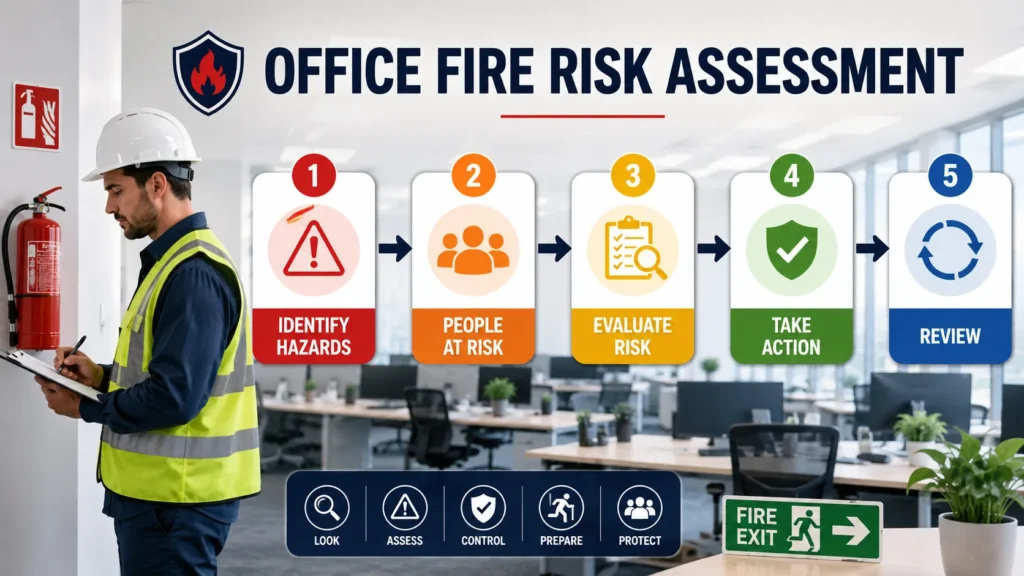
Step 1: Identify Fire Hazards
Consider the three basic elements needed for fire:
Ignition sources + fuel + oxygen
Possible ignition sources include electrical equipment, heaters, cooking appliances, smoking materials, and certain work activities.
Potential fuels include paper, packaging, furniture, waste, chemicals, and other combustible materials.
Step 2: Identify People at Risk
Consider everyone who may be present, including:
- employees
- visitors
- contractors
- cleaners
- security personnel
- lone workers
- people unfamiliar with the premises
- people who may require assistance during evacuation
Location and working patterns should also be considered.
Someone working alone outside normal hours may face different risks from employees working in a fully occupied office during the day.
Step 3: Evaluate and Reduce Risk
Determine whether ignition sources can be removed or controlled and whether combustible materials can be reduced or separated appropriately.
Existing fire precautions should also be evaluated.
Step 4: Record and Implement Appropriate Measures
Significant findings and required controls should be managed appropriately.
Actions may include improving electrical safety, changing storage arrangements, maintaining fire doors, updating emergency procedures, improving training, or installing additional protection.
Step 5: Review the Assessment
Fire risk assessment is an ongoing process.
A review may be necessary when there are significant changes involving:
- office layout
- occupancy
- equipment
- work activities
- storage
- building alterations
- fire protection systems
- staffing arrangements
It should also be reconsidered following relevant incidents or evidence that existing precautions may no longer be adequate.
| Fire Risk Assessment Stage | Key Question |
|---|---|
| Identify hazards | What could cause or support a fire? |
| Identify people | Who could be affected? |
| Evaluate risk | Are existing precautions adequate? |
| Record and act | What improvements are required? |
| Review | Has anything changed? |
Essential Fire Safety Equipment for Offices
Fire safety equipment should be selected according to the risks identified in the workplace rather than through a one-size-fits-all approach.
Fire Detection and Alarm Systems
Early warning gives occupants valuable time to evacuate.
Detection and alarm arrangements should be appropriate for the building’s size, layout, occupancy, and risks.
Employees should recognise the alarm and know exactly what action to take when it activates.
Fire Extinguishers
Different types of fire require appropriate extinguishing equipment.
Extinguishers should be:
- appropriately selected
- correctly positioned
- clearly identifiable
- unobstructed
- inspected and maintained
- used only by people where appropriate and safe to do so
Life safety takes priority over attempting to fight a fire.
Fire Doors
Fire doors can help contain fire and smoke, protecting escape routes and limiting fire spread.
They should not be obstructed, damaged, or improperly wedged open.
Emergency Lighting
A fire or related incident may interrupt normal electrical lighting.
Emergency lighting helps occupants identify escape routes and safely navigate towards exits.
Fire Exit Signs
Escape routes and exits should be clearly identifiable.
Signage becomes especially important for visitors, contractors, and employees who may be unfamiliar with a particular area.
Sprinklers and Suppression Systems
Some workplaces may use automatic sprinklers or specialised suppression systems depending on building design and risk.
Areas containing sensitive or high-value equipment may require protection designed around their particular hazards.
How to Protect Employees During an Office Fire
Every employee should understand what to do when a fire alarm sounds.
The procedure should be simple enough to follow under pressure.
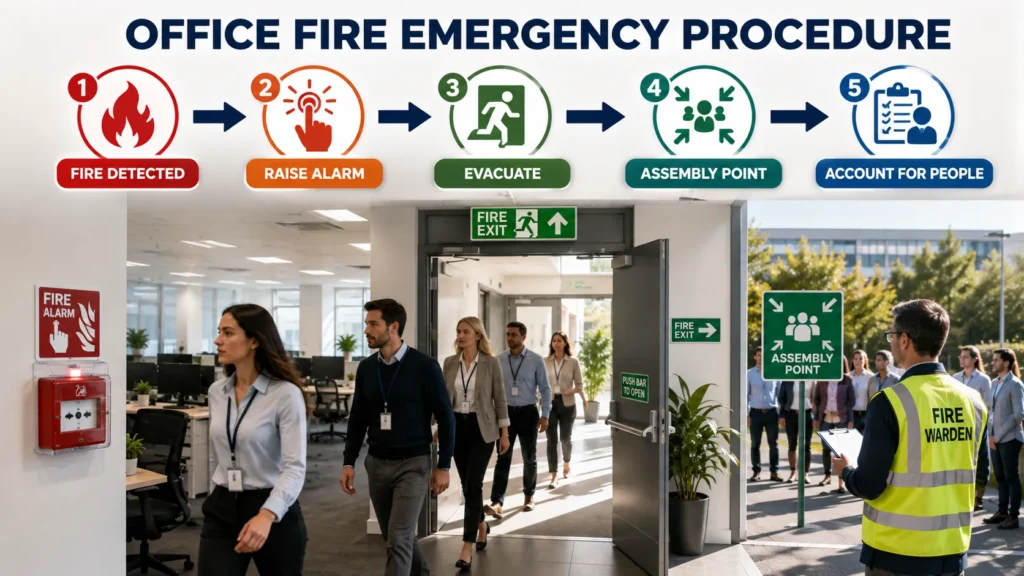
Office Fire Emergency Flowchart
Fire or Smoke Detected
↓
Raise the Alarm
↓
Follow the Emergency Procedure
↓
Evacuate Using a Safe Escape Route
↓
Proceed to the Assembly Point
↓
Account for People
↓
Emergency Services Manage the Incident
↓
Re-Enter Only When Authorised
Employees should not delay evacuation to collect laptops, bags, coats, documents, or other personal belongings.
Lifts should not be used during a fire unless they are specifically designed and designated for the relevant emergency procedure.
Fire Evacuation Plans and Emergency Procedures
An effective evacuation plan explains how people will leave the building safely and what will happen after evacuation.
It should address:
- alarm arrangements
- primary escape routes
- alternative escape routes
- emergency exits
- assembly points
- fire warden responsibilities
- visitor management
- contractor arrangements
- assistance for people who require it
- communication with emergency services
- accounting for occupants
People Who May Need Assistance
Emergency planning should consider people who may not be able to use standard evacuation arrangements independently.
Suitable planning may be required for people with mobility, sensory, cognitive, or other needs affecting evacuation.
The objective should be to establish arrangements before an emergency occurs, rather than attempting to improvise during a fire.
Visitors and Contractors
Visitors may have little knowledge of the building.
Reception procedures, induction arrangements, host responsibilities, signage, and emergency instructions can help ensure they understand what to do.
Contractors may also introduce additional hazards through tools, temporary equipment, maintenance work, or changes to normal access arrangements.
Fire Safety Training for Office Employees
Fire protection equipment cannot provide maximum value if employees do not understand emergency procedures.
Fire safety training should provide employees with knowledge relevant to their workplace and responsibilities.
Training may cover:
- common workplace fire hazards
- fire prevention
- alarm procedures
- escape routes
- emergency exits
- assembly points
- fire doors
- reporting hazards
- evacuation procedures
- responsibilities during emergencies
Employees with additional duties may require more specialised training.
Fire Marshals
Fire marshals may support workplace emergency arrangements.
Depending on organisational procedures, their duties may include:
- helping coordinate evacuation
- checking designated areas where safe and required
- directing occupants towards exits
- reporting information at assembly points
- identifying fire safety concerns
- supporting drills
- promoting good fire safety practices
Training should match the person’s actual responsibilities.
Why Fire Drills Matter
A written evacuation plan is valuable, but a drill tests how effectively that plan works in practice.
Drills can reveal problems such as:
- confusion over escape routes
- slow evacuation
- blocked exits
- poor alarm awareness
- uncertainty at assembly points
- weaknesses in visitor management
- unclear responsibilities
Findings should be reviewed and used to improve procedures.
Fire Drill Improvement Flowchart
Plan Drill
↓
Brief Relevant Responsible Personnel
↓
Activate Procedure
↓
Observe Evacuation
↓
Record Issues
↓
Correct Weaknesses
↓
Update Procedures or Training
↓
Test Again
This creates a continuous improvement cycle rather than treating drills as a box-ticking exercise.
Protecting Office Assets from Fire
Protecting people must always be the first priority, but effective office fire safety also supports the protection of physical and digital assets.
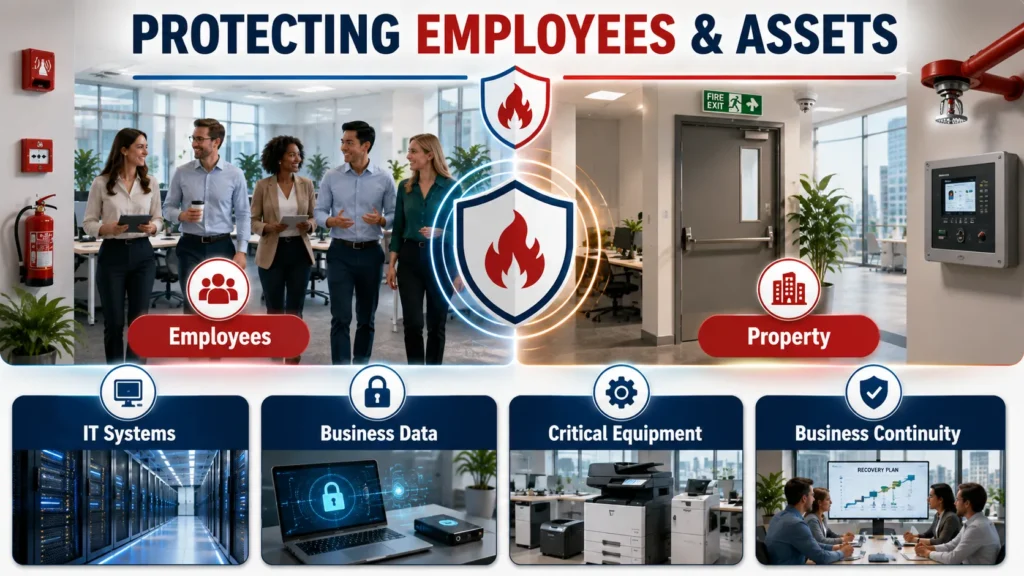
IT Equipment
Computers, networking equipment, telecommunications systems, and specialist devices can represent significant financial investment.
Preventive electrical maintenance, suitable environmental conditions, early detection, and good housekeeping can reduce exposure.
Servers and Critical Infrastructure
Server rooms may support essential business systems.
Controls should reflect the equipment, electrical load, ventilation, access arrangements, and importance of the infrastructure.
Business Records
Important paper documents should be stored appropriately, particularly where loss could affect legal, financial, contractual, or operational activities.
Digital copies and secure backup strategies can support resilience.
Data Protection and Backups
Fire damage does not need to destroy an entire building to disrupt a business.
Damage to a server, power system, network cabinet, or critical workstation may be enough to interrupt operations.
Organisations should consider:
- secure backups
- off-site or appropriately protected data storage
- system recovery procedures
- alternative communication methods
- remote-working capability where appropriate
Business Continuity Planning
Fire safety and business continuity should complement each other.
A continuity plan may address:
Fire Incident → Employee Safety → Site Access Restricted → Critical Systems Assessed → Alternative Operations Activated → Recovery → Normal Operations Restored
This helps an organisation move from emergency response towards operational recovery.
Fire Safety for Modern and Hybrid Offices
The modern office has changed significantly.
Hybrid working, flexible schedules, hot-desking, shared workspaces, and increased use of portable electronic devices create additional considerations.
Hot-Desking
Employees working from different areas may be less familiar with nearby exits.
Emergency information should therefore remain visible and accessible rather than relying entirely on familiarity.
Hybrid Working
Lower occupancy does not automatically mean lower fire risk.
Employees working during quieter periods may have fewer colleagues nearby and may need to understand lone-working and emergency arrangements.
Co-Working Spaces
Different organisations sharing the same premises need clear coordination regarding:
- alarms
- escape routes
- assembly points
- drills
- visitor arrangements
- shared fire safety systems
- responsibilities for common areas
Increased Device Charging
Flexible working has increased the number of laptops, phones, tablets, headphones, power banks, and other rechargeable equipment used in offices.
Charging practices should therefore form part of modern electrical and fire safety awareness.
Office Fire Safety Checklist
A simple inspection checklist can help identify problems before they contribute to an emergency.
| Check | What to Look For | Action |
|---|---|---|
| Escape routes | Clear and unobstructed | Remove obstructions immediately |
| Fire exits | Accessible and identifiable | Correct access/signage issues |
| Fire doors | Closed correctly and undamaged | Report defects |
| Extinguishers | Accessible and maintained | Arrange inspection where needed |
| Alarm system | Suitable and maintained | Follow testing arrangements |
| Emergency lighting | Operational | Record and address defects |
| Electrical cables | No obvious damage | Remove/report defective equipment |
| Extension leads | No unsafe overloading | Reduce load/improve outlets |
| Heaters | Away from combustibles | Reposition/control use |
| Kitchen appliances | Clean and appropriately maintained | Address defects |
| Waste | Not accumulating | Improve housekeeping |
| Server rooms | No inappropriate storage | Remove combustible clutter |
| Batteries | No damage or overheating | Isolate/report defective devices |
| Staff knowledge | Procedures understood | Provide training/refresher |
| Risk assessment | Current and relevant | Review when required |
How Technology Is Improving Office Fire Safety
Technology increasingly supports traditional fire prevention and emergency management.
Smart Detection Systems
Modern detection technology can help identify developing hazards and communicate alerts quickly.
Connected Fire Safety Systems
Connected systems can support central monitoring and improve visibility across larger or multi-site organisations.
Digital Inspection Records
Digital inspection tools can make it easier to record checks, assign corrective actions, track outstanding issues, and demonstrate that problems have been addressed.
Automated Maintenance Alerts
Maintenance platforms can provide reminders when inspections, testing, servicing, or corrective work is due.
Occupancy and Building Management Technology
Depending on the building and system design, modern building technologies may support occupancy awareness, emergency communication, or monitoring of critical areas.
Technology should enhance rather than replace competent fire safety management.
Common Office Fire Safety Mistakes to Avoid
Some of the most serious weaknesses arise from everyday habits rather than complex technical failures.
Blocking Fire Exits
Storage should never compromise an escape route.
Wedging Fire Doors Open
A convenient shortcut can undermine an important fire protection measure.
Overloading Electrical Sockets
Temporary electrical solutions can gradually become permanent and unsafe.
Ignoring Damaged Equipment
A damaged charger, cable, socket, appliance, or battery should be reported rather than continuing to be used.
Allowing Poor Housekeeping
Paper, packaging, waste, and unnecessary storage increase available fuel and may obstruct access.
Treating Training as a One-Time Activity
Employees change, offices change, and procedures change.
Training arrangements should reflect current risks and responsibilities.
Failing to Review Fire Risk Assessments
A risk assessment that no longer represents the workplace provides limited practical value.
Forgetting Visitors and Contractors
Emergency procedures must account for people who do not work in the office every day.
Assuming the Alarm System Solves Everything
An alarm warns people of danger. It does not replace safe escape routes, competent management, training, maintenance, or emergency planning.
Building a Strong Office Fire Safety Culture
Effective fire safety is easier to maintain when it becomes part of normal workplace behaviour rather than something considered only during inspections.
A strong culture starts with management commitment.
Managers should demonstrate that reporting hazards is encouraged and corrective action is taken seriously.
Employees should feel confident reporting:
- damaged electrical equipment
- obstructed exits
- damaged fire doors
- missing signage
- unsafe storage
- defective lighting
- overheating devices
- other potential fire hazards
The goal is continuous improvement.
Leadership Commitment
↓
Clear Responsibilities
↓
Employee Awareness
↓
Hazard Reporting
↓
Corrective Action
↓
Training and Drills
↓
Monitoring and Review
↓
Improved Fire Safety Culture
Practical Office Fire Prevention Tips
Daily prevention does not need to be complicated.
Organisations can improve office fire safety by:
- keeping escape routes clear at all times
- preventing unsafe electrical overloading
- reporting damaged electrical equipment
- keeping combustible materials away from heat sources
- controlling portable heater use
- maintaining good kitchen housekeeping
- keeping fire doors unobstructed
- ensuring extinguishers remain accessible
- preventing inappropriate storage in server rooms
- managing battery charging safely
- providing employees with clear emergency information
- including visitors and contractors in evacuation arrangements
- carrying out drills
- maintaining fire protection systems
- reviewing fire risk assessments when circumstances change
Small preventive actions carried out consistently can remove hazards before they develop into emergencies.
Learning Resources and Fire Safety Courses
Readers who want to develop professional knowledge beyond general workplace awareness can explore relevant fire safety and risk management training available through Inspire College.
- ProQual Level 4 Certificate in Fire Risk Assessment
- Fire Safety Training
- Fire Risk Assessment Training
- Health and Safety Training
This creates a stronger internal learning pathway:
Office Fire Safety Awareness
↓
Fire Safety Training
↓
Fire Risk Assessment Knowledge
↓
Advanced Fire Safety Competence
↓
Professional Development
Office Fire Safety: From Compliance to Business Resilience
The strongest office fire safety strategies do more than meet minimum requirements.
They create a workplace where hazards are identified early, employees understand their responsibilities, escape routes remain available, equipment is properly managed, and emergency arrangements are regularly tested.
The relationship can be understood simply:
Prevention + Protection + Training + Preparedness = Greater Fire Resilience
Prevention reduces the likelihood of ignition.
Protection limits the spread and consequences of fire.
Training helps people respond appropriately.
Preparedness ensures that procedures have been considered before an emergency occurs.
Together, these measures protect employees while reducing potential damage to buildings, technology, information, equipment, and business operations.
Final Thoughts
Office fire safety should never be viewed simply as a collection of alarms, extinguishers, signs, and documents.
It is an ongoing management process built around risk assessment, prevention, protection, employee awareness, emergency planning, training, maintenance, and continuous review.
Every workplace is different. A small administrative office, multi-storey corporate headquarters, shared workspace, call centre, and technology business may face different hazards and evacuation challenges. Fire precautions should therefore reflect the actual people, activities, equipment, layout, and risks within the premises.
For UK organisations, understanding the responsibilities associated with workplace fire safety and maintaining a suitable fire risk assessment are fundamental parts of effective fire safety management.
Employees also have an important role. Reporting damaged equipment, keeping exits clear, following charging procedures, respecting fire doors, understanding evacuation arrangements, and responding correctly to alarms can all contribute to a safer workplace.
At the organisational level, protecting employees should remain the first priority. However, a well-designed fire safety strategy also protects property, IT infrastructure, critical information, business operations, reputation, and long-term organisational resilience.
The most effective approach is therefore proactive rather than reactive:
Identify the risks. Control the hazards. Protect the workplace. Train employees. Test emergency arrangements. Review regularly.
When these principles become part of everyday office management, fire safety moves beyond compliance and becomes an important part of protecting both people and the assets on which the organisation depends.